OCR · A-Level · Religious Studies
The Problem of Evil and Suffering
This guide dissects the Problem of Evil and Suffering, a cornerstone of OCR A-Level Religious Studies. It explores the profound philosophical clash between the existence of an all-good, all-powerful God and the reality of suffering, equipping candidates to tackle high-mark essay questions with analytical precision.
- 5 min read
- 2 worked examples
- 3 practice questions
- 6 key terms
Study Notes
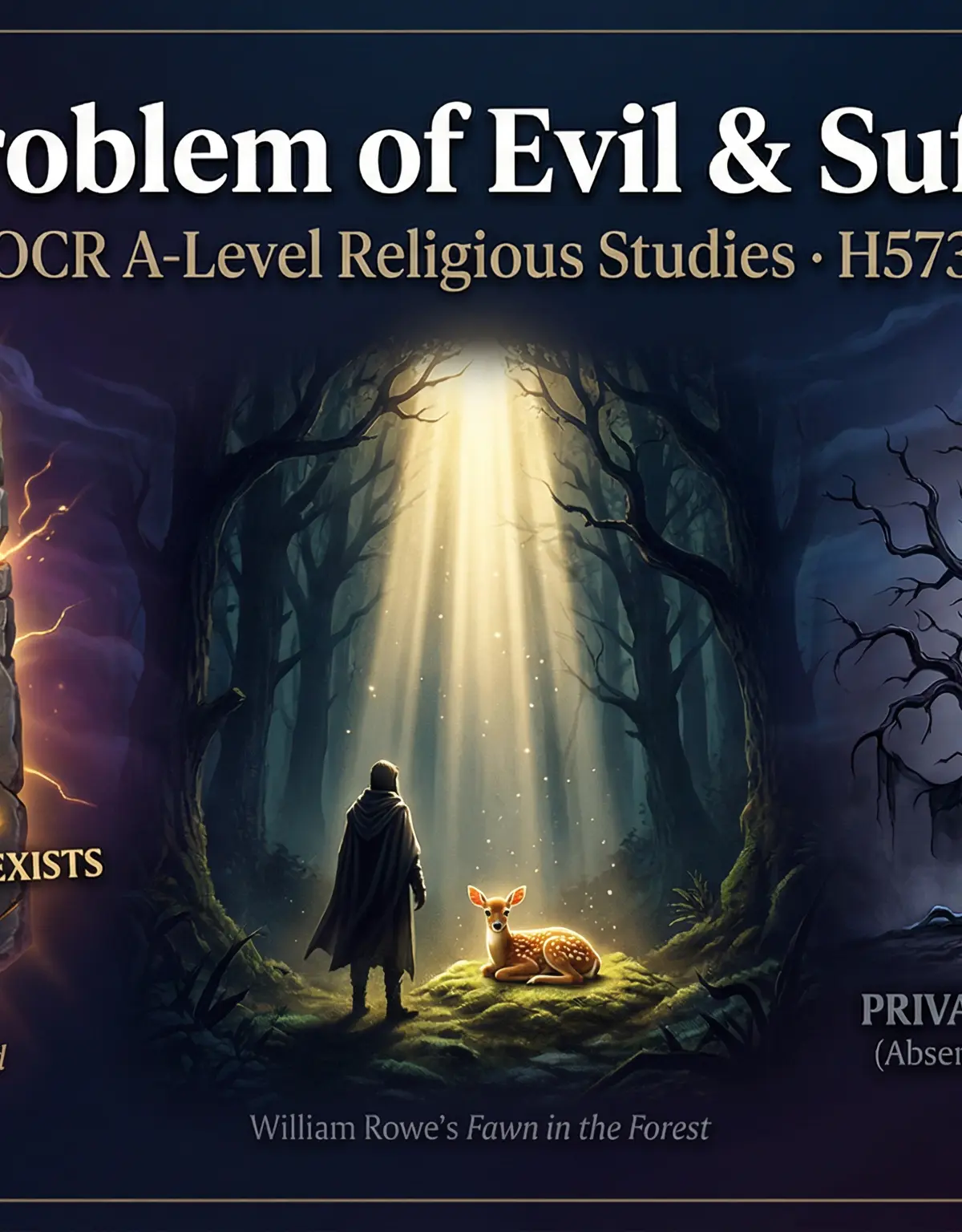
Overview
The Problem of Evil and Suffering is arguably the most significant challenge to theism. For the OCR H573 specification, candidates must move beyond a simplistic understanding and engage with the rigorous philosophical distinctions between the Logical and Evidential forms of the problem. This involves a precise application of scholarly language and a critical evaluation of the two major theodicies: the Augustinian (Soul-Deciding) and the Irenaean/Hickean (Soul-Making) models. Examiners expect a dialectical approach, where arguments are not merely listed but are used to critique and respond to one another. High-level responses will demonstrate a firm grasp of the AO1 content—such as Mackie's Inconsistent Triad, Rowe's fawn, and Hick's epistemic distance—and deploy it to construct a sustained, evaluative AO2 argument that directly addresses the question. This guide provides the conceptual tools, specific knowledge, and exam strategies necessary to achieve this.

Key Concepts & Distinctions
The Two Forms of the Problem
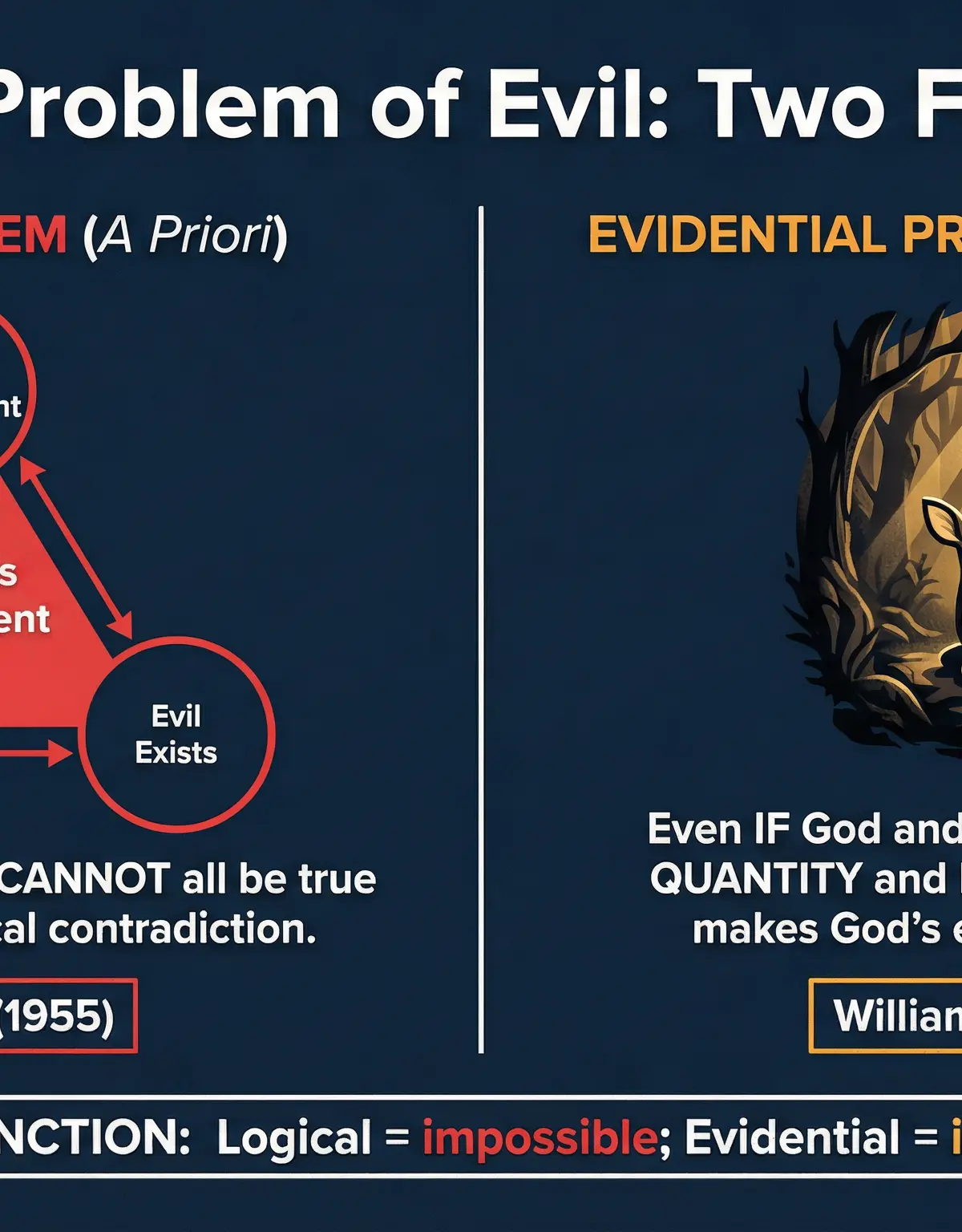
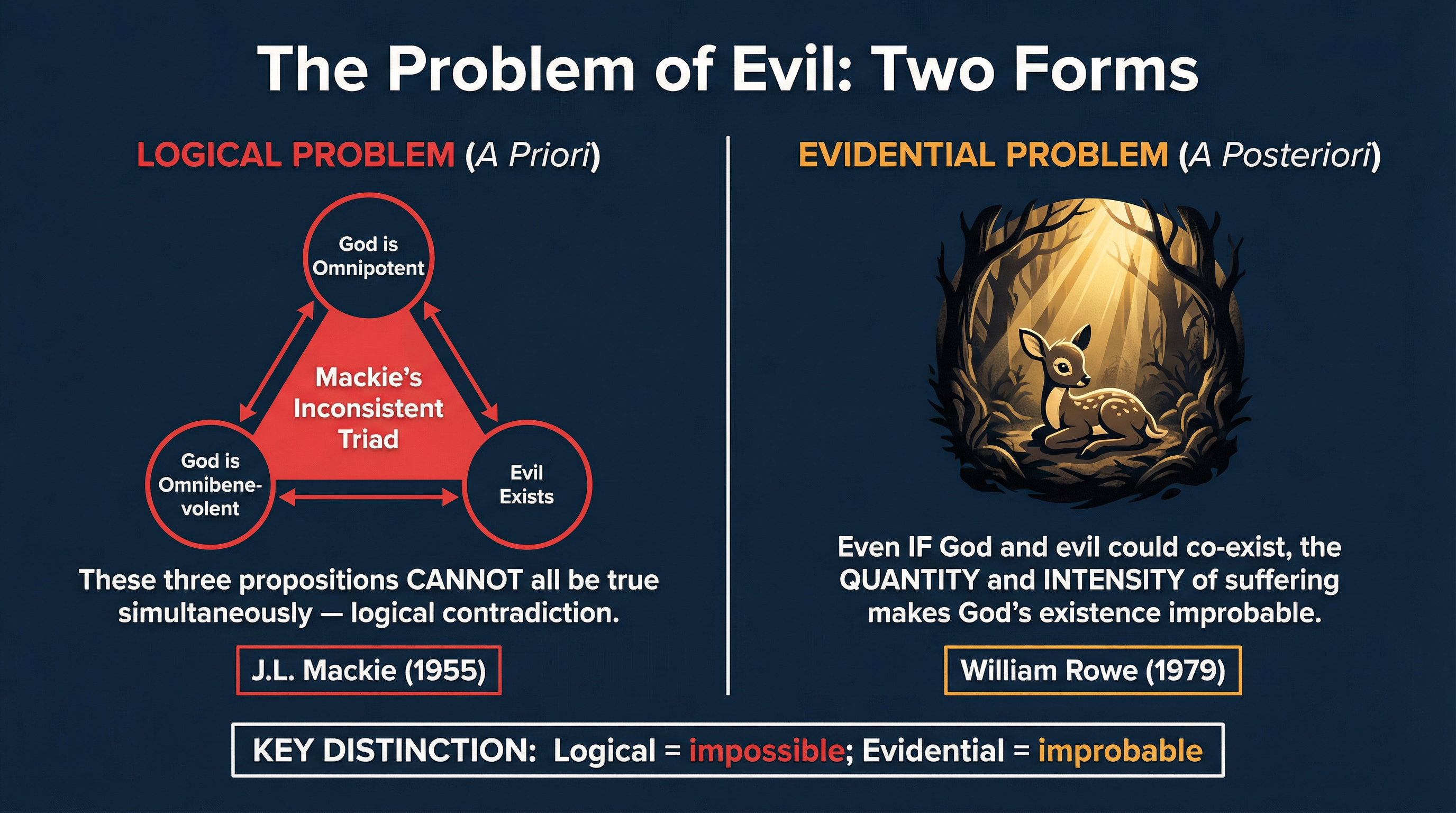
The Logical Problem of Evil: This is an a priori argument, meaning it is based on logic and reason alone. Popularised by J.L. Mackie, it argues that the following three propositions are logically inconsistent and cannot all be true at the same time: 1. God is omnipotent. 2. God is omnibenevolent. 3. Evil exists. Mackie contends that a God with these attributes would both want to and be able to eliminate evil. The existence of evil, therefore, logically contradicts the existence of such a God. The key word here is impossible.
The Evidential Problem of Evil: This is an a posteriori argument, based on observation of the world. William Rowe famously uses the example of a fawn dying in a forest fire, suffering terribly for no apparent purpose. Rowe argues that while it might be logically possible for God and evil to coexist, the sheer quantity and intensity of gratuitous suffering (suffering that serves no greater good) makes God's existence highly improbable.
Moral vs. Natural Evil
A crucial distinction for earning marks is between Moral Evil and Natural Evil. Moral Evil is suffering that results from the free choices of human beings (e.g., murder, theft, war). Natural Evil is suffering that results from the non-human world (e.g., earthquakes, disease, tsunamis). A successful theodicy must be able to account for both types of evil, and candidates who fail to distinguish them are limited in the marks they can achieve.
Key Individuals & Theodicies
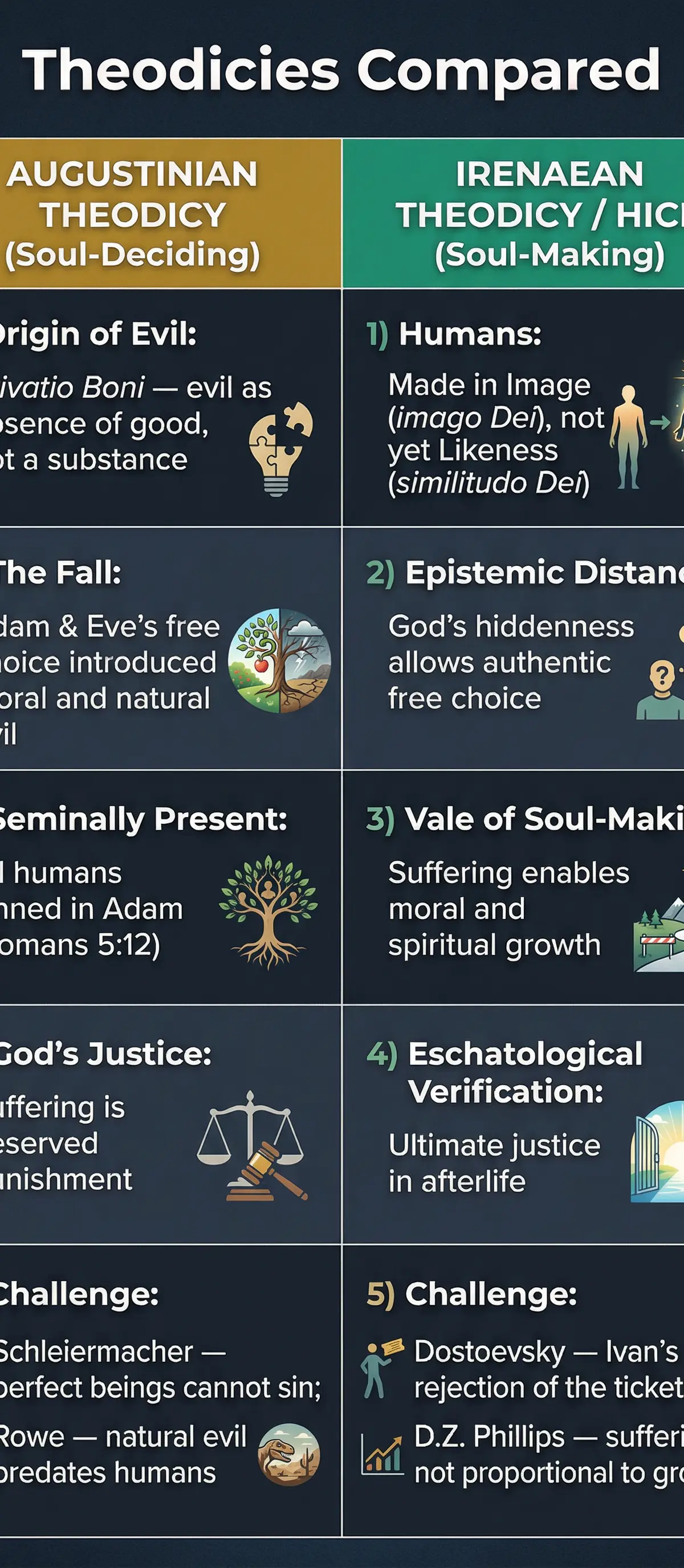
Augustine of Hippo (Soul-Deciding Theodicy)
- Role: 4th-century theologian who formulated one of the most influential theodicies in Christian history.
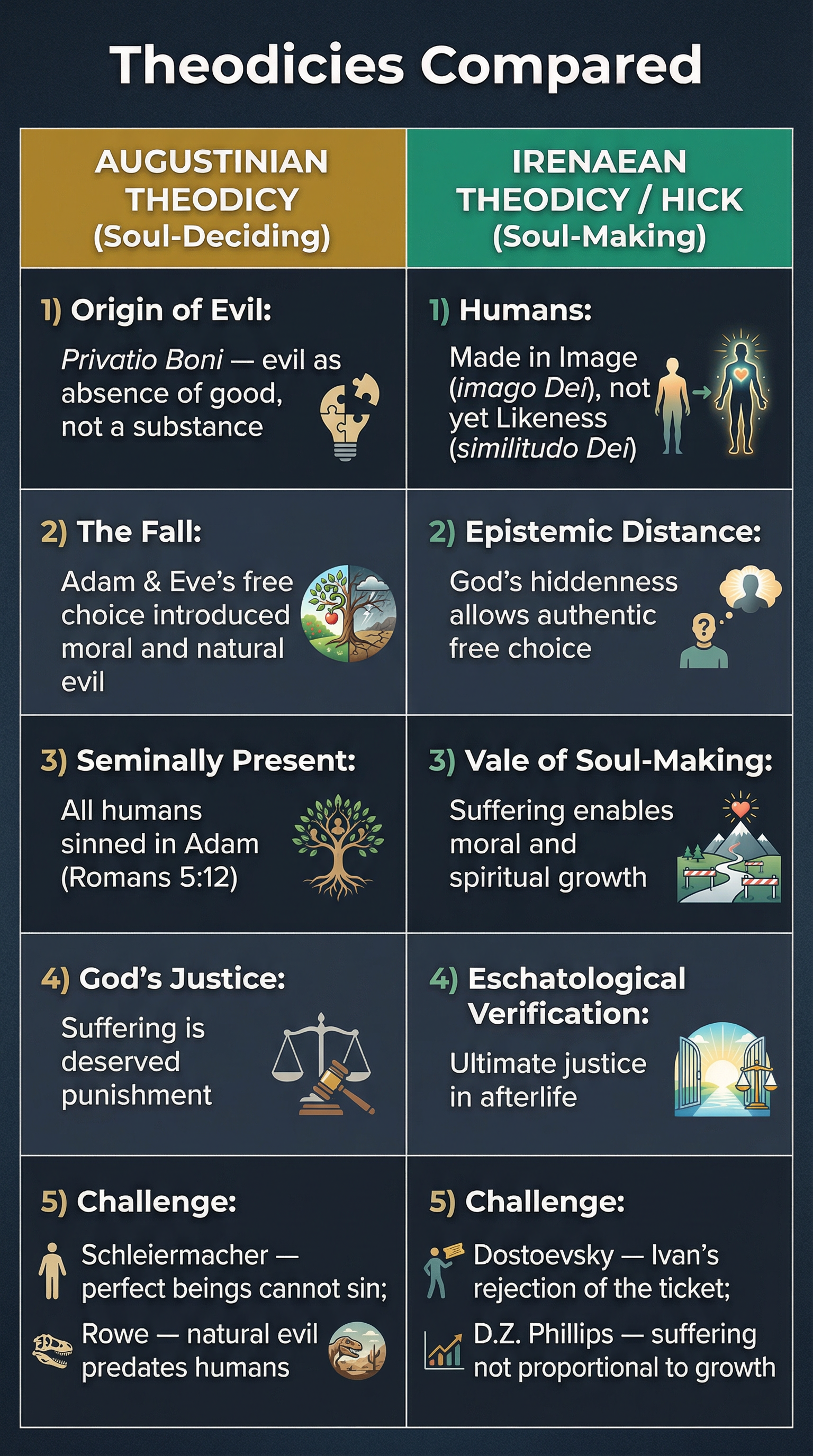
- Key Concepts: Defines evil as privatio boni (a privation or absence of good), not a substance created by God. He argues that the world was created perfectly, but the Fall of Adam and Eve, a misuse of free will, introduced both moral and natural evil. All humanity is considered 'seminally present' in Adam, thus sharing his guilt and deserving of punishment.
- Impact: This theodicy justifies God by placing the blame for evil squarely on the shoulders of humanity. However, it faces powerful critiques, notably from Friedrich Schleiermacher, who argued that a perfect creation could not logically choose to sin, and from modern science, which shows natural evil existed long before humans.
Irenaeus & John Hick (Soul-Making Theodicy)
- Role: Irenaeus (2nd century) provided the initial framework, which was developed into a comprehensive modern theodicy by John Hick (20th century).
- Key Concepts: Humans are not created perfect but are developing towards the 'likeness of God' (similitudo Dei). This requires a world with challenges and suffering, which Hick, borrowing from the poet Keats, calls the 'Vale of Soul-Making'. For this process to be authentic, God must maintain an 'epistemic distance', a cognitive gap that allows for genuine freedom. All suffering is ultimately justified through eschatological verification, where everyone will eventually achieve salvation.
- Impact: This theodicy presents suffering as a tool for spiritual growth. Its main challenges come from the sheer scale of suffering (is it all proportional to growth?) and the problem of universal salvation (if everyone is saved, are our choices truly free?). Dostoevsky's character Ivan Karamazov famously 'returns the ticket', refusing to accept a heaven built on the suffering of innocent children.
Worked Examples
2 worked examples — open one to explore the question and available guidance.
Practice Questions
Test your understanding — click to reveal model answers
Explain the evidential problem of evil. (12 marks)
Hint: Focus on William Rowe and the concept of 'gratuitous' suffering. Use the fawn in the forest example.
Analyse the weaknesses of the Augustinian theodicy. (20 marks)
Hint: Focus on two or three major criticisms. Use Schleiermacher for the logical critique and modern science for the empirical critique.
To what extent is the Free Will Defence a successful response to the problem of moral evil? (20 marks)
Hint: Explain Plantinga's argument, but then evaluate its limits. Does it justify the *amount* of evil? What about natural evil?