WJEC · A-Level · Religious Studies
Religious Identity and Belonging
This study guide explores how religious identity is constructed and maintained within communities. It focuses on the key sociological and theological concepts that WJEC examiners expect candidates to master, providing a clear path to achieving high marks by linking theory to real-world religious practice."
- 6 min read
- 3 worked examples
- 5 practice questions
Study Notes
Overview
This topic delves into the heart of what it means to belong to a religion. For the WJEC A-Level examination, candidates must move beyond simple descriptions of beliefs and analyse the mechanisms that forge and sustain religious identity. This involves a close look at the sociological functions of religion, particularly how rituals and communal practices create a powerful sense of shared identity and social cohesion. Examiners expect a sophisticated understanding of scholarly theories from figures like Ninian Smart, Arnold van Gennep, and Emile Durkheim. High-level responses will demonstrate the ability to apply these theoretical frameworks to specific religious traditions, such as Christianity and Islam, using precise terminology. The key to success is to explain how practices like baptism or communal prayer shape an individual's sense of self and their place within the wider religious body, weighing the relative importance of internal faith versus external actions.
Key Concepts & Thinkers
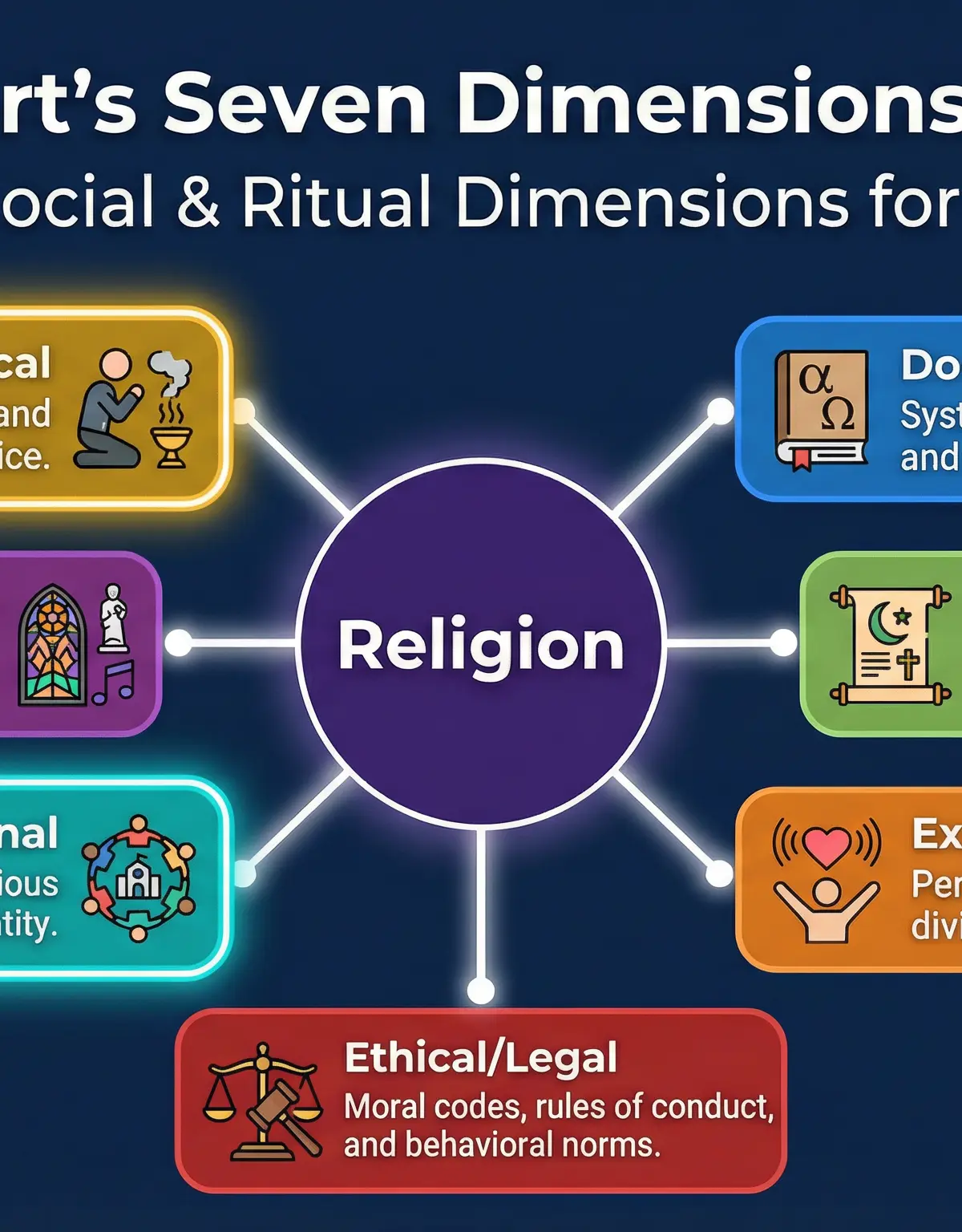
Ninian Smart: The Seven Dimensions of Religion
What it is: Ninian Smart proposed that to understand a religion, we must look at it as a multi-faceted organism. He identified seven 'dimensions' that are present in almost all traditions. For the study of religious identity, the Social and Ritual dimensions are paramount.
- Social/Institutional Dimension: This refers to the way religion is organised and the sense of community it fosters. It includes the formal structures (e.g., the Church, the Mosque) and the informal sense of fellowship and belonging (e.g., Christian Koinonia, Islamic Ummah).
- Ritual/Practical Dimension: This covers the acts of worship, prayers, and ceremonies that believers perform. These are the shared practices that make belief tangible and reinforce the bonds of the social group.
Why it matters: Smart gives candidates a framework to categorise and analyse religious life. When discussing identity, you can earn credit by showing how the ritual dimension (e.g., attending Mass) reinforces the social dimension (belonging to the Catholic community). It helps to structure an argument and ensures a comprehensive approach.
Arnold van Gennep: The Rites of Passage
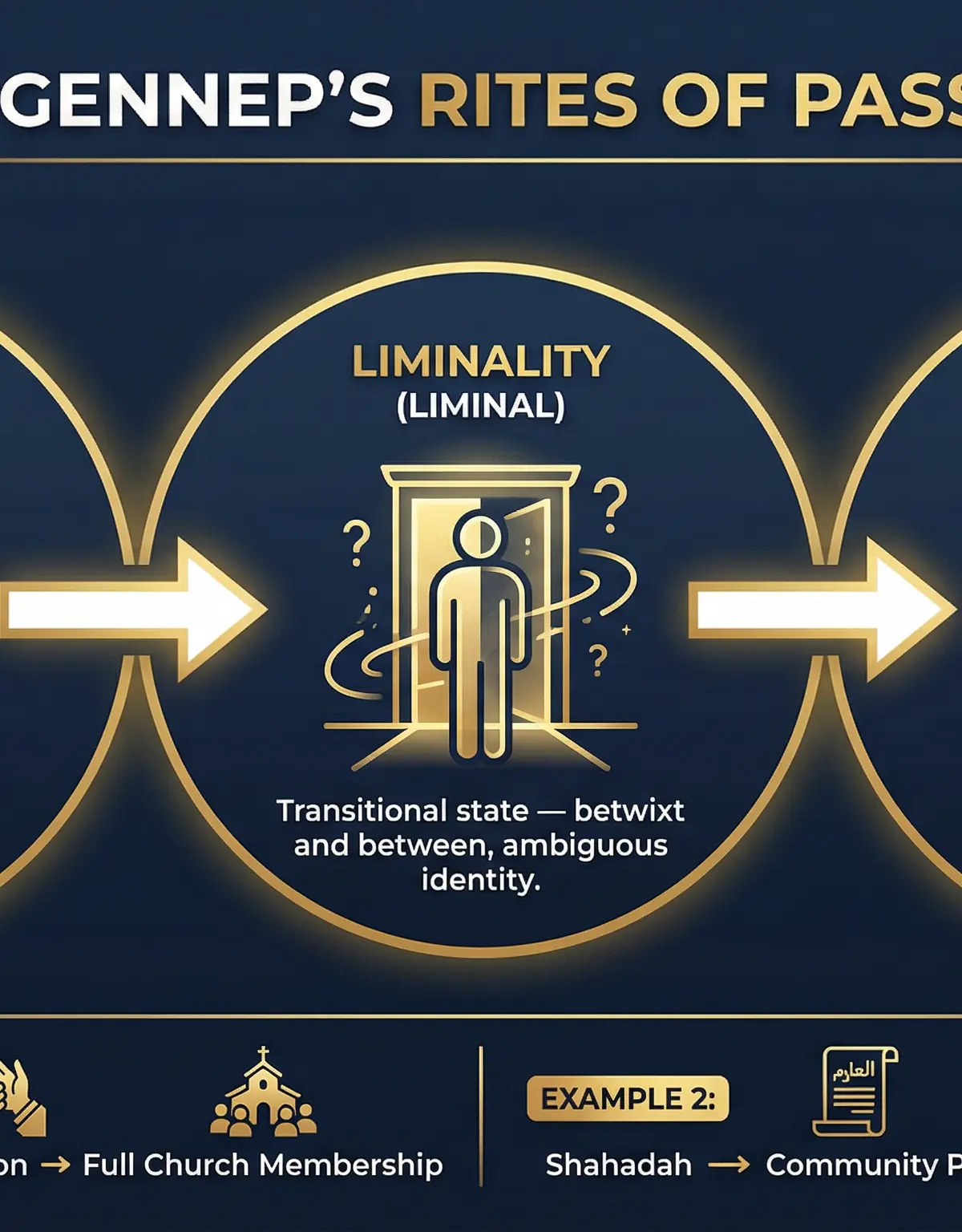
What it is: The anthropologist Arnold van Gennep observed that many rituals marking a change in an individual's status follow a common, three-part structure. These 'rites of passage' are fundamental to how identity is formally changed within a community.
- Separation (Pre-liminal): The individual is first removed from their previous social context. This can be a physical separation or a symbolic one.
- Liminality (Liminal): This is the crucial 'in-between' or threshold stage. The individual is outside of their old identity but has not yet been fully integrated into the new one. It is a state of ambiguity and transformation.
- Incorporation (Post-liminal): The individual is formally welcomed back into the community with their new status and identity.
Why it matters: This is a vital analytical tool. Instead of just describing a baptism, a candidate can analyse it using van Gennep's stages to explain how it functions to change a person from an outsider to an insider. Marks are awarded for this analytical application of theory to practice.
Emile Durkheim: Religion and Social Cohesion
Role: Sociologist
Key Idea: Durkheim had a functionalist view of religion. He argued that the primary purpose of religion is not about the worship of gods, but about the creation and maintenance of social cohesion. In his view, when a society worships its totem or god, it is, in effect, worshipping itself—its own collective identity and shared values. Religious rituals are the means by which the 'collective effervescence', or heightened feeling of community, is generated and sustained.
Impact: Durkheim provides a critical, sociological lens for AO2 evaluation. It allows candidates to argue that the true significance of religious identity lies not in its theological claims, but in its power to bind people together. This is a powerful counter-argument to purely faith-based perspectives.
Second-Order Concepts
Orthodoxy vs. Orthopraxy
This is a crucial distinction for evaluating religious identity. Orthodoxy means 'right belief'—defining membership based on adherence to a specific creed or set of doctrines. Orthopraxy means 'right practice'—defining membership based on participation in rituals and adherence to a moral code. A key evaluative question is which of these is more significant in defining who is truly a member of a religious group.
Individual vs. Communal Identity
This theme runs through the entire topic. How much of religious identity is about an individual's personal, internal faith and spirituality, and how much is it defined by their public affiliation and participation with an institutional group? Examiners look for responses that can explore the tension and interplay between these two facets of identity.
Source Skills
When presented with a source on this topic (e.g., an extract from a sociologist or a religious text), apply the following method:
- Content: What does the source argue about identity, ritual, or community?
- Provenance: Who wrote it (e.g., a sociologist like Durkheim, a theologian, an anthropologist like van Gennep)? How does their perspective shape their argument?
- Application: How can you use the ideas in the source to support or challenge a claim? For example, you could use a quote from Durkheim to support the argument that practice is more important than belief."
Worked Examples
3 worked examples — open one to explore the question and available guidance.
Practice Questions
Test your understanding — click to reveal model answers
Explain Ninian Smart's social and ritual dimensions of religion. (20 marks)
Hint: Define each dimension clearly and then show how they are interconnected, using specific examples from one or more religions.
Explain how Emile Durkheim understood the function of religion. (20 marks)
Hint: Focus on the key terms: 'functionalism', 'social cohesion', and 'collective effervescence'.
'Rites of passage are the most important factor in forming a religious identity.' Evaluate this view. (30 marks)
Hint: Agree with the statement using van Gennep. Disagree by bringing in other factors like personal belief (orthodoxy), upbringing, or the social dimension outside of specific rites. Come to a clear judgement.
Explain the difference between orthodoxy and orthopraxy using examples from one religion. (20 marks)
Hint: Define both terms clearly. For Christianity, you could contrast the emphasis on the Nicene Creed (orthodoxy) with the emphasis on sacraments and good works (orthopraxy).
'Without a community, there is no religious identity.' Evaluate this view. (30 marks)
Hint: This is a question about the social vs. individual aspects of identity. Agree using Smart's social dimension and Durkheim. Disagree by focusing on the role of personal, individual faith, mystics, hermits, or those who believe but do not belong (the 'unchurched').