WJEC · A-Level · Religious Studies
Situation Ethics
Dive into Joseph Fletcher's radical Situation Ethics, a theory that rocked the 1960s by placing selfless love (agape) as the ultimate moral compass. This guide unpacks the core principles, critical debates, and exam strategies needed to master this key A-Level topic and impress examiners.
- 5 min read
- 2 worked examples
- 3 practice questions
- 6 key terms
Study Notes

Overview
Situation Ethics, proposed by Joseph Fletcher in his 1966 book Situation Ethics: The New Morality, is a teleological and relativist Christian ethical theory. It emerged from the turbulent social and theological landscape of the 1960s, famously championed by figures like J.A.T. Robinson who called for a 'new morality' for 'man come of age'. The theory rejects the rigid, rule-based approach of legalism (like Natural Law) and the chaotic, rule-free approach of antinomianism. Instead, it offers a 'middle way' where only one principle is absolute: agape, or selfless, unconditional love. For the WJEC A-Level exam, candidates must demonstrate a precise understanding of this middle way, be able to explain Fletcher's core principles, and critically evaluate the theory's practicality and coherence, particularly in contrast to deontological systems. Marks are awarded for showing how agape becomes the sole determinant of a moral action, justifying the means by the loving end.

Key Principles & Concepts
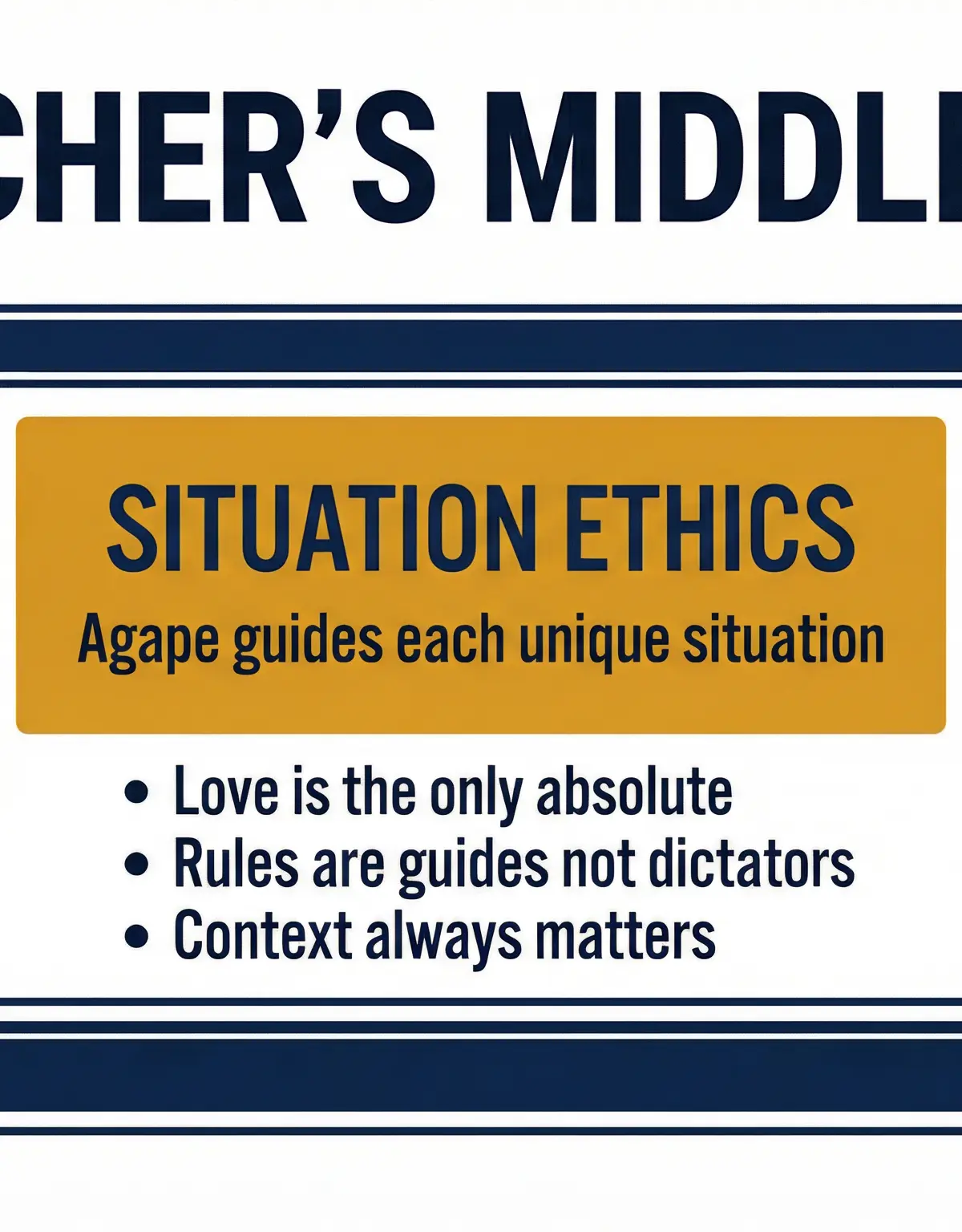
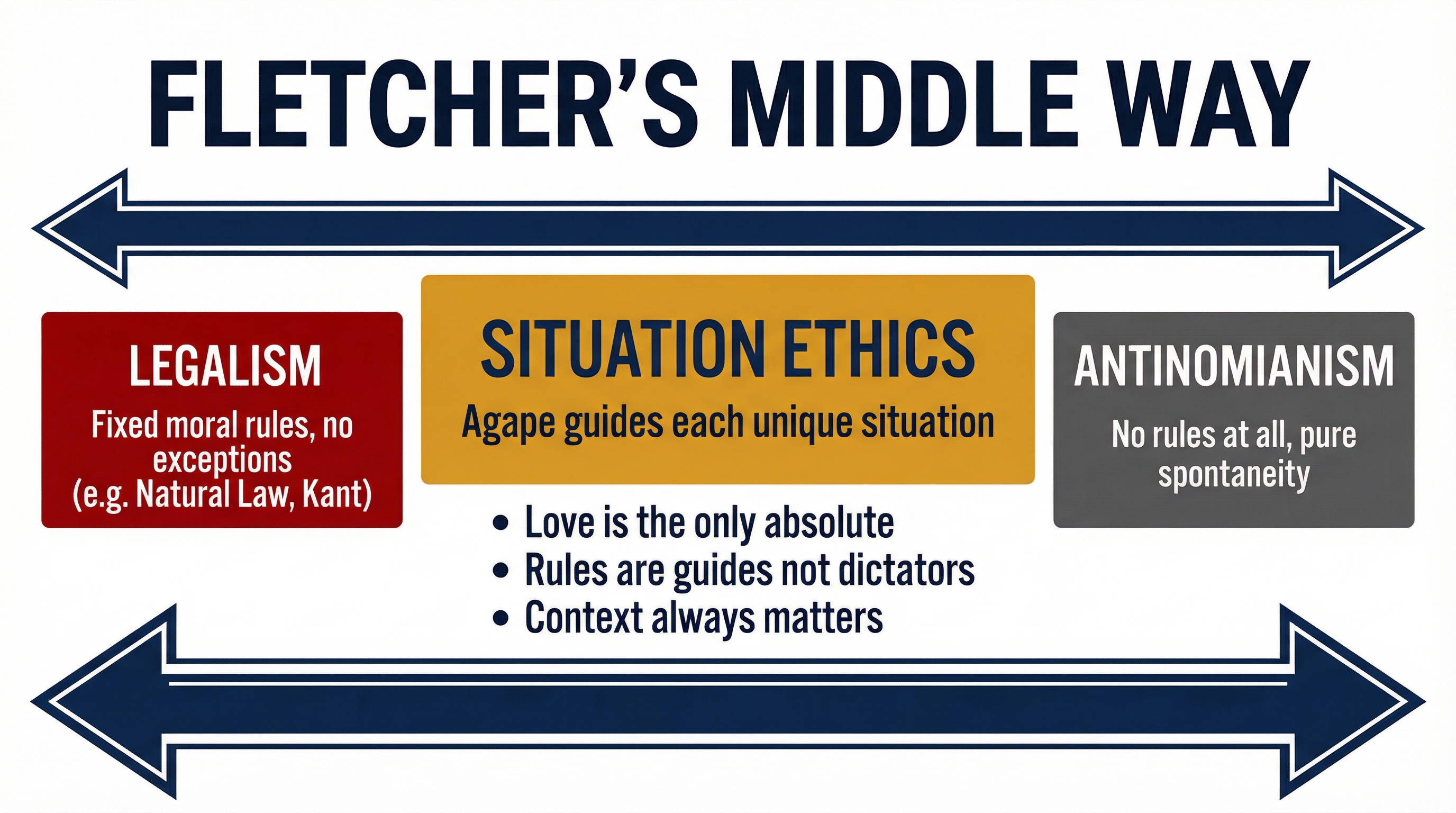
Fletcher's Middle Way
What it is: Fletcher carves a path between two extremes. He rejects the inflexible, exceptionless rules of legalism and the standardless chaos of antinomianism. Situation Ethics respects rules as 'illuminators' or guidelines, but they can and must be broken if love demands it.
Why it matters: This is a foundational concept. Marks are awarded for a precise definition of this 'middle way'. It shows you understand the unique space Fletcher tried to create in ethical thought.
Specific Knowledge: You must be able to define legalism (e.g., Natural Law, Kantian ethics) and antinomianism (no rules) to properly contextualise Fletcher's position.
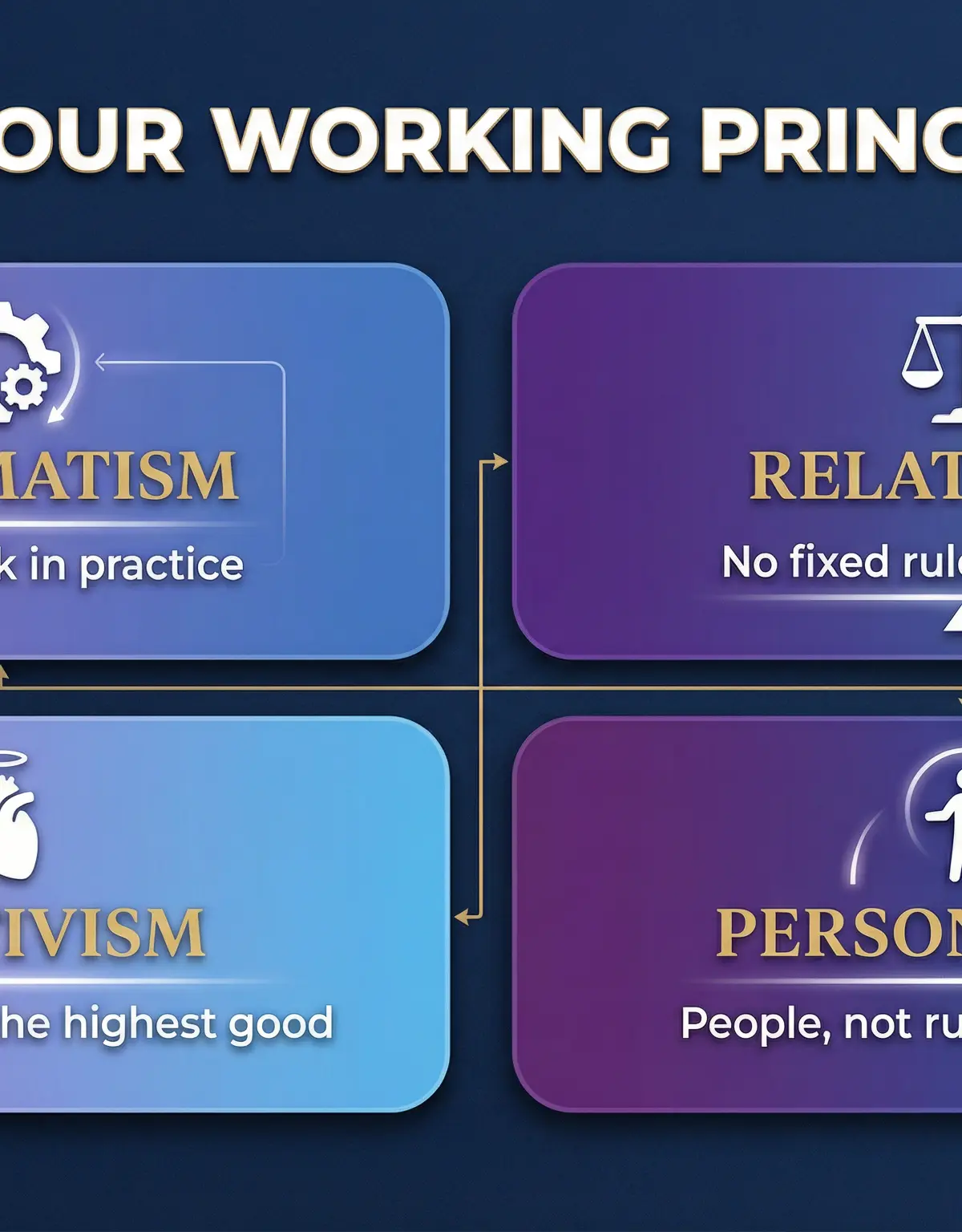
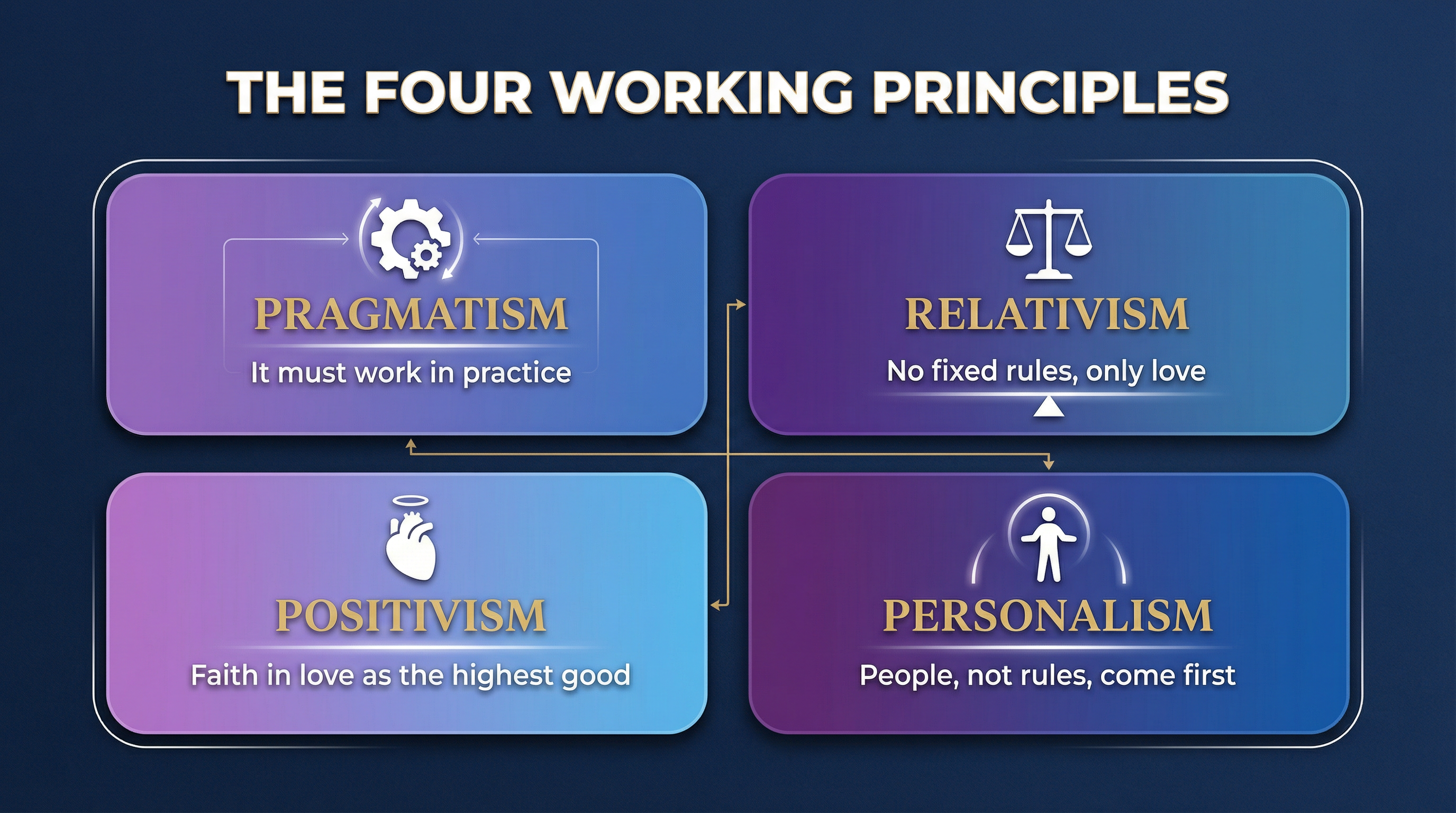
The Four Working Principles
These are the practical assumptions a situationist brings to a moral dilemma. They are the 'how-to' guide for applying the theory.
1. Pragmatism: The proposed course of action must work in practice. It must lead to a genuinely loving outcome.
2. Relativism: All decisions are relative to the situation and, most importantly, relative to love. No rule is absolute except 'love thy neighbour'.
3. Positivism: The commitment to love as the ultimate good is not based on reason or empirical evidence, but on a voluntary act of faith—a 'theological posit'.
4. Personalism: People are the ultimate moral value. The situationist puts people first, not rules. The question is not 'what does the law say?' but 'what does love demand for this person in this situation?'
The Six Fundamental Principles
These are the core propositions that define the content of the theory.
- Love is the only intrinsic good: Only agape is good in and of itself. Everything else (honesty, justice, etc.) is only instrumentally good if it serves love.
- Love is the ruling norm: Christian decision-making is ruled by love, which replaces all other laws and commandments.
- Love and justice are the same: Justice is simply love distributed. It is love applied to the wider community.
- Love is not a matter of liking: Agape is an attitude of selfless goodwill, not a feeling. It wills the neighbour's good whether we like them or not.
- The end justifies the means: This is the teleological heart of the theory. Any action, no matter how controversial, can be justified if it produces the most loving outcome.
- Decisions are made situationally: Moral choices are made in the moment, in the specific context, not by a pre-determined rulebook.
Key Individuals
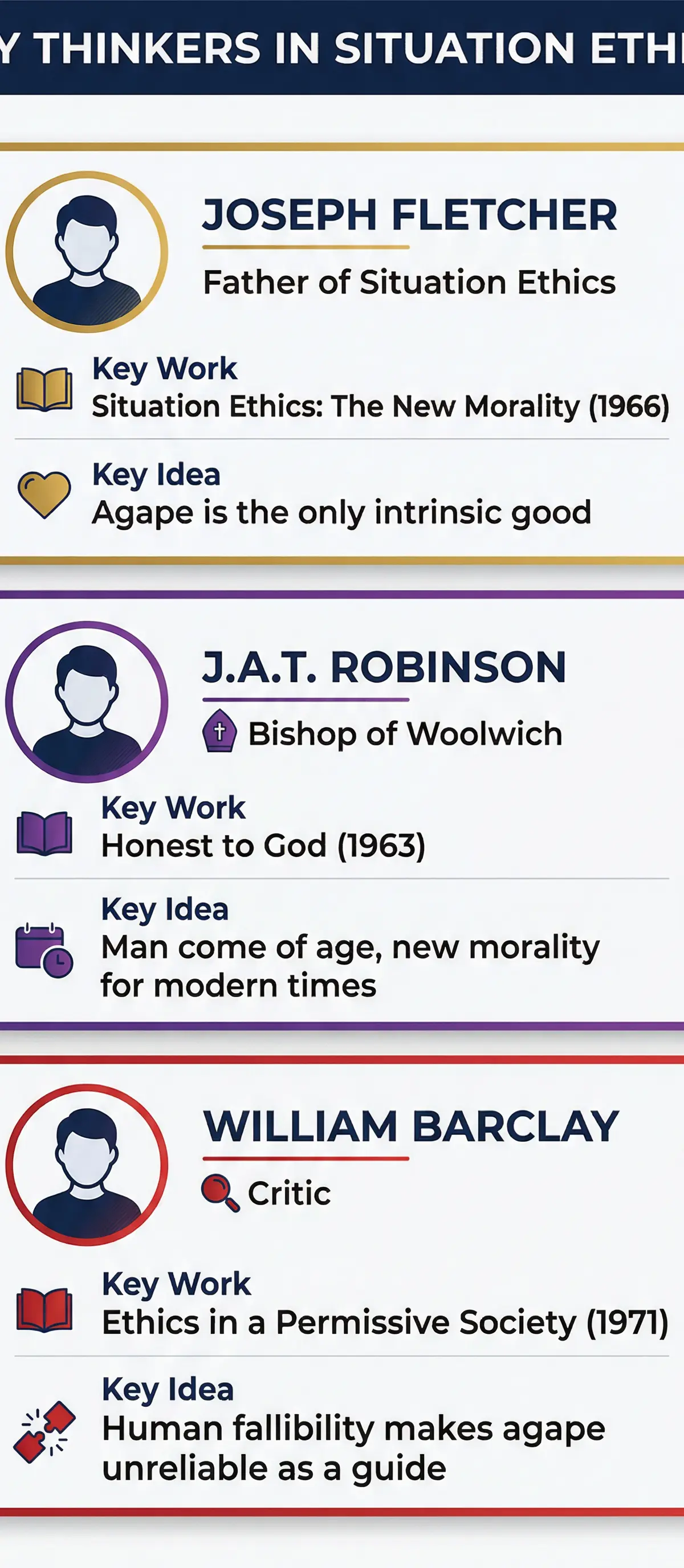
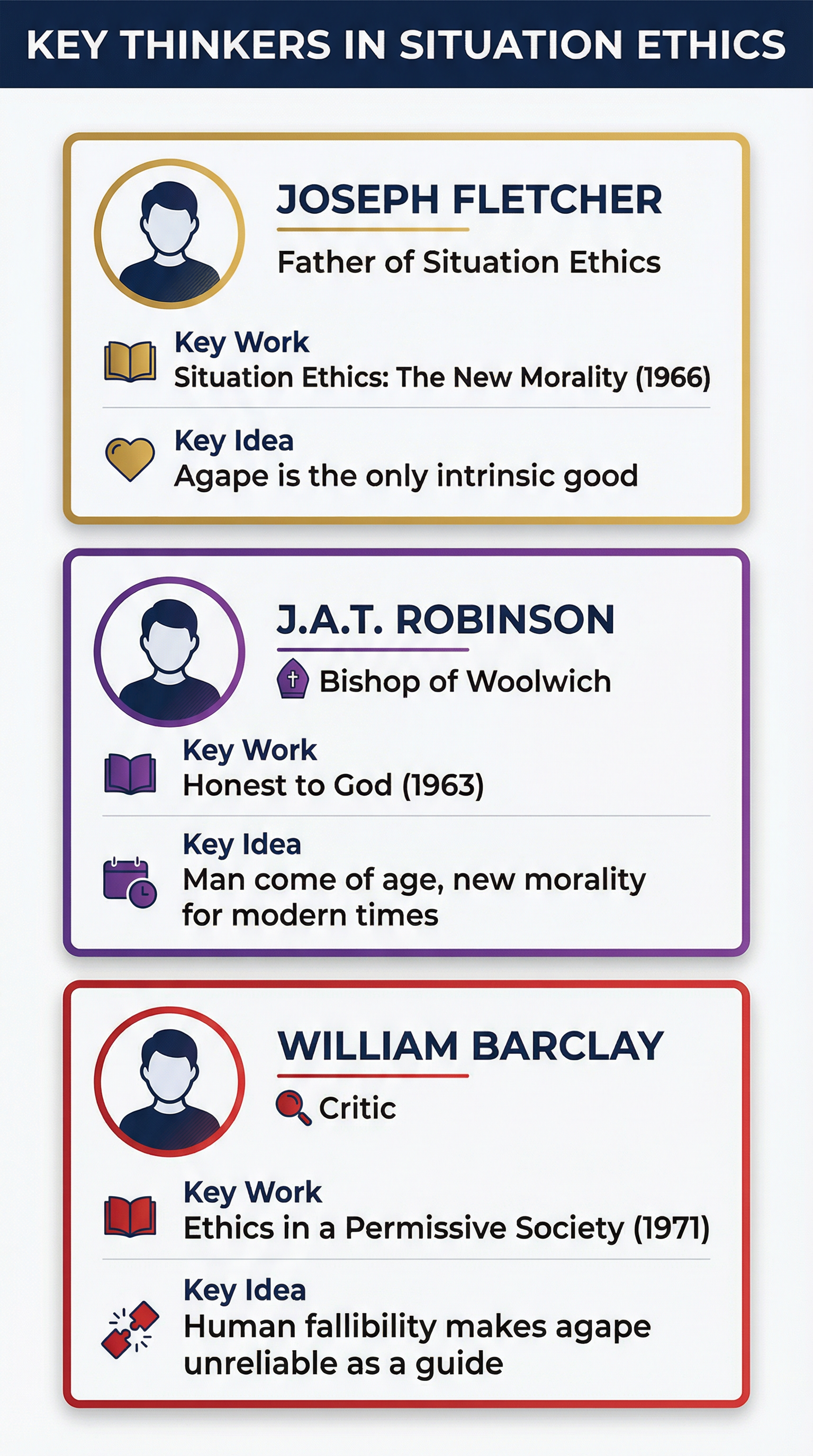
Joseph Fletcher (1905-1991)
Role: American Episcopal priest and academic; the architect of Situation Ethics.
Key Actions: Published Situation Ethics: The New Morality (1966), popularising a Christian ethical framework based on agape.
Impact: Challenged traditional Christian ethics and sparked a major debate about the role of rules, conscience, and love in moral decision-making.
J.A.T. Robinson (1919-1983)
Role: Bishop of Woolwich and influential theologian.
Key Actions: Published Honest to God (1963), arguing that modern Christians had 'come of age' and needed a 'new morality' free from rigid, outdated dogma.
Impact: He created the theological climate that made Fletcher's work so resonant. He provided the intellectual justification for moving beyond legalism.
William Barclay (1907-1978)
Role: Scottish theologian and prominent critic of Situation Ethics.
Key Actions: Published Ethics in a Permissive Society (1971), where he argued that Fletcher's theory was dangerously idealistic.
Impact: Barclay provides the classic counter-argument for AO2 essays. He contended that humans are fallible and need the protection of absolute rules to prevent them from justifying selfishness as 'love'.
Worked Examples
2 worked examples — open one to explore the question and available guidance.
Practice Questions
Test your understanding — click to reveal model answers
Explain the Six Fundamental Principles of Situation Ethics. (12 marks)
Hint: List each principle and briefly explain what it means in the context of the theory.
'The principles of Situation Ethics are too vague to be useful.' Evaluate this view. (18 marks)
Hint: This is an AO2 question. Argue for and against the statement. Use William Barclay as your key critic and counter with Fletcher's defence.
Explain what Fletcher means by 'Personalism' and 'Pragmatism'. (8 marks)
Hint: Define each term and explain its role as one of the Four Working Principles.