WJEC · A-Level · Religious Studies
Sources of Wisdom and Authority in Islam
This guide provides a comprehensive analysis of the Sources of Wisdom and Authority in Islam for WJEC A-Level Religious Studies. It delves into the hierarchy of the Qur'an, Sunnah, Ijma, and Qiyas, equipping students with the critical knowledge and evaluative skills needed to excel in the exam.
- 7 min read
- 3 worked examples
- 5 practice questions
- 7 key terms
Study Notes
Overview
This study guide explores the foundational sources of Islamic jurisprudence (Usul al-Fiqh) as required by the WJEC A-Level specification (Component 3, Option E). A mastery of this topic is essential, as it underpins the entire framework of Islamic law and theology. Examiners expect candidates to demonstrate precise knowledge of the hierarchy of sources — the Qur'an, Sunnah, Ijma, and Qiyas — and to critically evaluate their interplay and authority. This involves understanding the ontological status of the Qur'an as Kalam Allah (the uncreated speech of God), the meticulous science of Hadith authentication, and the role of scholarly reasoning in deriving legal rulings. High-level responses will move beyond mere description to analyse the tensions between traditionalist adherence to textual sources and modernist reinterpretations in the contemporary world. Success in this area requires not just memorisation of facts, but a deep engagement with the intellectual and theological principles at stake.
Key Events & Developments
The Revelation of the Qur'an
Date(s): c. 610 - 632 CE
What happened: The Prophet Muhammad began receiving divine revelations from the Angel Jibril on Laylat al-Qadr (The Night of Power). These revelations, which form the text of the Qur'an, continued for approximately 23 years until his death.
Why it matters: This is the foundational event of Islam. The Qur'an is considered the literal, uncreated word of God (Kalam Allah), making it the primary and most authoritative source of wisdom and law. All other sources are subordinate to it.
Specific Knowledge: Laylat al-Qadr (610 CE), Angel Jibril, concept of wahy (revelation).
The Compilation of the Qur'an
Date(s): c. 633 CE (Abu Bakr's compilation) & c. 650 CE (Uthmanic Codification)
What happened: After many memorisers of the Qur'an (huffaz) were killed in the Battle of Yamama, the first Caliph, Abu Bakr, commissioned Zayd ibn Thabit to collect the scattered written materials and compile a single volume. Later, the third Caliph, Uthman ibn Affan, commissioned a committee, also led by Zayd, to produce a standardised version (the Uthmanic Mushaf) and destroy all variant copies to ensure unity.
Why it matters: This process ensured the preservation and standardisation of the Qur'anic text, providing a single, universally accepted scripture for the entire Muslim world. Candidates must avoid describing this as a creative "editing" process; it was a meticulous collection and verification.
Specific Knowledge: Abu Bakr, Umar ibn al-Khattab, Uthman ibn Affan, Zayd ibn Thabit, Battle of Yamama (633 CE).
The Development of Hadith Science
Date(s): 8th - 9th Centuries CE
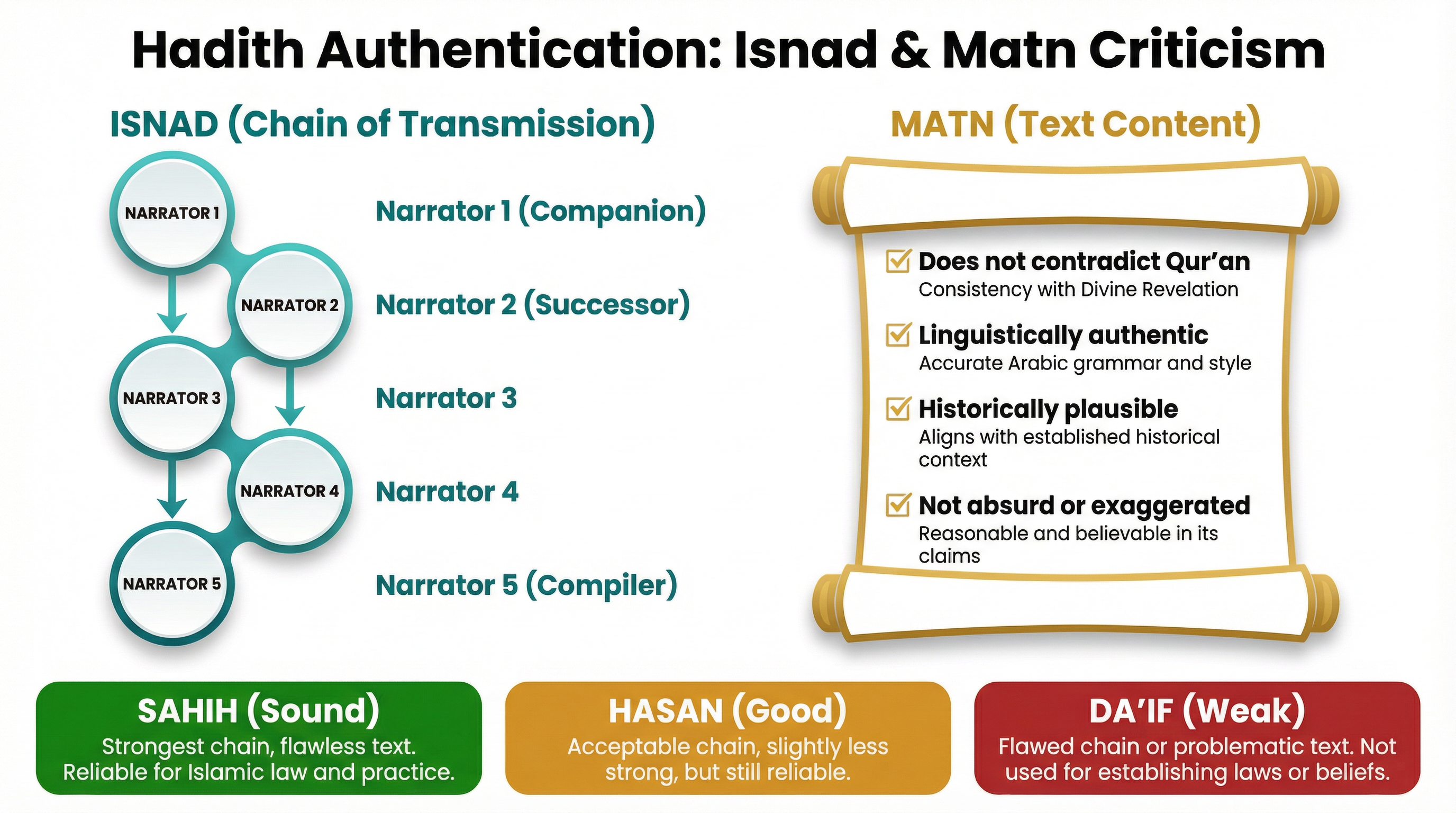
What happened: As the sayings and actions of the Prophet (the Sunnah) became crucial for legal interpretation, a rigorous methodology developed to authenticate the written reports (Hadith). This involved two key areas of criticism: Isnad (analysing the chain of narrators) and Matn (analysing the text's content).
Why it matters: This science provided a mechanism to sift authentic reports from weak or fabricated ones, establishing a reliable secondary source of authority. It demonstrates the intellectual rigour of early Islamic scholarship. Marks are awarded for accurately distinguishing between classifications like Sahih, Hasan, and Da'if.
Specific Knowledge: Isnad, Matn, Sahih, Hasan, Da'if, Mutawatir, key compilers like al-Bukhari and Muslim.
Key Individuals
The Prophet Muhammad
Role: The final prophet in Islam, who received the Qur'anic revelation and whose life (Sunnah) serves as a model for all Muslims.
Key Actions: Transmitted the Qur'an to his companions, established the first Muslim community in Medina, and provided a living example of Islamic principles.
Impact: His Sunnah is the second most important source of authority after the Qur'an, providing essential context and practical application of its teachings. The Qur'anic command 'Obey Allah and obey the Messenger' (4:59) is the basis for the Sunnah's authority.
Zayd ibn Thabit
Role: The chief scribe of the Prophet Muhammad.
Key Actions: Entrusted by Caliph Abu Bakr to lead the initial compilation of the Qur'an into a single volume. Later, he was tasked by Caliph Uthman to lead the committee that produced the standardised Uthmanic codex.
Impact: His central role in both major stages of the Qur'an's compilation makes him a pivotal figure in the preservation of the primary source of Islam.
Al-Shafi'i
Role: Jurist and architect of the classical theory of Islamic jurisprudence (Usul al-Fiqh).
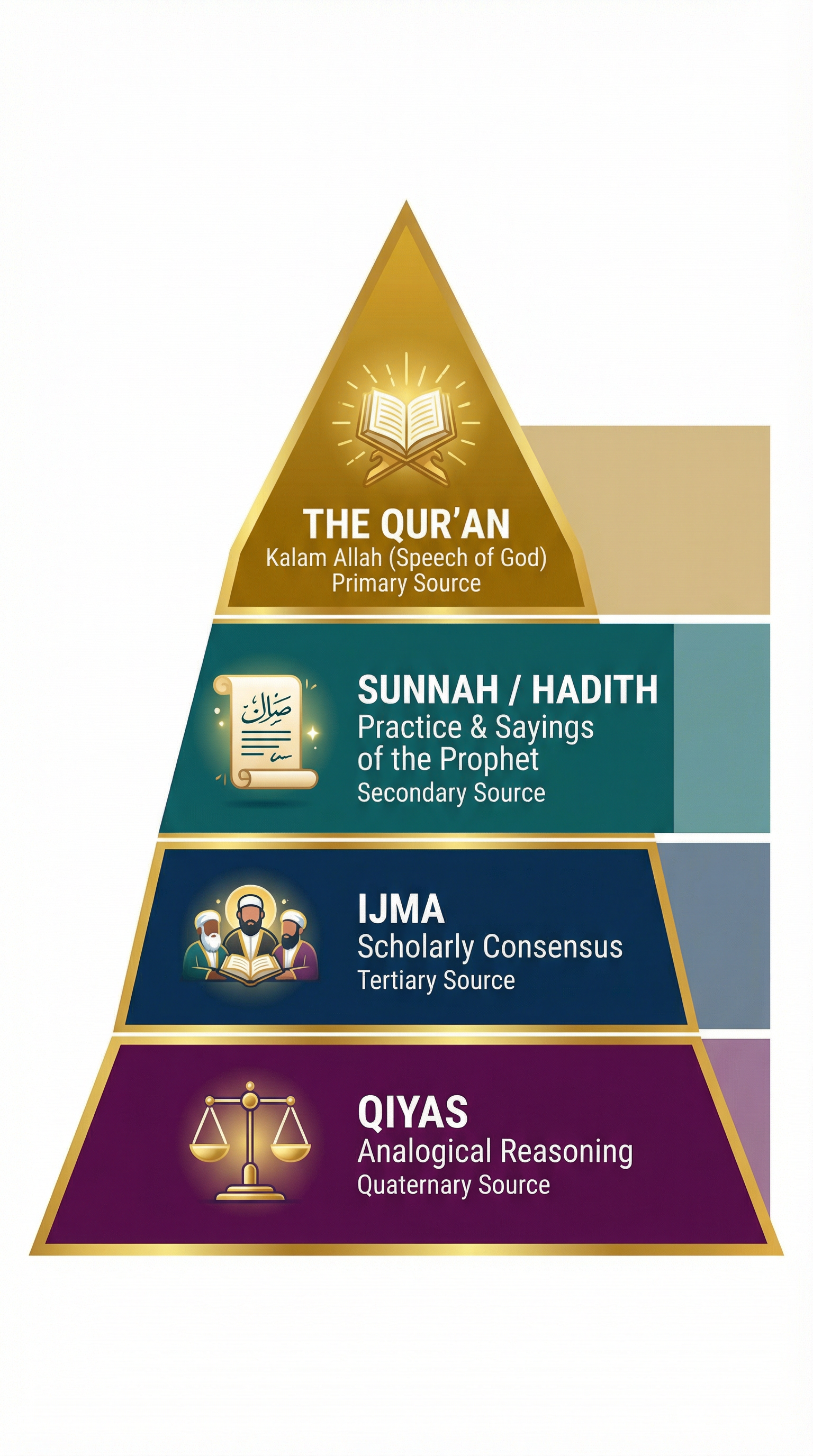
Key Actions: In his seminal work, Al-Risala, he formally articulated the hierarchy of the four main sources: Qur'an, Sunnah, Ijma, and Qiyas. He championed the authority of the Sunnah and systematised the use of analogical reasoning (Qiyas).
Impact: He created the foundational legal methodology that has dominated Sunni jurisprudence for centuries. Candidates should credit him with establishing the four-source framework.
Second-Order Concepts
Causation
The development of the sources of authority was driven by necessity. The death of the Prophet created a leadership vacuum and a need to preserve his teachings. The deaths of the huffaz at the Battle of Yamama was a direct trigger for the first compilation of the Qur'an. The geographical expansion of the Islamic empire led to variations in Qur'anic recitation, which caused Uthman to commission a standardised text. The emergence of new legal and ethical problems not explicitly covered in the Qur'an caused the development of methodologies like Qiyas.
Consequence
The immediate consequence of the Uthmanic codification was the unity of the Muslim community around a single, undisputed text. The long-term consequence of the development of Hadith science was the creation of a vast and detailed body of literature that guides every aspect of Muslim life. The systematisation of Usul al-Fiqh by al-Shafi'i led to the formation of distinct schools of law (madhahib) but also provided a common framework for legal reasoning.
Change & Continuity
The Qur'an represents continuity; it is seen as the eternal, unchanging word of God. The methods of interpreting and applying that word, however, represent change and development. The move from oral transmission to a written, codified text was a significant change. The development of Qiyas was an innovative change to address new circumstances. The core principles of the Qur'an and Sunnah remain constant, but their application through fiqh (jurisprudence) is dynamic.
Significance
The historical significance of this topic is immense. The process of collecting, preserving, and interpreting these sources shaped Islamic civilisation, law, theology, and culture. For A-Level candidates, its significance lies in understanding that Shari'ah is not a single book but a complex, source-based methodology. Understanding this process is key to evaluating debates between traditionalist and modernist Muslims today.
Source Skills
When presented with a source (e.g., a Hadith or a quote from a scholar), candidates must first identify its nature. Is it from the primary source (Qur'an) or a secondary one (Hadith)? If it's a Hadith, what is its likely classification (Sahih, Hasan, Da'if)? Consider the provenance: who is the author/compiler (e.g., al-Bukhari)? When did they live? What was their purpose? This allows for an evaluation of the source's authority and potential bias, which is crucial for AO2 marks.
Visual Resources
2 diagrams and illustrations
Interactive Diagrams
1 interactive diagram to visualise key concepts
Conceptual Flow Outline
The Hierarchy of Sources in Sunni Islam (Usul al-Fiqh)
Worked Examples
3 worked examples — open one to explore the question and available guidance.
Practice Questions
Test your understanding — click to reveal model answers
Explain the role of Zayd ibn Thabit in the preservation of the Qur'an. (12 marks)
Hint: Focus on his role in TWO distinct stages of the Qur'an's compilation and the reasons for each.
Describe the main classifications of Hadith. (8 marks)
Hint: Define and explain the three main categories: Sahih, Hasan, and Da'if.
'The science of Hadith guarantees the authenticity of the Prophet's Sunnah.' Evaluate this view. (30 marks)
Hint: Consider arguments for the reliability of the science (rigour, criteria) and arguments against it (human element, time gap, potential for error).
Explain how Qiyas (analogical reasoning) is used to derive Islamic rulings. (12 marks)
Hint: Define Qiyas, explain the four components (asl, far', 'illah, hukm), and use a clear example.
Explain the significance of the Uthmanic codification. (8 marks)
Hint: Focus on the consequences of Uthman's actions for the Muslim community.