WJEC · A-Level · Religious Studies
The Soul, Mind and Body
This study guide delves into the profound philosophical debate about the nature of the soul, mind, and body, a cornerstone of WJEC A-Level Religious Studies. It unpacks the critical arguments from Plato and Descartes to Ryle and Dawkins, providing the analytical tools needed to excel in the exam. Mastering this topic requires understanding not just what each thinker believed, but why their arguments succeed or fail.
- 6 min read
- 3 worked examples
- 5 practice questions
- 7 key terms
Study Notes

Overview
This guide covers WJEC Theme 1A, exploring philosophical beliefs about the soul, mind, and body. The central tension is between Dualism (the idea that the mind/soul is a separate, non-physical substance) and Monism/Materialism (the view that everything is ultimately physical). Candidates are expected to precisely explain the theories of key thinkers and critically evaluate their coherence, particularly regarding personal identity and the possibility of life after death. Examiners look for a clear understanding of the distinction between substance dualism (Plato) and property dualism/monism (Aristotle), and the ability to analyse modern critiques from Ryle and Dawkins. Success in this topic hinges on moving beyond mere description to a sharp, analytical assessment of the arguments' strengths and weaknesses.
Key Thinkers and Developments
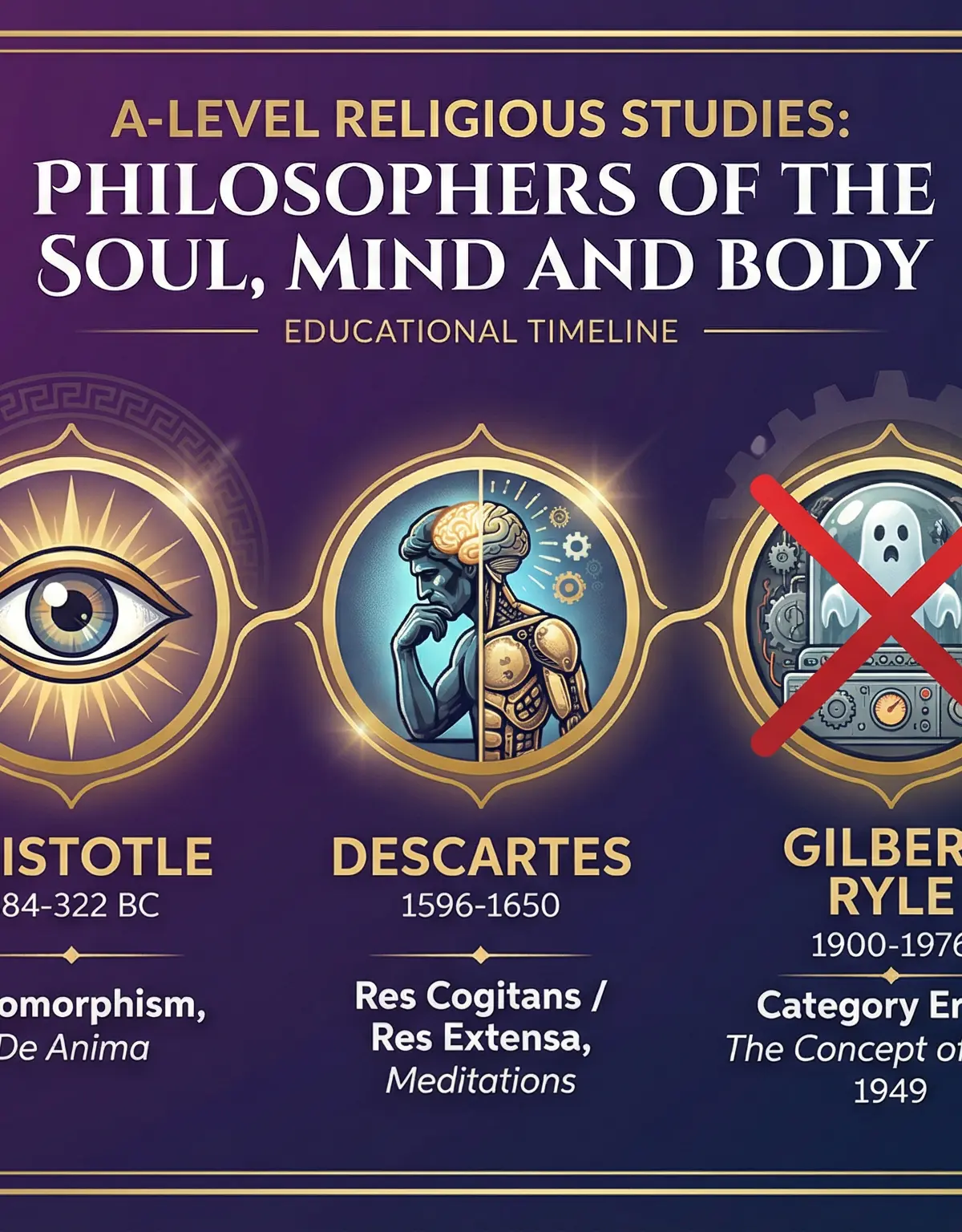
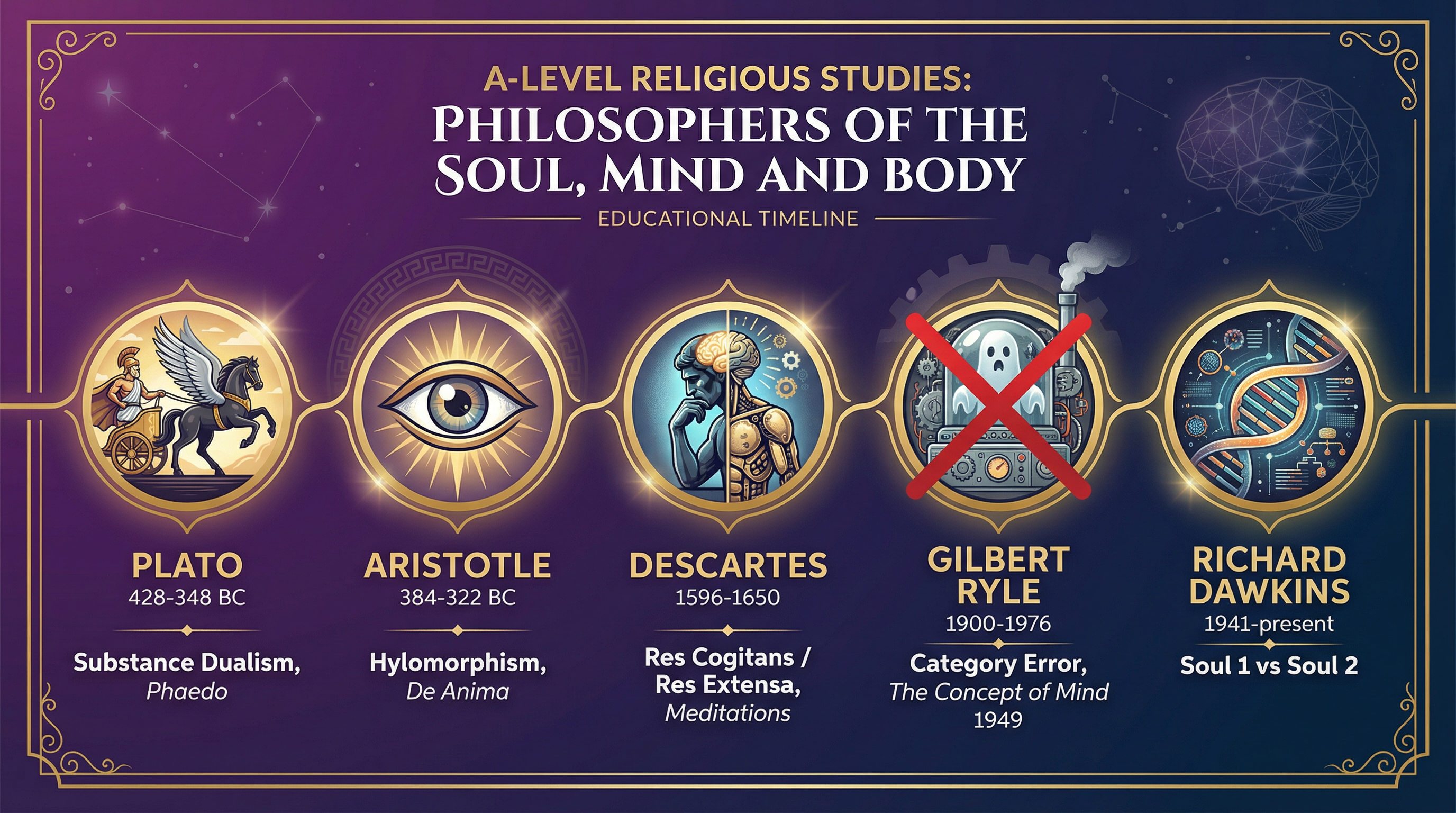
Plato (c. 428-348 BC): Substance Dualism
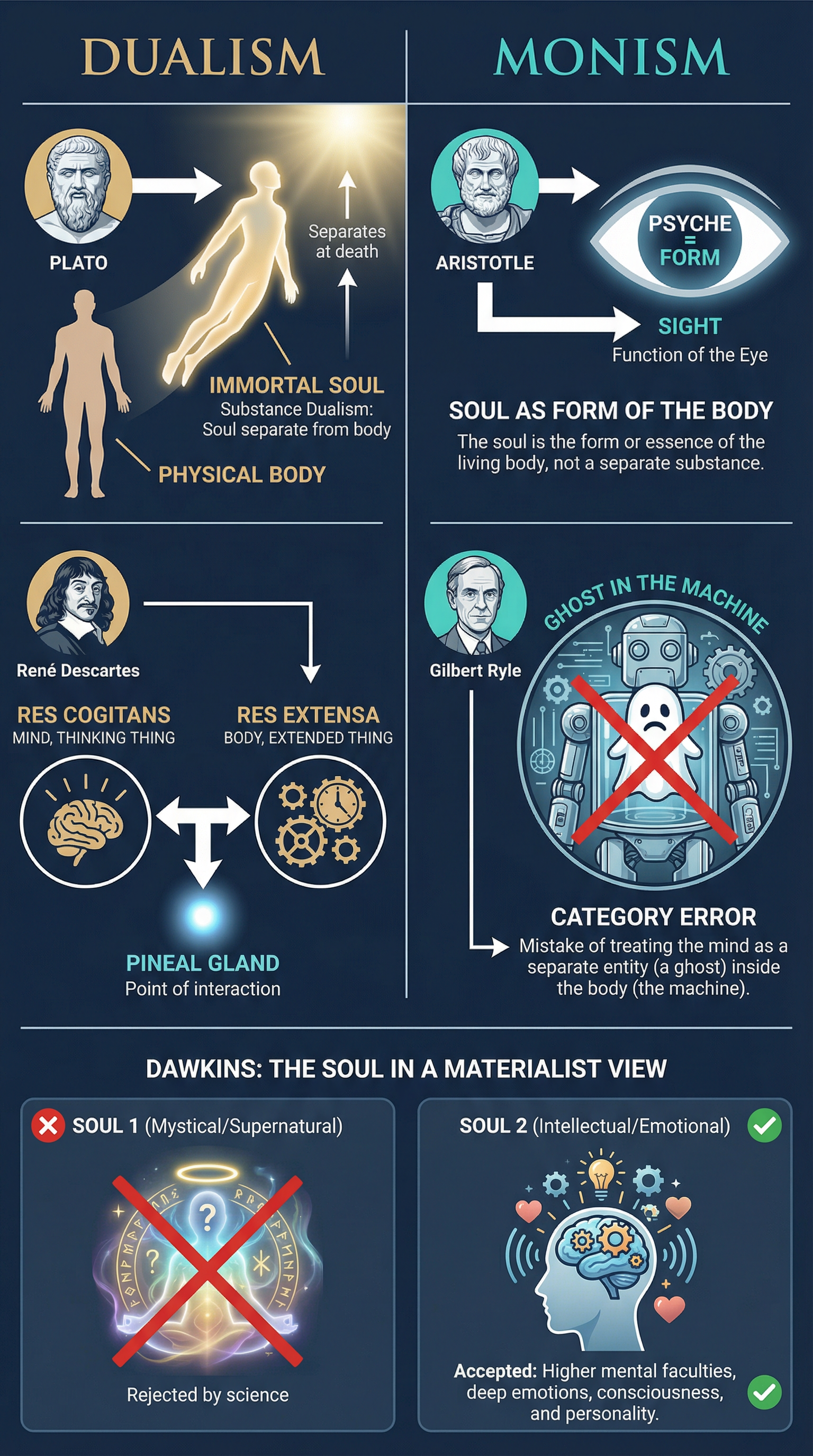
What happened: Plato argued that the soul is an immortal, immaterial substance, distinct from the mortal, physical body. He believed the soul existed before birth in the Realm of the Forms and returns there after death.
Why it matters: This is the classic formulation of substance dualism. It establishes a clear framework for a disembodied afterlife, where personal identity resides in the soul alone. Examiners expect candidates to explain this using the Charioteer Analogy from Phaedo.
Specific Knowledge: The soul is divided into three parts: Reason (the charioteer), Spirit/Honour (the noble horse), and Appetite/Desire (the unruly horse). The body is described as a prison for the soul.
Aristotle (c. 384-322 BC): Hylomorphism and Monism
What happened: Aristotle, Plato's student, rejected substance dualism. He argued the soul (psyche) is the form of the body, its organising principle and function. It is not a separate entity.
Why it matters: This is a monist or hylomorphic view. It suggests the soul cannot be separated from the body, just as sight cannot be separated from a functioning eye. This has major implications for the afterlife, making a disembodied existence impossible and pointing towards a model of resurrection if there is to be any life after death.
Specific Knowledge: Use the analogy of the eye and sight or the wax seal. The soul is the actuality of a body that has life. Do not confuse Aristotle's concept of form with Plato's Forms.
Rene Descartes (1596-1650): Cartesian Dualism
What happened: Descartes revived dualism with two key arguments. He established the mind (res cogitans, thinking thing) as a distinct substance from the body (res extensa, extended thing).
Why it matters: Descartes provides a modern, rationalist defence of dualism. Candidates must analyse his specific arguments, not just give a biography. His work sets the stage for the modern mind-body problem.
Specific Knowledge: Argument from Doubt (I can doubt my body exists, but not that I am thinking, therefore I am a thinking thing) and the Argument from Divisibility (the body is divisible, the mind is not). He identified the pineal gland as the point of interaction.
Gilbert Ryle (1900-1976): The Ghost in the Machine Critique
What happened: Ryle launched a linguistic attack on Cartesian dualism, calling it a category error. He argued that talking about the mind as a separate thing inside the body is a fundamental misunderstanding of mental language.
Why it matters: Ryle reframes the debate. He argues the problem is not that the soul does not exist, but that the question itself is confused. Mental states are about how we behave and are disposed to behave, not about secret inner events.
Specific Knowledge: Use Ryle's analogy of the visitor asking to see the University after being shown all the colleges and libraries. The mind is not another item in the inventory; it is the way the items are organised and function. Published in The Concept of Mind, 1949.
Richard Dawkins (1941-Present): Materialism and Soul 1 versus Soul 2
What happened: As a biologist, Dawkins provides a modern materialist perspective. He argues that our identity and consciousness are entirely rooted in our physical brains and genetic makeup.
Why it matters: Dawkins shows how a scientific worldview challenges traditional dualism. His distinction provides a useful way to separate the supernatural concept of the soul from the idea of human consciousness and personality.
Specific Knowledge: Soul 1 is the traditional, supernatural, immortal soul which Dawkins rejects. Soul 2 is the metaphorical soul of intellectual and emotional life, which he accepts as a product of the physical brain.

Second-Order Concepts
Causation
Plato's view that the physical world is a poor reflection of the eternal Forms causes the soul to seek knowledge and virtue. Descartes' need for a certain foundation for knowledge caused him to develop his method of doubt, leading to the Cogito and his dualism. The philosophical confusion caused by Cartesian language led Ryle to develop his theory of category errors.
Consequence
The major consequence of dualism is the possibility of a disembodied afterlife and the idea that our true identity is non-physical. This leads to a devaluing of the physical body and world. The consequence of monism/materialism is that personal identity is tied to the physical body, making the concept of an afterlife more problematic and often requiring a belief in bodily resurrection.
Change and Continuity
The fundamental questions about consciousness and identity have remained the same from Plato to the present day. However, the language and methods used to answer the questions have changed dramatically, from Plato's metaphysics to Ryle's linguistic analysis and Dawkins' scientific materialism.
Significance
The debate is significant because it directly impacts our understanding of what it means to be human, the nature of personal identity, and the possibility of life after death. It forms the foundation for many ethical and religious beliefs.
Visual Resources
2 diagrams and illustrations
Interactive Diagrams
1 interactive diagram to visualise key concepts
Conceptual Flow Outline
Plato's Charioteer Analogy: Reason must control Spirit and Appetite to guide the soul towards the Forms.
Worked Examples
3 worked examples — open one to explore the question and available guidance.
Practice Questions
Test your understanding — click to reveal model answers
Explain Descartes' arguments for the distinction between the mind and the body. (20 marks)
Hint: Focus on the two specific arguments from his Meditations: the Argument from Doubt and the Argument from Divisibility. Use the correct Latin terminology.
'Ryle's critique of the ghost in the machine successfully demolishes Cartesian dualism.' Evaluate this view. (30 marks)
Hint: Analyse the strengths of Ryle's critique (avoids interaction problem, logical clarity) against its weaknesses (fails to account for qualia/subjective experience). Come to a clear, justified judgement.
Explain what Ryle meant by a category error. (10 marks)
Hint: Use one of Ryle's own analogies to illustrate your explanation. Ensure you link it back to the specific mistake Descartes made.
To what extent is the soul immortal? (30 marks)
Hint: This is a synoptic question. Draw on multiple thinkers. Plato argues the soul is naturally immortal; Aristotle and Dawkins deny this. Descartes implies it; Ryle makes the question confused. Come to a clear judgement.
Explain Dawkins' distinction between Soul One and Soul Two. (10 marks)
Hint: Define both terms clearly and explain why Dawkins, as a materialist, rejects one and accepts the other.