WJEC · GCSE · Religious Studies
Key beliefs of Buddhism
This study guide provides a comprehensive analysis of the key beliefs of Buddhism for WJEC GCSE Religious Studies candidates. It focuses on the core Dhamma as a practical path to Enlightenment, equipping students with the precise terminology, conceptual understanding, and exam technique required to achieve top marks.
- 5 min read
- 3 worked examples
- 5 practice questions
- 7 key terms
Study Notes
Overview
This guide covers the fundamental teachings of Buddhism, known as the Dhamma, as required by the WJEC GCSE specification. For examiners, a strong response demonstrates not just knowledge of these beliefs, but a clear understanding of how they interlink to form a coherent path towards the ultimate goal of Nibbana. Candidates are expected to analyse concepts like the Three Marks of Existence and the Four Noble Truths with precision, using correct Pali terminology. A key focus for earning high marks is the ability to distinguish between the Theravada and Mahayana schools of thought, particularly their differing views on the ideal spiritual practitioner: the Arhat versus the Bodhisattva. This topic is not about abstract philosophy; it is about a practical diagnosis of the human condition and a prescribed cure. This guide will provide the detailed knowledge and analytical skills needed to excel.
Key Beliefs & Concepts
The Three Marks of Existence (Tilakkhana)
What they are: These are the three fundamental characteristics of all conditioned phenomena in the universe.
- Anicca (Impermanence): The principle that everything is in a constant state of flux and change. Nothing lasts. Candidates gain credit for explaining that suffering arises from our attachment to things as if they were permanent.
- Anatta (No-Self): The doctrine that there is no fixed, unchanging, independent self or soul (in contrast to the Hindu concept of Atman). What we perceive as a 'self' is a temporary combination of the Five Aggregates (Skandhas).
- Dukkha (Unsatisfactoriness): Often translated as 'suffering', it encompasses the entire spectrum from physical pain to a subtle, pervasive sense of dissatisfaction with life. It is the core problem that the Buddha's teachings aim to solve.
Why they matter: Understanding the Three Marks is foundational. They explain why we suffer (clinging to impermanent things and a false sense of self) and set the stage for the Four Noble Truths.
The Four Noble Truths (Cattari Ariyasaccani)
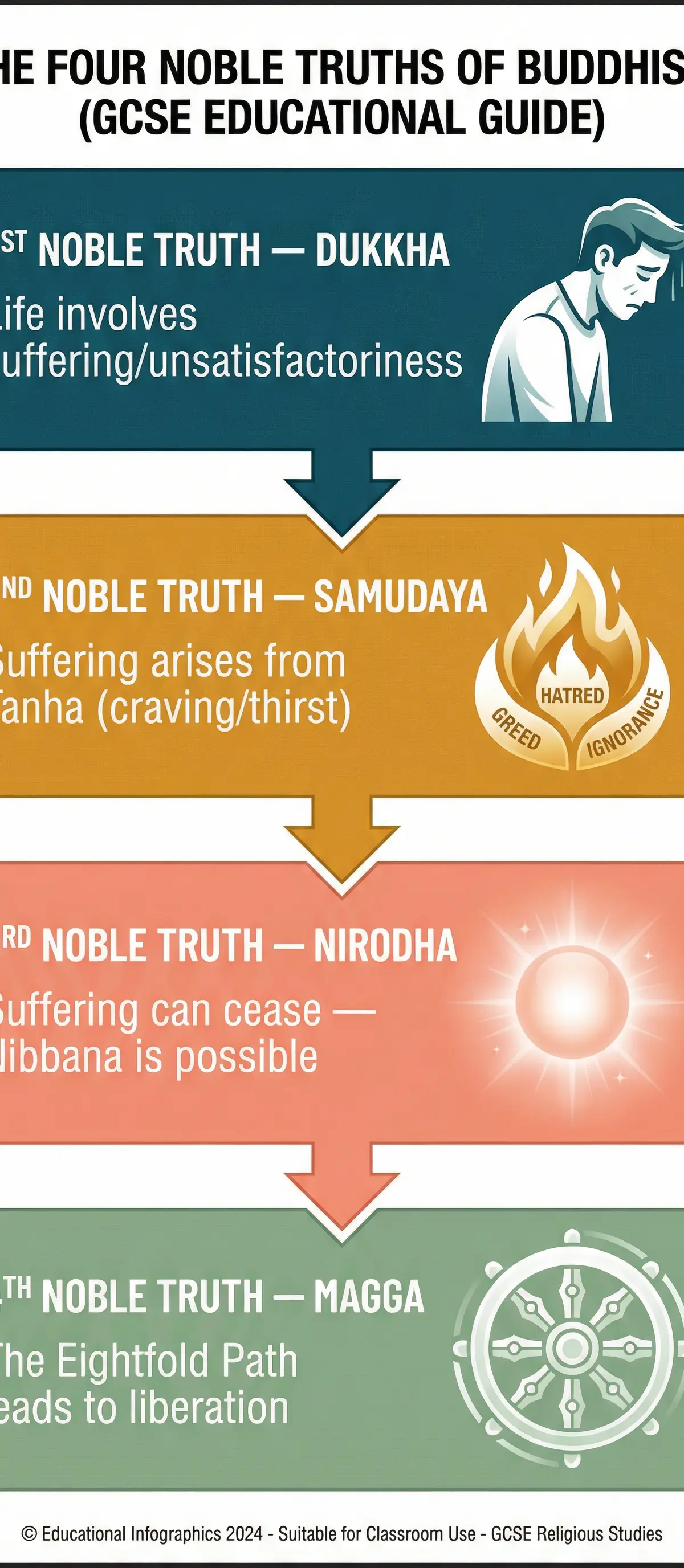
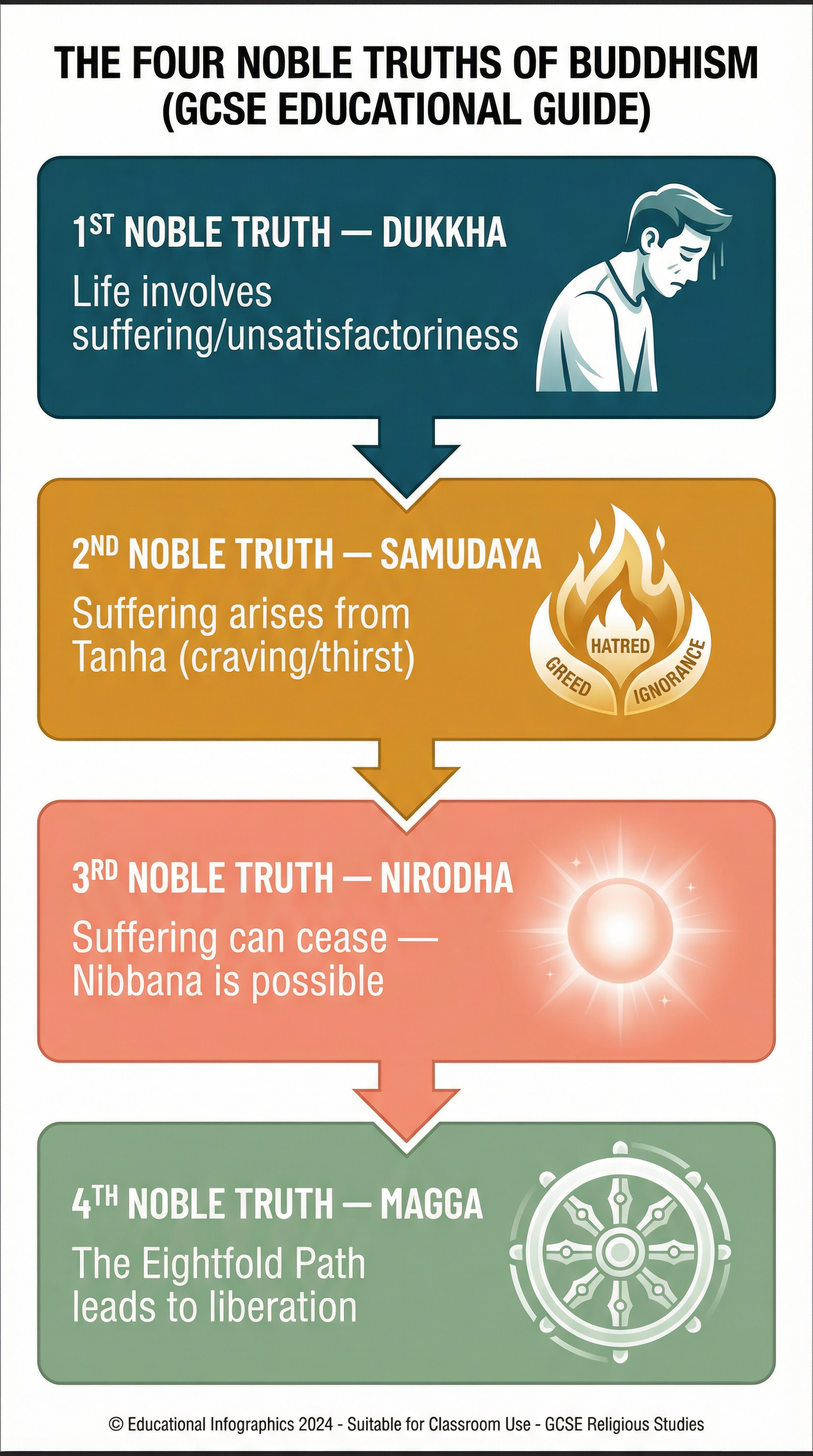
What they are: The Buddha's first sermon, structured like a medical diagnosis.
- The Truth of Dukkha: The diagnosis. Life inevitably involves suffering and unsatisfactoriness.
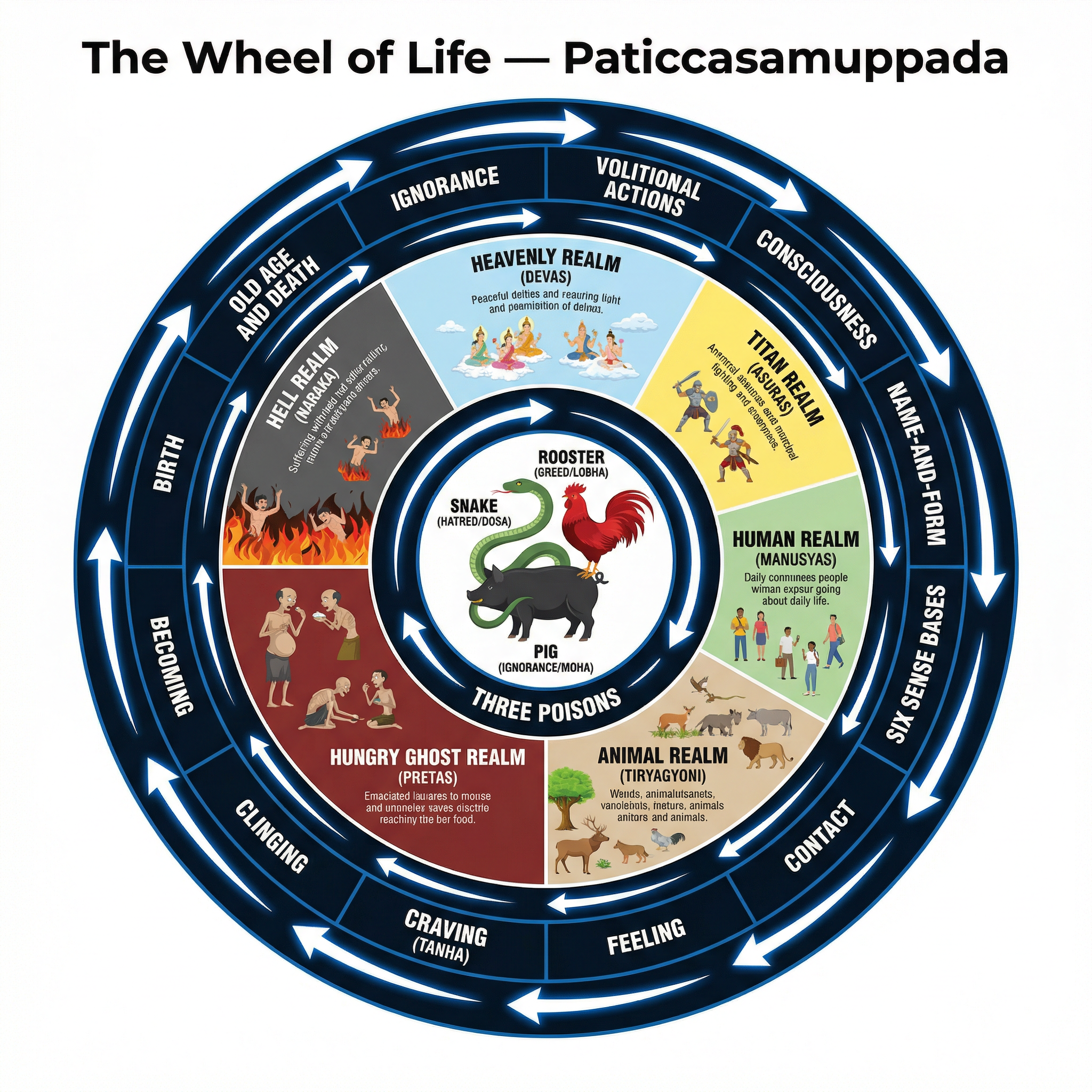
- The Truth of Samudaya: The cause. The origin of suffering is Tanha (craving or 'thirst'), which is fuelled by the Three Poisons: Greed (Lobha), Hatred (Dosa), and Ignorance (Moha).
- The Truth of Nirodha: The prognosis. It is possible for suffering to cease. This cessation is Nibbana.
- The Truth of Magga: The prescription. The way to end suffering is to follow the Noble Eightfold Path.
Why they matter: This is the core framework of the entire Buddhist path. Marks are awarded for showing the logical progression from one truth to the next and for explicitly linking Samudaya to the Three Poisons.
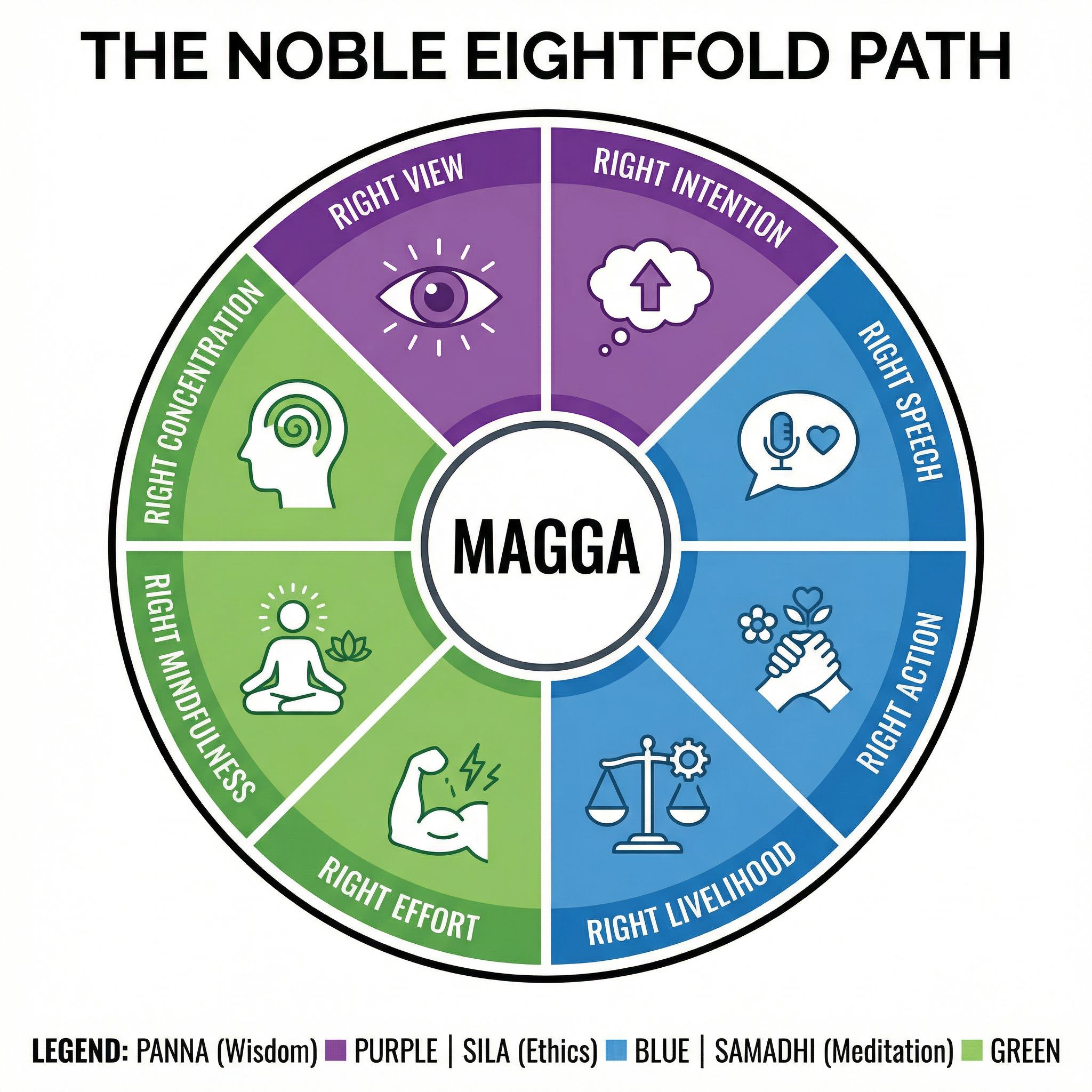
The Noble Eightfold Path (Magga)

What it is: The practical guide to ending Dukkha, often called the 'Middle Way'. It is divided into three sections.
- Wisdom (Panna): Right View, Right Intention.
- Ethical Conduct (Sila): Right Speech, Right Action, Right Livelihood.
- Mental Discipline (Samadhi): Right Effort, Right Mindfulness, Right Concentration.
Why it matters: This is the 'how-to' of Buddhism. Candidates must know the three sections and be able to explain how the eight factors work together to purify the mind and develop wisdom.
Dependent Origination (Paticcasamuppada)
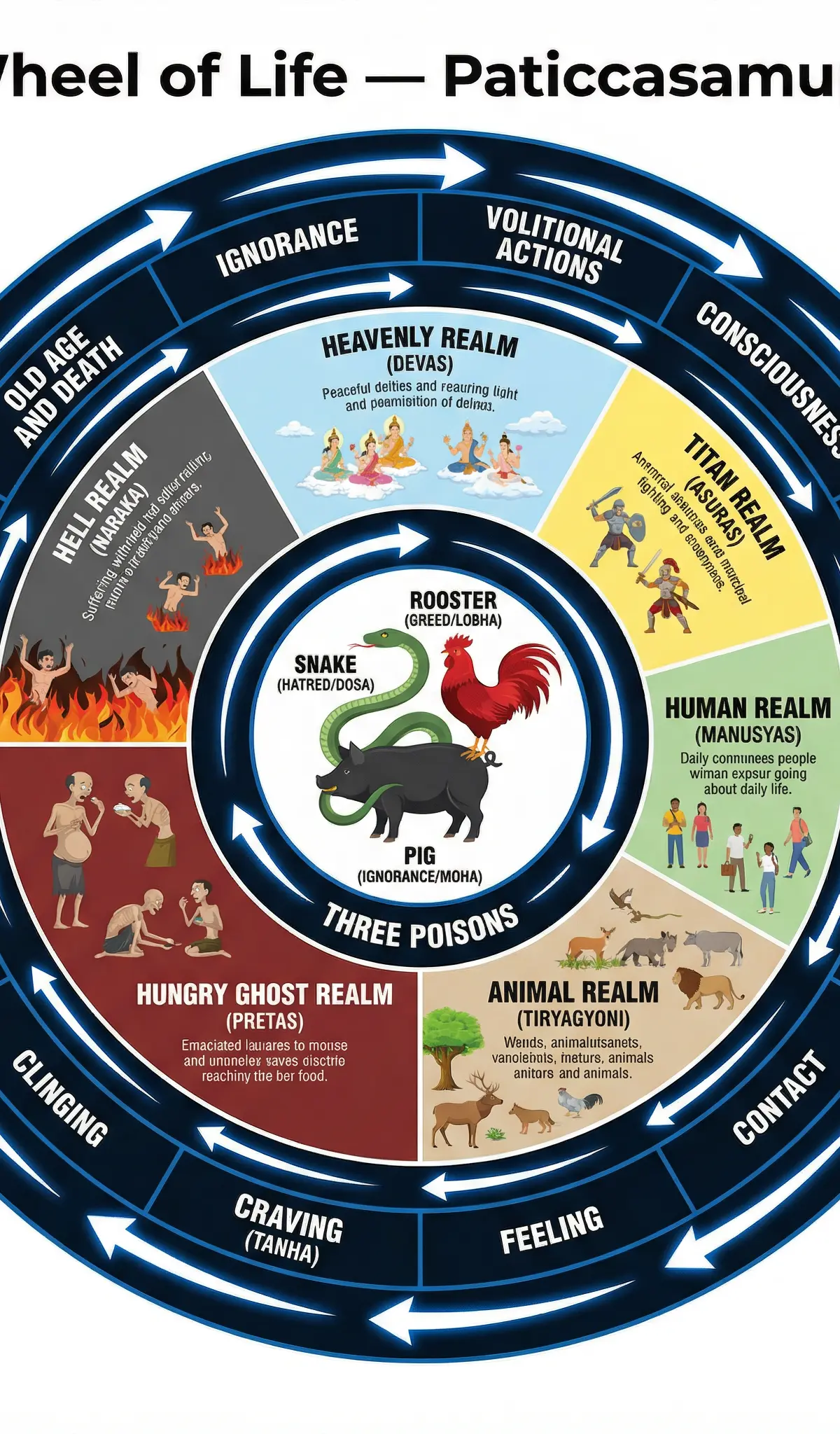
What it is: The teaching that all things arise in dependence on other things. Nothing exists in isolation. This is often visualized as the Wheel of Life, showing the 12 links (Nidanas) that keep beings trapped in Samsara (the cycle of birth, death, and rebirth).
Why it matters: It provides a detailed explanation of how suffering arises and perpetuates. It also reinforces Anatta by showing that there is no independent 'self' but rather a series of conditioned processes.
Key Individuals: Arhat vs. Bodhisattva
The Arhat (Theravada Ideal)
Role: A 'worthy one' who has achieved Nibbana and will not be reborn.
Key Actions: Follows the Eightfold Path diligently to extinguish their own defilements and craving.
Impact: Represents the ultimate goal of the Theravada tradition – individual liberation from Samsara.
The Bodhisattva (Mahayana Ideal)
Role: An enlightened being who postpones their own final Nibbana out of compassion to help all other sentient beings achieve enlightenment.
Key Actions: Cultivates Bodhicitta (the mind of enlightenment) and practices the Six Perfections (Paramitas).
Impact: Represents the ultimate goal of the Mahayana tradition – universal liberation. This is seen as a more compassionate and ambitious path.
Worked Examples
3 worked examples — open one to explore the question and available guidance.
Practice Questions
Test your understanding — click to reveal model answers
Describe the teaching of Anatta (no-self). (2 marks)
Hint: What does Buddhism say is there instead of a soul?
Explain the role of the Three Poisons in the cycle of Samsara. (5 marks)
Hint: How do Greed, Hatred, and Ignorance cause suffering and lead to rebirth?
Explain the difference between Buddhist rebirth and Hindu reincarnation. (8 marks)
Hint: Focus on the concept of the soul (Atman vs. Anatta).
Explain two parts of the Noble Eightfold Path. (4 marks)
Hint: Pick two from the eight and say what they mean in practice.
"Following the Five Precepts is the most important part of being a Buddhist." Discuss. (15 marks)
Hint: Consider the importance of ethics (Sila) versus wisdom (Panna) and meditation (Samadhi). Are actions more important than beliefs or mental training?