OCR · GCSE · Sociology
The Media and Crime
This study guide explores the critical relationship between the media and crime, a core topic for OCR GCSE Sociology. It dissects how media representations shape public perception, often creating a distorted view of reality, and equips you with the key theories and concepts needed to analyse this process for high marks."
- 7 min read
- 2 worked examples
- 2 practice questions
Study Notes
Overview
This topic examines the social construction of crime news, a fundamental concept in OCR J202. For most people, the media is the primary source of information about crime, deviance, and the justice system. However, media representations are not a simple mirror to reality. They are a product of selection, interpretation, and ideological frameworks. Examiners expect candidates to move beyond a common-sense understanding and apply sociological theories to analyse how and why the media portrays crime in specific ways. You will need to understand the influence of news values, the process of creating moral panics, and the concept of deviancy amplification. A key skill is contrasting the picture of crime presented in the media with the statistical reality revealed by official data like the Crime Survey for England and Wales. Mastering this topic means you can critically deconstruct news stories and understand their powerful role in shaping social attitudes and even influencing police priorities.
Key Concepts & Theories
The Social Construction of News & News Values
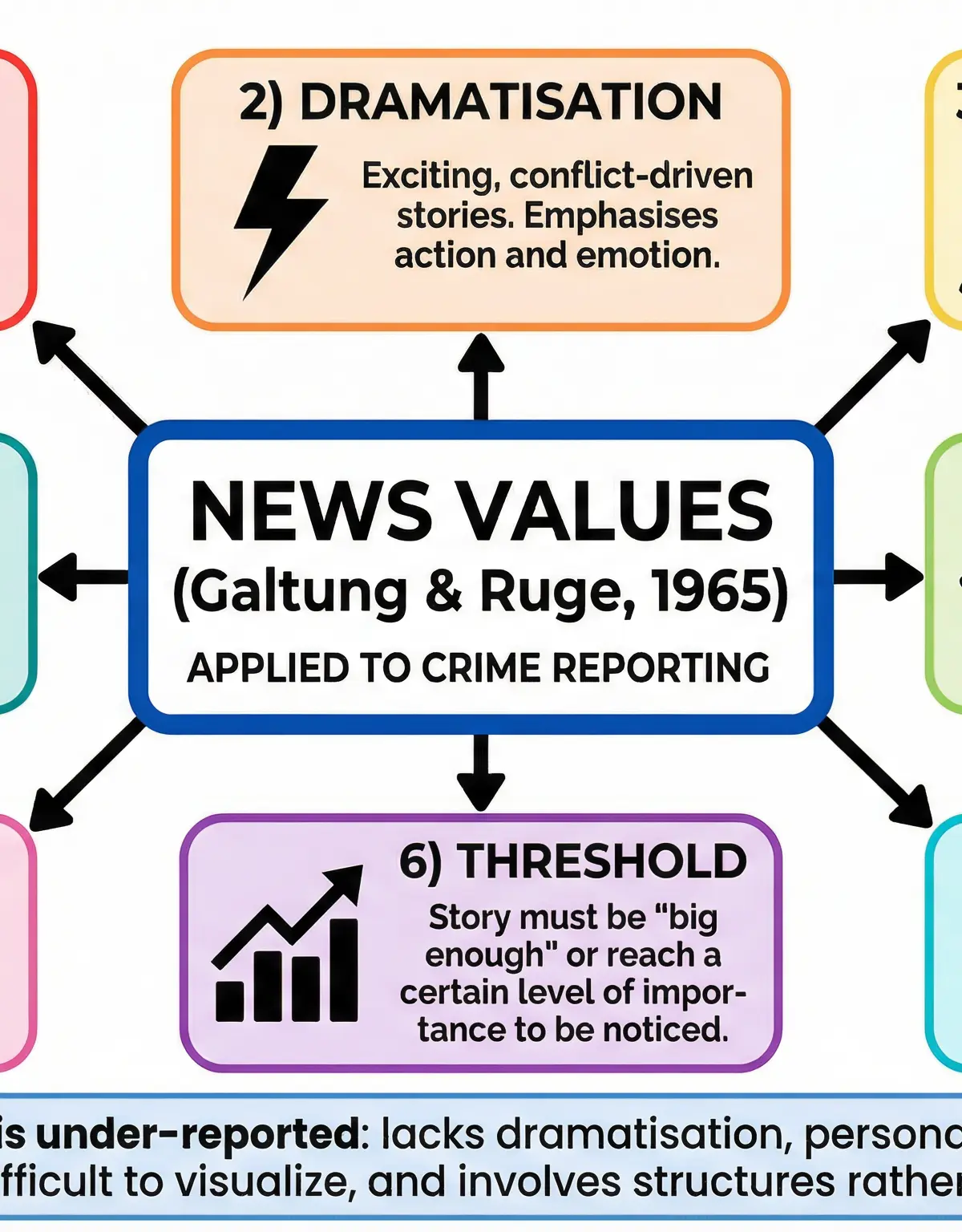
What happened: In 1965, sociologists Johan Galtung and Mari Ruge analysed international news stories to understand why some events become news while others are ignored. They identified several 'news values' – a set of professional, unconscious criteria used by journalists and editors to select and prioritise stories.
Why it matters: These values explain why media coverage of crime is patterned and predictable. Crimes that are dramatic, recent, personal, and involve negativity or high-status individuals are far more likely to be reported than complex, structural crimes like corporate fraud. This creates a distorted picture of risk, leading the public to fear violent crime from strangers, which is statistically rare, while ignoring more common and widespread offences.
Specific Knowledge: Candidates must know and apply Galtung and Ruge's news values. Key values include: Immediacy, Dramatisation, Personalisation, Higher-status persons, Negativity, Threshold, Unexpectedness, and Consonance. Credit is given for explaining how these lead to the over-representation of violent crime and the under-representation of white-collar crime.
Moral Panics and Folk Devils
What happened: Stanley Cohen's (1972) study, Folk Devils and Moral Panics, is the foundational text. He analysed the intense media reaction to minor clashes between two youth groups, the 'Mods' and 'Rockers', in Clacton in 1964. The media coverage was wildly out of proportion to the actual events.
Why it matters: Cohen developed a theoretical model to explain this phenomenon. A 'moral panic' occurs when the media identifies a group as a threat to societal values. This group becomes a 'folk devil', a scapegoat for wider social anxieties. The media coverage is sensationalised, leading to public concern and calls for a crackdown from 'moral entrepreneurs' (politicians, police chiefs). This can lead to a deviancy amplification spiral.
Specific Knowledge: You must use the term disproportionality – the reaction is excessive relative to the real threat. Name Stanley Cohen (1972) and his study of the Mods and Rockers. Be able to identify the stages: identification of a folk devil, media exaggeration, and the role of moral entrepreneurs.
The Deviancy Amplification Spiral
What happened: Building on Cohen's work, Jock Young (1971) studied police and media responses to marijuana use in Notting Hill. He found that the very act of trying to control the behaviour led to it becoming more widespread and organised.
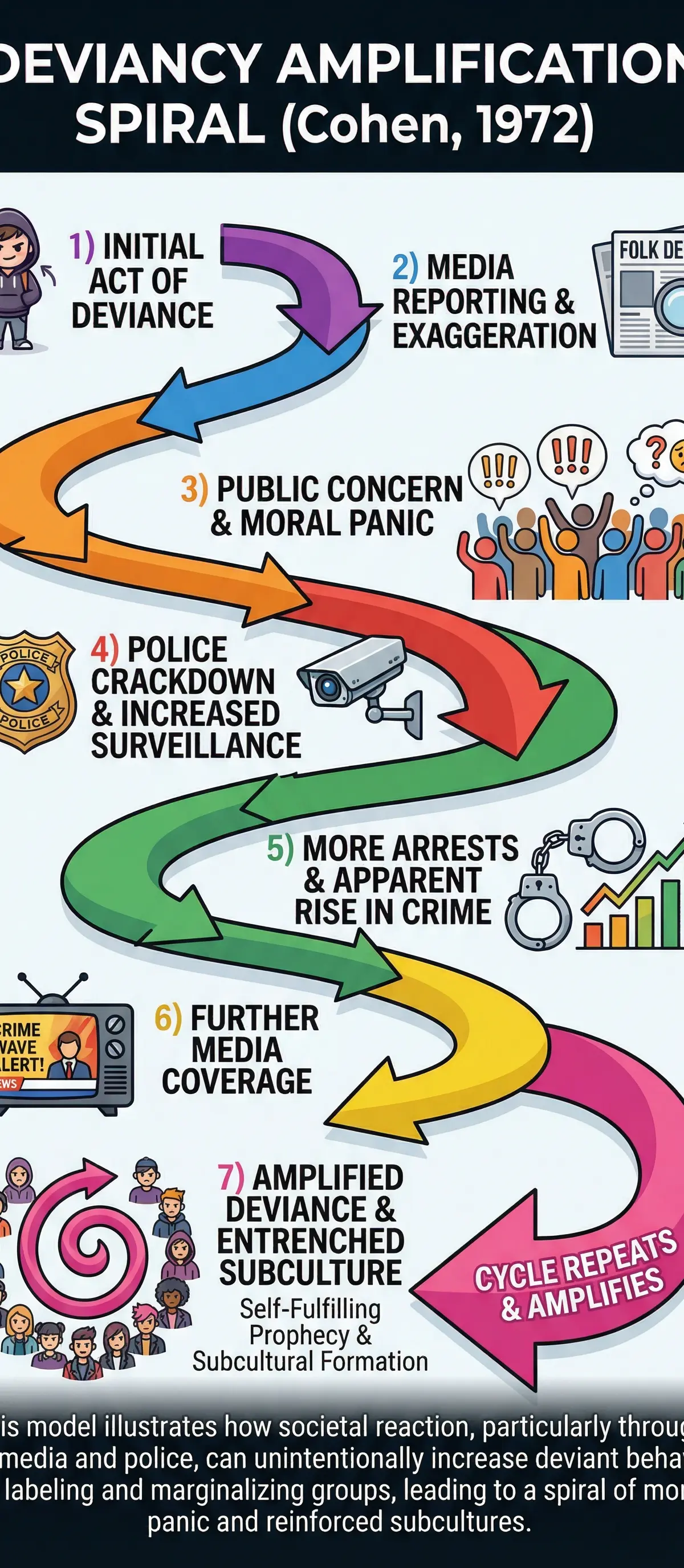
Why it matters: The 'Deviancy Amplification Spiral' is a positive feedback loop. Media reporting on deviance creates public concern, leading to a police crackdown. This increased surveillance results in more arrests, which seems to justify the initial media panic. The targeted group, feeling persecuted and labelled, may retreat into a more deviant subculture, reinforcing their 'outsider' status. The media's attempt to report on deviance ends up making it worse.
Specific Knowledge: Link this concept to Labelling Theory. The process is: Initial Deviance → Media Reporting → Public Concern → Police Crackdown → More Arrests → Further Media Coverage → Amplified Deviance. Use this to explain the consequence of media reporting.
Key Individuals
Stanley Cohen
Role: Interactionist Sociologist
Key Actions: Authored Folk Devils and Moral Panics (1972), analysing the media's reaction to the Mods and Rockers.
Impact: Provided the foundational theory of moral panics, introducing key concepts like 'folk devils', 'moral entrepreneurs', and the importance of 'disproportionality'. His work is essential for any analysis of media and crime.
Jock Young
Role: Left Realist & Interactionist Sociologist
Key Actions: Studied drug-takers in Notting Hill, developing the concept of the 'Deviancy Amplification Spiral'.
Impact: Showed how societal reaction, driven by the media and police, can amplify rather than reduce deviance. His work provides a crucial link between media reporting and the consequences for criminal justice and subcultures.
Galtung & Ruge
Role: Communication Theorists
Key Actions: Identified the 'News Values' that shape the selection of news stories.
Impact: Their framework is the primary tool for explaining why crime reporting is selective and biased towards certain types of crime. It allows for a systematic analysis of the social construction of crime news.
Theoretical Perspectives
Marxism
Marxists argue the media is an Ideological State Apparatus. Its coverage of crime serves the ruling class by focusing on the street crimes of the working class, distracting from the more harmful 'crimes of the powerful' (corporate crime, state crime). This reinforces the idea that the working class is the source of society's problems and justifies heavy policing of their communities.
Pluralism
Pluralists argue the media simply reflects audience demand. Crime is a popular topic, so the media provides the stories the public wants to read. In this view, news is a commercial product driven by the market, not ideology. The diversity of media outlets means no single perspective can dominate.
Interactionism
Interactionists focus on the micro-level processes. They are interested in how media labelling can create a 'master status' for individuals and groups, leading to a self-fulfilling prophecy. Concepts like moral panics and deviancy amplification are central to this perspective."
Worked Examples
2 worked examples — open one to explore the question and available guidance.
Practice Questions
Try the question, then reveal an answer plan or example response
Describe two ways in which the media may distort the reality of crime. (8 marks)
Hint: Think about what is over-represented and what is under-represented. Use a sociologist to support one of your points.
Explain how the concept of 'news values' helps us to understand the media's reporting of crime. (12 marks)
Hint: Define news values, name Galtung and Ruge, and give at least three specific examples of news values, explaining how each one applies to crime reporting.
Watch or listen (optional)
Test your understanding of The Media and Crime
Active recall beats re-reading. Take an instant quiz now to test what you’ve learned and lock it into long-term memory.
7 days Premium · Then the free plan continues · No card, no charge