OCR · GCSE · Sociology
The Role and Functions of Education
This study guide critically examines the Functionalist and Marxist perspectives on the role of education in society, a core topic for OCR GCSE Sociology. It provides the essential knowledge, exam skills, and multi-modal resources needed to analyse whether education promotes social harmony or reinforces capitalist inequality.
- 5 min read
- 3 worked examples
- 5 practice questions
- 6 key terms
Check what you remember
Read the wording for your board, then hide it and explain Social Solidarity in your own words. Rough notes are fine. This is a self-check, with no mark or grade.
Reference: OCR
The feeling of community and shared identity that binds individuals together as a society.
Study Notes
Overview
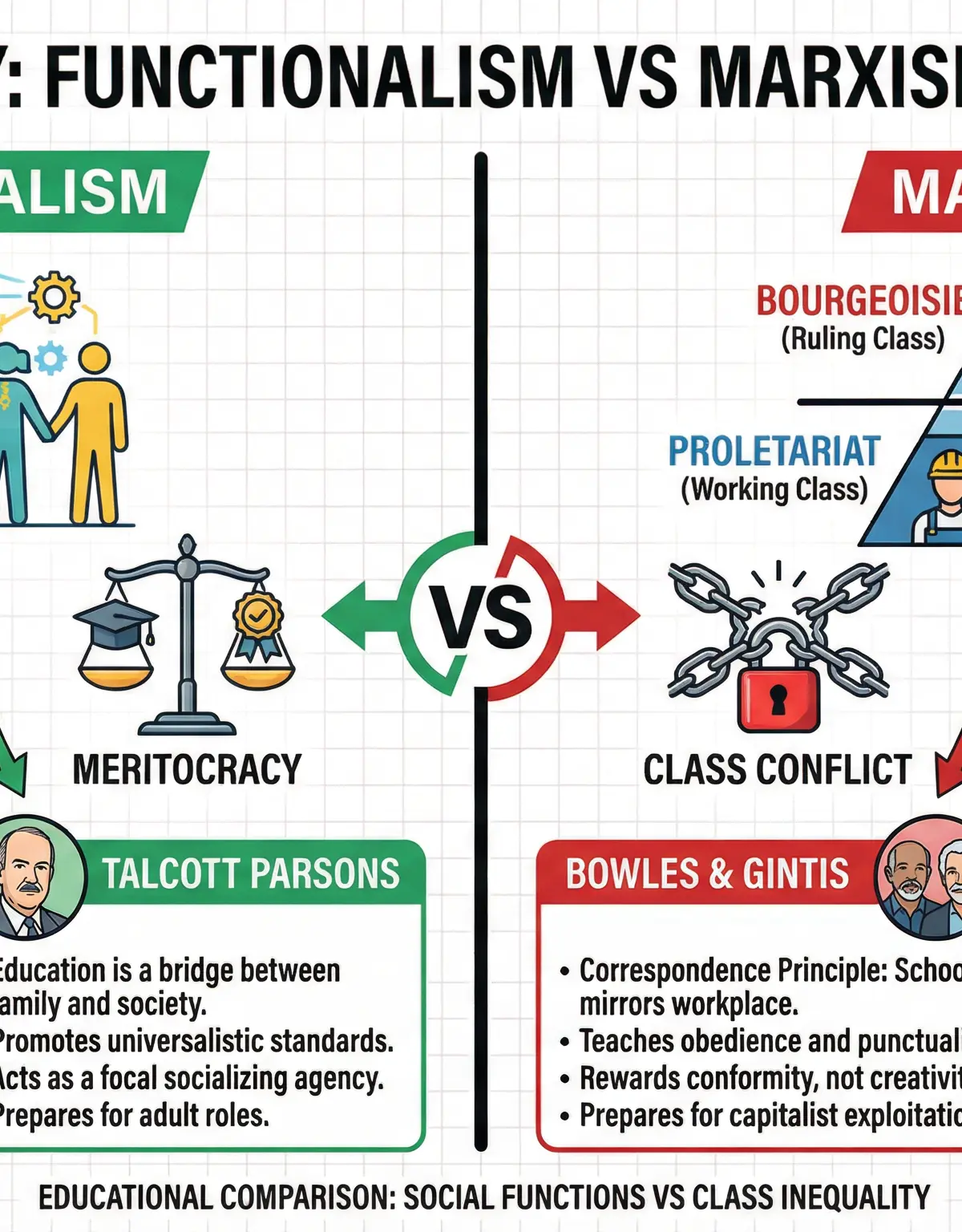
This guide delves into the central debate in the sociology of education: what is school actually for? For your OCR J202 exam, you are required to move beyond a common-sense understanding of education and critically engage with two major sociological theories: Functionalism and Marxism. Functionalists, like Émile Durkheim and Talcott Parsons, argue that education serves the needs of society as a whole by creating social solidarity and allocating roles based on merit. In stark contrast, Marxists, such as Bowles and Gintis, contend that education is a tool of the ruling class, designed to reproduce class inequality and create a docile workforce for capitalism. Examiners expect you to not only understand these theories but to directly compare and contrast them, using specific sociological concepts and studies to support your analysis. This topic is not just about what happens in classrooms; it's about power, control, and the very structure of society.
Key Perspectives & Theorists
Functionalism (Consensus Theory)
Core Idea: Education performs positive functions for society, creating social harmony and ensuring the most talented individuals get the most important jobs.
Key Thinkers:
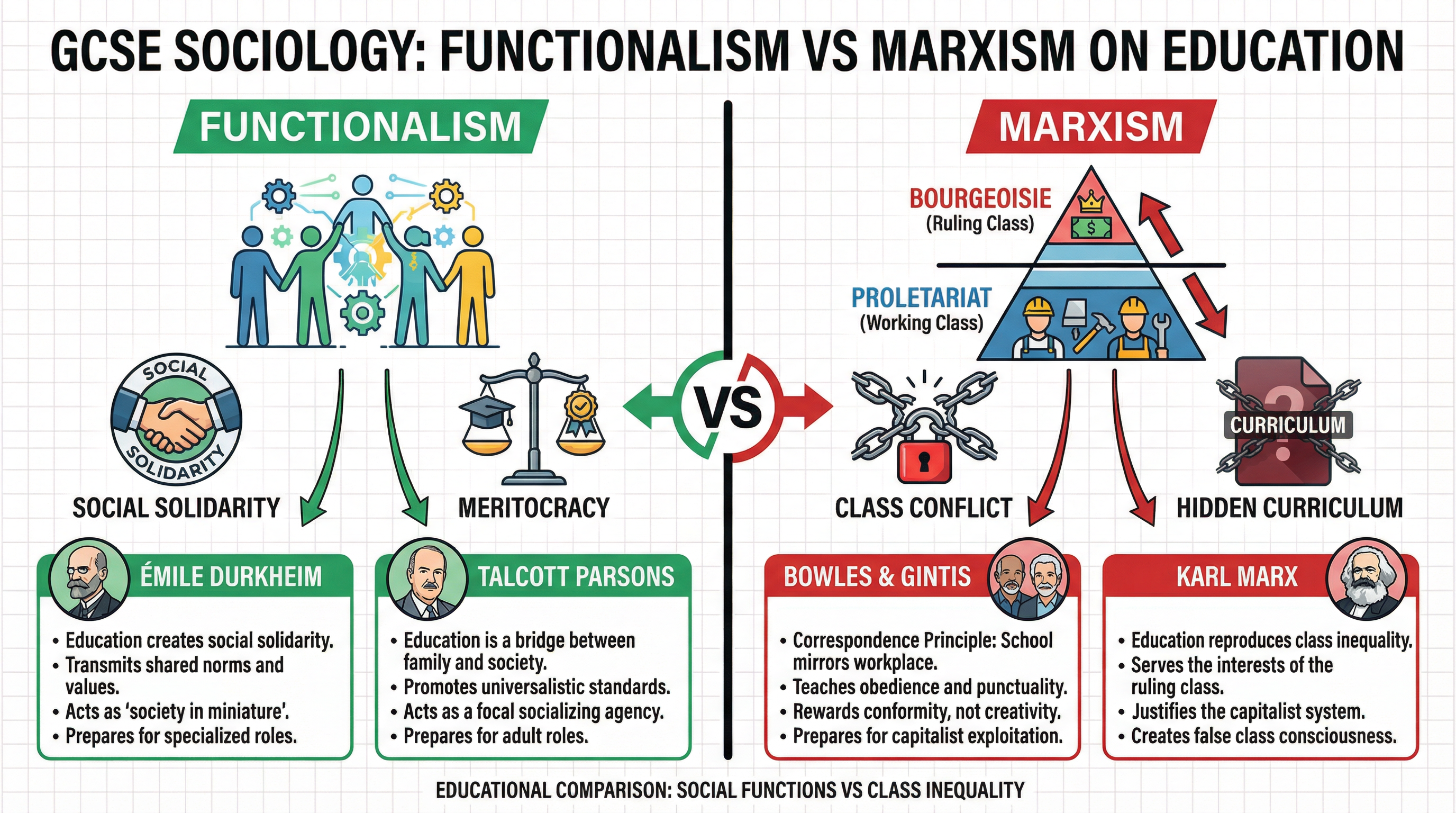
- Émile Durkheim: Argued education creates social solidarity by transmitting a shared culture and norms, creating a 'society in miniature'. It also teaches specialist skills for the complex division of labour in modern society.
- Talcott Parsons: Saw education as a bridge between the family and wider society. It moves children from the particularistic standards of the home to the universalistic standards of society, where everyone is judged by the same rules. This process, he argued, is meritocratic.
Marxism (Conflict Theory)
Core Idea: Education serves the interests of the capitalist ruling class (the bourgeoisie) by maintaining and legitimising social inequality.
Key Thinkers:
- Samuel Bowles & Herbert Gintis: Developed the correspondence principle, arguing that school mirrors the workplace. The hierarchy, discipline, and lack of control in school prepare working-class students for their future as exploited workers.
- Paul Willis: In his study 'Learning to Labour', he showed how a group of working-class 'lads' formed a counter-school culture that rejected the school's values. Ironically, this rebellion prepared them perfectly for the manual labour jobs that awaited them, thus still reproducing class inequality.
Second-Order Concepts
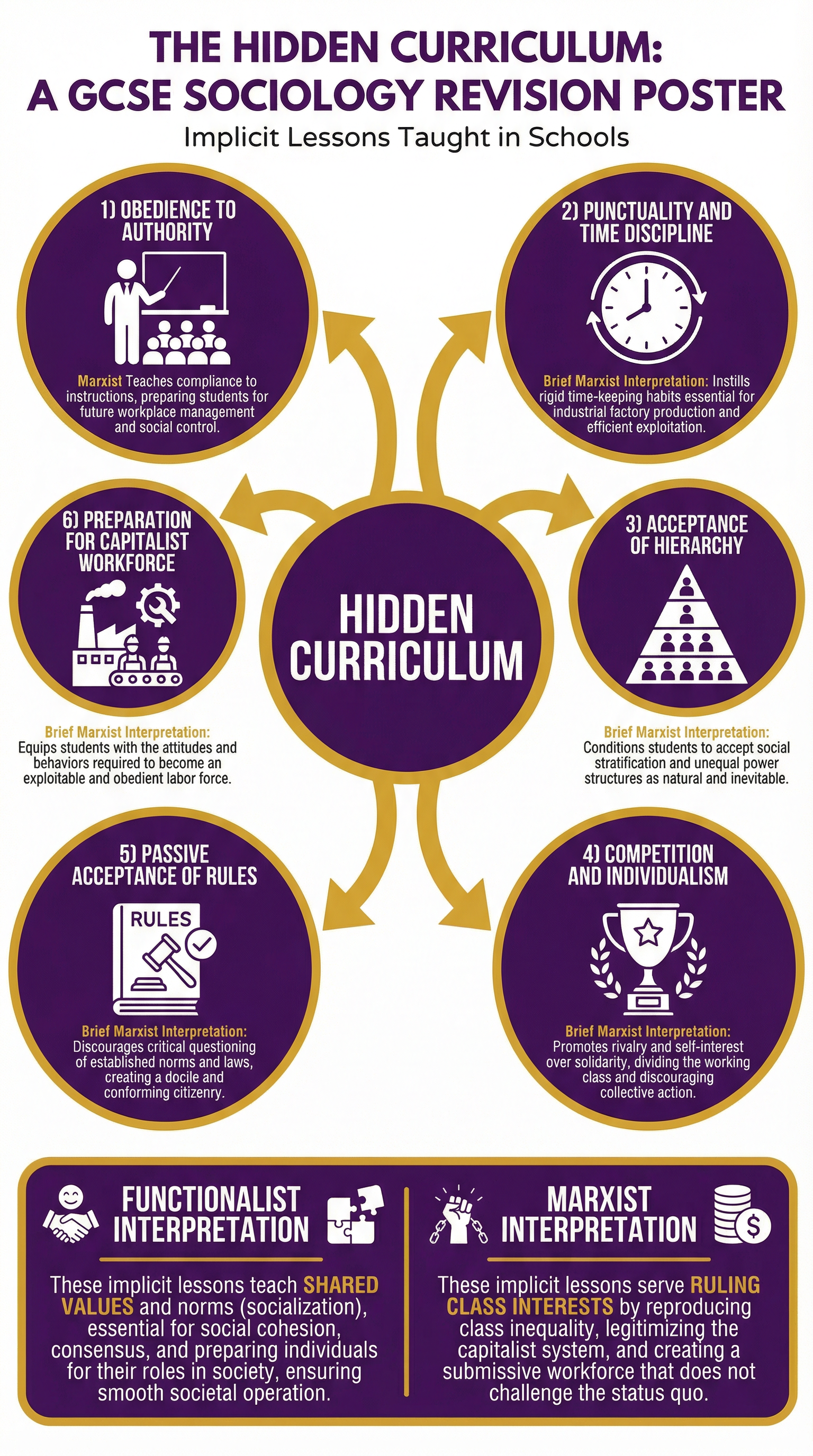
The Hidden Curriculum
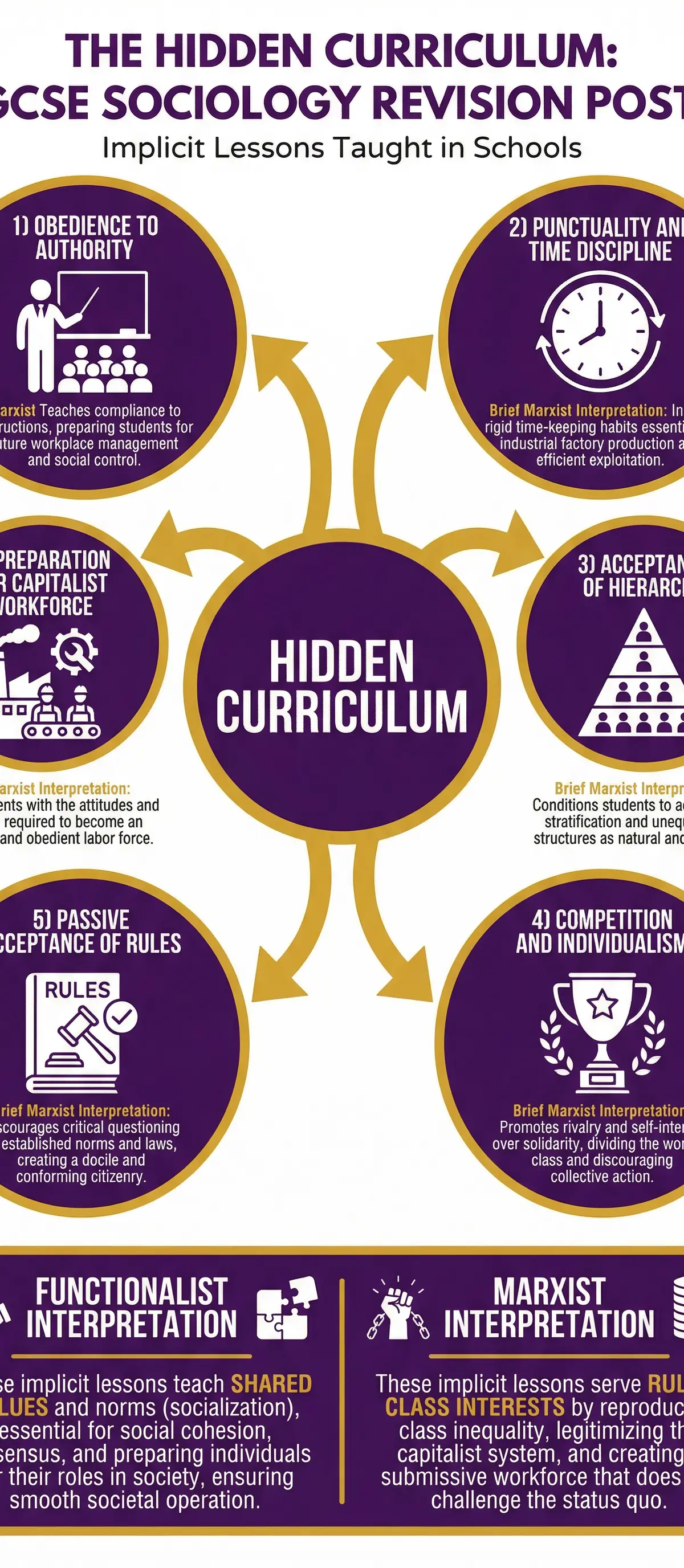
This is one of the most important concepts. It refers to the lessons learned in school that are not formally taught, such as obedience, punctuality, and respect for authority.
- Functionalist View: The hidden curriculum teaches the shared values and norms necessary for social cohesion.
- Marxist View: The hidden curriculum teaches values that serve capitalism, creating a passive and obedient workforce. It instils a 'false class consciousness' where workers accept their own exploitation.
Meritocracy
- Functionalist View: Education is a meritocracy where everyone has an equal opportunity to succeed based on their ability and effort. This ensures the most talented people fill the most important roles, which benefits everyone.
- Marxist View: Meritocracy is a myth. The education system is rigged to favour the middle and upper classes, who have more cultural and economic capital. The myth of meritocracy makes it seem like failure is the individual's fault, not the fault of an unfair system.
Source Skills
When presented with a source in the exam (e.g., a quote from a sociologist, a news article about schools), you must apply your theoretical knowledge. Ask yourself:
- What does the source say? Is it describing a Functionalist idea (like social cohesion) or a Marxist one (like the correspondence principle)?
- Who created it? Is it a sociologist? A politician? This affects its perspective and reliability.
- How does it relate to the theories? Does this source support or challenge the Functionalist or Marxist view? For example, a source showing a strong link between private schooling and top university places would challenge the Functionalist idea of meritocracy.
Visual Resources
2 diagrams and illustrations
Interactive Diagrams
1 interactive diagram to visualise key concepts
Conceptual Flow Outline
Concept map showing the key ideas of Functionalism and Marxism on education.
Worked Examples
3 worked examples — open one to explore the question and available guidance.
Practice Questions
Try the question, then reveal an answer plan or example response
Describe two functions of education according to Functionalists. (6 marks)
Hint: Think about Durkheim's two main ideas.
Explain how the hidden curriculum prepares working-class pupils for their future roles in a capitalist society. (12 marks)
Hint: Use the Marxist perspective and the work of Bowles and Gintis. Think about the correspondence principle.
Evaluate the Marxist view of education. (24 marks)
Hint: Start by explaining the Marxist view (correspondence principle, hidden curriculum, myth of meritocracy). Then, evaluate it using Functionalism, Feminism, and studies like Willis's.
Distinguish between particularistic and universalistic standards. (4 marks)
Hint: Define each term and state where each set of standards is typically found, according to Parsons.
Explain what sociologists mean by the 'myth of meritocracy'. (8 marks)
Hint: Start by defining meritocracy, then explain why Marxists consider it a myth, using concepts like cultural capital.
Exam technique
How to turn what you know into marks
How to approach the question
1. **Identify the theory**: Is the question asking about Functionalism, Marxism, or both? 2. **Identify the command word**: 'Describe', 'Explain', 'Evaluate'? This tells you what skill is being tested. 3. **Plan your points**: For essays, plan your 'for' and 'against' paragraphs.
How to structure your answer
- Essay questions
- Balanced argument is key. Introduction setting out the debate -> Paragraphs FOR the view -> Paragraphs AGAINST the view -> Developed, justified conclusion that weighs up the evidence.
- Source questions
- Analyse the source's content and link it to your own sociological knowledge. Explain how the source supports or challenges a particular view.
- Explain questions
- PEE: Point (make a clear sociological point), Evidence (use a study, concept, or theorist), Explain (explain *how* your evidence proves your point and links to the question).
Timing
Approximately 1 minute per mark. For a 12-mark question, spend 12-15 minutes. For a 24-mark essay, plan for 5 minutes and write for 25-30 minutes.
Common pitfalls
- Mixing up Functionalist and Marxist ideas.
- Describing theories without applying them to the specific question.
- Forgetting to write a conclusion for essay questions.
- Asserting that education is meritocratic without acknowledging the Marxist critique.
What the command words want
- Describe
- State two clear, separate points. Develop each with a sentence or two of detail or an example.
- Explain how/why
- Give reasons. Use connective words like 'because', 'this leads to', 'as a result of'. Link several causes or factors together.
- Using the source...
- You must explicitly refer to the source in your answer, quoting or paraphrasing from it.
- Evaluate / To what extent do you agree
- You MUST look at both sides of the argument. Use phrases like 'On the one hand...', 'However, on the other hand...'. Your conclusion must state how convincing you find the argument to be.
Watch or listen (optional)
Test your understanding of The Role and Functions of Education
Active recall beats re-reading. Take an instant quiz now to test what you’ve learned and lock it into long-term memory.
7 days Premium · Then the free plan continues · No card, no charge