OCR · GCSE · Sociology
Types of Crime
Types of Crime is a cornerstone topic in OCR GCSE Sociology (J204), requiring candidates to move beyond common-sense understandings and apply precise sociological classifications to criminal behaviour. From the white-collar boardroom to the digital world of cyber-crime, this topic reveals how power, inequality, and social construction shape what society labels as 'criminal'. Mastering this topic is essential for high-mark responses, as examiners consistently reward candidates who can distinguish between crime types, link them to theoretical perspectives, and critically evaluate official statistics.
- 9 min read
- 3 worked examples
- 5 practice questions
- 10 key terms
Check what you remember
Read the wording for your board, then hide it and explain Crime in your own words. Rough notes are fine. This is a self-check, with no mark or grade.
Reference: OCR
An act that violates the formal, codified laws of a society and is subject to official sanctions such as imprisonment or fines.
Study Notes
Overview
This topic requires candidates to demonstrate a sophisticated understanding of how crime is categorised and socially constructed within OCR J204. Rather than treating crime as a simple, objective category, sociology asks us to question who defines crime, whose interests are served by those definitions, and why certain crimes receive more attention than others. Examiners expect candidates to use precise sociological terminology, apply theoretical perspectives (Marxist, Functionalist, Feminist), and critically engage with official statistics by acknowledging the 'dark figure' of unrecorded crime. This topic connects directly to social control, deviance, and inequality — making it a rich source of synoptic questions.
Key Concepts & Developments
Crime vs. Deviance: The Foundational Distinction
What it means: A crime is any act that violates the formal, codified laws of a society and is subject to official sanctions (e.g., imprisonment, fines). Deviance refers to any behaviour that violates the informal social norms of a group or society, attracting social disapproval rather than legal punishment. These categories overlap but are not identical: murder is both criminal and deviant; wearing unusual clothing is deviant but not criminal; tax evasion may be criminal but is often socially normalised in certain circles.
Why it matters: Examiners award marks for candidates who explicitly acknowledge this distinction and its complexity. The social construction of crime — the idea that what counts as criminal varies by time, place, and power — is a recurring theme. Homosexuality was criminalised in England and Wales until 1967; cannabis possession laws have changed multiple times. This demonstrates that crime is not a fixed, natural category but a product of social and political processes.
Specific Knowledge: The Wolfenden Report (1957) recommended decriminalisation of homosexuality; the Sexual Offences Act (1967) enacted this in England and Wales. The Misuse of Drugs Act (1971) classified cannabis as a Class B drug.
Personal and Violent Crime
What it means: Personal crime involves direct harm to an individual's physical or psychological wellbeing. Examiners credit candidates who distinguish between instrumental violence (violence used as a means to an end, e.g., a mugging where the goal is money) and expressive violence (violence driven by emotion, e.g., a fight fuelled by anger or jealousy). This distinction demonstrates analytical depth beyond simply listing examples.
Why it matters: Official statistics from the Crime Survey for England and Wales (CSEW) consistently show that violent crime is concentrated among young men aged 16–24. However, feminist sociologists argue that domestic violence — which disproportionately affects women — is systematically under-reported, meaning official figures underestimate its true prevalence. The 'dark figure' of crime is particularly significant here.
Specific Knowledge: According to the ONS Crime Survey for England and Wales 2022/23, approximately 1.4 million adults experienced domestic abuse in the year ending March 2023. Feminist sociologist Frances Heidensohn argues that the criminal justice system is male-dominated and reflects patriarchal values, which affects how crimes against women are processed.
Property Crime
What it means: Property crime involves the taking or damaging of another person's possessions without direct violence. Key examples include burglary, theft, vandalism, and arson. It is statistically the most common category of crime recorded by police.
Why it matters: Functionalists such as Robert Merton use property crime to illustrate his strain theory: when individuals cannot achieve culturally valued goals (e.g., wealth) through legitimate means, they may resort to innovation — using illegitimate means to achieve the same ends. This explains property crime as a product of structural inequality rather than individual moral failure.
Specific Knowledge: Merton's strain theory (1938) identifies five adaptations to anomie: conformity, innovation, ritualism, retreatism, and rebellion. 'Innovation' — accepting cultural goals but using illegitimate means — is the adaptation most associated with property crime.
White-Collar Crime vs. Corporate Crime
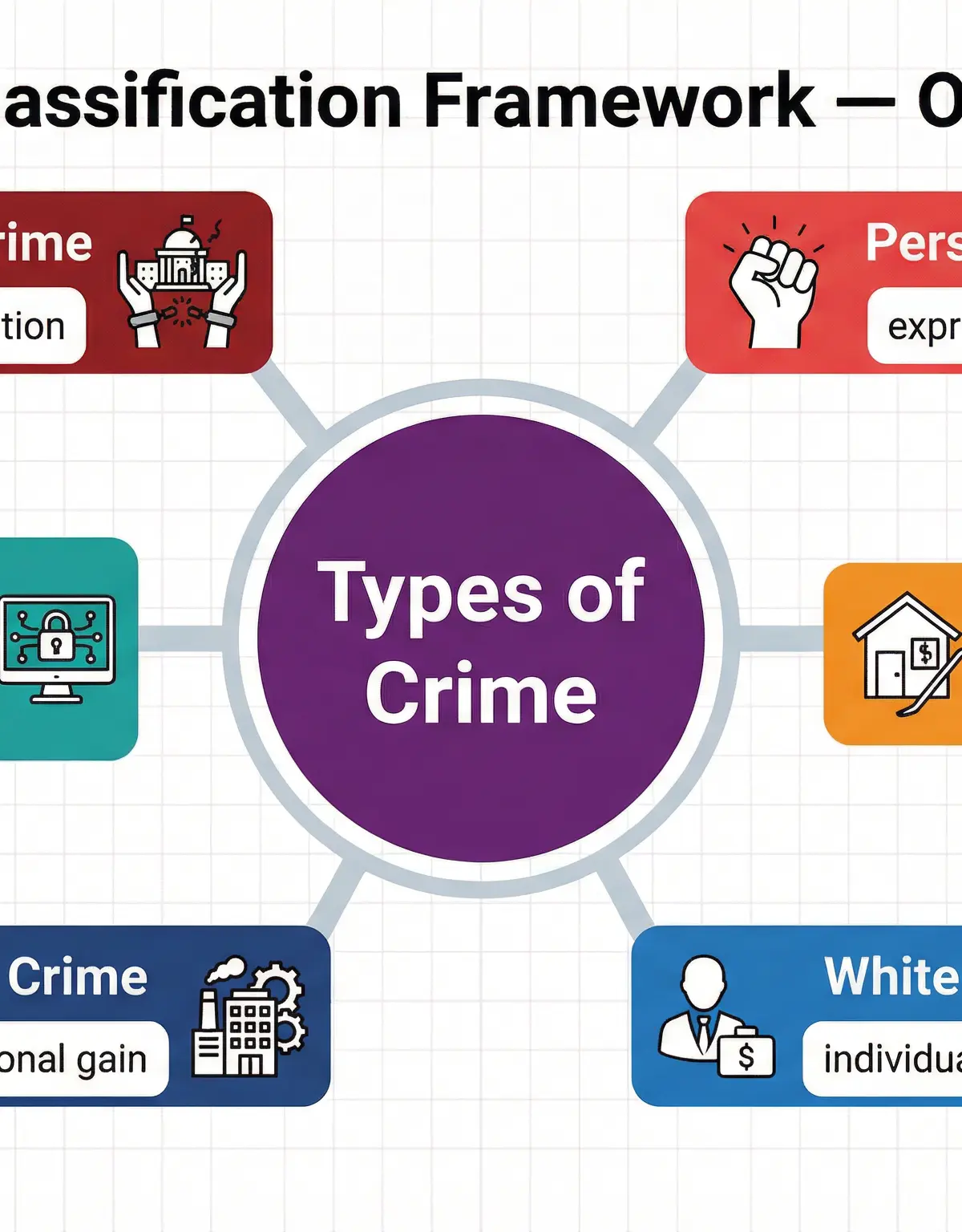
What it means: This is one of the most frequently examined distinctions in this topic. White-collar crime was coined by Edwin Sutherland in 1949 and refers to crime committed by a person of respectability and high social status in the course of their occupation, for personal gain. Examples include embezzlement, insider trading, and expense fraud. Corporate crime, by contrast, is committed by or on behalf of a business organisation to advance its interests or profits. Examples include the Volkswagen emissions scandal (2015), where the company installed software to cheat emissions tests, and the Enron accounting fraud (2001).
Why it matters: Marxist sociologists argue that corporate crime is systematically under-policed because the ruling class controls the state and the law. William Chambliss (1975) argued that laws are designed to protect the interests of the powerful. The consequences of corporate crime are often far greater than street crime — the 2008 financial crisis, driven partly by fraudulent banking practices, cost the UK economy an estimated £7.4 trillion — yet few individuals faced criminal prosecution.
Specific Knowledge: Edwin Sutherland coined 'white-collar crime' in his 1949 book of the same name. The Volkswagen 'Dieselgate' scandal (2015) affected approximately 11 million vehicles worldwide. The Enron collapse (2001) wiped out $74 billion in shareholder value and 20,000 jobs.
Cyber-Crime
What it means: Cyber-crime encompasses criminal acts that use computers and digital networks as tools or targets. For OCR, candidates should distinguish between three sub-categories: cyber-trespass (unauthorised access to systems, e.g., hacking); cyber-violence (using digital means to cause psychological harm, e.g., cyberstalking, online harassment); and cyber-fraud (using digital means to deceive for financial gain, e.g., phishing, identity theft).
Why it matters: Technological change has created entirely new categories of deviance, challenging traditional legal frameworks. The dark figure of cyber-crime is exceptionally large — the majority of cyber-fraud goes unreported. This demonstrates how official statistics fail to capture the true extent of crime in the digital age.
Specific Knowledge: The Computer Misuse Act (1990) was the first UK legislation to criminalise hacking. According to the CSEW 2022/23, fraud and computer misuse accounted for approximately 40% of all crime experienced by adults in England and Wales, yet these crimes are chronically under-represented in police recorded crime statistics.
State Crime
What it means: State crime refers to illegal or harmful acts committed by governments or their agents. This includes genocide, torture, illegal surveillance, and political corruption. The concept challenges the assumption that the state is a neutral enforcer of the law — instead, the state itself can be a perpetrator of crime.
Why it matters: State crime is difficult to prosecute because states control the legal apparatus. Marxists argue this is evidence of the ruling class using state power to maintain control. The concept of state crime forces candidates to question the neutrality of law and social control.
Specific Knowledge: The Nuremberg Trials (1945–46) established the principle that individuals could be held criminally responsible for state actions. The UK Hillsborough disaster (1989) and subsequent cover-up by South Yorkshire Police is a domestic example of state agents acting illegally. The Chilcot Report (2016) raised questions about the legality of the 2003 Iraq War.
Key Theoretical Perspectives
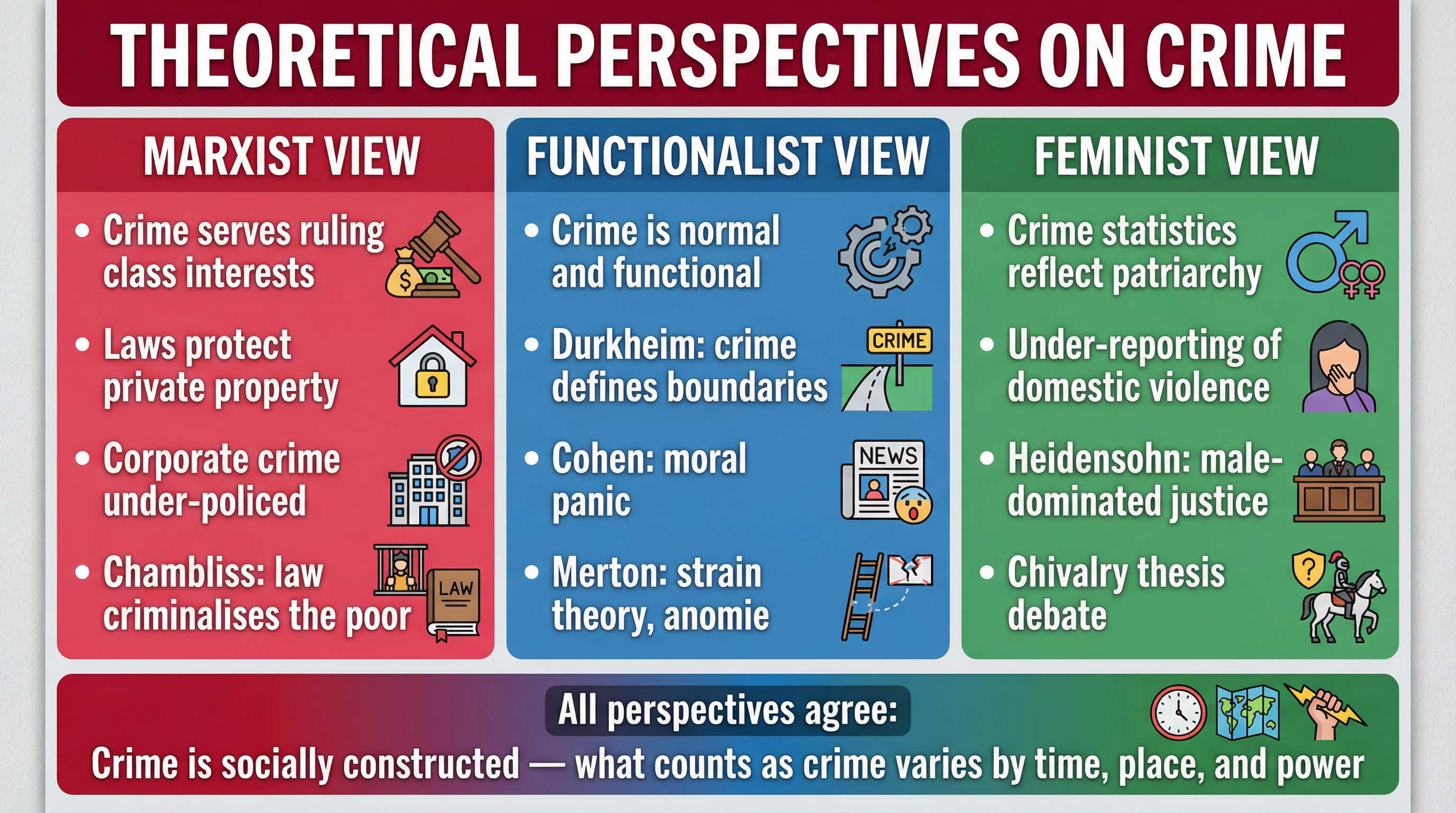
Marxism and Crime
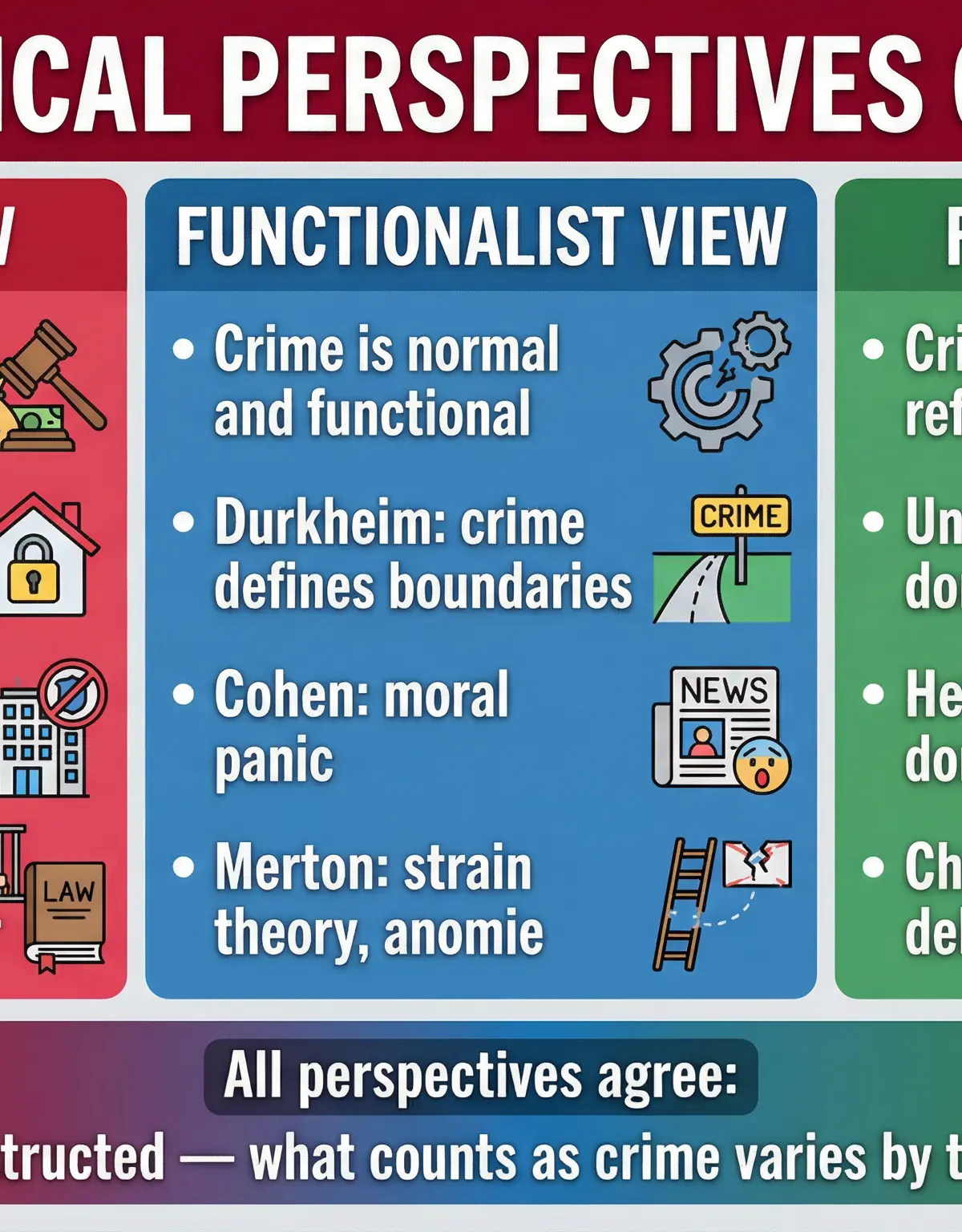
Marxist sociologists argue that crime is a product of capitalist inequality. The law is not a neutral set of rules but a tool of the ruling class (bourgeoisie) to protect their property and interests. This explains why property crime is heavily policed while corporate crime is under-prosecuted. Chambliss (1975) demonstrated that the criminal justice system consistently criminalises the behaviours of the poor while ignoring the far more damaging crimes of the wealthy. For candidates, applying Marxism to corporate crime or the selective enforcement of law is a reliable route to higher marks.
Functionalism and Crime
Emile Durkheim argued that crime is a normal and inevitable feature of all societies. It serves two functions: it reinforces social solidarity by uniting society against the criminal, and it marks the boundaries of acceptable behaviour. Too little crime suggests a society is overly repressive; too much indicates a breakdown of social norms (anomie). Stanley Cohen's concept of moral panic (1972) — where media and public reaction to a crime or deviant group is disproportionate to the actual threat — is a key Functionalist-influenced concept for this topic.
Feminist Perspectives and Crime
Feminist sociologists highlight how crime statistics and criminal justice reflect patriarchal structures. Frances Heidensohn argues that women are controlled through fear of crime and social expectations of femininity. The chivalry thesis (Otto Pollak, 1950) suggests that the male-dominated justice system treats female offenders more leniently — though this is contested by evidence that women are often treated more harshly for crimes that violate gender norms. Feminists also emphasise the chronic under-reporting of domestic violence and sexual assault, arguing that official statistics fundamentally misrepresent the gendered nature of victimisation.
Visual Resources
2 diagrams and illustrations
Interactive Diagrams
2 interactive diagrams to visualise key concepts
Conceptual Flow Outline
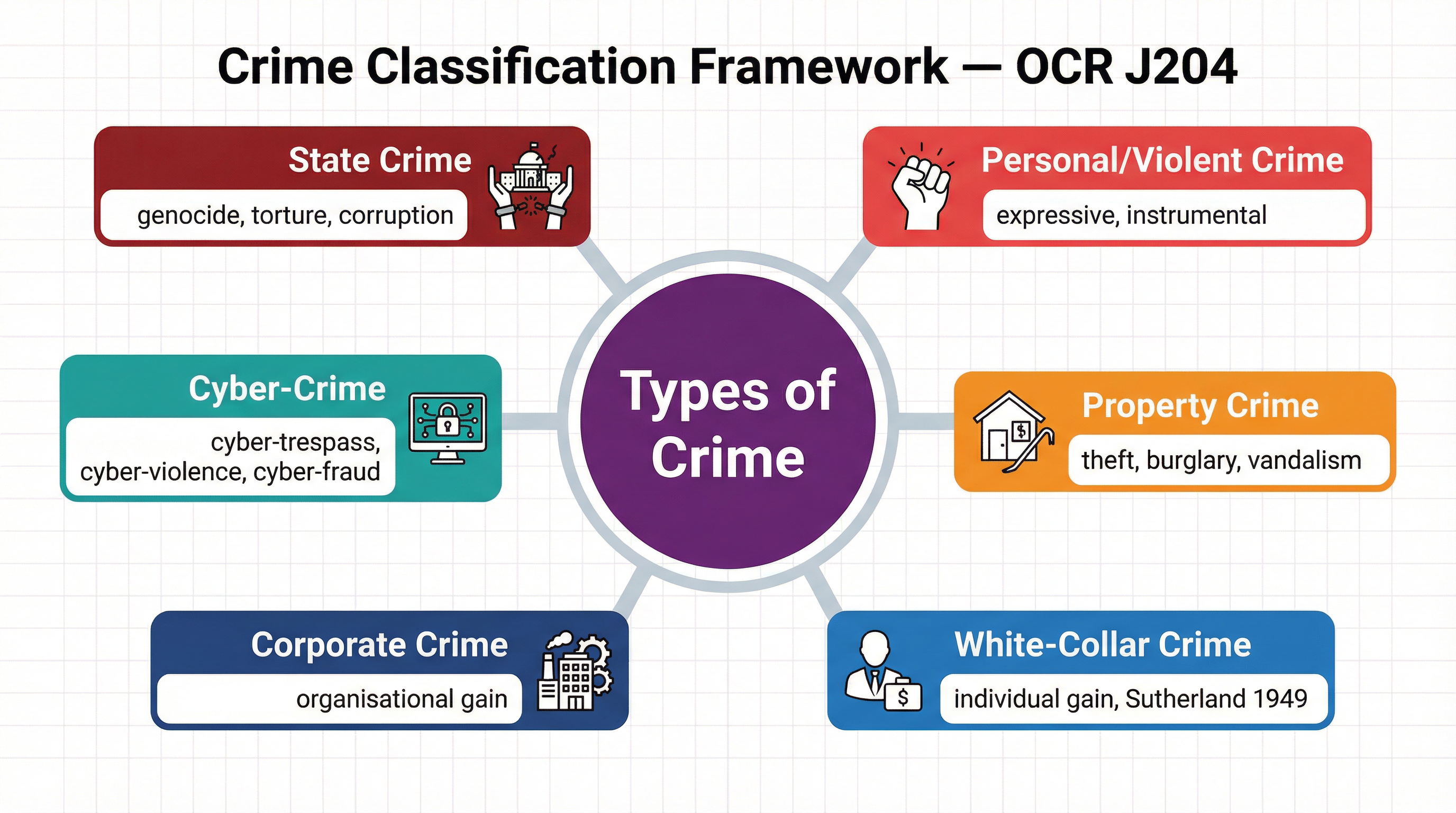
Classification of Types of Crime — OCR J204 Framework
Conceptual Flow Outline
Why Official Crime Statistics Are Unreliable — Critical Framework
Worked Examples
3 worked examples — open one to explore the question and available guidance.
Practice Questions
Try the question, then reveal an answer plan or example response
Describe two types of property crime. (4 marks)
Hint: Identify each type clearly, then develop with an explanation or example. Aim for 2 marks per type.
Explain why white-collar crime is often under-reported. (8 marks)
Hint: Use PEEL structure. Apply at least one theoretical perspective. Consider who the victims are and why they may not report.
Using sociological perspectives, evaluate the view that the criminal justice system treats all types of crime equally. (12 marks)
Hint: Apply Marxism, Feminism, and Functionalism. Use specific evidence. Ensure your conclusion takes a clear, justified position.
Explain how technological change has created new types of crime. (8 marks)
Hint: Focus on cyber-crime categories. Link to the social construction of crime — new technologies create new norms and new laws.
Assess the usefulness of official crime statistics for understanding the true extent of crime in society. (12 marks)
Hint: Consider what official statistics include and exclude. Apply at least two theoretical perspectives. Use the dark figure concept. Reach a clear judgement.
Exam technique
How to turn what you know into marks
How to approach the question
Always read the command word first. For OCR Sociology, 'Describe' requires developed features; 'Explain' requires causal reasoning; 'Evaluate' or 'Assess' requires a balanced argument with a clear judgement. Identify the sociological concept in the question and plan which perspectives you will apply before writing.
How to structure your answer
- Essay questions
- Introduction (define key terms, outline your argument) → Argument FOR (with evidence and theory) → Argument AGAINST (with evidence and theory) → Counter-argument or nuance → Conclusion (sustained judgement: 'Overall, the evidence suggests...')
- Source questions
- Content (what does the source tell us?) → Provenance (who created it, when, and why?) → Usefulness (what can we learn from it?) → Limitations (what does it not tell us? What might be missing or biased?)
- Explain questions
- PEEL structure: Point (state your reason/cause), Evidence (name a sociologist, study, or statistic), Explanation (explain HOW this leads to the outcome), Link (connect back to the question). Repeat for each cause/reason.
Timing
Approximately 1 minute per mark. A 12-mark essay should take around 15 minutes including 2–3 minutes of planning. A 4-mark describe question should take 4–5 minutes.
Common pitfalls
- Conflating crime and deviance — always acknowledge the distinction and the overlap
- Confusing white-collar crime (individual gain) with corporate crime (organisational gain) — this is a common mistake that loses marks
- Using official statistics without acknowledging the dark figure — always caveat statistics with awareness of under-reporting
- Describing crime without applying a theoretical perspective — description alone is capped at Level 2
- Failing to reach a judgement in evaluation questions — the conclusion must take a clear, justified position
What the command words want
- Describe
- Provide two or more developed features with supporting detail. Each feature needs identification AND explanation. Aim for 2 marks per feature.
- Explain why
- Use PEEL structure. Provide multiple explained reasons, each linked to sociological evidence or theory. Do not just list — explain the causal mechanism.
- How far do you agree
- Present a balanced argument with evidence on both sides. Apply at least two theoretical perspectives. Conclude with a clear, substantiated judgement.
- Using sociological perspectives, evaluate
- Apply at least two named perspectives (e.g., Marxism, Feminism) with named sociologists. Ensure you evaluate — show strengths and limitations of each perspective.
Watch or listen (optional)
Test your understanding of Types of Crime
Active recall beats re-reading. Take an instant quiz now to test what you’ve learned and lock it into long-term memory.
7 days Premium · Then the free plan continues · No card, no charge