Study Notes
Overview
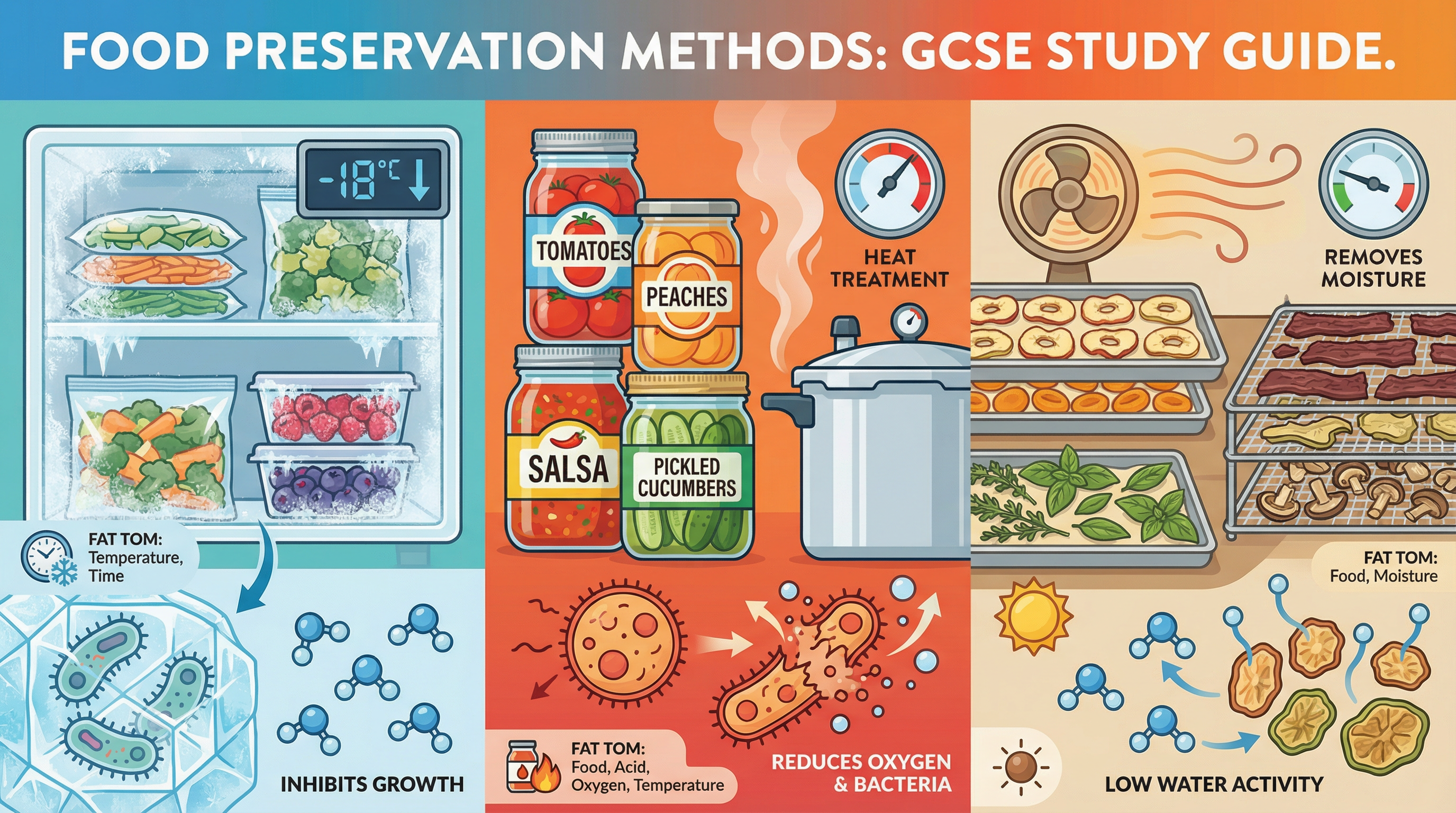
This study guide provides a comprehensive overview of food preservation methods as required by the AQA GCSE Food Preparation and Nutrition specification. Understanding how and why food is preserved is fundamental to food science, linking directly to food safety, nutrition, and food choice. Examiners expect candidates to demonstrate a clear scientific understanding of the principles behind each preservation method, specifically how they manipulate the conditions required for microbial growth. This involves a detailed knowledge of temperature control, water removal, and chemical preservation, and their impact on enzymes, bacteria, yeasts, and moulds. Credit is awarded for using precise terminology and for evaluating the effects of these methods on the nutritional and sensory properties of food.
Key Preservation Principles
The Science of Spoilage: FAT TOM
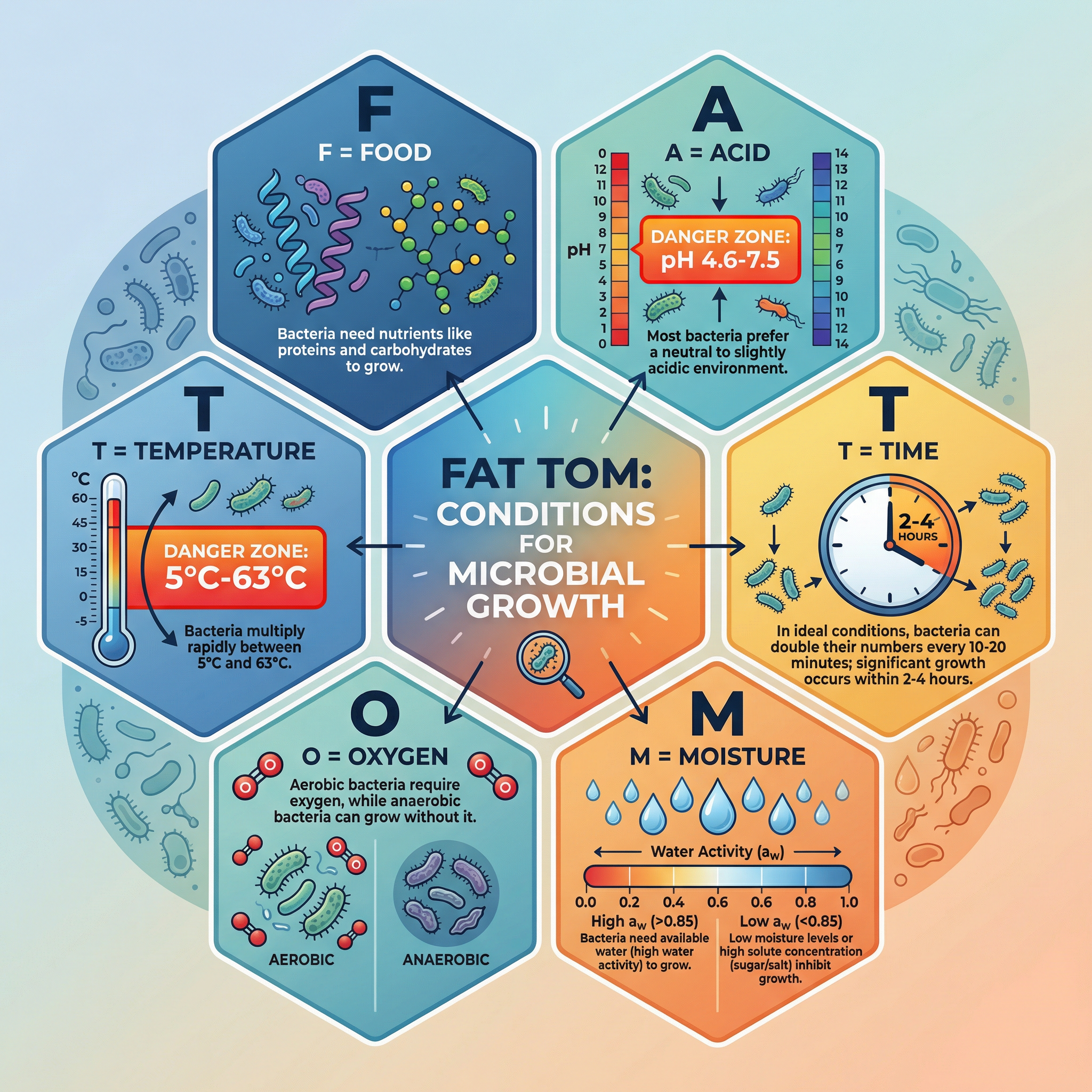
Food spoilage is primarily caused by the growth of microorganisms (bacteria, yeasts, and moulds) and the action of enzymes. To control spoilage, we must control the conditions that allow these microorganisms to thrive. These conditions are summarised by the acronym FAT TOM:
- Food: Microorganisms need a source of nutrients, such as proteins and carbohydrates.
- Acid: Most microorganisms prefer a neutral pH (around 7.0). High or low pH levels inhibit their growth.
- Temperature: Microorganisms have optimal temperature ranges for growth. The 'danger zone' for rapid multiplication is between 5°C and 63°C.
- Time: Given enough time in the right conditions, microorganisms will multiply to levels that cause spoilage.
- Oxygen: Many microorganisms (aerobic) require oxygen to grow.
- Moisture: Microorganisms need water to survive. This is measured as 'water activity' (aw).
How Preservation Works
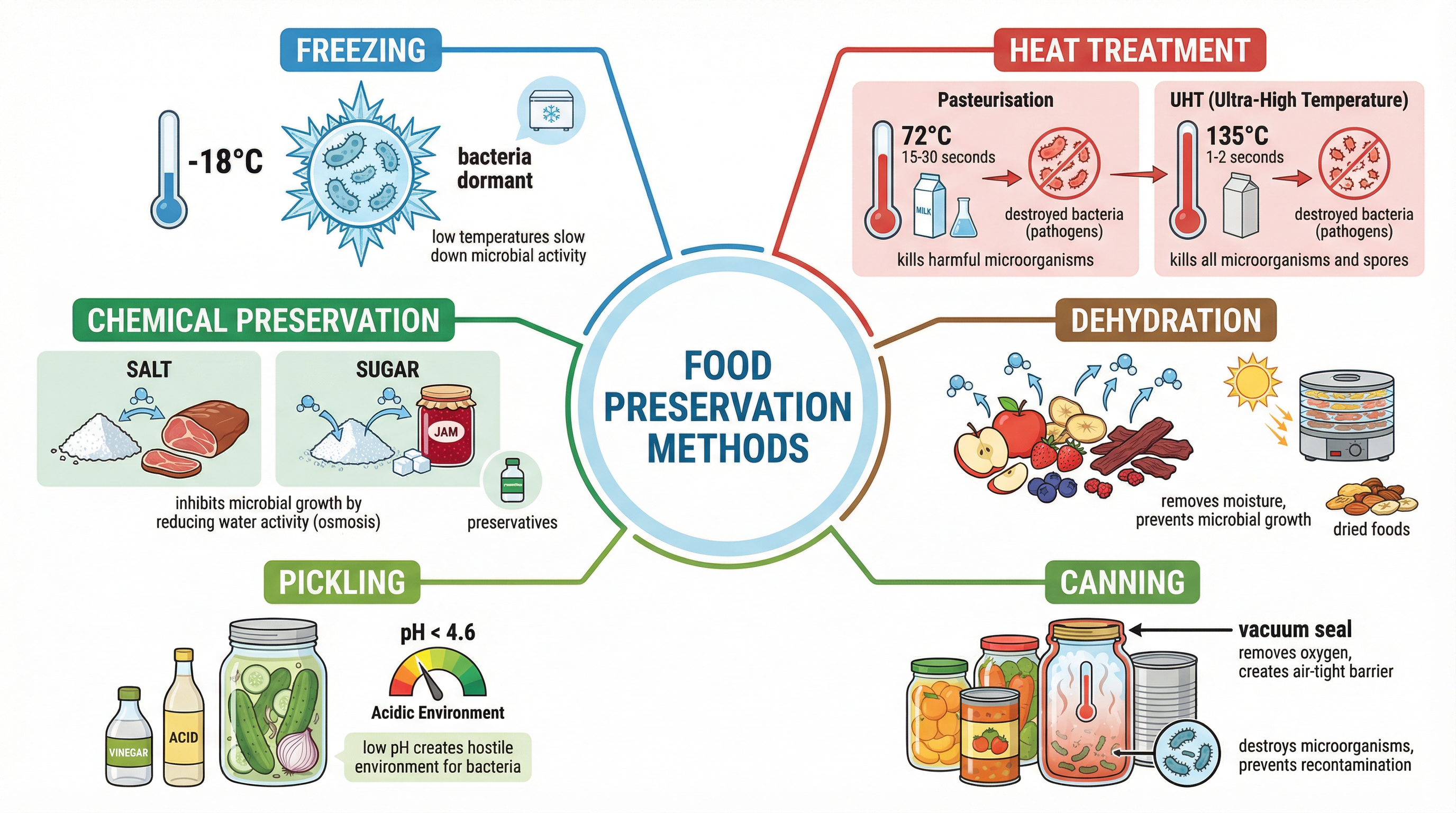
All preservation methods work by altering one or more of the FAT TOM conditions to create an environment where microorganisms cannot grow or survive. For example, freezing lowers the temperature, dehydration removes moisture, and pickling increases acidity.
Main Preservation Methods
1. Temperature Control: Freezing
Mechanism: Freezing involves reducing the temperature of food to -18°C. This does not kill bacteria but makes them dormant, meaning their metabolic processes slow down so much that they cannot reproduce. It is a critical distinction that freezing induces dormancy, not destruction. This also slows down enzyme activity, preventing further ripening and spoilage.
Impact:
- Nutritional: Excellent nutrient retention, especially if food is blanched before freezing. Minimal loss of vitamins.
- Sensory: Can damage the texture of delicate foods with high water content (e.g., strawberries, lettuce) as ice crystals rupture cell walls.
Specific Knowledge: Candidates must state -18°C as the correct temperature for domestic freezers to gain full marks.
2. Temperature Control: Heat Treatment
Mechanism: Heat treatment uses high temperatures to destroy microorganisms and enzymes. There are two key industrial processes:
- Pasteurisation: Heating to 72°C for 15-30 seconds. This kills pathogenic (harmful) bacteria but not all spoilage bacteria, hence pasteurised products like milk still require refrigeration.
- UHT (Ultra-High Temperature): Heating to 135°C for 1-2 seconds. This destroys all bacteria and their spores, rendering the product sterile. UHT products can be stored at ambient temperatures for long periods.
Impact:
- Nutritional: Causes significant loss of heat-sensitive, water-soluble vitamins like Vitamin C and B group vitamins.
- Sensory: Can cause changes in flavour, colour, and texture (e.g., cooked flavour of UHT milk).
3. Removal of Moisture: Dehydration
Mechanism: This method involves removing water from the food, thus inhibiting the growth of microorganisms which require it. This reduces the water activity (aw) of the food. Methods include sun drying, oven drying, and freeze-drying.
Impact:
- Nutritional: Concentrates nutrients and calories. However, some vitamins, like Vitamin C, are lost through oxidation.
- Sensory: Significantly alters texture, colour, and flavour, creating a new product (e.g., grapes to raisins).
4. Chemical Preservation
Mechanism: Adding substances that make the food environment hostile to microbes.
- Pickling: Adding an acid like vinegar lowers the pH to below 4.6, which is too acidic for most bacteria to survive.
- Salting/Sugaring: These work by osmosis. The high concentration of salt or sugar draws water out of the microbial cells, causing them to dehydrate and die. This also reduces the water activity of the food itself.
Impact:
- Nutritional: Adds high levels of salt or sugar, which has health implications. Pickling can leach some minerals and vitamins.
- Sensory: Creates a distinct salty, sweet, or acidic flavour and can change the texture of the food.
Second-Order Concepts
Causation
Why do we need preservation? The primary cause is the natural process of decay driven by microorganisms and enzymes. The need for preservation was historically driven by the need to store food after harvest for the winter months. In modern times, it is driven by consumer demand for year-round availability of food and the global transportation of food products.
Consequence
The development of preservation techniques has had profound consequences. It has enabled the growth of cities (as large populations can be fed), supported exploration and military campaigns, and created the global food market we have today. However, it has also led to an increased consumption of processed foods, which can be high in salt, sugar, and fat.
Change & Continuity
While the fundamental principles of preservation (drying, salting) have been used for thousands of years (continuity), the methods have evolved dramatically with technology (change). We have moved from sun-drying to industrial freeze-drying, from salting to using specific chemical preservatives. The core scientific principles, however, remain the same.
Significance
Food preservation is hugely significant as it underpins food security, public health, and the modern food industry. A failure to understand and apply these principles leads to food waste and foodborne illness.