OCR · GCSE · Further Mathematics
Standard Form
This guide provides a comprehensive, exam-focused breakdown of Standard Form for OCR GCSE Further Mathematics. It covers everything from the core principles of writing numbers in the form A × 10ⁿ to performing complex calculations, ensuring you can secure every mark available on this crucial topic.
- 4 min read
- 3 worked examples
- 5 practice questions
- 6 key terms
Study Notes

Overview
Standard Form, or Scientific Notation, is a fundamental concept in mathematics designed to simplify the handling of very large and very small numbers. In your OCR GCSE Further Mathematics exam, this topic (specification reference 1.3) is not just about converting numbers; it’s about procedural fluency, particularly in non-calculator contexts, and applying the rules to solve multi-step problems. Examiners will expect you to be precise with the format A × 10ⁿ, where 1 ≤ A < 10, and to confidently manipulate these numbers through addition, subtraction, multiplication, and division. This topic frequently appears in questions involving bounds, estimations, and compound measures, making it a vital skill for accessing higher-level marks across the paper. Mastering the adjustment of numbers after a calculation is often the key to full marks.
Key Concepts
Concept 1: The Structure of Standard Form
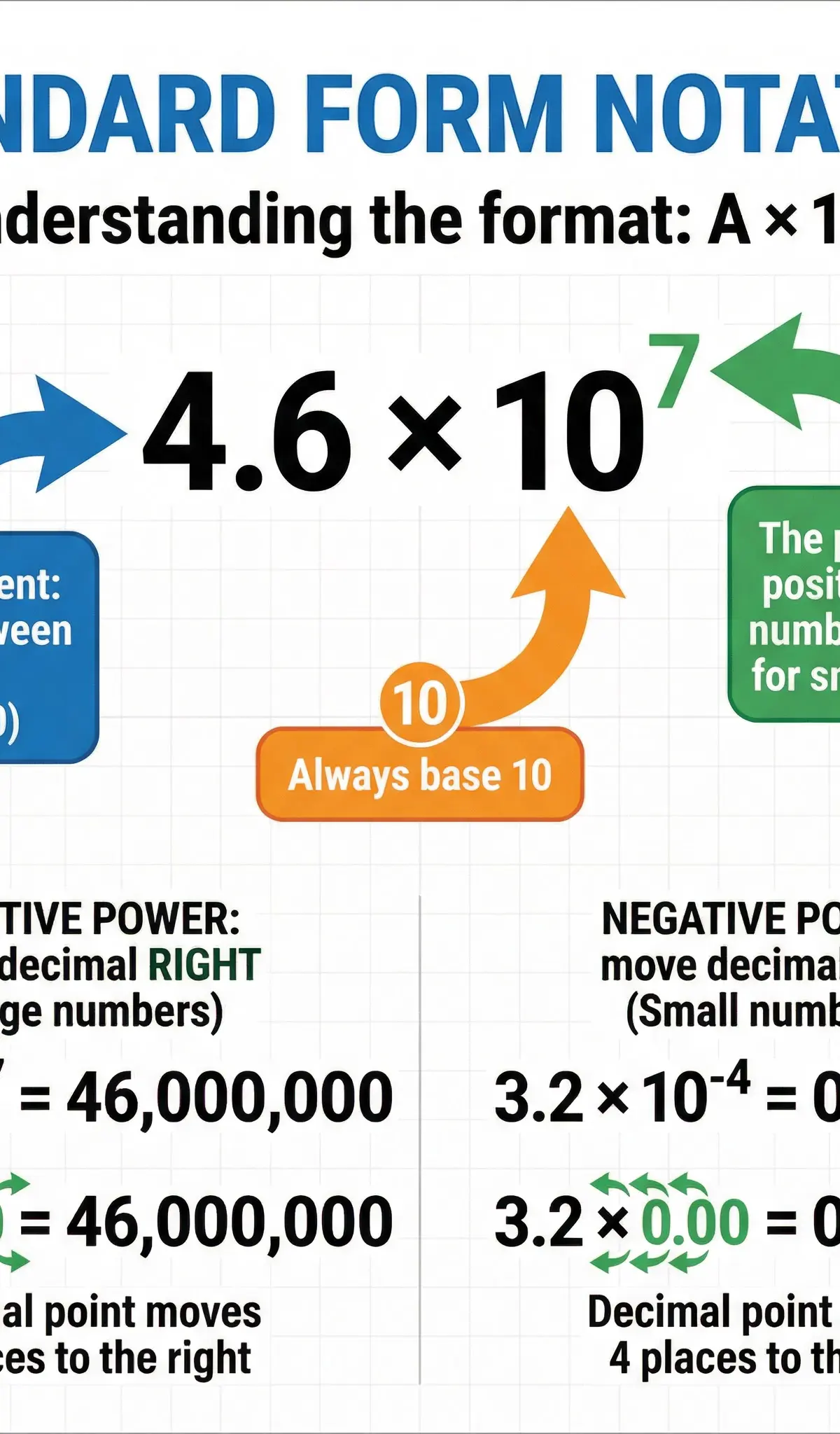
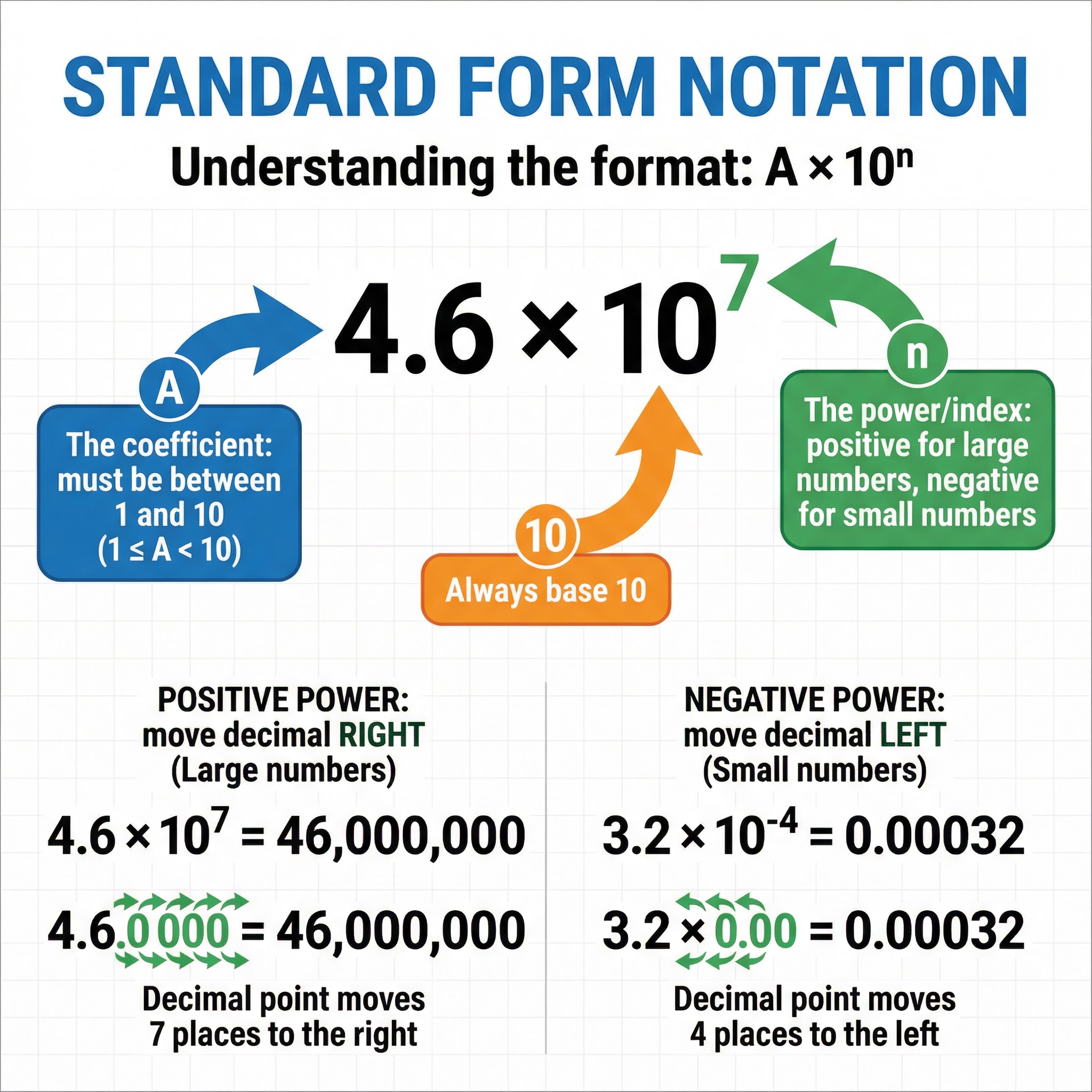
Standard Form expresses a number in two parts: a coefficient (A) and a power of 10 (10ⁿ). The single most important rule, and the one most frequently tested, is that the coefficient A must be greater than or equal to 1 and less than 10 (1 ≤ A < 10). The power, n, is an integer that tells you the magnitude of the number.
- Positive Power (n > 0): Indicates a large number. The value of 'n' tells you how many places the decimal point has been moved to the left. For example, 5,800,000 becomes 5.8 × 10⁶.
- Negative Power (n < 0): Indicates a small number (a decimal between 0 and 1). The value of 'n' tells you how many places the decimal point has been moved to the right. For example, 0.00025 becomes 2.5 × 10⁻⁴.
Concept 2: Operations with Standard Form
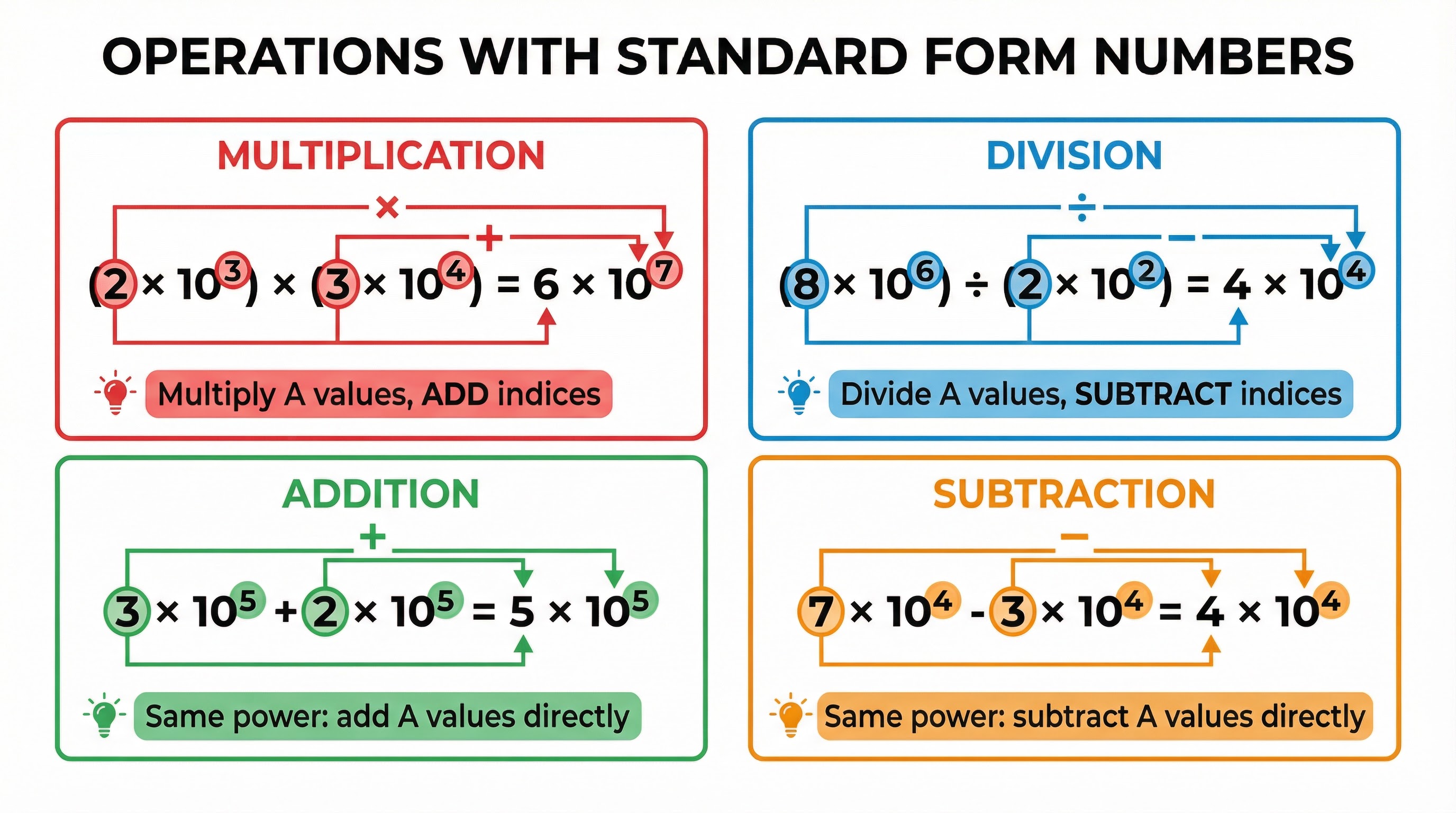
Examiners test all four operations. The rules differ significantly between them.
-
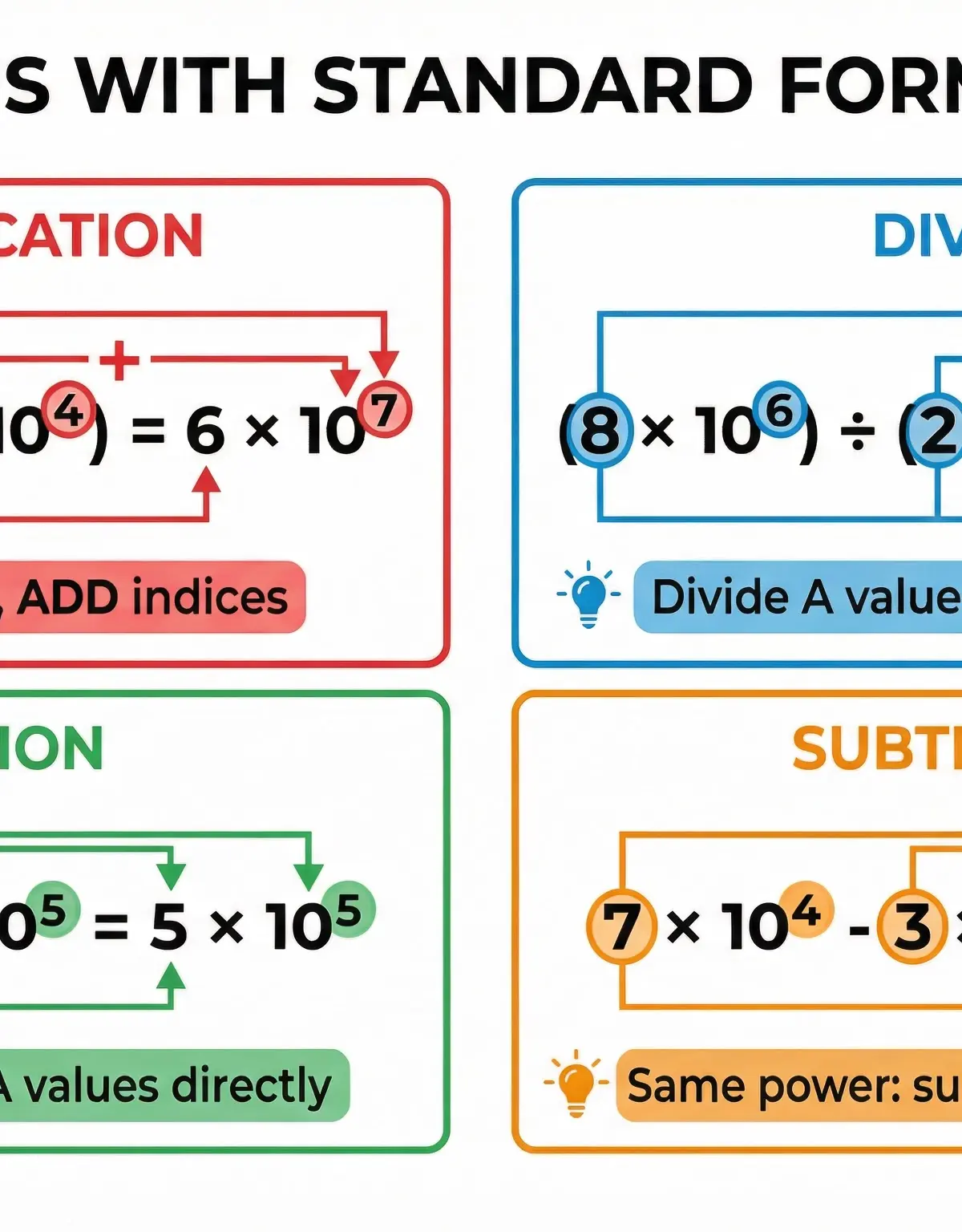
Multiplication: Multiply the coefficients, and add the powers.
- Example: (4 × 10⁵) × (2 × 10³) = (4 × 2) × 10⁵⁺³ = 8 × 10⁸.
-
Division: Divide the coefficients, and subtract the powers.
- Example: (9 × 10⁷) ÷ (3 × 10²) = (9 ÷ 3) × 10⁷⁻² = 3 × 10⁵.
-
Addition and Subtraction: This is where most candidates lose marks. You can only perform the operation if the powers of 10 are the same. If they are different, you must first convert one of the numbers to match the other.
- Example (different powers): Calculate (6.2 × 10⁴) + (3 × 10³).
First, convert one number. It's often easier to change the higher power: 6.2 × 10⁴ = 62 × 10³.
Now, add them: (62 × 10³) + (3 × 10³) = 65 × 10³.
Finally, adjust the answer back to standard form: 65 × 10³ = 6.5 × 10⁴. This final adjustment is crucial for the A1 mark.
- Example (different powers): Calculate (6.2 × 10⁴) + (3 × 10³).
Mathematical Relationships
The core relationships are the index laws, which are essential for multiplication and division. Remember, these are given on some formula sheets, but you must know how to apply them fluently.
- Multiplication Law: aᵐ × aⁿ = aᵐ⁺ⁿ (Must memorise)
- Division Law: aᵐ ÷ aⁿ = aᵐ⁻ⁿ (Must memorise)
- Power of a Power Law: (aᵐ)ⁿ = aᵐⁿ (Must memorise) - This is tested when squaring or cubing a number in standard form. For example, (2 × 10³)², you must square the 2 (giving 4) AND multiply the index by 2 (giving 10⁶), resulting in 4 × 10⁶.
Practical Applications
Standard form is used everywhere in science and engineering to make sense of the universe. This context can be used by examiners to frame AO3 problem-solving questions.
- Astronomy: Distances between planets (e.g., the distance from Earth to the Sun is approx. 1.5 × 10⁸ km).
- Biology: The size of cells or bacteria (e.g., a red blood cell is about 7 × 10⁻⁶ m in diameter).
- Chemistry: Avogadro's constant, the number of atoms or molecules in one mole of a substance, is approximately 6.022 × 10²³.
- Computing: Data storage, measured in bytes (e.g., a terabyte is 1 × 10¹² bytes).
Visual Resources
2 diagrams and illustrations
Interactive Diagrams
2 interactive diagrams to visualise key concepts
Conceptual Flow Outline
Flowchart showing the process of converting an ordinary number into standard form.
Conceptual Flow Outline
Decision diagram for adding or subtracting numbers in standard form.
Worked Examples
3 worked examples — open one to explore the question and available guidance.
Practice Questions
Test your understanding — click to reveal model answers
Write the number 0.0000502 in standard form.
Hint: Move the decimal point to the right until you get a number between 1 and 10. How many places did you move it?
Calculate (7.5 × 10⁸) ÷ (2.5 × 10³). Give your answer in standard form.
Hint: Divide the coefficients first, then deal with the powers of 10.
A rectangular field has a length of 5.2 × 10⁴ metres and a width of 3 × 10³ metres. Calculate the area of the field in square metres. Give your answer in standard form.
Hint: Area of a rectangle is length times width. Remember the rules for multiplying in standard form.
The mass of a proton is 1.67 × 10⁻²⁷ kg. The mass of an electron is 9.11 × 10⁻³¹ kg. Calculate how many times heavier the proton is than the electron. Give your answer to 2 significant figures.
Hint: How many times heavier means you need to divide the mass of the proton by the mass of the electron.
Given that x = 5 × 10⁶ and y = 8 × 10⁵, find the value of 3x + 2y. Give your answer in standard form.
Hint: Calculate 3x and 2y first. Then you will need to add them, which will require making the powers of 10 the same.
Test your understanding of Standard Form
Active recall beats re-reading. Take an instant quiz now to test what you’ve learned and lock it into long-term memory.
7 days Premium · Then free forever · No card, no charge