A Level Biology Syllabus Edexcel

You open the official Edexcel biology document, scroll for a bit, then scroll some more. Topic names blur together. Practical skills are mixed in with theory. Some revision sites call things one name, your teacher uses another, and your textbook seems to assume you already know the course map.
That's where most students get stuck.
Some are trying to recover after months of doing less than they meant to. Others are aiming high and don't want to waste time revising the wrong things. Teachers see the same problem from the other side. Students often work hard, but without a clean mental model of the specification, their revision stays fuzzy.
A good guide to the A Level Biology syllabus Edexcel should do more than list content. It should tell you what each part of the course is for, how it tends to show up in exams, where people lose marks, and how to revise in a way that matches the paper in front of you.
Your Clear Map to the Edexcel A Level Biology Syllabus
A lot of students think they have a motivation problem when they in reality have a map problem.
If your course feels huge, that usually means you're seeing it as one giant mass of “biology” instead of a set of linked sections with clear exam purposes. Once that changes, revision gets calmer. You stop asking, “Where do I even start?” and start asking, “Which bit do I fix first?”
Take a common situation. A student says they're “bad at biology”. After ten minutes, they demonstrate they can explain osmosis, enzymes, and inheritance reasonably well, but they panic on data questions, practical design, and anything that links two topics together. That's not being bad at biology. That's having an incomplete picture of the course.
Practical rule: Don't revise Edexcel biology as one subject. Revise it as content knowledge, application, practical method, and synoptic links.
That shift matters because the official Pearson Edexcel Biology A specification is arranged as a two-year course, with Topics 1 to 4 common to AS and further advanced content beyond that. Pearson also states that practical work is central to the course, so revision has to include both theory and practical skills, not just fact recall, as set out in the Pearson Edexcel Biology A specification.
What students usually need from the syllabus
- A clear structure: Which topics belong to the earlier part of the course, and which build on them later.
- Exam meaning: Whether a topic mainly turns up as knowledge recall, data interpretation, longer explanation, or synoptic application.
- Revision priorities: Which areas need flashcards, which need diagrams, which need practical-method practice, and which need timed questions.
Once you see the course this way, the specification stops looking like a wall of text and starts behaving like a checklist.
First Things First Are You Studying Biology A or B
This is the first confusion to sort out, because plenty of students search for Edexcel biology resources and accidentally revise the wrong specification.
Edexcel offers Biology A and Biology B. They aren't the same course presented with different covers. They overlap in biological ideas, but they organise learning differently, and that changes which resources are useful.
How to identify your course fast
Check one of these before revising anything substantial:
- Ask your teacher directly. It sounds obvious, but it's the fastest fix.
- Look at your textbook cover and contents page. “Salters-Nuffield” is the giveaway for Biology A.
- Check your school's scheme of work or homework platform. Departments usually label the specification clearly.
If you're still unsure, look at how the content is organised.
Biology A feels like separate rooms
Biology A (Salters-Nuffield) usually feels more topic-based. You move through recognisable areas of biology, building from molecules and cells into genetics, ecology, homeostasis, disease and beyond.
That structure suits students who like saying, “This week I'm revising Topic X.”
It also helps with targeted repair. If membranes are weak, you can focus on that chunk. If immunity questions keep going wrong, you know where to look.
Biology B feels like one connected building
Biology B is more concept-led. Instead of treating topics as neat boxes, it organises biology around broader themes and connections. That can be brilliant for students who naturally think in links and patterns.
It can also be frustrating at first, because the boundaries are less tidy. You may feel as if plant biology, transport, ecology and development are woven together more than you expected.
Students often assume every Edexcel revision website matches their exact course. It doesn't. The wrong spec can make good revision feel confusing for no good reason.
Why this matters for revision
If you use Biology B notes for Biology A, or the other way round, the danger isn't just missing content. You also end up learning the course in the wrong shape.
That matters because exam preparation depends on pattern recognition. A student doing Biology A benefits from topic-by-topic tracking. A student doing Biology B often benefits more from revision organised around big ideas and links.
A quick cheat sheet helps:
| Specification | Main feel | Best revision style |
|---|---|---|
| Biology A | Topic-based | Build a checklist by topic, then practise mixed questions |
| Biology B | Concept-led | Revise by big ideas, then train yourself to link contexts |
If you're studying A Level Biology syllabus Edexcel, don't skip this identification step. It saves hours.
Biology A Topic Breakdown The Salters-Nuffield Path
If you're on Biology A, your course has a clearer staircase than many students realise. It starts with the core language of biology, then scales up into bigger systems and more demanding applications.
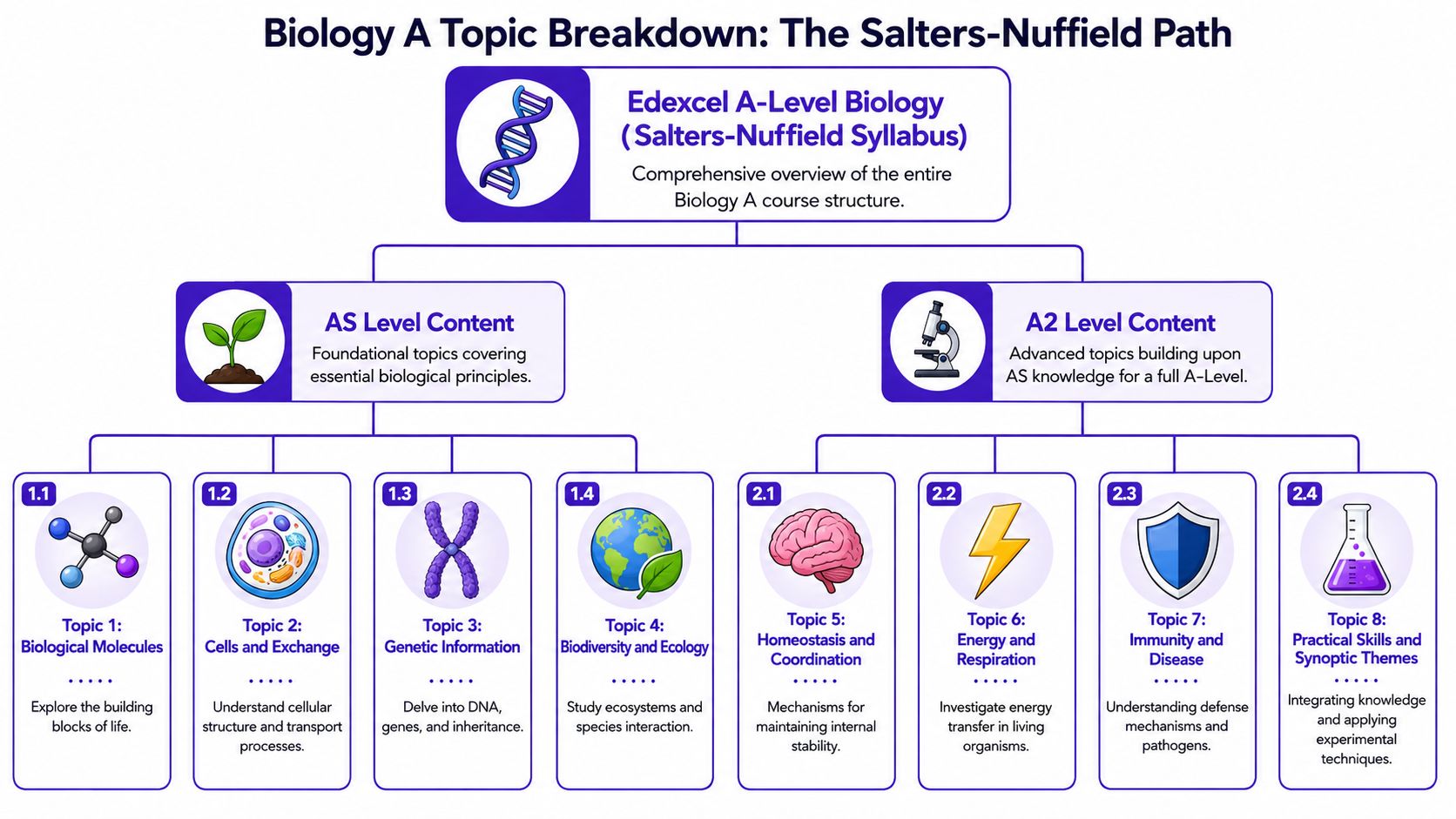
The AS foundation topics
The earlier part of the course is where many exam strengths and weaknesses begin.
Topic 1 Biological molecules
This is the chemistry of life. Proteins, carbohydrates, lipids, water, enzymes. Students often treat it as memorising definitions, but exam questions regularly reward precision. If you mix up structure and function, marks disappear quickly.Topic 2 Cells and exchange
In this topic, membranes, transport, microscopy, and exchange surfaces become central. A lot of students understand the story in words but struggle when the exam asks them to apply it to an unfamiliar cell or tissue.Topic 3 Genetic information
DNA, genes, protein synthesis, variation, inheritance. This topic is full of sequences and cause-and-effect chains. If your written answers here are vague, the examiner can't award what you meant.Topic 4 Biodiversity and ecology
This moves biology outwards into populations, ecosystems, conservation, and relationships between organisms and environment. Students sometimes underestimate it because it sounds descriptive, but it's rich in application and data handling.
The later A Level content
Later topics raise the demand. They expect you not just to know facts, but to use earlier knowledge in more complex settings.
Topic 5 Homeostasis and coordination
Hormones, nervous control, feedback systems. The common trip-up is learning diagrams without understanding why each step matters.Topic 6 Energy and respiration
Energy transfer, ATP, respiration, photosynthesis links. Students can recite pathways but then stumble on comparisons, practical setups, or questions with unfamiliar wording.Topic 7 Immunity and disease
Pathogens, defences, response, and disease processes. This often looks manageable in notes and harder in papers because questions blend explanation with application.Topic 8 Practical skills and synoptic themes
In this topic, students discover whether they've learned biology as separate pages or as a joined-up subject. Practical understanding and cross-topic thinking become impossible to fake.
The so what for each topic
A useful way to think about Biology A is this:
| Topic area | What it trains you to do in exams |
|---|---|
| Molecules and cells | Use precise terms and explain mechanisms |
| Genetics | Follow chains of logic clearly |
| Ecology | Read data in context |
| Homeostasis and disease | Explain control systems and responses |
| Energy topics | Link processes across scales |
| Practical and synoptic work | Think like a biologist, not a memoriser |
A strong student doesn't just ask, “What's in Topic 3?” They ask, “What kind of marks does Topic 3 usually require me to earn?”
That's the difference between covering the syllabus and using it.
Biology B Topic Breakdown The Concept-Led Path
Students on Biology B sometimes worry because their course feels less tidy on paper. That's normal. Biology B isn't trying to separate biology into sealed compartments. It wants you to understand the subject through bigger organising ideas.
What concept-led actually means
In a topic-led course, you might revise cells for a week, then genetics, then ecology.
In a concept-led course, one broad area can pull together several strands at once. You may meet development, plant biology, transport, environment, and survival as connected parts of a larger biological picture.
That's useful because real biology doesn't happen in school-sized boxes. A plant's growth, its gas exchange, its environment, and its adaptation all affect one another.
How this changes the exam feel
Biology B questions often reward students who can move comfortably between scales. You might start with a familiar process and then apply it in a less familiar context.
That means revision works better when you organise notes around questions such as:
- How does structure affect function?
- How do organisms interact with their environment?
- How is change controlled over time?
- What links molecular biology to whole-organism survival?
Common student mistakes in Biology B
One mistake is revising only as if the course were Biology A in disguise. It isn't.
Another is going too vague. Because the course is concept-led, some students produce broad summaries full of nice ideas but too few exact biological details. Exams still reward accurate terminology, careful explanation, and clear application.
If you study Biology B, your job isn't to know less detail. It's to organise detail under bigger ideas.
A good revision model for Biology B
Use a two-layer system:
- Core concept pages
Build summary sheets for each major idea or unit. - Attached evidence and examples
Under each concept, add the exact processes, definitions, and case examples that prove you understand it.
That way, you avoid both extremes. You won't memorise disconnected facts, and you won't float into vague waffle either.
For teachers, this is often the heart of the issue. Students need help seeing that concept-led doesn't mean less rigorous. It means the links matter earlier.
Your Exam Papers Structure and Weightings
Knowing the content without knowing the paper structure is like training for a match without knowing the rules.
For Edexcel Biology A, the exam setup matters because each paper asks for a slightly different kind of performance. One paper rewards secure recall and clean explanation of the earlier material. Another tests later content. The final paper asks whether you can connect ideas and handle practical thinking across the course.
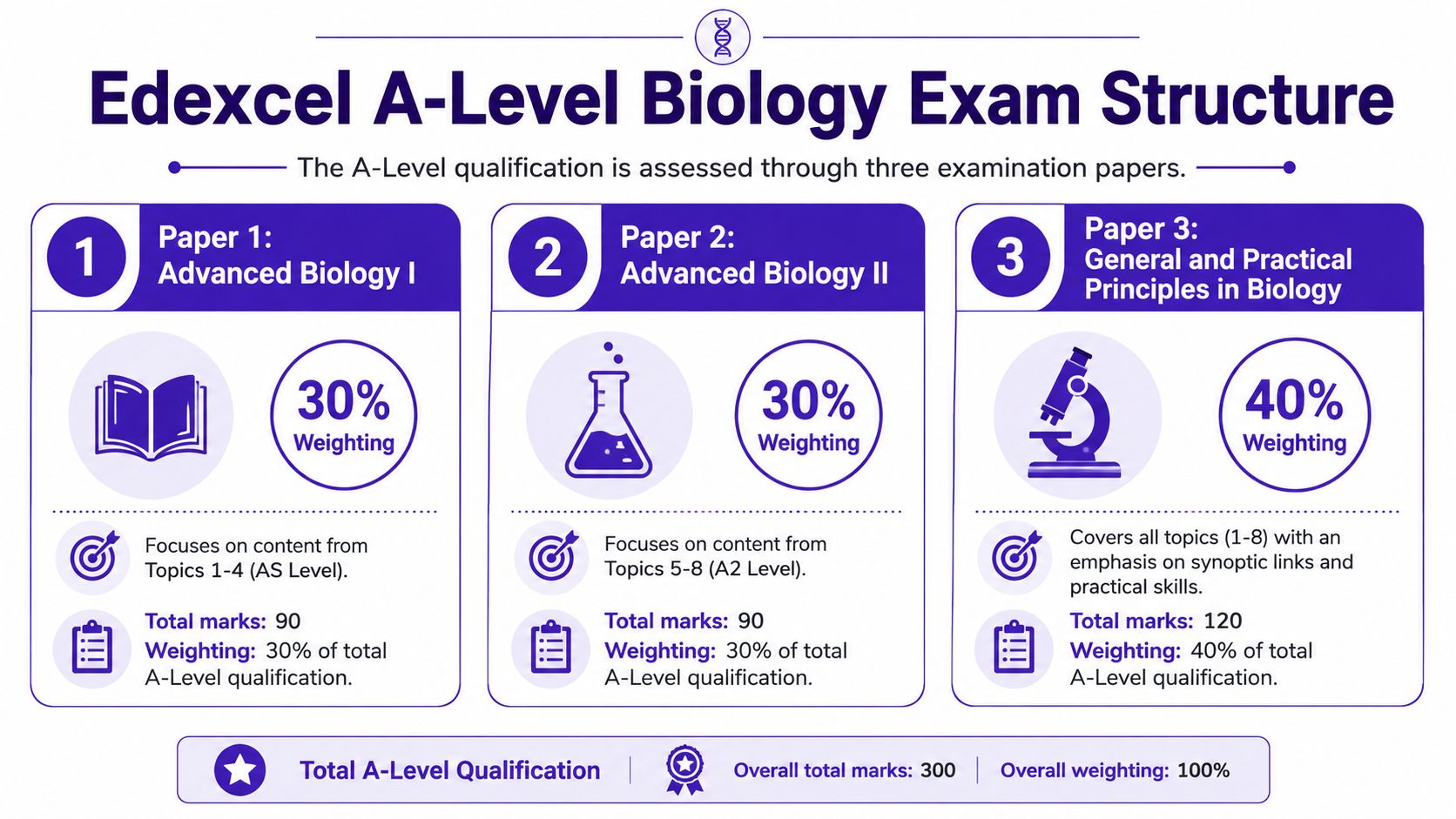
Edexcel A Level Biology Exam Paper Breakdown 2026
| Paper | Title | Duration | Marks | Weighting | Content Assessed |
|---|---|---|---|---|---|
| Paper 1 | Advanced Biology I | Not specified here | 90 | 30% | Topics 1 to 4 |
| Paper 2 | Advanced Biology II | Not specified here | 90 | 30% | Topics 5 to 8 |
| Paper 3 | General and Practical Principles in Biology | Not specified here | 120 | 40% | Topics 1 to 8, with practical and synoptic emphasis |
What these weightings mean in real revision
Paper 3 carries the largest chunk of the qualification, so students who ignore mixed-topic practice usually feel that pain later. They may know plenty, but they haven't practised joining it up.
Paper 1 and Paper 2 still matter heavily. They reward topic security. If Topic 2 is weak, Paper 1 feels unstable. If Topic 6 is shaky, Paper 2 quickly exposes it.
A smart revision plan mirrors the paper structure:
- For Paper 1: practise earlier topics with strong emphasis on precise definitions, mechanisms, and structured short answers.
- For Paper 2: build depth in later topics, especially where processes need careful explanation.
- For Paper 3: mix everything. Use practical questions, unfamiliar contexts, and cross-topic tasks.
For timed practice, a bank of A-Level Past papers is useful because students need to feel the shift from “I know this” to “I can produce it under exam pressure”.
What students usually get wrong about Paper 3
They think it's just Paper 1 and Paper 2 combined.
It isn't. Paper 3 asks a different question: can you use biology flexibly? Can you interpret an experiment, spot a pattern, connect one topic to another, and explain your reasoning clearly?
That's why students who memorise beautifully sometimes underperform there, while students with slightly less raw recall but better linking skills can do surprisingly well.
Mastering Assessment Objectives and Command Words
Lots of lost marks come from this simple problem. The student knows biology, but doesn't answer the actual instruction on the page.
Assessment Objectives sound technical, but in practice they're very human. They ask three things. Do you know it? Can you use it? Can you think with it?
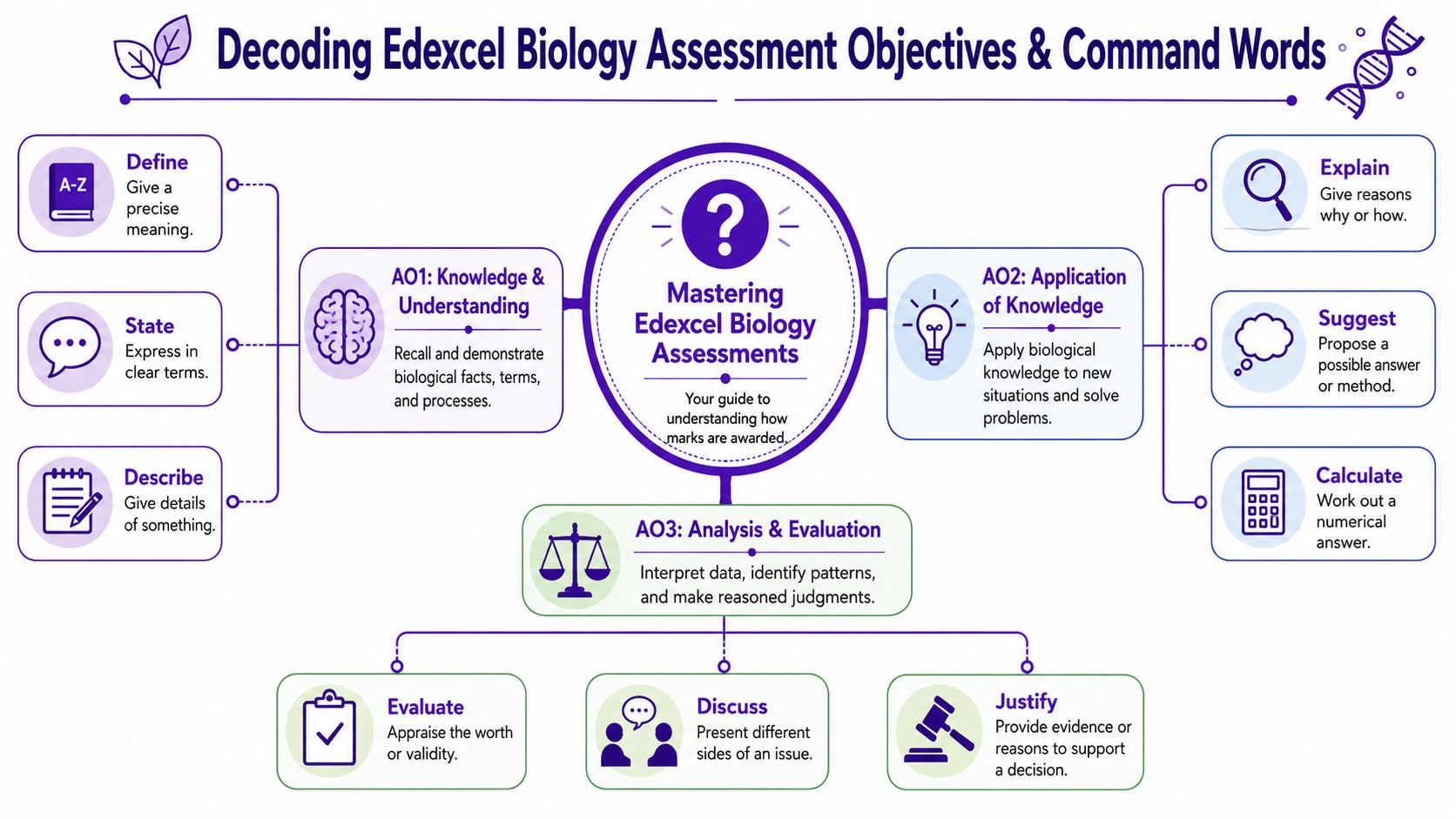
AO1 means knowing the biology
This is your factual base. Terms, definitions, processes, stages, structures.
If a question says define, state, or sometimes describe, it often leans heavily on AO1. The examiner isn't asking for a life story. They want accurate biology with no fluff.
Example:
- If the command word is state, give the fact.
- If the command word is define, give the exact meaning.
- If the question asks for a process, keep the steps in order.
The trap here is over-writing. Students often dump everything they know, hoping a mark will land somewhere. That wastes time and can blur a correct answer.
AO2 means applying what you know
Here, many “I revised loads” students come unstuck.
AO2 asks you to use biology in a new setting. The process may be familiar, but the example isn't. Maybe the question gives an unfamiliar organism, graph, medical context, or environmental situation.
Common AO2 command words include:
- Explain
- Suggest
- Calculate
For many students, explain is the danger word. They think it means “say more”. It usually means “show the chain of cause and effect”.
Here's a quick way to test yourself. If your answer could fit almost any biology question, it's probably too generic for AO2.
A good habit is checking Edexcel mark schemes after practice questions. You start seeing how specific the expected application really is.
AO3 means analysing and evaluating
This is the part that feels most grown-up. Data interpretation. Method critique. Judging evidence. Noticing trends and limits.
Common AO3 command words include:
- Evaluate
- Discuss
- Justify
Students often panic here and think they need to sound clever. They don't. They need to be balanced, specific, and rooted in the evidence given.
A strong AO3 answer usually does three things. It identifies what the evidence shows, points out a limitation or alternative view, and reaches a reasoned judgement.
A short video can help if command words still feel abstract:
A simple command-word survival guide
| Command word | What the examiner usually wants |
|---|---|
| Define | Precise meaning |
| State | Short factual answer |
| Describe | Relevant details of what happens or what is shown |
| Explain | Reasons, mechanisms, cause and effect |
| Suggest | A plausible answer using biology |
| Calculate | A correct numerical method and answer |
| Compare | Similarities and differences |
| Evaluate | Strengths, weaknesses, and a judgement |
| Justify | A supported decision or conclusion |
If you feel behind, this is one of the fastest places to improve. You don't need to relearn the whole course. You need to match your answer to the job the question set.
The Practical Endorsement CPAC Explained
The practical side of A Level Biology confuses students because it has two different lives.
One life happens in the lab, where your teacher assesses how you work. The other appears in the written papers, where practical understanding turns into marks. Students often notice the first and underestimate the second.
What CPAC is really about
The Practical Endorsement is a separate pass or fail part of the course. Teachers assess whether you can work safely, follow procedures, make observations, handle data, and show practical competence over time.
That means your approach in practical lessons matters. Not just your final write-up, but how you plan, observe, record and respond.
Why practical work still matters in written exams
A student sometimes says, “The endorsement isn't graded, so it's not the main thing.”
That misses the point. The lab skills you build there feed directly into exam questions. If you can't recognise variables, limits, control measures, sources of error, or how to improve a method, written papers will expose that.
Typical practical-based written questions ask you to:
- Identify variables
- Interpret results
- Comment on reliability
- Suggest improvements
- Explain why a method was used
The most common practical trip-ups
- Confusing accuracy with reliability
Students often treat them as interchangeable. They aren't. - Ignoring the reason behind a step
If you memorise “use a water bath” but don't know why, application questions become shaky. - Giving vague evaluation points
“Do repeats” is not enough on its own. Repeats of what, and why?
Good practical revision is less like memorising a recipe and more like learning how a cook thinks. You need the method, but you also need the reason for each move.
How to revise practical biology properly
Try this method instead of rereading practical sheets.
- Take one required practical or class experiment.
- Cover the method and rebuild it from memory.
- Name the independent, dependent, and control variables.
- List two limitations and two realistic improvements.
- Predict what graph or data pattern you might see.
If your department gives practical booklets, use them actively. If you want a structured tool for coursework-style thinking and guided support within exam rules, you can also explore Nea Coach.
Teachers usually spot the same pattern here. Students who engage properly in practicals often become calmer in Paper 3, because unfamiliar method questions stop feeling unfamiliar.
Connecting the Dots Exam Trends and Synoptic Links
High grades in biology come from connection, not just collection.
A student may know the facts of membranes, enzymes, inheritance, immunity and ecology separately. But top-level performance appears when they can use one area to illuminate another. That's what synoptic thinking looks like.
What synoptic really means
Synoptic questions ask you to draw from more than one area of biology at once.
For example, a question might involve:
- cell transport ideas inside a disease context
- genetics inside biotechnology
- ecology inside conservation policy
- enzyme thinking inside digestion or respiration data
This is why revision by isolated chapter can hit a ceiling. It builds knowledge, but not flexibility.
Themes that are becoming more applied
Recent Edexcel IAL Biology revision analysis highlights greater attention to applied themes such as sustainability, biodiversity, and control of gene expression, suggesting a move towards application rather than pure recall in ways that are highly relevant for students preparing for synoptic questions, as discussed in these Edexcel IAL Biology study notes.
That matters because students often revise as if biology were frozen. It isn't. The framing of questions can pull familiar science into newer settings.
Newer contexts students should take seriously
Some recent revision coverage around Edexcel IAL Biology includes themes such as:
- plant-based products and sustainability
- biodiversity and endemism
- seed banks
- climate change evidence
- control of gene expression
The issue isn't that these ideas are impossible. It's that students sometimes meet them as “extra reading” rather than as examinable application contexts.
If a topic sounds modern, don't assume it's optional. In biology, modern context often becomes the test of whether you can apply old knowledge well.
How to build synoptic skill deliberately
Try revision sessions built around bridges, not chapters.
A few useful bridges:
- Membranes to immunity
Transport, receptors, cell signalling. - Genetics to biotechnology
Gene expression, regulation, application. - Ecology to climate change
Population effects, biodiversity, conservation. - Enzymes to practical work
Rate, variables, control, interpretation.
A strong synoptic answer often feels simple when you read it. That's because the student has done the hidden work of linking ideas beforehand.
For teachers, this is one of the most important habits to cultivate. Don't just ask students what they know about a topic. Ask what else it connects to.
Build Your Ultimate Revision Plan with MasteryMind
By this point, the syllabus should look less like a fog and more like a route.
The next problem is turning that route into actual weekly work. Many students slip again at this stage. They make a lovely revision timetable, then fill it with vague tasks like “revise cells” or “do biology”. Those plans look organised and achieve very little.
Turn the syllabus into a live checklist
A useful revision plan for Edexcel biology has four moving parts:
- Topic tracking so you know what's weak
- Question practice so knowledge gets tested
- AO targeting so you fix the type of mark you keep losing
- Mixed review so Paper 3 doesn't catch you cold
That's why digital tools can help if they're aligned tightly to the specification. One option is Online Revision for A-Level, which lets students track topics, work through exam-style questions by specification area, and practise with feedback linked to assessment demands rather than just generic scores.

A weekly model that actually works
Here's a practical structure students can stick to.
| Day type | Focus | Example |
|---|---|---|
| Knowledge day | Learn one narrow chunk well | Enzyme action or DNA replication |
| Application day | Do exam questions on that chunk | Short answers and data questions |
| Practical day | Review one method or experiment | Variables, errors, improvements |
| Synoptic day | Mix topics | Link immunity with cell recognition |
This prevents a common trap. Students often revise only what feels comfortable. Usually that means reading notes. But reading notes is like checking a map without walking the route.
What to do if you're behind
If you feel behind, don't try to “catch up” by rushing every topic once.
Do this instead:
- Audit the course thoroughly. Mark each area secure, shaky, or unknown.
- Repair the highest-frequency weaknesses first. Usually command words, practical questions, or a few central topics.
- Use short cycles. Learn, test, mark, improve.
- Start mixed practice early. Don't wait until you “know everything”.
For active recall, some students also like using tools outside their main platform. If quick question-based retrieval helps you stay engaged, a DNAnswer quiz can be a useful extra way to test what has been retained.
What good revision feels like
Good revision doesn't always feel easy. It often feels slightly uncomfortable because you're forcing retrieval, checking mistakes, and tightening weak areas.
But it should feel clear.
You should know:
- what topic you're doing
- what question type you're improving
- what mistake you're trying not to repeat
- what paper that work is helping with
That's the main aim with the A Level Biology syllabus Edexcel. Not to admire the specification. To use it.
If you want your revision to feel organised instead of overwhelming, try MasteryMind. It gives you a way to turn the syllabus into trackable topics, targeted practice, and exam-focused feedback, so each study session has a clear job.
Ready to master this topic?
Practise with quizzes, blurt exercises and exam questions on MasteryMind.
7 days Premium · Then free forever · No card, no charge