A Level Practice Questions Chemistry: Your a* Masterplan
You've probably got one of two moods right now.
Either you're staring at a pile of Chemistry papers thinking, “I've left this too late,” or you're already doing well and you want a method that propels you into A or A* territory. Both groups usually get told the same thing: do more past papers.
That advice isn't wrong. It's just incomplete. In A-Level Chemistry, the students who improve fastest usually aren't the ones who mindlessly churn through question after question. They're the ones who learn how exam questions work, how mark schemes reward precision, and how to turn every mistake into a repeatable fix.
That's the value of A Level practice questions for Chemistry. Not volume on its own. Strategy.
Teachers know this too. A student can “know the topic” and still bleed marks through vague explanations, missing units, weak structure, or poor choice of examples. So if you're sceptical about AI-generated revision advice, fair enough. Chemistry marking is too specific for fluffy tips. We need examiner reality, not generic motivation.
Stop Drowning in Past Papers Start a Real Strategy
A student sits down on Sunday afternoon with good intentions. They print three papers, highlight a few questions on rates, do half of one organic section, then get stuck on a calculation and switch to flashcards. By the end, they feel busy but not better.
That's what most students call revision. It feels productive because it takes time. It isn't strategic because nothing is organised around the marks.
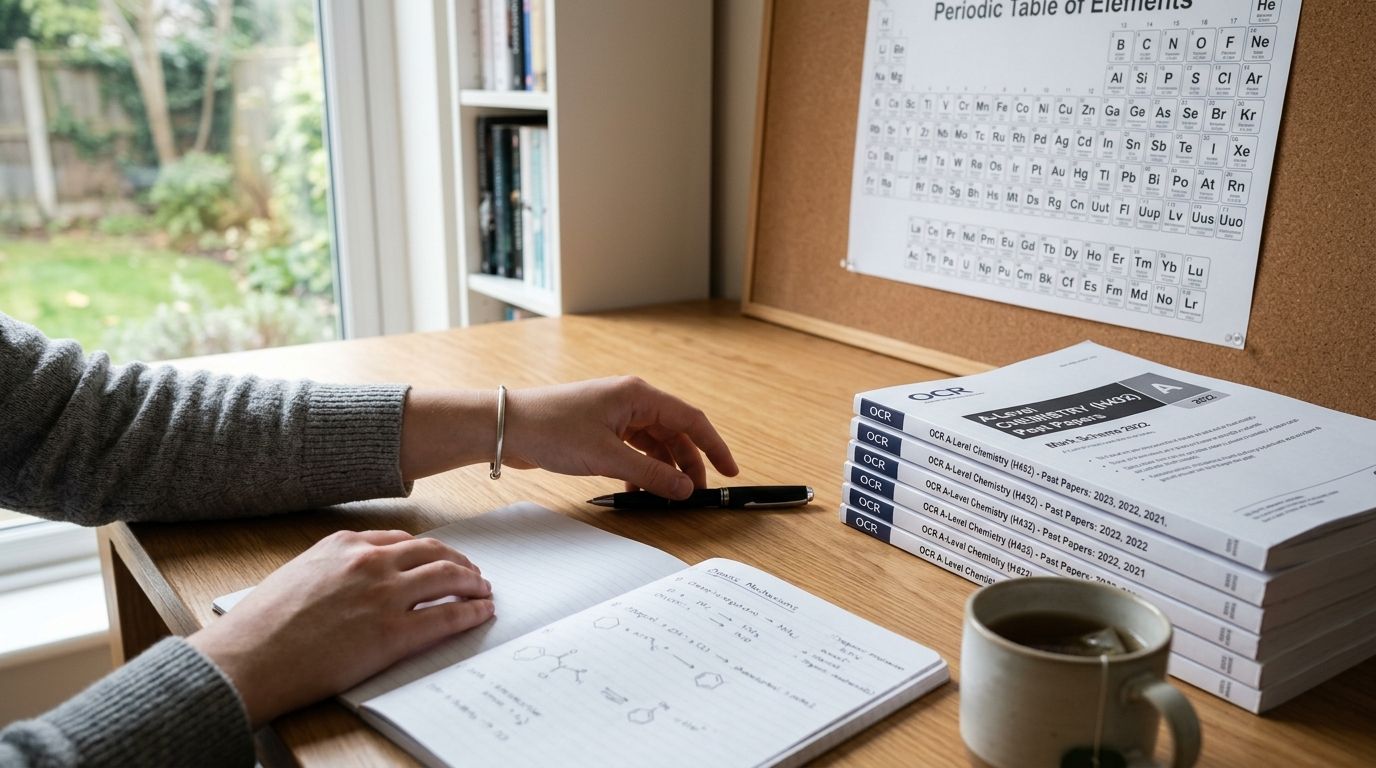
The fix starts with a mindset shift. Practice questions aren't there to prove what you know. They're there to build what you can do under pressure. If a question exposes a weakness in electrode potentials, bond angles, or transition metal colour changes, that's useful. It's not a setback. It's a map.
What random practice gets wrong
When students say, “I did loads of questions and still didn't improve,” I usually see one of these problems:
- Wrong paper type: They used questions that didn't match AQA, Edexcel, or OCR wording.
- Wrong goal: They were chasing completion, not learning.
- Wrong review method: They checked the answer, shrugged, and moved on.
- Wrong timing: Everything was either fully open-book or unrealistically rushed.
Practical rule: If a question doesn't change how you revise afterwards, you haven't really used it.
A much better starting point is to pair your question practice with a proper revision framework. If you want a broader reset on how to organise the subject, this guide on A-Level Chemistry revision techniques is worth reading alongside your question work.
Make every question earn its place
Before you open a paper, decide what that session is for. Maybe today is calculation structure. Maybe it's mechanism explanations. Maybe it's one timed section only. That tiny decision changes everything.
For students who need a clean source of exam material, start with board-aligned A-Level Past papers. Then stop treating them like a checklist. Use them like a training plan.
Choose Your Weapons Wisely Align Practice with Your Exam
Not all Chemistry questions train the same skill. A vague online worksheet can be fine for recall, but it won't always train the exact wording, command words, or mark allocation your examiner uses.
That matters more than many students realise. As of the 2023–2024 academic cycle, over 92% of UK A-Level Chemistry students from AQA, Edexcel, and OCR exam boards reported using structured practice question banks as a primary revision tool, with 54% of top-grade (A) students using AI-enhanced platforms that aligned command words to specific exam boards*.

Exam board alignment isn't optional
AQA, Edexcel, and OCR overlap heavily in content, but they don't ask in exactly the same way. One board may reward a very direct mechanistic explanation. Another may expect a more explicit link between data and conclusion. If your practice doesn't reflect that, you can end up learning “Chemistry in general” instead of “how your examiner gives marks”.
Use a quick filter when choosing questions:
| Check | What you're looking for |
|---|---|
| Board | AQA, Edexcel, or OCR match |
| Spec point | The exact topic statement, not just a broad chapter |
| Command word | Explain, Evaluate, Calculate, Suggest, Deduce |
| Mark style | Short answer, multi-step maths, practical analysis, essay |
Teachers tend to spot this instantly. Students often don't. A decent answer in one context can still fall short in another if it misses the board-specific expectation.
Read the command word before the science
Many students dive straight into the topic content and ignore the command word. That's backwards. The command word tells you what shape the answer needs to take.
A simple way to think about it:
- Calculate means method, units, and usually clear working.
- Explain means cause and effect. Not just what happens, but why.
- Evaluate means balance. Strengths, limits, and judgement from evidence.
- Suggest means use Chemistry logic even if you haven't seen the exact scenario before.
- Deduce means the answer is in the information given, but you must extract it carefully.
Students often lose marks because their Chemistry knowledge is weakly organised, not because it's missing.
That's why targeted platforms can help when they're built around UK exam specs. One option is Subjects for UK students, where questions are mapped to exam boards and command words rather than thrown together by topic alone. That's useful because it trains the response style as well as the content.
Don't just collect questions. Curate them.
A strong question set usually includes:
- Recent board-style wording: So your practice reflects current language.
- A mix of short and extended responses: Because Chemistry isn't only calculations.
- Practical interpretation items: Especially where method, uncertainty, and data trends matter.
- Command-word variety: So you aren't accidentally overtraining one response type.
A short walkthrough can help students see what this looks like in practice:
If you're choosing between ten random resources and one tightly matched set of board-specific questions, pick precision. Chemistry marks reward precision.
Build Your Revision Rhythm with Timed Practice and Spaced Review
Most students start too hard or too late. They jump straight into full papers under strict timing, panic, and conclude they're bad at Chemistry. That isn't always true. Often they've just skipped the middle stages.
Good revision builds in layers. First, you learn the method. Then you speed it up. Then you make it reliable.
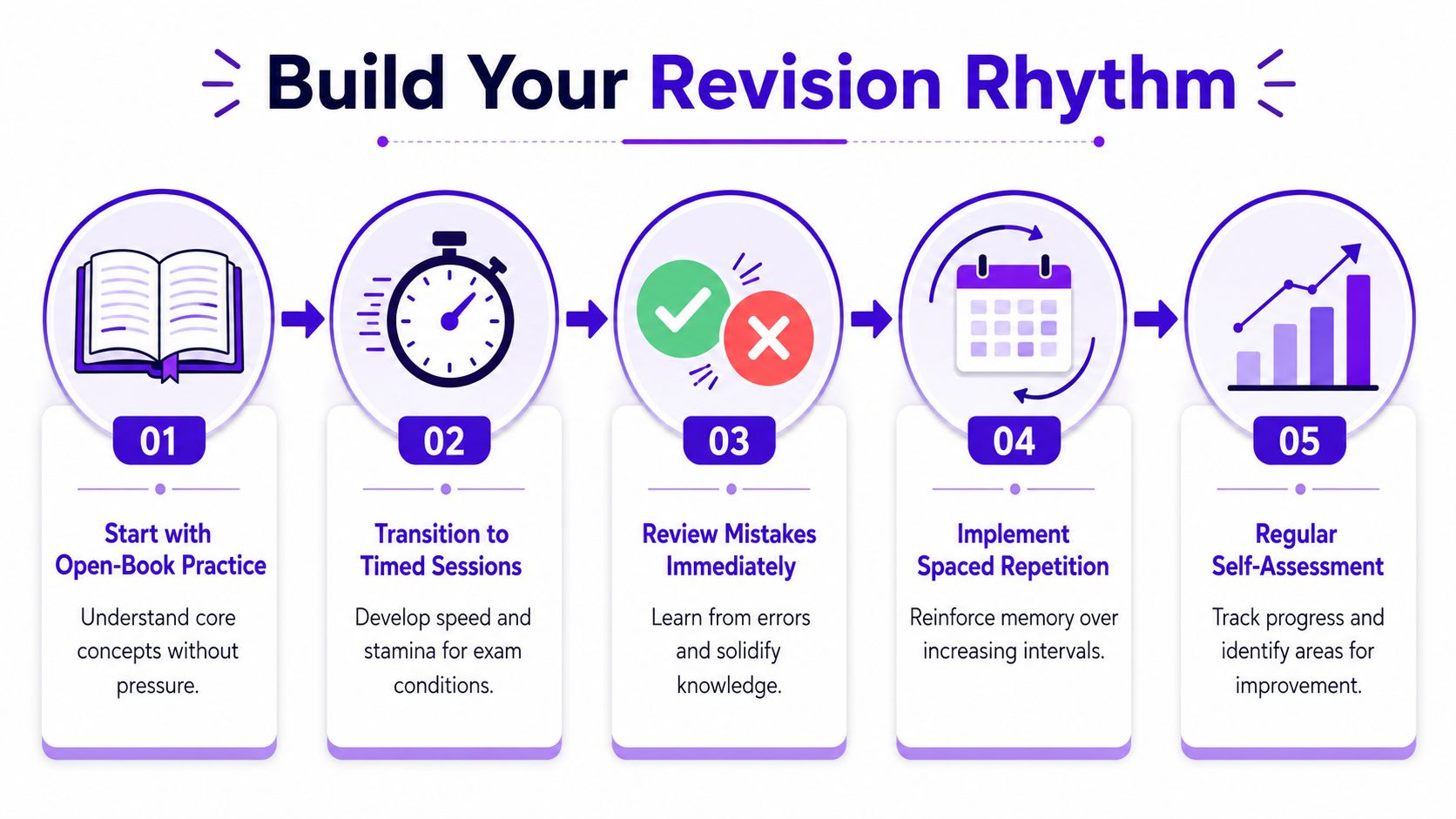
Move from open-book to exam conditions
There's nothing wrong with open-book practice at the start. In fact, it's often the smartest move. If you're learning how to set up equilibrium expressions or structure a six-marker on enthalpy changes, notes can help you build the habit correctly.
Then tighten the conditions in stages:
Open-book attempt
Focus on method and wording.Closed-book untimed attempt
See what you can recall without support.Single-question timed attempt
Build speed without the fatigue of a whole paper.Timed section
Learn pacing across related questions.Full paper simulation
Only once the earlier steps are stable.
This progression matters because a 2021 Sutton Trust study found students completing at least 100 specification-aligned practice questions had a 21% higher chance of achieving an A or A. In addition, JCQ's 2023 data showed that 41% of A Chemistry students practiced under timed conditions for at least 15 complete exams**.
A weekly rhythm that students can actually keep
You don't need a heroic timetable. You need one you'll still follow next week.
Try this structure:
Monday
Topic rebuild: one weak area, open-book, short questions onlyWednesday
Timed set: one focused burst on calculations, organic mechanisms, or practical dataFriday
Mistake review: redo questions you got wrong without looking at the answer firstSunday
Mixed practice: one mini-paper with topics shuffled together
That last part matters. Mixed-topic practice is where recall gets tested properly, because the exam won't tell you what chapter you're in.
Spaced review stops the fake confidence problem
Students often “know” a topic right after revising it. Then a week later it's gone. That's not failure. That's memory doing what memory does unless you revisit material deliberately.
Use a simple review loop:
| When | What to do |
|---|---|
| Same day | Correct errors and rewrite the key method |
| Two to three days later | Reattempt a similar question from memory |
| One week later | Mix that topic into unrelated questions |
| Two weeks later | Test it under timed conditions |
If you only revise what feels familiar, you protect your confidence and weaken your grade.
For students who want a cleaner way to simulate timing, Exam Practice for A-Level can help structure timed sessions without having to build them manually. The important part isn't the tool itself. It's the routine: timed work, immediate review, then spaced return.
Think Like an Examiner Mark Your Work and Find the Gaps
A lot of students “mark” work by checking whether the final answer matches. That's too shallow for A-Level Chemistry.
Examiners don't reward good intentions. They reward what's on the page. If you got the right number but didn't define units properly, if you knew the bonding idea but didn't include the numerical justification, or if your explanation was chemically sound but too vague for the mark scheme, the mark still goes.
Use the mark scheme like a forensic tool
When you review an answer, don't ask only, “Was I right?” Ask:
- What exact phrase or step got the mark?
- What did I assume the examiner would infer?
- Did I skip a technical detail because I thought it was obvious?
- Was this a knowledge problem or an exam-technique problem?
That distinction changes your next step. A knowledge problem means content revision. An exam-technique problem means deliberate practice in answer construction.
A perfect example is bond angle explanation. A 2024 analysis of AQA and OCR mark schemes reveals that 68% of bond angle questions demand a precise numerical justification, such as “-2.5° per lone pair”, yet only 32% of available online practice resources include this level of detail, leaving students unprepared. That's exactly the sort of hidden expectation that catches able students out.
Build a mistake log you'll actually use
Don't create a massive spreadsheet that you abandon after three days. Keep it simple and brutal.
Use four columns:
| Question type | What I lost marks on | Why it happened | What I'll do next time |
|---|---|---|---|
| Bond angle explanation | Missing numerical justification | I gave a generic answer | Memorise the required phrasing and practise three more |
| Titration calculation | Unit handling | I rushed the setup | Write units at each line |
| Practical method | Vague improvement suggestion | I didn't tie it to error reduction | Link every improvement to a specific source of uncertainty |
This works because patterns appear fast. Some students always lose marks on notation. Others on command words. Others write sensible but underdeveloped long answers.
Mark schemes don't just tell you the answer. They tell you what the examiner needed to see and what you failed to make visible.
Red ink is useful when you use it properly
Teachers know this instinctively. The comments students hate reading are often the most valuable thing on the page. “Too vague.” “Units missing.” “Need comparison.” “No link back to question.” Those aren't personal criticisms. They're recurring mark losses.
If your mistake log shows the same issue three times, stop doing more full papers for a moment. Drill that weakness directly. That's how a level practice questions chemistry becomes targeted revision rather than a confidence-damaging grind.
Deconstruct the High-Value Questions Maths Essays and Practicals
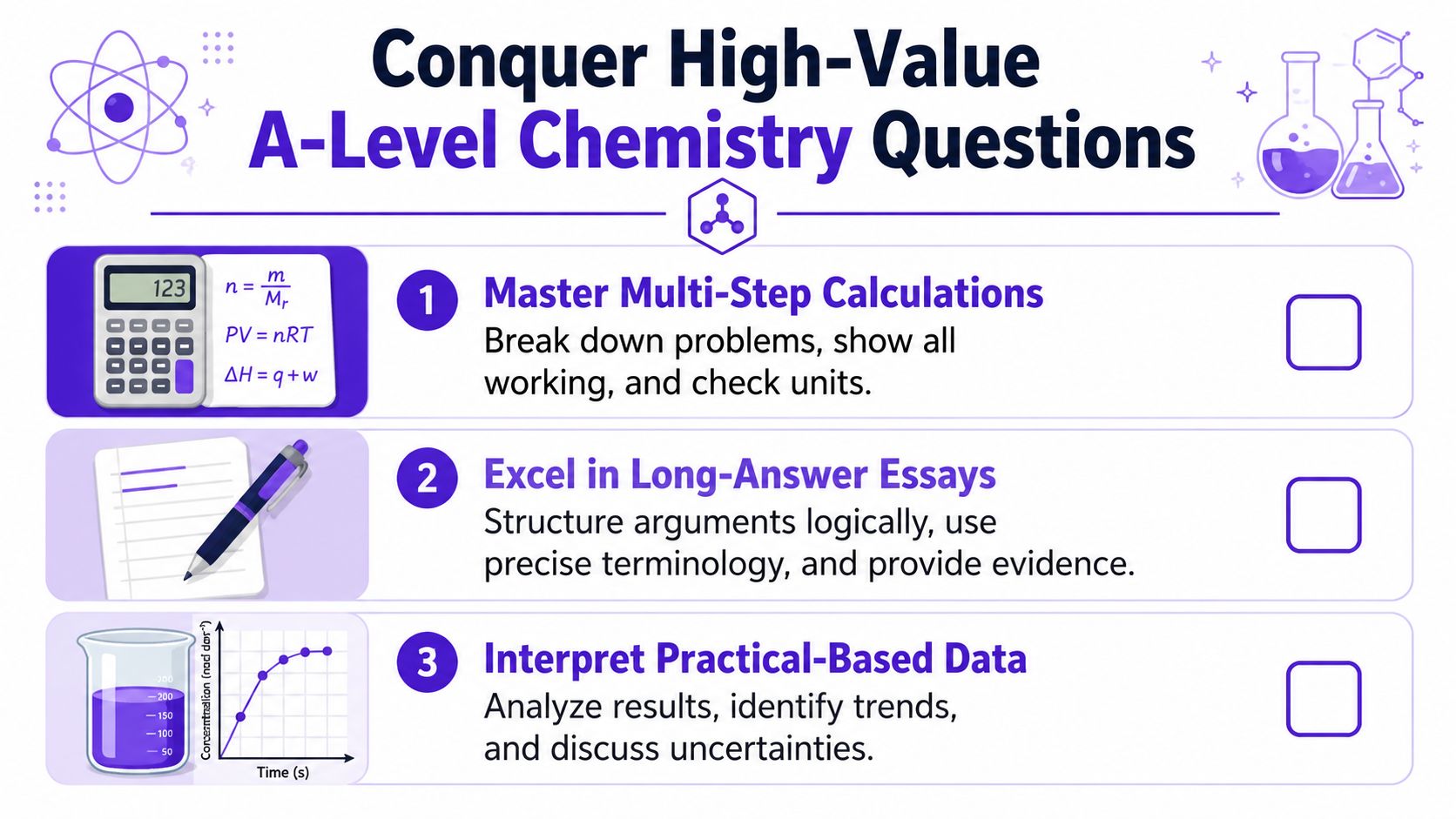
Some question types carry more risk than others. They're where marks swing sharply because they test multiple skills at once. In Chemistry, the big three are usually multi-step calculations, extended writing, and practical-based analysis.
Students who struggle often aren't weak across the whole subject. They're weak in one of these formats.
Maths questions need a visible method
Chemistry calculations punish hidden thinking. You may know what to do in your head, but if your steps aren't visible, you can't reliably pick up method marks and you can't diagnose errors.
This is especially important because UK A-Level Chemistry students who systematically practice calculation questions show a 34% higher success rate in achieving A/A. The most common pitfall, accounting for 42% of lost marks in extended questions, is failing to explicitly state chemical equations or define units*.
Use this routine every time:
Write the equation or relationship first
Rate equation, moles formula, electrode equation, whatever applies.Label the values with units
Don't leave numbers floating on the page.Substitute clearly
Make it obvious what came from the question.Check the final unit and significant figures
Many marks disappear right here.
A calculation answer should look almost boring. That's good. Boring is reliable.
Extended answers reward structure, not waffle
The hardest long answers aren't usually hard because the Chemistry is impossible. They're hard because students dump knowledge instead of building an argument.
AQA is especially clear here. AQA A-Level Chemistry papers are explicitly structured with a 24-mark essay question in Section C of Paper 2, and this single question accounts for 12.5% of the total A-Level grade. The mark scheme rewards breadth, depth, and accuracy, and an answer that misses the required depth can be capped at 4 marks regardless of writing quality. That means a fluent answer can still score badly if it isn't organised around the rubric.
For these answers, use a planning frame before you write:
- Pick three distinct chemistry areas that accurately reflect the title.
- Decide your best examples before writing the first sentence.
- Include precise chemistry such as equations, mechanisms, conditions, or state symbols where relevant.
- Link each paragraph back to the title so the response stays analytical rather than descriptive.
A lot of students write only what they remember first. That creates narrow essays with repeated ideas. Breadth has to be intentional.
A long answer isn't a memory dump. It's a controlled demonstration that you can select, connect, and explain Chemistry accurately.
There's another structural issue in free-response theory questions. UK A-Level Chemistry practice question data reveals that 73% of students who fail to achieve A grades miss marks in FRQs due to incomplete Point-Evidence-Explain structuring in theoretical explanations, particularly in benzene delocalisation and Kekulé model refutation questions.* When students explicitly link the evidence to the theory and then explain the contradiction, their answers become much more mark-scheme friendly.
A quick PEE model looks like this:
| Part | What it should do |
|---|---|
| Point | State the chemistry claim directly |
| Evidence | Give the experimental or factual support |
| Explain | Show why that evidence supports or challenges the model |
Practical questions test how you think about evidence
Practical questions catch students who memorised methods but never thought about why each step matters. Examiners often want more than “repeat the test” or “use better equipment”.
Train yourself to ask:
- What variable is being controlled?
- What source of uncertainty is largest?
- How would this change improve reliability, accuracy, or validity?
- Does the graph or table support the conclusion?
There's also a technical precision issue many students underestimate. In stoichiometry and ionic equation work, notation matters. Examiners can withhold marks for missing state symbols even when the numerical chemistry is right. That's why practical and theoretical answers both need technical care, not just conceptual understanding.
A final example from calculations shows how procedural gaps appear. AQA examiner reporting has highlighted that many lower-graded candidates omit the order of reaction step before calculating K, even though that step is essential. The safest routine is to identify the order first, isolate variables second, and only then calculate the constant and its units. Students who break these stages apart make fewer avoidable mistakes.
Your Masterplan From Revision to Results
The panic usually comes from vagueness. You know Chemistry is big. You know the exam is coming. You know you should be doing more. But “more” is a terrible plan.
A better plan has four clear parts.
First, match your practice to your exam board. Don't revise from random Chemistry content when your marks depend on board-specific wording and expectations.
Second, build a rhythm. Open-book when you're learning. Timed when you're stabilising. Spaced review when you want the topic to stay put.
Third, mark like an examiner. Stop asking only whether the answer was right. Start asking what evidence of understanding the mark scheme demanded.
Fourth, train the high-value formats directly. Calculations need method and units. Essays need structure and range. Practical questions need reasoning tied to data and uncertainty.
What this changes for students and teachers
For students, this approach replaces that horrible feeling of “I'm revising loads and nothing's sticking” with something much more useful. You can see why you lost marks, what pattern keeps repeating, and what to do next.
For teachers, it turns practice into a diagnostic process instead of a completion exercise. That matters because improvement in Chemistry often looks less like “covering more content” and more like fixing the same few mark-losing habits with precision.
If you want one place to organise that kind of structured approach, Online Revision for A-Level can sit alongside your normal class notes, teacher feedback, and past-paper work. Used properly, a tool should sharpen the process, not replace the thinking.
The students who recover late aren't always the ones who suddenly become geniuses. They're often the ones who finally stop revising in a fog. The students who reach A* usually aren't doing magic either. They've just learned to practise in the exact shape the exam rewards.
You don't need perfect motivation. You need a system you'll trust and repeat.
MasteryMind gives you a practical way to apply this system with exam-board-aligned questions, timed exam practice, and feedback built around how UK exams are marked. If you want your a level practice questions chemistry work to feel organised rather than random, explore MasteryMind.
Ready to master this topic?
Practise with quizzes, blurt exercises and exam questions on MasteryMind.
7 days Premium · Then free forever · No card, no charge