Aims and Objectives of a Business: Your 2026 Exam Guide
You turn the page in the exam hall and see it.
“Analyse the aims and objectives of a business.”
If that question makes your brain go fuzzy, you're not alone. A lot of students know the words, but they don't know how to use them in an answer. That's where marks disappear. You write “make profit”, “grow”, “be successful”, and it feels right, but it sounds too vague for top-band marks.
The good news is that this topic is learnable fast. Once it clicks, it becomes one of those areas where you can pick up marks again and again because the same logic shows up in case studies, short-answer questions, and longer analyse or evaluate questions.
Your Guide to Aims and Objectives Starts Here
Think about two businesses.
One is a small local sandwich shop run by a family. The other is a huge international company selling phones, tablets, and software. They're both businesses, but they don't wake up each morning chasing goals in exactly the same way.
The sandwich shop might care most about surviving, paying bills on time, and keeping regular customers coming back. The big company might care about launching new products, protecting its brand, and growing in different markets. Both need direction. Both need a plan. That's where aims and objectives of a business come in.
A lot of textbook definitions make this sound more complicated than it is. Strip it back and the idea is simple. A business needs to know where it wants to go, and it needs clear steps to get there. If it doesn't, managers can't judge progress, staff won't know what matters most, and decisions become random.
That matters in real life, and it matters for your grade. In an exam, the students who score well don't just define the terms. They apply them to the business in the question. They spot whether the business is new or established, small or large, profit-making or not-for-profit. Then they choose aims and objectives that fit.
Quick exam truth: vague answers usually sit in the middle of the mark scheme. Precise, contextual answers move up.
If you want more structured practice after reading, Online Revision for A-Level can help you test this topic in an exam-style format rather than just rereading notes.
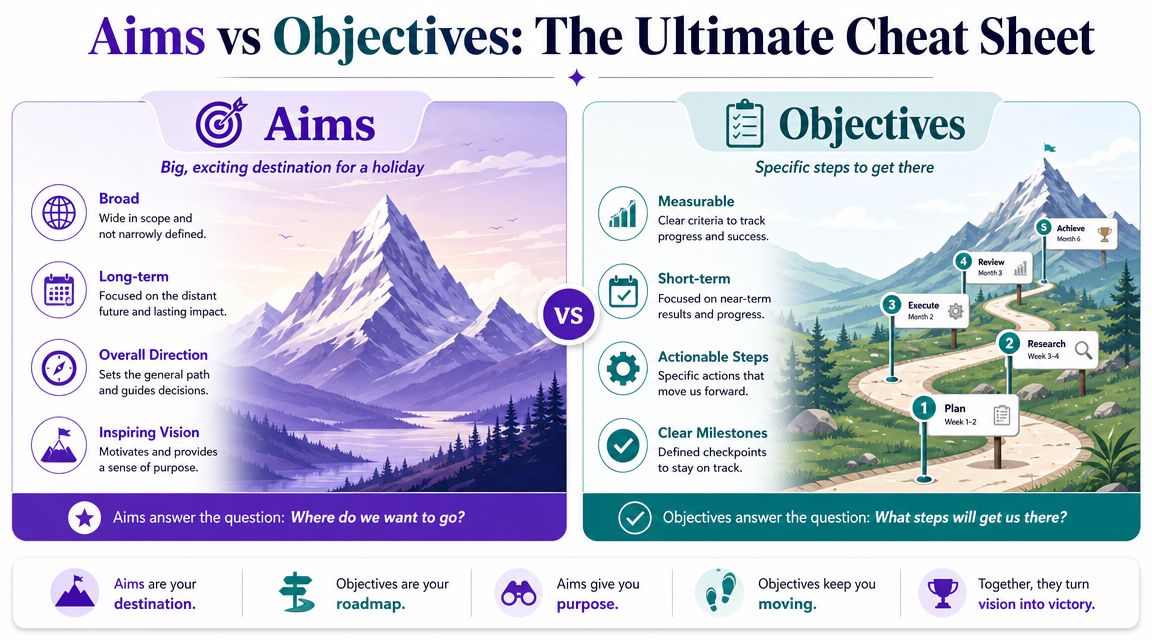
Aims vs Objectives The Ultimate Cheat Sheet
This is the most common confusion point. Students mix up aims and objectives, and once that happens, the whole answer gets messy.
The holiday analogy that makes it stick
An aim is like saying, “I want an amazing summer trip.”
That's the big picture. It gives direction. It tells you what success looks like in a broad sense.
An objective is like saying:
- Save money: put aside a set amount each month.
- Book key parts: sort flights and accommodation by a deadline.
- Prepare properly: learn useful phrases or plan transport before you go.
The aim gives you the destination. The objectives give you the route.
The difference in one clean table
| Term | What it means | What it looks like |
|---|---|---|
| Aim | A broad overall goal | “Build a strong reputation” |
| Objective | A specific target that helps achieve the aim | “Improve repeat customer visits by using a loyalty scheme and tracking retention” |
What examiners want you to say
A strong answer usually shows these contrasts clearly:
- Aims are broad: they're general intentions such as survival, growth, profit, or social impact.
- Objectives are specific: they turn broad intentions into clear targets or actions.
- Aims are long-term: they often reflect the bigger direction of the business.
- Objectives are more immediate: they help managers check whether the business is moving in the right direction.
A quick business example
Take a clothing brand.
Its aim might be to become a trusted name among young shoppers.
Its objectives might include improving online sales, reducing customer churn, or lowering customer acquisition cost. Those KPI-style measures are the kind of detail that lifts an answer because they sound like real business thinking, not classroom waffle.
A lot of revision pages stop at the definition stage. Better guides for UK learners go one step further and show how to apply the difference to case studies, which is where the marks really are.
If you can say “the aim is the broad destination, while the objective is the measurable step”, you've already fixed one of the biggest exam mistakes.
Why Businesses Need Aims and Objectives to Survive
A business without clear aims and objectives lacks direction. It can be busy, but the work may not lead to progress.

Suppose a small business owner spends the morning replying to emails, ordering stock, posting on Instagram, and chasing late payments. That sounds productive. But if the underlying problem is poor cash flow, those jobs are not equally important. Aims and objectives help managers decide what deserves attention first.
That matters in exams because students often describe objectives as a nice extra. Examiners want a sharper point. Businesses use aims and objectives to guide decisions, measure performance, and improve the chance of survival.
They turn effort into direction
In a real business, time and money are limited. Managers cannot treat every task as urgent. Clear aims help them choose between options.
A cafe might need to decide whether to buy new furniture or keep more cash in reserve. A retailer might choose between opening longer hours or improving staff training. Without a clear objective, those decisions become guesswork. With one, the choice is easier because managers can ask a simple question. Which option helps us reach the target?
This is why stronger exam answers explain cause and effect. Aims set priorities. Priorities shape decisions. Better decisions improve performance.
They help managers control the business
Control sounds boring, but it is one of the biggest reasons objectives matter.
If a business says it wants to "grow", that is too vague to manage properly. A manager needs something more precise to check. Are sales rising? Are repeat customers increasing? Are costs under control? Clear objectives give managers a benchmark, so they can compare actual results with what they planned.
Analysts at Quisitive note that many UK firms use customer management systems to track performance through data rather than instinct alone, as shown in Quisitive's summary of UK data use. The point for your exam is simple. Businesses do not just set goals for decoration. They use goals to monitor whether their actions are working.
If you want to connect this idea to marketing, this guide for social media marketers shows how firms tie content and campaigns to clear targets instead of posting randomly.
They reduce costly mistakes
Small firms have less room for error than large ones. One poor decision on pricing, stock, staffing, or promotion can cause real damage.
Clear objectives reduce that risk because they keep attention on what matters most. If survival is the priority, the business may focus on cash flow, cost control, and customer retention. If growth is the priority, it may accept lower short-term profit to gain market share. The objective shapes the decision.
That is the nuance many students miss. The "right" objective depends on the business situation. In an exam case study, always link the objective to the firm's circumstances.
What gets marks in a written answer
A weak answer says, "businesses need objectives to be successful."
A stronger answer explains the chain clearly:
- aims give the business a clear focus
- objectives turn that focus into measurable targets
- managers compare actual performance with those targets
- they make changes if performance is off track
- this helps the business survive, grow, or improve efficiency
That chain is analysis. Analysis lifts your grade.
If you are revising across topics, you can view all study subjects and practise linking business ideas in the way examiners reward.
Exam tip: If you explain how objectives improve decision-making and control, you are already writing beyond a basic definition.
Real World Examples from a Cafe to a Charity
This topic gets easier when you stop thinking in abstract words and start seeing actual organisations.
A local cafe
A small independent cafe doesn't usually begin with a grand aim like “dominate the global beverage sector”. It's more likely to aim for survival, a good local reputation, and loyal repeat customers.
Its objectives could include tighter stock control, stronger customer service, and steady local demand. The owner may care just as much about paying suppliers on time and keeping enough cash in the bank as they do about making profit.
That's why practical planning matters. If you want to see the sort of real issues cafe owners think about, this guide on how to plan your cafe finances gives useful context for how financial aims turn into day-to-day choices.
A fast-growing tech startup
A startup often has a very different personality. Its main aim may be rapid growth, market entry, or building a strong user base before rivals do.
Its objectives are likely to sound more data-heavy. Managers may track things like Customer Acquisition Cost, Average Revenue Per User, and churn because those indicators help them judge whether growth is healthy or expensive. This is the kind of language that can make an A-Level answer sound more realistic and more commercial.
A good objective doesn't just sound impressive. It gives managers something they can actually act on.
A national charity
A charity still needs aims and objectives, but profit is not the main purpose. Its aim may be social impact, public awareness, or helping a specific group of people.
Its objectives might focus on fundraising, volunteer recruitment, service delivery, or campaign reach. The key point is this: not every organisation exists to maximise profit. If you spot that in an exam, you immediately look more thoughtful.
Why context changes everything
One of the easiest ways to lose marks is to give the same answer for every business. A corner shop, a tech startup, and a charity should not all have identical aims.
A better answer asks:
- What type of organisation is it?
- How big is it?
- What stage is it at?
- What matters most right now?
That last question is huge. For many businesses, especially smaller ones, aims can include community impact as well as financial survival. In the UK, SMEs accounted for 60% of employment and 48% of turnover in 2024, which shows they matter economically as well as commercially, according to Dinsmore's discussion of UK SMEs.
That means the aims and objectives of a business may include keeping local jobs, supporting nearby suppliers, and building trust in the area, not just chasing profit.
If you're revising similar topics like stakeholders, finance, and marketing alongside this one, it helps to view all study subjects so you can connect ideas instead of revising each topic in isolation.
How to Write Perfect SMART Objectives
Students often write objectives that are really just aims in disguise.
“Increase sales.”
That sounds fine until you realise it tells a manager almost nothing. Increase which sales? By how much? By when? Using what method? Is it realistic?
That's why SMART objectives matter.
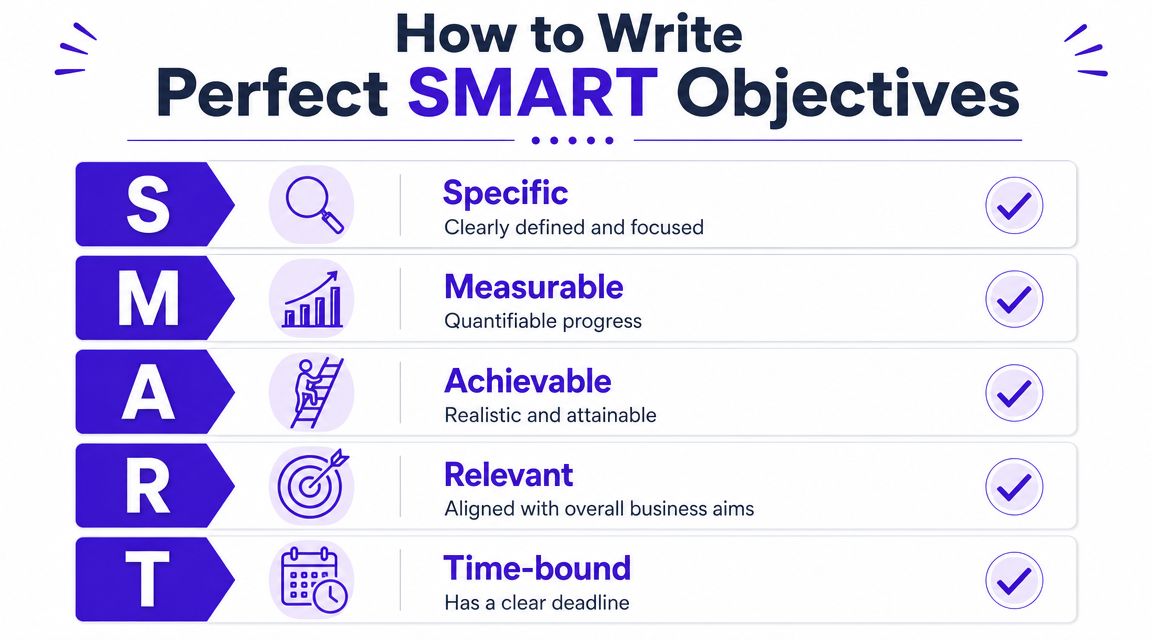
What SMART means
Here's the quick version in a table you can remember.
| Letter | Meaning | Simple test |
|---|---|---|
| S | Specific | Is the target clear? |
| M | Measurable | Can progress be tracked? |
| A | Achievable | Is it realistic? |
| R | Relevant | Does it fit the main aim? |
| T | Time-bound | Is there a deadline? |
Turning weak objectives into strong ones
Take this weak objective:
“Increase sales.”
Now improve it step by step.
- Specific: increase online sales of one product line
- Measurable: track performance using a clear KPI
- Achievable: make sure the target fits the business's resources
- Relevant: link it to the wider aim, such as growth
- Time-bound: add a deadline
A stronger version would be something like: increase online sales of a chosen product line by using targeted promotion and tracking performance over a set period.
Notice what happened. The target became clearer, more realistic, and easier to judge.
Why measurable really matters
The “M” is where many strong answers stand out. Modern businesses don't just say “do better”. They use data.
UK organisations that define objectives through KPI-led data projects can improve decision quality, and goals like revenue growth are often turned into metrics such as CAC, ARPU, and churn, as explained by Pragmatic Institute on aligning data projects with business goals.
That means a student who writes about measurable indicators sounds much closer to real business practice.
Here's a useful way to approach it:
Memory hook: an aim tells you the dream. A SMART objective tells you what to check on Friday.
A short explainer can help if you prefer hearing the framework out loud:
Common SMART mistakes
Students usually slip up in one of these ways:
- Too broad: “be more popular”
- Not measurable: “improve customer happiness”
- Not realistic: a tiny firm writing giant growth targets with no evidence
- No deadline: nothing says when success should happen
- No link to the aim: the objective sounds random
If you're practising these with digital revision tools, use them to check whether your answer includes all five parts. For example, MasteryMind gives examiner-style practice and feedback aligned to UK exam boards, which can help you spot when your objective is still too vague.
A student-friendly formula
If you freeze in an exam, use this sentence starter:
To support the aim of [broad goal], the business could set the objective of [specific target], measured by [KPI or indicator], within [time period].
That one line can rescue a whole paragraph.
The Exam Zone Acing Your Aims and Objectives Questions
It is at this point that grades jump. Not because the topic changes, but because your answer technique gets sharper.
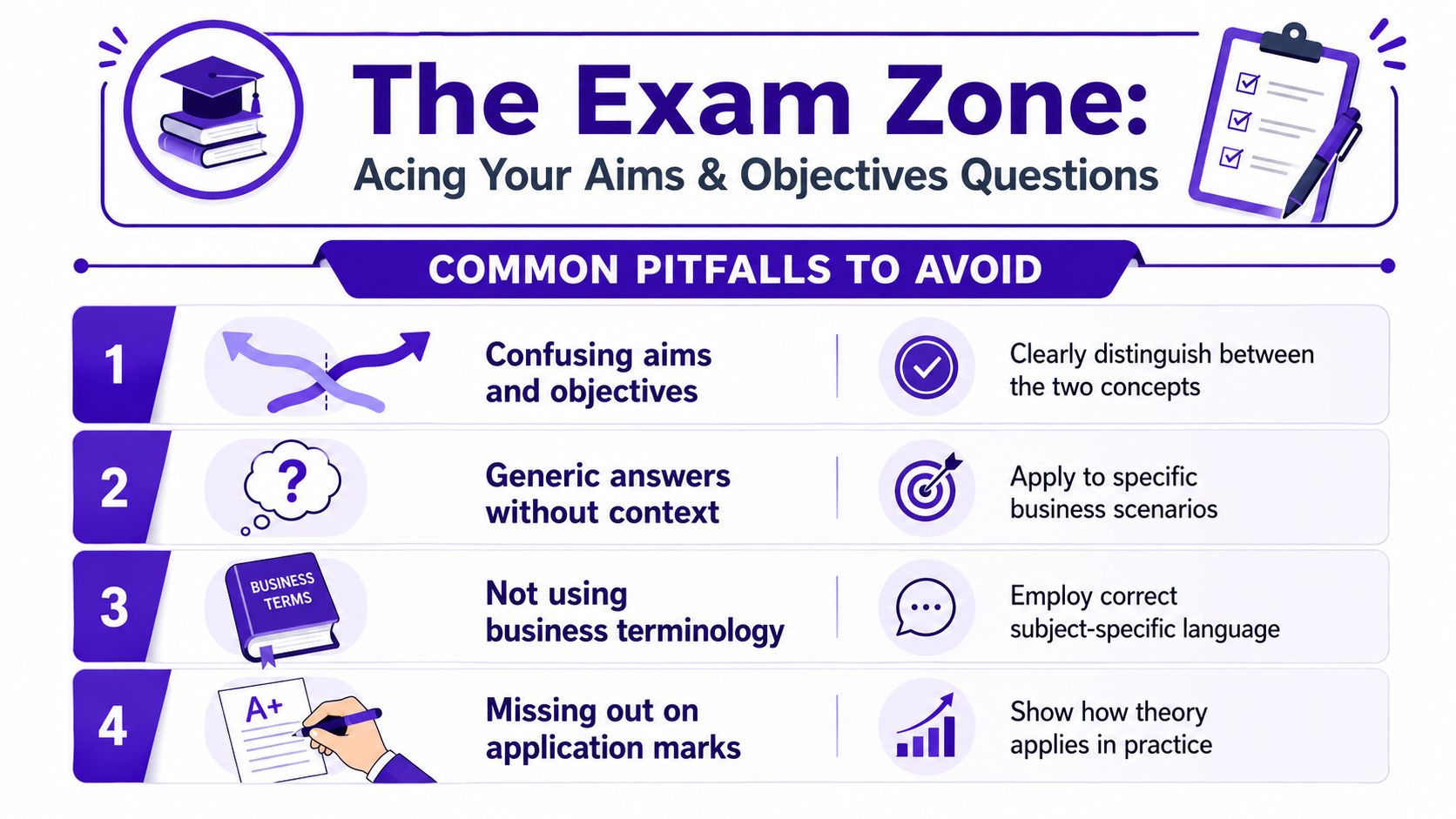
The mistakes that cost marks
A lot of weak answers do one of these:
- They confuse the key terms: they call an aim an objective, or the other way round.
- They stay generic: they write about “making profit” with no link to the case study.
- They ignore context: they forget that a new small business may care more about survival than expansion.
- They stop at description: they identify an objective but never explain why it matters.
For small firms, this is especially important. An often-missed exam point is that for the 99.9% of UK businesses that are small, objectives are often about survival and managing cash flow, not just profit, and the British Business Bank highlights a persistent finance gap, meaning an objective to secure a £20,000 overdraft may matter more than a vague growth target, as discussed in this piece on underserved small businesses.
That kind of contextual point can instantly improve an answer because it sounds realistic.
What a strong answer does instead
A strong response usually follows this pattern:
- State the aim or objective clearly
- Apply it to the business in the question
- Explain the likely effect
- Link back to success, risk, or decision-making
That's basically AO1, AO2, and AO3 working together.
A sample exam question
Analyse two objectives a new small business might set.
A solid answer might choose:
- Survival
- Positive cash flow
Why those two? Because a new small business often faces limited resources, uncertain demand, and pressure to cover short-term costs.
Model answer breakdown
Here's the kind of paragraph structure that works.
Point 1
A new small business may set an objective to maintain positive cash flow. This means making sure enough money is coming into the business to pay wages, rent, and suppliers. This objective is important because a business can be busy and still struggle if payments go out before customer income arrives. If cash flow is controlled well, the business has a better chance of staying open long enough to build a customer base.
Point 2
Another likely objective is survival in the early stage of trading. A new business may not focus first on large profits because it needs to establish itself, attract repeat customers, and reduce the risk of failure. If managers prioritise survival, they may keep costs tight, avoid risky expansion, and make more cautious decisions. That can create a stable base for growth later.
The best exam answers don't sound fancy. They sound precise.
A final examiner-style checklist
Before you move on from this topic, check your answer against these questions:
- Have I separated aims from objectives clearly?
- Have I used the case study details?
- Have I explained why the objective matters?
- Have I considered the business type or size?
- Have I written at least one analytical chain using “because”, “therefore”, or “this could lead to”?
If you want to practise that exam method directly, Exam Practice for A-Level gives question-by-question practice with mark-focused feedback, which is useful when you're trying to turn knowledge into actual exam marks.
If you want a revision tool that turns topics like aims and objectives into exam-style questions with feedback linked to UK mark schemes, take a look at MasteryMind. It's built for GCSE and A-Level learners who need structured practice, not just more notes to read.
Ready to master this topic?
Practise with quizzes, blurt exercises and exam questions on MasteryMind.
7 days Premium · Then free forever · No card, no charge