Analysis of Dulce Et Decorum Est: A GCSE & A-Level Guide
You open the poem, see Latin in the title, then get hit with mud, blood, gas and a man dying in front of his mates. If you're revising fast, it can feel like everyone else “gets” Dulce et Decorum Est and you're just trying not to drown in the language. If you're aiming higher, the problem is different. You know the poem is anti-war, but that answer alone won't get you the marks sitting at the top of the mark scheme.
That's where a sharp analysis of Dulce et Decorum Est matters. Not a vague summary. Not a list of techniques. What examiners want is a clear argument about how Owen uses language, structure and context together.
A lot of students miss the same two high-value ideas. First, the massive gap between the noble Latin title and the filthy, violent English of the poem itself. Second, the way Owen slowly strips the soldiers of dignity through a pattern of dehumanising imagery. If you can explain those two things clearly, your essay starts sounding far more precise.
Your Guide to Nailing 'Dulce et Decorum Est'
A student I taught once knew plenty of quotations from the poem but kept writing the same point in different words: “war is horrible”. That's not wrong. It's just too broad. Examiners reward students who can say how Owen makes war seem horrible, and why he presents it that way.
That's why this poem often divides students into two groups. One group retells what happens. The other group analyses Owen's choices. The second group scores better because they turn observation into argument. Instead of saying “the soldier dies painfully”, they say Owen uses violent sensory language and broken rhythm to force the reader to experience panic rather than observe it.
What strong answers do differently
Strong answers usually do three things:
- Track a pattern: They don't analyse one word in isolation. They follow an idea across the poem, such as exhaustion, panic, or dehumanisation.
- Link AO2 and AO3: They connect technique to context. Owen's gas attack imagery matters more because he wrote from lived experience of trench warfare.
- Explain the poem's purpose: They show that Owen isn't just describing war. He's attacking the belief that dying for your country is noble.
Practical rule: If your point could fit almost any war poem, it's probably too general.
If you're building revision from scratch, keep your notes usable. One page for context. One for structure. One for key quotations. One for essay plans. That's more effective than drowning in random annotations and hoping something sticks.
For students who want organised practice instead of scattered notes, Online Revision for GCSE can help you turn poem knowledge into exam-style responses.
The Story Behind the Poem Context Is Everything for AO3
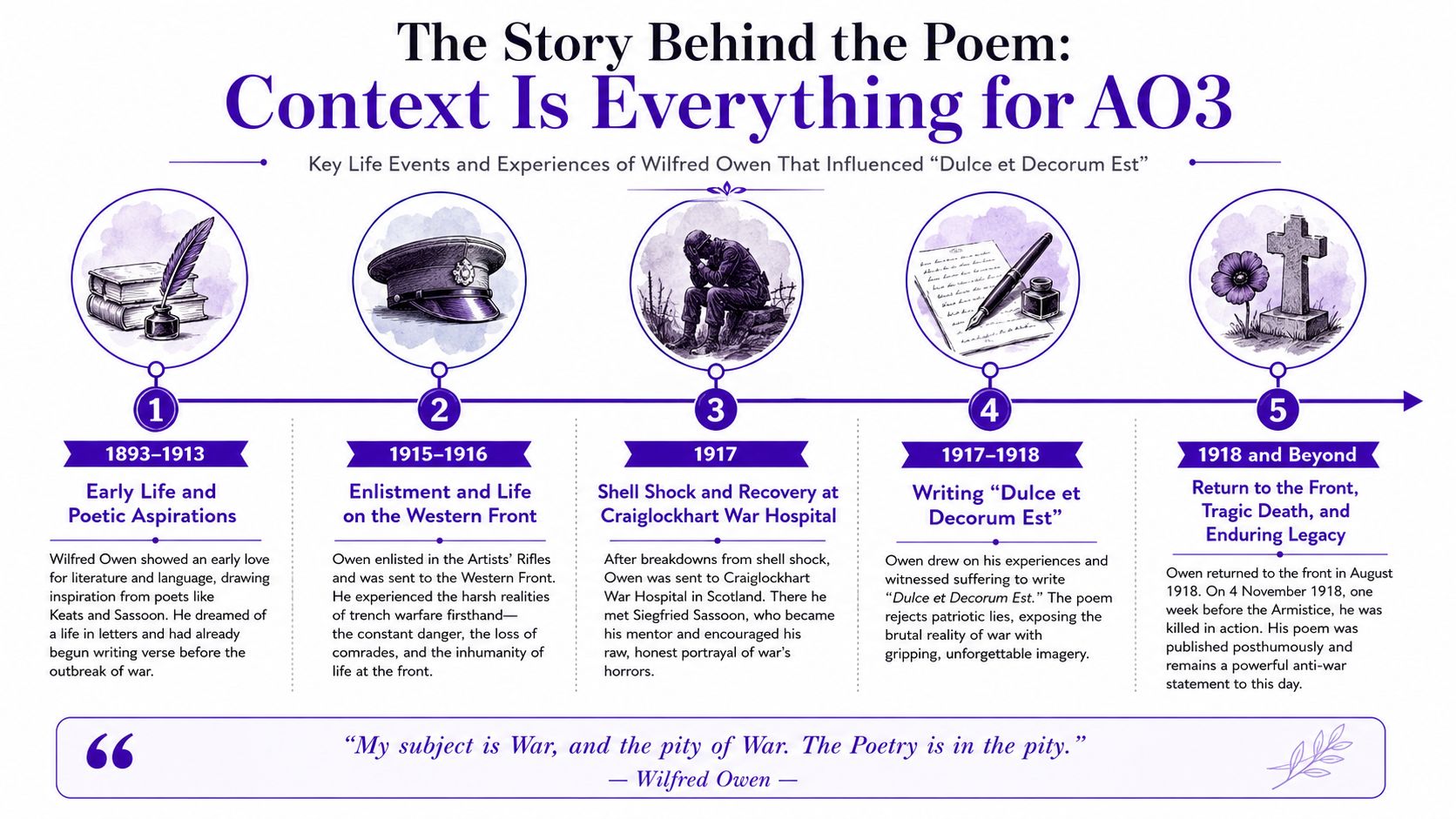
The poem only really clicks when you remember that Owen wasn't inventing horror from a distance. Wilfred Owen's poem is historically anchored in a gas attack he witnessed in 1917. That matters because the poem doesn't read like patriotic fantasy. It reads like testimony.
The context you actually need
You don't need to dump a history textbook into your essay. You need a few relevant points used well.
Here's the core of it:
Owen was a soldier in the First World War.
His writing comes from direct exposure to trench conditions and combat trauma.The gas attack is central.
The most shocking scene in the poem is rooted in something Owen witnessed, which gives the poem unusual authority and urgency.He attacks an old patriotic idea.
The title comes from Horace's Latin phrase “Dulce et decorum est pro patria mori”, which Owen calls the “old Lie” in a direct challenge to the glorification of war.He was part of a wider change in war poetry.
Over 90% of British war poets moved from pro-war to anti-war sentiment between 1914 and 1918, a shift noted in this discussion of Owen's historical context.
How to turn context into marks
Weak AO3 sounds like this: Owen fought in the war so he knows what it was like.
Better AO3 sounds like this: Because Owen's poem is rooted in a gas attack he witnessed in 1917, the vivid suffering of the dying soldier works as direct evidence against patriotic ideas that present war as noble.
That second version does more. It links context to writer's purpose.
Context only helps if it changes your reading of the poem.
Another useful move is comparison. If you've studied idealised war poetry elsewhere, Owen becomes even more powerful because he tears down that comforting version of war. His anger isn't abstract. It's aimed at people and ideas that made young men believe death in battle was glorious. That's why the ending sounds accusatory rather than reflective.
Teachers often look for students who can use context with control rather than bolt it on at the end. One sentence, properly linked to a quotation, is worth more than a whole paragraph of detached background.
If you're comparing war poetry, MasteryMind exam preparation for The Soldier gives a useful contrast in attitude and presentation.
Breaking Down the Poem's Blueprint Form and Structure
A lot of students treat structure as an afterthought. They say the poem has four stanzas, maybe mention enjambment, then move on. That leaves marks behind. In this poem, structure isn't decoration. It helps Owen recreate the physical and mental collapse of the soldiers.
Why the opening feels controlled
The poem begins with a strange kind of order. According to LitCharts' analysis of the poem's structure, the first two stanzas adopt a near-sonnet form with a regular iambic pentameter, creating a trudging, controlled pace. That matters because the men are exhausted, but the poem still holds them in a kind of grim formation.
This is a clever choice. A traditional-sounding structure usually suggests elegance or balance. Owen twists that expectation. He uses a disciplined frame to present men who are anything but heroic. They are “Bent double” and broken down. The gap between traditional form and ruined bodies already starts undermining romantic ideas of war.
Where the structure breaks
Then the gas attack hits.
The poem's rhythm and syntax become far less stable. The final two stanzas break into irregular syntax and longer lines to mimic the chaotic agony of the gas attack, again noted in the LitCharts reading. Instead of steady movement, the reader gets disruption. The poem doesn't just describe panic. It produces it.
Here's a useful way to write about that:
- Before the attack: The structure feels heavy and controlled, echoing the soldiers' weary march.
- During the attack: Sudden disruption mirrors shock and confusion.
- After the attack: The poem moves into nightmare and memory, showing that trauma doesn't end when the event ends.
That last part is important. Owen doesn't stop at battlefield action. He shows replay, haunting and mental aftershock.
Form as meaning
A strong AO2 point might sound like this:
Owen uses structural asymmetry so the poem collapses alongside the soldiers' safety. The movement from near-regular form into disrupted rhythm mirrors the shift from exhausted endurance to immediate terror, making psychological trauma part of the poem's shape.
That's stronger than just saying “the structure becomes irregular”.
You can also notice how the poem narrows and widens its focus. It begins with a group of soldiers moving together, then suddenly zooms in on one man who fails to get his helmet on in time. That shift matters. Owen takes war from mass movement to individual suffering. He makes the reader witness one body, one death, one memory. This stops the poem from becoming an impersonal account of battle.
A short exam formula
Use this three-step line when writing about structure:
| Structural feature | What happens | Why it matters |
|---|---|---|
| Near-regular opening | Trudging pace | Suggests drained, controlled movement |
| Sudden disruption | Panic in gas attack | Forces reader into chaos |
| Disturbed ending | Memory and accusation | Shows trauma lasts beyond the event |
If you remember one thing, remember this. In Owen's poem, form carries meaning. The structure is part of the anti-war message.
Owen's Arsenal of Words Analysing Language and Imagery
Most students can spot that Owen's language is violent. Fewer can explain the pattern underneath it. The strongest close analysis doesn't just collect techniques. It notices that Owen keeps lowering the soldiers' status until they barely seem human.
The opening strips away dignity
“Bent double, like old beggars” is a brutal opening. Soldiers are usually imagined as strong, upright and purposeful. Owen gives you the opposite. They are bent, tired and compared to people associated with poverty and weakness.
Then comes “coughing like hags”. That simile gets reduced too often to “they are old”. It does more than that. “Hags” carries a supernatural edge. It's ugly, warped and disturbing. The men start to seem less like honoured soldiers and more like grotesque figures in a nightmare.
That pattern matters.
Progressive dehumanisation
A key insight many guides skim past is Owen's progressive dehumanization strategy. Exam-related feedback discussed in this video resource notes that only 22% of top-grade UK essays successfully link words such as “hags” and “cud” to a layered strategy of animalistic and supernatural imagery.
That means this is a real separator.
You can track it like this:
- “Old beggars” reduces soldiers to social ruin.
- “Hags” gives them a warped, eerie quality.
- “Cud” connects the body to animal chewing and loss of dignity.
This isn't random description. Owen shows war eroding identity step by step. The men aren't presented as glorious defenders of the nation. They become exhausted bodies, damaged voices and animal-like mouths.
The dehumanising imagery matters because it shows what war does to people before it kills them.
Sensory violence and sound
Owen also attacks the reader's senses. Verbs like “guttering, choking, drowning” don't let the death stay distant. They are physical and ongoing. The line feels hard to say cleanly, which suits the scene. Language itself starts to choke.
A smart point here is that Owen often chooses words that are ugly in the mouth. The rough sounds and thick consonants make the poem feel clogged and harsh. That's useful for AO2 because you're analysing the reader's experience, not just identifying a technique.
You can phrase it like this:
| Word or phrase | Method | Effect |
|---|---|---|
| “Bent double” | physical imagery | removes heroic posture |
| “like old beggars” | simile | presents soldiers as degraded and vulnerable |
| “coughing like hags” | simile with supernatural connotations | makes the men seem distorted and haunted |
| “cud” | animal imagery | reduces human speech and suffering to bodily function |
| “guttering, choking, drowning” | visceral verbs | recreates the violence of death in real time |
A model analytical move
Try this sentence shape in an essay:
Owen's imagery becomes progressively less human. He first presents the soldiers as “old beggars”, then “hags”, and later uses “cud”, suggesting that war destroys not only the body but also identity, dignity and speech.
That's the kind of point examiners can reward because it tracks development.
If you want to test that kind of thinking against another war poem full of physical threat and instability, exam-aligned Bayonet Charge questions are useful for practice.
The Power of the Title Decoding the Great Irony
A lot of essays throw in, “the title is ironic”, and stop there. That's not enough. The title is one of Owen's most deliberate weapons, and misunderstanding it costs students marks.
Why the title matters so much
Over 60% of student errors in recent GCSE exams stem from misinterpreting the title's irony, according to Eduqas guidance on refreshing the teaching of the poem. The problem is usually this. Students spot that the poem disagrees with the Latin phrase, but they don't explain how the contrast works.
The key phrase here is socio-linguistic gap. It sounds technical, but the idea is simple. The title is in classical Latin, associated with education, authority and cultural prestige. The poem itself is packed with brutal trench English: mud, choking, blood, panic. Owen places those two worlds side by side so they clash.
Latin versus trench reality
The title comes from Horace, a Roman poet. That gives the phrase weight. It sounds old, wise and respectable. But Owen fills the poem with scenes that make the phrase look obscene.
That contrast gives you a sharper argument than “it's ironic”. You can say:
- The Latin title sounds noble and detached.
- The body of the poem is immediate, bodily and horrifying.
- Owen uses that clash to expose how elite language can hide physical suffering.
Top-band AO3 often appears in such analysis. You're not only identifying irony. You're explaining how language, class and cultural tradition work together.
Owen puts tradition on trial
The cleverness of the title is that Owen doesn't paraphrase the idea. He keeps the original Latin. That means he preserves its authority only to destroy it. The phrase arrives carrying centuries of patriotic honour, then the poem forces it to face the evidence of modern mechanised war.
Owen doesn't merely reject the slogan. He makes the reader watch it fail.
That's a strong line of argument because it links purpose and method. Owen wants to challenge not just one bad opinion, but an inherited tradition that taught young men to equate death with glory.
An exam-ready paragraph shape
If the question mentions title, irony, message or writer's purpose, build a paragraph like this:
- Start with the Latin phrase and its noble tone.
- Contrast it with the poem's violent, bodily language.
- Explain that Owen exposes the phrase as false when tested against real suffering.
- End on purpose. He attacks the rhetoric used to justify war.
Here's that argument in compact form:
The title sounds dignified because it uses classical Latin associated with authority and honour, but Owen fills the poem with gas, blood and choking so that this lofty statement collapses under the weight of trench reality. The irony comes from the clash between elevated patriotic language and the actual experience of soldiers.
That's the sort of point that stands out because it moves past label-spotting and into interpretation.
Unpacking the Big Ideas Themes and Tone
Once the details are secure, the poem's larger meanings become easier to see. Owen isn't making one simple point. He builds several linked arguments, all driven by anger, pity and warning.
The themes that matter most
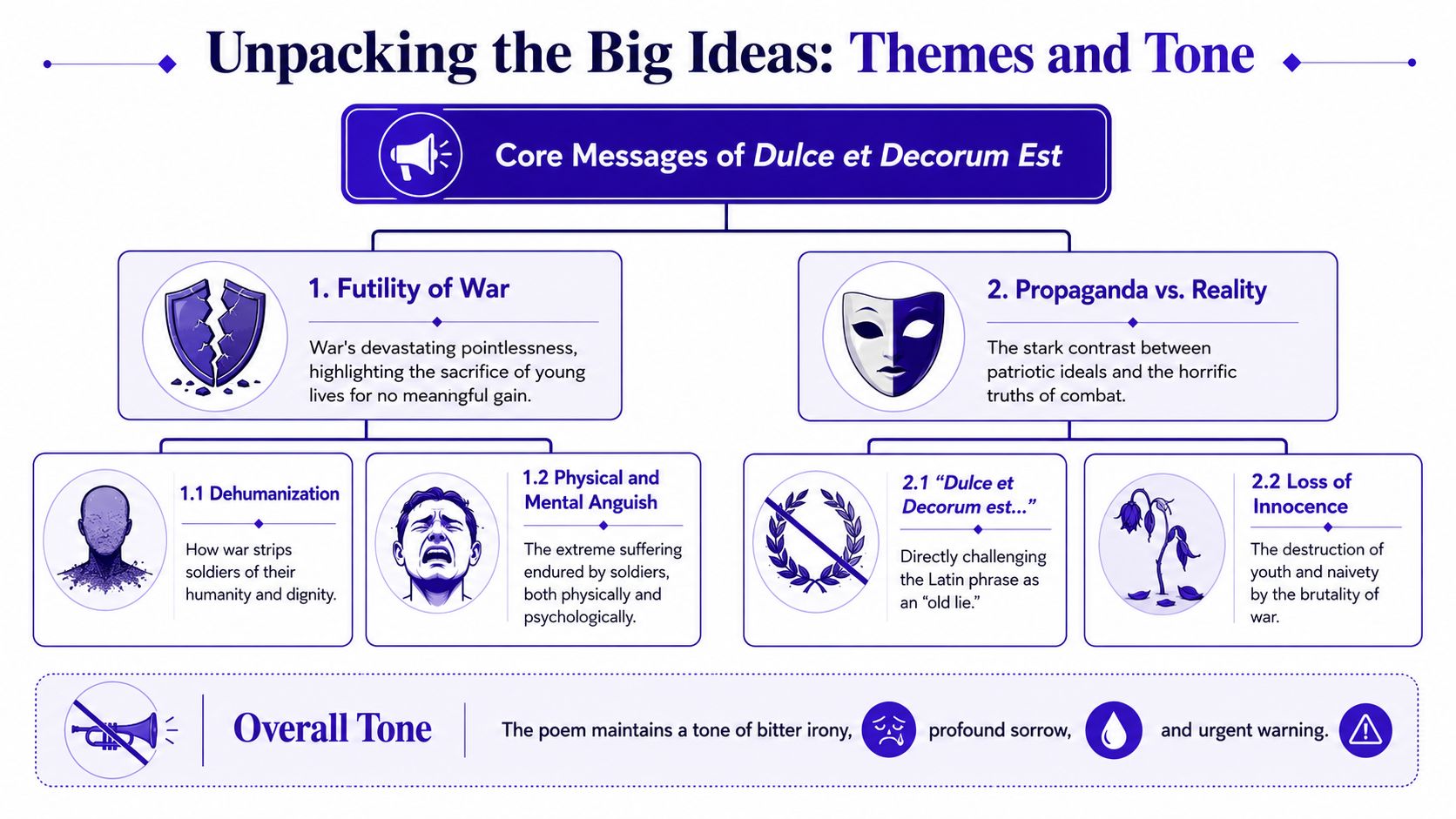
The biggest theme is propaganda versus reality. The poem attacks the polished idea of patriotic death by forcing the reader to confront what battlefield suffering looks like.
A second major theme is loss of humanity. As covered earlier, Owen's imagery reduces the men from soldiers to damaged bodies and distorted figures. War doesn't just injure them. It strips away identity and dignity.
There's also physical and psychological trauma. The gas victim's death is central, but the poem doesn't end there. The speaker is haunted by what he has seen, which suggests trauma continues in memory.
Tone is more than sadness
Students often describe the tone as “sad” or “angry”. Both are partly true, but neither is enough on its own.
The tone is better described as:
- Bitter, because Owen attacks the lie behind patriotic slogans
- Pitying, because he focuses on suffering soldiers rather than abstract battle
- Furious, because the final address turns outward in accusation
- Traumatised, because the memory remains vivid and unresolved
The poem doesn't mourn war from a distance. It speaks from inside the damage.
A useful big-picture summary
If you need one line for revision, use this:
| Big idea | What Owen argues |
|---|---|
| War and glory | The myth of noble sacrifice collapses under real suffering |
| Patriotism | Patriotic rhetoric can become dangerous when it hides truth |
| Humanity | War degrades and dehumanises soldiers |
| Trauma | Violence continues in memory after the event itself |
Essays often become more confident at this point. Instead of saying “Owen shows war is bad”, you can say he exposes the gap between heroic language and bodily truth, while showing that war destroys both life and identity.
Your Ultimate Quote Bank for Revision
Good revision quotes do two jobs. They're memorable, and they can flex across more than one point. You don't need to memorise the whole poem. You need a set of quotations you can use for AO2 and AO3 without forcing them.
The quotes worth knowing
| Quote | What it shows | Best use in an essay |
|---|---|---|
| “Bent double, like old beggars” | Exhaustion and loss of dignity | Use for dehumanisation, anti-heroic imagery, physical suffering |
| “coughing like hags” | Distorted, grotesque suffering | Use for simile, progressive dehumanisation, nightmarish tone |
| “GAS! GAS! Quick, boys!” | Sudden panic and chaos | Use for structural disruption, urgency, shock |
| “guttering, choking, drowning” | Violent, ongoing death | Use for visceral verbs, sensory impact, trauma |
| “blood-shod” | Brutal physical damage | Use for bodily suffering and trench imagery |
| “as under a green sea, I saw him drowning” | Distorted perception and horror | Use for simile, helplessness, surreal atmosphere |
| “Come gargling from the froth-corrupted lungs” | Graphic physical detail | Use for shock, disgust, anti-war purpose |
| “The old Lie” | Direct moral judgement | Use for writer's message and attack on propaganda |
| “Dulce et decorum est / Pro patria mori” | The slogan Owen dismantles | Use for title analysis, AO3, irony, classical allusion |
How to revise them properly
Don't revise quotes as detached scraps. Revise them in clusters.
For example:
- Cluster for suffering: “Bent double”, “blood-shod”, “guttering, choking, drowning”
- Cluster for dehumanisation: “old beggars”, “hags”, “cud”
- Cluster for purpose and irony: “The old Lie”, “Dulce et decorum est / Pro patria mori”
That helps because exam questions rarely ask for one isolated technique. They ask how the poet presents conflict, suffering, reality, attitudes or message.
The quotation that carries AO3
One quotation deserves extra attention. The poem's technical core is its allusion to Horace's Odes, quoting “Dulce et decorum est pro patria mori” verbatim. As this analysis of Owen's poem explains, this classical quotation acts as a rhetorical benchmark against which Owen contrasts the true nature of gas warfare.
That's why this quote is so useful. It doesn't only give you language analysis. It opens up writer's purpose, historical context and the poem's attack on patriotic tradition.
Revision shortcut: Learn fewer quotes, but learn more to say about each one.
A quick memory method
Try this simple routine:
- Pick five quotations.
- Write one technique beside each.
- Add one theme beside each.
- Practise turning each into a full analytical sentence.
That final step matters most. Recognition isn't enough. In the exam, you need retrieval plus explanation.
From Analysis to A-Star Essay Plans and Model Paragraphs
Knowing the poem is one thing. Writing a calm, precise essay under time pressure is something else. At this critical point, students either cash in their revision or waste it by producing a paragraph full of labels and no argument.

A smart starting point is to remember how central this poem is in real exam preparation. Over 850,000 UK students study “Dulce et Decorum Est” annually for GCSEs, and exam boards such as AQA, Edexcel and WJEC expect students to analyse how its content, structure and context deconstruct the “old Lie”, as outlined in this GCSE guide to the poem. So if this poem feels important, that's because it is.
A model paragraph
Question: How does Owen present the reality of war in Dulce et Decorum Est?
Model paragraph:
Owen presents war as degrading and brutally unheroic from the opening line. The soldiers are described as “Bent double, like old beggars”, a simile that immediately strips them of the dignity usually associated with soldiers. Instead of presenting them as proud fighters, Owen compares them to figures linked with weakness, poverty and exhaustion. This dehumanising image helps him attack idealised views of combat because the men's bodies already show the truth that patriotic slogans hide. The effect is strengthened by the poem's heavy opening rhythm, which creates a trudging pace and makes the soldiers seem physically crushed by war.
That paragraph works because it does four things cleanly. It makes a point. It uses evidence. It zooms in on language. It links the method to Owen's anti-war purpose.
Two essay plans you can actually use
Essay plan one on suffering and conflict
Question: How does Owen present suffering in Dulce et Decorum Est?
Paragraph 1
Opening exhaustion and damaged bodies.
Use: “Bent double, like old beggars”, “blood-shod”.Paragraph 2
Gas attack as immediate terror.
Use: “GAS! GAS! Quick, boys!”, “guttering, choking, drowning”.Paragraph 3
Lasting trauma through memory and nightmare.
Use the dream image and the final accusatory ending.Conclusion
Owen shows suffering as physical, mental and moral. War destroys the body, then haunts the mind.
Essay plan two on writer's message
Question: How does Owen challenge patriotic ideas about war?
Paragraph 1
Anti-heroic presentation of soldiers.
Use the opening dehumanising similes.Paragraph 2
Brutal realism of the gas scene.
Explain how violent detail disproves noble propaganda.Paragraph 3
The Latin phrase and “The old Lie”.
Focus on irony, authority and attack on tradition.Conclusion
Owen dismantles the idea that dying for your country is glorious by confronting the reader with what such death really looks like.
A writing routine that helps under pressure
If your essays freeze halfway through, simplify your process:
- Read the key word in the question twice: suffering, conflict, attitude, message, reality
- Choose three quotations before you start writing: don't hunt for them mid-paragraph
- Build one argument per paragraph: don't cram every idea into one messy block
- End paragraphs with purpose: always return to what Owen wants the reader to think
Students who want more structured writing support often benefit from reading essential essay composition guides alongside regular practice, especially if they know the ideas but struggle to shape them into an argument.
For timed practice with real exam wording, A-Level Past papers can help you test whether your analysis holds up when the clock is running.
A quick explanation can also help if you want to hear ideas spoken through before writing them:
You do not need a perfect essay to score highly. You need a controlled one. If your argument is clear, your quotations are chosen carefully, and your analysis keeps linking back to Owen's purpose, you're already doing what strong students do.
If you want a structured way to practise poems like Dulce et Decorum Est, MasteryMind offers curriculum-aligned revision for UK learners, including exam-style questions, feedback linked to assessment objectives, and practice that matches major exam boards.
Ready to master this topic?
Practise with quizzes, blurt exercises and exam questions on MasteryMind.
7 days Premium · Then free forever · No card, no charge