AQA Biology Specification: Your Ultimate Guide for GCSE & A-Level
Staring at the AQA Biology specification can feel like trying to read a different language. It’s dense, it’s long, and it’s easy to feel overwhelmed before you’ve even started. But here’s the secret: it’s not a rulebook designed to catch you out.
Think of it as the ultimate cheat sheet, straight from the people who write your exams. It tells you exactly what could come up.
Your Ultimate Roadmap to Exam Success
Whether you're panicking and playing catch-up or you're pushing for a grade 9, the AQA Biology specification is the single most valuable document for your revision. So many students fall into the trap of just revising from textbooks, but these often have extra fluff that won't be on the exam. The specification cuts through all that noise.
It's your official map. Every topic, every required practical, and every skill you need is laid out in plain sight. Revising without it is like trying to find your way through a new city without Google Maps – you might get there eventually, but you're guaranteed to waste time and take some seriously wrong turns.
Why Mastering the Specification Is a Game-Changer
Getting to grips with this document gives you a huge advantage. If you feel like you're behind, it gives you a clear, focused checklist to work through. And if you're aiming for the top grades, it helps you spot the subtle links between topics that are essential for hitting those high-level marks.
Making the spec the heart of your revision plan gives you:
- Total Clarity: It lists every single thing that can be on your exam papers. No more nasty surprises on the day.
- Efficient Study: You can finally stop wasting hours on content your textbook includes "for interest" and focus only on what will actually earn you marks.
- Smarter Exam Technique: The spec breaks down the assessment objectives, helping you understand how you'll be marked, not just what you'll be marked on.
By using the AQA Biology specification as your primary revision tool, you move from just passively reading to actively preparing. You start to think like an examiner, which is the key to answering questions in the precise way they want.
In this guide, we're going to pull apart the specification for both GCSE and A-Level. We'll translate the jargon, map out the topics for each paper, and explain the practical skills and command words that are crucial for your success. We’ll also look at how modern tools like MasteryMind are built around this exact document to make your revision smarter, not harder.
Right, let's get into it.
Cracking the Code of AQA GCSE Biology

Right, let’s get stuck in. At first glance, the AQA GCSE Biology specification can look like an intimidating mountain of information. But once you see how it’s put together, you’ll realise it’s actually a clear and logical roadmap.
Think of it less like one giant textbook and more like a seven-part TV series. Each episode is a core topic, starting with the microscopic world of cells and building up to the huge, interconnected web of ecosystems. Once you’ve mastered one, you have the knowledge to properly understand the next.
The Seven Core Topics You Need to Know
The entire GCSE course is built on seven key pillars. Some of these will feel familiar from earlier school years, but they’ll be explored in much greater depth, while others will introduce completely new concepts. Getting a solid grip on what each one covers is the absolute first step to effective revision.
Here’s the essential breakdown:
- Topic 1: Cell Biology: The absolute foundation. This is where you'll cover everything from the key differences between animal and plant cells to microscopes, cell division (mitosis and meiosis), and the role of stem cells.
- Topic 2: Organisation: This topic zooms out to see how all those cells work together. You'll learn about major organ systems like the digestive and circulatory systems, plus the vital job of enzymes.
- Topic 3: Infection and Response: Time to become a disease detective. This topic covers pathogens, how different diseases spread, and the incredible ways your immune system fights back, including the science behind vaccinations.
- Topic 4: Bioenergetics: It sounds complex, but this is really all about energy in living things. You'll dive deep into two of the most important processes on the planet: photosynthesis and respiration.
- Topic 5: Homeostasis and Response: This is the body's control centre. It explores how your body maintains a stable internal environment and responds to changes, covering the nervous system, hormones, and reflexes.
- Topic 6: Inheritance, Variation and Evolution: Get ready to explore genetics. This topic unravels DNA, genetic inheritance, Darwin's theory of evolution by natural selection, and how we classify all life on Earth.
- Topic 7: Ecology: The final topic zooms out to the biggest picture of all. You'll study how organisms interact with each other and their environment, tackling ecosystems, biodiversity, and our human impact on the planet.
How the Topics Are Split Between Your Exams
Knowing these seven topics is one thing, but understanding how you’ll be tested on them is what gives you a real strategic edge. AQA splits the content across two separate exam papers, and each one has its own specific focus.
This structure is your secret weapon for targeted revision. You can find more detail on this in the AQA GCSE Biology specification breakdown on classroom42.com.
Knowing exactly which topics fall on which paper allows you to focus your energy where it matters most. In the final weeks before Paper 1, for example, you can dedicate your time exclusively to Topics 1-4, knowing the others can wait. This is how you revise smarter, not just harder.
To make this crystal clear, here’s a simple table mapping it all out.
AQA GCSE Biology Paper Breakdown
The table below gives you a straightforward summary of which topics are assessed on each of the two GCSE Biology exam papers. Use it as a checklist to track your revision progress.
| Exam Paper | Topics Covered | Total Marks |
|---|---|---|
| Paper 1 | 1. Cell Biology 2. Organisation 3. Infection and Response 4. Bioenergetics | 96 Marks |
| Paper 2 | 5. Homeostasis and Response 6. Inheritance, Variation and Evolution 7. Ecology | 96 Marks |
Each paper is worth 96 marks, making a total of 192 marks for the qualification.
By understanding this fundamental structure, you’re no longer just passively reading a textbook—you're an active strategist. You can now build a revision plan that mirrors exactly how you'll be examined. For more specific practice aligned with these topics, you might find our dedicated AQA GCSE Biology revision tools really helpful. This clear roadmap is your first major step towards exam confidence.
Stepping Up to AQA A-Level Biology
If you thought GCSE Biology was a challenge, get ready to shift gears. The jump to the AQA A-Level Biology specification is a big one, but it’s also where the subject becomes genuinely fascinating. This isn't about simply memorising facts anymore; it's about learning to think like a biologist.
The course is cleverly structured to build on itself. You don't just "do" a topic and then forget about it. Everything you learn in your first year (the AS content) is the bedrock for what comes next. It’s like building a house – you can't start thinking about the roof until you have solid foundations.
The Foundational Four: Your AS Topics
Your A-Level journey kicks off with four core topics that lay the groundwork for everything else. These aren’t just hurdles to get over in Year 12; they are the fundamental principles you'll keep coming back to right up until your final exams.
Here's a quick look at your starting blocks:
- Biological Molecules: Welcome to the chemistry of life. You'll go way beyond basic food groups to get to grips with the intricate structures of carbohydrates, lipids, proteins, and nucleic acids. Think of these as the tiny, essential Lego bricks that build every living thing.
- Cells: Prepare for a much deeper dive into the microscopic world. You’ll explore the complex machinery inside eukaryotic cells and contrast it with the elegant simplicity of prokaryotic cells. You'll also cover the nature of viruses and the techniques we use to study cells.
- Organisms Exchange Substances with Their Environment: This is all about biological plumbing and transport. You'll investigate how gas exchange works in a range of organisms, unpack the details of digestion and absorption, and explore the marvels of the mammalian circulatory system.
- Genetic Information, Variation and Relationships: Here, you get to the very heart of life itself—DNA. This topic covers everything from the structure of DNA and how proteins are made, to the causes of genetic diversity and the ways we classify the vast spectrum of life on Earth.
The first four topics are assessed in two AS papers, each lasting 1 hour 30 minutes. But don’t be fooled into thinking you can forget them in Year 13. The advanced topics build directly on this knowledge, and all eight topics can appear in your final A-Level exams.
Building on the Foundations: The A-Level Topics
Once you've mastered the AS content, you'll move on to the four advanced A-Level topics. This is where things really start clicking into place, and you begin to see the bigger picture of how entire biological systems work together.
These topics demand a much deeper level of analysis and application:
- Energy Transfers In and Between Organisms: This takes GCSE bioenergetics to a whole new level. You’ll explore photosynthesis and respiration in incredible detail, right down to the specific biochemical pathways. You’ll also zoom out to see how that energy flows through entire ecosystems.
- Organisms Respond to Changes in Their Internal or External Environment: Expanding on homeostasis, this topic covers the intricate details of nervous and hormonal control. You'll discover how organisms, from plants to people, perceive and react to the world around them.
- Genetics, Populations, Evolution and Ecosystems: A powerful topic that connects the molecular world of DNA with the grand scale of populations and evolution. You’ll get your hands on gene technologies, inheritance patterns, and the driving principles of natural selection.
- The Control of Gene Expression: This is one of the most exciting, modern fields in biology. You'll learn how genes are switched on and off, the role of stem cells, and the genetic basis of cancer and cutting-edge gene therapies.
The single most important thing to grasp is that A-Level Biology isn't just a list of disconnected topics. It's one continuous story. A concept from 'Biological Molecules' is absolutely essential for understanding 'The Control of Gene Expression' later on. This is what examiners call synoptic understanding.
Hitting the top grades means you need to make these connections without even thinking about it. When an exam question on ecosystems pops up, your brain should automatically start pulling in knowledge from photosynthesis and respiration. It’s this skill that separates the good students from the great ones.
To start building these connections with targeted practice, check out our specialised AQA A-Level Biology resources.
Understanding How Your Exam Is Marked
Ever had that sinking feeling when you get an exam paper back, knowing you understood the topic but still dropped marks? It’s a common frustration, and the reason often isn't your biology knowledge. The culprit is usually a misunderstanding of what the question is truly asking for. This is where you learn to think like an examiner.
Your final grade isn’t just about how many facts you can remember. It's about showing off specific skills that AQA groups into Assessment Objectives, or 'AOs'. Getting your head around these is the key to unlocking marks that other students miss. Every single question on your paper is designed to test one or more of these skills.
What Are Assessment Objectives Anyway?
Think of AOs as the rules of the game. If you don't know the rules, you can't win. In AQA Biology, there are three main objectives you need to master. They represent different levels of thinking, from simple recall to complex analysis.
Here's the breakdown in plain English:
- AO1: Show What You Know. This is the most straightforward objective. It tests your ability to remember and state biological facts, definitions, and processes. If a question asks you to 'state' or 'define', it’s testing AO1.
- AO2: Apply What You Know. This is where it gets more interesting. AO2 tests if you can take a biological concept and apply it to a new or unfamiliar situation. Questions might ask you to 'suggest' or 'predict' an outcome based on your knowledge.
- AO3: Analyse and Evaluate. This is the top tier. AO3 is about pulling apart information, interpreting data, judging the validity of a method, or forming a conclusion. It’s where you show you can think critically like a scientist.
A common mistake is treating every question like an AO1 question and just listing facts. The students who get top marks are the ones who can identify which AO is being tested and tailor their answer to match it perfectly.
Decoding the Language of Your Exam
The single biggest clue to what an examiner wants is the command word at the start of the question. Words like 'describe', 'explain', and 'evaluate' might seem similar, but in an exam, they are worlds apart and demand completely different answers.
For example, a 'describe' question on the nervous system might just ask you to outline the path of a nerve impulse (AO1). An 'explain' question would demand more, asking why myelin sheaths speed up transmission (AO2). Then, an 'evaluate' question might give you data from two different drugs affecting synapses and ask you to judge which is more effective, using evidence from the table (AO3).
This infographic shows a typical A-Level study path, where the progression from AS to A-Level demands an increasing focus on these higher-order AO2 and AO3 skills.
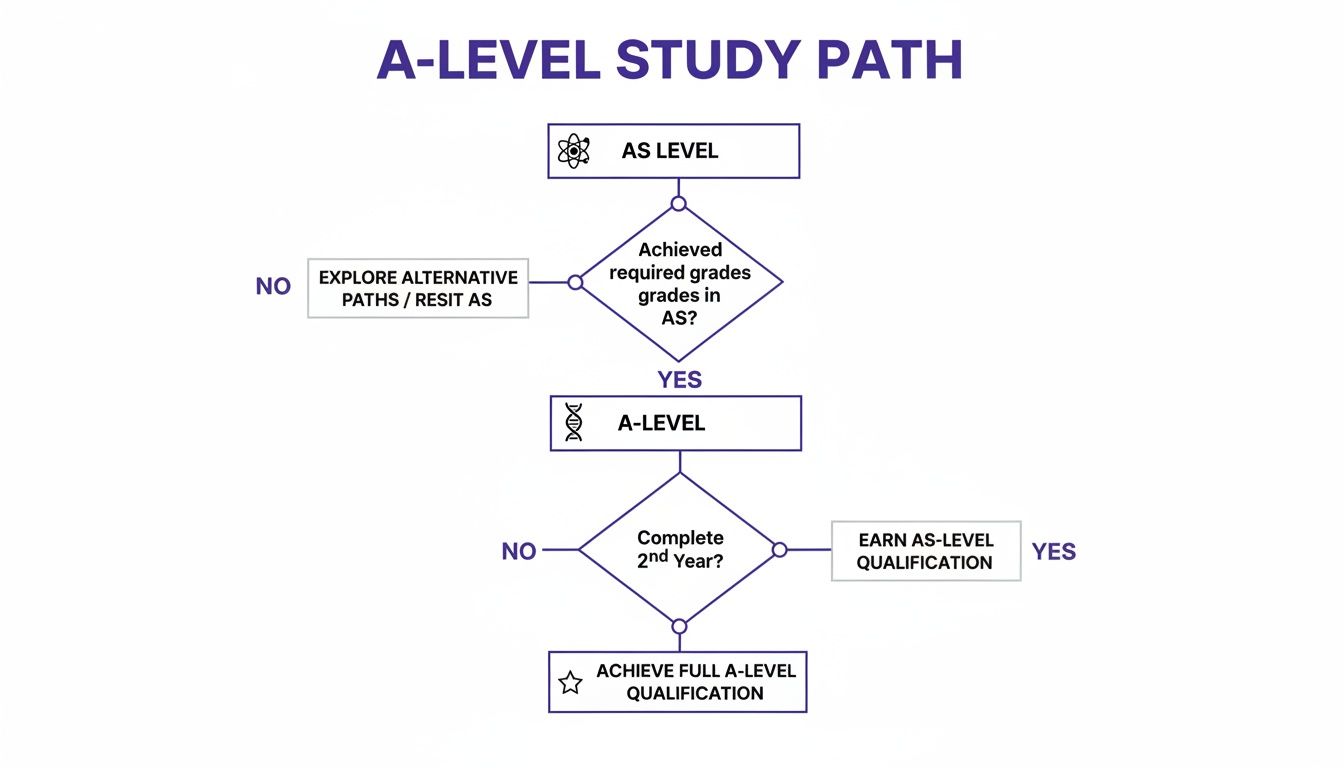
As the flowchart illustrates, the full A-Level qualification builds directly upon AS foundations, requiring you to not just know things, but to apply and evaluate that knowledge from across the entire AQA Biology specification.
Putting It All Together for Top Marks
The mark schemes themselves show you exactly how this works. If you look at past papers, you’ll see how marks are specifically awarded for AO1, AO2, and AO3. You can even explore the mark scheme structure from PMT from the June 2023 exams to see this in action.
The extended response questions, in particular, are built to test all three. They need you to logically link points to form a coherent argument, showing a clear progression from basic knowledge to higher-order evaluation.
Mastering this isn't just about memorising content; it's about developing a sharp and repeatable exam technique. By learning to decode what each question is asking for, you're not just revising biology—you're learning the language of the exam itself. And that's the skill that separates a good grade from a great one.
Mastering Required Practicals and Maths Skills

Let's get one thing straight: the required practicals are not just a box-ticking exercise you do in class and then forget about. They are a guaranteed source of exam questions, making up a hefty 15% of the total marks on your written papers. So, if you’ve been tempted to just go through the motions in your lab lessons, now is the time for a major rethink.
Think of them less as following a recipe and more as learning to think like a scientist. The examiners don’t just want to know if you can set up a water bath; they want to see if you understand why you’re doing it, what your results actually mean, and how you could improve the entire experiment.
This is a massive opportunity. For students who prepare well, these questions are a fantastic way to hoover up marks. For those who don't, it’s a huge area of risk.
More Than Just a Method
When you revise a required practical, you can’t just memorise the steps. The real marks are found in understanding the science behind the experiment. AQA will test you on everything from the core principles to spotting potential sources of error.
For every single practical, you need to be able to confidently answer these questions:
- Why? What is the fundamental scientific idea being investigated? (e.g., in the enzyme practical, what’s the link to collision theory?)
- How? What is the purpose of each step in the method? Why was that specific piece of equipment the right tool for the job?
- What if? What are the key variables? How do you control them, and what would happen if you failed to do so?
- So what? How do you process the data you collect? What do the results actually tell you about the biology?
The best way to revise for practical-based questions is to treat them like any other topic in the AQA Biology specification. They require a deep understanding of the method, application of your knowledge, and critical evaluation—hitting AO1, AO2, and AO3 all at once.
The Maths Skills You Cannot Ignore
Here’s a hard truth that catches so many students out: a big chunk of your biology exam is actually a maths test in disguise. At GCSE, a full 10% of the marks are for maths skills. This jumps to a massive 20% at A-Level. These skills are almost always tested within the context of practicals and data analysis.
You simply cannot afford to let them slide. Getting comfortable with these calculations is often the difference between just scraping a pass and securing a top grade.
Key mathematical skills you’ll be tested on include:
- Calculating percentage change: A classic for any experiment involving growth or reaction rates.
- Working with standard form: Essential when you're dealing with microscopic sizes or huge population numbers.
- Interpreting graphs and charts: You'll need to spot trends, calculate gradients (to find a rate of reaction), and even extrapolate data.
- Using statistical tests: At A-Level, this gets more serious. You'll need to get your head around standard deviation and know when to use tests like the chi-squared test.
Turning Weakness into Strength
Feeling a bit shaky on practicals and maths is completely normal, but trust me, it's an area you can definitely conquer with focused practice. Don't just reread your lab book; you need to actively test yourself.
Start with a blank piece of paper and try to write out the method for a required practical from memory. Then, challenge yourself to explain the purpose of each step without looking at your notes. Finally, find past paper questions on that practical and try to answer them under timed conditions.
This process of active recall builds robust, flexible knowledge that you can apply to any experimental scenario the examiners throw at you. By tackling this head-on, you can turn what feels like a common weakness into one of your biggest strengths in the exam hall.
Building a Revision Plan That Actually Works

Knowing what's in the AQA Biology specification is one thing, but turning that document into a genuinely effective revision plan is another game entirely. It’s like having a map but no idea how to read it. The real secret is creating a smart study schedule that gets you results without causing burnout.
If your current strategy is just re-reading your textbook until your eyes glaze over, it’s time for a change. Passive learning might feel productive, but the science behind memory tells us it’s one of the worst ways to make information stick. You need to get active.
From Passive Rereading to Active Recall
The two most powerful, science-backed techniques for locking in knowledge are active recall and spaced repetition.
Active recall is all about forcing your brain to retrieve information without peeking at your notes. Think of it this way: it’s easy to recognise the Krebs cycle in your textbook, but can you draw it from memory? That struggle to remember is what builds strong, lasting neural pathways.
Spaced repetition is the other piece of the puzzle. It means reviewing topics at increasing intervals—revisiting something after a day, then a few days, then a week. This tells your brain, "Hey, this is important, don't forget it!" and cleverly interrupts the natural forgetting curve.
Effective revision shouldn't feel easy. That feeling of wrestling with a concept or struggling to remember a definition is exactly where the learning happens. The struggle is a good thing—it’s what builds strong memories.
Building Your Specification-Based Schedule
Right, let's put this into practice using the AQA spec as our ultimate guide.
- Break It Down: Print off the AQA Biology specification. This is your master checklist. Go through each topic (like Topic 1: Cell Biology) and break it down into its smaller sub-points.
- Use a Traffic Light System: Grab some highlighters and code every single point. Green for concepts you’re confident with, amber for those that are a bit shaky, and red for your definite weak spots.
- Plan Your Sessions: Sketch out a weekly timetable, but be specific. Don't just block out "Biology Revision." Instead, schedule "Active recall on mitosis" or "Practice questions on osmosis." Focus on those red and amber topics first.
- Schedule the Spacing: This is crucial. As soon as you finish a topic, get your calendar out and schedule the follow-up reviews: one for the next day, another for three days' time, and another for a week later. This takes the guesswork out of spaced repetition.
Smarter Revision with Modern Tools
Let's be honest, creating all these quizzes and managing a spaced repetition schedule by hand can be a massive time sink. This is where a good revision tool can make a real difference.
Platforms like MasteryMind are designed around these very principles. They use the official AQA Biology specification to generate endless practice questions, and the clever bit is that they automatically focus on your weaker areas based on how you perform. The system constantly adapts, keeping you challenged just the right amount.
By combining the solid framework of the specification with proven learning techniques, you’re not just revising harder—you’re revising smarter. It’s a targeted, efficient approach that actually works.
AQA Specification: Your Questions Answered
When you're getting to grips with the AQA Biology specification, a few questions always pop up. Let's run through some of the big ones to clear things up and help you focus your revision.
How Much of the A-Level Exam Is Based on AS Content?
A massive chunk. Everything you learn in your first year (AS) is fair game for your final A-Level papers. The exams are deliberately synoptic, which is just a fancy way of saying they expect you to connect ideas from different topics, often mixing AS and A-Level concepts in a single question.
Forgetting your AS material is probably the biggest pitfall you can stumble into. Keep it fresh throughout your second year; it’s the bedrock on which all the trickier A-Level topics are built.
What Is the Best Way to Revise for 6-Mark Questions?
The trick to nailing a 6-marker is all about structure and hitting the right Assessment Objectives (AOs). First, slow down. Read the question, pinpoint the command word (like ‘evaluate’ or ‘describe’), and underline the key science words. Before you even think about writing, scribble down a quick plan to make sure your answer flows logically.
For every point you make, you need to back it up with the why – the biological reasoning (that’s your AO1/AO2). If the question asks you to ‘evaluate’, you absolutely have to argue both sides before landing on a solid, justified conclusion. That’s the only way to hit the top marks for AO3.
Honestly, the secret is just practice. Do these questions under timed conditions, then pull up the official mark scheme and compare your answer, line by line. It’s the fastest way to learn what the examiners are really looking for.
Can I Pass if I Am Bad at the Required Practicals?
In theory, maybe. But you’d be making life unnecessarily hard for yourself. Questions about the required practicals are guaranteed to make up at least 15% of the total marks across the written papers. These aren't just about memory; they test if you actually understand the methods, can handle data, and can evaluate the results.
Skipping revision on these means you’re basically throwing away a huge pile of marks before you even walk into the exam hall. Plus, at A-Level, you have the separate Practical Endorsement to worry about, which is a non-negotiable for most science degrees. It’s much smarter to treat the practicals as just another core revision topic.
Ready to turn your understanding of the AQA Biology specification into exam success? MasteryMind generates endless, spec-aligned practice questions that adapt to your knowledge gaps, helping you revise smarter. Try it for free and see the difference at https://masterymind.co.uk.
Article created using Outrank
Ready to master this topic?
Practise with quizzes, blurt exercises and exam questions on MasteryMind.
7 days Premium · Then free forever · No card, no charge