AQA Philosophy Specification: 2026 Guide to Success
You download the aqa philosophy specification, open the PDF, scroll once, and immediately get hit with that familiar feeling: this is a lot. Topic lists. Assessment language. Strange codes like AO1 and AO2. It can feel less like a course guide and more like a legal document written to ruin your evening.
That reaction makes sense. Philosophy attracts more students, but it also asks a lot of them. UK A-Level Philosophy entries rose by 4.2% in 2025, but Ofqual reporting from the same period highlighted an essay-heavy dropout risk that was 12% higher than average humanities according to the specification document summary on Scribd. If the subject feels heavy, that’s because it is heavy. Not impossible. Just badly handled by students who revise it like a fact-only subject.
The trick is to stop treating the specification like background paperwork. It’s your map. Every strong student I’ve taught eventually realises the same thing: the exam gets easier when the spec stops being a mystery.
Your Guide to Beating the AQA Philosophy Spec
Most students make one of two mistakes.
Some ignore the aqa philosophy specification completely and revise from random class notes, YouTube videos, and whatever worksheet turns up in the folder. Others read the specification once, panic, and decide it’s too abstract to be useful. Both approaches cause the same problem. You end up working hard without being sure you’re working on the right thing.
Teachers know this too. A sceptical teacher reading an AI-written guide will usually ask one fair question: does it understand how this course is assessed, or is it just listing philosophers? That’s the difference that matters. This course isn’t won by vague “critical thinking”. It’s won by knowing exactly what content is required, what kind of thinking is rewarded, and how to turn both into marks under pressure.
Practical rule: The specification is not a reading task. It’s a decision-making tool.
That means you need to read it differently. Not as a wall of information, but as answers to three exam questions:
What must I know
The named theories, arguments, objections, and responses.What must I do with that knowledge
Explain it clearly, analyse it properly, and evaluate it with judgement.What will the paper look like
The structure, timing, and style of questions you’ll face.
If you get those three things straight, the course becomes far less foggy. You stop revising “philosophy” in the abstract and start preparing for this exam board, this course, and this style of paper. That’s where confidence starts.
The AQA Philosophy A-Level at a Glance
It is 7:40 pm, you open your notes, and the course suddenly looks bigger than it did in class. Anselm is on one page, Gettier on another, and somewhere in the middle you are supposed to remember how the exam is structured. That is usually the moment students start revising hard but not accurately.
Start with the frame of the exam. It settles everything else.
The AQA A-Level Philosophy course is 100% exam-based. There is no coursework. Your final grade comes from two 3-hour written papers, each worth 100 marks, with each paper counting for 50% of the A-level.
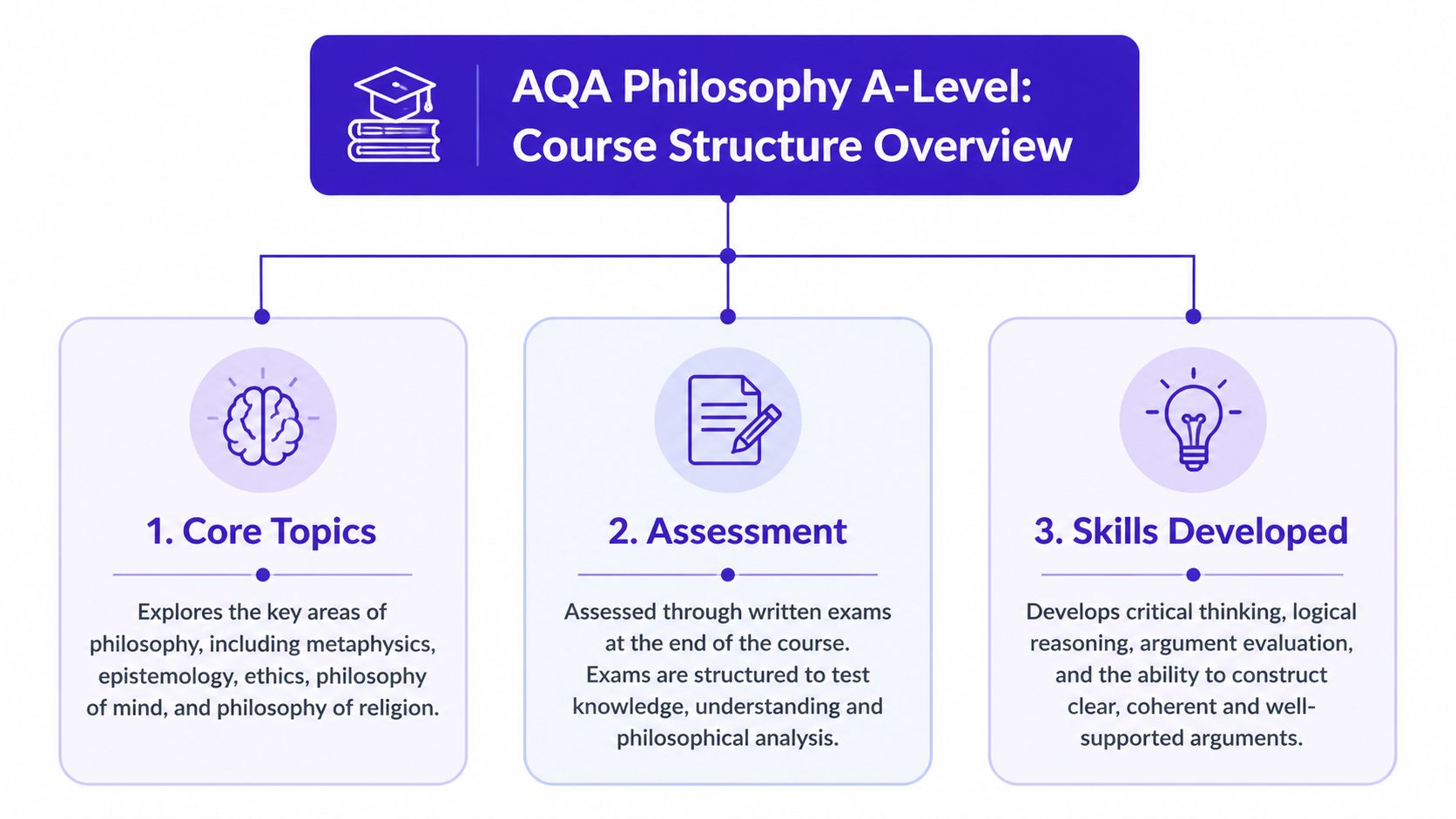
The whole course in one table
| Paper | Topics Covered | Duration | Marks | Weighting |
|---|---|---|---|---|
| Paper 1 | Epistemology and Moral Philosophy | 3 hours | 100 | 50% |
| Paper 2 | Metaphysics of God and Metaphysics of Mind | 3 hours | 100 | 50% |
That table gives you more than admin detail. It gives you a revision map.
You are not preparing for one giant philosophy exam. You are preparing for two separate papers, each with its own pair of topics, and each demanding enough written control to keep going for three hours. Students often focus on what they know and ignore how long they must keep producing clear arguments. The course rewards knowledge, but it also punishes weak pacing.
What each paper is really asking you to do
Paper 1 covers Epistemology and Moral Philosophy. In plain terms, you are dealing with questions about knowledge and questions about right and wrong. This paper often feels more familiar because the examples sound closer to everyday life. That can help, but it can also tempt students into loose explanation and common-sense opinions instead of precise philosophical argument.
Paper 2 covers Metaphysics of God and Metaphysics of Mind. Here, students often feel the ground move under their feet. The ideas are more abstract, so the examiner is watching closely for clear definitions, accurate distinctions, and careful use of scholars and objections. If Paper 1 can lure students into being casual, Paper 2 can scare them into being vague. Both problems cost marks.
If you want to compare how philosophy sits alongside other GCSE and A-Level subjects, remember what makes this one awkward in a very specific way. You need to know difficult content and then argue about that content under time pressure, without drifting into waffle.
The course tests two skills at once
AQA builds the exam around Assessment Objectives, usually shortened to AO1 and AO2. You do not need to panic about the labels. You do need to understand the job each one is doing.
AO1 is about knowing the material and explaining it accurately. That includes philosophical analysis, so this is not just memory. You must set out theories, arguments, objections, and responses clearly and in the right shape.
AO2 is about evaluation and judgement: you weigh strengths and weaknesses, test whether an objection really works, and decide which position is more convincing.
A good analogy is that AO1 builds the case properly, while AO2 tests whether the case survives scrutiny.
That matters for revision. If your notes only help you remember what Descartes or Bentham said, they are only doing half the job. If your revision is full of opinions but thin on accurate explanation, that is the other half missing. The specification is really telling you to train both muscles together.
Why this overview helps more than students expect
The aqa philosophy specification can feel dense because it names exact theories, exact objections, and exact lines of response. At first, that feels restrictive. Under exam pressure, it is helpful. It tells you what has to be ready.
A simple way to organise the course is to keep three layers in view:
Two papers
Revise for the structure you will sit.Four topics
Split your planning by topic so nothing disappears into a messy folder of notes.Two assessment skills
Build every revision session around explanation and evaluation, not one without the other.
That is the battle plan hidden inside the course outline. Once you can see the paper structure, the topic structure, and the skill structure, the specification stops feeling like a wall of text and starts acting like instructions.
Breaking Down the Four Core Syllabus Topics
Students often say, “I know the topic names, but I still don’t know what I’m meant to understand.” Fair complaint. Topic titles in philosophy can sound like they were designed to confuse normal people.
Here’s the simpler version. Each part of the aqa philosophy specification asks a big question. Once you know that question, the detail becomes easier to organise in your head.

Epistemology
This is the study of knowledge. Not “knowledge” in the loose everyday sense, but a much sharper question: what does it mean to know something?
AQA requires students to cover the tripartite definition of knowledge, usually called justified true belief, along with Gettier’s original counter-examples and responses including infallibilism, no false lemmas, reliabilism, and virtue epistemology, as set out in the AQA subject content.
That sounds technical, so put it in ordinary language:
- Tripartite view asks whether knowledge is just true belief plus good reasons.
- Gettier problems try to show that luck can sneak in even when those conditions seem satisfied.
- Responses like reliabilism try to repair the theory by changing what counts as a proper route to knowledge.
This topic often confuses students because the argument moves in layers. You’re not just learning one theory. You’re learning a theory, then an attack on it, then attempted repairs, then criticism of those repairs.
If you can’t explain Gettier clearly, your later evaluation usually collapses.
A lot of weak answers happen because students jump straight to criticism before they’ve nailed the core setup. Don’t do that. In epistemology, sequence matters.
Moral Philosophy
This is the part students usually find easiest to enter and hardest to master. The opening question feels familiar: what makes an action right or wrong? But the writing can become shallow if you stay at the level of “I think this is unfair”.
AQA expects students to study key normative ethical theories, including utilitarianism, deontological ethics, and virtue ethics, along with their criticisms. A key challenge is that each theory branches into its own logic.
Here’s a student-friendly way to hold them apart:
| Theory | Core idea | Common trap |
|---|---|---|
| Utilitarianism | Judge actions by consequences and overall good | Turning it into “whatever most people want” |
| Deontological ethics | Judge actions by duty, rules, or principles | Forgetting why rules matter morally |
| Virtue ethics | Judge actions by character and human flourishing | Writing vague points about being “a good person” |
Moral Philosophy rewards clean comparison. You need to know not just what each theory says, but what each one thinks the others get wrong. That’s where stronger evaluation begins.
Metaphysics of God
This topic asks whether belief in God can be defended by reason. Students often treat it like Religious Studies by accident. It isn’t. This is an argument paper.
AQA requires precise focus on the named arguments and objections. That includes specific formulations of the cosmological, design, and ontological arguments rather than broad discussion about religion in general. The specification also expects students to handle criticism properly, not as random disagreement.
Three common ways students lose control in this topic are:
They retell arguments vaguely
“The universe must have a cause” is not enough. You need the structure of the argument.They mix thinkers together
Aquinas is not Anselm, and Paley is not the same thing as a modern fine-tuning argument.They evaluate before defining
If the examiner can’t tell which exact version of the argument you mean, your criticism has nothing firm to hit.
This topic becomes much easier when you treat every argument like a machine. What are its parts? What assumptions make it run? Where could it break?
Metaphysics of Mind
Many students wobble at this point because the examples feel less concrete. The core issue is simple enough though: what is the relationship between mind and body?
You’re dealing with positions about whether the mind is something separate from the physical body, whether mental states can be reduced to brain states, and how conscious experience fits into a scientific picture of the world. The details vary, but the exam pressure is always the same. Can you define the position accurately, then show where its strengths and weaknesses lie?
A useful classroom analogy is this. Think of the topic as a battle over what kind of thing a person is. Are you a soul using a body? A biological machine with mental states? Something else entirely? Once students see that, the topic stops feeling like a pile of abstract labels.
Why topic detail matters more than broad confidence
One hidden difficulty in the aqa philosophy specification is that the content works like a dependency chain. Some ideas only make sense once earlier ones are secure.
For example:
- You need the tripartite view before Gettier
- You need Gettier before reliabilism makes sense
- You need clear explanation before serious evaluation works
That’s why students sometimes feel “bad at essays” when the underlying problem is earlier. They’re trying to evaluate a theory they don’t fully understand yet.
Teachers usually spot this quickly. Students often don’t. If your essay feels thin, go backwards. The missing mark may be an explanation problem, not an evaluation problem.
Cracking the Code of Assessment Objectives
You open a 25-mark question, your mind goes blank, and suddenly every philosopher you revised seems to blur into one. That usually is not a knowledge problem. It is an assessment objective problem. You have not yet separated what AQA wants you to show from how you show it.
Here is the plain-English version. AO1 is accurate explanation. AO2 is reasoned evaluation.
If you mix them up, essays feel harder than they are. If you keep them separate, the paper becomes much more manageable, because each paragraph has a job.
AO1 is the part where you show clear, correct understanding
AO1 covers the content of the course. You need to state theories accurately, explain arguments in the right order, define key terms properly, and show you understand relevant objections and replies.
A good analogy is building a case file. AO1 is the evidence folder. If the facts are messy, incomplete, or confused, the final judgement will wobble.
Take reliabilism. Strong AO1 does not just mention that knowledge involves a reliable process. It explains why reliabilism appears in the first place, namely as a response to the problem raised by Gettier cases. It also makes the structure clear enough that another student could follow your explanation without guessing what you mean.
Examiners reward precision here. They want to see that you know the theory, not that you recognise the terminology.
AO2 is the part where you test the theory under pressure
AO2 is where you weigh arguments. You are asking whether a view survives criticism, whether an objection really hits the target, and whether a reply solves the problem or just patches over it.
That is why AO2 works like cross-examination in court. A claim is not strong because it sounds confident. It is strong because the reasoning holds up when challenged.
Students often lose marks here by writing verdicts too early. "Descartes is wrong" is not evaluation. "Descartes' argument depends on the possibility of clear conceivability tracking real possibility, and that link is open to challenge" is evaluation, because it gives the examiner a reason.
What examiners are really looking for
AQA is not asking for two separate mini-essays called knowledge and evaluation. They want both working together. AO1 gives your essay bones. AO2 gives it movement.
A useful rule is simple. If a sentence could appear in a textbook, it is probably AO1. If a sentence weighs whether the point succeeds, fails, or only partly succeeds, it is probably AO2.
That matters in timed conditions. Under pressure, students often write a long explanation and assume that one brief criticism at the end counts as strong evaluation. Usually it does not. AO2 needs development, not just appearance.
Quick contrast: weak phrasing and stronger phrasing
| Weak response | Stronger response |
|---|---|
| “Gettier proves JTB is wrong.” | “Gettier cases challenge the claim that justified true belief is sufficient for knowledge, because they suggest a person can have justification and truth while still arriving at the belief through luck.” |
| “Utilitarianism is bad because it allows horrible actions.” | “A serious objection is that utilitarianism can permit actions that conflict with ordinary ideas of justice if those actions increase overall happiness, which puts pressure on its treatment of individual rights.” |
| “Dualism seems unrealistic.” | “Dualism faces the interaction problem, because if mind and body are different kinds of substance, it is difficult to explain how a non-physical mind could causally affect a physical body.” |
The stronger versions do two things at once. They explain the point accurately and show why it matters.
A practical battle plan for AO1 and AO2
Use the specification as a training map, not a reading list. For every theory, argument, or objection you revise, practise the same five-step sequence:
- State the claim clearly
- Explain the reasoning behind it
- Add the strongest objection
- Test whether that objection is decisive
- Finish with a judgement you can defend
That pattern turns revision into exam technique. It stops you collecting isolated notes and starts training the exact moves that pick up marks.
If you want to drill that skill under timed conditions, Exam Practice for A-Level helps you rehearse the difference between explaining a theory and evaluating it, which is exactly the distinction many students miss until too late.
One final point. If your essays keep coming back with comments like "more depth" or "needs analysis", do not assume you are bad at evaluation. Very often, the core issue is that AO1 is still too thin, so AO2 has nothing solid to work with. Strong judgement grows out of clear explanation. In Philosophy, that is the code you need to crack.
How to Tackle Every Type of Exam Question
A lot of stress in Philosophy comes from treating every question like it needs the same kind of answer. It doesn’t. A 3-mark definition question and a 25-mark essay are different jobs.
The first thing to do in the exam is identify the command word and mark value. That tells you the depth, the structure, and the balance between AO1 and AO2.

The short questions
Short questions are where students throw away easy marks by overcomplicating things.
For lower-mark questions, your job is usually precision, not flair.
3-mark questions
Define or identify the concept directly. Give a clean statement. If a term has parts, include the parts. Don’t write a mini essay.5-mark questions
Explain the point with a little more development. One clear definition plus a brief example or clarifying sentence usually works better than padding.12-mark questions
These need organised explanation. You’re usually showing understanding and analysis of a theory or argument. Keep the chain of reasoning tight.
A good rule is this: lower marks punish vagueness more than they reward style.
The essay questions
The longer essay is where timing, structure, and nerve all matter. Students often know more than they show because they panic and start writing before thinking.
For the highest-mark questions, give your answer a shape the examiner can follow:
Open the debate clearly
State the issue and define the key position.Build the theory properly
Explain the argument or view with enough detail to support later evaluation.Present the strongest challenge
Not a weak complaint. A real objection.Consider a reply
Good philosophy doesn’t stop at attack. It tests whether the theory can answer back.Judge the issue
Don’t just summarise both sides. Decide which side is stronger and why.
The best essays don’t sound busy. They sound controlled.
That control is exactly what students can practise through timed writing and targeted Exam Practice for A-Level, where command words and exam conditions are the whole point rather than an afterthought.
Matching the question to the skill
Here’s a simple way to decode what the paper wants from you.
| Question type | Main demand | Common mistake |
|---|---|---|
| Define | Precision | Giving examples instead of a definition |
| Explain | Clear AO1 development | Drifting into evaluation too early |
| Analyse | Following the argument step by step | Listing points with no logic |
| Evaluate | Weighing strengths and weaknesses | Writing both sides but never judging |
Students often ask whether they should always include evaluation if they can. Not always. If the question is asking for explanation, then forced evaluation can waste time and blur the answer.
A useful walkthrough sits well here if you want to see exam thinking in action:
One practical example
Take a question asking you to explain reliabilism.
A weak answer says it’s about beliefs coming from reliable processes and then wanders off into whether that’s a good theory.
A stronger answer does this instead:
- defines reliabilism clearly
- links it to the failure of justified true belief
- explains why reliability matters
- shows how the theory tries to avoid knowledge by luck
That answer knows its task. It explains first. Evaluation can come later if the question asks for it.
Your Smart Revision Plan and the Tools to Power It
Most students don’t fail Philosophy because they never revised. They fail because their revision was too passive. Reading notes feels productive. Highlighting feels organised. Neither guarantees that you can explain Gettier under pressure or build a judgement on Kant in a timed essay.
Good revision for the aqa philosophy specification has to copy the demands of the paper. That means retrieval, structure, and repeated practice with arguments.

Stop revising by chapter and start revising by spec point
Textbooks are useful, but they can blur what’s essential. The specification is sharper. Build your revision around exact items the course requires.
Try turning each topic into a checklist of named concepts, arguments, and criticisms. Then revise at three levels:
Core definition level
Can you state the theory accurately in plain English?Argument level
Can you explain how the reasoning works step by step?Evaluation level
Can you test it, challenge it, and defend a final judgement?
That method stops you from having “sort of” knowledge. Philosophy punishes sort-of knowledge very quickly.
Use active recall, not passive comfort
If your revision looks tidy but your brain goes blank in class, the issue is usually recall.
Use methods that force retrieval:
Blurting
Write everything you can remember about one spec point from memory, then check the gaps.Flash questions
Ask direct prompts such as “What does Gettier challenge?” or “What is the key claim of virtue ethics?”Mini plans
Plan essay answers in five minutes without writing the full response.Timed paragraphs
Pick one objection and explain it properly in a short timed burst.
Revise in the format the exam demands. Thinking is harder than rereading, and that’s exactly why it works.
Build one page maps for each topic
Philosophy becomes easier when you can see relationships, not just isolated facts. A one-page map for each major area works well.
For example, on an epistemology map you might place justified true belief in the middle, then connect it to Gettier, then branch out to no false lemmas, infallibilism, reliabilism, and virtue epistemology. Add one criticism and one defence for each branch.
Do the same in ethics. Put utilitarianism, deontology, and virtue ethics in relation to each other rather than in separate revision silos. Students write better when they can compare theories quickly.
Use essay practice earlier than you think
A common mistake is waiting until late in the year to start writing essays because you “don’t know enough yet”. In Philosophy, essay practice is part of learning the content.
You don’t have to start with full essays. Start with:
- Single introductions
- One developed objection
- A conclusion that evaluates
- A paragraph comparing two thinkers
When you want full exam-style material, use A-Level Past papers to get used to real wording and realistic pressure.
Use one tool that keeps the specification and exam skill together
A common issue for many revision systems is their fragmentation. Students have notes in one place, question practice somewhere else, and essay feedback nowhere useful. A tool only helps if it keeps the spec, command words, and practice format tied together.
One option is MasteryMind, which is described by its publisher as an AI-powered revision platform aligned to UK exam specifications, including A-Level subjects. In practical terms, that matters here because students need practice that matches specification points, command words, and mark allocation instead of generic philosophy quizzes. If a platform tags questions by skill and topic, gives AO-style feedback, and lets students move from quick recall to longer written responses, it fits how this course is learned in practice.
Teachers tend to judge tools by one question: does this reduce vague revision and increase precise practice? Students ask a simpler one: does it help me know what to do next? The right system should answer both.
From Specification Shock to Exam Confidence
The aqa philosophy specification looks intimidating when you first open it because it compresses a whole course into exam-board language. Once you translate it into real questions, real topics, and real skills, it becomes much more manageable.
The students who improve fastest usually do three things. They learn the exact content instead of revising loosely. They separate AO1 from AO2 so they know whether they’re explaining or judging. And they practise answers in the style the exam rewards.
That’s the shift that matters. The specification stops being a warning label and starts acting like a blueprint.
If you’re behind, you can still recover by being selective and disciplined. If you’re aiming high, this is how you stop dropping marks you didn’t need to lose. Philosophy is demanding, but it isn’t random. The paper follows rules. Learn those rules, practise to them, and the subject becomes beatable.
If you want a more structured way to turn the aqa philosophy specification into daily practice, MasteryMind gives UK learners specification-aligned questions, exam-style practice, and feedback that stays focused on the skills A-Level papers reward.
Ready to master this topic?
Practise with quizzes, blurt exercises and exam questions on MasteryMind.
7 days Premium · Then free forever · No card, no charge