Master the AQA Psychology A-Level Specification: Your Ultimate 2026 Success Guide
Feeling a bit swamped by the AQA Psychology A-level specification? You're not alone. But think of it less as a stuffy rulebook and more as the game plan for your exams—and knowing it inside out is your secret weapon. This guide is your personal map, whether you’re aiming to turn a disappointing mock result into a top grade or you’ve got your sights set on an A* from the start.
Your Ultimate A-level Psychology Roadmap

Getting organised is half the battle, and that’s exactly what we’re going to do here. When you truly understand the specification, you stop studying blindly and start creating a clear, targeted plan for every topic, question, and exam paper you'll face.
Whether you're just starting your A-level journey or you’re deep into revision, that official AQA document can look pretty intimidating. It’s dense, full of formal language, and the topic lists can feel endless. But here’s the secret: it’s the single most important tool you have. It tells you exactly what can come up in your exams. No surprises, no hidden curveballs.
This guide translates that complex document into a straightforward action plan. We’ll show you how to use the AQA Psychology A Level specification to your advantage, breaking down what you need to know, the skills you need to show, and exactly how your final grade is put together.
Why Is Psychology So Popular, Anyway?
If you chose Psychology, you’re in good company. It has quickly become one of the most popular A-levels in the UK. In 2023, it was the second most-taken subject right after Maths, with a massive 72,930 results issued. Its popularity has shot up by 17.6% in the last seven years alone, which shows just how many students, like you, are drawn to the puzzles of the human mind.
This popularity means you're part of a huge, curious community. It also means the competition for top grades can be fierce, which is why having a smart, strategic approach is so crucial. Getting to know the specification is your first step towards standing out from the crowd.
What This Guide Will Do for You
We're going to move beyond just listing topics. The goal here is to give you a clear, actionable plan that builds your confidence and, most importantly, gets you the results you want. We'll help you:
- Decode the content: Figure out what the compulsory and optional topics actually cover in practice.
- Master the exams: Learn the structure of all three papers and understand how they’re different.
- Unlock every mark: Get to grips with the Assessment Objectives (AOs) that examiners use to grade your answers.
- Build a smart revision plan: Discover effective study techniques and tools, including platforms for Online Revision for A-Level, to make your study time truly count.
This course is a journey into what makes people tick. To get started on this fascinating path, you can explore our comprehensive A Level Psychology course, designed to guide you through the syllabus from day one. Right, let's start building your road to success.
Right, let's get to grips with the AQA A-level Psychology specification (that's code 7182, by the way). Think of it less like a boring document and more like your map to the finish line. It tells you exactly what the examiners expect you to know and what skills you need to show off. Honestly, getting your head around this from the start is the difference between smart, targeted revision and late-night panic cramming.
First things first: this is a linear A-level. In simple terms, that means you'll do all your exams right at the end of the two years. There's no banking an AS grade after Year 1 and coasting. It’s a marathon, not a sprint, and it means you need to keep everything you learn ticking over, from your very first lesson on social influence to your final revision sessions.
Understanding this structure isn't just admin; it’s the first step to taking control. It helps you see how all the different parts of the course connect and turns revision into a focused plan rather than a frantic guessing game.
The Core Content You Must Know
In your first year, everyone studies the same four compulsory topics. This is the bedrock of your A-level, and it all gets examined on Paper 1. No matter what you specialise in later, you have to nail these first.
- Social Influence: This is where you find out why people conform and obey. You’ll get stuck into the classic, and often shocking, studies by people like Asch and Milgram. The real skill here isn't just learning what they found, but learning how to pull their methods and conclusions apart like a true psychologist.
- Memory: Ever wondered how your memory actually works (or doesn't)? This topic breaks it down. You’ll look at theoretical models, the different kinds of long-term memory, and the frustrating reasons we forget things. You'll also tackle the huge, real-world issue of eyewitness testimony and just how reliable it really is.
- Attachment: Here, we look at the powerful bonds formed between infants and their caregivers. You’ll explore Bowlby's influential theories and the famous 'Strange Situation' study, digging into how our earliest relationships might just set the template for the rest of our lives.
- Psychopathology: This is the clinical side of psychology. You’ll start by figuring out how we even define what is 'abnormal', before studying the characteristics of phobias, depression, and OCD. You'll then compare the different approaches – from biological to behavioural – used to explain and treat these conditions.
Navigating Your Optional Topics
Once you hit your second year, things get a bit more specialised. You'll still have compulsory content to cover (like Biopsychology and more Research Methods), but Paper 3 is where you get to focus on the topics that interest you most.
The crucial thing to remember is that you must study one topic from each option block. You don't get a free-for-all pick'n'mix. You can't, for example, decide to study Relationships, Schizophrenia, and Aggression.
AQA Options at a Glance
| Option Block 1 (Choose One) | Option Block 2 (Choose One) | Option Block 3 (Choose One) |
|---|---|---|
| Relationships | Cognition and Development | Forensic Psychology |
| Gender | Schizophrenia | Addiction |
| Stress | Eating Behaviour | Aggression |
This choice is usually made by your school or college, so your revision has to be laser-focused. There's no point wasting precious time learning about Addiction if your class is studying Forensic Psychology. Double-check with your teacher so you are 100% certain which three optional topics you are being prepared for.
It's also really important to know that exam boards sometimes tweak their courses. As of September 2025, AQA has made some updates to both the AS (7181) and A-Level (7182) specifications to keep them current with modern research. It's always a good idea to check out the latest AQA specification updates to make sure your revision notes are perfectly aligned with what you'll be examined on.
Mastering the Three Exam Papers
Your final A-level grade is decided by your performance across three distinct exam papers. It’s absolutely vital to know what you're walking into with each one. All three are two hours long and worth 96 marks, but they test completely different areas of the AQA Psychology A-level specification.
Understanding the unique focus of each paper is the key to avoiding a common pitfall: applying the wrong knowledge in the wrong exam. You wouldn't use the same approach for a short sprint as you would for a marathon, and the same logic applies here. Each paper demands a different strategy, pace, and mindset. Let's break down exactly what you're up against.
Paper 1: Introductory Topics in Psychology
This is your foundations paper. It covers all the core topics you likely encountered at the very beginning of your A-level journey. Think of it as testing the bedrock concepts that every single AQA Psychology student needs to know inside and out.
The content here is completely non-negotiable and will always be:
- Social Influence
- Memory
- Attachment
- Psychopathology
You’ll face a mix of multiple-choice questions, short-answer questions, and at least one beefy 16-mark essay. Nailing Paper 1 is all about having a rock-solid command of the key theories, studies, and vocabulary for these four topics.
Paper 2: Psychology in Context
This paper switches gears significantly. It's less about memorising specific topic details and more about understanding the how and why of psychological inquiry. This is where your scientific and analytical skills really get a chance to shine.
Paper 2 brings together two massive components of the course:
- Approaches in Psychology: This covers the different lenses psychologists use to understand behaviour, such as the biological, cognitive, and psychodynamic approaches. You’ll also find all your Biopsychology content assessed here.
- Research Methods: This is a huge part of the paper. A massive 25% of your entire A-level grade is based on research methods, and a large chunk of those marks are found right here. You need to be totally confident in everything from experimental design to choosing the right statistical test.
An insider tip: Research Methods isn't just another topic; it's the backbone of your A-level. AQA places such a high value on these skills that you could, in theory, pass the entire A-level just by acing the research methods questions across all three papers. That’s how crucial they are.
Paper 3: Issues and Options in Psychology
Paper 3 is where the course becomes more tailored to what you and your class have studied. It's a blend of one compulsory topic on the big questions in psychology, plus three optional specialist subjects chosen by your school.
This paper is always structured with:
- Issues and Debates in Psychology: This is mandatory for everyone. It requires you to think critically about overarching arguments like nature vs. nurture, free will and determinism, and the different types of bias in research.
- Your Three Optional Topics: Your school will have chosen one topic from each of the three option blocks. This could be Schizophrenia, Forensic Psychology, and Relationships, for example. You’ll only ever be examined on the three specific topics you have been taught.
This flowchart shows how the entire AQA specification fits together, from the core document down to the content and assessment objectives.
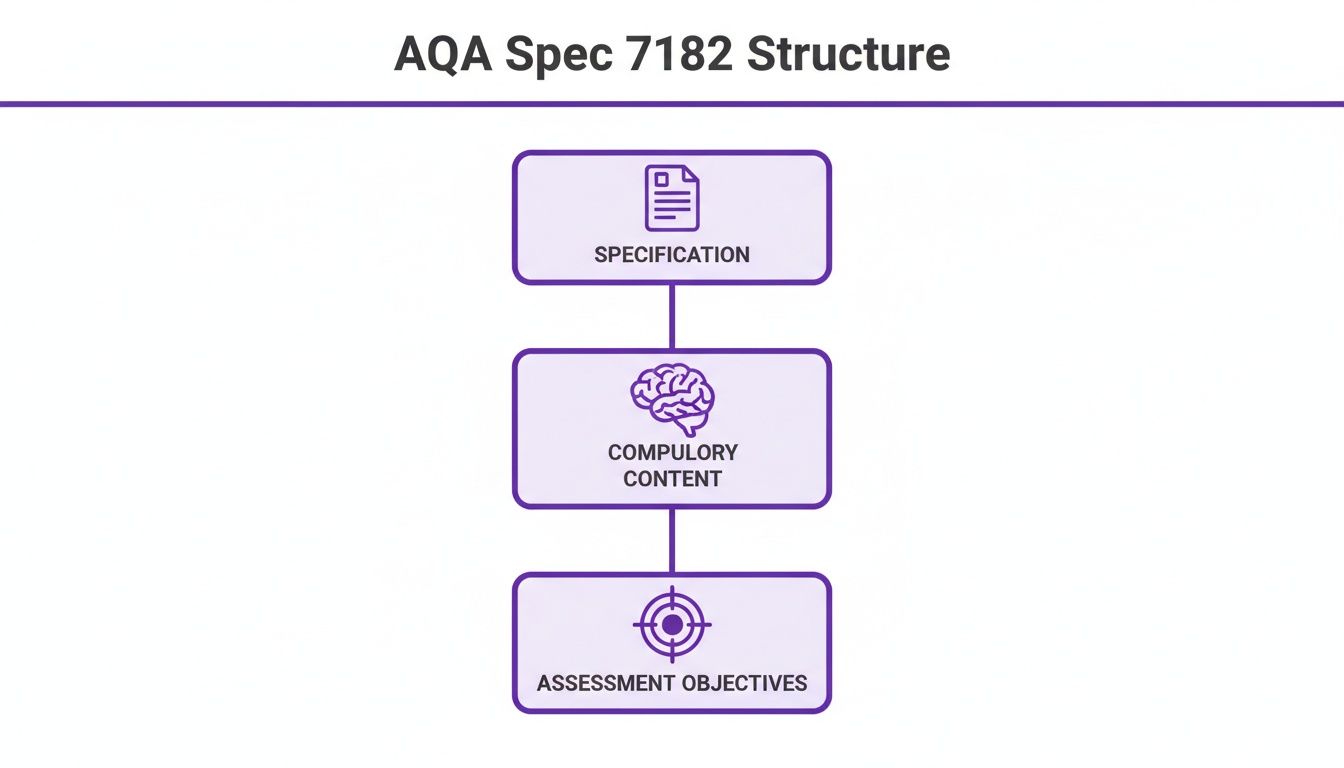
It’s a great visual reminder that every topic you learn and every question you answer is directly linked back to this official structure.
One of the most effective ways to see how these different styles work in practice is to get your hands dirty with official AQA A-Level Psychology Past Papers. It’s the closest you can get to the real thing before the big day.
AQA A-Level Psychology Exam Paper Breakdown
To give you a crystal-clear overview, here’s a side-by-side comparison of the three papers. Notice how the core stats are identical, but the content is completely different.
| Feature | Paper 1 Introductory Topics in Psychology | Paper 2 Psychology in Context | Paper 3 Issues and Options in Psychology |
|---|---|---|---|
| Content | Social Influence Memory Attachment Psychopathology |
Approaches in Psychology Biopsychology Research Methods |
Issues & Debates in Psychology + 3 Optional Topics |
| Marks | 96 marks | 96 marks | 96 marks |
| Duration | 2 hours | 2 hours | 2 hours |
| Contribution | 33.3% of A-Level | 33.3% of A-Level | 33.3% of A-Level |
Getting to grips with this structure is the first major step toward smart, effective revision. It allows you to compartmentalise your notes, practice the specific skills needed for each paper, and walk into that exam hall knowing you’re prepared for whatever AQA has in store.
Unlocking Marks with Assessment Objectives
Have you ever had that frustrating moment? You and a friend revise the exact same topic, you feel you both know your stuff, but they walk out of the exam with significantly more marks on an essay. The reason, almost every time, comes down to the Assessment Objectives, or AOs.
Getting your head around these isn't just a bonus—it's the absolute key to unlocking the top grades in A-level Psychology. For anyone serious about hitting their target, whether that’s a hard-won C or a coveted A*, understanding the AOs is non-negotiable. They are the rulebook the examiners use to award marks. Once you know the rules of the game, you can start playing it to win.
Think of the AQA Psychology specification not as a long list of topics to memorise, but as a guide to the specific skills you need to show off in the exam. Shifting your mindset to think in terms of AOs will transform your revision from simply cramming facts to actively collecting the right kind of points for any question that comes your way.
AO1: Know It
This is your 'what'. AO1 is all about demonstrating your knowledge and understanding of psychological theories, concepts, studies, and all the key terminology. When you see a question asking you to 'Outline' or 'Describe', you're being asked for pure AO1.
Think of AO1 as filling your psychologist's toolbox. You need the essential facts, names, dates, and findings right at your fingertips. For instance, describing the procedure of Zimbardo's Stanford Prison Experiment or outlining the main features of the Multi-Store Model of Memory is classic AO1.
But here’s the catch: many students get stuck at this stage, treating the whole A-level like one giant memory test. While a solid foundation of knowledge is crucial, on its own, it will rarely bag you more than a third of the marks available in a big essay question.
AO2: Apply It
This is where your understanding is really put to the test. AO2 is all about application. It requires you to take that AO1 knowledge and apply it to a fresh situation—a real-world example or, more commonly, a short scenario in the exam question (often called a 'stem').
You'll spot an AO2 question a mile off. Look for command words like 'Apply' or 'Explain', or whenever you see a short story about someone like 'Jenny' or 'David'.
For example, you might get a scenario about a toddler being clingy and anxious at nursery. An AO2 question will ask you to use your knowledge of attachment theory to explain that child's behaviour. You don't just state Bowlby's theory (that’s AO1); you have to connect the theory directly to the child in the stem, using the specific details provided to make your point.
This skill is what separates the good students from the great ones. It proves you haven't just memorised the information, but that you can actually use it like a real psychologist would.
AO3: Evaluate It
Now for the big one. This is the mark-winner, the grade-booster, the key to the A and A* grades. AO3 is all about analysis, interpretation, and evaluation. It's where you get to step into the role of a critic and show the examiner you can think deeply and critically about the subject.
When you see command words like 'Discuss', 'Evaluate', 'Compare', or 'Assess', you know you're in AO3 territory. A 'Discuss' question, for instance, is typically a blend of AO1 (for the knowledge) and AO3 (for the discussion points). For a 16-mark essay, a massive 10 of those marks are often for AO3 alone.
So, what does that look like in practice?
- Critiquing a study's methodology: You could question a small sample size for its low generalisability or point out that an artificial lab setting gives a study low ecological validity.
- Comparing and contrasting theories: You might argue that the biological explanation for OCD is reductionist because it completely ignores important cognitive factors.
- Considering the wider implications: You could discuss the serious ethical issues raised by Milgram's obedience research or the real-world practical applications of cognitive-behavioural therapy.
In a competitive academic landscape, mastering all three AOs is vital. Recent statistics on A-level results showed the average points score per entry rose from 35.29 to 35.55. While that might seem small, it shows how intense the competition for top grades is, and where every single mark truly matters. You can find out more about how A-level results are measured and see the latest statistics on the official government website.
Building Your A Level Revision Strategy

Knowing the AQA Psychology A-level specification is one thing. Actually using it to build a revision plan that works is a whole other ball game. Whether you’re smarting from a disappointing mock result or dead-set on hitting that A*, a solid strategy is your best bet. Let's get beyond aimless rereading and last-minute panic. It’s time to build a system that delivers.
This isn't about working harder—it’s about working smarter. The best revision plans are grounded in psychological principles that actually help you move information from your shaky short-term memory into your reliable long-term memory. This is the key to walking into your exams with real, unshakeable confidence.
Laying the Foundations with Proven Techniques
Effective revision has very little to do with how pretty your notes are. It's all about how you interact with the material. To make knowledge stick, you have to engage with it actively. Two of the most powerful methods, backed by decades of cognitive psychology research, are active recall and spaced repetition.
Active Recall: This is the act of pulling information out of your brain, not just pushing it in. Instead of rereading a chapter on attachment, close the book and try to explain Bowlby’s theory out loud. Or grab a blank piece of paper and scribble down everything you can remember about a specific study. That feeling of struggle is your brain building stronger connections.
Spaced Repetition: Don't cram a topic for five hours straight and then forget about it for a month. A much better approach is to review it in short, sharp bursts over increasing intervals—after a day, then a few days later, then a week, and so on. This process signals to your brain that this information is important and worth remembering.
When you put these two techniques together, you create a seriously powerful revision routine. It stops being a box-ticking exercise and starts becoming a proper memory-building workout.
Let’s be honest, a common trap is spending hours creating beautiful, colour-coded notes without ever actually testing if you can recall the information from scratch. Real learning happens when you force your brain to retrieve the facts, not when you just make them look nice on a page.
Mastering Exam Technique with Targeted Practice
All the knowledge in the world won't help you if you can't apply it effectively under exam pressure. This is where mastering your exam technique is non-negotiable. The trick is to practise in a way that truly simulates the real thing, right down to the command words and mark schemes of the AQA Psychology A-level specification.
This is where a good online platform can be a game-changer. Tools like MasteryMind are built specifically around the AQA spec, letting you filter thousands of questions by topic, paper, and even by Assessment Objective (AO). This allows you to build your skills methodically.
For instance, when revising Attachment, you could break it down like this:
- Test AO1: Start with quick-fire questions to make sure you can accurately describe the key concepts of Bowlby’s theory.
- Move to AO2: Progress to application questions that ask you to use the theory in a new or unfamiliar scenario.
- Finish with AO3: Tackle some 16-mark essays where you have to evaluate the theory, using detailed feedback to sharpen your arguments.
Using Examiner-Style Feedback to Pinpoint Weaknesses
The final piece of the puzzle is getting the right kind of feedback. Knowing you lost marks isn't enough; you need to know why. A vague comment like "needs more detail" is next to useless. What you really need is examiner-style feedback that breaks down your performance against each Assessment Objective.
Imagine getting an essay back with comments like, “Your AO1 knowledge is solid, but you missed a clear opportunity to apply it to the stem, costing you crucial AO2 marks,” or “Your AO3 evaluation points were relevant, but they needed more development to get into the top band.” This is the kind of specific, actionable advice that actually helps you improve.
By consistently practising with targeted questions and analysing your performance, you can systematically turn your weaknesses into strengths. You'll soon learn to spot the difference between an 'Outline' and a 'Discuss' question in a heartbeat, and you'll know exactly how to structure your answers to tick off every AO mark. That’s how you walk into the exam hall not just hoping for the best, but knowing you’ve done the work and are fully prepared.
Turning Your Hard Work Into Exam Success
So, there you have it – the complete blueprint for the AQA Psychology A-level specification. We've pulled back the curtain on the course structure, broken down the exams, and cracked the code on the Assessment Objectives that hold the key to every single mark. The journey from feeling overwhelmed to feeling confident starts right here, and it's built on smart, consistent effort.
This isn't about cramming facts until your head spins. It's about really getting to grips with the subject. Let your own curiosity guide your revision. Start questioning the big ideas in Issues and Debates, notice how concepts like memory or social influence play out in your daily life, and most importantly, get into the habit of practising in a way that feels just like the real thing.
From Theory to Top Grades
Getting your head around the difference between AO1, AO2, and AO3 is the first big hurdle cleared. The next job is to make that knowledge second nature. From now on, every time you plan an essay or look at a practice question, you should be asking yourself: "Where will I get my description marks? How can I apply this to the scenario? What critical points will earn me those crucial evaluation marks?"
This shift in thinking is what really separates the students who just get by from those who genuinely excel. It turns revision from a chore into a tactical game where you're actively hunting for marks. Whether you're aiming for an A* or just looking to secure your target grade, you now have a clear plan to make it happen.
The real secret to doing well is making sure any point you make is properly explained. One well-developed evaluation point is always worth more than a messy list of four brief strengths or weaknesses. When it comes to essays, depth always trumps breadth.
Putting Your Plan Into Action
The final piece of the puzzle is putting all of this into practice. Start today, be strategic, and stay consistent. All the hard work you've put into understanding the spec will really pay off when you see those grades start to climb.
- Get active: Ditch the passive habit of just re-reading your notes. Use active recall methods like blurting or making flashcards to force your brain to retrieve information.
- Practise with purpose: Don't just churn through past papers without a goal. Focus your practice on specific topics or skills you find tricky. Effective Exam Practice for A-Level helps you target those weaker areas and build up your confidence bit by bit.
- Think ahead: As you start preparing for university, especially if you're applying for a psychology degree, it’s a great idea to look at some strong psychology personal statement examples. They can give you fantastic ideas on how to articulate your passion and understanding of the subject.
With a smart strategy and a commitment to regular practice, you have everything you need to smash this A-level.
Got Questions? We’ve Got Answers
If you’ve got a few questions swirling around about the AQA Psychology A-level, you're in good company. Let’s clear up some of the most common queries we hear from students.
How Much Maths Is Actually in A-level Psychology?
Let's get this one out of the way first. You don't need to be a maths genius, but you do need to be solid on the basics. At least 10% of your final A-level marks will come from mathematical skills, which are set at a standard similar to GCSE Maths.
This really just means getting comfortable with things like:
- Working out percentages, fractions, and ratios.
- Drawing and, more importantly, interpreting graphs, charts, and tables.
- Understanding core statistical concepts, especially what 'statistical significance' really means for a piece of research.
While you'll find these skills are a big focus in Paper 2 (Research Methods), they can crop up in any paper where you're asked to make sense of data from a study.
Can I Use the Same Studies for Different Topics?
Yes! In fact, you absolutely should. This isn't cheating; it's one of the smartest ways to revise. Re-using a core study across different topics shows the examiner you have a deep, connected understanding of psychology. It also makes your revision so much more efficient.
A classic example is Milgram's obedience research. It's a cornerstone of the Social Influence topic, of course. But it's also a fantastic source of evaluation points (AO3) when you're discussing ethical issues in the mandatory Issues and Debates section on Paper 3. The golden rule is to always link it back and make your point relevant to the specific question in front of you.
What’s the Biggest Mistake Students Make in Exams?
Hands down, one of the most frequent and costly errors is the 'pre-rehearsed essay dump'. This is where a student has memorised a 'perfect' essay on a topic, but then writes it all out in the exam without actually answering the question that was asked. If the question includes a scenario (the 'stem'), but your essay ignores it completely, you've just kissed all your AO2 (application) marks goodbye.
Another huge pitfall is writing a purely descriptive essay for a 16-marker. If the command word is 'Discuss' or 'Evaluate', the examiner is looking for critical thinking. Just describing a theory might feel safe, but it’s a recipe for a low grade, as the majority of the marks (up to 10 out of 16) are for AO3 (evaluation).
Is the AS Spec the Same as Year One of the A-level?
They look very similar on the surface, but they are two completely separate qualifications. The full A-level (specification code 7182) is a two-year linear course, which just means all your exams happen right at the very end of the second year.
The topics you cover in your first year (like Social Influence and Memory) are the same as the AS course content, but the A-level specification goes into much more depth. It also includes extra compulsory content like Biopsychology and all the optional topics you choose in Year 2. Most importantly, you cannot 'cash in' an AS result and have it count towards your final A-level grade.
Ready to put all this knowledge into practice? MasteryMind offers unlimited, AI-powered practice that’s perfectly aligned with the AQA specification. You can get instant, examiner-style feedback on everything from quick knowledge questions to full 16-mark essays, helping you build the skills and confidence for exam day. Start for free at MasteryMind.
Ready to master this topic?
Practice with quizzes, blurt exercises, and exam questions on MasteryMind.
7 days of full Premium · No card required · Free plan forever after