The 10 Best Revision Websites for GCSE & A-Levels (2026)

Exams Are Coming. Revise Smarter, Not Just Harder.
That pre-exam feeling is horribly familiar. You open a folder of notes, realise half of it still looks vague, then bounce between YouTube, group chats, and three tabs that all claim to be the answer. If you're behind, you want something that helps fast. If you're aiming high, you want something that turns decent knowledge into actual marks.
That's why the best revision websites aren't just the ones with the most content. They're the ones that feel closest to the actual paper you're about to sit. Question style matters. Command words matter. Mark schemes matter. If a site teaches you facts but not how examiners want them used, it can leave you sounding smart and still dropping marks.
That's the standard used here. Exam realism comes first. This list looks at which sites prepare you for your board, your paper style, and the pressure of answering properly. UK revision sites increasingly lean on active, visual, and exam-style learning rather than just dumping notes on a page, which is exactly the right direction for GCSE and A-Level prep according to Stats Academy's UK revision approach. If you want to fight memory decay effectively, that matters too.
You don't need ten platforms open at once. You need a few that do the right jobs well.
1. MasteryMind
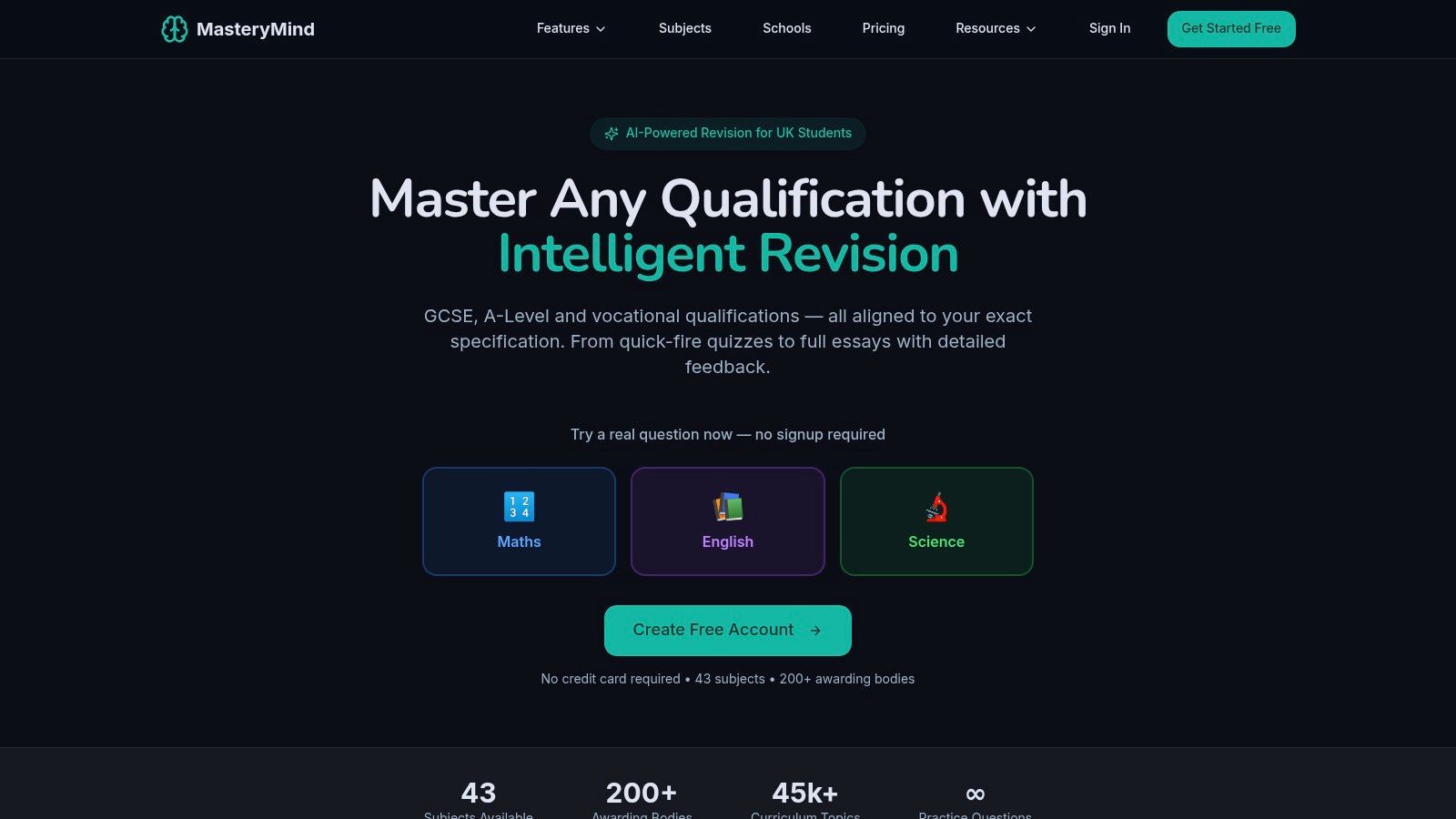
A student can know the content, revise for hours, then still drop marks because the answer sounds like class notes rather than an exam response. MasteryMind ranks highly because it trains the exam version of the subject. The wording, command terms, and mark allocations are tied closely to major UK exam boards, so practice feels much nearer to the paper students will face.
That exam realism matters. Plenty of revision sites are good at recap. Fewer are good at teaching what a six-mark answer needs, when method marks are available, or why a response that is broadly right still would not score full marks.
The strongest part of MasteryMind is the feedback. In maths, it checks method rather than just the final number. In essay subjects, it pushes students back toward assessment objectives, which is where a lot of grades are won or lost. In English and computer science especially, that makes a difference, because weak automated tools often miss structure, logic, or subject-specific accuracy.
That is what good AI Powered Revision should do. It should correct the habit, not just the answer.
I would use it with students who are past the “teach me the topic from scratch” stage and need to convert knowledge into marks. It is also useful for independent revision because the platform gives enough guidance to keep a student moving without constant teacher input. Teachers and tutors get something practical out of it too, since progress is easier to track by topic and by exam skill, rather than by vague confidence levels.
A few trade-offs are worth being honest about:
- Best fit: Students who need board-aware practice rather than general revision prompts.
- Feedback quality: Stronger than most generic quiz tools, especially where workings, structure, and mark schemes matter.
- Good for pressure practice: Adaptive difficulty and mixed-topic tasks help once basic recall is secure.
- Free plan available: Easy to test before paying.
- Limits still exist: Final polishing for nuanced essays, coursework judgement, and borderline mark calls still benefits from a teacher.
One feature I like is the Blurt Challenge. Getting students to say an answer aloud is a quick way to expose weak recall, muddled vocabulary, and half-learned processes. Used properly, it closes the gap between passive revision and producing an answer under pressure.
NEA Coach is also a sensible addition for coursework-heavy subjects. It gives section-level guidance and mark estimates without crossing into doing the work for the student, which is a line some tools handle badly. That makes it more useful in real schools, where teachers need support tools they can trust, not shortcuts that create problems later.
2. BBC Bitesize
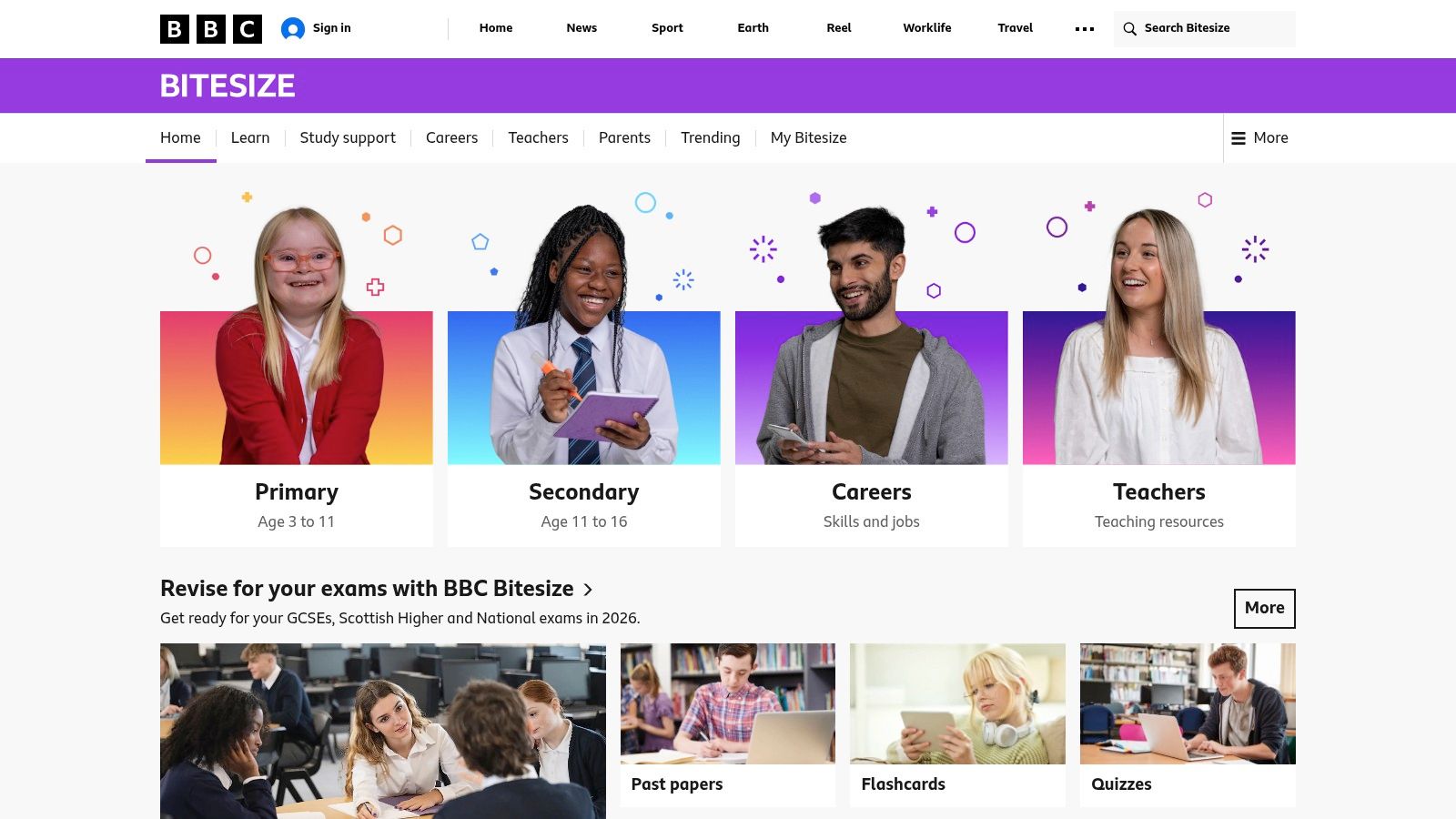
BBC Bitesize is still one of the safest recommendations for GCSE students, especially when panic has set in and they need something clear immediately. It's one of the best-known free revision platforms for GCSE learners and is regularly recommended in UK education roundups because it covers major subjects like maths, science, English literature, history, geography, and computer science with short videos, quizzes, and topic explanations, as noted in this UK guide to GCSE revision websites.
Its strength is clarity. Bitesize explains topics in plain English without talking down to students. If a pupil says, “I know I did this in class but I can't remember what any of it means,” this is often the quickest reset.
Where Bitesize earns its place
It works brilliantly as a first-stop content hub. The short clips and recap-style pages help students rebuild a shaky topic before moving to harder practice elsewhere. Teachers usually trust it too, because the quality control is consistent and the writing is clean.
What it doesn't do as well is deep exam drilling. The quizzes are useful, but they don't usually recreate the pressure, phrasing, and mark-scheme precision of specialist exam practice sites.
- Best for quick resets: Ideal when a topic has gone fuzzy and needs re-explaining fast.
- Strong accessibility: Free, familiar, and easy to use on web or mobile.
- Good breadth: Covers most mainstream GCSE needs well.
- Less strong for top-end exam technique: It won't replace proper question practice if you're chasing high grades.
For many students, BBC Bitesize is the tool that gets them unstuck. It just shouldn't be the only tool in the stack.
3. Seneca Learning

Seneca Learning is one of the easiest sites to keep using when motivation is low. That matters more than students admit. If a platform feels heavy, they dodge it. Seneca keeps lessons short, quick, and interactive enough that even reluctant revisers usually stick with it longer than they expect.
The format is simple. Read a bite-size chunk, answer a quick question, move on. That fast loop suits content-heavy subjects where students need repeated exposure before anything sticks.
Why students keep returning to it
Seneca is built for short sessions, which fits how many students revise. UK students often rely on a mix of online platforms, video, and institutional learning systems for support, so tools that reduce friction and make it easy to jump straight into retrieval practice have an edge, as noted in the Jisc-related summary discussed by Zoe Talent Solutions.
That's where Seneca is clever. It lowers the barrier to starting. You don't need loads of setup, and the instant feedback keeps momentum going.
Good revision sites don't just contain information. They make it easy to come back tomorrow.
Still, exam realism is mixed. Seneca helps students learn and remember content efficiently, but the free experience leans more towards knowledge-building than full paper-style practice. For some students, that's perfect early on. Nearer the exam, they usually need a tougher practice engine beside it.
- Best for momentum: Good for students who procrastinate or revise in bursts.
- Useful for teachers: Class setup is straightforward.
- Strong on recall loops: Quick questioning helps stop passive reading.
- Not the closest exam simulation: It's better for learning and reinforcing than for final paper rehearsal.
4. Save My Exams
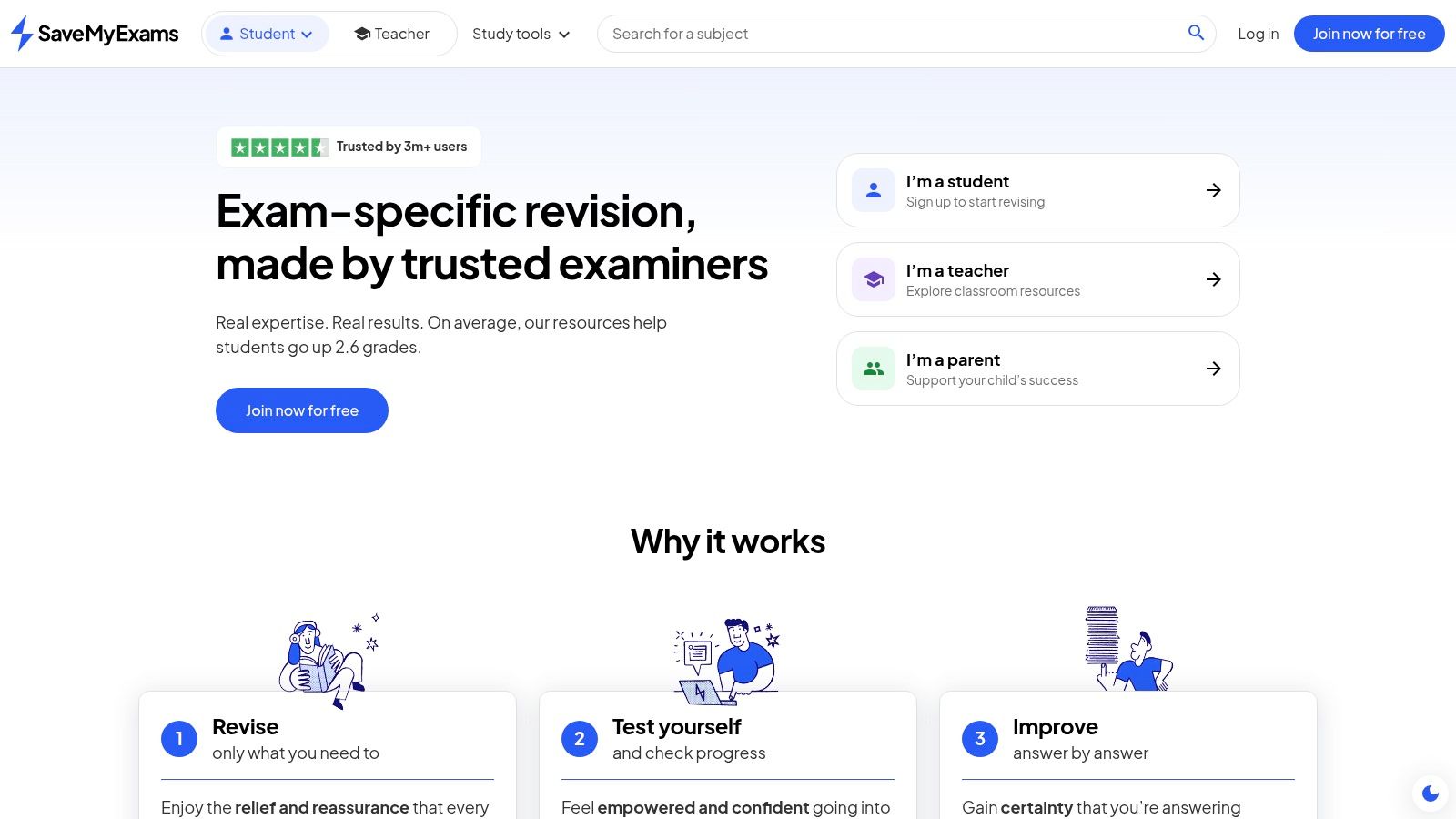
Save My Exams tends to click at the point where revision gets serious. A student has read the notes, watched the videos, highlighted half the textbook, and still freezes when a six-mark question uses awkward wording. That is the gap this site addresses.
Its real strength is exam realism. The content is organised by board and topic, and the jump from revision notes to exam-style questions is quick. That matters more than students think. If the command words, level of detail, and phrasing are close to the paper they will sit, practice starts to transfer properly.
I rate it highly because it feels built for the second half of revision. Early on, students often need simple explanations and recall practice. Later, they need to handle mark schemes, apply knowledge under pressure, and spot the difference between "describe", "explain", and "evaluate" without guessing. Save My Exams is much better at that stage than many prettier platforms.
For sciences and maths, especially, the workflow is solid. Revise one weak topic. Answer a batch of questions written in a familiar exam style. Check what the mark scheme wanted. Fix the gap. Repeat.
That loop is close to how good teachers structure intervention before mocks.
- Strong on exam realism: Board-specific materials make practice feel closer to the actual paper.
- Best for technique as well as content: Useful once students need to convert knowledge into marks.
- Good for structured independent revision: Notes, flashcards, and questions are grouped sensibly.
- Less friendly for casual browsing: Students who want quick, low-effort revision can find it a bit dense at first.
- The paywall is a significant consideration: Free access is useful, but the better question banks and support sit on the paid side.
For teachers, the quality control is reassuring. For students, the message is simpler. If you want revision that looks and feels more like the exam you are heading into, Save My Exams is one of the better options.
5. Physics & Maths Tutor
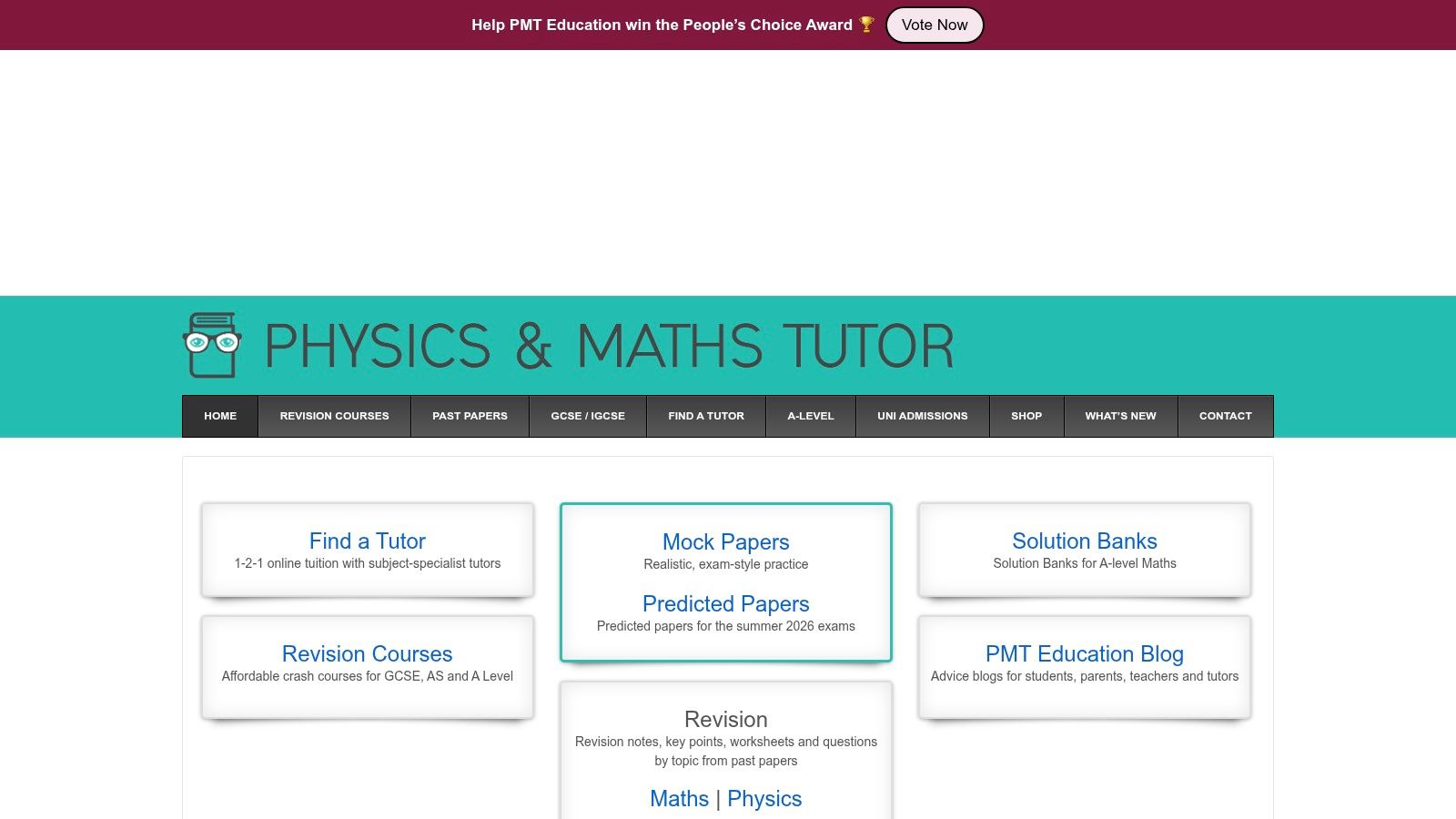
Physics & Maths Tutor has never pretended to be glamorous. Good. Revision websites don't get marks for looking sleek. They get marks for putting the right questions in front of students at the right time, and PMT does that very well.
It's one of the best free archives for past papers, topic questions, and revision notes. For mock prep, it's often the site teachers steer students towards because it's practical and gets on with the job.
Why PMT still matters
The value here is volume and organisation. Students can pull up questions by topic, year, and board without digging through loads of clutter. That makes it particularly useful once revision turns from “learn this topic” into “hammer this weakness until it stops costing marks”.
PMT is strongest with students who already know that exam prep is repetitive. They don't need sparkle. They need access.
If a student has three weeks left and needs question mileage, PMT becomes very hard to beat.
Its downside is obvious. The interface is functional, sometimes a bit clunky, and support depth can vary by subject. But none of that matters much if the goal is realistic paper practice.
- Best free question archive: Excellent for drilling by topic and paper.
- Strong for mocks: Works well when students need lots of exam exposure fast.
- Broad enough beyond the name: Not just physics and maths now.
- Less guided: Students who need hand-holding may prefer a more structured platform.
6. DrFrostMaths
DrFrostMaths is one of the easiest recommendations in the whole list if the subject is maths. It's free, widely used in schools, and built around the thing maths revision needs. Plenty of targeted questions with immediate checking and clear topic tracking.
For exam realism, Dr Frost does something important. It treats maths as a skills map, not a pile of pages. That's exactly how teachers think about it when diagnosing weaknesses.
Best for maths students who need precision
The topic mapping is excellent for finding gaps. A student who says “I'm bad at algebra” usually isn't bad at all algebra. They're weak on a narrower slice. Dr Frost helps narrow that down, then gives enough focused practice to fix it.
The auto-marked homework and dashboards make it useful for classrooms as well as solo revision. Teachers can set work and track where a class is slipping. Students can stop guessing what they need to revise.
- Best maths-only pick: Stronger than many all-purpose sites for targeted maths improvement.
- Very practical for schools: Assignment and tracking tools are built in.
- Free and proven: No nonsense, no major barrier to entry.
- Only for maths: You'll need other tools for every other subject.
- Function over style: It's not pretty, but that's not the point.
If you want maths marks, this is one of the most dependable specialist tools around.
7. Cognito
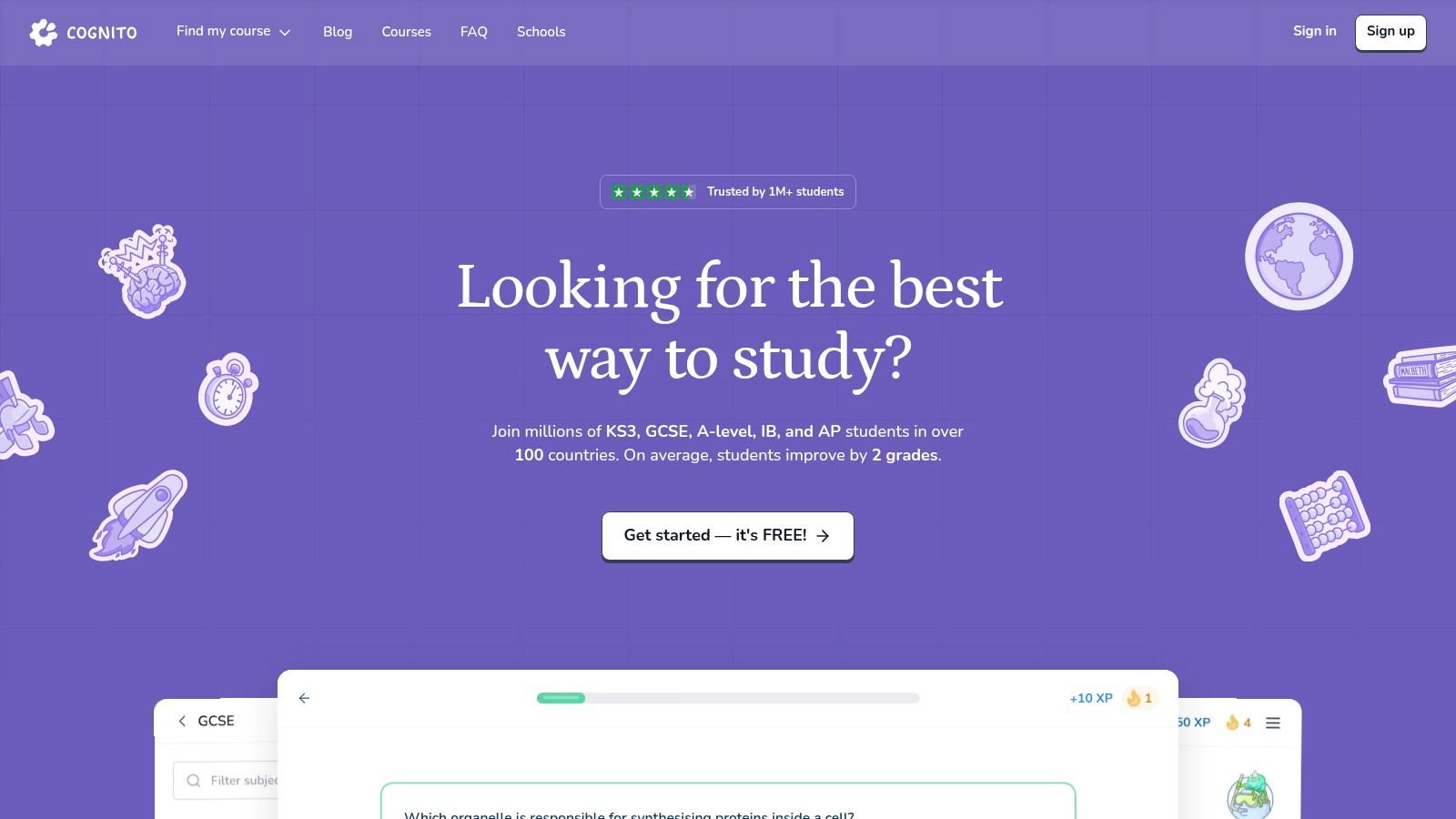
Cognito suits a very common revision pattern. A student realises at 8:40pm that they still do not properly understand electrolysis, watches a short video, answers a few questions, and gets back on track before the panic sets in. For GCSE science in particular, that speed matters.
What I like about Cognito is that it respects how students revise, especially the ones who struggle to start. The videos are short, the quiz follows immediately, and the whole process is easy to repeat on a phone or laptop. That makes it good for building momentum.
On exam realism, though, Cognito sits in the middle of the pack. The explanations are clear and the questions usually point students toward the right facts and methods, but it does not mimic full exam conditions as closely as the strongest exam-practice sites. You get useful retrieval and topic checks. You get less practice with extended command words, mark scheme nuance, and the small wording traps that cost marks in real papers.
That trade-off is fine if you use it properly.
I'd recommend Cognito as a repair tool first and an exam-technique tool second. It works well when a student needs to relearn a topic cleanly before moving on to past paper questions elsewhere. Teachers tend to like it for the same reason. The teaching is tidy, the subject coverage is sensible, and students are more likely to actually use it than a huge bank of static notes.
Best for quick science catch-up with decent question practice
Cognito is strongest in GCSE sciences and useful in maths. It is less convincing for essay subjects, where exam realism depends much more on structure, judgment, and mark scheme interpretation.
- Best for short revision sessions: Strong for students who revise in bursts rather than long blocks.
- Good teaching clarity: Explanations are concise and usually get to the sticking point quickly.
- Decent exam alignment: Better than pure video platforms, but not the closest match to full paper conditions.
- Strong free option: Plenty of value without paying first.
- Less useful for final polishing: Students still need proper past papers and mark schemes before the exam.
8. tutor2u
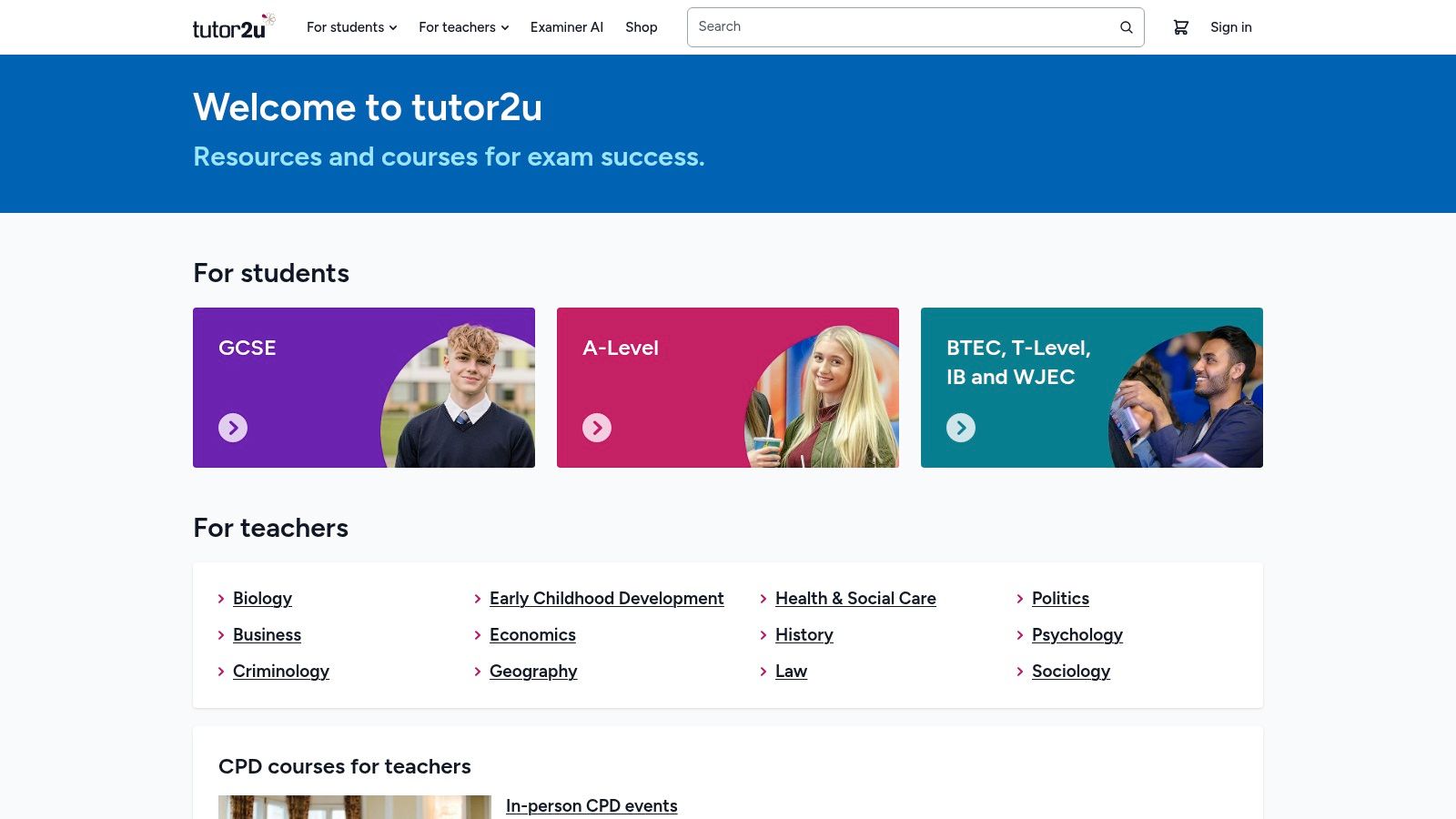
tutor2u is where I'd send strong A-Level students in essay-based subjects who need sharper argument, better examples, and more synoptic thinking. It's especially useful in Economics, Business, Psychology, Sociology, Politics, and Geography, where exam success depends on more than memorising definitions.
This is less of a generic revision site and more of a specialist teaching resource with revision products attached. That's usually a good sign.
Where tutor2u earns its keep
The subject expertise shows. Materials tend to feel like they were made by people who know precisely where students lose marks in longer responses. That makes a difference in subjects where a student can know quite a lot and still write a mediocre answer.
The live sessions and workbooks are helpful too, especially for students who need a bit more accountability than a static notes page can provide.
For essay subjects, the jump from decent to excellent usually comes from argument structure, selection of evidence, and judgment. tutor2u understands that.
Trade-offs are straightforward:
- Best for A-Level essay subjects: Particularly useful for analytical writing.
- Good examiner-style thinking: Strong on skills, not just facts.
- Useful revision skills support: Helpful if a student's method is poor.
- Paid content is its main appeal: The best bundles aren't free.
- Not the broadest GCSE option: Its flagship strength is older students in specific subjects.
9. Up Learn
Up Learn suits a specific kind of student. Usually ambitious, usually organised, and usually willing to spend time inside one structured course rather than patching revision together from five free sites.
Its biggest appeal is that it gives revision a clear pathway. Students don't have to decide what to do next every ten minutes. For some, that's a relief. For others, it can feel restrictive.
Strong for deep, structured A-Level prep
Up Learn works best when a student wants a full guided route through a subject. The videos, diagnostics, and progress tracking create a stronger sense of progression than many free platforms manage. That can be especially useful for students targeting top grades who want less randomness in their revision.
The trade-off is obvious. It's premium, subject coverage is selective, and not every student needs something this all-in.
- Best for structured independent learners: Good if you want one main platform.
- Strong accountability feel: Progress tracking helps students stay honest.
- Good fit for high-grade goals: Better for depth than quick catch-up.
- More expensive than free alternatives: Worth weighing carefully.
- Not for every subject or board: Check the match before buying.
If free sites feel scattered and you want a clearer road, Up Learn makes sense.
10. Get Revising
Get Revising isn't a content site in the same way as most of the others here. That's exactly why it deserves a place. A lot of students don't have a revision knowledge problem first. They have a planning problem.
If your revision timetable lives only in your head, it usually turns into panic, guilt, and random subject hopping. Get Revising helps stop that.
A planner, not a question bank
The main strength is timetable creation. Students can build a revision plan around exam dates and availability, edit it easily, and print it if they want something visible on the wall rather than buried in a phone. That's basic, but useful.
It also pairs well with stronger content sites. Use Get Revising to decide when you'll revise. Use the others to decide what you'll do in that slot.
- Best for organisation: Helps students turn stress into a visible plan.
- Useful across all subjects: Because it isn't tied to content.
- Free and simple: Low effort to start using it.
- Not enough on its own: It needs a companion site for actual practice.
- User-shared material varies: Treat shared resources carefully.
Students who say “I don't even know where to start” often need this before they need another set of notes.
Top 10 Revision Websites: Side-by-Side Comparison
A student can look busy for two hours and still do almost nothing that resembles an authentic paper. That is why this comparison puts exam realism first. I care less about shiny features and more about whether a site trains the habits exams genuinely reward: reading command words properly, applying knowledge under pressure, and checking your answer against something close to a real mark scheme.
Some sites are strong for explanation. Some are strong for planning. A smaller group are genuinely good at turning revision time into exam-ready practice. That difference matters.
| Platform | Exam realism and core use | What stands out | Quality ★ | Price/Value 💰 | Target 👥 |
|---|---|---|---|---|---|
| MasteryMind 🏆 | Exam-board-aligned practice, AO-based feedback, adaptive difficulty, spaced review | Voice Blurt for active recall, NEA Coach (JCQ-compliant), step-by-step maths checks | ★★★★☆ Strong for realistic practice and feedback that points to exam technique | 💰 Free tier. Premium includes NEA Coach and advanced tools | 👥 GCSE & A-Level (Years 3–13), schools, tutors |
| BBC Bitesize | Syllabus-mapped guides, videos, quizzes, printable notes | Clear explanations and very reliable coverage | ★★★★☆ Strong teaching resource, but lighter on true exam-pressure practice | 💰 Free, ad-free | 👥 KS1–KS5 students; first-stop revision |
| Seneca Learning | Adaptive courses, spaced review, bite-size notes with quizzes | Fast learn-test-repeat loop, useful teacher tools | ★★★★☆ Good for recall and coverage. Less convincing for longer exam responses | 💰 Free core. Premium adds more exam-style practice | 👥 KS2–A-Level students & teachers |
| Save My Exams | Examiner notes, topic-sorted questions, mock papers | Board-specific model answers and diagnostics | ★★★★☆ Very close to exam style, especially for science and maths drilling | 💰 Paid membership for the strongest features | 👥 GCSE & A-Level students wanting exam drills |
| Physics & Maths Tutor (PMT) | Past-paper archive, topic question sets, model answers | Huge free archive organised by board and year | ★★★☆☆ Excellent for raw past-paper practice. Feedback is thinner and the interface feels basic | 💰 Free | 👥 Maths & science students, schools |
| DrFrostMaths | Maths question banks, auto-marked homework, teacher analytics | Strong diagnostics and assignment tools | ★★★★☆ One of the better maths options for targeted, exam-style repetition | 💰 Free | 👥 GCSE/A-Level maths students & teachers |
| Cognito | Short topic videos, in-line quizzes, flashcards | Quick explanations with built-in retrieval | ★★★☆☆ Helpful for plugging knowledge gaps. Less like sitting an actual paper | 💰 Free core. Optional school packages | 👥 Busy learners KS3–A-Level |
| tutor2u | Micro-courses, live revision sessions, workbooks | Strong examiner and teacher pedigree for essay subjects | ★★★★☆ Better than most for command words, structure, and written evaluation | 💰 Mostly paid bundles; some free boosters | 👥 A-Level students in humanities & social sciences |
| Up Learn | Structured video courses, diagnostics, formative assessment | Highly guided courses with optional marked papers | ★★★★☆ Strong for understanding and grade chasing. More guided than exam-hall realistic | 💰 Premium pricing (paid plans) | 👥 Students targeting top A-Level grades |
| Get Revising (Student Room) | Revision timetables, drag-and-drop planner | Planner-first approach with shared resources | ★★★☆☆ Useful for revision control, not for exam-style practice itself | 💰 Free | 👥 Students organising multi-subject revision |
The short version is simple. If exam realism is the test, MasteryMind, Save My Exams, PMT, and DrFrostMaths tend to do the heaviest lifting. If a student mainly needs clear reteaching before they practise, BBC Bitesize, Cognito, and Seneca usually earn their place.
That trade-off is where students often go wrong. They choose the site that feels easiest to use, then wonder why scores stay flat. Easy explanations help, but marks usually move when revision starts to look like the paper students will sit.
Your Perfect Revision Stack Making These Sites Work for You
It's 7:30pm, you've opened five revision tabs, copied a colour-coded timetable, watched half a video, and still haven't answered a single exam question. I see this a lot. Students mistake activity for revision, then panic when marks do not shift.
A small revision stack works better because each site should do one clear job. For most students, that means planning, reteaching, and exam-style practice. If one tool tries to do all three, it usually does one of them badly.
Start with the planner. Get Revising is useful here because it puts some limits on your week. If you have mocks, coursework, sport, and a part-time job, your plan has to fit real life or you will ignore it by Wednesday. Good revision plans are boringly realistic.
Then add one content hub. BBC Bitesize and Cognito are good choices when a question exposes a weak topic and you need a clean explanation fast. Use them after a mistake, not as an excuse to spend two hours passively reading notes you might never need. That order matters. The exam paper should tell you what to fix.
The third layer does the heavy lifting. Use a practice engine that looks and feels close to the paper you will sit. That means board-specific wording, proper command words, mark scheme logic, and feedback that tells you why an answer would or would not score. MasteryMind, Save My Exams, PMT, and DrFrostMaths are the tools I'd put in that category, with DrFrostMaths especially useful for maths students who need lots of targeted practice.
A common challenge arises from exam-board mismatch, where a student can revise the correct topic using the wrong style of question. This leads to them being caught out by wording, structure, or mark scheme detail in the exam. Exam realism is the filter that prevents this.
For a lot of students, the setup is simple:
- Planner: Get Revising
- Content refresh: BBC Bitesize or Cognito
- Exam practice: MasteryMind, Save My Exams, PMT, or DrFrostMaths for maths
If you are behind, keep the stack small. One content site and one practice site is enough. If you are chasing top grades, put most of your time into the practice tool and use the content site only to patch the gaps those questions reveal.
The best stack is the one you will use repeatedly under proper exam conditions. Choose a few tools that match your subjects, your board, and the way your papers are marked. Then stick with them long enough for the practice to become familiar, not just comfortable.
If you want one platform built around realistic UK exam practice rather than generic revision, MasteryMind is an easy place to start. It offers specification-aligned questions, examiner-style feedback, and a free plan, so you can see whether it fits your revision before paying.
Compare MasteryMind with other revision tools
Side-by-side comparisons of MasteryMind and other revision tools, feature by feature.
Ready to master this topic?
Practise with quizzes, blurt exercises and exam questions on MasteryMind.
7 days Premium · Then free forever · No card, no charge