Biology AQA GCSE Revision: Your Ultimate 2026 Guide
Your biology notes are open. There are arrows, diagrams, half-finished flashcards, and at least one page that made sense yesterday but now looks like a different language. If your exam is close, you might be thinking, “I've left this too late.” If you're already doing well, you might be thinking, “How do I stop dropping silly marks?”
Both problems are fixable.
AQA GCSE Biology can feel huge because it mixes facts, processes, practicals, graphs, and exam wording. One minute you're revising mitosis, the next you're trying to remember why a control variable matters, and then a six-marker asks you to evaluate something and suddenly your brain leaves the chat. That's normal. The trick is to stop treating revision like one giant pile and start treating it like a game map with clear missions.
Your Game Plan for AQA GCSE Biology
A student I taught once had the classic panic setup. Exercise book full of class notes. A revision guide with sticky tabs everywhere. Screenshots of random diagrams on their phone. They kept saying, “I am revising,” but most of what they were doing was rereading. Lots of time spent. Not much sticking.
What changed things was simple. We stopped asking, “How many hours can you do?” and started asking, “What gets marks in AQA Biology?”
That shift matters. Good Biology AQA GCSE revision isn't about making your desk look productive. It's about building three things at the same time:
- Topic control so you know the core ideas in each part of the course
- Recall strength so you can pull facts out of your memory without staring at a page
- Exam language so you answer the question the way AQA rewards it
If you're behind, this helps you recover fast because you stop wasting energy on low-value revision. If you're aiming high, this is how you turn decent knowledge into sharper exam answers.
What a smart plan looks like
Think of the course like a game with seven main levels. You don't need to complete every side quest before you can improve. You need to know where the big score comes from, and then practise the moves that work under pressure.
The strongest route usually looks like this:
- Learn the map of the course.
- Revise in short, focused bursts instead of endless marathons.
- Test yourself from memory.
- Practise command words, not just content.
- Use practical questions to train method thinking.
- Finish with past papers and mark schemes.
Practical rule: If your revision session doesn't force you to remember something without looking, it probably feels more useful than it really is.
That's why students who feel “busy” aren't always improving. Highlighting can look impressive. So can rewriting notes neatly. But the exam won't ask whether your notes were colourful. It asks whether you can explain osmosis, compare types of respiration, or spot an uncontrolled variable in a method.
If you want a wider revision setup across your subjects, the Available subjects page is useful for seeing how Biology fits into a bigger GCSE plan.
The mindset that helps most
You don't need perfect motivation. You need a repeatable system.
Some days your brain will cooperate. Some days it won't. On the bad days, do one small session properly. Twenty-five minutes of real retrieval beats two hours of drifting between tabs, snacks, and “revision with me” videos. On the good days, stack a few focused sessions and keep going.
You can do this. But you need a method, not just hope.
Breaking Down the AQA Biology Syllabus
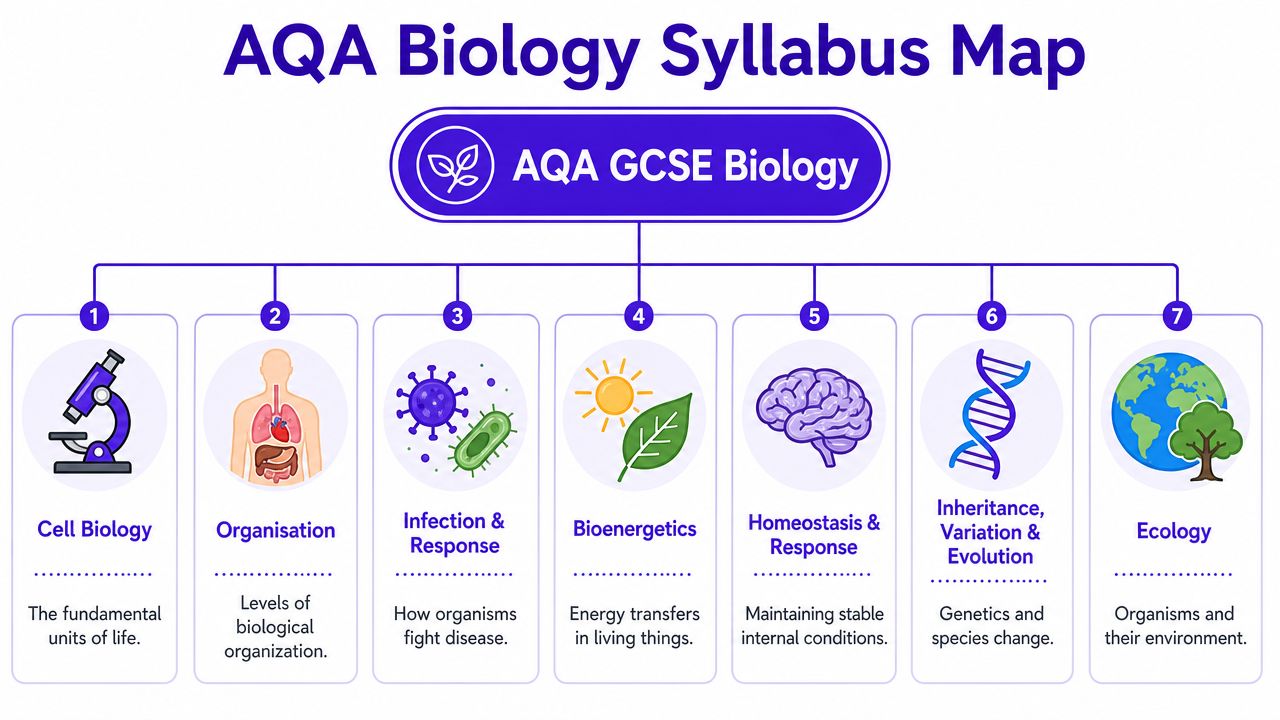
The AQA course gets easier when you stop seeing it as “all of biology” and start seeing it as seven manageable blocks. These are the highest-yield topic clusters for GCSE revision, and guidance for UK learners recommends short 25 to 30 minute sessions with active recall, self-quizzing, and spaced repetition to help you remember the specification vocabulary and command-word responses that AQA expects in answers, as noted in this GCSE Biology revision guidance.
The seven topics that matter
Here's the course map in plain English.
| Topic | What you need to know | Where students often lose marks |
|---|---|---|
| Cell Biology | Cell structure, microscopy, transport, mitosis | Mixing up diffusion, osmosis, and active transport |
| Organisation | Digestion, enzymes, circulation, plant tissues | Forgetting links between structure and function |
| Infection and Response | Pathogens, immunity, vaccination, medicines | Vague answers that don't name the biological process clearly |
| Bioenergetics | Photosynthesis, respiration, factors affecting rates | Missing variables on required practical style questions |
| Homeostasis and Response | Nervous system, hormones, temperature, blood glucose | Confusing control centres, receptors, and effectors |
| Inheritance, Variation and Evolution | DNA, genes, genetics, selection, evolution | Weak definitions and poor genetic cross working |
| Ecology | Food chains, cycles, communities, biodiversity | Dropping marks on graph interpretation and sampling language |
That already feels smaller than “revise biology”.
How to chunk each topic
Don't revise “Cell Biology” as one giant task. That's like saying you're going to watch all of a series in one go and somehow remember every plot twist. Split each topic into short missions.
For example, a Cell Biology revision block could look like this:
- Session one: Cell structure and specialised cells
- Session two: Microscopy and required practical style calculations
- Session three: Diffusion, osmosis, and active transport
- Session four: Cell division and growth in multicellular organisms
Organisation can be split the same way:
- Digestion and enzymes
- The heart and blood vessels
- Plant organisation
- Transport in plants
What to focus on inside each topic
Students often revise the headline idea but skip the details that earn marks. AQA likes precision.
Take Bioenergetics. Knowing that photosynthesis uses light energy is fine, but it isn't enough on its own. You also need to be comfortable with limiting factors, interpreting graphs, and writing a clean explanation of why a change in light intensity can affect glucose production.
Take Homeostasis and Response. Lots of students know that the body keeps conditions stable, but they muddle up who does what. If a question asks about blood glucose control, you need to track the sequence properly. Detect change, send message, trigger response. Consider notifications on your phone. A sensor notices something, the control centre processes it, then the body acts.
AQA Biology rewards answers that follow the chain of events in the right order.
A practical way to cover the whole course
Use a weekly rotation rather than staying in one topic for too long. That helps keep ideas fresh and stops revision becoming stale. One pattern that works well is:
- Early week: A harder topic such as Homeostasis or Inheritance
- Midweek: A process-heavy topic such as Bioenergetics or Infection and Response
- Later week: Ecology or Organisation, plus one short review of a previous topic
That mix keeps your brain switching gear. Biology exams do that too.
The marks trap to avoid
Some students think top grades come from knowing more and more facts. In reality, they often come from knowing the right facts clearly and being able to use them accurately. Historical AQA performance reports from 2019 to 2024 show that 14% of GCSE Biology candidates achieved grade 9 across the exam period, a figure described as stable since the GCSE reforms. That tells you something important. Grade 9 isn't about luck. It comes from handling a tough paper with consistent precision.
Your revision should reflect that. Don't just collect information. Organise it, quiz it, and make sure you can use it.
Revision That Actually Works Active Recall and Spaced Repetition
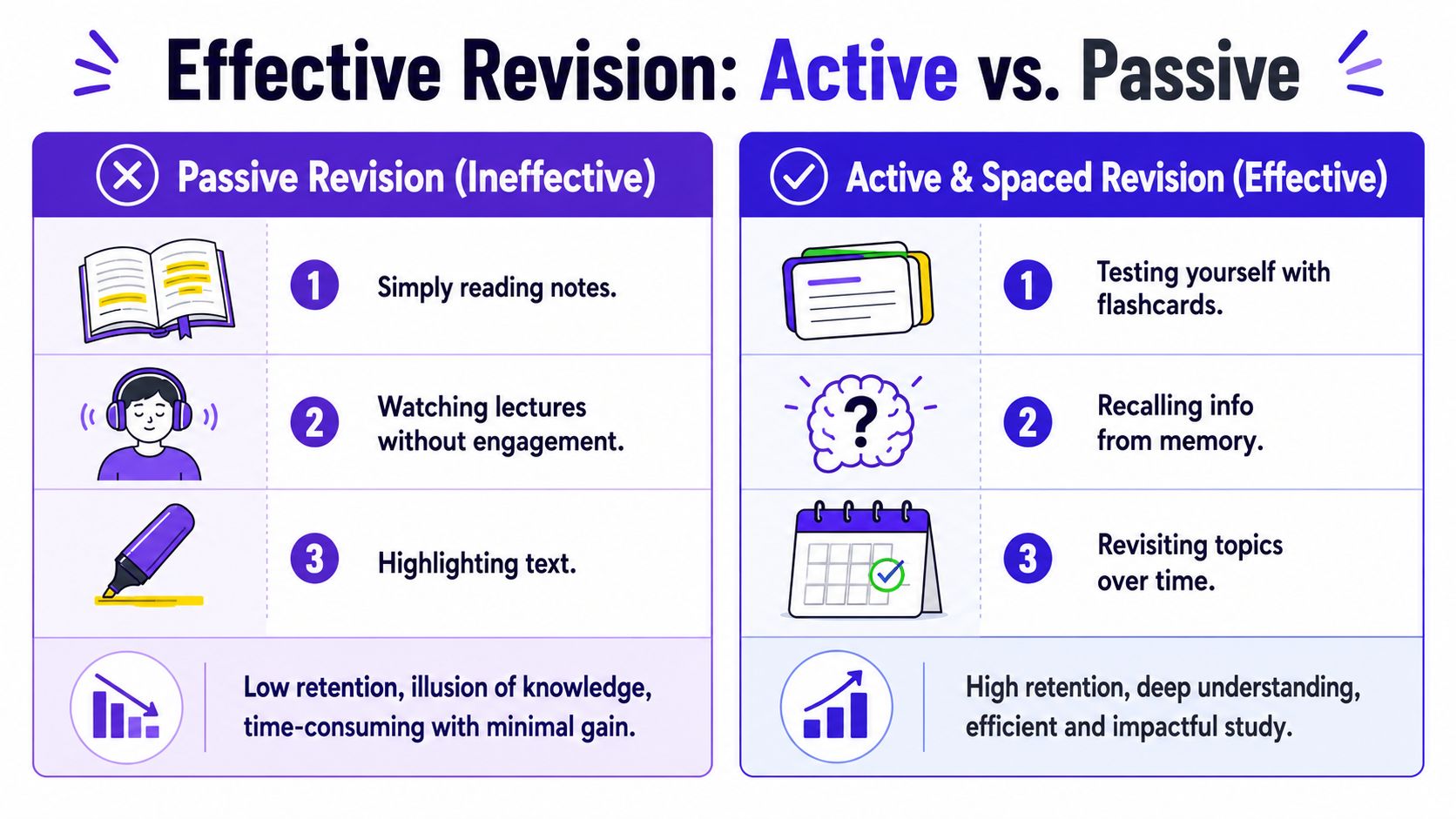
Most students know what bad revision looks like, even if they still do it. Read the page. Highlight a few lines. Watch a video. Nod along. Feel productive. Forget half of it the next day.
That's passive revision. It's like listening to a song a lot and assuming you can suddenly sing every lyric perfectly. Recognition is not the same as recall.
Why active recall beats rereading
Active recall means dragging the answer out of your memory without looking first. That can feel harder, which is exactly why it works better. Your brain has to do the lifting.
The 2023 National Survey of Secondary Education found that students who did at least 10 minutes of daily active recall scored, on average, 12% higher in final AQA Biology exams than those who relied only on passive reading. The same survey found that 89% of GCSE students used structured revision resources, and 74% used flashcards or active recall methods.
Those figures matter because they match what teachers see all the time. The students improving fastest usually aren't the ones staring at notes the longest. They're the ones testing themselves regularly.
What active recall looks like in real life
Here are methods that count:
- Flashcards: Cover the answer and force yourself to say it before checking.
- Blurting: Close the book and write everything you remember about one topic.
- Teach it aloud: Explain the cardiac cycle to your wall, sibling, or pet.
- Question lists: Turn a page of notes into five exam-style prompts.
- Diagram recall: Redraw a nephron, leaf, or reflex arc from memory.
A simple test is this. If you can do the task while half-distracted, it's probably too passive.
Here's a useful explainer if you want the learning method behind the schedule side of revision. This Guide for course creators explains spaced repetition clearly, even though it's aimed at people designing courses rather than sitting exams.
Why spaced repetition stops last-minute panic
Spaced repetition means revisiting material over time instead of cramming it once. The concept is similar to keeping a Snapchat streak alive. One giant effort at the end doesn't replace regular check-ins. Memory works in a similar way.
Try this pattern:
| Topic | First review | Second review | Third review |
|---|---|---|---|
| Osmosis | Same day | Two days later | One week later |
| Hormones | Same day | Three days later | One week later |
| Ecology terms | Same day | Two days later | Six days later |
You don't need perfect intervals. You need repeated retrieval before the topic disappears from your head.
A short video can help if you want a visual explanation of study habits that support retention.
Make your revision do some work
If you want a practical framework for building stronger recall sessions, MasteryMind's active recall guide gives a clear starting point.
Stop asking, “Did I cover the topic?” Ask, “Could I answer a question on it with no notes open?”
That question changes everything.
Decode the Examiner's Mind Mastering Command Words
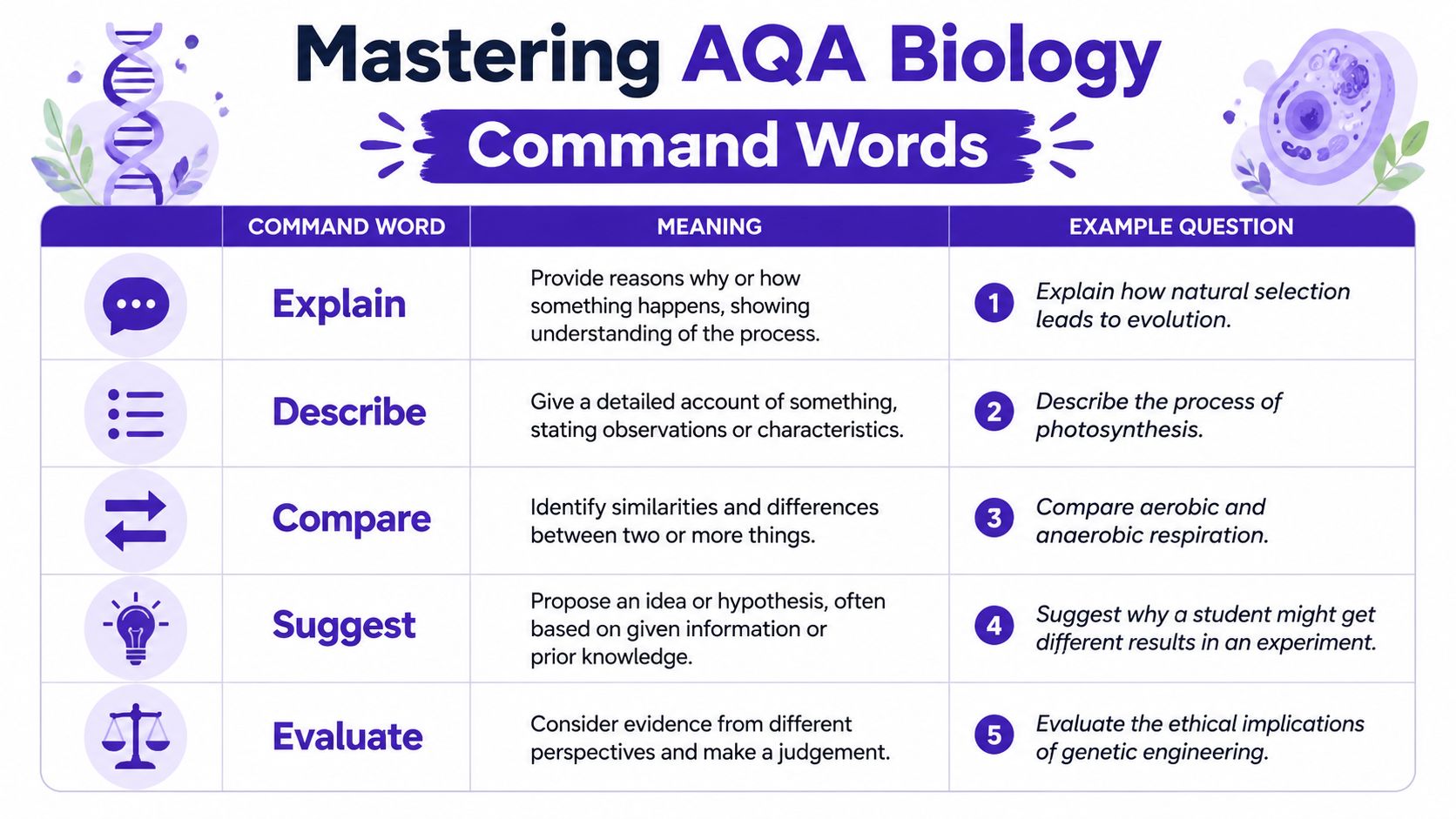
A lot of students know more biology than their marks show. The problem isn't always the science. It's the wording. AQA questions are full of command words that subtly tell you how to answer, and if you ignore them, you can lose marks even when your knowledge is solid.
This is one of the most underserved parts of Biology AQA GCSE revision. Guidance on AQA-specific notes points out that performance depends on precise exam-board language, and that revision improves when students map content to command words, mark allocations, and common examiner expectations rather than just collecting more notes, as discussed in this AQA Biology notes guidance.
What the command words really mean
Here's the student-friendly version.
| Command word | What AQA usually wants | Common mistake |
|---|---|---|
| Describe | Say what happens or what you can see | Explaining reasons when the question only wanted observations |
| Explain | Give reasons or a mechanism | Listing facts without linking cause and effect |
| Compare | Give similarities and differences | Writing only one side |
| Suggest | Use clues and your knowledge to make a sensible idea | Panicking because the answer wasn't memorised |
| Evaluate | Weigh up evidence and make a judgement | Giving one opinion with no balance |
Before and after examples
Describe
Question: Describe what happens to the rate of photosynthesis as light intensity increases.
Weak answer: “Photosynthesis gets better because plants need light.”
Better answer: “The rate of photosynthesis increases as light intensity increases, then reaches a point where it levels off.”
The second answer sticks to what is happening. It doesn't wander into explanation unless asked.
Explain
Question: Explain why enzymes stop working well at high temperatures.
Weak answer: “They stop because it is too hot.”
Better answer: “High temperatures change the shape of the enzyme's active site, so the substrate no longer fits as well and fewer enzyme-substrate complexes form.”
That answer gives the mechanism. It earns marks because it answers the “why”.
Compare
Question: Compare aerobic and anaerobic respiration.
Weak answer: “Aerobic respiration uses oxygen.”
Better answer: “Aerobic respiration uses oxygen and releases more energy. Anaerobic respiration does not use oxygen and releases less energy.”
Compare means you need both sides on the page.
Suggest
Question: Suggest why a student got different results in repeated osmosis tests.
Weak answer: “The experiment was wrong.”
Better answer: “The potato pieces may not have been the same size, or excess solution may have remained on them before measuring mass.”
Suggest questions are about sensible scientific ideas. They often reward logical possibilities rather than one perfect phrase.
Evaluate
Question: Evaluate the use of a new drug treatment.
Weak answer: “It is good because it helps people.”
Better answer: “The treatment could improve health outcomes, but it may also have side effects or cost more than existing treatments. Its value depends on how effective it is compared with current options.”
Evaluate answers need balance. Think scales, not slogans.
A quick rule for longer questions
For four-mark and six-mark questions, use the command word as your writing style.
- Describe means sequence and observations
- Explain means because, therefore, so
- Compare means both, whereas, however
- Evaluate means advantage, limitation, judgement
“Answer the command word first. Then add the biology.”
That sounds obvious, but loads of marks disappear because students rush in with content and forget the task.
Practise with mark schemes, not vibes
One of the fastest ways to improve is to answer one question, mark it accurately, and then look at the wording AQA rewards. If you want to find AQA GCSE mark schemes, use them to notice repeated phrases, not just to count marks.
A good habit is to keep a mini list called “AQA answer language”. Every time you miss a mark because your wording was too vague, write the sharper version down. Over time, your answers start sounding more exam-ready.
That's how students stop saying, “I knew it really,” after the paper. Knowing it in your head and writing it in a mark-scheme-friendly way are not the same skill. You need both.
How to Revise AQA Required Practicals
Required practicals scare students more than they need to. The reason is simple. Many people try to memorise the final result and hope that will cover everything. AQA doesn't assess practical work that way.
Guidance on AQA practical revision makes this clear. Practical work is assessed through the required practical content, so revision should focus on variables, measurements, and error analysis, not just the result. Marks are often awarded for method precision, control of variables, and correct interpretation of trends, as explained in this practical revision guide.
What to learn from each practical
For every practical, train yourself to answer these questions:
- What is the independent variable?
- What is the dependent variable?
- Which variables must be controlled?
- How is the measurement taken?
- What could reduce accuracy?
- What pattern would the graph show?
If you can answer those six things, you're in a strong position.
Use one practical as your model
Take the classic potato osmosis practical. Students often remember the broad idea that potato mass changes in different sugar concentrations. Useful, but incomplete.
What gets marks is the process thinking:
- Independent variable: concentration of the solution
- Dependent variable: change in mass of the potato pieces
- Controls: size of potato pieces, volume of solution, time left in solution, temperature
- Method detail: dry the potato before reweighing so extra liquid doesn't distort the result
- Data handling: calculate percentage change in mass and plot concentration against biological response
- Error thinking: not all potato cylinders are identical, balance precision may affect readings
That's much closer to how exam questions are written.
Precision matters more than people think
AQA likes methods that are specific. “Measure it carefully” is weak. “Use the same length and diameter of potato cylinders” is better. “Keep the volume of each solution the same” is better. Precision is what makes a method repeatable.
If you want a general writing model for clearer experimental methods, this guide on how to write lab procedures is handy because it shows how to make steps specific and usable.
In practical questions, the examiner often cares less about whether you remember the headline and more about whether you can think like a scientist.
A quick way to practise practicals
Instead of revising practicals as long paragraphs, turn each one into a one-page grid:
| Part | Your notes |
|---|---|
| Aim | What is being tested |
| Variable changed | Independent variable |
| Variable measured | Dependent variable |
| Controls | Things kept the same |
| Accuracy issues | Sources of error |
| Improvements | How to make results more reliable |
That format stops practical revision becoming messy. It also makes last-minute review much easier.
A Flexible 4 Week AQA Biology Revision Timetable
A timetable should help you think, not trap you. If you miss one session, that doesn't mean the whole plan is ruined. It just means you move things around and keep going.
This four-week version mixes content, retrieval, practicals, and exam practice. The shorter evening slot is there on purpose. It gives you a spaced review point without needing another heavy session.
4-Week AQA GCSE Biology Revision Timetable
| Day | Morning Session (45 mins) | Afternoon Session (45 mins) | Evening Session (25 mins) |
|---|---|---|---|
| Monday | Cell Biology core concepts | Command word practice with short questions | Flashcards on today's topic |
| Tuesday | Organisation and enzymes | Required practical review | Blurting from memory |
| Wednesday | Infection and Response | Past paper questions | Quick corrections and reteach |
| Thursday | Bioenergetics | Graphs and data interpretation | Flashcards on weak areas |
| Friday | Homeostasis and Response | Longer-answer practice | Review of earlier week topics |
| Saturday | Inheritance, Variation and Evolution | Genetics questions and exam wording | Short self-quiz |
| Sunday | Ecology | Mixed-topic retrieval | Light recap or rest |
How to use it without burning out
Some students work better in the morning. Some don't. Shift the slots if needed, but keep the balance:
- One content session to learn or tighten knowledge
- One application session to use that knowledge
- One short recall session to revisit it later
That pattern matters because it stops you doing all input and no output.
How the four weeks can change
Use the same skeleton each week, but change the focus.
- Week one: Build coverage and identify weak topics
- Week two: Revisit weak areas and add more command word practice
- Week three: Increase mixed-topic questions and practical analysis
- Week four: Focus on past papers, corrections, and short reviews rather than learning brand new content
If you fall behind, cut the extras first. Keep the essentials. Topic recall, exam questions, and review. That trio does most of the heavy lifting.
The Best Resources for Your AQA Biology Revision
Resources are useful only if they match the exam you're sitting. That sounds obvious, but loads of students revise from generic biology material and then wonder why their answers don't fit AQA wording.
AQA's 2020 report found that 63% of students who used AQA-specific revision guides achieved a grade 7 or above, compared with 45% of those who used non-board-specific materials. That's a strong reminder to choose resources that line up with the actual specification and question style.
What to prioritise first
Start with resources that are clearly AQA-focused.
- AQA specification: This is your checklist. If a topic isn't on it, don't let it steal your time.
- AQA past papers and mark schemes: These show the language and structure the examiner rewards.
- Board-specific revision guides: Better than random internet notes because the wording is closer to your paper.
- Selected YouTube channels: Good for difficult processes like immunity, respiration, and hormones, but pause and quiz yourself after watching.
If you like handwritten revision, some students find a Stylus Pen helpful for drawing cleaner diagrams and annotating digital notes, especially for topics like the heart, nephron, and plant transport where labelled structures matter.
Use tools that match the method
A resource should support the way good revision works. That means retrieval, spacing, and exam technique. It should also help with command words, because that's where a lot of students leak marks.

One option that fits that approach is MasteryMind. It gives UK learners exam-board-aligned practice, including AQA Biology questions, command-word-based tasks, spaced review scheduling, and GCSE Past Papers. That matters because it ties together the three things students often separate by mistake. Content knowledge, retrieval practice, and exam-style wording.
A simple resource stack that works
You don't need ten apps and fifteen notebooks. A lean setup is usually better.
Try this combination:
| Need | Resource type | What to do with it |
|---|---|---|
| Know what to revise | AQA specification | Tick off each subtopic honestly |
| Learn tricky content | Revision guide or trusted video | Make short notes, then close it |
| Remember it | Flashcards or blurting | Test yourself without looking |
| Score marks | Past papers and mark schemes | Practise real wording and corrections |
The best revision resources don't just tell you biology. They force you to use it.
That's the standard to judge everything by. If a resource only lets you read, scroll, or watch, make sure you add your own quiz step straight after. Otherwise it's easy to mistake familiarity for mastery.
When your revision becomes specific, board-aligned, and active, the subject stops feeling random. You start to see patterns. The same command words come back. The same practical logic shows up. The same weak spots become fixable.
If you want one place to turn this into daily practice, MasteryMind gives you AQA-aligned revision that matches how GCSE Biology is examined. Use it to test recall, practise command words, work through past papers, and keep your revision organised without building the whole system from scratch.
Ready to master this topic?
Practise with quizzes, blurt exercises and exam questions on MasteryMind.
7 days Premium · Then free forever · No card, no charge