Blood Brothers Summary: Your Ultimate GCSE Guide
If you're revising Blood Brothers, there's a good chance you're in one of two moods. Either you've left it a bit late and need a rescue plan, or you know the plot already but keep thinking, "How do I turn this into actual marks?" Both are fixable.
A lot of blood brothers summary pages stop at "this happens, then this happens." That's not enough for GCSE. Examiners don't reward plot retelling on its own. They reward your ability to explain why events matter, how Russell builds meaning, and how the play connects to ideas like class, fate, and responsibility.
Your No-Stress Guide to Blood Brothers
Blood Brothers shows up again and again in UK classrooms for a reason. It's dramatic, memorable, and packed with themes examiners love. It's also a text that many students study. Over 20,000 students sit related exams annually across major boards like AQA and Edexcel, and AQA alone reported 15,000+ entries in 2024 GCSE English Lit papers featuring the play, according to this Blood Brothers study guide PDF.
That matters because you're not just learning a story. You're learning a text that exam boards know inside out, and they expect more than a basic recap.
The smart way to revise is to build from the ground up. First, know the world of the play. Then, lock in the characters. After that, get the plot straight. Only then should you move into themes, quotes, and exam technique.
Practical rule: If you can't explain a scene in simple language, you probably can't analyse it properly yet.
If you want extra structured practice alongside this guide, Online Revision for GCSE can help organise the messy part of revision. But first, let's get the play clear in your head.
Setting the Scene The World of Blood Brothers
Willy Russell didn't write Blood Brothers in a vacuum. The play is rooted in Liverpool and in a Britain where class shaped almost everything, from housing to education to the jobs people could hope for.
The musical version premiered in 1983 and later ran in the West End for over 24 years, attracting an estimated 10 million theatregoers, as noted in this summary of Blood Brothers. That long life on stage matters because audiences kept recognising something painfully real in it. The story of two boys split by class didn't fade. It stayed relevant.
Liverpool and class division
At the centre of the play are two homes that might as well be two different countries. The Johnstones live with insecurity, overcrowding, and constant financial pressure. The Lyons family live with comfort, privacy, and control.
That contrast isn't just background. It's the engine of the tragedy.
When students get confused here, it's usually because they treat class as a theme floating above the plot. It isn't. Class affects the characters' daily choices:
- Mrs Johnstone's desperation makes the original separation possible.
- Mickey's environment shapes his confidence, language, and later prospects.
- Edward's privilege gives him safety, polish, and opportunities he doesn't even have to fight for.
- Linda's relationships are pulled into that divide too, because love in the play never exists outside social pressure.
Why context gets you marks
For GCSE, context works best when it's tied to a moment in the play. Don't bolt it on at the end like a history fact you've remembered at the last second.
A weak point would be this: "The play is about class in Britain."
A stronger point is this: Russell makes Mickey and Edward speak, think, and react differently because their upbringing has taught them different expectations about the world. That turns class from an abstract issue into something the audience can hear and watch.
Context should explain a character's choices, not sit beside them like a spare note in brackets.
The Thatcher-era connection
The play's West End success overlapped with the Thatcher era, which gives its social criticism extra force in performance history, as discussed in the earlier linked source. Even if your exam answer focuses on the text itself, that wider context helps you see why the play feels angry as well as tragic.
Russell isn't saying, "What a sad accident." He pushes us toward a harsher conclusion. A divided society creates divided futures.
The clearest way to understand the core narrative is:
| Family | What their world offers | What that means for the child |
|---|---|---|
| Johnstones | Instability, struggle, little protection | Mickey grows up vulnerable to pressure and disappointment |
| Lyons | Security, education, social confidence | Edward grows up believing doors will open |
That table is basically the whole play in miniature.
Meet the Characters Who Drives the Story
Before the plot starts racing, get the people clear. Students often lose marks because they mix up what a character does with what a character represents. You need both.
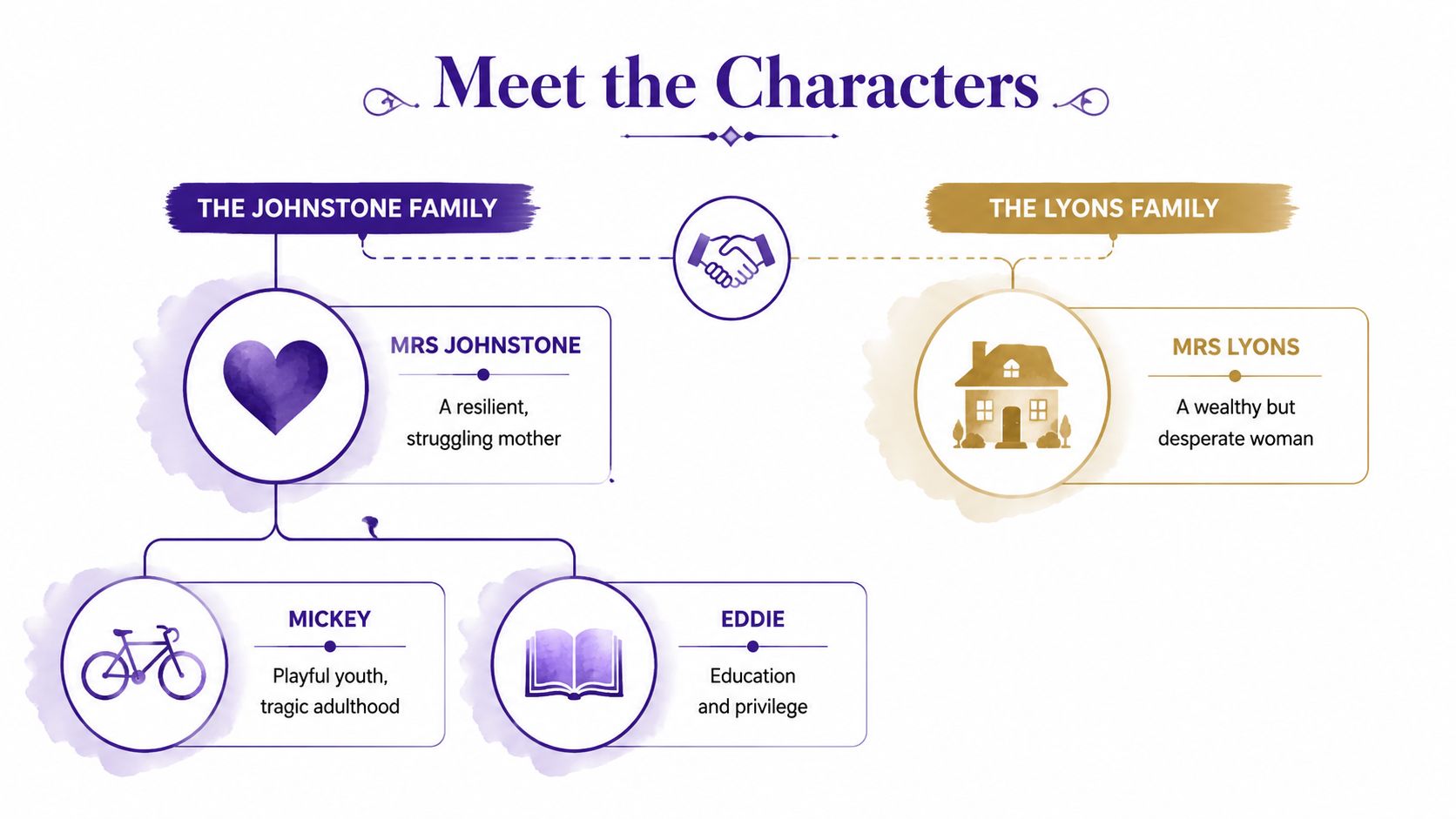
Mrs Johnstone
Mrs Johnstone is the emotional starting point of the play. She isn't presented as perfect. She jokes, struggles, worries, and makes a terrible decision. But Russell makes that decision understandable by surrounding her with pressure.
She's important in essays because she sits at the crossing point of poverty, motherhood, and superstition. If you're writing about fate, class, or responsibility, she matters.
A useful way to think about her is this: she isn't weak, but she is cornered.
Mrs Lyons
Mrs Lyons begins as controlled and respectable, but that image cracks more and more as the play goes on. She's desperate for a child, then desperate to keep control, then desperate to protect her lie.
Students sometimes write about her too narrowly as "the villain." That's not quite enough. She's manipulative, yes, but she's also fearful. Russell shows that wealth doesn't remove anxiety. It just changes its shape.
Mickey and Edward
These two are the heart of any blood brothers summary.
Mickey grows up in hardship. He's funny, lively, and warm as a child, which makes his later decline more painful. Russell doesn't want us to see him as doomed from birth. He wants us to see what happens when a bright, energetic child hits a world that offers fewer ways forward.
Edward grows up with security and polish. He can seem naive, but that naivety is part of the point. He doesn't fully understand the barriers Mickey faces because he's never had to.
Linda and the Narrator
Linda is more than "the girl in the middle." She links the boys' childhood and adult lives, and her choices reveal how the play's emotional tensions become public and destructive.
The Narrator matters for top-grade analysis because he shapes the audience's response throughout. He doesn't just tell the story. He hangs over it like a warning.
The Narrator turns ordinary scenes into ominous ones. Even moments of fun feel unstable because he keeps reminding us that tragedy is coming.
Quick character grid
- Mrs Johnstone: loving, pressured, impulsive, trapped by circumstance
- Mrs Lyons: controlled, possessive, anxious, increasingly unstable
- Mickey: playful, emotional, vulnerable, damaged by social reality
- Edward: open-hearted, confident, privileged, protected
- Linda: loyal, practical, caught between love and survival
- Narrator: watchful, unsettling, symbolic voice of fate and judgement
If you can describe each character in one line and then expand it with a scene, you're in good shape.
The Plot An Act-by-Act Summary
Most students need a blood brothers summary that's clear enough to remember, but sharp enough to use in an essay. That's what this is.

Act One
The play opens with the ending hanging over it. We know early on that something terrible has happened, and that sense of doom never really leaves.
Mrs Johnstone is poor and already struggling to support a large family. She discovers she's expecting twins while working for the wealthy Mrs Lyons. Mrs Lyons, who can't have children, persuades her to give one baby away in secret. Mrs Johnstone agrees, and the twins are separated at birth.
This single decision creates the whole tragedy. One child, Mickey, stays with the Johnstones. The other, Edward, is raised by the Lyons family.
As children, the boys meet by chance and become instant friends. They don't know they're brothers. Their friendship feels natural and joyful, which is exactly why the audience feels the injustice of their separation so strongly. They invent the idea of becoming "blood brothers," a childish game that carries huge dramatic irony because they already are brothers.
Mrs Lyons panics when she sees their bond growing. She becomes more controlling and arranges to move away, trying to stop the connection.
What to remember from Act One
Act One gives you the key ingredients of nearly every essay topic:
- The secret that drives the plot
- Childhood innocence before adult damage sets in
- Class difference through the contrast between homes
- Superstition and fate through repeated warnings and fears
- Dramatic irony because the audience knows more than the boys
Students often miss this. Act One isn't just setup. It already contains the whole tragedy in miniature.
Act Two
Act Two is where childhood differences harden into adult consequences. Mickey and Edward meet again as teenagers, and their friendship restarts, but now class matters more sharply. The gap between them has widened.
Linda becomes central here. She has history with Mickey, but Edward is drawn into the relationship too, which creates emotional tension alongside the social one.
Mickey's life becomes more difficult. Adult responsibility, lack of opportunity, and bad decisions begin to crush him. He ends up involved in crime, is imprisoned, and later struggles badly in ordinary life. Edward, by contrast, moves forward through education and status with far less resistance.
This is a good point to watch a quick recap if you need the sequence fixed in your head before learning quotes.
The final section of the play is brutal because everything converges at once. Mickey feels betrayed. Edward still doesn't fully understand the depth of Mickey's pain. Linda is caught between them. The secret of their birth finally comes out, but too late to save anyone.
The confrontation ends in the deaths of both brothers.
The simplest chain of cause and effect
If you struggle to remember plot, learn it as a chain:
- Poverty creates the impossible choice
- The twins are separated
- They meet and bond anyway
- Adults try to break that bond
- Class shapes them differently as they grow
- Resentment, misunderstanding, and secrecy build
- The truth arrives too late
- The tragedy is fulfilled
A strong essay doesn't retell every event. It picks the events that prove an argument.
Unpacking the Big Ideas Themes and Symbolism
Plot transitions into grades. If plot tells you what happens, themes tell you what Russell wants us to think about what happens.

Nature versus nurture
The central question is simple. Are Mickey and Edward shaped more by birth or by upbringing?
Because they are twins, Russell gives himself a built-in experiment. The boys start with the same biological origin, but they grow into very different adults because they are raised in different social worlds. That pushes the audience toward the idea that environment matters massively.
But don't oversimplify it. Russell isn't saying biology means nothing. He's using the twins to expose how strongly society interferes with human potential.
A useful exam sentence would be: Russell presents the twins' shared origins as a challenge to the idea that social difference is natural, because their contrasting lives come from upbringing rather than worth.
Social class
Class isn't just one theme among many. It's the play's organising force.
You can see it in:
- Language. Mickey and Edward sound different because they have grown up in different environments.
- Expectations. Edward assumes a future is waiting for him. Mickey has to survive the present first.
- Power. Mrs Lyons can influence events because money gives her options. Mrs Johnstone has fewer.
This is why the ending feels social as well as tragic. The deaths don't come out of nowhere. Russell spends the whole play showing how inequality creates pressure, frustration, and distortion.
Exam insight: If you're stuck, ask yourself, "Who has choices in this scene, and who doesn't?" That usually leads you straight to class analysis.
If you want to go deeper with texts like this across your course, Mastering UK English literature is a useful starting point for structured revision practice.
Fate and superstition
The play constantly raises the possibility that the brothers are doomed. Mrs Johnstone's superstitions, the Narrator's warnings, and the repeated sense of prophecy all make the audience feel that some ending cannot be escaped.
But Russell keeps the idea slippery. Is fate real in the world of the play, or do people use superstition to explain social cruelty they don't want to face directly?
That's an excellent debate for essays. A thoughtful answer doesn't choose one side too quickly. It shows that Russell makes fate feel real on stage while also showing that human actions and social systems drive the disaster.
Symbols that matter
| Symbol or device | What it suggests | Why it helps your analysis |
|---|---|---|
| Blood brothers pact | Innocence, connection, irony | The boys act out a truth they don't know |
| Narrator | Fate, judgement, warning | He controls the mood and foreshadows tragedy |
| Songs and repeated motifs | Memory and inevitability | Repetition makes the play feel cyclical |
| Marilyn Monroe references | Fantasy, glamour, escape, disappointment | They reveal Mrs Johnstone's hopes and illusions |
The trick is not just naming a symbol. Explain its effect. If you write "The Narrator symbolises fate," that's only half done. Add what he does to the audience. He makes us read even happy moments as fragile.
GCSE Exam Power-Up Quotes and Model Answers
Students usually make their biggest jump at this point. Knowing the play is one thing. Writing a response that scores well is another.
What AQA wants
In AQA GCSE English Literature specification 8702, Blood Brothers is set for Paper 2, Section B, and students answer on an extended extract of around 40 to 50 lines from Act 1 or Act 2. The question is marked with AO1 worth 12 marks and AO2 worth 12 marks, for 24 marks total, according to this Blood Brothers summary and study page.
For AQA, the common mistake is spending too long retelling what happens in the extract. The extract is there so you can zoom in on language, form, and structure, then connect it to the whole play.
AQA method that actually works
Use a simple pattern:
- Answer the question directly
- Select a short quotation
- Analyse a word, image, or dramatic method
- Link the moment to the wider play
- Tie it back to Russell's message
For example, if the extract focuses on superstition, don't just say Mrs Johnstone is superstitious. Say how Russell uses that belief to create tension, foreshadow tragedy, and perhaps mask the harsher truth that poverty has forced her into impossible choices.
Start with the writer's method, not the plot. Examiners can see the extract too. What they need from you is interpretation.
Quote bank you can actually use
Here are some of the most useful quotations to learn because they connect to multiple themes.
"If either twin learns that he was once a pair, they shall both immediately die."
Good for fate, superstition, fear, dramatic irony. The absolute language creates a curse-like feeling."I wish I was our Sammy."
Good for Mickey's childhood frustration and ideas about masculinity, status, and power."I don't wanna be a judge. I wanna be... an engine driver."
Good for Edward's innocence and the irony that privilege doesn't stop him longing for something ordinary and free."The devil's got your number."
Good for the Narrator's ominous tone and the sense that doom follows the characters."I could have been him."
This is one of the most important ideas in the whole play. It's brilliant for class, identity, and the final recognition that social circumstances have shaped both men differently.
Model paragraph for AQA
Question idea: How does Russell present the power of fate in this extract and elsewhere in the play?
Russell presents fate as an oppressive force by making superstition sound terrifyingly certain. When Mrs Johnstone hears that "if either twin learns that he was once a pair, they shall both immediately die", the absolute phrasing makes the warning feel like a prophecy rather than a rumour. Russell uses this to create dramatic irony because the audience knows the twins' friendship is already pushing them towards the forbidden truth. However, the play also suggests that what looks like fate is tied to human desperation and social inequality. Mrs Johnstone accepts the arrangement because poverty has left her with too few choices, so Russell may be showing that tragedy is not only supernatural but also built by the conditions people live in.
That paragraph works because it doesn't stop at "fate is important." It analyses method and offers a bigger interpretation.
What Edexcel wants
Edexcel usually pushes students toward a whole-text response on character or theme. That means you need a line of argument across the entire play, not just close analysis of one extract.
The trap here is writing a paragraph for each scene with no overall point. A stronger answer builds one central idea and keeps proving it.
A simple Edexcel thesis on class could be:
Russell presents social class as the force that turns a natural brotherly bond into a tragedy, because the twins' different upbringing shapes their confidence, opportunities, and ability to cope with adult pressure.
Then each paragraph proves one part of that.
Model paragraph for Edexcel
Russell shows the impact of class most painfully through the different pressures Mickey and Edward face as adults. Mickey's early humour and energy make his later collapse more tragic, because the audience can see that he was not born defeated. Instead, Russell suggests that his environment has worn him down. Edward, by contrast, moves through life with confidence that comes from protection and expectation. This contrast makes the final recognition, "I could have been him," devastating, because it reduces the gap between them to circumstance rather than character. Russell uses the brothers to criticise a society that gives one child support and another struggle, then pretends their outcomes are purely personal.
A quick board comparison
| Exam board focus | Best revision approach |
|---|---|
| AQA | Practise extract analysis, zoom in on methods, then link outward |
| Edexcel | Build a whole-text argument and track a theme across key moments |
One smart habit is to revise scenes by question type. For AQA, ask, "What methods are visible here?" For Edexcel, ask, "How does this scene advance my argument across the whole play?"
If you need realistic practice material for that, GCSE Past Papers are useful because they force you to write under the same kind of pressure you'll get in the exam.
Why Blood Brothers Still Matters Today
Blood Brothers lasts because it still asks uncomfortable questions. What happens when two people with the same starting point are treated as if they belong to different worlds? How much freedom do people really have when money, housing, education, and status push them in opposite directions?
That's why the play doesn't feel like a museum piece. Teenagers still recognise the unfairness in it. Teachers still teach it because the issues haven't gone away. And examiners keep setting it because it gives students the chance to write about character, structure, context, and big ideas all at once.
If you remember one thing, make it this. The tragedy isn't only that the brothers die. The tragedy is that the play suggests society helped write that ending long before the final scene.
You've got a lot more than a basic blood brothers summary now. You've got the plot, the pressure points, the themes, and the exam angle. That's what turns revision into marks.
If you want a smarter way to revise texts like Blood Brothers, MasteryMind gives UK students exam-board-aligned practice, structured feedback, and revision that moves from quick recall to essay-level analysis. It's built for GCSE and A-Level learners who want clearer guidance, better habits, and practice that precisely matches what the exam asks for.
Ready to master this topic?
Practise with quizzes, blurt exercises and exam questions on MasteryMind.
7 days Premium · Then free forever · No card, no charge