Bonding and Structure Your Ultimate GCSE and A‑Level Guide
You're probably in one of two places right now. Either you've opened a bonding question, seen words like lattice, structure and conductivity, and felt your brain stall. Or you're aiming high and you know this topic keeps showing up in mark schemes, so you want the version that helps you get the marks.
That instinct is right. Bonding and structure isn't a side topic. It's one of the chemistry areas that underpins whether you write a vague answer or a precise one. If you can look at a substance and work out what particles it has, how they're arranged, and what forces are holding them together, a lot of exam questions become much easier. Even if you're revising from scratch, this is one of the best places to rebuild.
Why Bonding and Structure Unlocks Top Chemistry Grades
You sit in an exam hall and read something like this: Explain why diamond has a high melting point but carbon dioxide has a low boiling point. Both are made from non-metals. Both involve covalent bonding. But one answer gets full marks and one turns into a mess of half-remembered phrases.
That's the moment bonding and structure matters.
Students often think this topic is just definitions. It isn't. It's one of the clearest examples of how chemistry rewards reasoning. If you know the structure, you can usually predict the property. If you can predict the property, you can explain the mark scheme answer instead of guessing. That matters when exam pressure hits.
The stakes are real. In Summer 2024, the UK GCSE pass rate at grade C/4 or above was 67.6%, which means nearly a third of students did not achieve a pass in at least one GCSE subject, according to Statista's summary of UK GCSE pass rates. Foundational topics like this are often where grades recover or slip.
Why students get stuck here
Most students don't fail because they've never seen the words ionic, covalent or metallic before. They get stuck because they can't decide which level to answer at.
- Too vague: “It has strong bonds.”
- Too random: “It's hard because the atoms are close together.”
- Too long: They write a paragraph when the mark scheme wanted one sharp sentence.
Strong chemistry answers usually start with particles and forces, not fluff.
If you need a reset in how science can feel more hands-on, small practical activities can help make abstract ideas stick. Even younger learners often build intuition from fun science experiments for kids, especially when they're trying to connect invisible particle ideas to real materials.
And if your bigger issue is staying organised across topics, using tools for AI Powered Revision can help you turn this from panic revision into targeted practice.
The Three Main Types of Chemical Bonds
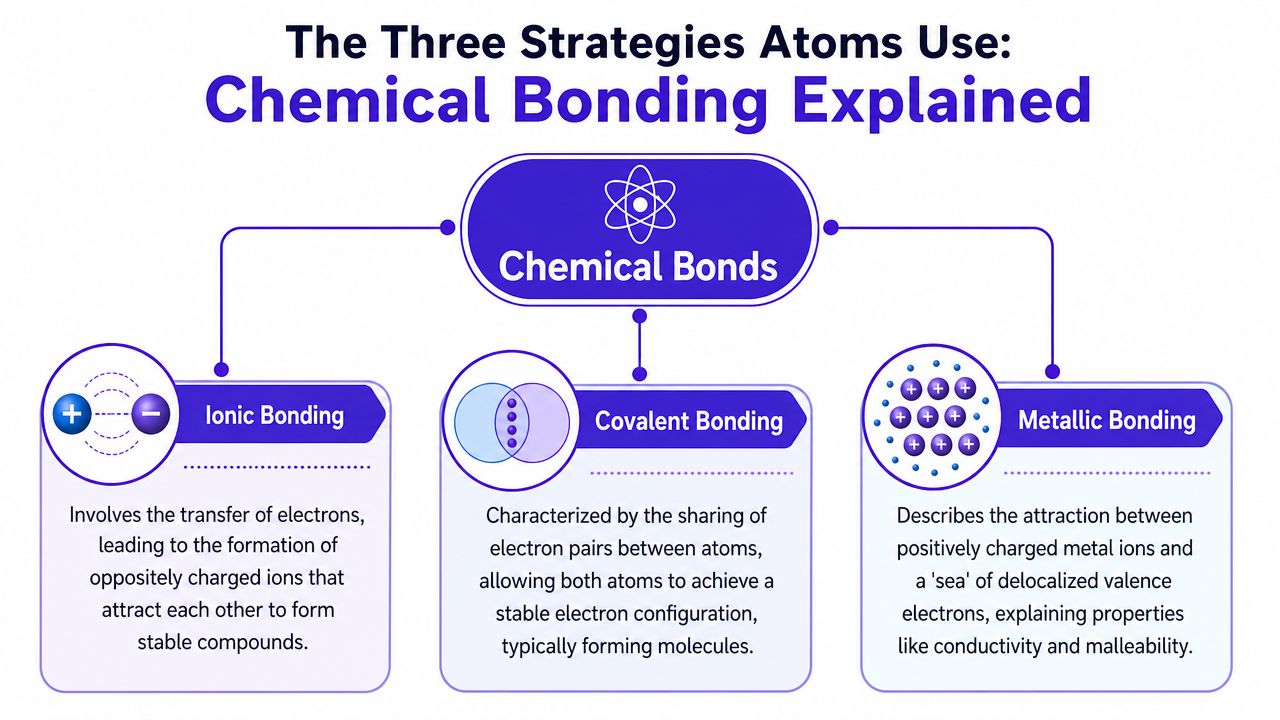
UK GCSE Chemistry specifications such as AQA's define exactly three types of strong chemical bonds: ionic, covalent, and metallic, and this topic makes up approximately 18% of the total exam content in Topic 2 according to the AQA bonding, structure and properties specification.
The core idea you need first
Atoms bond because a full outer shell is more stable.
Core rule: At GCSE, treat bonding as atoms gaining stability by transferring or sharing electrons, or by forming a structure with delocalised electrons in metals.
That single idea stops the topic feeling like three unrelated definitions.
Ionic bonding
Think of ionic bonding as a transfer deal. A metal atom loses one or more electrons. A non-metal atom gains them. That creates ions with opposite charges, and those opposite charges attract.
Sodium chloride is the classic example. Sodium transfers an electron to chlorine. Sodium becomes a positive ion. Chlorine becomes a negative ion. The bond is the electrostatic attraction between those oppositely charged ions.
What examiners want from you:
- Name the particles correctly: They are ions, not atoms.
- Mention charge: Oppositely charged ions attract.
- Link to structure when needed: Ionic substances usually form a giant lattice.
A weak answer says, “Sodium gives chlorine an electron.” A strong answer adds the reason marks are awarded: this forms oppositely charged ions that attract strongly.
Covalent bonding
Covalent bonding is a co-operative share. Two non-metal atoms share pairs of electrons so each can count those shared electrons in its outer shell.
Students often say “they swap electrons”. Don't. In covalent bonding, they share.
Examples include:
- Hydrogen, H₂ with one shared pair
- Oxygen, O₂ with a double bond
- Nitrogen, N₂ with a triple bond
- Methane, CH₄ with four single covalent bonds
The key phrase is simple: a covalent bond is a shared pair of electrons.
Metallic bonding
Metallic bonding is the hardest to picture at first, so use a structure image in your head. Metal atoms lose hold of their outer electrons. Those electrons become delocalised, meaning they are free to move through the whole structure. What's left is a lattice of positive metal ions.
The attraction is between:
- positive metal ions
- and delocalised electrons
That's why metals conduct electricity. The electrons can move and carry charge.
A quick way to remember all three
Try this:
- Ionic = transfer
- Covalent = share
- Metallic = community pool
That last one works because the electrons aren't stuck between just two atoms. They belong to the structure as a whole.
If you like connecting chemistry to bigger material questions, this becomes even more interesting when you start wondering what are planets made of, because the behaviour of materials on Earth and beyond still comes back to how particles bond and arrange themselves.
Simple Molecules vs Giant Structures
A big jump in bonding and structure happens when the exam stops asking about one bond and starts asking about a whole substance.
That's where many students slip. They remember the word covalent, then assume all covalent substances behave the same way. They don't.
Simple molecular substances
A simple molecule is a small group of atoms joined by covalent bonds. Water and carbon dioxide are standard examples.
Inside each molecule, the covalent bonds are strong. But the molecules themselves are separate from each other. The forces between those molecules are much weaker than the covalent bonds inside them.
That's why many simple molecular substances have low melting and boiling points. You don't need to break the strong covalent bonds to melt them. You only need to overcome the weak forces between molecules.
A very common exam mistake is writing “simple molecules have weak bonds”. That's inaccurate. They have strong covalent bonds within each molecule and weak intermolecular forces between molecules.
If the question is about melting a simple molecular substance, talk about the forces between molecules, not the covalent bonds inside one molecule.
Giant covalent structures
Now zoom out.
Some covalent substances don't form small separate molecules. They form huge repeating networks called giant covalent structures. In the AQA specification, students must recognise examples such as diamond, graphite and silica from bonding diagrams and structure diagrams.
In these structures, atoms are joined by covalent bonds throughout the whole lattice. There are no individual little molecules to separate. If you melt one, you must break many strong covalent bonds.
That's why these substances have very high melting points. The specification example often used is diamond, which has a melting point of 3550°C in the verified material.
Giant ionic lattices and metallic structures
Ionic compounds also form giant repeating arrangements, called ionic lattices. Positive and negative ions repeat in all directions. Metals form giant metallic structures with positive ions in a sea of delocalised electrons.
These aren't molecules either. That matters because the way particles are arranged decides what the exam wants you to say about melting point, conductivity and hardness.
A simple comparison that sticks
To illustrate:
- A simple molecule is a small team. Strong links inside the team, weaker links between teams.
- A giant structure is a whole city. The connections run across the entire place.
That one distinction explains loads of chemistry answers. If the whole structure is strongly connected, it usually takes much more energy to change its state.
How Structure Determines A Substance's Properties
Bonding and structure directly translates into marks. The examiner gives you a substance and asks for its melting point, electrical conductivity, or sometimes solubility. Your job is to move from structure to property with a clear chain of reasoning.
The cleanest method is this:
- Identify the structure type.
- State the particles present.
- State the forces or bonds involved.
- Link that directly to the property.
Simple molecular substances
Simple molecular substances have strong covalent bonds within molecules, but weak forces between molecules.
Because those intermolecular forces are weak, only a small amount of energy is needed to overcome them. Therefore, these substances usually have low melting and boiling points.
They also don't conduct electricity because they have no free ions and no delocalised electrons.
Giant covalent structures
Giant covalent structures contain many atoms joined by strong covalent bonds throughout the whole structure.
Because many strong covalent bonds must be broken, these substances have very high melting points. Diamond is the classic example. Graphite is the important exception students must handle carefully because it can conduct electricity due to electrons that can move through its layers.
Giant ionic lattices
Ionic compounds contain positive and negative ions held together by strong electrostatic attraction in a giant lattice.
Because those attractions are strong, ionic compounds usually have high melting points. But conductivity depends on whether ions can move. In a solid lattice, ions are fixed in place, so the substance does not conduct. When molten or dissolved, the ions are free to move, so it can conduct electricity.
That one line appears again and again in mark schemes.
Metallic structures
Metals are made of positive ions in a lattice with delocalised electrons.
Because the attraction between positive ions and delocalised electrons is strong, metals usually have high melting points. They conduct electricity because the delocalised electrons can move through the structure.
They are also malleable. At GCSE, the key idea is that layers of atoms can slide while the metallic bonding is maintained.
The best property answers use “because” and “therefore”. That forces your explanation to stay logical.
Bonding, Structure, and Properties Summary
| Structure Type | Bonding | Melting/Boiling Point | Electrical Conductivity | Example |
|---|---|---|---|---|
| Simple molecular | Strong covalent bonds in molecules, weak intermolecular forces between molecules | Usually low because only weak intermolecular forces are overcome | Does not usually conduct | Carbon dioxide |
| Giant covalent | Strong covalent bonds throughout a giant network | Very high because many strong covalent bonds must be broken | Usually does not conduct, except graphite | Diamond |
| Giant ionic | Strong electrostatic attraction between oppositely charged ions | High because strong attractions act throughout the lattice | Conducts when molten or dissolved, not when solid | Sodium chloride |
| Metallic | Attraction between positive metal ions and delocalised electrons | Usually high | Conducts as a solid and liquid | Copper |
Common exam traps
- Mixing up bonds and forces: In simple molecules, melting does not mean breaking covalent bonds.
- Forgetting the state: Ionic compounds only conduct when ions can move.
- Ignoring exceptions: Graphite conducts, even though it is giant covalent.
- Writing descriptions without explanation: “It has a high melting point” is not enough. You need the reason.
A lot of modern materials science still runs on the same idea you learn here. Researchers examining accelerating materials development with AI are still asking the same core question: how does structure control properties? Your GCSE answer is the school version of a real scientific habit of mind.
How to write the mark scheme version
Try this sentence frame when you practise:
- Simple molecular: It has a low melting point because there are weak intermolecular forces between molecules, so little energy is needed to overcome them.
- Ionic: It conducts when molten because the ions are free to move and carry charge.
- Metallic: It conducts electricity because it has delocalised electrons that can move through the structure.
- Giant covalent: It has a high melting point because many strong covalent bonds must be broken.
If your answer includes the right particles, the right force, and the right consequence, you're in good shape.
Drawing Dot and Cross Diagrams Like a Pro
Dot and cross diagrams look simple until you lose marks for one tiny missing charge. That's why this skill needs a method, not guesswork.
The Royal Society of Chemistry notes that learners often “use far more words than they need” on structure and bonding questions, and the verified data also states that 45% of UK GCSE students lose marks due to inefficient writing, discussed in the RSC article on teaching structure and bonding at 14 to 16. For diagram questions, efficiency matters even more. You want the marks on the page fast.
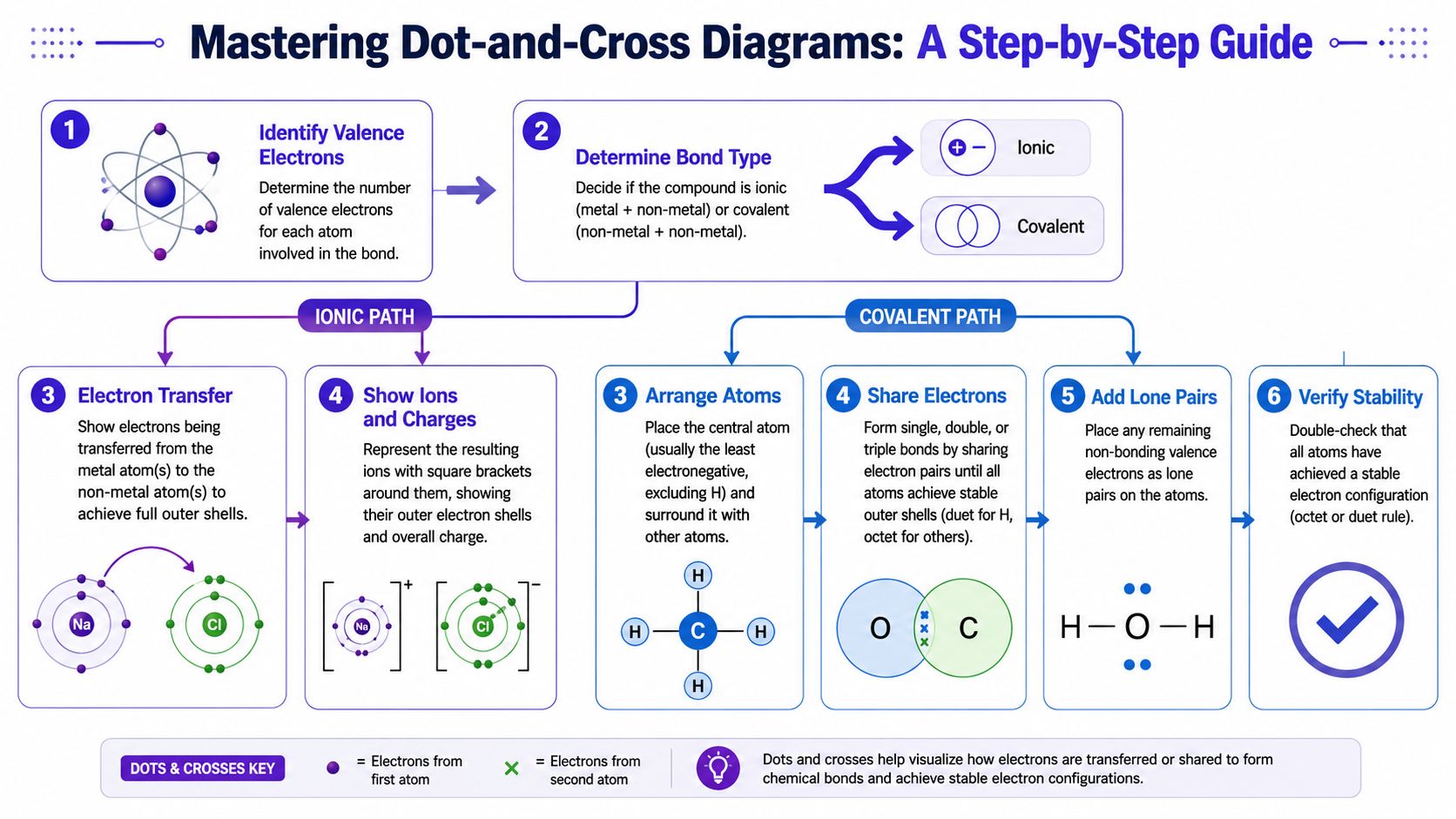
The four-step ionic method
AQA's specification gives four key steps for ionic dot and cross diagrams. Keep them in this order.
Draw the outer shells
Only show the outer electrons. Inner shells usually aren't needed at GCSE.Work out electron transfer
Decide which atom loses electrons and which gains them.Draw the electronic configuration of the ions
After transfer, show the new outer shells.Write the charge of each ion
Many students often drop easy marks at this stage.
Take sodium chloride. Sodium has one electron in its outer shell. Chlorine has seven. Sodium transfers one electron to chlorine. Then draw:
- sodium ion in square brackets with a + charge
- chloride ion in square brackets with a − charge
- a full outer shell shown for chloride
The covalent method
Covalent diagrams are different because nothing is transferred. Electrons are shared.
For methane, CH₄:
- Put carbon in the centre.
- Carbon needs four more electrons to fill its outer shell.
- Each hydrogen needs one more electron.
- Draw four shared pairs between carbon and the four hydrogens.
A shared pair must contain one electron from each atom. That's why the dot and cross style matters.
A quick visual walk-through helps when you're checking your own setup:
The decision tree that saves time
If a question gives you a formula and asks about bonding, don't start writing immediately. Run this mental decision tree first.
- Metal + non-metal? It's probably ionic.
- Non-metal + non-metal? It's probably covalent.
- Element that is a metal on its own? Think metallic bonding.
Exam shortcut: Decide the bond type first. Then choose the particles. Then choose the language that matches those particles.
That stops vague answers like “it has atoms joined strongly”. Examiners want precision: ions, molecules, or positive metal ions and delocalised electrons.
Errors that keep showing up
- Missing brackets around ions
- Missing ion charges
- Drawing transfer in a covalent bond
- Forgetting that shared pairs count for both atoms
- Adding too many electrons to hydrogen
If you want more guided practice with exam-style tasks, worked answers, and structure-specific revision prompts, MasteryMind learning resources are useful for drilling the exact kind of mistakes students make under time pressure.
Beyond GCSE Mastering A-Level Bonding Concepts
A lot of students walk into A-Level chemistry thinking bonding is familiar territory. That's risky.
According to the verified data from Sherpa Online, students often miss the conceptual jump from GCSE to A-Level, and this contributes to a 22% drop in performance on bonding questions that require deeper understanding such as lattice energy and polarisation, as discussed in Sherpa Online's piece on minding the gap from GCSE to A-Level.
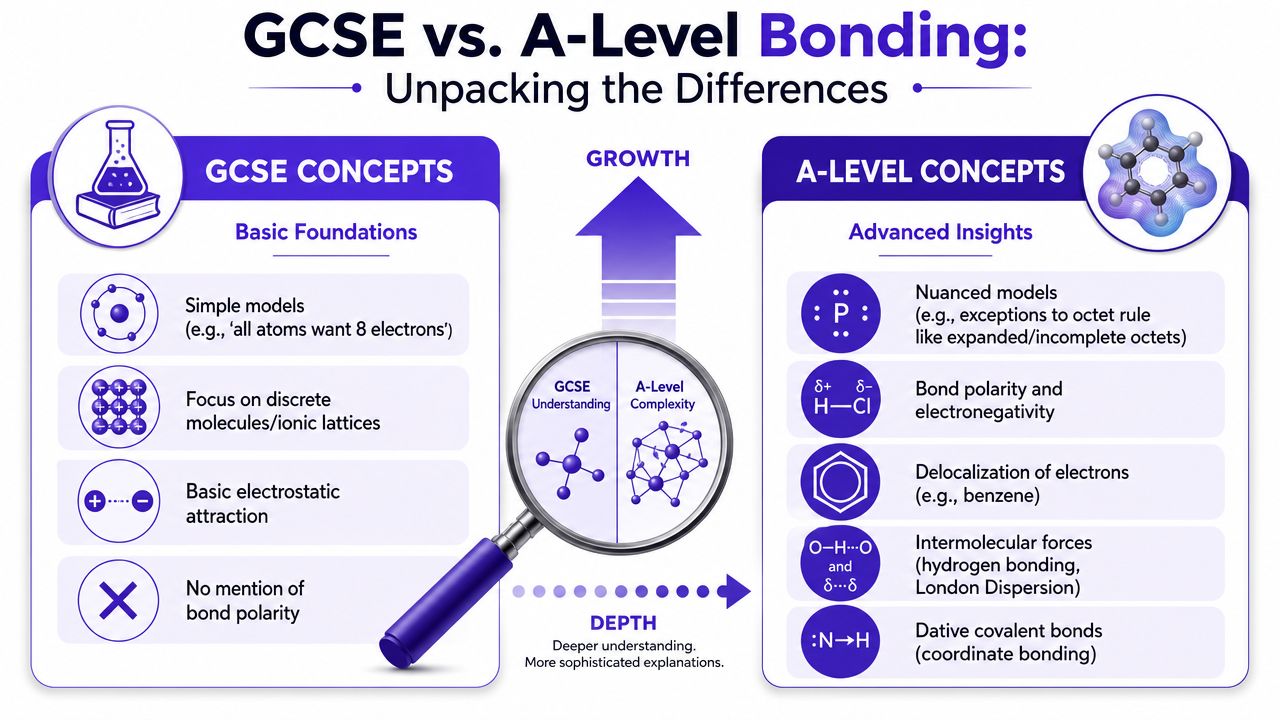
What changes at A-Level
At GCSE, ionic bonding is usually taught as electron transfer followed by attraction between ions. That model is useful, but A-Level wants more than the basic story.
You start meeting ideas like:
- Lattice energy or lattice enthalpy, which helps explain how stable ionic compounds are
- Polarisation, where ions can distort electron clouds
- Covalent character in ionic compounds, which shows bonding isn't always as neatly boxed as GCSE makes it seem
- A wider view of intermolecular forces, including more precise distinctions
That doesn't mean GCSE taught you the wrong thing. It means GCSE gave you a first model. A-Level asks whether that model is detailed enough.
The misconception that causes trouble
Some students hear that ionic bonding at A-Level has “little addition” in a basic descriptive sense, then assume no serious upgrade is needed. But the difficulty isn't in repeating the definition. It's in applying a more refined model to unfamiliar questions.
GCSE gives you the map. A-Level asks you to explain the terrain.
For example, a GCSE student might say an ionic substance has a high melting point because of strong electrostatic attraction. That's a valid GCSE answer. An A-Level student may need to compare compounds, think about ion size and charge, and link those to lattice energy.
How to prepare properly
If you're moving up, don't revise bonding as if it's a memory test only. Treat it as a model that becomes more precise.
A smart upgrade routine looks like this:
- Re-learn definitions tightly: Make sure GCSE wording is exact.
- Ask what the model leaves out: Why do some substances blur the line between ionic and covalent?
- Practise harder comparisons: Not just “what is bonding?”, but “why is one structure more stable than another?”
If you're working towards top grades, regular practice with A-Level Past papers is one of the fastest ways to spot where your GCSE model stops being enough.
Your Bonding and Structure Exam Action Plan
By this point, you should be able to do four things under pressure:
- Classify the bond type quickly
- Recognise the structure of the substance, not just the bond
- Link structure to properties using clear cause-and-effect language
- Draw dot and cross diagrams without missing charges or shared pairs
Try these exam-style checks.
Quick practice
Explain why magnesium oxide has a high melting point.
Marking guidance: mention a giant ionic lattice, strong electrostatic attraction between oppositely charged ions, and lots of energy needed to overcome those attractions.Explain why graphite conducts electricity but diamond does not.
Marking guidance: both are giant covalent structures, but graphite has electrons that can move through the structure.Draw the dot and cross diagram for hydrogen chloride.
Marking guidance: show one shared pair between hydrogen and chlorine, and show the remaining outer electrons on chlorine correctly.
A strong final step is timed practice. Don't just reread notes. Write the answer, check whether you named the right particles, and cut any sentence that doesn't earn marks. If you want a more realistic way to test yourself, Exam Practice for GCSE works best when you use it like a real paper and force yourself to answer in full.
If you want revision that feels closer to an actual exam than a generic quiz app, MasteryMind is built for UK learners preparing for GCSEs and A-Levels. It matches questions to exam boards, breaks responses down by assessment objective, and gives examiner-style feedback that helps you tighten answers instead of just spotting whether they're right or wrong.
Ready to master this topic?
Practise with quizzes, blurt exercises and exam questions on MasteryMind.
7 days Premium · Then free forever · No card, no charge