Chemistry GCSE Quiz: Ace Your 2026 Exam with This Guide
You open a chemistry paper, read the question, and get that horrible split second where your brain seems to delete everything. You revised bonding. You revised calculations. You definitely remember doing a page on rates, acids, and electrolysis. But the question doesn't ask for the neat, textbook definition you memorised. It asks you to explain, compare, or calculate.
That's where a lot of revision falls apart.
A typical chemistry GCSE quiz can make you feel busy without making you exam-ready. You click through a few recall questions, get most of them right, and feel better for ten minutes. Then a real exam question appears and suddenly you have to choose the right formula, show your method, use key scientific language, and answer the command word properly. That's a different skill.
Students who are trying to rescue a grade need practice that builds control fast. Students aiming high need practice that exposes weak spots before the exam does. Teachers want something stricter than random online multiple choice. All three groups are looking for the same thing in the end. Not more revision for the sake of it, but revision that matches the paper in front of you.
That Sinking Feeling Before a GCSE Chemistry Exam
A lot of students know this moment well. You see a question on titrations, moles, or bonding and think, “I revised this, so why can't I answer it?” The issue usually isn't that you know nothing. It's that recognising a topic and using it under exam conditions aren't the same thing.
Take a student who can say that ionic bonding involves attraction between oppositely charged ions. Fine. Then the paper asks why a substance has a high melting point, or why it conducts when molten but not when solid. Now they have to connect structure to property. That's where confidence can wobble.
When revision feels familiar but not usable
Reading notes creates familiarity. Watching videos can help you understand. Highlighting your exercise book can make revision feel organised. None of that guarantees you can produce an answer when the pressure is on.
A proper chemistry GCSE quiz should force you to do at least one of these things:
- Retrieve knowledge from memory without prompts
- Apply facts to a new example
- Work through a calculation clearly
- Respond to the command word, not just the topic
You don't need more passive revision. You need more moments where your brain practises pulling the answer out.
That's why students who want to recover quickly often do better with short bursts of exam-like practice than with another evening of rereading notes. If you want a more structured route into that kind of practice, Online Revision for GCSE is built around the way UK students are assessed.
What real confidence feels like
Real confidence isn't “I've seen this topic before.” It's “I know how to start.” Even when a question is hard, exam-ready students can usually identify the process:
- What is the command word?
- What topic is this really testing?
- What working or key vocabulary will gain marks?
- Have I answered the full question?
That shift matters. It turns panic into process.
Why Most Online Chemistry Quizzes Let You Down
A lot of online quizzes are organised by topic. That sounds sensible, but it often creates a trap. Students answer isolated questions on atoms, bonding, or reactions and think they're making strong progress, while the GCSE exam expects them to switch between recall, explanation, calculation, and structured response. Public quiz resources often prioritise quick revision over those mark-earning distinctions, even though the UK GCSE system is driven by specification alignment and cognitive demand, as noted by Grade Gorilla's GCSE chemistry revision questions.
Topic knowledge is only part of the job
A weak quiz asks, “What is electrolysis?” A stronger one asks, “Explain why aluminium is extracted by electrolysis rather than carbon reduction.” Same topic. Very different demand.
That difference is where students lose marks. The exam isn't only checking whether you've heard of a concept. It's checking whether you can use it with enough precision to satisfy the command word.
Here's the mismatch many students run into:
| Quiz style | What it tests | What the exam often needs |
|---|---|---|
| Quick recall | Recognition | Precise retrieval |
| Simple multiple choice | Surface understanding | Written reasoning |
| Topic-isolated practice | One idea at a time | Mixed-topic judgement |
| Instant right or wrong | Outcome | Method and wording |
Command words change everything
If a question says state, you need a concise fact.
If it says explain, you need a reason linked logically to the question.
If it asks you to calculate, method matters, not just the final answer.
Teachers know this already, but students often don't see how serious the gap is until mocks. They think they're bad at chemistry, when really they're undertrained in exam response.
Practical rule: Before answering any chemistry question, circle the command word and ask what kind of response it demands.
Why generic quiz success can be misleading
Getting a string of short questions right can feel productive. But if those questions never ask for written explanation, multi-step working, or application to unfamiliar examples, they can create a false sense of security.
That's especially obvious in chemistry because the subject mixes factual knowledge with mathematical thinking and precise scientific communication. You don't just need to know. You need to show what you know in the right form.
Take the Ultimate GCSE Chemistry Quiz
A useful chemistry GCSE quiz should feel like a mini paper, not a guessing game. The set below is deliberately mixed. It tests recall, explanation, calculation, interpretation, and synthesis.
If you're doing this properly, don't scroll straight to the answers in the next section. Write your responses first. Even rough answers are useful because they reveal what your brain can produce unaided.
For students who want more of this exam-style approach, Exam Practice for GCSE focuses on questions that feel closer to what happens in real assessment.
Mini quiz questions
Question 1
Define the mole.
Question 2
Explain why magnesium oxide has a high melting point.
Question 3
A student makes a product in a reaction.
- The theoretical yield is 10 g
- The actual yield is 8 g
Calculate the percentage yield.
You should show your working.
Question 4
At room temperature, a gas occupies 24 dm³ per mole according to standard GCSE chemistry relationships in Revision Science's quantitative chemistry quiz.
A sample contains 2 moles of gas.
What volume does it occupy at room temperature?
Question 5
A student says:
“Water and carbon dioxide are both covalent, so they must have similar properties.”
Evaluate this statement using ideas about bonding, structure, and molecular shape. Your answer should go beyond naming the bonding type.
How to attempt them like an examiner would want
Don't just hunt the final number or shortest wording. Use this approach:
- For definitions, keep the wording scientifically accurate.
- For explanations, link cause and effect. Don't just list facts.
- For calculations, write the formula first, substitute clearly, and include units.
- For evaluative questions, test the claim. Agree partly if needed, then qualify it.
Where students usually get stuck
The hardest question here for many students isn't the calculation. It's Question 5. That's because it asks for judgement. You have to combine ideas rather than recall one neat fact from a revision card.
That's exactly why this kind of quizzing matters. A real paper often rewards the student who can connect topics under pressure.
Model Answers and Examiner-Style Feedback
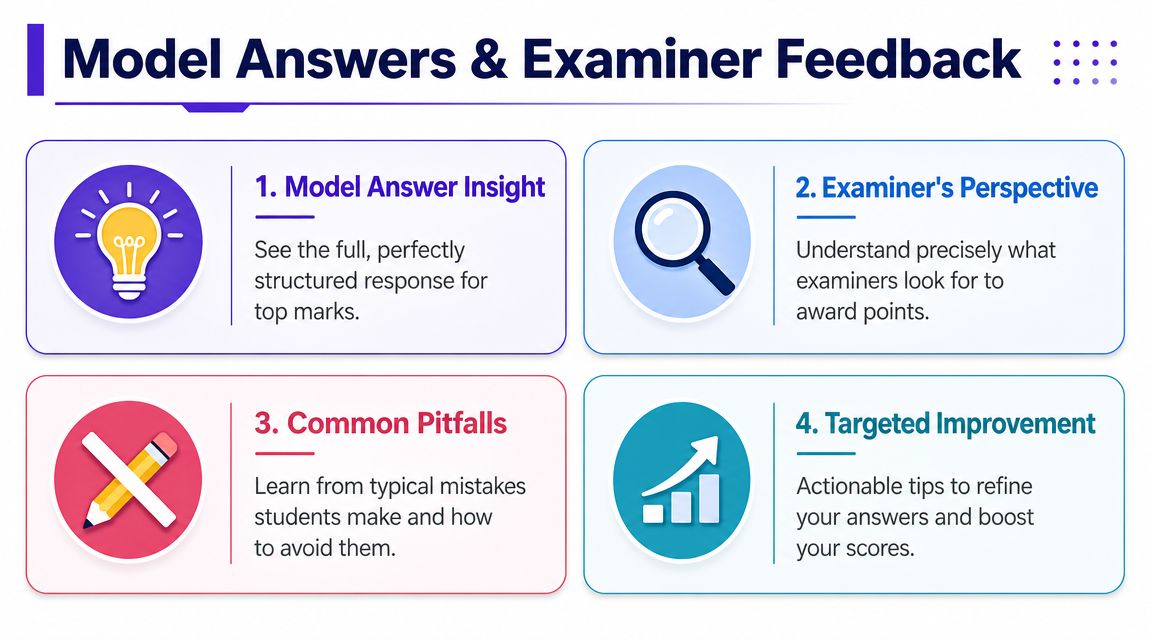
A strong quiz should not leave you with a bare answer sheet and a vague sense that you "sort of get it". It should show you what a mark-worthy response looks like, why it earns credit, and where a weaker answer slips. That is the difference between topic familiarity and exam-readiness.
Question 1 model answer
The mole is the amount of substance containing 6.022 × 10²³ particles.
This scores well because it is precise. "Amount of substance" is the correct scientific phrase, and 6.022 × 10²³ is the detail examiners expect. A weaker response often uses loose wording such as "a lot of atoms", which is not accurate enough because a mole can refer to atoms, molecules, or ions.
Common pitfall: Writing "the mass of a substance" instead of "amount of substance".
Question 2 model answer
Magnesium oxide has a giant ionic structure. There is strong electrostatic attraction between oppositely charged ions. A lot of energy is needed to overcome these attractions, so it has a high melting point.
This answer works because it builds a full chain of reasoning. Structure leads to force. Force leads to property. Examiners reward that cause-and-effect link because chemistry marks are often hidden in the connection, not just in the keyword.
Common pitfall: Writing only "it has strong bonds". That is too general and does not name the ionic attraction in the lattice.
Question 3 model answer
Use the formula:
percentage yield = (actual yield ÷ theoretical yield) × 100
Substitute the values:
percentage yield = (8 ÷ 10) × 100
percentage yield = 80
So, the percentage yield is 80%.
This is the sort of layout that protects marks under pressure. Formula first. Values next. Final answer with the percent sign. If arithmetic goes wrong, the method is still visible, and that can matter in a real exam.
Common pitfall: Swapping actual yield and theoretical yield.
Question 4 model answer
If 1 mole occupies 24 dm³, then 2 moles occupy:
2 × 24 = 48 dm³
So, the gas volume is 48 dm³.
The chemistry is simple, but the exam skill is still being tested. Students often lose credit by dropping the unit. In calculations, the unit is part of the answer, not an optional extra.
Common pitfall: Writing 48 with no unit, or giving the unit as cm³.
Question 5 model answer
The statement is only partly correct. Water and carbon dioxide are both covalent because they are made from non-metals sharing electrons, but they do not have similar properties in every way. Water is a bent molecule and carbon dioxide is linear, so their shapes are different. Those differences affect how the molecules interact and help explain why their properties are not "the same because both are covalent". A high-mark answer tests the claim, then uses bonding, structure, and shape to support the judgement.
This is much closer to what an examiner wants from an evaluate question. It does not stop at identification. It judges the statement, qualifies it, and supports the judgement with chemistry. That is application, which is where many recall-only quizzes fall short.
Common pitfall: Answering with one sentence such as "yes, because both are covalent". That shows recognition of a fact, but not the reasoning that earns the marks.
Why feedback matters more than answer keys
An answer key tells you the destination. Feedback shows you the route you missed.
That matters because students can arrive at the same wrong answer for completely different reasons. One student has forgotten the content. Another knows the chemistry but skips a unit. Another reads "evaluate" as "define" and gives the wrong style of response altogether. Exam-readiness depends on spotting which of those happened.
Good feedback works like a teacher annotating your method in the margin. It points to the exact gap. Was the science inaccurate? Was the explanation too vague? Did the answer ignore the command word? Platforms that explain how AI marking works are useful here because their primary value is not speed. It is the ability to identify the missing feature in the response, so you can fix the habit before exam day.
Written chemistry answers also rise or fall on clarity. If a student understands the idea but writes it in a muddled way, the mark can still go missing. A short guide for students on academic writing can help with sentence control and precision, especially for "explain", "compare", and "evaluate" questions where phrasing shapes the mark as much as knowledge does.
Mapping Your Revision to Any Exam Board
A student on AQA and a student on Edexcel can both revise electrolysis, both know what oxidation means, and still face questions that reward slightly different habits. That is why exam-board matching matters. The chemistry overlaps a lot, but the way topics are grouped, worded, and assessed can change the route to the marks.
Students usually ask, "Will this quiz fit my board?" Teachers often ask a sharper version of the same question. "Does it match the specification closely enough to build exam-readiness, not just topic familiarity?" That second question is the right one.
A useful quiz should map in two directions at once. First, it should cover the core content shared across boards. Second, it should train the response style each board expects. The first checks what you know. The second checks whether you can use that knowledge under exam conditions. If you want to compare that with real paper wording, GCSE Past Papers help because they show how similar chemistry ideas appear in different exam-board formats.
Specification mapping table
| Quiz Question | AQA Specification | Edexcel Specification | OCR Specification | WJEC Specification |
|---|---|---|---|---|
| Question 1 on the mole | Quantitative chemistry | Key concepts and calculations | Quantitative chemistry ideas | Quantitative chemistry |
| Question 2 on magnesium oxide | Bonding, structure and properties | Bonding and structure | Chemical bonding and structure | Bonding and substances |
| Question 3 on percentage yield | Quantitative chemistry and yield | Calculations in chemistry | Reaction calculations | Chemical calculations |
| Question 4 on gas volume | Quantitative chemistry and gas volumes | Amount of substance | Moles and gas calculations | Quantitative relationships |
| Question 5 on water and carbon dioxide | Bonding, structure, properties, molecular shape | Covalent substances and properties | Structure and bonding application | Structure, bonding and properties |
What this means in practice
The labels change. The mental moves do not.
Across AQA, Edexcel, OCR, and WJEC, students still need to define key terms precisely, show method in calculations, connect structure to properties, and respond properly to command words such as "explain", "compare", and "evaluate". Exam-readiness comes from practising those moves in context, not from collecting isolated facts.
A good way to picture it is this. The specification is the map, but the exam is the road test. If your revision only checks whether you can recognise a topic name, you may feel prepared while still missing marks on wording, sequencing, or method. A stronger quiz asks the same chemistry in a form that makes you retrieve, select, and apply ideas the way the paper will.
That is also why students are using digital revision tools more carefully now. A broad guide to AI study aids for students can help you compare tools, but the key question stays the same. Does the tool only test recall, or does it train the assessment objectives and command-word handling your board rewards?
A strong quiz asks whether you can answer the topic in the form your exam board marks highly.
From Quizzing to Mastery The Next Step in Your Revision
Short quizzes help, but they work best as part of a system. If you only do random practice when you feel guilty, your revision stays patchy. If you return to topics in a planned way and keep testing yourself under changing levels of difficulty, your knowledge gets more usable.
What effective quizzing actually looks like
A decent routine usually includes three ingredients.
- Active recall: You answer from memory before checking notes.
- Spaced review: You come back to topics after a gap instead of cramming them once.
- Adaptive challenge: Questions stop being easy recall all the time and start demanding explanation, application, and judgement.
This matters a lot in chemistry because some topics look simple until the question changes shape. Molecular shape is a good example. Public quiz pages often stay at the level of naming shapes, but a stronger task asks students to apply VSEPR ideas to unfamiliar examples and sort out misconceptions about lone-pair repulsion and bond angles, which is why ChemQuiz's molecular geometry material points to an opportunity for more application-focused practice.
One way to scale that practice
A platform such as MasteryMind can fit here because it generates curriculum-aligned questions, adjusts difficulty from recall to analysis, and gives examiner-style feedback linked to UK exam boards. That's useful if you want more than a static chemistry GCSE quiz and need repeated practice without inventing your own question set every evening.
The point isn't to replace teachers, textbooks, or past papers. It's to make your daily revision more responsive.
Here's a quick look at the kind of study workflow many students prefer when they want structure built in:
A smarter weekly pattern
Try something like this:
- Start with a short quiz on one weak chemistry topic.
- Review feedback immediately and rewrite one poor answer.
- Revisit the same idea later mixed with another topic.
- End the week with exam-style questions that combine recall, explanation, and calculation.
That pattern is much closer to exam preparation than endlessly rereading notes. It also helps both ends of the ability range. Students trying to catch up get a clear starting point. High attainers get better at handling unfamiliar twists.
Go From Last-Minute Panic to Exam-Ready Confidence
A good chemistry GCSE quiz doesn't just ask whether you remember a fact. It reveals whether you can use chemistry the way the paper demands. That's the shift that matters.
If your revision has felt frustrating, that doesn't automatically mean you're bad at chemistry. It may just mean you've spent too much time on low-demand tasks and not enough on command words, structured answers, and mixed-skill practice. Once you train those properly, the subject usually feels more manageable.
Keep the focus on exam readiness
When you revise chemistry, ask better questions:
- Can I define this accurately from memory?
- Can I explain it, not just recognise it?
- Can I show every step in the calculation?
- Can I answer the command word, not my favourite version of the topic?
That's how students move from panic to control.
Teachers and independent learners who want a broader view of digital support tools may also find this guide to AI study aids for students useful, especially when comparing tools for retrieval, feedback, and revision structure.
Keep your revision practical. Mark your answers truthfully. Fix one weakness at a time. Then repeat. Confidence grows when you can see yourself handling harder questions, not when you just spend longer “doing revision”.
If you want exam-style chemistry practice with command-word awareness, structured feedback, and UK exam-board alignment, try MasteryMind and turn revision into something you can use in the exam hall.
Ready to master this topic?
Practise with quizzes, blurt exercises and exam questions on MasteryMind.
7 days Premium · Then free forever · No card, no charge