Coursework Help UK: Ace Your NEAs Ethically in 2026
You've probably got one of two tabs open right now. One is your coursework brief. The other is a search for coursework help in the UK because the deadline is getting uncomfortably real.
Maybe you've left it late and need to recover fast. Maybe you're organised and want to squeeze every possible mark out of your NEA. Either way, the same worry kicks in: what counts as help, and what crosses the line into cheating?
That worry is sensible. In the UK, 70% of students report experiencing extreme pressure annually due to heavy coursework loads, which is exactly why structured support matters, as noted by Coursework Helper UK. Pressure is common. Panic is common. Handing over your thinking to someone else still isn't allowed.
Good coursework help in the UK should make you better at the subject, clearer about the mark scheme, and more confident about what you've written yourself. Bad help offers shortcuts that can cost you marks, your credibility, or worse. Teachers know the difference. Examiners do too.
What follows is the line I'd draw for any student I teach: get support, ask questions, use tools, improve your draft, but keep the work as your own thinking in your own words.
That Blank Page Feeling The Smart Way to Start Coursework
You sit down to begin. The title looks vague, the brief feels longer every time you reread it, and the first sentence refuses to appear.
That blank-page moment isn't laziness. It's usually a mix of pressure, uncertainty, and not knowing what “good” looks like yet. A lot of students looking for coursework help in the UK aren't trying to dodge the work. They're trying to get unstuck without getting into trouble.
A common pattern looks like this. A Year 12 student opens a history NEA, reads the wording three times, then starts searching for “example answer” instead of asking the more useful question: what is this task asking me to do? The panic comes from treating the whole project as one giant threat instead of a series of smaller decisions.
Start with movement, not perfection
Your first job isn't writing polished paragraphs. It's creating traction.
Try this:
- Underline command words: If the task says analyse, compare, evaluate, or explain, those words tell you how marks are awarded.
- Circle the content limits: Dates, texts, case studies, or data requirements matter more than students realise.
- Write a rough aim sentence: One sentence only. What are you trying to prove, show, or investigate?
- List what you already know: Even scrappy notes count. They reduce that “I have nothing” feeling.
Practical rule: Don't begin with the introduction. Begin with the easiest part you can answer honestly.
If your brain freezes when you try to “revise”, switch the task. Many students make better progress by focusing on retrieval first. A useful place to begin is understanding active recall study method, because recalling what you know often exposes what your coursework still needs.
The question behind the panic
Students usually ask, “Can someone help me with this?” The better question is, “Can someone help me think this through without taking over?”
That's the version teachers can respect. It's also the version that improves your work. If help gives you a clearer plan, sharper evidence, and stronger self-checking, it's useful. If it replaces your decisions, it's a problem.
The blank page gets less scary once you stop hunting for rescue and start building a method.
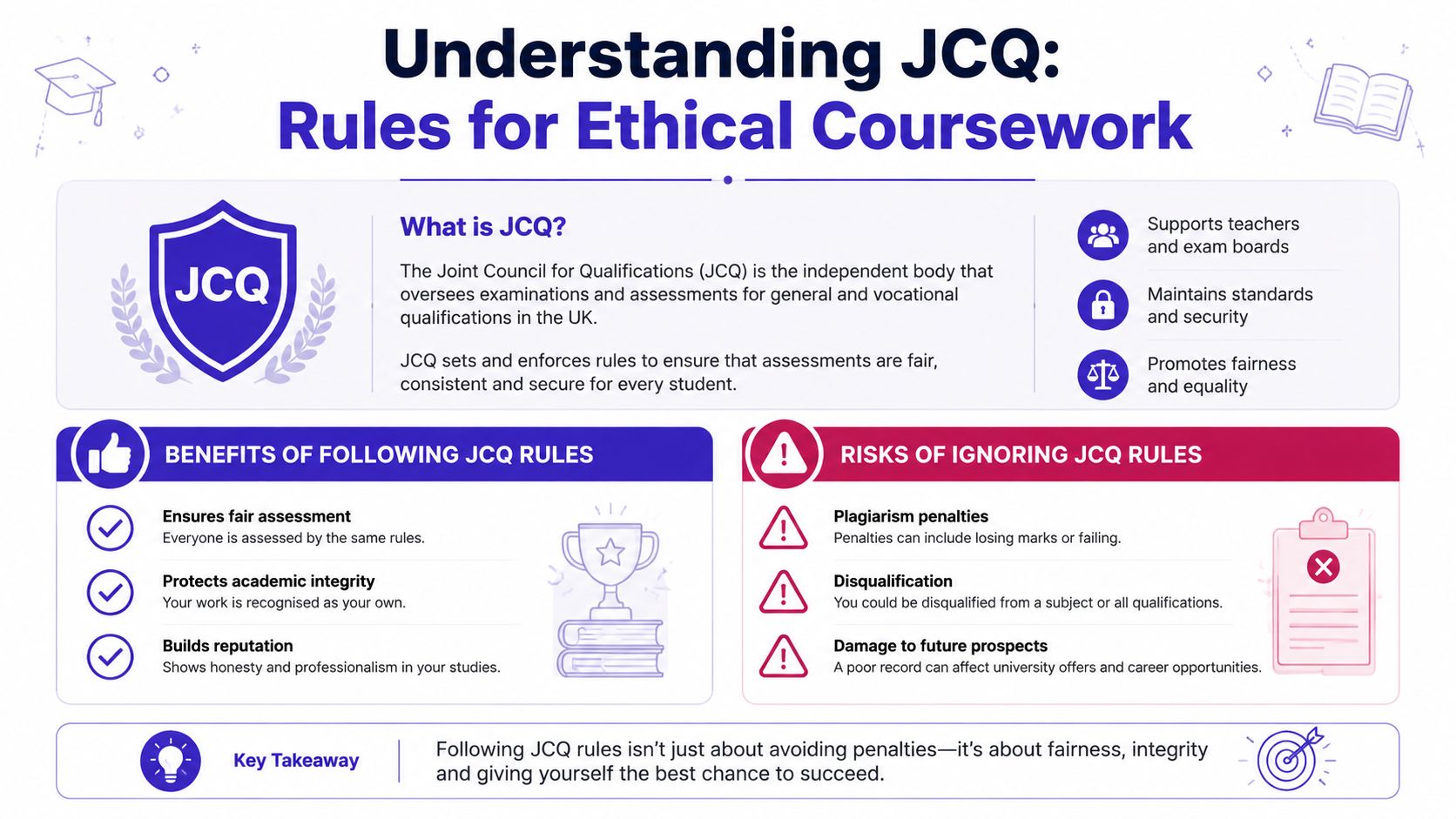
Understanding the Rules of the Game JCQ and You
You hand in a draft. Your teacher reads two paragraphs, then pauses. The ideas sound sharper than anything you said in class, the phrasing does not sound like you, and suddenly the question is not “Is this good?” but “Whose work is this?”
That is the primary pressure around coursework help in the UK. The problem is rarely getting support. The problem is crossing the line where support starts doing the assessed thinking for you.
JCQ rules matter because coursework and NEAs are supposed to show your own knowledge, judgement, and process. Teachers can guide. Tools can prompt. A platform like MasteryMind's NEA Coach can help you question your reasoning and spot gaps. None of those can become a substitute author. If the final decisions, wording, and analysis are no longer yours, you are in dangerous territory.
What counts as legitimate help
Allowed help usually improves your understanding without writing the assignment for you. A good rule is simple. Support should leave a clearer student behind, not a polished document that the student cannot defend.
That often includes:
- Explaining the task: A teacher, tutor, or study tool can help you understand what the brief is asking.
- Discussing structure: You can test whether your sections are in a sensible order and whether your argument builds properly.
- Clarifying subject knowledge: If a theory, source, method, or text is confusing, get the concept explained before you write.
- Checking against standards: Looking at detailed exam marking criteria can show you what examiners reward, so your redraft is based on evidence rather than guesswork.
- Flagging problems: Someone can point out weak evidence, unclear expression, or missing references, as long as you do the fixing.
A useful comparison is driving lessons. Your instructor can tell you when you missed the mirror check. They cannot sit in your seat during the test.
What crosses the line
The line is crossed when the help supplies assessed thinking, wording, or evidence that you present as your own.
| Allowed | Not allowed |
|---|---|
| “Paragraph three needs a clearer argument.” | “Use this new paragraph instead.” |
| “You have described the evidence, but not evaluated it.” | “I added the evaluation for you.” |
| “Your referencing is inconsistent.” | “I inserted sources you have not read.” |
| “This plan is too broad for the word count.” | “I generated the final response. Edit it slightly and submit it.” |
AI creates extra confusion because it can sound confident even when it is wrong, and it can produce fluent prose faster than a student can think. That speed is exactly why you need rules. Used properly, AI works like a questioning tutor. It can ask what your claim means, test whether your evidence matches it, or suggest areas to check in the specification. Used badly, it becomes a ghostwriter with no accountability.
If you could not explain how a sentence was formed, why that evidence was chosen, or what the conclusion means, it should not be in your submission.
Three questions to ask before using any support
Run every form of help through these checks:
- Did this improve my understanding, or did it replace my thinking?
- Can I explain and defend every part of this to my teacher without a script?
- Would I be comfortable recording this help if my school asked how I produced the work?
Teachers notice patterns students miss. A sudden jump in vocabulary, a change in tone halfway through, or a level of judgement that does not match classwork can raise concerns quickly. Students are safest when their work sounds like their best self, not like somebody else wearing their name badge.
The aim is honest performance under the rules. Get guidance that makes you better at the task. Keep the authorship with you.
Plan Before You Panic How to Structure Your Project
It is 8:40pm, the folder is open, and the brief still feels huge. That moment tricks students into doing the wrong first job. They start writing paragraphs before they know what those paragraphs need to prove.
A better start is to treat coursework like building a frame before putting up the walls. The plan is not extra admin. It is the part that stops you producing three pages that sound busy but miss the Assessment Objectives, the method, or the rules on what kind of help you can use.
Break the task into decisions
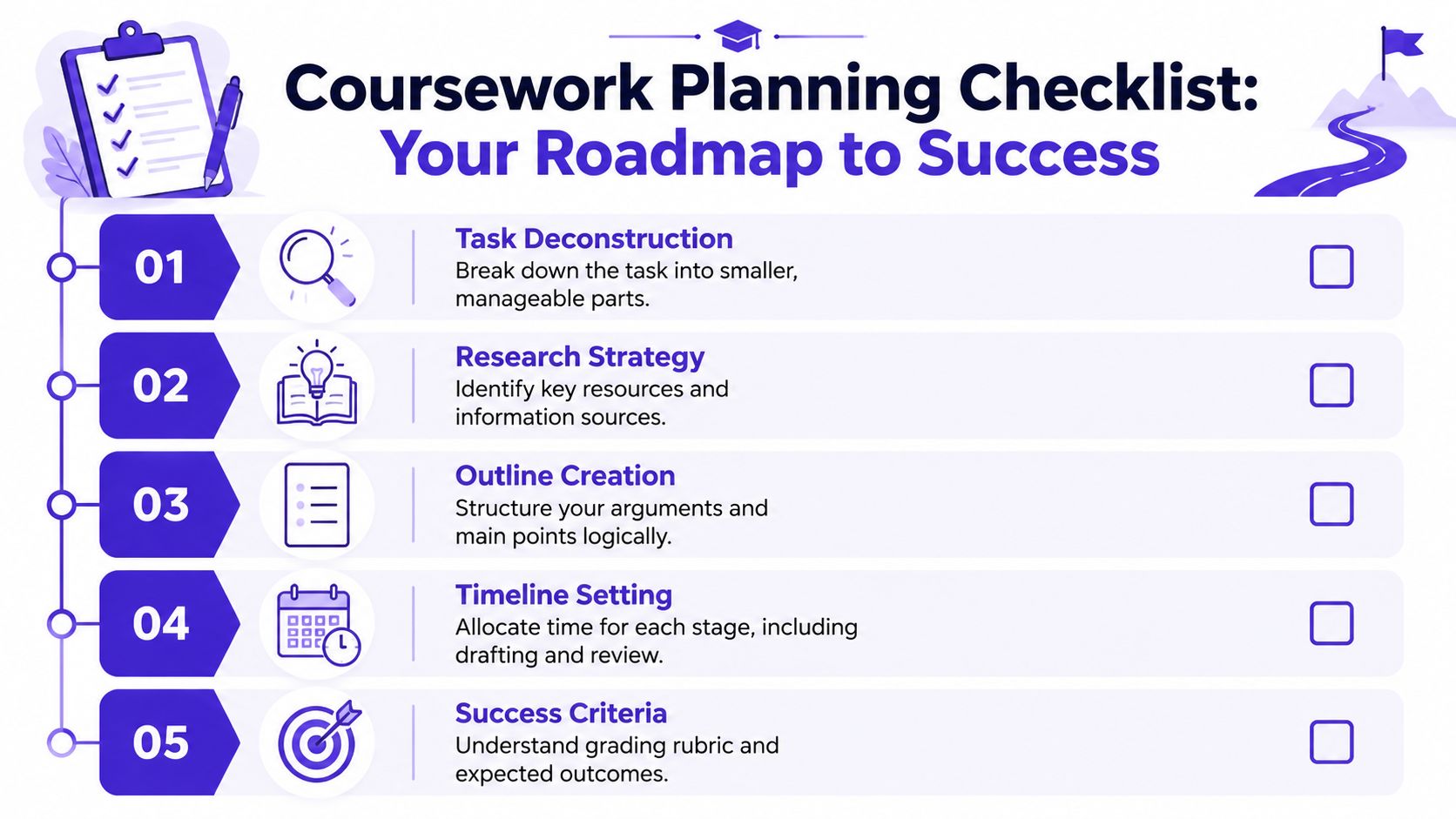
A coursework brief usually contains several jobs hidden inside one title. Students get overwhelmed because they try to solve all of them at once.
Separate the task first:
- What is the actual question? Write it in your own words without changing its meaning.
- What form does the answer need to take? Essay, investigation, analysis, evaluation, design log, practical write-up.
- What evidence will you need? Textual references, case studies, data, primary research, images, experiments.
- What are the constraints? Word count, deadline, citation style, teacher guidance, exam board requirements.
That gives you something usable. A foggy task becomes a list of clear decisions.
Build your project around the mark scheme
Strong students do not just collect material. They organise it around what gets credited.
Start with the Assessment Objectives and ask simple, hard questions. Where do you need to analyse rather than describe? Where do you need to compare methods or interpretations? Where do you need to justify choices? If an AO rewards evaluation, your plan must leave room for judgement, not just information.
This is also the point where ethical support becomes easier to handle. If you know that Section 2 needs analysis and Section 3 needs evaluation, you can ask for the right kind of help. A teacher, tutor, or tool can question your reasoning or test whether a paragraph fits the AO. They should not write that paragraph for you.
A planning sequence that usually works
Use a sequence like this:
| Stage | What to produce |
|---|---|
| Decode the title | A one-sentence explanation of what the task is asking |
| Read the mark scheme | Notes on what high-level performance looks like |
| Gather material | Evidence grouped by theme, argument, case, or method |
| Build outline | Section headings with the point each section must prove |
| Draft in chunks | One section at a time, with sources attached |
| Review | A check against the relevant AO and project rules |
Notice what is missing. There is no “write everything in one sitting and hope it sorts itself out later”. That approach creates panic, weak structure, and messy authorship.
Use checkpoints, not guesswork
Set checkpoints before you draft. For example:
- By the end of Session 1, you should be able to explain the task clearly.
- By the end of Session 2, you should know which evidence belongs in each section.
- Before writing the full draft, you should have a skeleton outline with a purpose for every paragraph.
Students often skip this because it feels slow. It is usually faster. Rewriting a poor draft takes longer than pausing to plan a sound one.
If you use digital support, keep it in this lane. Tools such as automated AI marking for exams can help you compare a draft structure against likely criteria or spot sections that are underdeveloped. The safe use is diagnostic. It helps you see gaps. It does not replace your judgement, your notes, or your own writing.
Plan for proof, not just content
Each section of your project should answer two questions: what am I claiming, and how will I prove it? That sounds obvious, but it is where many drafts go soft. Students gather a pile of decent material, then stack it in a logical-looking order without a real line of argument.
A simple fix helps. Under every heading in your outline, jot down:
- Main point
- Evidence
- Explanation
- Link back to the task or AO
That four-part shape works like a route map. It keeps the project moving and makes it much easier to see whether support is improving your thinking or starting to replace it.
Good planning protects both quality and integrity. It gives ambitious students a clear route through the task, and it gives teachers something they can trust because the work grows from the student's own decisions.
Assembling Your Support Team Feedback Done Right
You hand over a draft and get three different reactions. Your teacher circles a paragraph and says the analysis is thin. A tutor says the structure wanders. An AI tool highlights missing evaluation. None of them are doing the same job, and that is the point.
Good support works like a relay team. Each person or tool should carry the work forward for a short distance, then hand it back to you. If one source starts doing all the thinking, the work stops being safely yours.

Your teacher first
Your teacher is the first checkpoint because they know the specification, the centre's rules, and the kind of feedback they are allowed to give under JCQ guidance. They can point out weaknesses, ask questions, and direct you back to the assessment objectives. They cannot co-author the piece with you.
So ask for feedback that keeps ownership on your side of the desk. "Is this good?" usually gets a vague answer. Better questions lead to usable guidance:
- “Which AO is least secure here?”
- “Where does my line of argument lose focus?”
- “Am I slipping into description instead of analysis?”
- “What kind of evidence would make this claim more convincing?”
Those questions do two things. They get sharper feedback, and they show that you are still doing the intellectual work yourself.
Tutors, parents, and other helpers
Outside support can be useful, but only if the boundaries are clear. A tutor should explain a concept, test your reasoning, and ask you to justify choices. A parent might help you set deadlines or listen while you talk through an idea. Neither should rewrite your paragraphs sentence by sentence.
A simple test helps here. After any conversation, ask yourself: could I explain and reproduce this point on my own? If the answer is no, the help was probably too heavy.
That matters to teachers for a reason. Authentic coursework has a traceable process. Drafts change because the student has understood more, not because an adult has polished the prose into a different voice.
Digital feedback without crossing the line
Digital tools belong in the feedback lane. They can help you check whether a section is underdeveloped, whether your argument answers the task, or whether you have neglected an assessment objective. They should not produce submission-ready wording for you to paste in.
One example is MasteryMind, which includes NEA Coach for question-led guidance and mark estimation designed around JCQ boundaries, alongside automated AI marking for exams that focuses on examiner-style feedback rather than writing your submission for you.
If you speak ideas more clearly than you type them, it can also help to streamline AI prompts with voice while keeping a record of what you asked and what you changed yourself.
Strong support should leave evidence in your process, not overwrite your final voice.
Who does what
| Support type | Useful for | Risk to watch |
|---|---|---|
| Teacher | Spec fit, AO-focused feedback, permitted guidance | Asking for approval instead of targeted advice |
| Tutor | Explaining content, challenging your reasoning, accountability | Rewording too much and blurring authorship |
| Parent or friend | Deadlines, listening, basic clarity checks | Giving subject advice they cannot justify |
| Digital tool | AO checks, question prompts, draft diagnostics | Copying suggestions without understanding them |
The aim is not to collect as much help as possible. The aim is to get the right kind of help at the right moment, then turn that feedback into your own decisions. That is the line ambitious students need. It is also the line careful teachers need to see.
Using AI as Your Socratic Tutor Not Your Ghostwriter
AI is where the arguments usually start. Students see speed. Teachers see risk. Both are right.
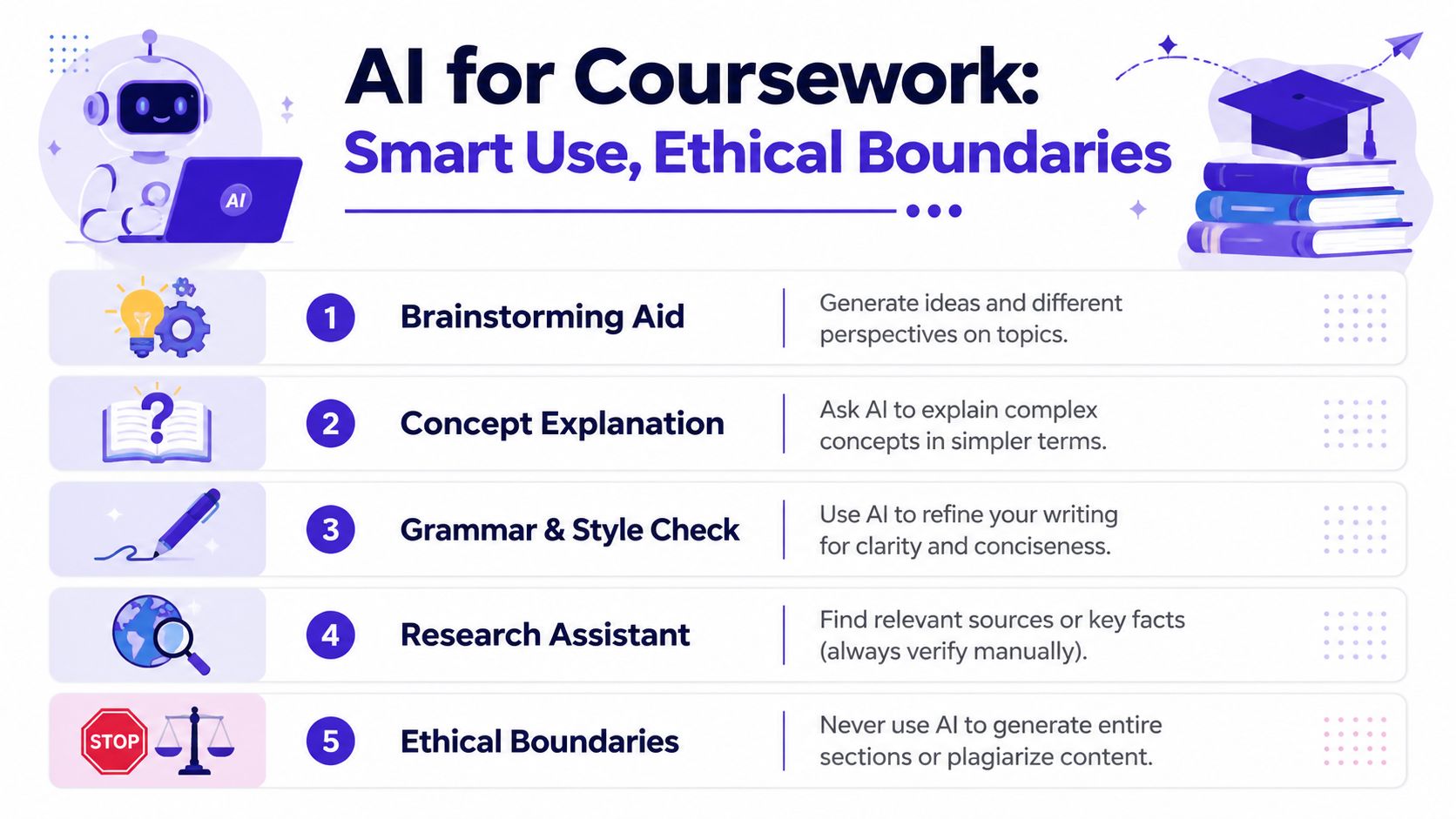
Used badly, AI turns into a ghostwriter. Used properly, it can act more like a demanding study partner that asks questions, tests your thinking, and helps you spot weak logic. That second version is the only one worth defending.
What ethical AI use actually looks like
Here's the split that matters.
Good use of AI
- Brainstorming angles: Ask for possible lines of argument, then choose and shape your own.
- Explaining hard material: Get a plain-English explanation of a concept you still don't grasp.
- Testing your outline: Ask where your logic looks thin or where a counterargument may be missing.
- Generating practice questions: Useful for checking whether you can defend your own draft aloud.
- Tidying expression: You can ask for clarity suggestions, then decide what to keep.
Bad use of AI
- Writing full sections for submission
- Rewriting your paragraph so heavily it stops sounding like you
- Inventing references or evidence
- Pasting output into coursework you haven't verified
- Using it to avoid thinking
A practical extra for students who think out loud is learning how to streamline AI prompts with voice. Speaking your question can be faster than typing when you're trying to refine an idea or test your own explanation.
Use prompts that force you to think
Weak prompt: “Write my coursework conclusion.”
Better prompts:
- “Ask me five questions that would improve my conclusion.”
- “Point out where this paragraph shifts from analysis into summary.”
- “Give me three counterarguments I need to answer.”
- “Turn my notes into revision questions, not an essay.”
Here's a useful explainer for the mindset behind that approach:
If you want a platform built around that style of use, AI Powered Revision is one option aimed at UK learners working to exam board specifications.
Use AI to expose gaps in your understanding. Don't use it to hide them.
Teachers are much more likely to trust AI use that is transparent, limited, and clearly tied to learning. Students are much safer when every AI interaction ends with the same question: can I now explain this myself without the tool open?
The Final Checks Documenting Help and Avoiding Plagiarism
Finishing your coursework isn't just about pressing submit. The last stage is quality control, protecting the marks you've earned.
If you've had help, know your school's policy on acknowledging it. Different centres can be stricter or more detailed about what they want recorded, especially for NEAs. If a teacher, tutor, or tool helped you understand the task, structure a plan, or spot weaknesses, be clear with yourself about what kind of support that was. The more honest your record is, the safer you are.
Check authorship before you check spelling
Before submission, read your work and ask:
- Does every paragraph sound like me?
- Can I explain each claim and each example without notes?
- Did I read the sources I cited?
- Have I borrowed sentence structure too closely from anywhere?
If any section feels strangely polished compared with the rest, stop there. That's where you need to rewrite in your own words.
Plagiarism is often sloppiness before it's dishonesty
A lot of students think plagiarism only means copying and pasting. It can also mean patching together phrases from articles, paraphrasing too closely, or citing something you never checked properly.
Use this final routine:
- Compare your draft to your sources. If the wording is too close, rewrite from memory.
- Check every quotation. Make sure it's exact and properly referenced.
- Review citations and bibliography. Consistency matters.
- Read it aloud. If you stumble, the phrasing may not be entirely your own.
- Use a plagiarism checker if your school permits it. Treat it as a warning light, not a magic fix.
The safest coursework is coursework you can defend line by line in front of your teacher.
Students often want coursework help in the UK because they're stressed, behind, or aiming high. None of that is a problem. The problem starts when support replaces ownership. If you keep the thinking, the choices, and the final wording with you, then the grade means something. It's yours.
If you want structured support without crossing the line, MasteryMind offers UK exam-board-aligned revision tools and coursework guidance designed around feedback, questioning, and mark awareness rather than direct rewriting. That makes it useful for students who want clearer next steps, and easier for teachers to take seriously.
Ready to master this topic?
Practise with quizzes, blurt exercises and exam questions on MasteryMind.
7 days Premium · Then free forever · No card, no charge