Enzymes and Factors That Affect Enzyme Activity: 2026 Guide
You turn the page in a biology exam and there it is. A question about potato, hydrogen peroxide, bubbles, and a graph that climbs, peaks, then drops. If enzymes make you think “I sort of know this, but I can't explain it properly”, that's exactly where marks disappear.
The frustrating part is that enzymes aren't usually hard because the science is impossible. They're hard because exam questions ask for precise explanation. You can't just say “it works better” or “it denatures”. You have to say why, and you have to link the graph, the molecule, and the practical setup.
That's why enzymes and factors that affect enzyme activity are such a high-value topic. Learn this well and you gain marks in short questions, graph questions, required practicals, and extended responses. If you're trying to rescue your grade, this topic gives you a lot back. If you're aiming high, it's one of the places where sharper wording separates solid answers from top-band ones.
Why Enzymes Are Your Secret Weapon in Biology
A lot of students meet enzymes as a pile of terms. Active site, substrate, denatured, optimum. It can feel like learning a script. But once you see the pattern, enzymes become one of the most predictable topics on the paper.
Enzymes are biological catalysts. In plain English, they speed up reactions in living things without being used up. Your body relies on them constantly. Digestion, respiration, DNA copying, cell signalling. None of that works fast enough without enzymes.
Why this topic shows up everywhere
Examiners like enzymes because the topic tests several skills at once:
- Knowledge. What an enzyme is and how it works.
- Application. Explaining what happens when temperature or pH changes.
- Data analysis. Reading graphs correctly.
- Practical science. Identifying variables, controls, errors, and improvements.
That means one enzyme idea can turn up in lots of question styles. A one-marker might ask for the name of the molecule an enzyme acts on. A four-marker might ask why the rate levels off. A six-marker might give you a practical and expect proper scientific reasoning.
When students lose marks on enzymes, it's often not because they know nothing. It's because they stop one sentence too early.
For example, if a graph rises with temperature, “particles have more energy” is only part of the answer. Better: enzyme and substrate molecules move faster, so collisions happen more often and more enzyme-substrate complexes form per unit time. That's exam language.
What makes enzyme questions manageable
Enzyme questions reward a method.
- Name the factor being changed.
- Describe the pattern shown.
- Explain it at molecular level.
- Check whether the question wants the limit or the optimum.
- Use the right command word.
If the question says describe, focus on what the graph does.
If it says explain, give the reason.
If it says evaluate, you need strengths, weaknesses, or limits of the evidence.
That's the secret. Enzymes aren't just biology content. They're a training ground for answering exactly what the mark scheme wants.
The Enzyme Toolkit Structure and Function
Before you can explain why enzyme activity changes, you need the shape story clear in your head. Most enzyme marks come from structure linked to function.
Enzymes are usually globular proteins. That means they're made of amino acids folded into a specific three-dimensional shape. That folding matters because it creates a region called the active site.

The active site is where the substrate binds. If the shape changes too much, the substrate no longer fits properly and the reaction slows or stops. That one idea drives almost every enzyme explanation you'll ever write.
Lock and key first, then induced fit
At GCSE, the lock and key model is a helpful starting point. The enzyme is the lock. The substrate is the key. Only the correct substrate fits the active site.
That works well for basic exam answers because it explains specificity. One enzyme doesn't act on every molecule. It acts on substrates with a shape that matches.
At A-Level, you're expected to go a bit further with the induced fit model. Here, the active site isn't totally rigid. It changes shape slightly as the substrate binds. Think of a glove closing around a hand rather than a hard lock waiting for a key.
What enzymes actually do
Enzymes speed up reactions by lowering activation energy. You don't need a dramatic definition. Keep it simple. Activation energy is the energy needed to start a reaction.
A useful analogy is a mountain. Without an enzyme, molecules have to get over the mountain. With an enzyme, it's like cutting a tunnel through it. The journey still happens, but it's easier to start.
Exam phrase to remember: enzymes increase the rate of reaction by lowering the activation energy.
That line is compact, accurate, and worth knowing exactly.
Where students get muddled
A common confusion is thinking enzymes “add energy” to reactions. They don't. They just make it easier for the reaction to happen.
Another confusion is mixing up enzyme and substrate. Keep it straight:
- Enzyme = the protein catalyst
- Substrate = the molecule the enzyme acts on
- Product = the molecule made at the end
If you're moving into health science or applied biology courses, these core cell and protein ideas keep coming back. A readable bridge into that wider context is this piece on Access to HE Diploma health professionals, especially if you want to see how school biology connects to later study.
What markers like to see
Strong answers often include these links:
- Specific shape leads to specific binding
- Active site enables enzyme-substrate complex formation
- Lower activation energy means reaction happens more easily
- Change in shape can stop substrate binding
That's the toolkit. If you've got those links clear, the factors that affect enzyme activity start making sense instead of feeling random.
The Big Four Factors That Control Enzyme Activity
You are in an exam, the question shows a graph, and the line rises, peaks, or levels off. The fastest way to marks is to ask: what changed, collision frequency or active site shape?
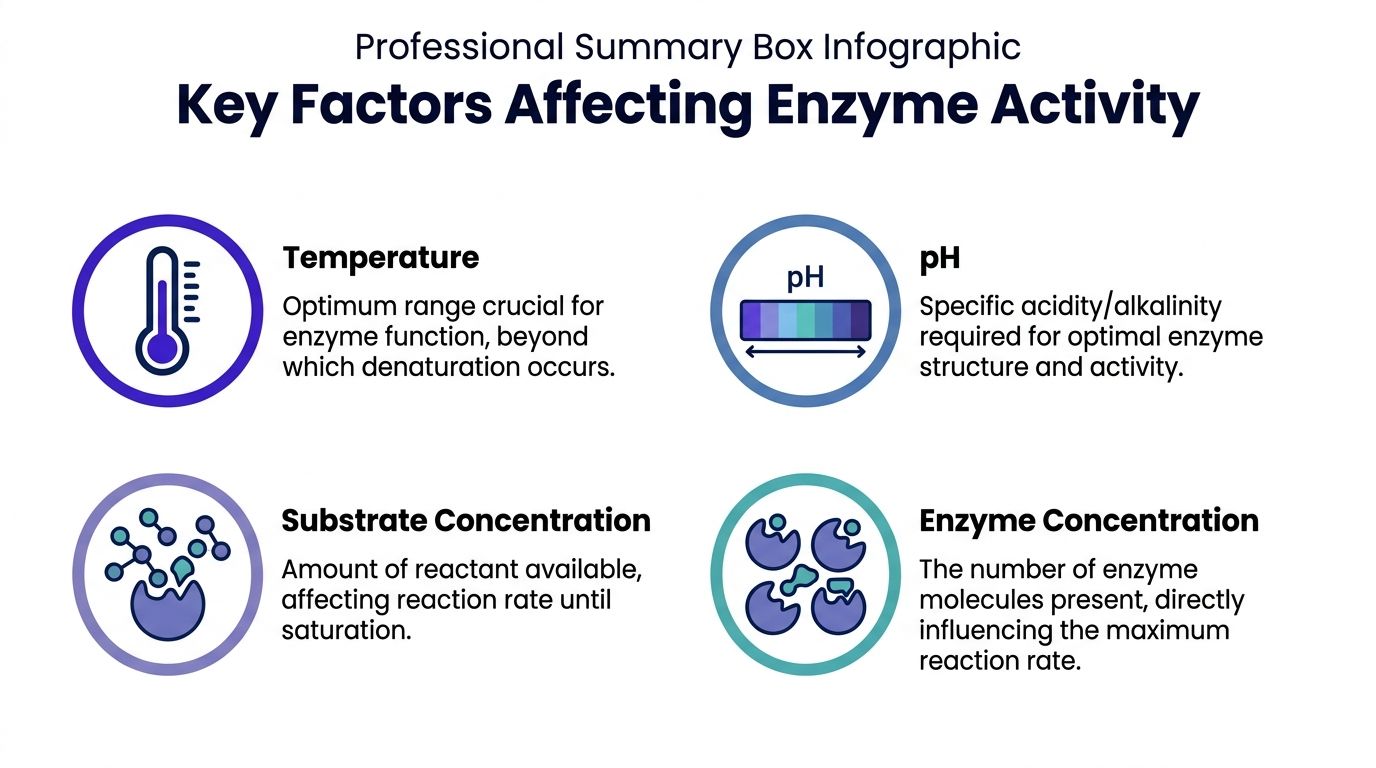
For most enzyme questions, four factors keep appearing: temperature, pH, substrate concentration, and enzyme concentration. Students often revise them as four disconnected cases, then struggle to explain graphs or practical results. A better approach is to sort every answer into two causes. Either particles are meeting more or less often, or the active site is changing shape.
That gives you a simple exam test:
- If the rate changes because molecules move and collide differently, mention collision frequency.
- If the rate changes because the enzyme's shape is altered, mention the active site and, where relevant, denaturation.
Markers reward that language because it explains the pattern rather than just describing it.
Temperature
Temperature questions usually want a two-stage explanation. Before the optimum, heating gives enzyme and substrate molecules more kinetic energy, so they move faster and collide more often. More successful collisions means more enzyme-substrate complexes form each second.
At the optimum temperature, the rate is highest.
Above the optimum, the answer changes. Heat disrupts bonds that help maintain the enzyme's three-dimensional structure. The active site changes shape, the substrate fits less well, and fewer enzyme-substrate complexes form. If the change is large enough, the enzyme is denatured.
For a 3-mark explain question, a strong answer often includes all three links:
- higher temperature increases kinetic energy
- successful collisions happen more often
- above the optimum, the active site changes shape because the enzyme denatures
A weak answer says, “the enzyme stops working.”
A stronger exam answer says, “above the optimum temperature, bonds in the enzyme are disrupted, changing its tertiary structure and active site, so the substrate no longer binds as effectively.”
That wording is much closer to mark-scheme language.
pH
pH works differently from temperature, but the exam logic is similar. Each enzyme has an optimum pH at which its active site has the right shape and charge for binding its substrate effectively.
If pH moves away from that optimum, hydrogen and ionic bonds involved in maintaining the enzyme's shape can be disrupted. That changes the active site. The substrate binds less easily, so the reaction rate falls. At extreme pH values, the enzyme can be denatured.
Students often lose marks here by staying vague. “The pH affects the enzyme” is too weak. You need the molecular reason.
A sharper answer sounds like this:
- as pH approaches the optimum, rate increases
- at the optimum pH, the rate is highest
- above or below the optimum, changes in bonding alter the active site
- extreme pH can denature the enzyme
A useful memory anchor is this. pH acts like changing the tension in a folded paper model. A small change can distort the shape. A large change can ruin the structure completely.
Substrate concentration
Substrate concentration gives a different graph shape, and examiners like that contrast. At low substrate concentration, many active sites are empty for part of the time. Adding more substrate increases the chance of collision between enzyme and substrate, so the rate rises.
Then the graph levels off.
That plateau matters. It means the enzyme has become saturated. In other words, the active sites are all occupied as often as possible under those conditions. Extra substrate cannot increase the rate further because the limiting factor is now the number of active sites, not the amount of substrate.
The supermarket checkout comparison works well here. If only a few customers arrive, adding more customers means more people are being served each minute. Once every checkout is busy, extra customers only form a queue. The serving rate does not increase unless you open more checkouts.
That is exactly the wording many mark schemes want:
“Rate increases with substrate concentration until all active sites are occupied. The rate then reaches a maximum because the enzyme is saturated.”
If you want practice spotting that rise-then-plateau pattern in real exam questions, use A-Level Past papers. Enzyme graph questions repeat the same wording across boards.
Enzyme concentration
Enzyme concentration is easy to forget, which is why it often appears in practical questions. If substrate is not limiting, increasing enzyme concentration increases the reaction rate because more active sites are available at the same time.
The key condition is important. If substrate is not limiting.
If there is plenty of substrate, adding more enzyme usually increases the rate. If substrate is scarce, adding more enzyme will not help much because many active sites will remain empty. In exam answers, that conditional phrase often makes the difference between a general statement and a full explanation.
A concise high-mark answer is:
“Increasing enzyme concentration increases the rate because more active sites are available for substrate molecules, provided substrate is not limiting.”
Here's the full pattern in one place.
| Factor | Effect on Rate | Reason (at molecular level) |
|---|---|---|
| Temperature | Rate rises to an optimum, then falls | Higher temperature increases collision frequency until heat disrupts the enzyme's shape and active site |
| pH | Rate is highest at an optimum and falls away from it | Changes in pH disrupt bonds involved in maintaining the active site shape |
| Substrate concentration | Rate rises, then plateaus | More substrate causes more collisions until all active sites are occupied |
| Enzyme concentration | Rate increases as more enzyme is added, if substrate is not limiting | More active sites are available for substrate molecules to bind |
A short visual recap can help lock in the pattern before you test yourself.
One final exam shortcut helps across all four factors. If the command word is describe, give the trend. If the command word is explain, add the molecular reason using terms such as collision frequency, active site, saturation, bonds, tertiary structure, and denaturation. That is how you turn enzyme knowledge into marks.
Reading the Signs Interpreting Rate of Reaction Graphs
A lot of enzyme questions aren't really asking if you know biology. They're asking if you can read a graph without panicking.
Students often mix up describe and explain. That's where marks leak away. If the question says describe, talk about the shape and trend. If it says explain, link the trend to collisions, active sites, saturation, or denaturation.
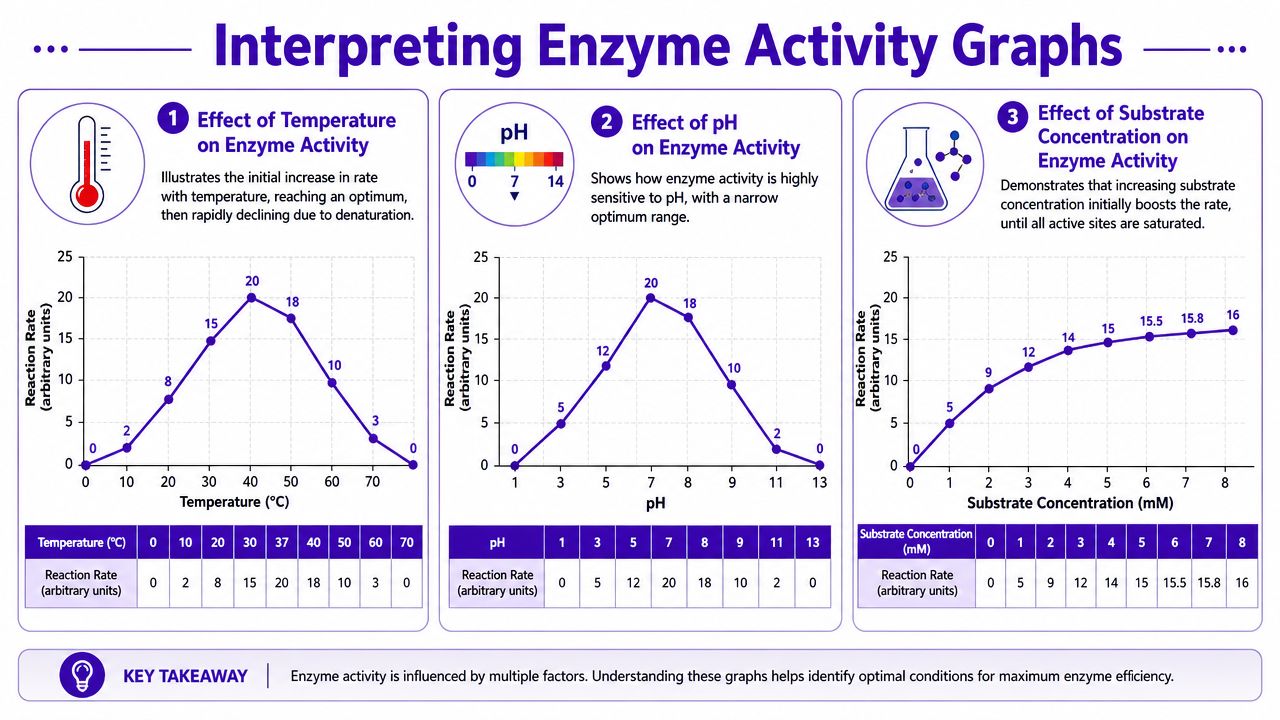
The bell-shaped graph
You'll see this for temperature and often for pH.
Your description should sound like this:
- the rate increases at first
- it reaches a maximum at the optimum
- it then decreases
That's enough for describe if the question only wants the trend.
For explain, add the reason. At first, increasing temperature causes more frequent successful collisions. After the optimum, the enzyme changes shape and fewer substrates fit the active site. For pH, the explanation centres on disruption of bonds that maintain the active site.
Write graph answers in two layers. First the pattern. Then the reason.
The rise-and-plateau graph
This is the classic substrate concentration graph.
A model answer could be:
“As substrate concentration increases, the rate of reaction increases because there are more frequent collisions between substrate molecules and enzyme active sites. The rate then levels off because all active sites are occupied, so the enzyme is saturated.”
That sentence does a lot of work. It gives trend and explanation in one neat structure.
Sentence starters that save time
If you freeze under pressure, use these.
- Describe opening: “As the value on the x-axis increases, the rate of reaction…”
- Optimum graph: “The rate reaches a maximum at the optimum, then decreases.”
- Collision explanation: “This is because molecules move faster and collide more often.”
- Saturation explanation: “This is because all active sites are occupied.”
- Denaturation explanation: “This is because the active site changes shape and the substrate no longer fits.”
If you want to sharpen this skill under timed conditions, Exam Practice for A-Level is useful for drilling command words rather than just rereading notes.
What not to write
Avoid these weak phrases:
- “the enzyme dies”
- “the graph goes weird”
- “it stops working because it's too much”
- “there's no more space”
Better alternatives:
- denatures
- becomes saturated
- fewer enzyme-substrate complexes form
- active site changes shape
A graph answer usually improves when you replace everyday language with one precise biological term.
From Theory to the Lab A Practical Guide
The school practical most students remember is catalase in potato breaking down hydrogen peroxide. You add the peroxide, watch bubbles or foam appear, and try to work out how temperature affects the reaction rate. It looks simple. In exam questions, though, the marks come from how well you think about the method.
The logic is straightforward. Potato tissue contains catalase. Catalase breaks down hydrogen peroxide and releases oxygen. More oxygen produced in a set time means a faster reaction.
The variables that matter
In a temperature investigation, the independent variable is temperature. The dependent variable is the rate of reaction, often measured by oxygen volume, bubble production, or foam height. The control variables might include the size of potato pieces, volume of hydrogen peroxide, concentration of hydrogen peroxide, pH, and reaction time.
If a question asks how to make the test fair, don't say “keep everything the same” and leave it there. Name the variables.
A stronger response might include:
- Potato size so each test has a similar amount of catalase
- Hydrogen peroxide volume so each trial starts with the same amount of substrate
- Timing method so reaction time is consistent
- pH so temperature is the only factor changing
Where practical questions usually hide marks
Examiners love asking about errors and improvements.
Common errors in this practical include difficulty keeping temperature constant, uneven potato surface area, and judging foam height by eye. Foam height is easy in class, but it's less precise than collecting oxygen in a gas syringe.
So if the paper asks for an improvement, say something specific:
- use a water bath to control temperature
- cut potato pieces with the same dimensions
- repeat trials and calculate a mean
- collect oxygen with equipment that gives a clearer measurement
That's the level of detail that sounds like science rather than guesswork.
If the question says “suggest an improvement”, tie it to a named weakness in the method.
Think like a real scientist
At school level, practicals are simplified on purpose. In real lab work, troubleshooting gets far more technical. If you're curious how much detail experimental biology can involve, Troubleshooting T4 DNA ligase is a good example of how scientists think through reaction conditions, failure points, and protocol design.
For your own revision, the important habit is this: every practical answer should connect method, fair test, and measurement quality. If you need a structured place to compare specification wording across boards, UK exam board revision guides can help you see what each board tends to emphasise in practical questions.
Beyond the Textbook Inhibitors and Other Factors
Once you've nailed the big four, the next step up is understanding that cells don't rely only on temperature, pH, and concentration. They also regulate enzymes in more targeted ways.
Inhibitors you need to distinguish
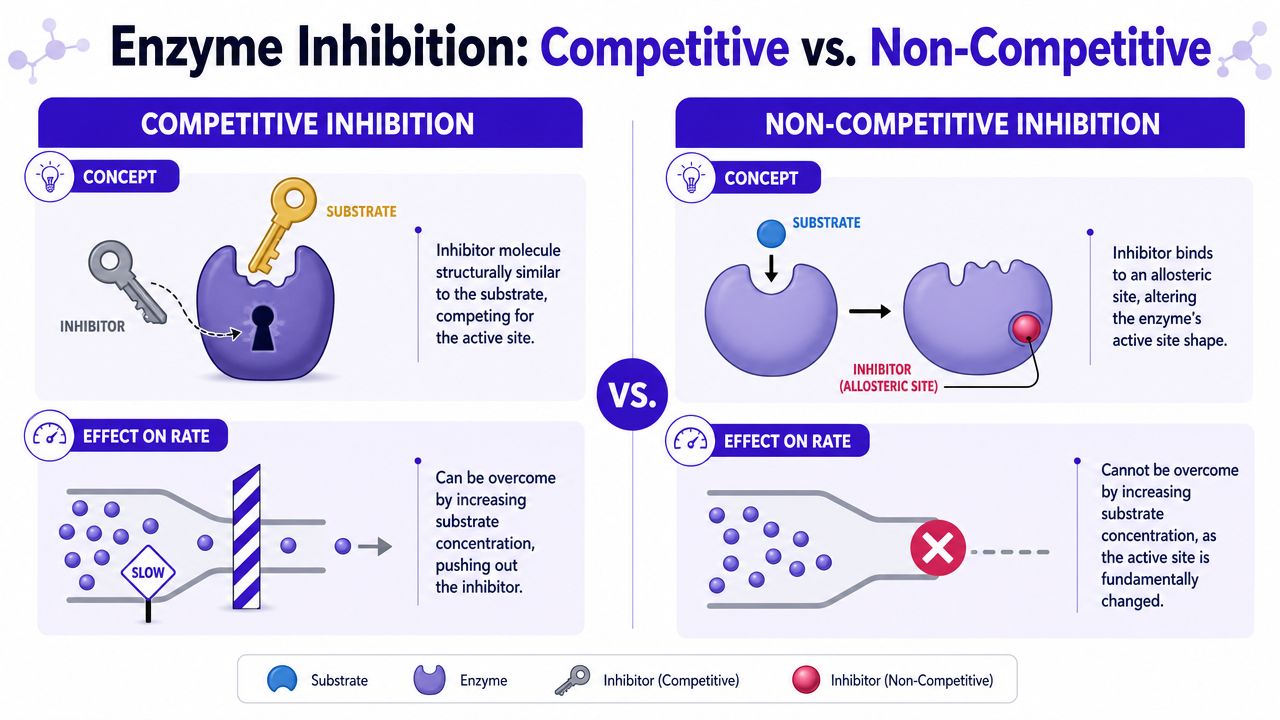
A competitive inhibitor competes with the substrate for the active site. Think of someone parking in your reserved parking space before you arrive. The spot is still usable, but the wrong thing is in it.
A non-competitive inhibitor binds elsewhere on the enzyme and changes the shape of the active site. That's more like someone locking the whole car park gate. Even if your car is right, access is disrupted.
That distinction matters because it affects how you explain changes in rate. Competitive inhibition is about blocking the active site directly. Non-competitive inhibition is about altering the enzyme's shape.
Cofactors and regulation
Some enzymes also need extra help from cofactors or coenzymes. These helper molecules support enzyme function. In exam answers, they often appear in questions that test deeper understanding of how enzymes operate in real cells rather than in isolated textbook diagrams.
There's also a common student question that goes beyond standard GCSE summaries. Many lessons focus on the “big four” factors, but students often want to know how cells regulate enzymes through allosteric control and post-translational modification such as phosphorylation and glycosylation. Mainstream teaching material does acknowledge these mechanisms, but they're often treated as side notes rather than central examinable detail, which can leave a gap in understanding, as discussed in this enzyme regulation teaching video.
Why real biology looks messier than school graphs
Textbook graphs are useful, but they are simplified. Real biological systems often involve multiple variables acting at once.
A good example comes from fungal research showing that enzyme activity can relate differently to humidity, CO2 concentration, and light intensity depending on growth stage, with statistically significant positive and negative relationships reported across enzymes including xylanase, laccase, CMCase, and β-glucosidase in this research article on enzyme activity in fungi.
That doesn't cancel your school graphs. It just reminds you what they are: controlled models. In exams, use the simplified model when asked. For top-grade evaluation, it's smart to recognise that real cells are more context-dependent.
Ace Your Exam Key Takeaways and Final Tips
If you want marks, keep your answers crisp and biological.
- Link structure to function. If the active site changes shape, explain how that affects substrate binding.
- Separate describe from explain. Describe the graph shape first. Explain the reason second.
- Use the right terms. Say enzyme-substrate complex, saturation, optimum, denaturation.
- Name variables properly in practicals. Independent, dependent, control.
- Don't stop at the obvious point. “Rate decreases” is rarely enough on its own.
The best part about this topic is that it becomes predictable once your wording improves. You don't need fancy language. You need accurate language.
If enzymes used to feel like a blur of graphs and keywords, they should now feel more like a pattern. And patterns are learnable. In the exam hall, that means less panic and more marks. If you want one place to keep practising those exact exam-style skills, Online Revision for A-Level is worth a look.
MasteryMind helps UK students revise the way exams work. If you want AI-powered practice that matches GCSE and A-Level specifications, command words, and mark schemes, try MasteryMind. It's built for students who want sharper exam technique, better feedback, and revision that feels closer to the examination paper.
Ready to master this topic?
Practise with quizzes, blurt exercises and exam questions on MasteryMind.
7 days Premium · Then free forever · No card, no charge