Flashcards for Chemistry: The a* Revision Guide 2026
You've probably done some version of this already. You open the chemistry textbook, stare at a page full of equations, ion tests, bond angles, conditions, colours, mechanisms, and definitions, then convince yourself that highlighting counts as revision.
It doesn't.
Chemistry punishes vague revision. If you can't recall a definition exactly, remember the reagent and condition together, or explain a trend in the order the mark scheme wants, you lose marks fast. That's true whether you're trying to drag a grade up from the danger zone or push a solid A into an A*.
That's why flashcards for chemistry work so well when they're done properly. Not random Quizlet-style cards. Not “term on one side, paragraph on the other” cards. Proper exam-focused cards that train recall in the same way your paper will demand it.
Why Your Chemistry Revision Isn't Sticking
Most chemistry revision fails for one simple reason. Students spend more time looking at information than pulling it out of memory.
That feels productive because rereading is easy. Notes look familiar. A highlighted page feels safe. But familiarity is not the same as recall, and chemistry papers don't ask whether a topic looks familiar. They ask whether you can produce it, under pressure, in the right wording, with the right steps.
Chemistry is cumulative, not disposable
This is what makes chemistry rough for a lot of students. You don't revise atomic structure once and move on forever. It keeps turning up later in bonding, periodicity, redox, energetics, organic chemistry, and explanations of reactivity.
The same thing happens at both GCSE and A-level. Knowledge stacks. If the base is weak, later topics feel harder than they should.
A major systematic review for the Education Endowment Foundation concluded that low-stakes quizzing and repeated retrieval practice are among the most effective ways to improve long-term memory and exam readiness, which fits the cumulative nature of UK chemistry specifications (retrieval practice evidence referenced here).
That matters because flashcards, when used properly, are a retrieval tool first. They force your brain to do the hard part.
Practical rule: If your revision lets you recognise the answer without having to generate it, it's probably too passive.
Why this matters for UK exams
AQA, OCR, Edexcel and WJEC don't reward “sort of knowing it”. They reward precision. You need exact definitions, exact ions, exact trends, exact formulae, and clear, structured explanations.
That's why a lot of students feel like they revised loads and still underperformed. They revised content. They didn't rehearse exam retrieval.
If you want to learn active recall strategies, chemistry is one of the clearest places to use them because the subject gives you obvious retrieval targets:
- Definitions such as oxidation, reduction, homologous series, enthalpy change
- Equations including ionic equations and required state symbols where relevant
- Reaction facts such as reagents, products, observations, conditions
- Explanations that depend on key words in a specific order
- Calculations that follow repeatable methods
The real issue with most flashcards
Most students make cards that are too broad, too wordy, or too generic.
Bad card: “Everything about alkanes.”
Bad card: “Electrolysis notes.”
Bad card: “Periodic table trends.”
Those aren't flashcards. They're tiny bad textbooks.
Good flashcards for chemistry are narrow. They test one retrievable thing at a time. Better still, they train the exact phrasing that wins marks.
That's the shift. Stop making cards like a student copying notes. Start making them like an examiner checking whether you can answer.
The Anatomy of an A* Chemistry Flashcard
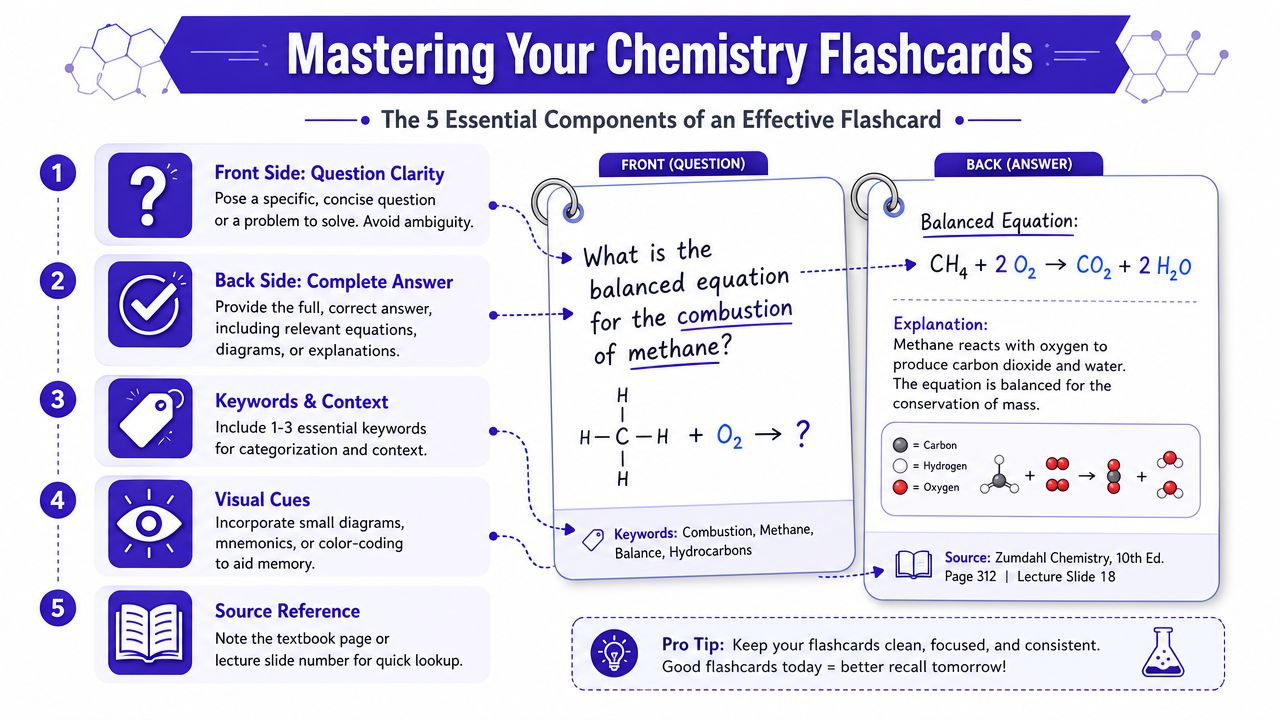
A strong chemistry flashcard does one job. It tests a specific piece of knowledge in a form you might need in an exam.
That means the front has to be tight, the back has to be complete, and the card has to match the type of chemistry you're revising. If you use the same card format for every topic, you'll waste time.
Use card types that fit the content
One reason flashcards for chemistry are high yield is that so much of the subject is built from repeatable reaction knowledge. An analysis of 334 chemistry questions found that 261 of them, or 78%, were variations of reaction-based items suited to flashcards (reaction-item analysis).
That doesn't mean every card should be a reaction card. It means you should build cards around the actual shapes chemistry questions take.
Here's the set I'd use.
| Topic type | Front of card | Back of card |
|---|---|---|
| Definition | “Define oxidation in terms of electrons” | Exact exam-board wording |
| Equation | “Write the ionic equation for…” | Fully balanced equation |
| Reaction conditions | “What reagents and conditions convert X to Y?” | Reagent, condition, catalyst if needed |
| Observation | “What do you see when…” | Precise visible change |
| Calculation method | “How do you calculate…” | Ordered method, not just final answer |
Definition cards should sound like mark schemes
A weak definition card says, “What is covalent bonding?” and then gives a messy sentence that's close enough.
That's not good enough for high grades. Definitions need the wording your board wants. If your class notes are vague, use your specification and class materials to tighten them up.
A better format looks like this:
- Front “Define ionic bonding.”
- Back exact wording you're expected to reproduce, with the key phrase highlighted
If a definition is often confused with another one, add a contrast note at the bottom. Keep it short.
Equation cards must force production
Don't put the unfinished equation on the front and let yourself fill the last bit in from context. That's too easy. Make yourself produce the whole thing.
Use prompts like:
- Complete recall “Write the symbol equation for the reaction between…”
- Ionic focus “Write the ionic equation for…”
- Conditions included “State the equation and conditions for…”
For calculations, don't just put the answer on the back. Put the method in steps. Chemistry exams give marks for process.
Reaction cards need cleaner structure
Here, a lot of students can level up fast. Organic and inorganic chemistry both involve linked facts, but if you cram all of them onto one card, recall gets muddy.
Use separate prompts for:
- Reactant to product
- Product to reagent
- Observation to test
- Condition to reaction outcome
That separation matters more than people think.
If a card tests too many things at once, you won't know what you actually forgot.
Add just enough context
A good card isn't anonymous. It should tell you where the fact belongs.
Use tiny labels like:
- AQA Organic
- GCSE Quantitative chemistry
- OCR Acids and bases
- Required practical
That helps when you sort decks and review weak areas. It also stops the classic problem of memorising a fact but forgetting which topic it belongs to.
If you like making revision resources from lessons, recorded explanations, or worked examples, tools for AI-powered educational video creation can help turn a process or mechanism into something visual before you convert the weak spots into cards. That works well for practical methods and multi-step organic routes.
Build cards for review, not for admiration
Pretty cards don't win marks. Reviewable cards do.
The best test is simple. Can you get through them quickly, accurately, and repeatedly? If yes, they'll work with effective spaced repetition techniques. If not, cut them down.
From Basic Recall to Examiner-Level Thinking
A lot of flashcards help you remember facts. Fewer help you answer chemistry like an examiner expects.
That's the jump most students never make. They can tell you what electrolysis is, or what reagent is used in a reaction, but they still drop marks on “explain”, “compare”, “suggest”, and “evaluate” questions because their retrieval practice never trained the answer shape.
Stop testing facts in only one direction
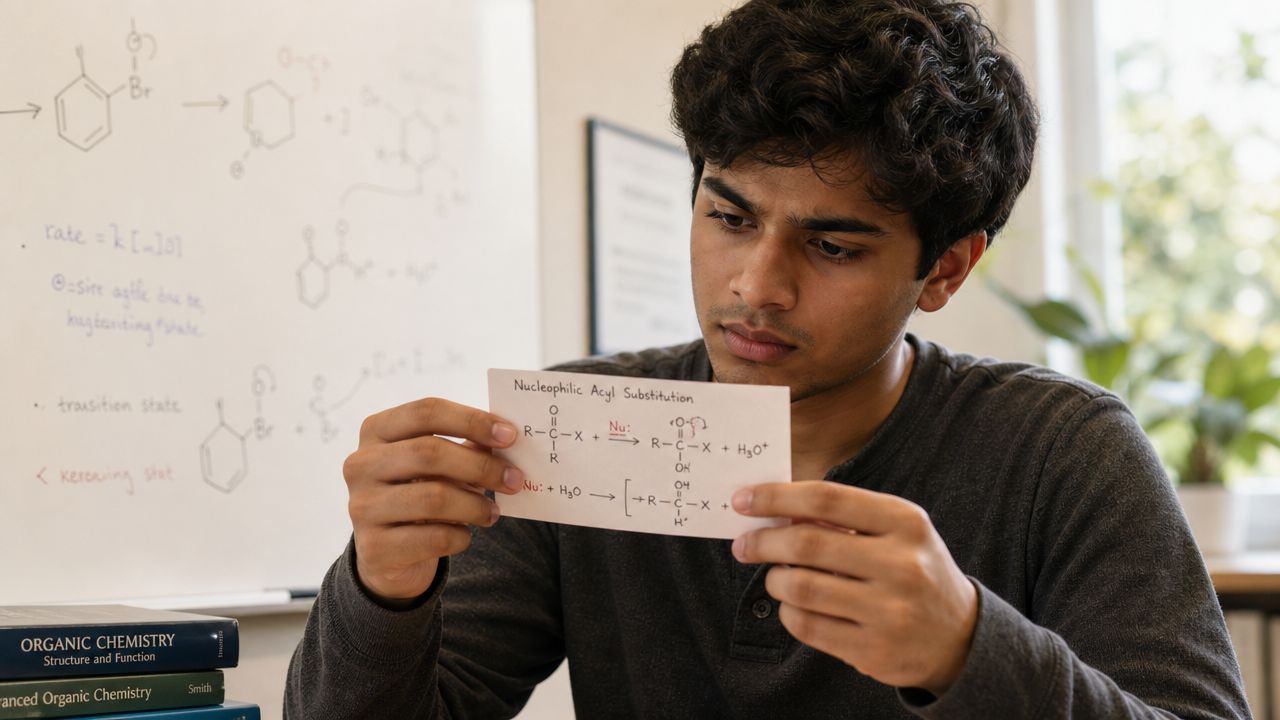
Chemistry facts often run both ways. Students usually learn one and ignore the other.
They'll learn:
alkene + steam = alcohol
But they won't train:
given the alcohol, what reagent and condition produced it?
That's a problem because exam questions flip direction all the time. They give you the product and ask for reagent, condition, catalyst, observation, or mechanism feature. If your cards only run forwards, your memory becomes lopsided.
A better deck includes paired cards that reverse the route. In practice that means:
- one card asking for the product from the starting material
- another asking for the reagent and condition from the product side
- sometimes a third asking for the type of reaction
That's what starts to feel like proper chemistry revision rather than trivia drilling.
Generic cards don't train exam answers
The biggest gap in most students' flashcard use is that they build generic cards instead of exam-board-specific ones. The visible problem is obvious. They memorise concepts, but they don't train themselves to use the command words, mark allocations, and structured reasoning expected by AQA, Edexcel, and OCR (exam-board-specific gap highlighted here).
This is exactly why some students sound good in class and still miss marks in written papers. They know the chemistry, but they don't present it in the form the paper rewards.
Your flashcards should not just ask “What is the answer?” They should ask “How would I write the answer for marks?”
Turn mark schemes into flashcards
This is the most useful upgrade you can make.
After you do a past-paper question, don't only mark it and move on. Mine it for cards. If the question was worth several marks, build a card that captures the examiner logic.
For example:
| Front | Back |
|---|---|
| Explain why ionic compounds conduct when molten but not when solid | Model answer with key phrases in order |
| Compare the bonding in graphite and diamond | Point-by-point structure using exam wording |
| Suggest why yield was lower than expected | Common valid chemistry reasons, phrased tightly |
The back of the card should not be a full essay. It should be a model skeleton. Enough to train structure. Enough to include the words that usually earn marks.
Use command-word cards
Students revise topic content, but often ignore command words until the exam. That's late.
Make cards with command words on the front and answer patterns on the back:
- Explain means give cause and effect clearly
- Compare means same-and-different, not two separate mini paragraphs
- State means short and exact
- Suggest means chemically plausible, even if not directly memorised
This works especially well for six-mark style responses and practical method questions, because the issue is rarely zero knowledge. It's usually loose wording and poor structure.
Build answer-template cards
These are underrated.
Some chemistry answers appear again and again in slightly different clothes. Trends down a group. Why a rate changed. Why a practical gave error. Why a bond takes energy to break. Why a spectrum shows a feature.
For those, build a card that teaches the reusable frame.
“Use the same explanation frame every time the chemistry is the same. Save brainpower for the new part of the question.”
That's how flashcards for chemistry stop being memory prompts and start becoming exam training.
Implement a Smart Study System
Making good cards is only half the job. If you use them badly, they still won't do much.
Students often say flashcards “don't work”, but what they usually mean is this: they read the front, flip too quickly, review randomly, and keep huge piles of weak cards they never properly answer. That's not retrieval practice. That's card-shuffling.
Use active recall properly
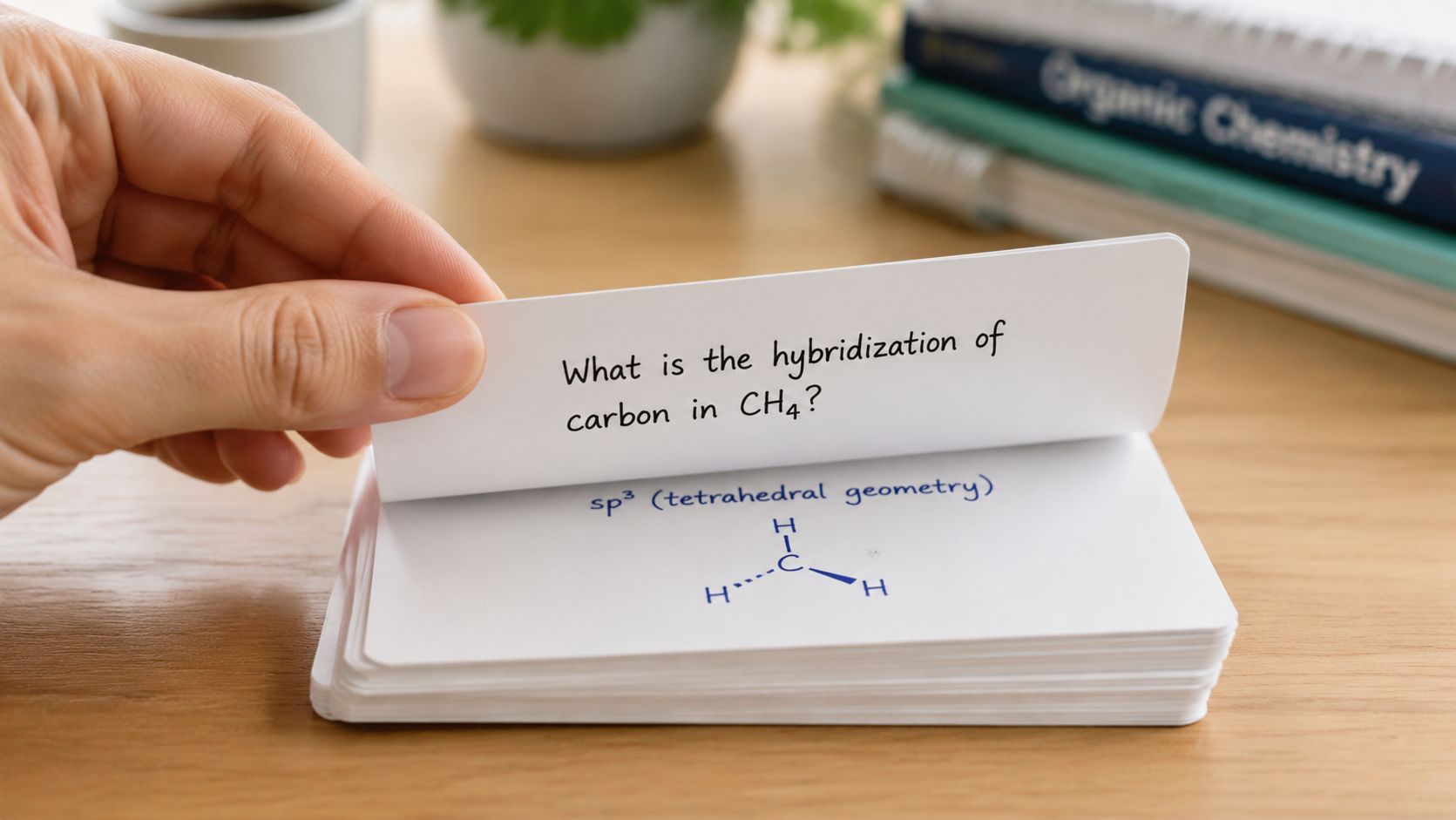
A flashcard only works when you try to retrieve the answer before checking it.
That sounds obvious, but loads of students still peek early or accept half-answers. In chemistry, that's dangerous because a half-remembered answer often sounds believable.
Use one of these methods when reviewing:
- Say it out loud for definitions, explanations, and trends
- Write it down for equations, calculations, and practical methods
- Draw it from memory for dot-and-cross diagrams, mechanisms, and apparatus setups
If speaking helps you think more clearly, voice-based recall can be useful. One example is MasteryMind, which includes a Blurt Challenge that compares spoken responses against curriculum objectives and then generates follow-up quizzes. That works well when you need to practise saying a chemistry explanation cleanly instead of just recognising it on a screen.
Spacing beats cramming
UK exam boards such as AQA and OCR assess chemistry through papers that draw on around two years of cumulative content, which is why spaced retrieval is far more useful than rereading for this kind of subject (cumulative exam content and spaced retrieval point).
That has one obvious implication. Don't leave flashcards for chemistry until Easter and then smash through all of them in a panic. Build a review rhythm that keeps older content alive.
A simple manual system works like this:
- New pile for cards you're still learning
- Soon pile for cards you got right but not confidently
- Stable pile for cards you can usually answer well
- Problem pile for cards you repeatedly miss
Move cards between piles accurately. If a card keeps failing, rewrite it. Don't just keep suffering through a badly made card.
Mix topics like the exam does
One trap with chemistry revision is over-blocking. You spend an hour only on bonding, then an hour only on rates, then an hour only on organic reactions. That can feel smooth, but real exams mix ideas.
So once a topic is familiar, start shuffling decks. Definitions, equations, practicals, calculations, organic routes. Mixed review is harder, which is exactly why it's useful.
If you want to build this into your routine, it helps to use advanced revision techniques like interleaved practice rather than keeping every topic in a neat isolated box.
Later in a revision cycle, adding worked examples and walkthroughs can help too. If your class notes are messy or incomplete, a solid guide on effective note taking methods can help you clean up lesson material before you turn it into cards.
Here's a useful explainer on the review side of the process:
Know when flashcards are not enough
This matters. Flashcards are brilliant for storing and retrieving chemistry knowledge. They are not a replacement for full exam practice.
Use cards to lock in the facts, methods, wording, and reactions. Then test whether you can apply them on mixed questions and past papers. If a card helps you remember Hess's Law but you still can't complete the exam question, the missing piece is practice, not more cards.
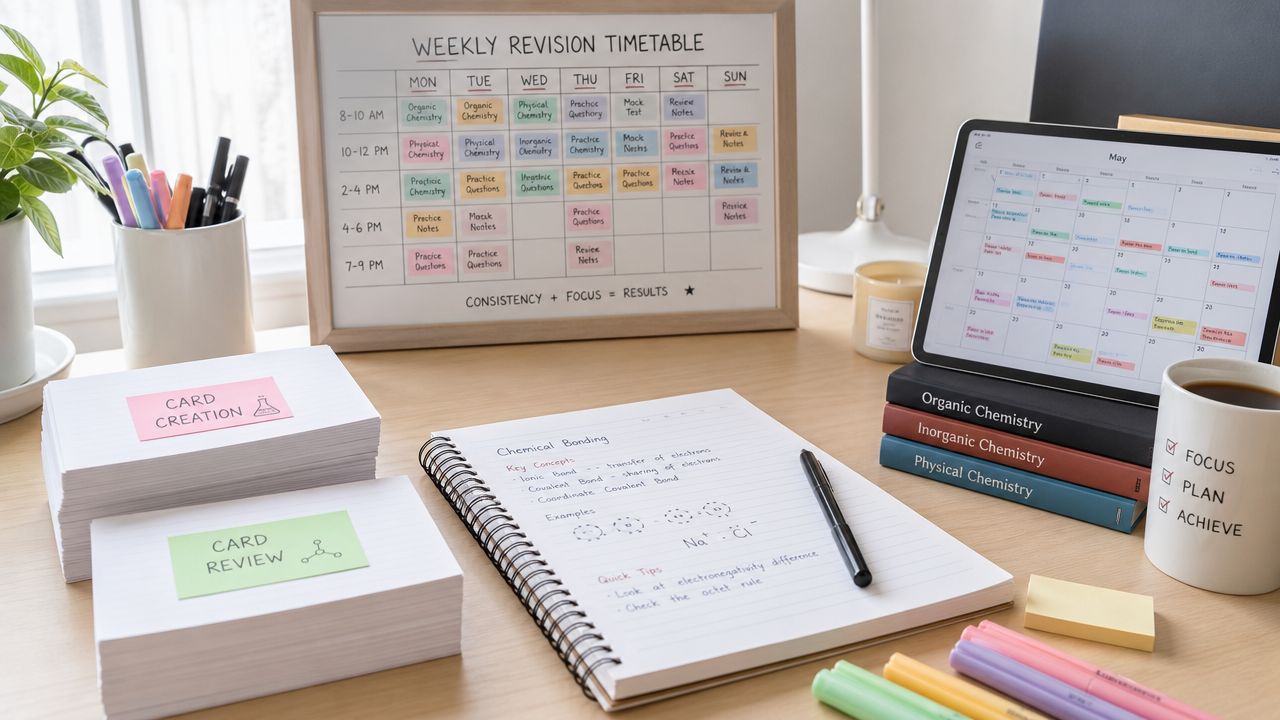
Build Your Weekly Revision Timetable
A good flashcard system lives or dies on routine. Not motivation. Not panic. Routine.
Most students make one of two mistakes. Either they spend hours making beautiful cards and never review them properly, or they try to review cards they never had time to build carefully in the first place. You need both card creation time and card review time, and they do different jobs.
Separate making from reviewing
Card creation works best close to the lesson or topic test. Review works best little and often.
That means your week should include:
- Short creation blocks after lessons, homework, or test corrections
- Daily review blocks where you go through existing cards
- Longer mixed sessions at the weekend for shuffled topic review
If you merge everything into one giant revision session, quality drops. You end up writing rushed cards and reviewing them badly.
Three routines that actually work
Different students need different setups, so here are realistic versions rather than one fantasy timetable.
The post-lesson blitz
You finish chemistry, get home, and spend a short block turning that lesson into cards.
This is the best method if your memory fades quickly after class. Make a small number of cards on the same day. Prioritise anything exact: definitions, practical steps, ionic equations, colours, conditions, and any mistake your teacher corrected.
This works especially well after organic lessons because chemistry flashcards should separate retrieval directions. One card should test product recall from reactants, and another should test reagent or condition recall from the product, which helps avoid common memory mistakes, especially in organic synthesis (bidirectional retrieval guidance).
The commuter routine
If you travel by bus or train, use that dead time for quick review, not deep learning.
This is where digital flashcards shine. Use the journey for straightforward recall cards. Save calculation cards, longer explanation cards, and mechanism drawing for when you've got paper and proper focus.
The rescue-plan routine
This one is for students who know they're behind.
Don't try to make cards for every page of chemistry you missed. Start with the highest-yield content from your specification, class tests, and weak topics. Build a lean deck. Review that daily. Add more only when the first batch is under control.
A smaller deck you actually review will beat a giant deck you avoid.
Turn mistakes into next week's cards
This is the most underrated habit in the whole system.
Every marked test, homework, or past-paper attempt should produce new cards based on what went wrong. Not generic topic cards. Specific error cards.
Examples:
- You forgot state symbols. Make equation cards that force full notation.
- You mixed up oxidation and reduction. Make contrast cards.
- You lost marks on “explain” questions. Make mark-scheme wording cards.
- You gave the right reagent but missed the condition. Split the retrieval direction.
A simple weekly model looks like this:
| Day | Focus |
|---|---|
| Monday to Friday | Short daily review |
| After each chemistry lesson | Make a few new cards |
| One evening | Review problem cards only |
| Weekend | Mixed-topic review and past-paper corrections |
That's manageable. More importantly, it compounds.
Beyond Memorisation to True Mastery
The point of flashcards for chemistry isn't to become a human storage unit for isolated facts. The point is to make the right knowledge appear fast when a question demands it.
That's a different mindset from most revision. Instead of hoping repeated exposure will make things stick, you train the exact act of recall. Instead of collecting notes, you build prompts. Instead of revising chemistry as one huge subject, you break it into retrievable units that map onto the way marks are awarded.
What changes when you do this properly
Students who improve fastest usually make the same switch.
They stop asking, “Have I revised this topic?”
They start asking, “Could I answer this cold, in exam wording, without looking?”
That change is huge. It makes revision honest.
Use flashcards for chemistry to secure the things that have to be precise. Definitions. Equations. Conditions. Observations. Explanations. Calculation methods. Then push those cards through active recall, spaced review, and mixed-topic practice until the knowledge stops feeling fragile.
The best flashcards don't just help you remember chemistry. They help you perform chemistry in exam conditions.
Keep the standard high
If a card is vague, rewrite it.
If a card is overloaded, split it.
If a card tests recognition instead of recall, tighten it.
If a card doesn't help you answer a real chemistry question, it probably doesn't deserve a place in the deck.
And once your recall is solid, move into full paper practice. That's where all this work pays off.
If you want a more exam-style way to apply what you've learned after flashcard review, tools built for Exam Practice for A-Level can help you turn remembered content into structured answers under pressure.
You do not need a complicated system. You need a strict one. Make better cards. Review them properly. Fix your weak answers. Repeat.
MasteryMind is an option if you want UK exam-board-aligned revision in one place. It's built for GCSE and A-Level learners and focuses on AQA, Edexcel, OCR, and WJEC question styles, command words, mark allocations, and feedback. If you want revision that connects recall practice to actual exam answers, you can explore MasteryMind.
Ready to master this topic?
Practise with quizzes, blurt exercises and exam questions on MasteryMind.
7 days Premium · Then free forever · No card, no charge