Master Flemings Left Hand Rule: Your 2026 Physics Guide
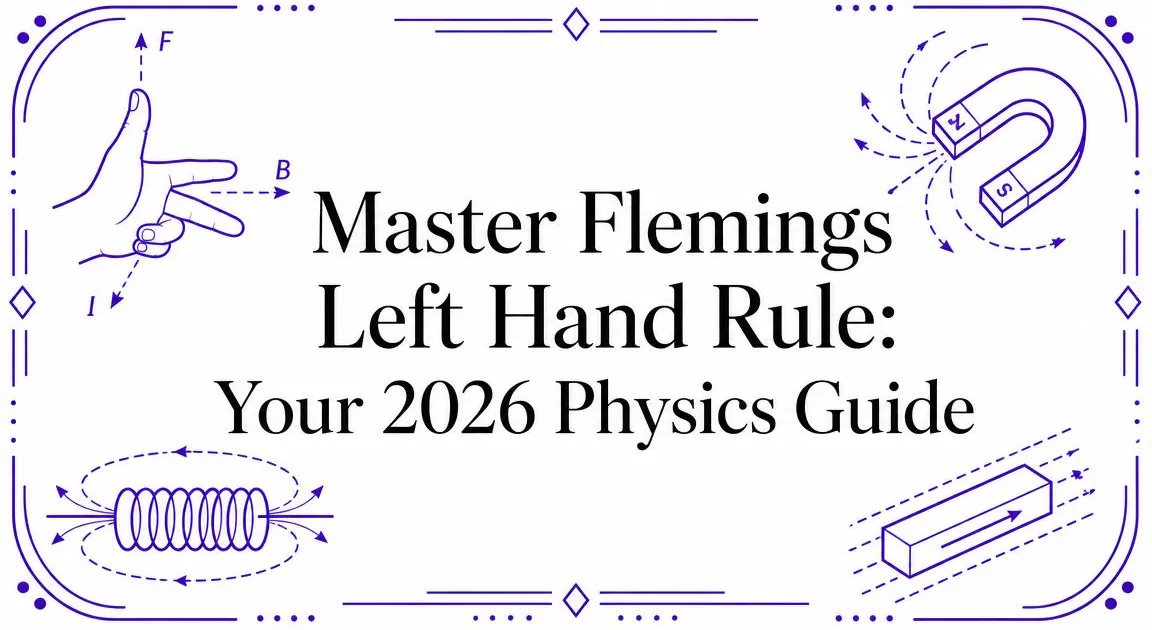
You're staring at a physics question with a magnet, a wire, and a couple of arrows. Your brain says, “I know I've seen this.” Your hand says, “Left? Right? Why are my fingers suddenly useless?”
That's where a lot of students are. Not because the idea is impossible, but because exam questions make a simple rule look more intimidating than it is. One sketch of a magnetic field and suddenly it feels like the whole of electromagnetism has turned against you.
It hasn't.
Fleming's Left-Hand Rule is one of those topics that can go from panic to easy marks once you know exactly what the examiner is asking you to do. It isn't a long theory answer. It's a direction tool. If you can read the diagram, line up your fingers properly, and avoid the classic mistakes, you can answer these questions fast and accurately.
For students trying to rescue their grade, that matters. For students aiming high, it matters too, because these are the kinds of marks you don't want to throw away under pressure. If you're building your revision plan, Online Revision for GCSE can help you stay organised, but first let's make this topic feel a lot less messy.
That Confusing Hand Thing in Your Physics Exam
You're in the exam hall. You turn the page and see a conductor between two magnetic poles. There's an arrow for current. Another arrow for the magnetic field. Then the question says something like, “State the direction of the force on the wire.”
At that moment, loads of students do the same thing. They vaguely remember a hand rule, raise a hand under the desk, bend a few fingers, then lose confidence because everything feels backwards. If that's you, you're normal.
The problem usually isn't the rule itself. The problem is that exams hide the simple idea inside unfamiliar diagrams. A wire might be shown side-on. Current might be into the page or out of the page. The field might be obvious, or it might be tucked into the magnet labels. Under stress, students mix up what each finger means, or worse, they use the wrong hand entirely.
You do not need to be “good at hands” to do this topic well. You need a reliable routine.
That's the key. Treat Fleming's Left-Hand Rule like a quick decoding method, not like a mysterious physics ritual. It's there to help you find the direction of motion or force when a current-carrying conductor sits in a magnetic field.
Why this topic feels worse than it is
A few things make it feel trickier than it is:
- The diagrams rotate. The physics stays the same, but the picture changes.
- Arrows overload people. Students know the labels, but not the order to process them in.
- Left and right-hand rules get mashed together. That confusion is extremely common in exams.
If you fix those three things, the topic settles down fast.
The good news for exam marks
This is one of those areas where a calm method beats panic every time. When you know what the thumb, first finger, and second finger stand for, and you know when the rule applies, many questions become much more mechanical. That's good news in a GCSE or A-Level paper, because “mechanical” means less guesswork and fewer silly errors.
What Is Fleming's Left Hand Rule?
Fleming's Left-Hand Rule is a mnemonic used to predict the direction of motion in an electric motor. It was developed by John Ambrose Fleming in the late 19th century, and it links three perpendicular quantities used in the motor effect: force, magnetic field, and current. In UK physics teaching, it remains a standard classroom tool because it helps students solve direction problems without needing complex vector analysis, as described in this overview of Fleming's Left-Hand Rule.
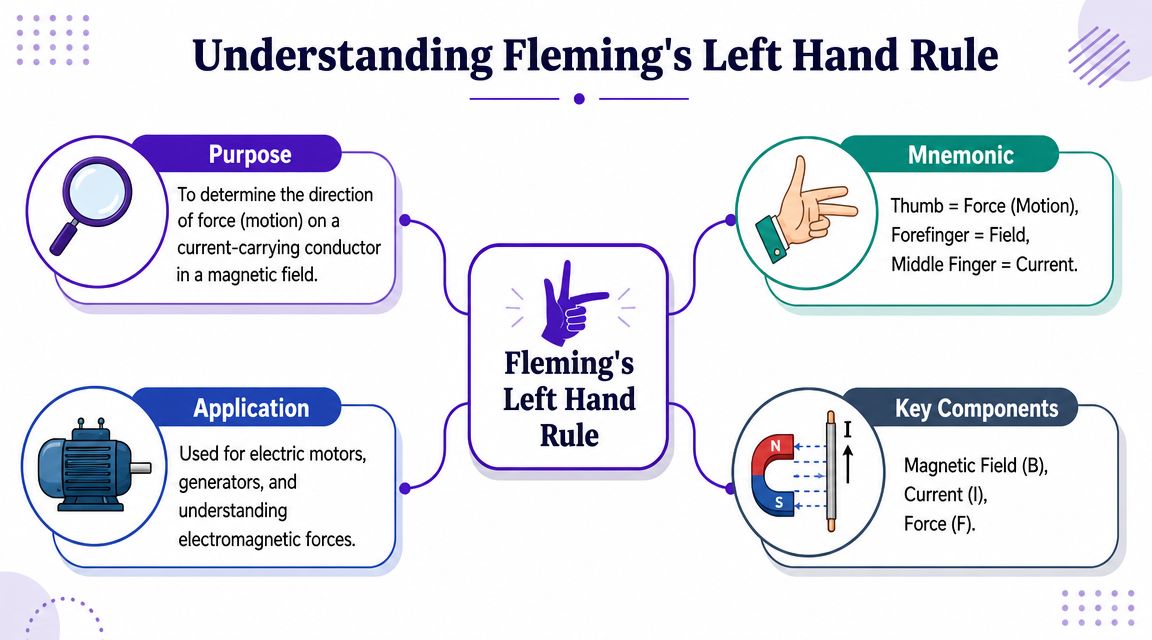
The finger meanings
Hold out your left hand so that your thumb, first finger, and second finger are all at right angles to each other.
Then match them like this:
- Thumb means force or motion
- First finger means magnetic field
- Second finger means current
A lot of students remember this with FBI:
- F for Force
- B for magnetic Field
- I for Current
That memory trick helps because the letters map neatly onto what the fingers are doing. If you forget the full wording in an exam, FBI can get you back on track quickly.
How to hold your hand properly
This matters more than students think. The rule only works if your three digits are perpendicular to each other.
If your fingers are all squashed together or only half-angled, you'll often convince yourself the force goes the wrong way. Examiners don't see your hand, of course, but they do see the answer that comes from a rushed setup.
Practical rule: Set the first finger and second finger first. Let the thumb reveal the answer.
That order helps because the question usually gives you the field and the current, and asks for the force.
A plain-English version
Think of Fleming's Left-Hand Rule as a matching game.
You already know two directions:
- where the magnetic field goes
- where the conventional current goes
Your hand then gives you the third direction:
3. where the conductor is pushed
That's why the rule is so useful in motor questions. It turns a direction puzzle into a hand position.
What students should not overcomplicate
You don't need a dramatic story about electrons smashing into magnets. At GCSE especially, keep the purpose simple. This rule is for finding direction in the motor effect.
If the question shows a current-carrying wire or coil in a magnetic field and asks about force, movement, or rotation, Fleming's Left-Hand Rule should jump into your mind straight away.
The Physics Behind the Motor Effect
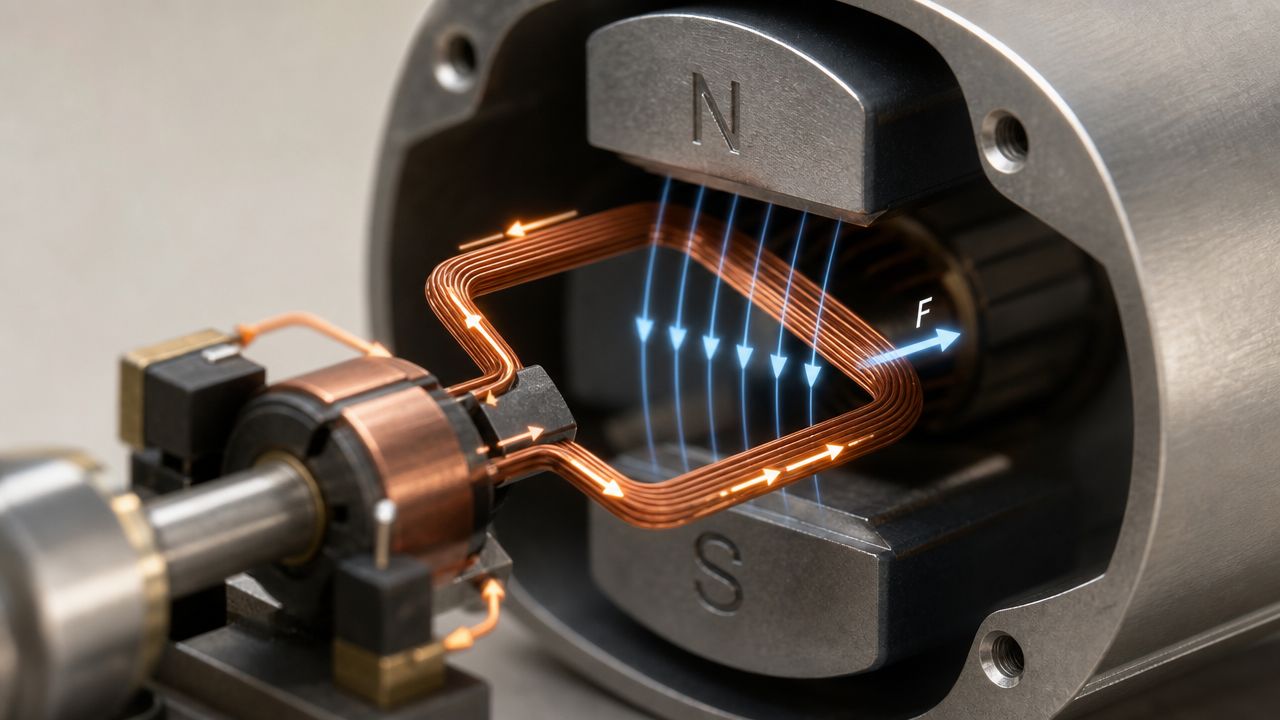
A wire carrying a current in a magnetic field can experience a force. That effect is called the motor effect, and Fleming's Left-Hand Rule is the shortcut for its direction.
Why a force appears
Current is a flow of charge. When charge moves through a conductor, it produces its own magnetic field around the wire. If that wire is placed inside another magnetic field, the two magnetic fields interact.
A simple way to think about it is this. Magnets can push and pull depending on how their fields line up. Around the current-carrying wire, the field from the current meets the external field from the magnet. That interaction creates an unbalanced effect, and the wire gets pushed.
You don't need to memorise a dramatic description. For exam purposes, the key idea is this: a current-carrying conductor in a magnetic field experiences a force.
When the force exists and when it disappears
In UK school physics, Fleming's Left-Hand Rule is best treated as a direction-finding mnemonic for the motor effect. Specifically, the force is only produced when the conductor's current is perpendicular to the magnetic field. If the arrangement changes so the conductor is aligned differently, the force drops to zero. The Institute of Physics practical notes that rotating the setup by 90° can eliminate the kick seen with the East–West orientation in the demonstration, as explained in this IOP guide to Fleming's Left-Hand Rule.
That one detail is gold in exams. If the current and field aren't at right angles, don't just force the hand rule onto the page and hope. Ask whether there should be any force at all.
If the current points along the field rather than across it, the push disappears.
What this means in a motor
In a simple motor, a coil sits in a magnetic field. Current flows through the sides of the coil. One side gets pushed one way, and the other side gets pushed the opposite way. Those opposite forces create a turning effect, so the coil rotates.
That's why motors turn instead of just sliding sideways. Each side of the coil feels a force, and together those forces produce rotation.
The equation link for A-Level students
If you're working at A-Level, you'll often meet the force equation for a straight conductor in a magnetic field:
| Quantity | Meaning |
|---|---|
| F | Force on the conductor |
| B | Magnetic flux density |
| I | Current |
| L | Length of conductor in the field |
The key exam point isn't just the symbols. It's the geometry. The force is strongest when the current is at right angles to the field, which matches the hand-rule picture.
How to revise the physics without drowning in it
A strong approach is to separate the topic into two layers:
- Layer one is the story. A current-carrying conductor in a magnetic field feels a force.
- Layer two is the exam tool. Use the left hand to find the direction.
If you want to find curriculum-aligned resources, practise both layers. You need enough understanding to explain the motor effect, but enough routine to use the rule quickly when the diagram appears.
How to Use the Rule Step-by-Step with Exam Examples
This is the part that saves marks. Not the definition. Not the history. The method.
The routine that works under pressure
Use this order every time:
Find the magnetic field first
The field goes from North to South. Point your first finger that way.Find the conventional current next
Point your second finger in the direction of current.Check the fingers are at right angles
Don't skip this. A sloppy hand position creates sloppy answers.Read the thumb
Your thumb gives the direction of the force or motion.
That's the whole process. If a question gives you field and current, your thumb gives the answer. If it gives you force and field, you can work backwards to think about current.
GCSE-style example
A wire sits between the poles of a magnet. The magnetic field is from left to right. The current in the wire is upwards.
How do you deal with it?
- Point your first finger from left to right.
- Point your second finger upwards.
- Your thumb now points in the direction of the force.
If you're doing this physically while reading, you'll usually feel the answer much faster than if you try to “visualise” it in your head. For many students, the hand is more reliable than mental rotation.
Don't argue with the diagram in your head. Build the shape with your fingers and trust the geometry.
What about into the page and out of the page
Here, students often wobble.
In many exam diagrams:
- a dot means a direction out of the page
- a cross means a direction into the page
A quick memory aid is this:
- dot looks like the tip of an arrow coming towards you
- cross looks like the tail feathers of an arrow going away
If the current is shown into the page, your second finger has to point away from you. If it's out of the page, it points towards you. That can feel awkward with your actual hand, so rotate your hand rather than changing the meaning of the finger.
A-Level-style example with a coil
A rectangular coil is placed in a magnetic field. Current goes up one side of the coil and down the other. The field runs from North to South across the gap.
One side of the coil experiences a force in one direction. The opposite side experiences a force in the opposite direction. That pair of forces creates a turning effect.
A strong answer doesn't just say “the coil rotates”. It explains why:
- One side has current in one direction, so the left-hand rule gives one force direction.
- The opposite side has current reversed, so the force is reversed there too.
- Together, those forces form a turning pair.
That's the kind of wording that gets more credit because it links the rule to the actual rotation.
A quick exam checklist
Before you write your final answer, check these:
- Have I used left hand, not right hand?
- Did I use conventional current?
- Did I identify field from North to South?
- Am I being asked for force, not current?
If you want focused Exam Practice for GCSE, drill lots of short direction questions. Speed matters here. The less you hesitate, the less likely you are to switch a direction by accident.
Left Hand Rule vs Right Hand Rule Explained
This is the part that catches students who know the content. They've revised both rules. They've seen both in class. Then the exam pressure kicks in and the wires get crossed.
The clean distinction is this:
- Left hand for motors
- Right hand for generators
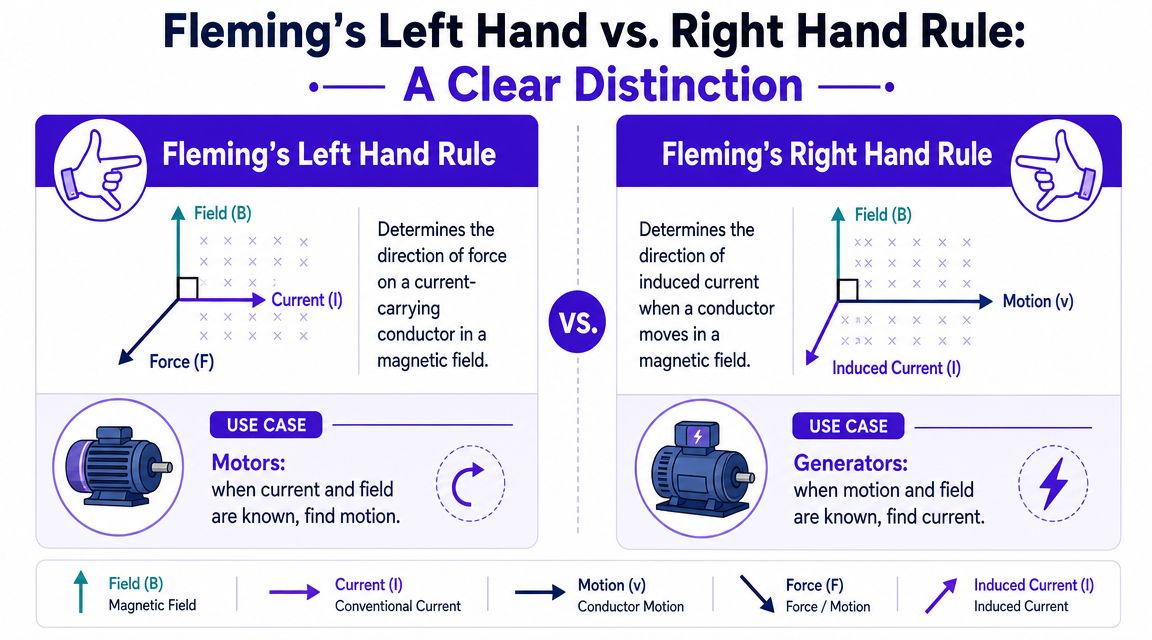
A common point of exam confusion is choosing between Fleming's left-hand and right-hand rules. Many guides say left is for motors and right is for generators, but they often don't explain the boundary conditions that tell you which rule an exam board expects. That distinction matters because students otherwise make inverse-scenario mistakes in diagrams involving current, field, and force, as discussed in this guide on Fleming's rule confusion.
The simple decision test
Ask one question:
Is electricity causing motion, or is motion causing electricity?
If electricity causes motion, you're in a motor situation. Use the left hand.
If motion causes electricity, you're in a generator situation. Use the right hand.
That one question clears up most confusion immediately.
A side-by-side comparison
| Aspect | Fleming's Left Hand Rule | Fleming's Right Hand Rule |
|---|---|---|
| Main use | Finds the direction of force or motion | Finds the direction of induced current |
| Typical device | Motor | Generator |
| What you usually know | Magnetic field and current | Magnetic field and motion |
| What you usually need | Force or movement direction | Current direction |
| Core idea | Electrical input produces movement | Movement produces electrical output |
Why students mix them up
They look similar on paper. Both involve fingers. Both involve magnetic fields. Both often show a wire and arrows. Under stress, students spot “magnet plus wire” and grab a hand rule before they've worked out the physical situation.
That's backwards. Don't choose the hand first. Choose the scenario first.
A reliable memory phrase
You can use this:
Motors move, so use the left hand to find motion. Generators generate current, so use the right hand to find current.
It isn't fancy, but it works because it names the output directly.
A quick explainer can help if you want to hear the distinction described aloud:
Boundary conditions examiners care about
The examiner usually signals the correct rule through the wording:
“State the direction of force on the wire”
That's a motor-effect clue. Think left hand.“Determine the direction of induced current”
That's an induction clue. Think right hand.“The conductor moves through a magnetic field”
Very likely a generator setup.“A current-carrying conductor is placed in a magnetic field”
Very likely a motor setup.
If you train yourself to read the verbs carefully, you'll stop treating the two rules like twins. They're related, but they answer different questions.
Common Mistakes and Exam Tips to Avoid Them
Students rarely lose these marks because the rule is impossible. They lose them because of a small slip early on.
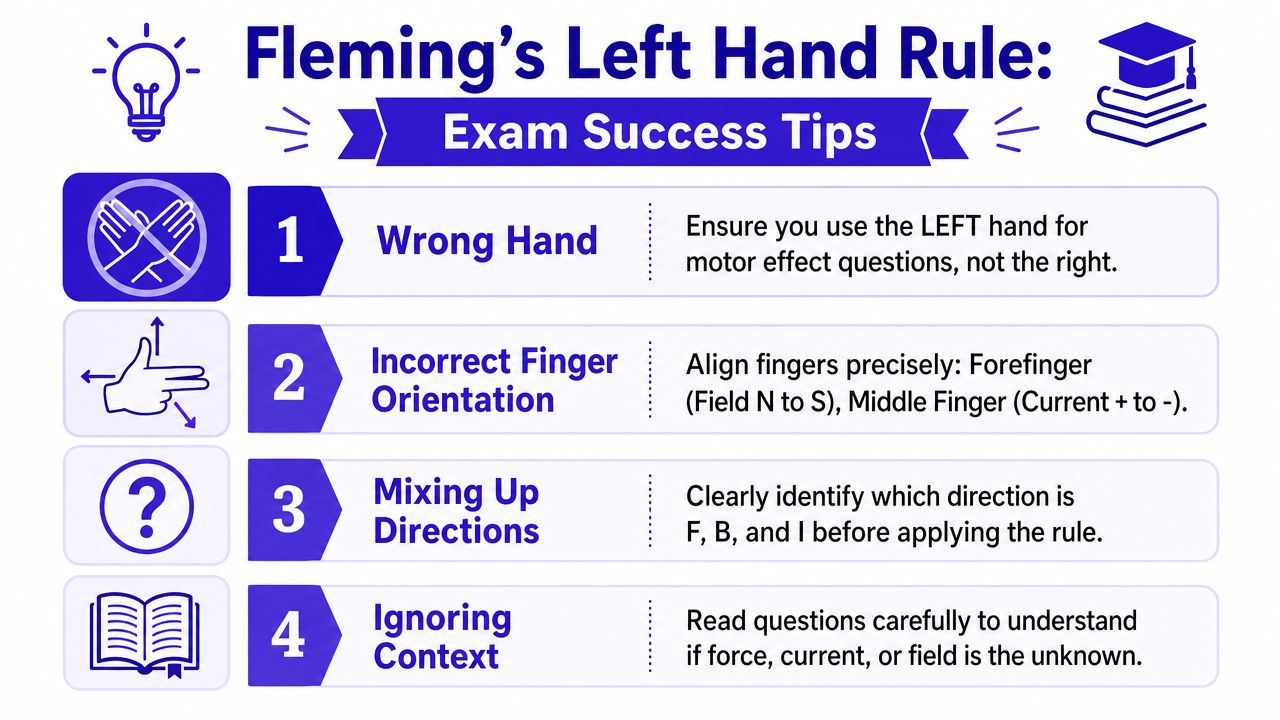
Mistake one using the wrong hand
This happens most when revision has mixed motors and generators together in one session.
Fix it by checking the output of the system before you touch your hand. If the question wants motion or force, it's left hand. If it wants induced current, it's right hand.
Mistake two getting the field direction backwards
Students sometimes follow the magnet labels vaguely instead of explicitly reading the field direction. In school physics questions, the magnetic field goes from North to South.
Write that onto the diagram first if needed. A tiny arrow labelled N to S can save the whole question.
Examiners reward students who slow down for five seconds at the start instead of guessing for thirty at the end.
Mistake three using electron flow instead of conventional current
Fleming's Left-Hand Rule uses conventional current. That's the direction a positive charge would move.
If the question gives current direction directly, use it as shown. If you start mentally swapping to electron flow when it isn't needed, you create confusion for yourself.
Mistake four forcing a direction when there should be no force
Students sometimes assume there must always be a push because the question mentions a magnetic field and a current. Not always.
If the current is not perpendicular to the field, the force can disappear. That's why reading the geometry matters as much as remembering the mnemonic.
A final mini-checklist before you move on
- Read the scenario first. Motor or generator?
- Mark the field direction. North to South.
- Use conventional current. Don't inadvertently switch systems halfway through.
- Keep fingers at right angles. The shape matters.
- Ask whether a force should exist. Don't invent one.
Teachers will know this already, but it's worth saying clearly for students. Most errors here are not deep-physics failures. They're process errors. Fix the process and the accuracy improves fast.
Time to Practise and Master the Motor Effect
Fleming's Left-Hand Rule gets easier the moment you stop treating it like a memory test and start treating it like a routine. Read the diagram. Identify field and current. Use your left hand. Let the thumb show the force.
That's the skill.
Try these short prompts on your own paper before you look anywhere else:
- A wire carries current into the page in a magnetic field directed left to right. What is the direction of the force?
- A current-carrying conductor experiences an upward force in a magnetic field directed right to left. What is the direction of the current?
- A coil in a motor has current flowing in opposite directions on its two sides. Explain why this causes rotation.
Then do more. Not because the rule is huge, but because speed and accuracy come from repetition. Questions on this topic reward students who've practised enough to stay calm.
If you want extra exam-style questions to work through, start with GCSE Past Papers and look for motor effect and electromagnetism items across different boards.
MasteryMind gives UK students a focused way to practise topics like Fleming's Left-Hand Rule without wasting time on random questions. It's built for GCSEs and A-Levels, with exam-board-aligned practice, instant feedback, and clear guidance on where your method is going wrong. If you want to turn shaky physics topics into dependable marks, try MasteryMind.
Ready to master this topic?
Practise with quizzes, blurt exercises and exam questions on MasteryMind.
7 days Premium · Then free forever · No card, no charge