French Revision GCSE: Boost Your Grades in 2026

Your notes are a mess. One page has verbs. Another has photo card answers. Somewhere in the pile there's a vocab list for holidays, and you're not even sure which exam board topic it belongs to.
That's normal. Most students don't fail at French because they never revised. They struggle because their revision is random. They read over notes, feel busy, then panic when they try an actual exam question and realise they can't produce the language under pressure.
Good French revision for GCSE is more practical than people think. You're not trying to “know French” in a vague sense. You're trying to perform well in a very specific exam, with clear paper types, recurring themes, and predictable mark-losing mistakes. Once you treat it like that, revision gets calmer and more effective.
Your GCSE French Revision Starts Here
You sit down to revise French and end up spending 40 minutes rewriting verbs, 10 minutes saying you will practise speaking later, and none of it touches the marks you keep losing in tests.
That pattern is common. It is also fixable.
GCSE French rewards students who train for the paper in front of them. Listening, reading, writing and speaking all count, and weak spots in one skill can drag down a grade even if another feels strong. Strong revision starts once you stop treating French as one vague subject and start treating it as four exam jobs.
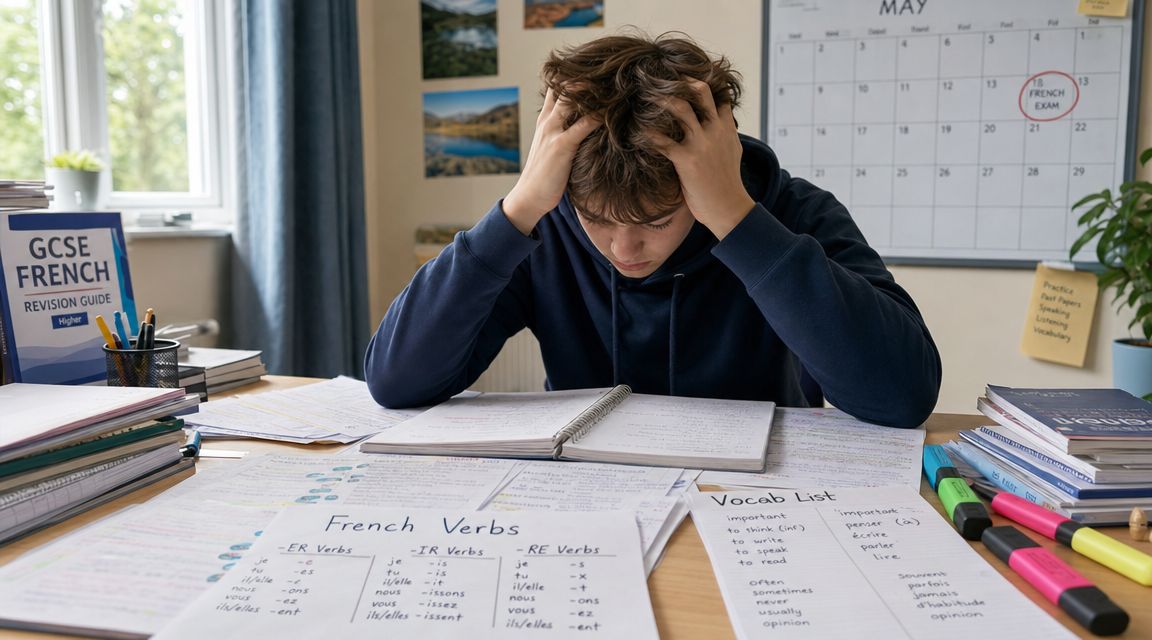
That changes what revision should look like. Reading over vocabulary lists has a place, but it will not fix hesitation in speaking or sloppy tense control in writing. Copying neat notes can feel productive, yet it rarely prepares you for pressure, timing, or the habit of missing small details that cost marks.
Students often ask what to revise first. Start with the skill that is currently losing you the most marks.
Start with a blunt audit
Use one sheet of paper. Write these four headings:
- Listening
- Reading
- Writing
- Speaking
Under each heading, write the problem in plain English.
- Listening: I recognise familiar words but miss the key detail.
- Reading: I understand the topic but get caught by negatives or time phrases.
- Writing: I have enough ideas, but verbs and agreements fall apart.
- Speaking: I know what I want to say, then freeze or answer too briefly.
Be specific. “Need to revise vocab” is too vague to help. “I cannot talk about last weekend without mixing tenses” gives you something you can practise and improve.
This is how experienced tutors spot the fastest route to higher marks. We do not begin with everything. We begin with the recurring errors that show up across multiple tasks.
Practical rule: If the task does not resemble the exam skill, it should only take up a small part of your revision time.
Build revision around performance
A lot of students choose revision based on mood. They pick the easiest topic, the neatest notes, or the task that feels safest. That lowers stress for an hour, but it does not build exam readiness.
A better method is to match each session to a skill and a clear outcome. One session might be short dictation practice for listening accuracy. Another might be speaking answers that add one justified opinion and one different tense. That is how revision turns into marks.
If you want a structured place to organise that practice, Online Revision for GCSE can help you sort work by topic and skill instead of drifting back to passive revision. If your notes are scattered across paper, phone screenshots and random tabs, these apps for student note-taking and focus can also help you keep practice sessions tighter and easier to repeat.
Ask a better question before every session: which skill am I training, and which mistake am I trying to remove? Asking that question changes everything.
Build Your Battle Plan A 4-Week Revision Timetable
A timetable only works if it reduces friction. If it's too detailed, you'll ignore it by day three. If it's too vague, you'll waste time deciding what to do. The sweet spot is a simple weekly structure that tells you what to focus on without trapping you in an impossible schedule.
For GCSE French, your content is organised around broad themes used by major exam boards such as AQA and Pearson Edexcel, including family and relationships, free time, school, local area, and holidays, with speaking lasting about 7–9 minutes at Foundation or 10–12 minutes at Higher according to this GCSE French topics guide. So your timetable should combine theme revision with paper practice.
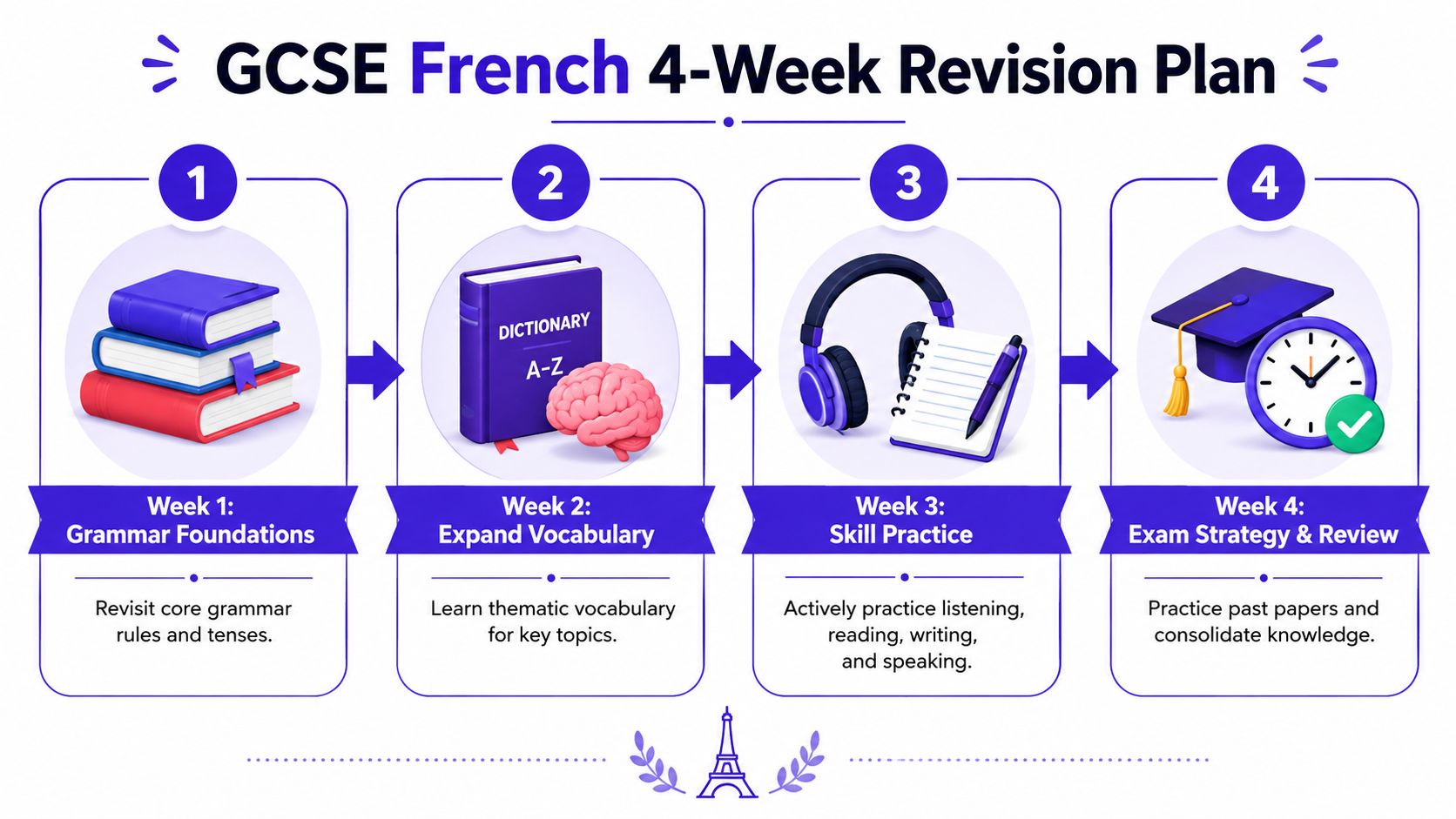
Week 1 fixes the gaps
Don't start with full papers. Start by finding the leaks.
Use this week to sort your topics and core grammar into three groups:
| Priority | What goes here | What to do |
|---|---|---|
| Secure | Topics you can already talk and write about | Quick review only |
| Shaky | Topics where vocab is patchy | Make flashcards and sentence drills |
| Weak | Topics you avoid or can't answer on | Give these first slot in revision sessions |
This is also the week to rebuild essential tense control. If your verbs are messy, everything else gets harder.
Weeks 2 and 3 train the actual skills
Many students finally start doing useful work at this stage. Split the two weeks so one leans more towards listening and reading, and the other leans more towards speaking and writing. You'll still touch all four, but each week gets a main emphasis.
A workable pattern looks like this:
- Short weekday sessions: one topic plus one skill
- Longer weekend slot: timed practice and correction
- One light review session: vocab recall and speaking rehearsal
If you struggle to stay organised, digital tools can help you keep notes, flashcards and timed study blocks in one place. A practical roundup of apps for student note-taking and focus is useful if your revision keeps disappearing into random tabs and half-finished documents.
Don't build a timetable that assumes you'll feel motivated every day. Build one that still works when you're tired.
Week 4 is for pressure, not new content
The final week should feel sharper. Less collecting. More performing.
Use it for:
- Timed listening tasks under proper conditions
- Reading questions with answer-checking straight after
- Writing responses done to time, then corrected
- Speaking runs done aloud, not in your head
One mistake I see a lot is leaving speaking until the end because it feels less urgent. That usually backfires. Speaking improves when answers become familiar enough to say smoothly, and that only happens with rehearsal.
If you're behind, don't scrap the whole plan. Compress it. Keep the order. Audit first, skill-build second, pressure-test last.
Master the Four Skills What to Actually Practise
You sit down to revise French, spend 40 minutes reading notes, and finish with that false sense of progress that disappears the moment you try to answer a question without help. I see this constantly. Students are often working hard, but on the wrong tasks.
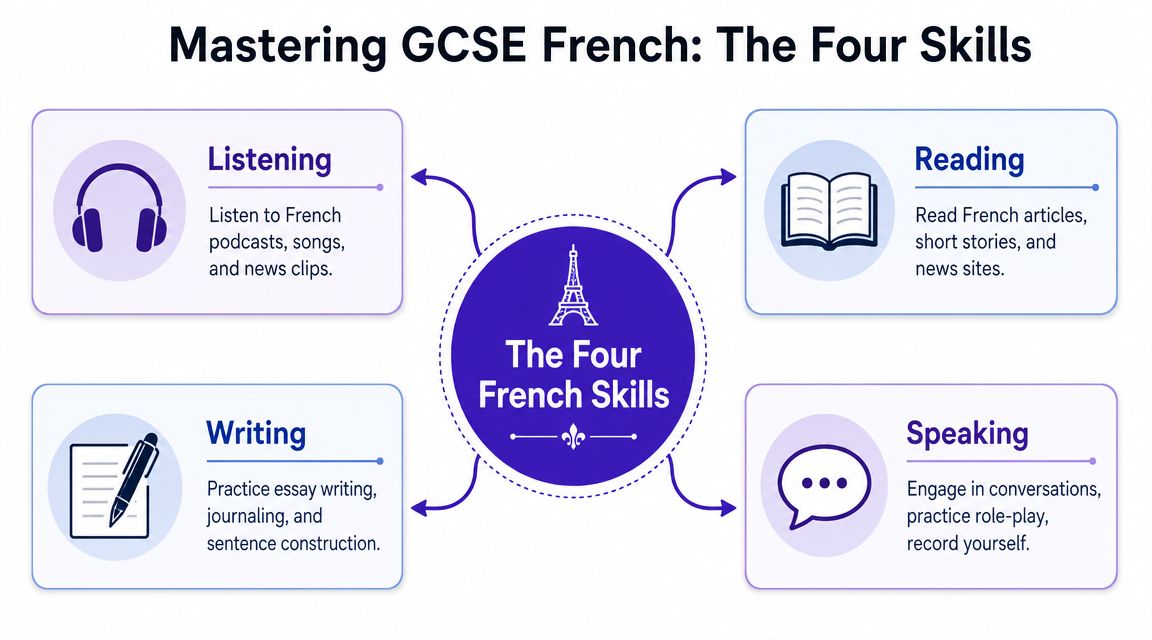
GCSE French rewards recall under pressure, accurate decoding, and clear communication across all four skills. So revision has to train those exact demands. A productive session leaves proof behind: a corrected paragraph, a transcript with gaps filled, a recording you have reviewed, or a reading answer backed up with evidence from the text.
That matters because students rarely lose marks only because they “don't know enough French”. More often, they lose marks through predictable exam errors. Missing a negative in reading. Hearing one key word but missing the tense in listening. Giving a speaking answer that starts well and then trails off. Writing a longer response with good ideas but weak verb control. The fastest gains come from practising the points where marks usually disappear.
Listening needs short, active work
Listening improves fastest when you stop treating it like background exposure and start treating it like close analysis.
Use short extracts and work them hard:
- Replay in small chunks: listen to one sentence, pause, and note the key words
- Transcribe what you hear: even partial transcription sharpens sound recognition
- Check meaning after sound: first catch the words, then work out the message
- Build a trap list: keep a page of familiar words, negatives, numbers, and tense markers that repeatedly catch you out
A lot of listening marks are lost on tiny details. One missed ne, one wrong number, one future tense misheard as present. Train your ear to notice those details and your scores rise much faster than they do from passive listening.
Reading is about proof
Strong readers do not answer from instinct. They locate the exact phrase that justifies the answer.
That sounds simple, but under exam pressure many students read roughly, spot a familiar word, and jump. That is how they get dragged into distractors. The safer method is slower at first and quicker once it becomes habit.
During reading practice:
- underline the words that prove your answer
- mark time references such as yesterday, next week, since, or conditional clues
- circle negatives and qualifiers such as ne...pas, jamais, seulement, and souvent
- translate the key phrase, not the whole text, if one line decides the answer
One sentence of evidence beats a vague overall impression every time.
Speaking improves through repetition, not last-minute confidence
Speaking is usually the most avoided skill because it feels exposing. That is also why it responds well to regular practice. Short daily speaking beats one long session at the weekend.
Start with a narrow routine. Answer one common question aloud. Record it. Listen back once. Improve one feature only. That might be pronunciation, a stronger opinion phrase, or a better tense. Then say it again.
If you want extra ideas to improve French speaking skills, use activities that force spoken output. Voice notes, short answers to predictable theme questions, and role-play turns are all more useful than reading model answers.
I tell students this all the time: if you cannot say it out loud now, you do not know it well enough for the speaking exam.
Later, switch into exam-style questioning so your practice matches the pressure and phrasing of the actual paper. Tools such as Exam Practice for GCSE are useful here because they move you from general conversation into question types that need timed, structured responses.
This video is also useful if you need a change of pace and want to hear practical revision guidance explained aloud.
Writing rewards control before flair
Students often assume their writing problem is a lack of vocabulary. Sometimes that is true. More often, the primary problem is accuracy under time pressure.
A student may know plenty of words and still drop marks through repeated mistakes: wrong endings, broken word order, extra pronouns, weak tense control, or copying English structure into French. That is why writing practice has to include correction, not just production.
A practical routine looks like this:
- keep an error log and track repeated mistakes across multiple answers
- rewrite one sentence in three tenses to test whether the structure really belongs to you
- check every verb before hunting for ambitious phrases
- compare your answer against the bullet points so relevance does not slip
The trade-off is straightforward. Students who chase complex language too early often produce messy answers. Students who control simpler language usually score more steadily. Secure sentences first. Wider range second.
Match the practice to the task
Different writing tasks need different kinds of preparation. Students lose marks because they revise “writing” as one big category instead of training the exact response each question asks for.
For shorter tasks, practise covering every bullet point clearly and cleanly. For the longer Higher Tier response, build stamina for a sustained answer with structure, development, and enough range to show what you can do. As noted earlier in the article, the open-ended Higher Tier task expects around 150 words, so the target is not maximum length. The target is a relevant answer that stays accurate as it develops.
Use this quick comparison:
| Task type | What usually matters most |
|---|---|
| Shorter response | coverage, clarity, correct tense use |
| Longer response | structure, development, variety, sustained accuracy |
The four skills are tested separately, but the revision should connect them. Read and prove meaning. Listen and catch detail. Speak and rehearse aloud. Write and correct with a sharp eye for the mistakes that keep costing marks. That is how revision starts matching the exam instead of just circling around it.
Make Your Grammar and Vocab Actually Stick
If you're revising grammar by staring at verb tables, you're making the job harder than it needs to be. Grammar only sticks when you use it. Vocab only sticks when it appears in context often enough that your brain stops treating it as random.
That's why passive revision keeps disappointing students. You may recognise the page. You may even feel familiar with the words. Then the exam asks for a translation or a written answer and nothing comes out cleanly.
Expert advice aimed at top GCSE French grades stresses moving beyond passive revision and focusing on verb control across multiple tenses, stock phrases, and mark-scheme-led self-checking of timed responses, because the exam rewards precision. That's the core message in this high-grade GCSE French advice article.
Learn language in chunks, not crumbs
Single words are slippery. Chunks are more usable.
Instead of memorising just one word, learn it inside a sentence frame:
- Je joue au foot
- J'ai joué au foot
- Je jouerai au foot
That does three things at once. It teaches the word, the tense pattern, and the word order.
Stock phrases matter for the same reason. They give you ready-made building blocks for speaking and writing. Even something simple like a thank-you phrase can become more memorable when you learn how it changes by tone and context. A practical example is Translate AI's French thank you guide, which shows why learning phrases as usable chunks works better than memorising isolated translations.
Retrieval beats rereading
Use flashcards if you want, but make them work harder. Don't just flip from French to English. Say the answer aloud. Put the word into a sentence. Change the tense. Add an opinion.
If you want a smarter system for reviewing material before you forget it, this guide to understanding spaced repetition is worth a look. The key idea is simple. Review just before the memory fades, not after it's gone.
The best vocab revision is slightly uncomfortable. If it feels too easy, you're probably recognising, not recalling.
For stronger students, the key differentiator isn't just “advanced language”. It's controlled language. Can you switch tense cleanly? Can you keep agreement accurate? Can you translate without dragging English structure into French? That's what moves marks.
Conquer Past Papers and Perfect Your Exam Technique
Past papers help only when you treat them as training, not as a score generator. Too many students do a paper, check the mark, feel annoyed, and stop there. That misses the useful part.
A stronger workflow is built around identifying weak areas, using short revision blocks, drilling vocab, and then moving into exam-format practice with corrections. Past papers and teacher-marked feedback are consistently recommended in that sequence in this GCSE French revision workflow guide.
Use the four-step cycle
Write this on the front of your folder if you need to:
- Do the paper under proper conditions
- Mark it with the mark scheme
- Analyse every lost mark
- Repeat the weak questions later
Most students stop at step two. The gains come from step three.
Build an error log you'll actually use
Your error log doesn't need to be pretty. It needs to be specific.
Try a table like this:
| Question | What went wrong | What to do next |
|---|---|---|
| Reading | Missed the negative | Scan for negatives before answering |
| Writing | Wrong verb ending | Drill that tense with five sentences |
| Listening | Recognised keyword but missed detail | Replay and transcribe short clips |
| Speaking | Hesitated at the start | Memorise stronger opening lines |
That turns revision into targeted repair instead of vague effort.
Think like an examiner
The mark scheme tells you what counts. Use it ruthlessly. If your answer is nearly right but not quite precise, don't give yourself the mark. If your writing answered only part of the prompt, count that fairly too.
For exam-style material, GCSE Past Papers can be useful if you want everything collected in one place rather than hunting across different sources. What matters most, though, is what you do after the paper. Correction is where the learning happens.
One final point. Redo old mistakes after a gap. If you can fix them a few days later without help, the revision is starting to stick.
Your Exam Day Checklist for Peak Performance
By exam day, your job is no longer to improve your French. Your job is to access what you already know. That means reducing avoidable stress and keeping your brain clear enough to retrieve language under pressure.
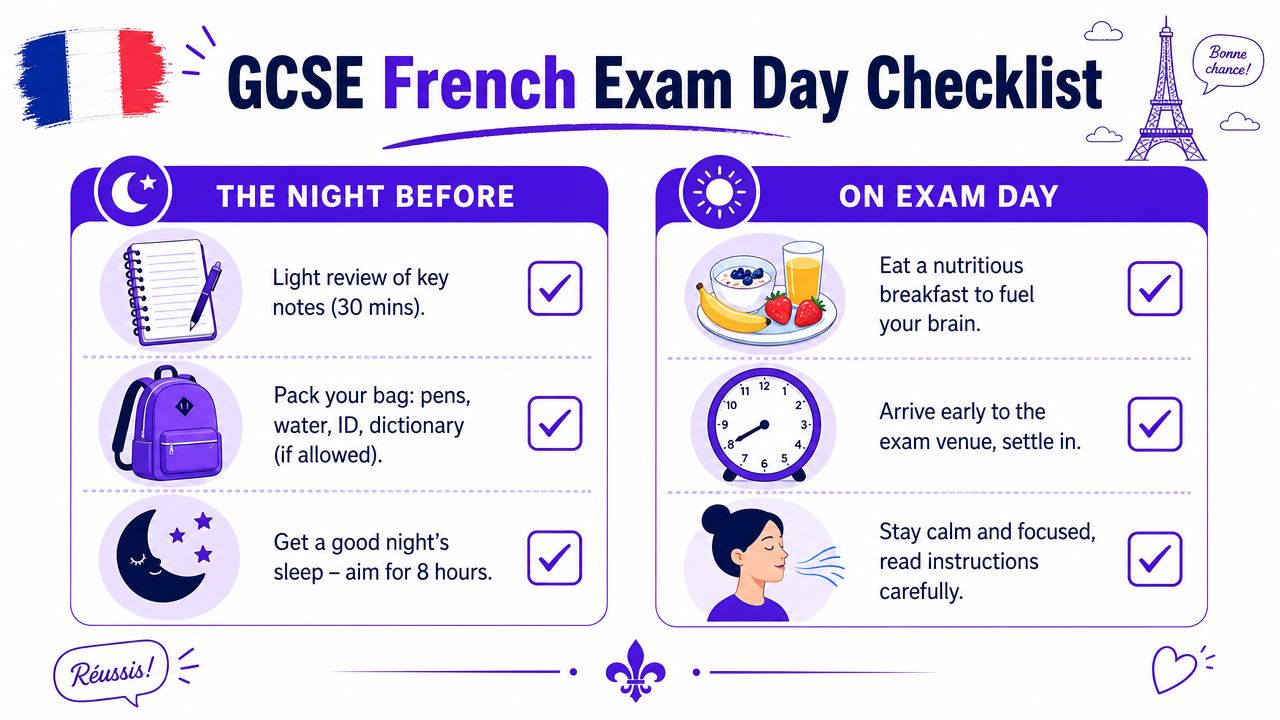
The night before
Keep it light.
- Review briefly: Go over key phrases, common corrections, and a few tense patterns.
- Pack properly: Pens, water, ID, and anything else your centre expects.
- Stop in time: Late-night cramming usually creates noise, not clarity.
On the day
Small habits matter more than students think.
- Eat something steady: You want focus, not a sugar crash.
- Arrive early: Rushing into a language exam puts your brain in the wrong gear.
- Read twice: Especially in listening and reading, keyword mistakes are expensive.
- Move on when stuck: Don't donate the rest of the paper to one bad question.
You do not need to feel calm to perform well. You need a routine strong enough to carry you through the nerves.
If you've revised by skill, corrected your weak patterns, and practised under exam conditions, you've done the right work. Trust that. GCSE French rewards preparation that is focused and repeatable, not dramatic last-minute effort.
If you want a structured way to practise French revision GCSE without relying on random notes and guesswork, MasteryMind offers exam-aligned revision for UK learners, including topic practice, past-paper style questions, and tools for building recall over time.
Ready to master this topic?
Practise with quizzes, blurt exercises and exam questions on MasteryMind.
7 days Premium · Then free forever · No card, no charge