GCSE Biology Practice Questions: Your Ultimate Revision Plan
You've probably had one of these revision sessions already. You sit down with your biology notes, highlight half the page, reread the same spread on enzymes or inheritance, and convince yourself it's going in. Then you open an exam question and suddenly it feels like the paper is written in a different language.
That's not laziness, and it doesn't always mean you “don't know the content”. Usually, it means your revision hasn't matched the job the exam is asking you to do. GCSE Biology rewards recall, yes, but it also rewards decoding command words, handling awkward data, showing method in calculations, and structuring longer answers so the examiner can give you the marks.
If you're behind and trying to recover, this matters because you need revision that gives fast feedback. If you're aiming for the top grades, it matters because strong knowledge alone still leaves marks on the table. Teachers know this too. The issue isn't whether students practise. It's whether they practise in a way that mirrors the paper.
Why Rereading Your Notes Is Not Enough
A lot of students revise biology in a way that feels productive but isn't. They reread class notes on cell division, skim a textbook chapter on ecology, then test themselves only at the very end. It feels tidy. It feels safe. It also falls apart when the question asks for application, not recognition.
You can see this in a simple example. A student reads a page on DNA structure and thinks, “Yep, I know that.” Then the exam asks them to explain how changes in a DNA sequence can affect a protein, or connect genetics to disease prevention, and they freeze. Recognition isn't the same as retrieval. If you want a useful refresher on the science itself, something like this article on bacterial DNA and infection control can help you connect content to real biological contexts, but the mark gain happens when you answer questions from memory.
That's why active recall matters. According to Exam Papers Plus on revising GCSE Biology effectively, active recall, retrieving information without looking at notes, is significantly more effective than passive revision like rereading. In plain English, your brain learns more when it has to work.
What passive revision sounds like
- “I remember seeing this.” That's familiarity, not mastery.
- “I'll test myself later.” Later often never comes, or it comes too late.
- “I understand it when I read it.” Exams don't let you read the answer first.
What active revision looks like
- Close the book first: Try to write or say everything you know about photosynthesis before checking.
- Answer actual questions: Don't stop at flashcards. Use exam-style prompts.
- Mark the gap: Separate what you knew from what you only recognised.
Practical rule: If your notes are open while you're “revising”, you're often reviewing, not proving.
GCSE Biology practice questions are your best tool. They force retrieval, expose weak spots fast, and train you to think in the format the paper uses. If you want a wider method for doing that consistently, this guide on active recall for A-Level students is still useful at GCSE because the memory principle is exactly the same.
Finding the Right Practice Questions for Your Exam
Not all practice questions are equally useful. Some are excellent. Some are outdated. Some are for the wrong board, the wrong tier, or the wrong science route. If you use the wrong material, you can work hard and still prepare badly.
GCSE Biology exams in the UK use the 1 to 9 grading system, with Grade 9 as the highest, and students choose between Triple Science or Double Science Award and between Foundation or Higher Tier, which changes the difficulty and content of the questions they face, as explained in this GCSE Biology revision overview.
Start with the non-negotiables
Before you download a single paper, check these three things:
Your exam board
AQA, Edexcel, OCR, and WJEC don't phrase questions in exactly the same way.Your route
Triple Science students cover content that Double Science students may not.Your tier
Foundation and Higher papers don't just differ in hardness. They can differ in what gets tested and how.
Use different question sources for different jobs
Students often treat every worksheet like it serves the same purpose. It doesn't.
| Resource type | Best use | What to watch out for |
|---|---|---|
| Full past papers | Timing, stamina, paper navigation | Don't use these too early without review |
| Topic questions | Fixing weak areas like homeostasis or genetics | Make sure they match your board |
| Mini quizzes | Quick recall between longer sessions | They can become too easy if overused |
Full papers are for pressure. Topic questions are for repair. Mini quizzes are for keeping facts alive between bigger sessions.
What usually wastes time
The biggest problem isn't a lack of resources. It's mess. Students end up scrolling through random PDFs, half-labelled worksheets, and old uploads with no clue whether the questions still fit the spec. Teachers see this all the time. The student looks busy, but the practice isn't organised.
A cleaner approach is to build from curated, board-aligned sets and then move into timed paper practice. If you want everything in one place for the paper side of revision, a collection of GCSE Past Papers can save a lot of dead time hunting around.
The right question at the right moment beats a huge stack of random questions every time.
Decoding Command Words and Question Types
Many students lose marks before they've even started answering. They read the topic correctly but misread the job. That's what command words control.
This isn't a small issue. Data from the UK Department for Education (2025) shows that 68% of Grade 5–6 students fail Biology exams due to misinterpreting command words, not lack of knowledge. AQA's 2024 examiner report confirms that “explain” and “evaluate” questions account for 42% of extended-mark questions, as noted in BBC Bitesize's guidance on exam command words.
If you're a student, that should be reassuring as well as alarming. It means a lot of mark loss is fixable. If you're a teacher, it confirms what classroom marking often shows. The misunderstanding sits in the question demand, not always in the science.
Why command words matter so much
Take these two prompts:
- Describe how water moves through a plant.
- Explain how water moves through a plant.
They are not asking for the same answer.
Describe wants a clear account of what happens.
Explain wants the reason or mechanism behind it.
A student can know the content and still underperform by giving a description when the examiner wants causation.
Common GCSE Biology command words
| Command Word | What the Examiner Wants | Example |
|---|---|---|
| Describe | State what happens in a clear sequence or summary | Describe what happens to the pupil in bright light |
| Explain | Give reasons, causes, or how one thing leads to another | Explain why exercise increases breathing rate |
| Compare | Identify similarities and differences | Compare mitosis and meiosis |
| Evaluate | Judge strengths, limits, or whether evidence supports a conclusion | Evaluate the use of a drug trial method |
| Calculate | Use the correct maths and show working | Calculate magnification from image and actual size |
| Suggest | Apply biological knowledge to an unfamiliar situation | Suggest why a population decreased suddenly |
The subtle traps
Students usually struggle most with three pairs.
Describe and explain
If the question says describe, don't wander into long reasoning. If it says explain, don't just list observations.
A weak answer to “Explain why the heart rate rises during exercise” often says: “The heart beats faster and breathing increases.” That's description. A stronger answer links cause and effect: muscles respire more, need more oxygen and glucose, and produce more carbon dioxide, so the body increases blood flow.
Compare and evaluate
Compare is balanced. You should place both sides next to each other.
Evaluate requires judgement. You weigh evidence and often finish with a reasoned conclusion.
A good evaluation answer usually sounds like someone making a case, not just naming points.
Calculate and suggest
These questions feel different, but they share one demand. You must think, not copy. Calculation questions test method. Suggest questions test whether you can transfer knowledge into a new setting.
A quick decoding routine
When you see a question, train yourself to pause for a few seconds and ask:
- What is the command word?
- What topic knowledge do I need?
- Do I need causes, differences, a method, or a judgement?
- How many marks are available?
That last point matters. A one-mark “state” question needs precision. A longer “evaluate” question needs developed reasoning.
Strategies for Acing Every Question Format
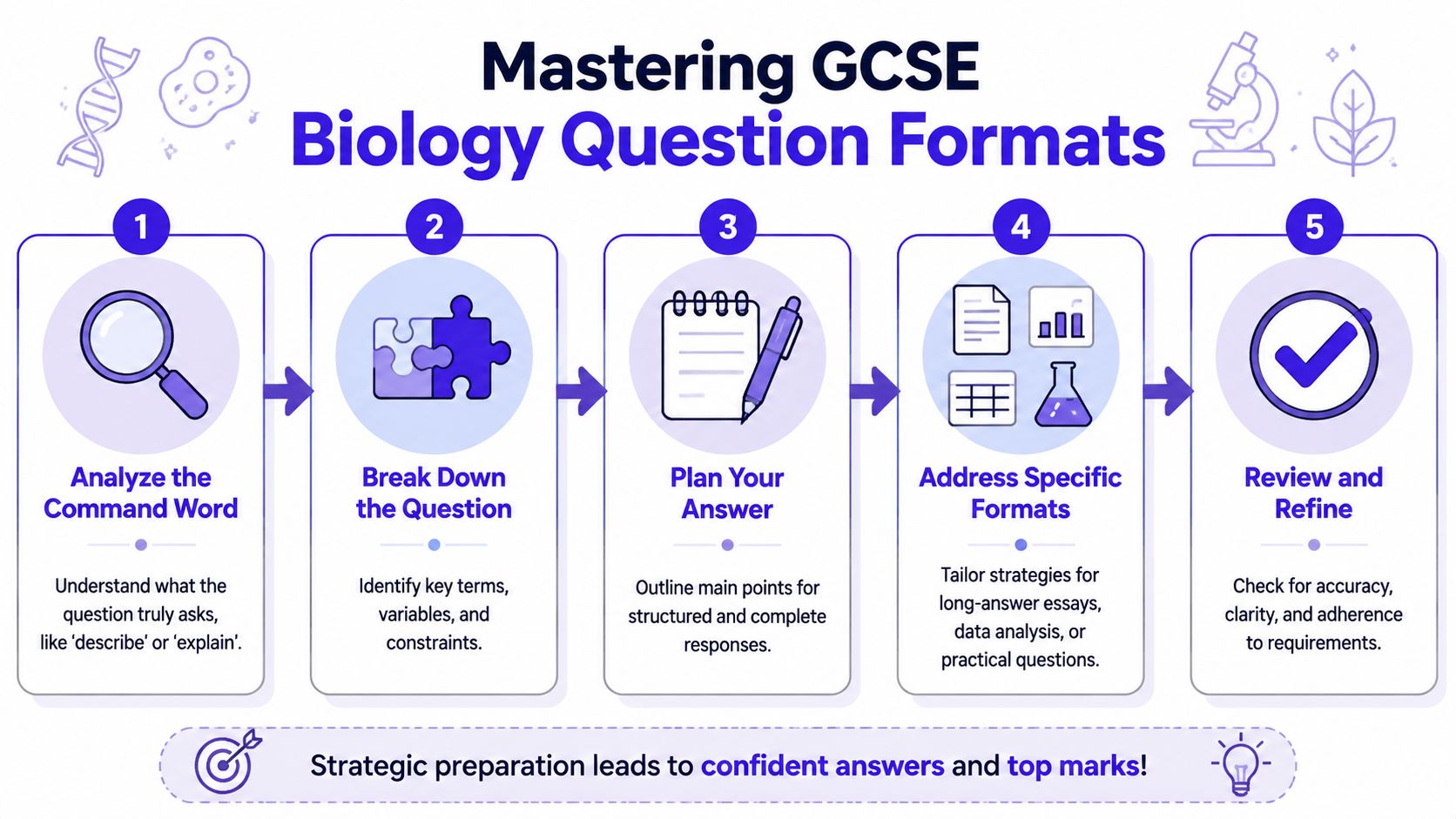
Some Biology question types create panic because they combine knowledge with technique. That's where students who “revise loads” still get stuck. The answer isn't to do more of the same. It's to use a method for each format.
Maths in Biology
A lot of students underestimate this area because they think Biology is mostly words. It isn't. GCSE Biology includes 10 to 15% maths content, and according to the 2025 Ofsted review of UK science education, 54% of students lose marks in Biology due to maths errors in calculation questions, as discussed alongside GCSE Biology paper resources at Twinkl's practice exam paper page.
The key problem is usually not the final arithmetic. It's poor setup.
A better method for calculation questions
Write the formula or relationship first
Even if you think it's obvious.Pull out the numbers from the question carefully
Include units.Substitute before solving
This makes checking easier.Show each line of working
You can recover marks even if the final answer is wrong.Check the unit and whether the answer is sensible
A negative population size or impossible percentage should warn you.
A lot of free worksheets only show the answer. That doesn't train the thinking. You need to see the route, not just the destination.
Required practical questions
These questions catch students out because they sit between content and method. You might know osmosis or enzymes perfectly well, but still miss marks on variables, controls, repeats, and conclusions.
Use practice questions here to revise the experiment as a system:
- Method: What are the steps?
- Variables: What is changed, measured, and controlled?
- Improvements: How would you make the results more reliable?
- Data: What does the graph or table show?
A useful way to revise practicals
Don't just memorise the practical write-up. Cover the sheet and answer these from memory:
- What was the independent variable?
- What was measured?
- Why was a control needed?
- Why repeat the test?
- What trend would you expect in the results?
That turns practical revision into proper exam rehearsal.
The 6-mark answer
This is the format students fear most, and often for the wrong reason. The problem usually isn't that the biology is too hard. It's that the response is badly organised.
A strong method exists. Save My Exams' guide to difficult GCSE Biology questions sets out a four-stage process for success on 6-mark extended writing questions:
- Identify the command word and the mark allocation
- Plan for about 30 seconds with 5 to 6 distinct bullet points
- Structure the answer using bullet points and clear scientific key terms
- Practise repeatedly until the structure becomes automatic
It also notes that students who fail to use bullet points are often capped at Level 2, which is 4 out of 6 marks. That's a huge loss caused by structure, not necessarily by knowledge.
Non-negotiable: For a 6-marker, plan before you write. If you don't, you'll repeat yourself and miss easy points.
What this looks like in practice
If the question asks you to explain differences between mitosis and meiosis, your plan might quickly include:
- Mitosis produces identical cells
- Meiosis produces genetically different cells
- Mitosis for growth and repair
- Meiosis for gamete formation
- Mitosis has one division
- Meiosis has two divisions
Then write using those points cleanly, with correct biological terms. Underline or clearly emphasise the key terms in your own working if that helps you stay precise.
Time management under pressure
GCSE Biology papers in England are consistently 1 hour 45 minutes, and a reliable rule is to allow roughly 1 minute per mark, according to Tutopiya's overview of GCSE Biology past papers.
That means your strategy has to match the clock.
- Short questions: Move briskly. Don't turn a one-mark answer into a paragraph.
- Calculations: Give them enough time to set out working properly.
- 6-markers: Budget thinking time, not just writing time.
If you want to rehearse that under realistic conditions, Exam Practice for GCSE is useful because timed conditions change how students think and write.
Build a Smart Revision Timetable with Spaced Practice
Most cramming feels intense, and that's why students trust it. You sit for hours, cover loads of content, and finish exhausted. The problem is that tired doesn't always mean effective.
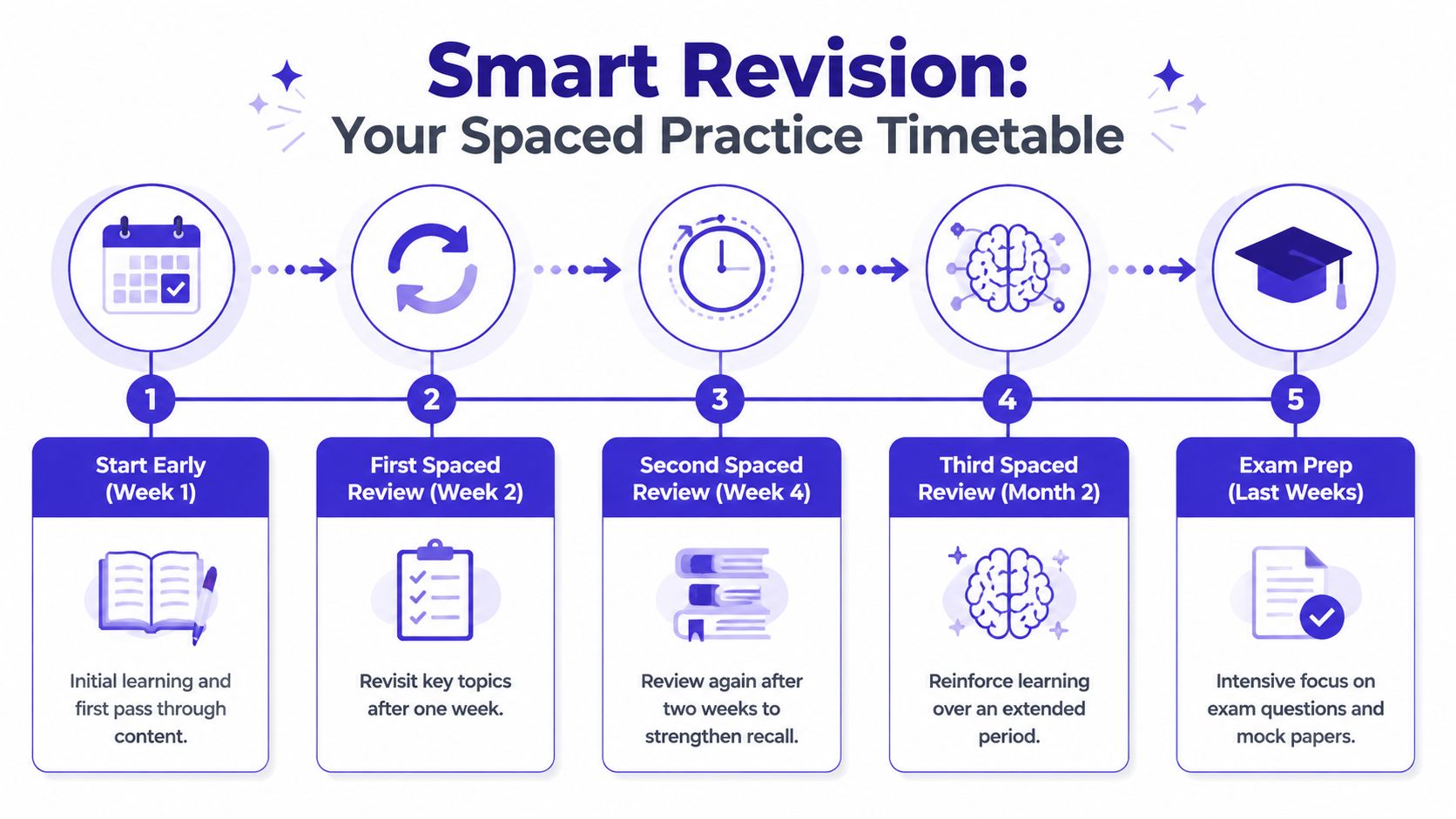
A better timetable spaces practice out and keeps bringing topics back just as they start to fade. That feels less dramatic, but it works far better for memory.
Why spacing works better than panic revision
You don't need to make revision harder for the sake of it. You need to make forgetting less likely. Spaced practice does that by revisiting content after a gap. Each return strengthens the memory and makes recall easier next time.
Pair that with retrieval and you've got a powerful system. If you want a quick explanation in video form before building your own plan, this is a useful watch:
A timetable that students can actually follow
A smart biology week doesn't need to be complicated. It needs to be repeatable.
Example weekly pattern
- Monday: One weak topic, answered from memory first, then checked
- Tuesday: Mixed short GCSE Biology practice questions from older topics
- Wednesday: Required practical recall and one data question
- Thursday: A small set of calculation questions with full working
- Friday: One longer question or mini paper section
- Weekend: Review errors, then retest the same weak areas without notes
This works because it mixes content, retrieval, and return. You're not just “doing biology”. You're strengthening specific memories and exam behaviours.
What students usually get wrong with timetables
The common mistake is overplanning and underdoing. A beautiful colour-coded schedule is useless if every session is too long, too vague, or too passive.
Keep the sessions tight and specific:
- Name the task clearly: “Answer 8 genetics questions” beats “revise genetics”.
- Build in repeats: Revisit the same topic after a gap.
- Mix old and new: Don't only study what you did that day in class.
Revision should leave traces. If you can't point to questions answered, mistakes corrected, or facts retrieved from memory, the session probably drifted.
If you want to understand the memory side in more depth, this guide on how spaced repetition aids GCSE revision explains why scheduled returns beat last-minute cramming.
Track Your Progress and Target Your Weaknesses
Doing lots of questions can still leave you stuck if you don't analyse your mistakes properly. Students often mark an answer, see that it's wrong, read the correct version, and move on. Then the same mistake appears a week later.
Real progress starts when you sort errors into types. Did you forget a fact? Misread the command word? Drop a unit in a calculation? Miss a control variable in a practical? Those are different problems, so they need different fixes.

Turn mistakes into categories
Try reviewing your last set of answers with a simple checklist.
| Mistake type | What it usually means | Best response |
|---|---|---|
| Knowledge gap | You didn't know the fact or process | Relearn, then retest soon |
| Command-word error | You answered the wrong task | Practise decoding the demand |
| Maths setup error | Your method broke before the calculation ended | Rewrite the full working |
| Practical reasoning error | You missed variables, controls, or conclusion logic | Rehearse experiment structure |
That stops revision from becoming emotional. “I'm bad at biology” isn't useful. “I keep dropping marks on setup in calculations” is useful because you can fix it.
Why feedback speed matters
This is especially important in calculations. According to the 2025 Ofsted review of UK science education, 54% of students lose marks in Biology due to maths errors in calculation questions, a problem not addressed by current practice tools that only provide final answers, as noted earlier from Twinkl's GCSE Biology practice paper resource. If you only see the final number, you often can't see where the reasoning broke.
Teachers know delayed feedback has limits. By the time marked work comes back, the student may not remember what they were thinking. Fast, detailed feedback changes that. It helps you catch patterns early and target the exact weakness instead of revising everything again.
A good progress system should help you answer three questions:
- What am I getting wrong repeatedly?
- Why am I getting it wrong?
- What specific question should I do next to fix it?
That's how GCSE Biology practice questions become more than revision material. They become a diagnostic tool.
If you want one place to practise, review mistakes, and keep your revision organised, MasteryMind is built for exactly that. It gives UK learners examiner-aligned questions, clear feedback, step-by-step maths verification, and spaced review tools so each practice session moves you forward.
Ready to master this topic?
Practise with quizzes, blurt exercises and exam questions on MasteryMind.
7 days Premium · Then free forever · No card, no charge