GCSE Chemistry Practice Questions: Your Ultimate 2026 Guide
You've probably done one of these already. Opened a past paper, answered a few questions, checked the mark scheme, felt mildly attacked by the wording, then told yourself you'd “do more tomorrow”.
That feels like revision. Sometimes it is. Often, it's just motion.
Good GCSE chemistry practice questions don't just test what you know. They train you to spot what the examiner is really asking, choose the right method fast, and write answers in the precise language that picks up marks. That matters whether you're trying to rescue a grade after leaving revision late or you're already strong and want to push into the top band.
Teachers know this too. Students rarely lose marks only because they “don't know chemistry”. They lose them because they rush a calculation setup, miss a control variable, ignore a command word, or write a vague explanation that sounds sensible but doesn't match the mark scheme.
The fix isn't glamorous. It's method. If you use GCSE chemistry practice questions properly, one page of questions can teach you more than a full booklet done badly.
Why Your Current Chemistry Practice Might Be Wasting Time
You finish a set of chemistry questions, mark it in five minutes, circle a few wrong answers, and feel like revision happened. Then a very similar question appears two days later and the same mistake shows up again.
That pattern is common because a lot of practice stops at completion. True gain comes from finding the exact point where your thinking slipped. GCSE chemistry is full of small decisions. Which formula fits here? Which unit needs changing? Which keyword does the examiner expect? If you do not inspect those decisions, the question becomes little more than handwriting practice.
A useful comparison is this. Doing lots of questions without analysis is like doing a practical where you only record the final colour change and ignore the method. You might know what happened, but you cannot reliably repeat it.
Three habits that waste marks and revision time
These are the patterns teachers see all the time.
Past paper autopilot
You keep answering in a straight line, even after hitting a question type that clearly trips you up. The page fills. Your understanding does not.Answer checking without diagnosis
You spot that an answer is wrong, copy the correct one, and move on. That feels tidy, but it hides the underlying problem. Did you miss a science fact, choose the wrong method, forget a unit conversion, or misread the command word?Comfort-zone practice
You return to familiar questions because they feel manageable. Meanwhile, six-mark practical questions, required practical methods, and multistep calculations stay untouched until the exam.
Practical rule: If you cannot explain why a mark was lost, the question is still unfinished.
This is why random question volume often disappoints. Chemistry marks are usually lost in patterns, and patterns can be fixed. A student who keeps dropping units needs a different fix from a student who writes vague explanations. A student who panics on electrolysis calculations needs a repeatable setup method, not another giant worksheet.
That is also why understanding exam marking criteria matters so much. Once you start reading your own work like an examiner, your mistakes stop looking random. They fall into categories you can work on.
Why one carefully analysed question can teach more than ten rushed ones
Take a mole calculation. A student gets the final answer wrong and decides the whole topic is a disaster. In class, that is rarely the full story. Often the chemistry idea was fine, but one step went wrong. The mass was left in mg instead of g. The ratio from the equation was skipped. The calculator entry was mistyped. Those are different errors, so they need different fixes.
The same thing happens with explain questions. Students often understand the science in normal speech, but exam answers need sharper wording. “It reacted more” is too vague. “The rate increased because particles collided more frequently” is far closer to what earns marks. That gap is not about intelligence. It is about translation.
Try using questions as material to examine, not just complete:
| Common student habit | Better method |
|---|---|
| Race through mixed questions | Slow down and identify the question type first |
| Check only the final answer | Check setup, method, units, keywords, and structure |
| Repeat easy topics | target the areas that regularly cost marks |
| Treat errors as proof you are bad at chemistry | Treat errors as evidence about what to fix next |
That shift changes the value of every practice session. One question can teach content, exam technique, and error control at the same time, if you pause long enough to pull it apart.
Decoding Your Exam Board and the Mark Scheme
Every chemistry paper has rules. If you know those rules, the paper becomes much less mysterious.
For AQA GCSE Chemistry, assessment is split across two 1 hour 45 minute papers, each worth 100 marks, for a total of 200 marks, and practice that mirrors that timing and mark allocation builds the right exam habits under pressure, as outlined in AQA-aligned quantitative chemistry revision guidance. That matters because practice isn't only about content recall. It's also about stamina, pacing, and getting used to the style of mark allocation.
Start with the specification, not random worksheets
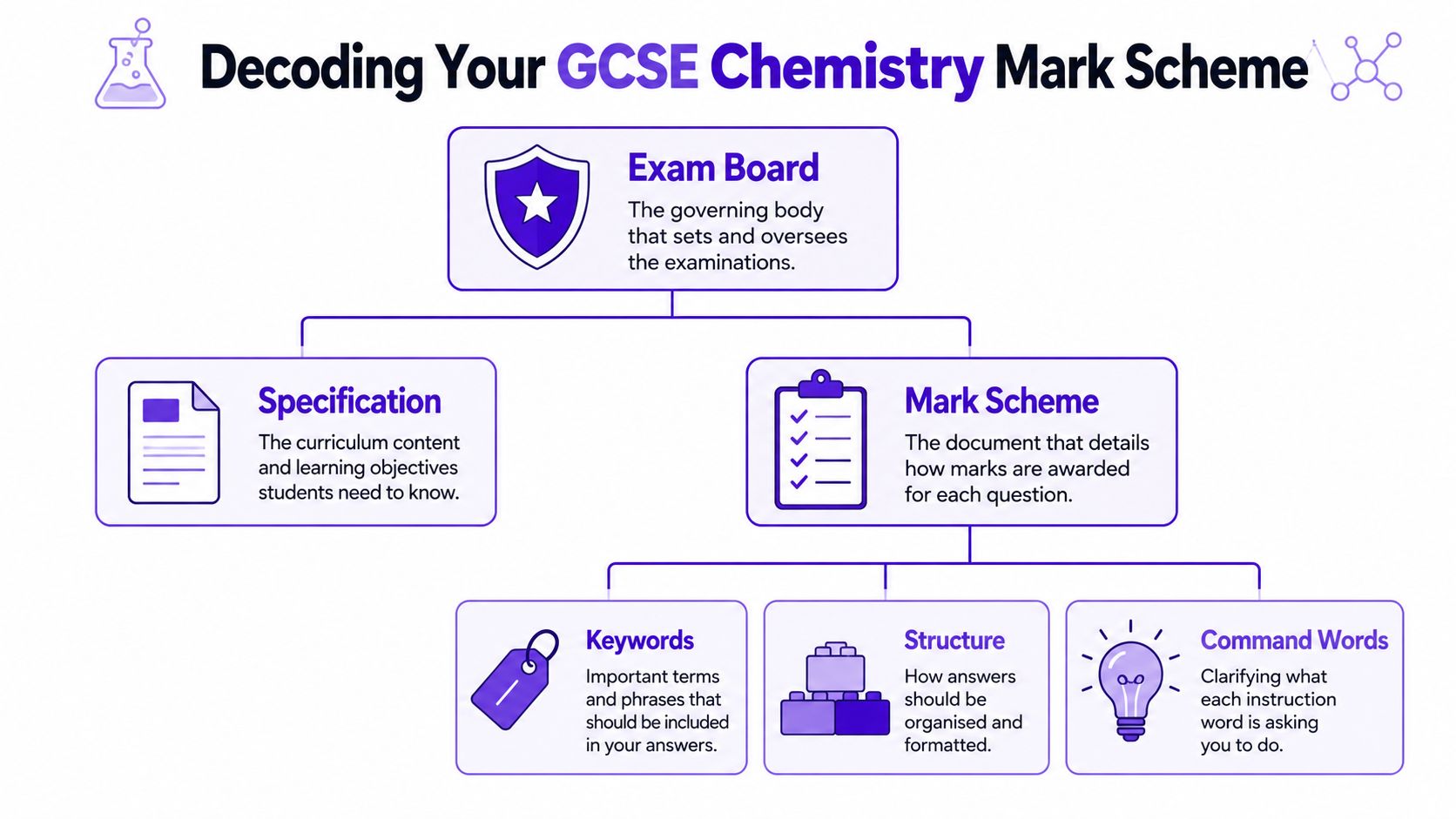
The specification is basically your revision map. It tells you what can be assessed and the language your exam board expects. If your school uses AQA, Edexcel, OCR, or WJEC, the exact ordering and wording may differ, but the principle is the same. Your practice should track the spec, not just whatever worksheet appears first in a search result.
Teachers already do this instinctively. Students should too.
A useful habit is to turn the specification into a checklist with three columns:
- Know it for facts, definitions, and required knowledge
- Can do it for calculations, graph reading, and practical method
- Can explain it for extended answers and “why” questions
That stops revision from becoming a pile of disconnected tasks.
Command words decide the shape of your answer
One of the easiest ways to throw marks away is to answer the wrong command word.
A short comparison helps:
| Command word | What it usually wants |
|---|---|
| Describe | What happens or what you observe |
| Explain | Why it happens, using chemistry reasoning |
| Evaluate | A judgement, supported with evidence or reasoning |
| Calculate | Working, method, units, final answer |
If a question says describe, don't drift into a long theory essay. If it says explain, don't just say what happened. Students often know the chemistry but mismatch the task.
Read the command word first, then underline the science topic, then decide the answer shape before you write anything.
That small pause saves a surprising number of marks.
Read the mark scheme like an examiner
Mark schemes aren't just for scoring yourself at the end. They tell you what the examiner is trained to reward.
Look for three things:
Keywords
These are the words that carry credit. If the mark scheme uses precise scientific language, your answer usually needs it too.Answer structure
Multi-mark questions often want points in a sequence, not a blob of ideas. Observation, reason, conclusion is a common pattern.Acceptable alternatives
Sometimes more than one phrasing works. Seeing that helps you avoid memorising one rigid sentence.
If you want a cleaner framework for understanding exam marking criteria, focus on the relationship between the specification, the command word, and the specific wording used in awarded answers. That's where marks are won.
Mastering the Hardest Questions Calculations and Practicals
The questions students fear most are usually the ones with the most method hidden inside them. Multi-step calculations. Required practicals. Rates of reaction. Titration-style setups. These are the questions where panic makes students skip steps.
That's why you need a routine.

How to break a calculation open
Don't start by hunting for an equation at random. Start by asking four things:
- What is the question asking for
- What values have I been given
- What unit is each value in
- What chemistry relationship connects them
This sounds basic, but it stops the classic mistake of reaching for a formula too early.
A good GCSE-style example from a worked chemistry walkthrough uses Mr = 192 and a mole quantity of 0.0125 to calculate a final mass of 2.4 g in a citric acid problem, showing how these questions train multi-step numerical reasoning rather than simple recall in this GCSE chemistry worked example video.
That example matters because it shows what examiners often reward. Not just the final number, but whether you can move logically from one step to the next.
A simple method for calculation questions
Try this order every time:
- Write down the target quantity.
- List the data from the question with units.
- Choose the relationship you need.
- Rearrange only if necessary.
- Substitute carefully.
- Check the unit on the final answer.
If you get stuck, ask yourself, “What intermediate value do I need first?” A lot of chemistry calculations are really two smaller calculations joined together.
Exam habit: Never do chemistry maths only in your head. Write each step. Even when you're confident.
That habit protects you when the pressure rises.
Practical questions reward method, not waffle
Practical-method questions feel annoying because students often know what the experiment is about, but not how to phrase the answer. Rates of reaction is the classic example.
For these questions, high-scoring answers usually do three things in order:
| Part of the answer | What to include |
|---|---|
| Measurement | State the method first, such as mass loss, gas collection, or the disappearing cross method |
| Control variables | Name what stays the same, such as temperature, concentration, or volume |
| Explanation | Link the trend to collision theory using the exact scientific idea |
For rates of reaction, top answers should state the measurement technique, identify control variables, and link changes to collision theory using the phrase more frequent successful collisions, as shown in AQA rates of reaction revision notes.
That phrase matters. “Particles move faster” isn't enough on its own. It sounds reasonable, but it doesn't finish the explanation in the way the mark scheme usually wants.
Students also forget reliability points. If data is collected over time, repeat the trial three times and calculate a mean. That's one of those details teachers say all year because it keeps appearing in mark schemes.
Use worked support when you're stuck on process
Some students don't need more questions. They need better support while they're learning how to solve them. If you're stuck on the reasoning behind a problem rather than the final answer, resources on solving chemistry homework problems can help you see how to unpack the method instead of just copying an answer.
And when you want exam-style sets arranged around actual paper format rather than random internet worksheets, using targeted GCSE Past Papers can make your practice more realistic.
This walkthrough format is useful if you want to hear the thinking behind difficult chemistry answers:
How to Design a Perfect Practice Session
Most students don't have a revision problem. They have a session design problem.
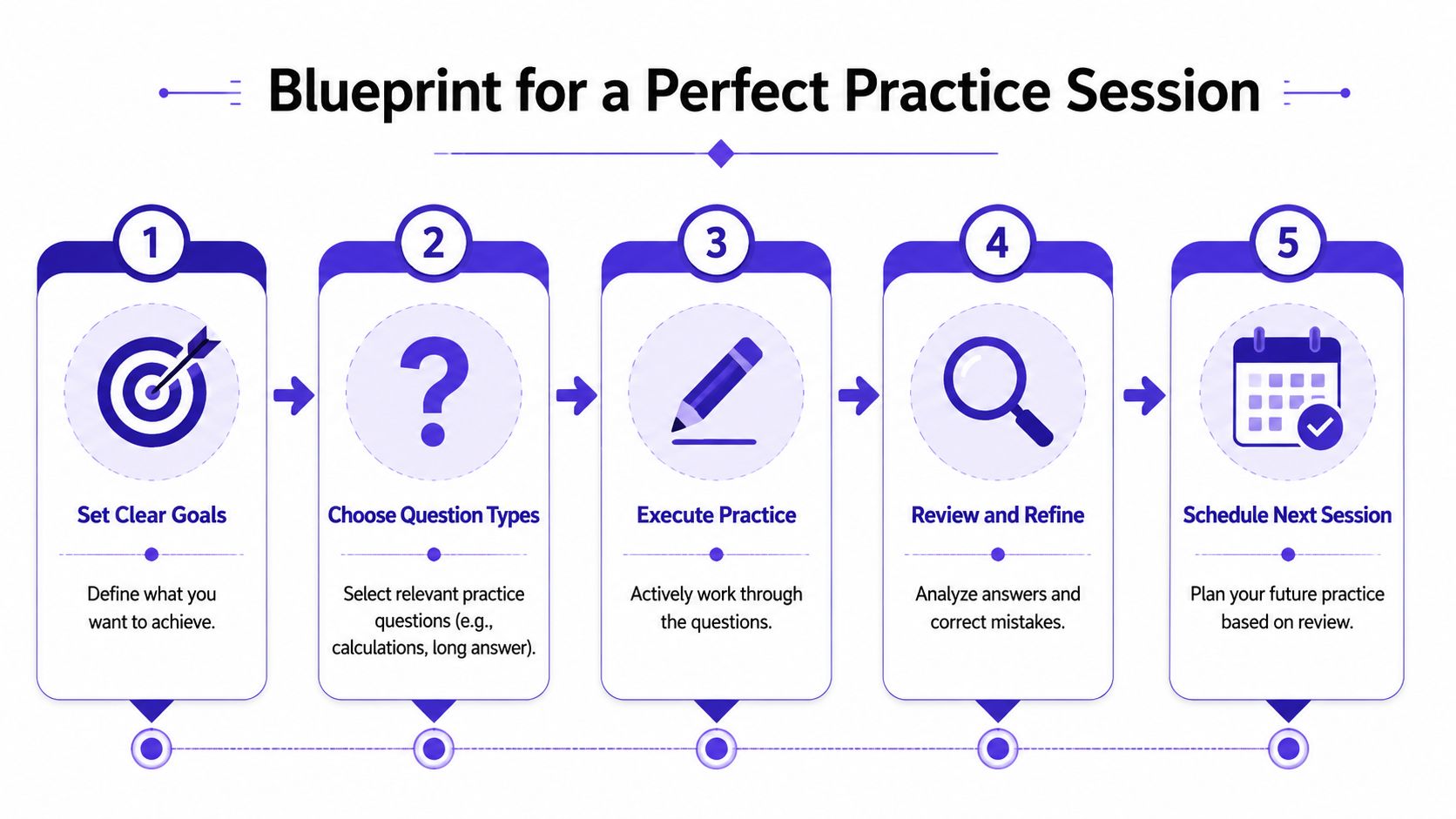
They sit down with good intentions, bounce between topics, do a few questions, check messages, then call it chemistry revision. A better session has a job. You should know whether you're training memory, method, speed, or exam stamina.
Match the session to the goal
Different practice formats do different things.
If you keep mixing everything together when you're weak on a topic, you can end up rehearsing confusion. If you only ever do isolated topic drills, you can struggle when the actual exam jumps between ideas.
A simple comparison helps:
| Revision goal | Better practice style |
|---|---|
| Learn or repair a weak topic | Focused topic block |
| Improve one skill, like calculations | Question set of the same type |
| Build flexibility | Mixed-topic practice |
| Build pace and stamina | Timed exam practice |
That's why a good week of revision usually includes both focused practice and mixed practice.
A session that works after school
You don't need an all-day study marathon. You need a session you'll repeat.
Try this pattern:
Start narrow
Pick one topic or one question type. “Quantitative chemistry” is still broad. “Moles from mass and Mr” is better.Work actively
Answer questions on paper. Don't just read them and think, “Yeah, I know that.”Review immediately
Mark the work while your thinking is still fresh.Finish with one fix
Rewrite one weak explanation, redo one calculation, or summarise one practical method.
Good revision sessions end with a correction, not just a score.
If you've got limited time, this matters even more. A short, deliberate session beats a longer distracted one.
When timed practice becomes important
Untimed practice is fine when you're learning. Timed practice matters when you're trying to perform.
At that point, use realistic conditions. Sit down, remove distractions, and answer a chunk of questions without stopping every minute to check. That's how you discover whether your knowledge survives pressure.
For students who want a digital version of that, Exam Practice for GCSE can be useful because it lets you rehearse exam-style conditions rather than only doing untimed revision tasks. The value isn't magic. It's the structure.
One warning. Don't make every session timed. If you're still trying to understand a method, timing yourself too early just teaches panic.
From Marking Your Work to Mastering the Content
The most important part of GCSE chemistry practice questions starts after you've answered them.
That's the bit students skip because it's less satisfying than ticking answers off. But marking is where improvement happens. Your raw score tells you where you are. Your review tells you how to move.
Don't just mark right or wrong
A cross isn't feedback. It's a flag.
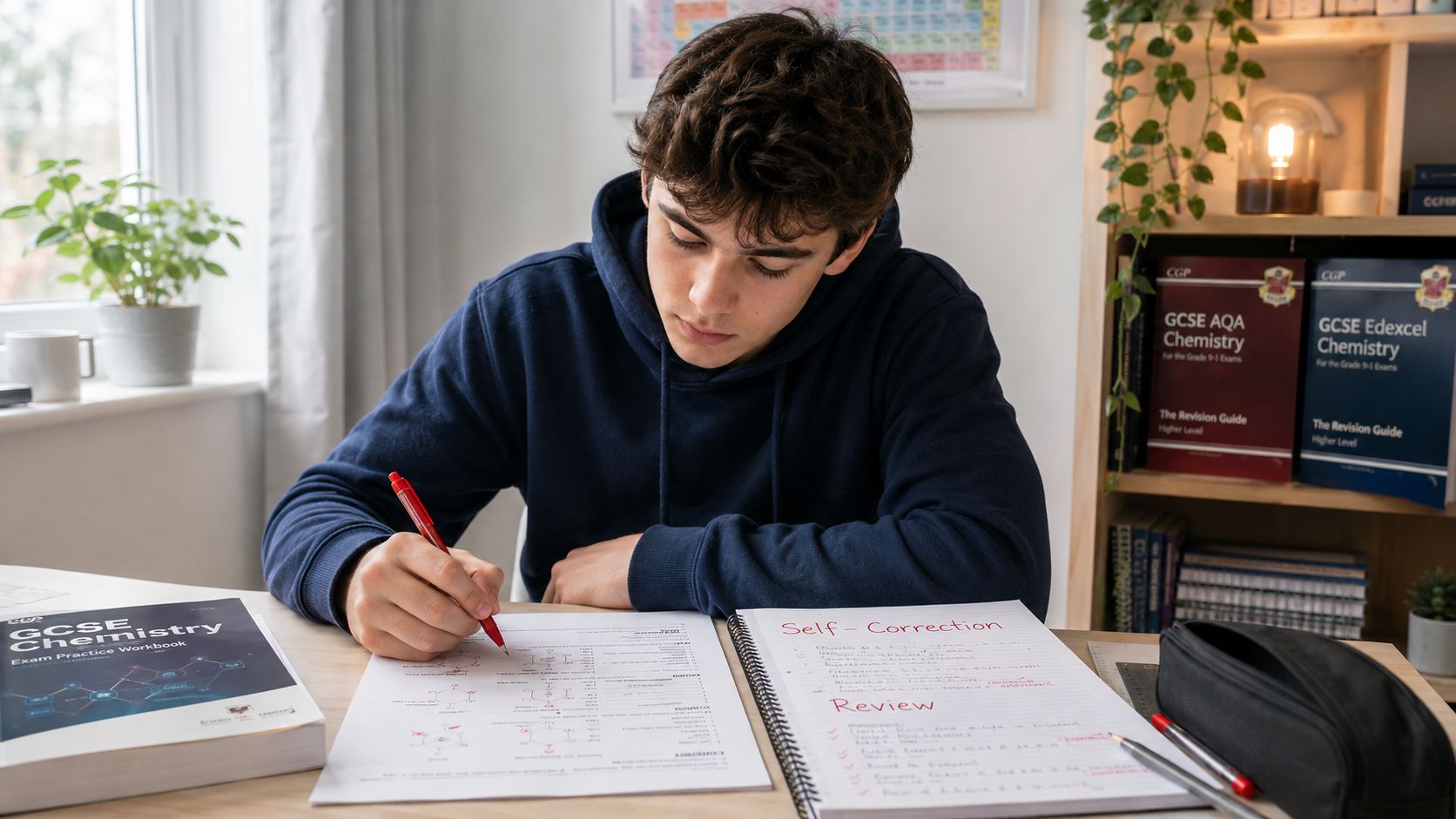
When you mark your work, classify every mistake. Most chemistry errors fall into one of these groups:
Knowledge gap
You didn't know the content.Method error
You knew the topic, but your steps were wrong.Language error
Your explanation was too vague or missed key wording.Question-reading error
You answered a different question from the one on the page.
That last one is more common than students think. Especially on explain questions.
Build a simple error log
You don't need a fancy spreadsheet. A page in a notebook works.
Use four headings:
| Question | What went wrong | Why it happened | Fix for next time |
|---|---|---|---|
| Mole calculation | Used wrong value | Rushed setup | Write known values first |
| Rates explanation | Too vague | Didn't use spec wording | Include collision phrase |
| Practical method | Missed control variable | Forgot structure | Use method, controls, explanation order |
That final column is the gold. “Revise topic” is too vague. “Always state units” or “name the control variables before the explanation” is much more useful.
Mark schemes reward precise language. If your answer sounds generally correct but not scientifically exact, that's often where the mark disappeared.
A major GCSE Chemistry pitfall is writing vague explanations such as “particles move faster” instead of specification-linked language like more frequent and successful collisions, and showing working matters because partial credit is often available for correct method even if the final answer is wrong, as highlighted in this exam-technique walkthrough.
Turn corrections into memory
A common mistake is correcting work once and never revisiting it. Then the same error comes back next week.
Instead, make your corrections active:
- Rewrite the answer without looking.
- Say the explanation out loud in full.
- Redo the calculation from scratch on a blank page.
- Return to the same error type later in the week.
That's how marking becomes learning.
Teachers often say students need to “learn from mistakes”, but that only happens when the mistake gets turned into a repeatable rule. If your note says, “I'm bad at calculations,” that's useless. If it says, “I forgot to convert before substituting,” that's actionable.
Your Path From Practice to Exam Confidence
You finish a set of chemistry questions, see a decent score, and still feel shaky about the actual exam. That gap matters. Confidence in GCSE Chemistry does not come from doing lots of questions. It comes from knowing how to read a question, spot the trap, and produce the kind of answer the examiner will credit under pressure.
That is why good practice has to do more than fill time. Each question should train a habit. You read the command word first. You separate a calculation into clear stages. You treat a practical question like a sequence you can reason through, rather than a paragraph you hope to remember. Then you mark your work to find the mistake behind the mistake.
Students often stop at the score. Examiners do not. They reward precise chemistry, clear working, and answers that match the wording of the mark scheme. If your revision only tells you whether you were right or wrong, it misses the part that improves your grade.
A better question to ask is, “What rule can I take from this?” One six-mark answer might teach you to mention control variables before results. One mole calculation might teach you to convert units before using the formula. One rates question might remind you that “particles move faster” is incomplete unless you link it to collisions. Small rules like these build reliable exam performance, in the same way repeated drills build muscle memory in sport.
If you want a structured way to practise that method, tools for Online Revision for GCSE can help if they match your specification and show clearly why an answer lost marks.
Keep the routine simple. Pick one weak area. Answer a short set of questions. Mark them carefully. Write down the rule each mistake teaches you. Return to the same question type a few days later and check whether the error has gone.
That is how confidence becomes real. It is no longer a feeling based on hope. It is the result of seeing a familiar question, knowing the steps, and trusting the method you have practised.
Ready to master this topic?
Practise with quizzes, blurt exercises and exam questions on MasteryMind.
7 days Premium · Then free forever · No card, no charge