GCSE Chemistry Required Practicals: A Complete Guide 2026
Are required practicals just the bit you did in the lab and then forgot about? That's the mistake a lot of students make, and it costs marks. In GCSE Chemistry, practicals don't stay in the lab. They come back in exam questions on methods, variables, observations, calculations, and evaluation.
That matters whether you're trying to drag a grade back up after a rough year or push for the top bands. Practical questions reward students who know what the method is doing, not just what the topic is called. If you can explain why a start line must be in pencil, why a solution is added drop by drop, or how to identify the dependent variable, you're already in a stronger position than many students who revise chemistry as a pile of flashcards.
The good news is that gcse chemistry required practicals are much more manageable once you stop treating them as random experiments and start treating them as a system. You need one official source for accuracy, one or two student-friendly explainers, and one place to practise turning knowledge into exam answers.
That's what this guide does. It doesn't just list the practicals. It reviews the most useful resources for AQA, Edexcel, OCR, and WJEC students, with a clear strategy for combining them. If you want practicals to become a source of marks instead of a revision panic, start here.
1. Chemistry Revision – GCSE & A-Level | MasteryMind
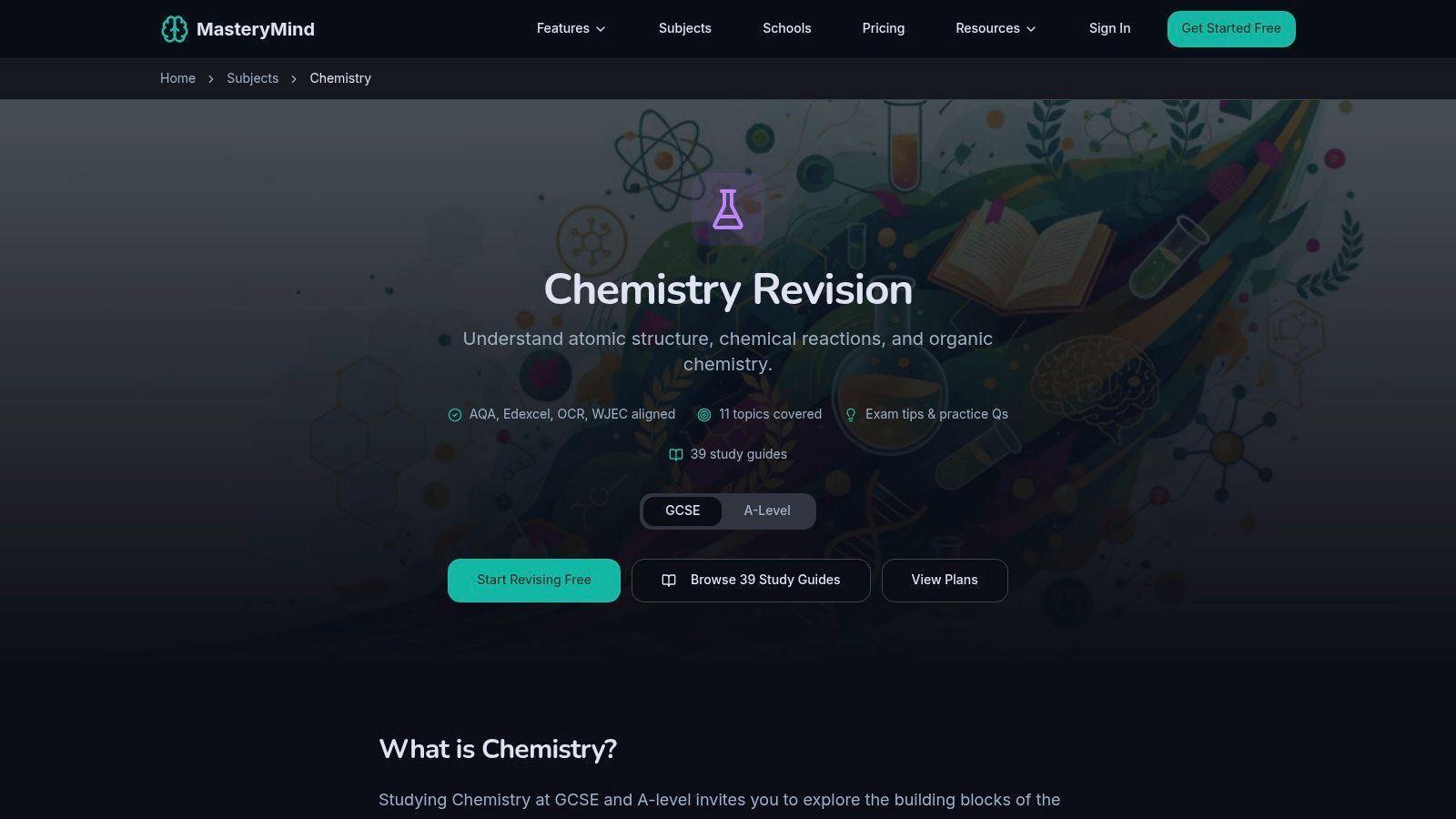
If your revision problem is, “I know the practical happened, but I can't answer the exam question on it,” MasteryMind is the strongest starting point in this list. The site is built around exam-board alignment, so you're not just reading chemistry content. You're practising the exact kind of thinking the paper wants.
That's especially useful for gcse chemistry required practicals, because these questions rarely reward vague memory. You need to describe methods with proper equipment, identify variables clearly, and explain why each step matters. MasteryMind is good at pushing you from recognition to actual written answers.
You can explore the broader Online Revision for GCSE platform first, then move into the chemistry hub when you want subject-specific practice.
Why it stands out
A lot of revision sites are fine for reading but weaker for correction. MasteryMind leans the other way. It's built for doing questions, getting feedback, and then fixing the exact weakness that lost the mark.
For practicals, that means it's useful when you keep making errors like these:
- Missing apparatus names: You write “heat the solution” instead of naming the beaker, Bunsen burner, evaporating basin, or glass rod.
- Blurry variable definitions: You know the experiment, but you don't state what is changed and what is measured.
- Weak method order: You include the right steps, but not in a sequence that would produce valid results.
Best for students who need structure
If you've fallen behind, adaptive practice helps because it stops revision becoming a giant random trawl through chemistry. If you're aiming high, the examiner-style feedback matters because it sharpens method writing and evaluation, not just recall.
The practicals angle is important here. MasteryMind explicitly covers required practical content, and the platform's exam-board-specific questioning means you're not revising in a vacuum. You're rehearsing the language and command words that appear in real assessments.
Practical rule: A strong practical answer reads like instructions another student could follow without guessing.
There's also a nice mix of tools. The voice-based Blurt Challenge works well for active recall on method steps, while the adaptive question flow is better for checking whether you can turn memory into marks. For teachers, this is the section that should reassure you the platform isn't just chemistry notes with an AI badge stuck on top. The focus is on exam method, specification fit, and feedback that points to what needs correcting.
Pros and limits
- Exam-board focus: It aligns with AQA, Edexcel, OCR, and WJEC, which makes it one of the few tools here that's useful beyond a single specification.
- Practical question training: It doesn't stop at content delivery. It helps students practise the exam answers tied to practical work.
- Feedback depth: AO breakdowns and examiner-style comments are valuable if you want to know why an answer is weak, not just whether it's wrong.
The main downside is simple. The deeper adaptive features sit behind Premium, so the best version is the paid one. It's also designed for UK exam boards, so it won't be the right fit for students studying outside that system.
Use it when you're past the “I've read the notes” stage and need to prove you can answer under exam conditions. That's where practical revision becomes real.
2. AQA GCSE Chemistry required practicals (official)
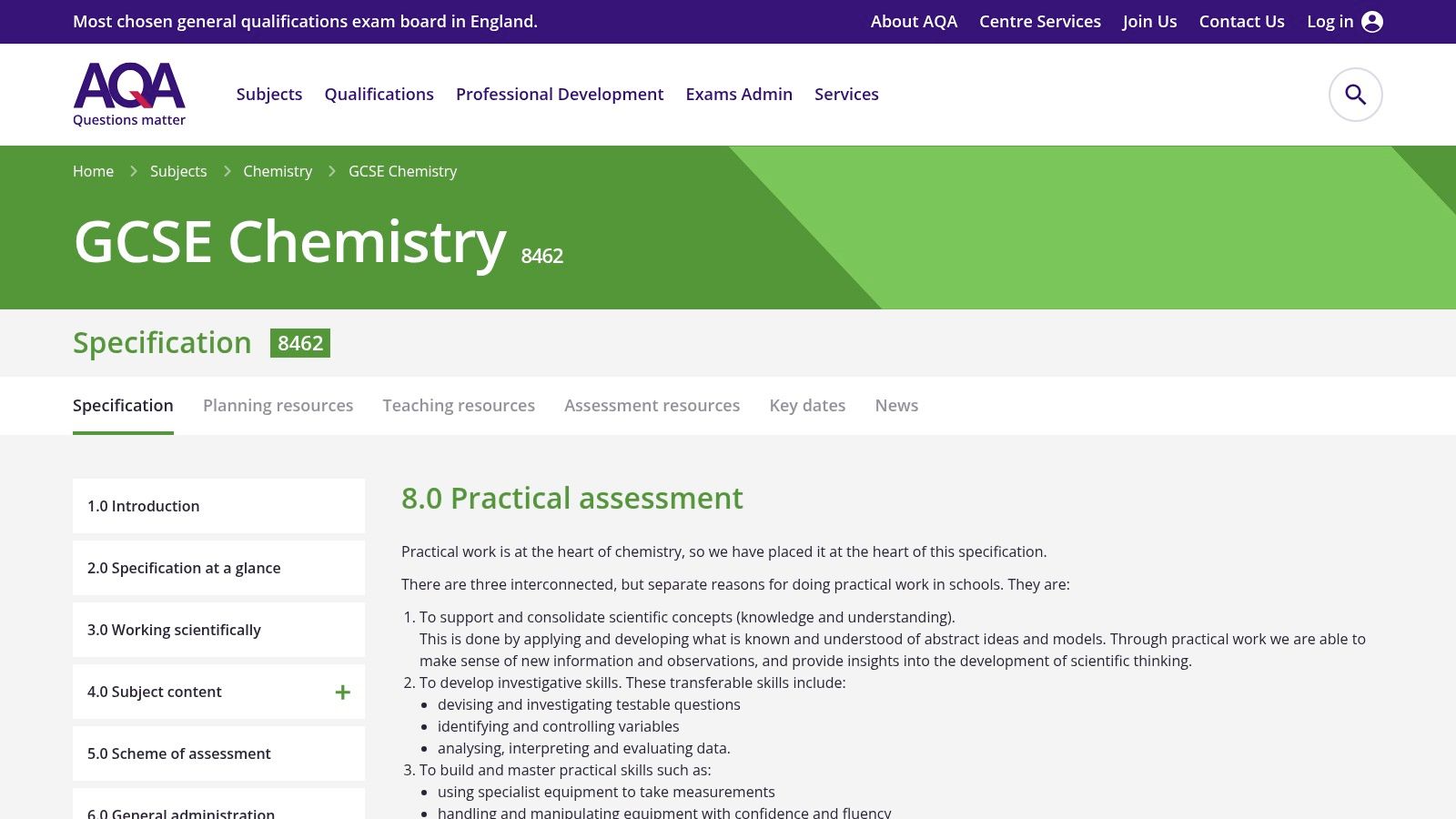
When students ask me which resource is essential, it's the official specification. Not because it's the easiest read. It isn't. But because it tells you exactly what AQA expects, using AQA's own wording.
According to the AQA GCSE Chemistry practical assessment page, there are exactly eight required practical activities across the course. That's the number you should build your revision around, not a half-remembered list from class notes.
What the official page clears up
The biggest strength of the official resource is accuracy. It shows how the practicals are split between the two papers and makes clear that some activities are marked “HT only”, including titration of a strong acid and strong alkali and ion testing for unknown compounds.
That matters because students often revise as if every chemistry student studies exactly the same practical content. They don't. Triple science students and combined science students don't have identical practical requirements, and AQA states that distinction directly.
A good next step after the specification is focused AQA GCSE exam preparation, especially if you want to turn official wording into exam questions rather than just reading the handbook.
Why teachers rate it, and students dodge it
Teachers trust the specification because it's the ground truth. Students dodge it because it can feel dry and technical. Both reactions are fair.
Use the official page for these jobs:
- Checking scope: Confirm whether a practical is core or tagged for Higher Tier only.
- Learning exact language: Match your terms to the specification, especially for apparatus and technique.
- Settling disputes: If your notes, a video, and a website all phrase something differently, the official wording wins.
Go to the official source when you need certainty, not comfort.
The limitation is obvious. It won't hold your hand through every method in student-friendly language, and it doesn't give you built-in quizzes or instant feedback. But that's not really its job. This is your anchor resource, the one you use to stop revision drifting into guesswork.
3. Save My Exams – Required practicals notes and questions (AQA GCSE Chemistry)
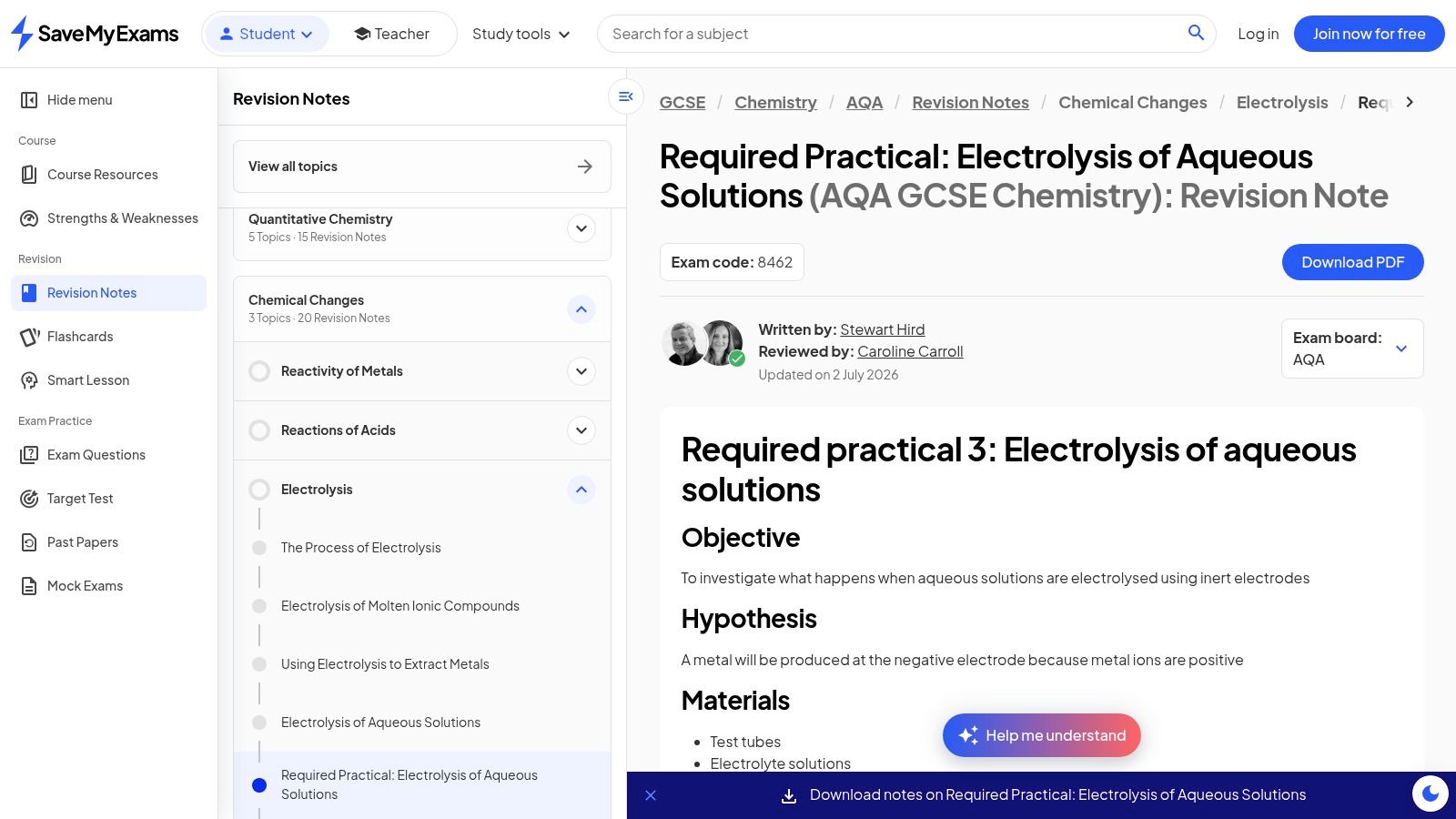
Save My Exams is where a lot of students go when the specification feels too dense and they want the practical translated into plain English. That's a fair use of it. The site is strong at turning formal chemistry content into cleaner notes with diagrams, typical observations, and exam-style prompts.
For required practicals, that matters because the exam often tests little details that vanish from memory first. You may remember “chromatography” as a concept, but not the exact setup points that make the method valid.
Where it helps most
The practical pages are useful after you've checked the official wording and want a more teachable version. They tend to break things into aim, apparatus, method, observations, and common question types, which suits self-study well.
This is the sort of resource I'd pair with active question practice. Read the note, close it, then try answering a practical method question from memory using Exam Practice for GCSE. That combination is much stronger than passive reading.
One especially important detail for Paper 2 practical work is that paper chromatography requires a start line drawn in pencil and the solvent level below the line, as highlighted in the verified practical guidance for this area. Save My Exams is handy because practical-specific pages make those technical details easier to revisit quickly.
Best use and biggest caution
Use Save My Exams when you want to tidy up understanding fast. It's especially useful the night you realise your class practical write-up isn't enough revision on its own.
Keep one caution in mind:
- Cross-check wording: It's a third-party revision site, so if a method detail seems different from the board language, go back to the specification.
- Don't rely on reading alone: Practical questions are written tasks. You need to practise writing full methods and evaluations.
- Expect some paywalls: Parts of the question bank and fuller support sit behind Premium.
The site works best as a bridge. It gets you from “I vaguely know this practical” to “I can explain what happens and why”. You still need exam-style practice to finish the job, but as a revision explainer, it's one of the more usable options.
4. Physics & Maths Tutor – AQA GCSE Chemistry required practicals notes
Physics & Maths Tutor is the emergency sheet resource. If you want a big, interactive learning journey, this isn't it. If you want a printable one-page reminder before a mock, it's excellent.
That's why so many students and teachers keep PMT in rotation. It strips the practical down to the points you're most likely to forget under pressure.
Why the format works
The one-page summary style is useful for practicals because method answers need precision, not waffle. You can annotate the sheet, add missing apparatus, and test yourself on the sequence.
Pairing PMT notes with GCSE Past Papers is a smart move. First learn the skeleton of the method from the sheet. Then answer a real-style question where you have to build the method back up into a full response.
Here's the catch. PMT is concise by design. That makes it fast, but it also means you may need another source when a teacher asks, “Why is that step necessary?” rather than “What comes next?”
A resource for speed, not depth
PMT excels in this regard:
- Last-minute refresh: Good before class tests, mocks, or after-school intervention.
- Printing and annotation: Useful for teachers building quick revision packs and for students who revise better on paper.
- Practical skills recap: Handy when you want the method and core skill in one glance.
Teacher view: PMT is often at its best when used as a summary sheet after proper teaching, not as the only teaching.
The weakness is the same as the strength. It's brief. That's perfect for consolidation, but not enough if the practical never really made sense the first time round. Use it for tightening revision, not building the whole topic from scratch.
5. Cognito – “AQA GCSE Chemistry required practicals: All 8 explained”
Cognito is one of the most student-friendly entries here. If you want a cleaner, more readable explanation of all the AQA chemistry practicals in one place, it does that job well. The tone is accessible, and that matters when revision panic has already kicked in.
Its “all explained” style is useful because practicals can feel scattered across different chemistry topics. Cognito pulls them together so students can see the whole map.
Why it suits mixed audiences
Students like Cognito because it feels manageable. Teachers often tolerate it because the explanations are generally direct and tied to what students need to know, rather than getting lost in extra chemistry detail.
A practical point that often trips students up is assessment style. Method questions on required practicals are typically worth 6 marks, with full-credit responses needing clear apparatus, accurate measurement detail, and unambiguous variables, based on the verified assessment guidance from this practical methods explanation video. That's exactly the kind of exam reality a student-friendly guide needs to reinforce.
Good refresher, not final authority
Cognito works best when you already know you need a reset, not a deep dive. For example, if you've revised electrolysis and water purification separately and now need one pass through the required practicals as a set, it's a useful reset tool.
Its strengths are easy to spot:
- Bite-sized explanation: Good for students who switch off when a resource gets too wordy.
- Coverage in one place: Useful for seeing the practicals together rather than hunting through topic pages.
- Video-led support: Helpful if you remember demonstrations better than text.
The trade-off is depth. You still need the official wording for exact scope and a stronger question platform for exam drilling. Cognito is the refresh resource. It gets the ideas back into your head quickly, which is often the first battle.
6. Chemistry Made Easy – The Lab: “All 8 GCSE Chemistry Required Practicals”
Chemistry Made Easy takes the one-page-summary idea and gives it a bit more breathing room. It's the kind of page you'd use when you want all the practicals gathered together but explained with enough warmth that it doesn't feel like reading a checklist.
This makes it useful for students who know they should revise required practicals, but keep putting them off because they seem fiddly and fragmented.
A good refresher before questions
The value here is simplicity. The methods, reminders, and exam tips are laid out in a way that's easy to scan, so it works well for a fast recap before you attempt practice questions.
That said, keep your chemistry teacher brain switched on while using it. Third-party summaries are useful, but they shouldn't replace the specification for exact wording or scope.
Some of the highest-value practical revision is just learning which tiny detail makes the method valid.
One of those tiny details appears in titration. Verified assessment guidance states that, in this kind of quantitative practical, students must measure 25 cm³ of solution and add the alkali drop by drop until the first permanent colour change is seen, with Higher Tier students also expected to link practical measurements to concentration calculations in mol/dm³ and g/dm³ through the same verified practical methods source cited earlier. If a summary page reminds you of that sequence clearly, it's doing useful work.
Who should use it
Chemistry Made Easy is a strong option for:
- Students rebuilding confidence: The tone is less intimidating than official material.
- Quick revision sessions: Good for short bursts after school or before homework.
- Method reminders: Helpful when you need to remember the order and purpose of steps.
Its limitation is depth. You won't get the same detail as a full handbook or workbook, and you won't get auto-marked practice. But for a student-friendly refresher page, it does its job well.
7. Collins – AQA GCSE Chemistry (9–1) Required Practicals Lab Book (print)
A print workbook still has a place, especially for practical revision. In fact, it can be one of the best formats for it. Practical questions reward students who can write methods, log variables, record observations, and evaluate procedure. A lab book forces you to do exactly that with a pen in your hand.
The Collins lab book is appealing because it feels like proper schoolwork in the best sense. It isn't trying to entertain you. It's trying to make you write down the parts of a practical answer that students usually skip.
Why the workbook format helps
A lot of students think they know a practical because they can recognise it on a screen. Then they sit an exam, and suddenly they can't produce a coherent method. A workbook exposes that weakness quickly.
This book is especially helpful for training the written habits examiners look for:
- Variables and results: You practise recording independent and dependent variables instead of leaving them implied.
- Evaluation language: You get used to commenting on errors, improvements, and valid outcomes.
- Common mistakes: A print reminder can be surprisingly effective for recurring slips.
That lines up well with practical assessment expectations. Verified guidance states that full-mark method answers need explicit equipment and clear measurement detail, and that practical work should involve developing a hypothesis rather than just copying a recipe, based on the same practical methods explanation resource set referenced in the verified data. A workbook format naturally supports that more deliberate style of thinking.
Best for class use and serious home revision
Teachers will probably like this more than students do at first glance, and that's usually a sign a workbook has substance. It gives structure. It creates a record. It makes revision visible.
For students, the appeal is different. If you're the kind of person who revises better by writing, highlighting, and physically tracking progress, this is more useful than another tab open on your laptop. The obvious downside is that it's AQA-specific and print-based, so it won't give you analytics, adaptive practice, or instant marking. But if your practical answers are messy, vague, or incomplete, a workbook can be exactly the reset you need.
7-Resource Comparison: GCSE Chemistry Required Practicals
| Item | Implementation / Complexity 🔄 | Resource requirements ⚡ | Expected outcomes ⭐ | Ideal use cases 💡 | Key advantages 📊 |
|---|---|---|---|---|---|
| Chemistry Revision, GCSE & A‑Level (MasteryMind) | Low user setup; high platform complexity (adaptive AI) | Internet, device; free tier available, Premium for full features | ⭐⭐⭐⭐ Improved exam technique, AO‑targeted progress and long‑term retention | UK GCSE/A‑Level revision pathways; teacher-led exam planning | AI adaptive practice, examiner‑style feedback, exam‑board alignment |
| AQA GCSE Chemistry required practicals (official) | Very low, static authoritative documents | Minimal; free downloadable handbook and PDFs | ⭐⭐⭐⭐⭐ Accurate alignment with assessment expectations (official wording) | Authoritative reference for teachers and curriculum planning | Official methods, apparatus lists, skill‑to‑assessment mapping |
| Save My Exams – Required practicals notes & questions | Low, straightforward site navigation | Internet; freemium (some worked solutions and Q banks behind paywall) | ⭐⭐⭐ Good targeted practice and worked solutions when unlocked | Self‑study and targeted practice after consulting the official spec | Clear practical write‑ups, exam‑style questions, student popular |
| Physics & Maths Tutor – practicals notes | Very low, downloadable one‑page PDFs | Free, printable PDFs; minimal tech needed | ⭐⭐ Quick recall and concise revision aids | Last‑minute revision, printable handouts for class/home use | Free, concise one‑page summaries; easy to annotate and print |
| Cognito – “All 8 explained” | Low, article + video format | Free video‑led content; some school‑targeted premium tools | ⭐⭐ Student‑friendly explanations and examiner tips (variable depth) | Bite‑sized refreshers and pairing with the official spec | Readable summaries, examiner focus, supportive videos |
| Chemistry Made Easy – The Lab | Low, consolidated web guide | Free web pages; easy to access on any device | ⭐⭐ Useful quick refresher before practice | One‑stop refresher prior to attempting exam questions | Student‑friendly language, exam tips, integrated revision links |
| Collins – AQA Required Practicals Lab Book (print) | Low, print workbook format | Low‑cost print purchase; no digital analytics | ⭐⭐ Helps practical recording and exam‑style evaluation skills | Classroom practicals, structured home lab records and revision | Affordable, structured record pages, exam‑style practice prompts |
Your Action Plan: From Panic to Practical Perfection
Don't just read about the practicals. Build a system for them. That's how you turn gcse chemistry required practicals from a weak spot into a reliable source of marks.
Start with the official specification or handbook for your exam board. For AQA students, that matters because the official document tells you the exact required practicals, shows where the paper split is, and makes clear where triple science and combined science differ. If there's ever a clash between your class notes, a website summary, and an online video, trust the awarding body first.
Then translate that official wording into something you can revise from. Save My Exams, PMT, Cognito, and Chemistry Made Easy all help in slightly different ways. Save My Exams is good for clearer notes and structured explanations. PMT is best when you want a fast printable summary. Cognito is strong for student-friendly walkthroughs. Chemistry Made Easy works well as a one-page refresher before you do questions.
After that, write. That's the stage students skip. Practicals aren't mastered when you've read the method. They're mastered when you can write the method, name the apparatus, define the variables, explain how data is measured, and spot what would make the result invalid. If you have the Collins lab book, use it for exactly that. Fill in results sections, evaluation points, and method steps properly. Don't leave them half-done.
Then test the whole thing under exam pressure. That's where MasteryMind becomes the most useful tool in this list. Its exam-board-specific practice, examiner-style feedback, and adaptive questioning make it well suited to practical revision because practical questions aren't about vague familiarity. They're about precision. You need to know whether your answer would score.
A simple routine works well:
- Anchor with the official spec: Learn the exact scope, language, and practical expectations.
- Clarify with notes: Use a student-friendly site to make the method and purpose of each practical stick.
- Consolidate with written practice: Complete exam-style questions, variable work, and evaluations.
- Master with AI feedback: Use a platform that marks against real exam logic and shows where your answer drops marks.
If you're cramming, this process stops revision becoming random. If you're aiming for the top grades, it gives you the level of detail that separates decent answers from high-scoring ones. Either way, practicals aren't a side topic. They're one of the most revisable parts of the course because the skills repeat. Method. Variables. Measurements. Validity. Evaluation. Once you train those properly, marks follow.
If you want one place to turn required practical revision into actual exam performance, try MasteryMind. It's built for UK exam boards, covers chemistry practical content clearly, and gives you examiner-style feedback that helps you fix the exact mistakes losing marks.
Ready to master this topic?
Practise with quizzes, blurt exercises and exam questions on MasteryMind.
7 days Premium · Then free forever · No card, no charge