Group 1 Metals: Your Ultimate GCSE & A-Level Guide (2026)
You open a chemistry paper, spot a question on Group 1, and your brain does one of two things. Either it calmly thinks, “one outer electron, loses it easily, reactivity increases down the group,” or it starts mixing up sodium, potassium, and whatever on earth a reducing agent is.
That gap matters because group 1 metals look easy at first, but examiners love the parts students only half understand. If you only memorise the basic trend, you'll miss marks on the “explain” questions. If you understand the reason behind the trend, you can handle both GCSE recall and the more awkward A-Level twists.
Meet the Alkali Metals An Introduction
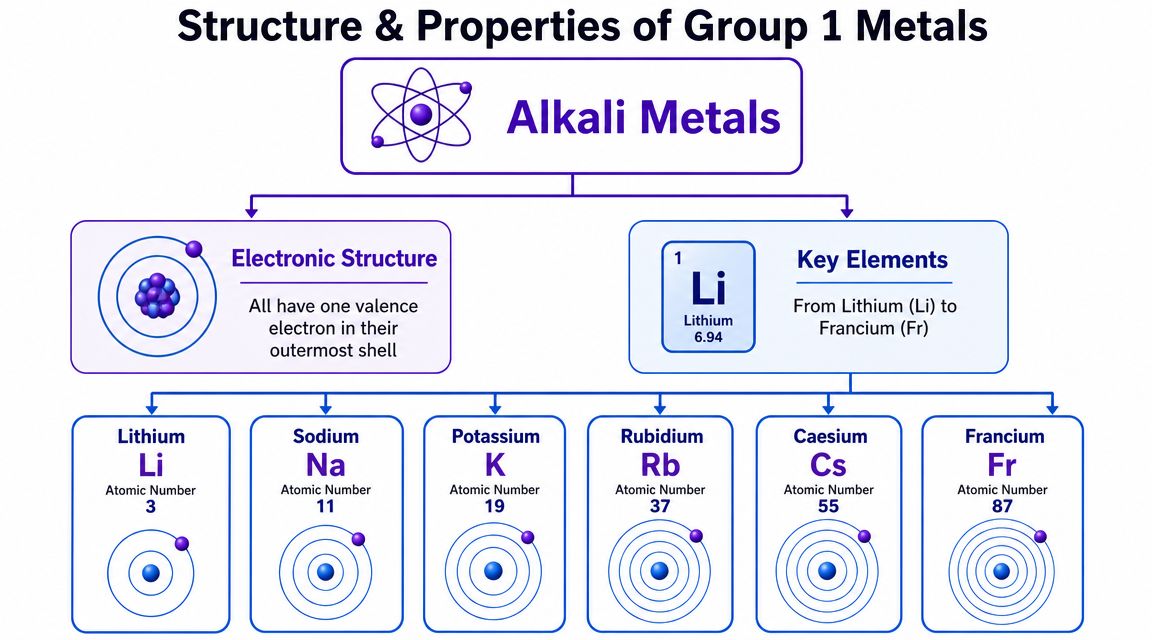
Group 1 metals are called the alkali metals. They sit in the first column of the periodic table and include lithium, sodium, potassium, rubidium, caesium and francium. At GCSE, you'll mostly meet lithium, sodium and potassium. At A-Level, you're more likely to be asked to explain their behaviour in more depth.

The reason they matter is simple. They're one of the clearest places where structure explains properties. If you can answer “what do these atoms look like?” you can usually answer “why do they react like that?”
Students often get stuck because they revise Group 1 as a list:
- soft
- shiny when cut
- stored under oil
- react with water
That list helps, but it won't carry you through a six-mark explanation.
Practical rule: If an exam question says explain, don't stop at the trend. Link the trend to electron arrangement, distance from the nucleus, and how easily the outer electron is lost.
If you're checking a tricky homework answer and want to compare your thinking with a worked response, an AI chemistry homework solver can be useful for spotting where your explanation is too vague. For wider subject support, you can also browse revision topics.
Structure and Physical Properties of Group 1 Metals
Every Group 1 metal has one electron in its outer shell. That single fact explains nearly everything.
Think of that outer electron like a loose jacket. The atom can keep it on, but not very securely. It's much easier to take off than if the atom had a nearly full outer shell and wanted to hold on tightly. Group 1 metals react by losing that one outer electron and forming a 1+ ion.
What they all have in common
These metals share several physical properties that show up again and again in exam questions.
- Softness: They're soft enough that the more familiar ones, such as lithium, sodium and potassium, can be cut.
- Shiny surface when freshly cut: The bright surface quickly dulls because it reacts with oxygen in the air.
- Low melting points compared with many other metals: Their metallic bonding is weaker than in many transition metals.
- Low density: Some of the best-known Group 1 metals are less dense than water.
- Stored under oil: This stops them reacting with oxygen and water vapour in the air.
Students sometimes learn those facts separately and miss the connection. These metals don't behave this way by accident. They have relatively weak metallic bonding because each atom contributes just one outer electron to the delocalised “sea” of electrons.
Why weak metallic bonding matters
In metals, positive ions are held together by attraction to delocalised electrons. In Group 1, that attraction is weaker than in metals that contribute more electrons per atom. That helps explain why they're softer and have lower melting points than many metals students are used to.
A short way to say it in an exam is shown below.
| Property | Simple reason |
|---|---|
| Soft | Weaker metallic bonding |
| Lower melting point | Less energy needed to overcome the bonding |
| Reactive | Outer electron is easy to remove |
| Forms +1 ions | Only one outer electron is lost |
A lot of students also confuse electronic structure with electron configuration notation. At GCSE, saying “they all have one electron in the outer shell” is often enough. At A-Level, you may need to be more precise, but the core idea is still the same.
If bonding itself feels shaky, Maeve's AI summary on chemical bonding can help you refresh the basics before coming back to Group 1.
A quick visual recap helps here:
If you're studying beyond GCSE and want broader support across topics, Online Revision for A-Level can help organise the bigger picture.
Explaining the Reactivity Trend Down the Group
The textbook rule is familiar. Reactivity increases down Group 1. For GCSE, that's the headline. For top marks, you need the reason.
Why reactivity increases
As you go down the group, atoms have more electron shells. That means two important things happen.
First, the outer electron is further from the nucleus.
Second, the inner shells create more shielding. In plain English, the positive pull of the nucleus doesn't affect the outer electron as strongly because inner electrons get in the way.
So even though the nucleus has more protons lower down the group, the outer electron is also further away and more shielded. The result is that the attraction between nucleus and outer electron becomes weaker overall. That makes the electron easier to lose.
This is where ionisation energy comes in. Ionisation energy is the energy needed to remove an electron from an atom. Lower ionisation energy means the atom loses its electron more easily. Group 1 metals get more reactive down the group because their outer electron is easier to remove.
When an examiner asks why potassium is more reactive than sodium, “it is lower down the group” is not enough. You need the chain: larger atomic radius, more shielding, weaker attraction, easier electron loss.
The wording that gets marks
A strong exam answer often sounds something like this:
- State the trend: potassium is more reactive than sodium.
- Give the structural reason: potassium has an extra electron shell.
- Explain the consequence: the outer electron is further from the nucleus and more shielded.
- Finish the logic: the attraction is weaker, so the electron is lost more easily.
That's the difference between a basic answer and one that collects the explanation marks.
The part most revision guides skip
Here's the subtle point that catches A-Level students. The trend is not perfectly simple in every context. While reactivity with water increases down the group, lithium is the strongest reducing agent and sodium is the weakest according to the chemistry explained in this alkali metals reference.
That sounds wrong at first, because students often assume “most reactive with water” must mean “strongest reducing agent.” They are related ideas, but they are not identical.
A reducing agent gives away electrons. Group 1 metals all do that, but the overall stability of the products also matters. For lithium, the behaviour is influenced not just by ionisation energy but also by hydration enthalpy. That's why A-Level questions sometimes reward students who go beyond the simple trend and explain the full energy picture.
Examiner mindset: GCSE usually rewards the simple down-the-group explanation. A-Level may reward you for spotting where the simple story needs refining.
If you're aiming high, remember this distinction:
- Reaction with water trend: generally increases down the group.
- Reducing power trend: not perfectly monotonic.
That's exactly the sort of nuance that separates memorised chemistry from understood chemistry.
Key Reactions of Alkali Metals You Must Know
This is the material students often think they know until they try to write the equations from memory. Don't leave that to luck. Learn the pattern.
Reaction with water
Group 1 metals react with water to produce a metal hydroxide and hydrogen gas.
The general equation is:
2M + 2H₂O → 2MOH + H₂
For specific examples:
- Lithium: 2Li + 2H₂O → 2LiOH + H₂
- Sodium: 2Na + 2H₂O → 2NaOH + H₂
- Potassium: 2K + 2H₂O → 2KOH + H₂
The observations matter just as much as the equation.
| Metal | Typical observation |
|---|---|
| Lithium | Floats, fizzes, moves slowly |
| Sodium | Floats, fizzes more strongly, melts into a ball and moves quickly |
| Potassium | More vigorous, may ignite with a lilac flame |
Students often write “it explodes” for all of them. That's too lazy for an exam answer. Use observations that fit the specific metal.
Reaction with oxygen
Group 1 metals also react with oxygen in air. That's one reason they tarnish quickly after being cut. At GCSE, the safest point is that they form metal oxides.
Examples:
- Lithium: 4Li + O₂ → 2Li₂O
- Sodium: 4Na + O₂ → 2Na₂O
- Potassium: 4K + O₂ → 2K₂O
At higher levels, you may also meet the idea that heavier Group 1 metals can form different oxygen compounds such as peroxides and superoxides. If your course expects that, make sure you know whether the question wants a basic oxide answer or a more advanced one.
Reaction with halogens
Group 1 metals react with halogens to form ionic salts.
Examples:
- 2Na + Cl₂ → 2NaCl
- 2K + Br₂ → 2KBr
- 2Li + F₂ → 2LiF
These reactions are usually vigorous because the metal atom wants to lose one electron and the halogen atom wants to gain one. It's a very good match.
A fast memory trick is this. Group 1 metals make +1 ions. Halogens make -1 ions. So the formula of the salt is usually in a simple 1:1 ratio, such as NaCl or KBr.
What examiners want you to say
If a question asks for both observations and explanations, don't merge them into a muddle.
Write them separately:
- what you see
- what forms
- why it gets more vigorous
That keeps your answer organised and stops you forgetting easy marks.
Common slips include:
- writing NaO instead of Na₂O
- forgetting hydrogen is H₂
- missing balancing
- saying the metal “disappears” instead of saying it reacts to form a hydroxide solution
Clear chemistry beats dramatic wording every time.
Uses Extraction and Strategic Importance
A lot of students wonder whether Group 1 is just another topic to memorise and forget. It isn't. These metals matter because their chemistry makes them useful.
Everyday and industrial uses
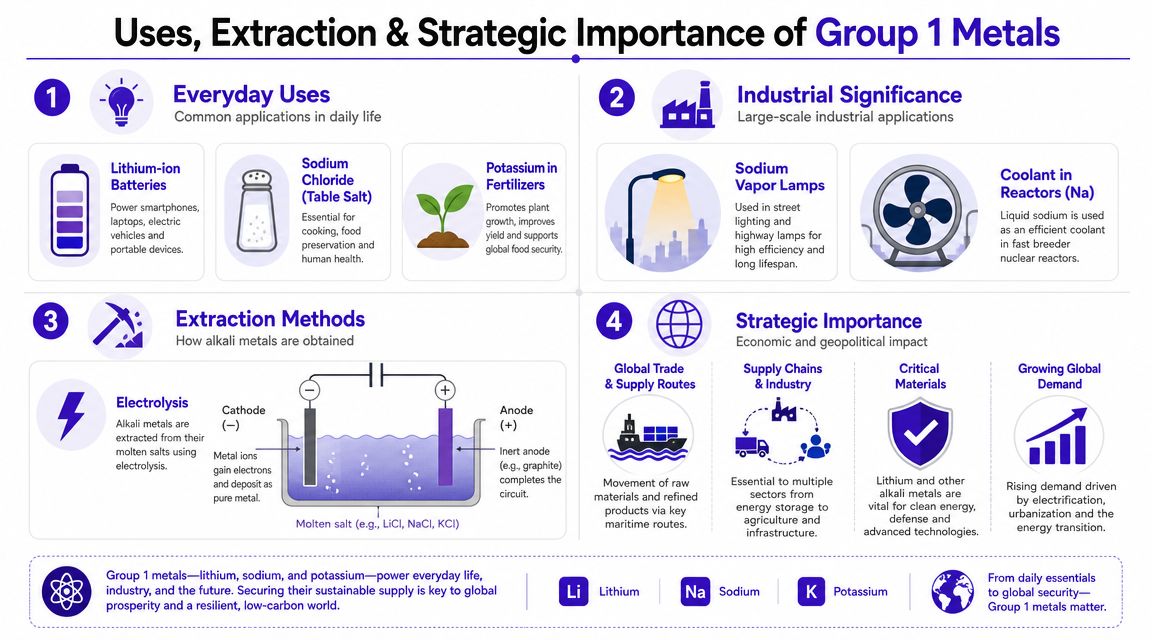
You'll come across examples like these in lessons and exam questions:
- Lithium: used in batteries
- Sodium compounds: used widely in industry and everyday chemistry
- Potassium compounds: important in fertilisers
- Caesium: used where very precise timing matters, such as atomic clocks
The key idea is that uses come from properties. Lithium is light and useful in battery chemistry. Sodium and potassium compounds are chemically important because they form stable ionic substances.
Why extraction is difficult
You can't extract Group 1 metals by heating them with carbon in the simple way used for less reactive metals. They are too reactive. If they're in a compound, they strongly prefer to stay there.
That's why they're usually extracted by electrolysis of molten salts. Electricity forces the ions to gain electrons and become atoms again. Students often remember the method but forget the reason. The reason is always the same. Their reactivity means chemical reduction is difficult, so electrical energy is used instead.
Why lithium matters so much in the UK
Lithium is the Group 1 metal with the biggest modern profile. Its strategic importance is tied to batteries, energy storage and transport. In the UK, battery electric vehicle registrations reached 382,100 in 2024, highlighting lithium's growing importance for energy security and the move away from fossil fuels, as noted in this UK-relevant lithium discussion.
That doesn't just make lithium a “batteries” fact for revision cards. It turns it into a useful example of how school chemistry links to supply chains, recycling and national policy.
Teachers often want students to make this link properly:
- Chemistry link: lithium readily forms ions and is useful in battery systems.
- Economic link: demand matters because batteries matter.
- Strategic link: supply, extraction and recycling all become important.
You don't need invented statistics to make that point. The chemistry already gives you the logic.
Answering Exam Questions and Avoiding Common Mistakes
Knowing the content is one thing. Writing it under pressure is another.
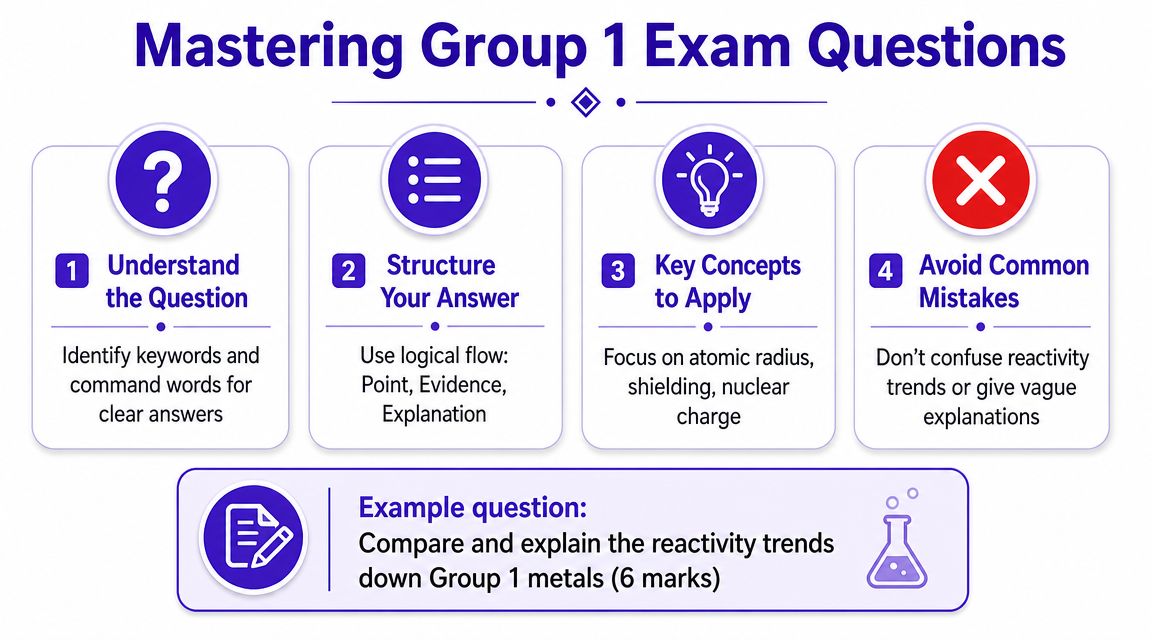
A common question is something like: Compare and explain the reactivity of sodium and potassium with water. Students usually know part of the answer, but they don't always package it in the way mark schemes reward.
A strong answer structure
Try this order.
Start with the comparison
Potassium is more reactive than sodium.Add observations
Potassium reacts more vigorously with water. Sodium fizzes and moves around on the surface. Potassium reacts faster and may ignite with a lilac flame.Explain using atomic structure
Potassium has one more electron shell than sodium. Its outer electron is further from the nucleus and more shielded by inner electrons.Finish with the key chemistry phrase
The attraction between the nucleus and the outer electron is weaker, so potassium loses its outer electron more easily.
That answer is much better than writing a paragraph that jumps randomly between flames, shells, and equations.
What a marker is looking for
A marker usually wants to see three things:
- knowledge of the trend
- accurate observations
- a full causal explanation
If one of those is missing, the answer often stalls in the middle mark range.
“More reactive because it is further down the group” sounds like chemistry, but it doesn't explain anything. Always say why being lower matters.
Mistakes that cost marks
Here are the big ones.
- Using vague language: “Potassium reacts more because it is bigger” is incomplete. Bigger in what way? Say the outer electron is further from the nucleus.
- Forgetting shielding: This is one of the easiest explanation marks to lose.
- Writing wrong formulas: Sodium oxide is Na₂O, not NaO.
- Leaving equations unbalanced: Even if the products are correct, unbalanced equations can lose credit.
- Confusing reducing agent with reaction speed: This catches stronger students because it feels like the same idea, but it isn't.
- Describing instead of explaining: “It fizzes a lot” is an observation, not an explanation.
A simple exam habit helps. Underline the command word in your head:
- describe means what happens
- explain means why
- compare means similarities and differences
If you're building timed technique, Exam Practice for A-Level is useful because it keeps you focused on answering in exam language rather than just reading notes.
Your Quick Revision Checklist for Group 1 Metals
If the exam is close, this is the short version you should be able to recall without notes.
The must-know points
- Group identity: Group 1 metals have one electron in the outer shell.
- Ion formed: They lose that electron to form 1+ ions.
- Physical properties: They are soft, reactive, and have relatively low melting points compared with many other metals.
- Storage: They're kept under oil because they react with air and moisture.
- Trend down the group: Reactivity increases down the group because the outer electron is further from the nucleus and more shielded.
- Key reaction with water: metal + water → metal hydroxide + hydrogen
- Key reaction with halogens: metal + halogen → ionic salt
- Extraction: obtained by electrolysis because they are too reactive for simpler extraction methods
The high-grade reminder
Don't let the simple trend trap you. At A-Level, you may need to recognise that the story is more nuanced than “down the group means more reactive in every possible sense.”
If you can explain reactivity using distance, shielding, and attraction, you're already writing better answers than most rushed revision guides prepare students for.
For last-minute retrieval practice, using GCSE Past Papers is one of the best ways to turn this checklist into actual marks.
If you want revision that feels closer to an exam than a pile of disconnected notes, MasteryMind is built for UK learners preparing for GCSEs and A-Levels. It gives you specification-aligned practice, examiner-style feedback, and a clear way to turn chemistry knowledge into better exam answers.
Ready to master this topic?
Practise with quizzes, blurt exercises and exam questions on MasteryMind.
7 days Premium · Then free forever · No card, no charge