History Source Analysis: A Guide to Ace Your Exams
You know the feeling. You open the paper, turn to the source question, and suddenly a cartoon, speech extract, or official report starts staring back at you like it was designed to ruin your grade.
Most students don't fail source questions because they know nothing. They fail because they panic, describe the obvious, and forget that history source analysis is a method, not a vibe. Examiners aren't looking for mystical insight. They want disciplined thinking on the page.
That's good news. It means you can train it. If you're trying to rescue your grade, there's a way back. If you're aiming for the top bands, the difference usually comes down to one thing: turning smart observations into sharp, exam-ready paragraphs.
That Sinking Feeling When You See the Source
A student sees a 1930s political cartoon. There's a grinning politician, a pile of money bags, and a caption that isn't immediately clear. The question asks how useful the source is for understanding government policy. The student spends two minutes decoding the drawing, three more retelling what's visible, then writes, “This source is useful because it shows a politician and money.”
That answer isn't useless. It's just nowhere near enough.
The problem is that source questions feel different from normal revision. You can memorise Elizabethan plots or Cold War dates. You can't memorise the exact source that will appear in the exam. That uncertainty is what rattles people. Students often think strong source analysis means being naturally “good at interpretation”. It doesn't. It means asking better questions, in the right order, under time pressure.
Teachers see the same pattern every year. Students either freeze or rush. They latch onto one obvious feature and stay on the surface. They spot bias and think they've finished. Or they write a generic sentence like “all sources are biased”, which sounds clever but earns little because it doesn't analyse this source.
The source question only feels unpredictable until you've got a routine for the first few minutes.
That's why a practical method matters more than vague advice like “add more detail” or “analyse deeper”. You need a system that works whether the source is a speech, a diary, a graph, a poster, or a cartoon. Once that system is automatic, panic drops and marks rise.
If you're rebuilding your confidence, structured practice helps far more than rereading class notes. Platforms offering Online Revision for GCSE can give you repeated exposure to source questions so the format stops feeling new every time.
Your First Five Minutes With Any Source
The first mistake students make is diving straight into the content. Slow down. Before you decide what the source means, work out what kind of object you're dealing with.
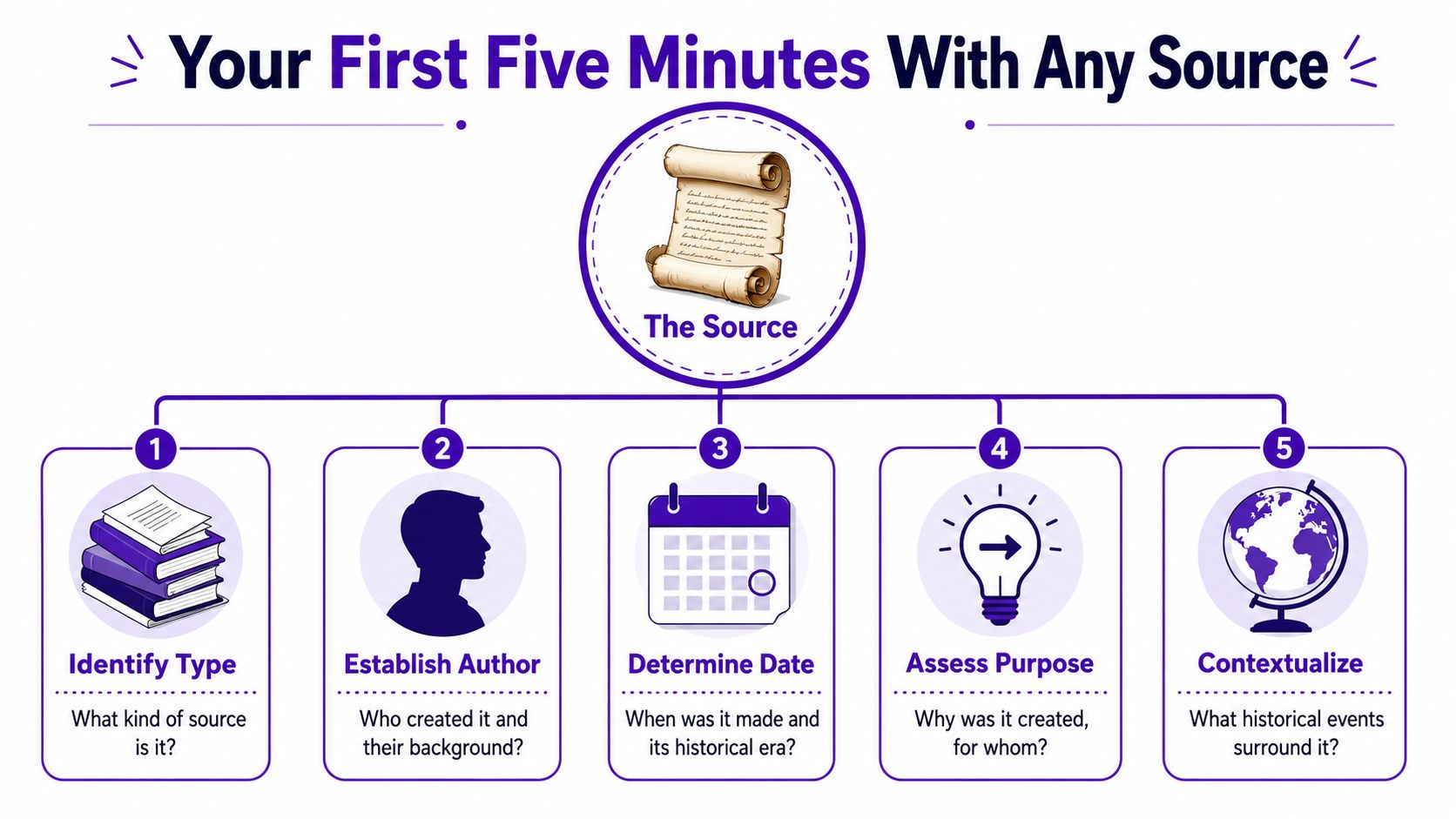
Use NOP before anything else
A simple starting frame is Nature, Origin, Purpose.
Nature
Ask what the source is.
A private diary entry behaves differently from a campaign poster. A government report differs from a newspaper cartoon. Form affects content. A speech aims to persuade. A memo may be more candid. A poster has to simplify. A cartoon exaggerates by design.
Useful opening questions include:
- Type of source. Is it visual, written, statistical, official, personal?
- Public or private. Was it meant for mass readership or a small audience?
- Immediate or reflective. Was it created in the moment, or later with hindsight?
If you want a quick refresher on different source types, this overview of primary sources for content creators is handy because it shows how format changes what a source can reveal.
Origin
Origin isn't just the author's name. It means the author's position in the historical world.
A factory worker, cabinet minister, suffragette campaigner, colonial administrator, and newspaper editor don't see the same event in the same way. Their role shapes what they notice, what they ignore, and what they need their audience to believe.
When you discuss origin, push past labels. Don't stop at “written by a politician”. Add the consequence.
- Position. What power or access did they have?
- Stake in the issue. What did they stand to gain or protect?
- Distance from events. Eyewitness, participant, commentator, later historian?
Purpose changes everything
Purpose is often the hinge of the whole answer. Why was this source created in this form, at this moment, for this audience?
A source designed to persuade will select evidence differently from one designed to record. A source made for officials may hide emotional language. A source made for the public may simplify or dramatise.
This matters even with numbers. Historians are warned by the American Historical Association that statistical material must be “scrutinized, criticized, and dissected” and that “numbers don't speak for themselves” in their discussion of history by numbers. So if a source includes casualty totals, output figures, or election data, don't treat that as automatically solid. Ask who compiled it, what it measures, and what it leaves out.
Practical rule: If your first paragraph could fit any source on any paper, it's too generic.
A good first sentence usually does three jobs at once. It identifies the source, suggests a line of argument, and points toward purpose. For example:
- “This public cartoon is useful because it shows how critics wanted readers to view the government, though its exaggeration limits it as direct factual evidence.”
- “This official report may offer detailed evidence, but its usefulness depends on why the department produced it and what it chose not to record.”
Timed practice matters here because these opening judgements have to become fast. Using Exam Practice for GCSE can help train that first-minute decision making under realistic pressure.
Reading Between the Lines for Context and Tone
You open the paper, read the source, and it looks straightforward. Then the mark scheme punishes any answer that only explains the obvious meaning. Top-band analysis goes further. It shows how the source sounds, what attitude sits underneath the words, and why that voice makes sense in that precise historical moment.
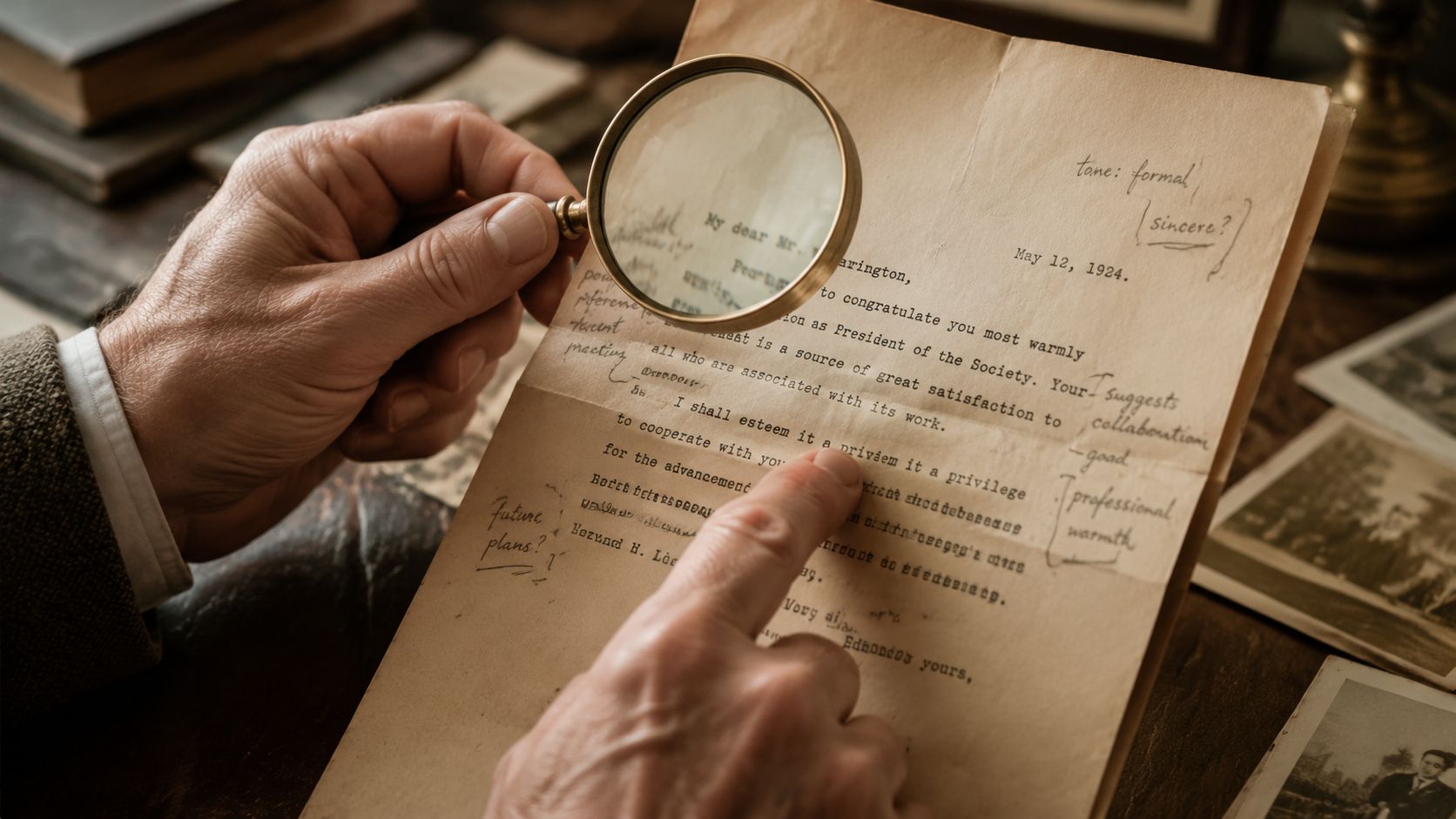
Tone tells you how to read the source
Students often spot content but miss attitude. Examiners notice that immediately.
Read for mood as well as message. Is the source defensive, triumphant, fearful, sarcastic, formal, bitter, patronising? Those choices affect how much weight you give its claims and what kind of evidence it provides. A triumphant speech does not just describe success. It tries to present events as success.
Tone usually appears through small signals. Repeated praise suggests approval. Loaded labels suggest contempt. Cautious, official phrasing may suggest an attempt to sound objective. That is not the same as being objective.
One method works well under timed conditions. Read a sentence aloud in your head and ask how it would sound if a politician, editor, or witness said it to a crowd. Students hear the attitude much faster that way.
Your annotations should use analytical verbs. Write “glorifies,” “dismisses,” “justifies,” “minimises,” “warns,” “blames.” Those words help you turn notes into exam sentences. If you want a broader method for spotting patterns in wording and meaning, this guide to qualitative analysis gives a useful framework.
Context sharpens the point
Context is not a fact dump. It is the reason the source sounds like this and says this now.
Many mid-band answers bolt on background knowledge at the end. High-scoring answers weave it into the analysis. AQA and Edexcel examiners reward that because it shows control. The student is not just recognising information. The student is explaining why the source takes that line.
Use four quick checks before you write:
| Context question | What to ask yourself |
|---|---|
| When exactly | What had just happened, or what was about to happen? |
| Who held power | Which government, ruler, party, or group shaped events? |
| What ideas mattered | Which beliefs or fears shaped public language at the time? |
| What pressure existed | Was there war, unrest, reform, election pressure, or economic trouble? |
That frame helps you produce the kind of sentence that picks up marks.
Weak: “The source is angry about protestors.”
Stronger: “The source uses hostile language about protestors because it was produced at a time when the authorities were presenting unrest as a threat to order.”
Best: “The source's hostile tone towards protestors reflects official anxiety about unrest in this period, so it is useful for showing how those in power framed dissent, even if it gives a one-sided picture of events.”
That final version does three jobs. It identifies tone, links it to context, and turns both into a judgement about usefulness. That is exactly the move students need in source questions.
Practice this with real exam material, not made-up examples. A set of GCSE Past Papers lets you compare how the same skill appears across different boards and periods.
Good contextualisation explains why the source took this tone, for this audience, at this moment.
The Difference Between Reliable and Useful
You are in an exam, the source is obviously biased, and the easy line is to dismiss it. That is exactly where marks get thrown away.
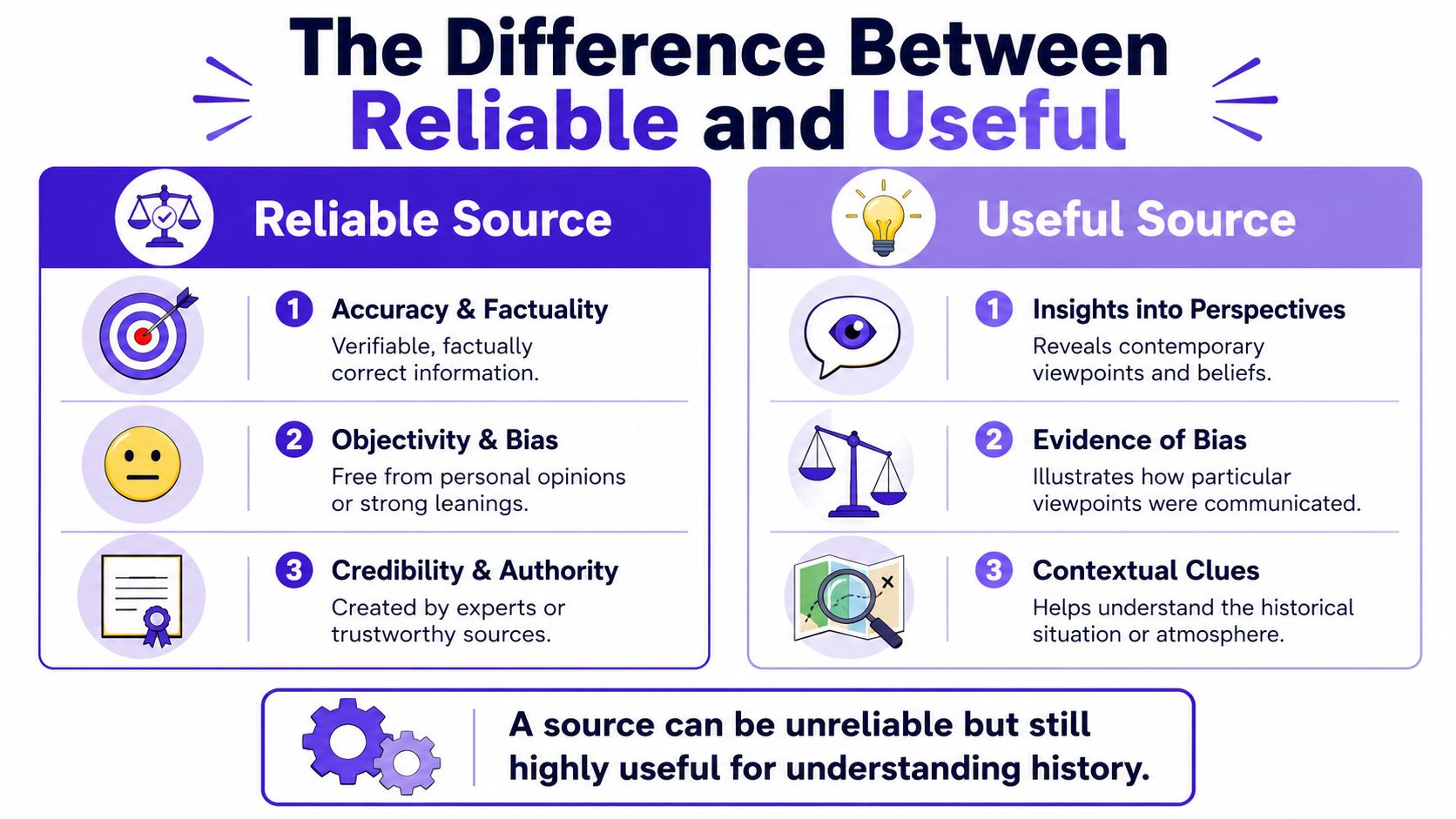
Stop merging two different judgements
Reliable means the source is accurate, or at least accurate enough, for the specific claim you want to make.
Useful means the source helps you answer the question.
Exam boards care about both, but they do not reward students who treat them as interchangeable. A propaganda poster may be weak evidence for what conditions were really like. It can still be strong evidence for what a government wanted people to believe. A private diary may get details wrong under stress, yet still be highly useful for showing fear, confusion, or prejudice at the time.
That is the examiner's distinction. Strong answers make it clearly.
A weak response usually says: “The source is biased, so it is unreliable and not useful.”
That closes the paragraph too early. History papers do not reward you for spotting bias alone. They reward you for explaining what that bias reveals.
What high-scoring answers actually do
The best paragraphs separate three questions:
| Question | What to judge |
|---|---|
| Can I trust this detail? | Check accuracy, exaggeration, omission, and whether other knowledge supports it. |
| Why was it produced like this? | Check purpose, audience, timing, and the author's position. |
| What does that make it useful for? | Decide whether it helps with facts, attitudes, priorities, propaganda, or public reaction. |
That is the move students miss. They stop at “biased.” Examiners want the next sentence.
Use phrasing like this:
- For reliability: “Its claim about living conditions needs caution because the writer had an incentive to present reforms positively.”
- For usefulness: “However, that motive makes it useful for showing how the authorities wanted reform to be seen.”
- For balance: “It is therefore limited as direct evidence of conditions, but valuable evidence of official priorities and messaging.”
Those sentence shapes work across AQA, Edexcel, OCR, and most source papers because they turn analysis into a judgement, not a label.
A source can be one-sided and still be very useful. The key is being precise about what it is useful for.
This is also where wider academic habits help. If you want a broader comprehensive guide on academic analysis, that piece shows the same core principle. Evaluate claims, method, purpose, and limitation separately instead of collapsing them into one verdict.
A quick exam example makes the difference clear. Suppose the source is a government poster praising evacuation in 1939. A mid-range answer says it is unreliable because the government wanted to look successful. A top-band answer says it is limited for judging how smooth evacuation really was, but useful for showing the message the government pushed to reassure parents and maintain confidence. That second answer does what examiners reward. It identifies the limit, then turns the source back into evidence.
Practise this on real questions, not invented textbook snippets. Work through GCSE Past Papers and force yourself to write one sentence on reliability and one separate sentence on usefulness for every source. That habit improves marks quickly because it stops the all-or-nothing judgement that drags answers down.
How to Structure a Perfect Source Analysis Paragraph
Good ideas don't score by themselves. Examiners reward ideas that are organised, signposted, and tied to the question. Most students need a writing frame, not because frames are simplistic, but because they stop your answer drifting into summary.
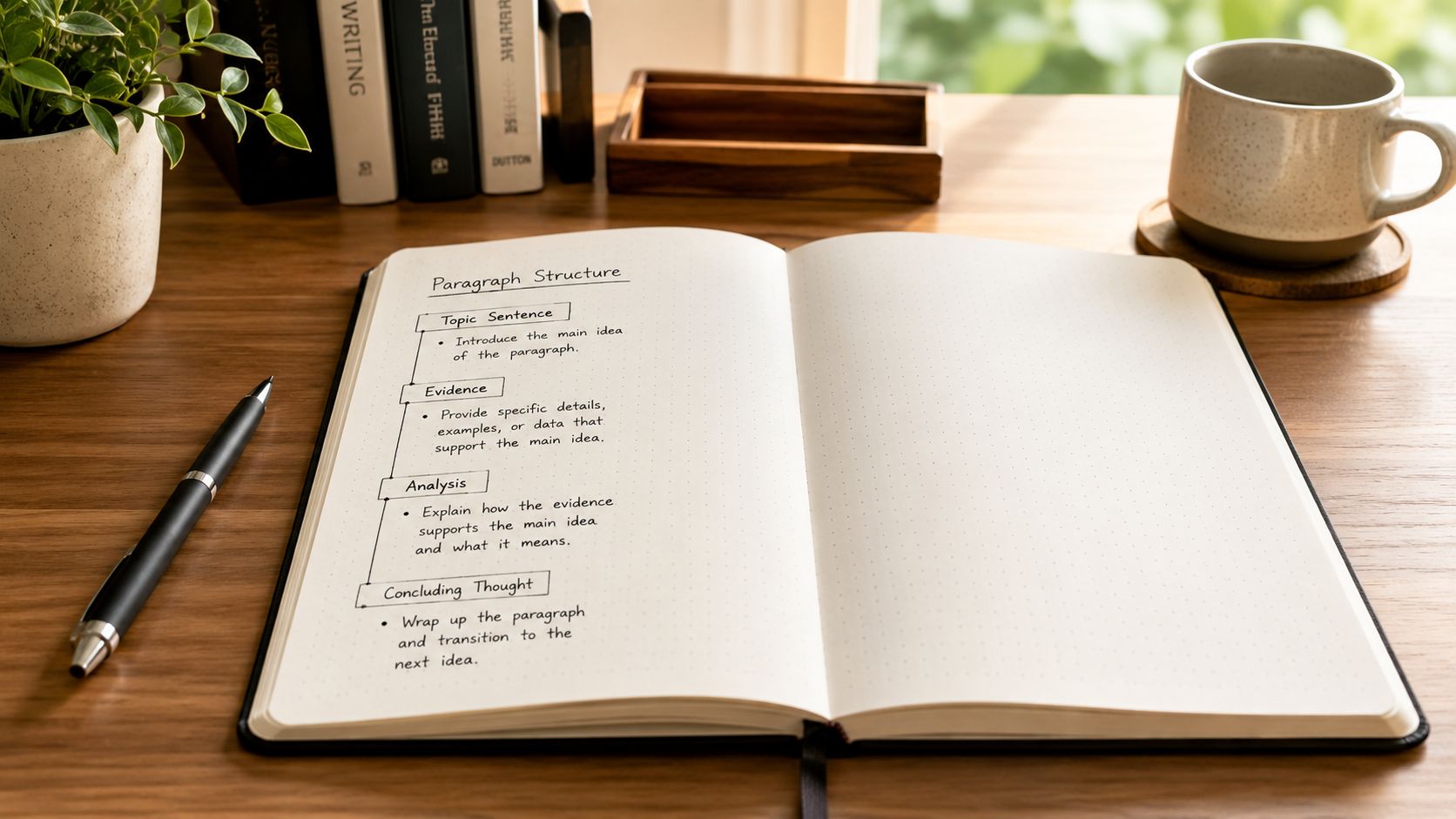
A paragraph shape that actually works
Use this version of PEEL, adapted for source questions:
Point
Make a judgement tied to usefulness, value, or interpretation.Evidence
Refer to a precise detail from the source.Explain
Analyse what that detail reveals about tone, perspective, or purpose.Link
Connect it to contextual knowledge and the exact question.
Here's the model in action:
| Paragraph move | Example sentence starter |
|---|---|
| Point | “The source is useful because it reveals…” |
| Evidence | “This is shown by the phrase/image/detail…” |
| Explain | “This suggests the author wanted the audience to…” |
| Link | “Therefore, it helps us understand… although its value is limited by…” |
That final clause matters. Top-band answers usually balance value and limitation in the same paragraph instead of bolting on a vague criticism at the end.
Sentence starters worth stealing
Students often waste time trying to sound pretentious. Plain English wins if the thinking is sharp.
Try these:
- “The source presents… in a deliberately… tone.”
- “This wording implies that…”
- “Because the source was produced by… it is likely to…”
- “Its usefulness lies less in factual accuracy and more in what it reveals about…”
- “However, this also limits the source because…”
- “When read against the context of… the source becomes more revealing.”
If you need a general framework for critical writing beyond history, this comprehensive guide on academic analysis is useful for sharpening the habit of making a claim, supporting it, and testing its limits.
Bring in corroboration without derailing the paragraph
Corroboration means checking the source against other evidence. In exam answers, that usually means your own knowledge or another source in the question booklet.
Keep it tight. One sentence is often enough.
For example:
“However, my own knowledge of wartime shortages suggests the source understates public hardship, which may reflect its official purpose.”
That sentence does a lot. It doesn't retell the textbook. It uses knowledge to test the source.
A short walkthrough can help if you want to hear this process modelled out loud:
The top-band move most students miss
Analyse what the source doesn't say.
A source's omissions matter. Historians are encouraged to ask who is missing, what is absent, and what the source cannot tell us in guidance on analysing historical research materials. A source may discuss policy without mentioning those harmed by it. A soldier's letter may describe morale but say nothing about censorship. A government leaflet may celebrate reform while ignoring resistance.
That kind of comment shows maturity because it treats the source as a constructed view, not a transparent window.
If you want structured help turning analysis into exam-style responses, MasteryMind's revision support includes guidance on how command words and mark schemes shape what your paragraph has to do.
Common Pitfalls and How to Sidestep Them
The fastest way to improve is to catch the habits that steadily drain marks. Most weak answers don't collapse because of one disaster. They leak points through small, repeated errors.
The checklist of avoidable mistakes
- Describing instead of analysing. Students retell the source. Instead, say what the detail suggests and why it matters.
- Mixing up origin and purpose. “It was written by a politician” is origin. “It was written to defend government policy” is purpose.
- Using generic bias comments. “All sources are biased” is true but thin. Identify the specific bias and its effect.
- Ignoring the date. A source from the start of a conflict may read very differently from one produced after defeat, reform, or scandal.
- Forgetting the audience. Public sources and private ones often need different judgements.
- Treating numbers as settled facts. Tables and totals still need interrogation, as covered earlier.
The better replacement
Use this quick swap table when you practise:
| Instead of this | Do this |
|---|---|
| “The source shows…” | “The source presents… in order to…” |
| “It is biased.” | “Its viewpoint is shaped by…” |
| “It is reliable because it is published.” | “Publication doesn't remove perspective, so its claims still need testing.” |
| “It is useful because it tells us facts.” | “It is useful because it reveals both information and attitude.” |
One historical reminder helps here. The habit of interrogating records is older than most students realise. In a history of data collection and early statistical thinking, John Graunt's work on London parish death records in the mid-17th century is described as the first recorded experiment in statistical data analysis. He worked with messy, fragmented records and still looked for patterns. That lesson is essential. Historians don't wait for perfect evidence. They question how evidence was compiled and what it can reliably support.
The best answers aren't built on certainty. They're built on careful judgement.
Your Source Analysis Questions Answered
A few source-analysis problems come up so often that they're worth keeping in one place.
Quick answers you can actually use
| Question | Short Answer |
|---|---|
| Do I always need to talk about provenance? | Yes, if the question is about usefulness, value, or interpretation. Origin and purpose usually affect the judgement. |
| What if I don't understand every word in the source? | Don't freeze. Use tone, visible clues, date, author, and context to build a partial but valid reading. |
| How is a cartoon different from a written extract? | Cartoons rely on symbolism, exaggeration, labels, and visual tone. Analyse those features as deliberately as you'd analyse word choice. |
| Should I call a source biased? | Only if you explain how, why, and with what effect. Generic bias comments won't carry much weight. |
| What if the source is clearly unreliable? | Ask what it still reveals about attitudes, motives, fears, or propaganda aims. |
| How do I handle digitised sources online? | Treat the digital version as a layer of interpretation. Students need to ask how platform curation, transcription errors, or cropping may shape meaning, especially when they can't inspect the original object, as discussed in this piece on analysing digitised historical sources. |
| Do exam boards want different skills? | The wording varies, but the core habits stay the same. Identify what the source is, place it in context, judge perspective, and support your view with knowledge. |
Keep one thought in mind when you revise. A source question is not a memory test dressed up as one. It's a judgement test. The students who score highest aren't the ones who write the most. They're the ones who make the clearest, best-supported decisions.
If you want more structured practice with exam-style history questions, MasteryMind gives UK learners a way to practise against board-aligned tasks and get feedback that matches how marks are awarded.
Ready to master this topic?
Practise with quizzes, blurt exercises and exam questions on MasteryMind.
7 days Premium · Then free forever · No card, no charge