How to Revise for English: A GCSE & A-Level Study Plan
Most English revision advice is too comfortable to work.
If your plan is to reread notes, highlight a few quotes, maybe do a past paper “later”, and hope your brain sorts itself out, that's not revision. That's revision cosplay. It feels productive because you're looking at English, but looking isn't the same as remembering, analysing, or writing under pressure.
Good English revision does three jobs at once. It helps you remember the material, turn that knowledge into examiner-friendly answers, and perform on the day when the clock is annoying and your brain goes blank. That matters whether you're trying to rescue a grade after a slow start or push an already solid grade higher. It also matters to teachers, because any revision system worth using has to line up with how marks are awarded.
English isn't one skill. It's a bundle of skills. You need recall for quotes and ideas, precision for analysis, and fluency for essays and transactional writing. If one part is weak, the whole paper suffers. So the smartest way to revise for English isn't random. It's structured, active, and brutally honest about what you can really do without your notes open beside you.
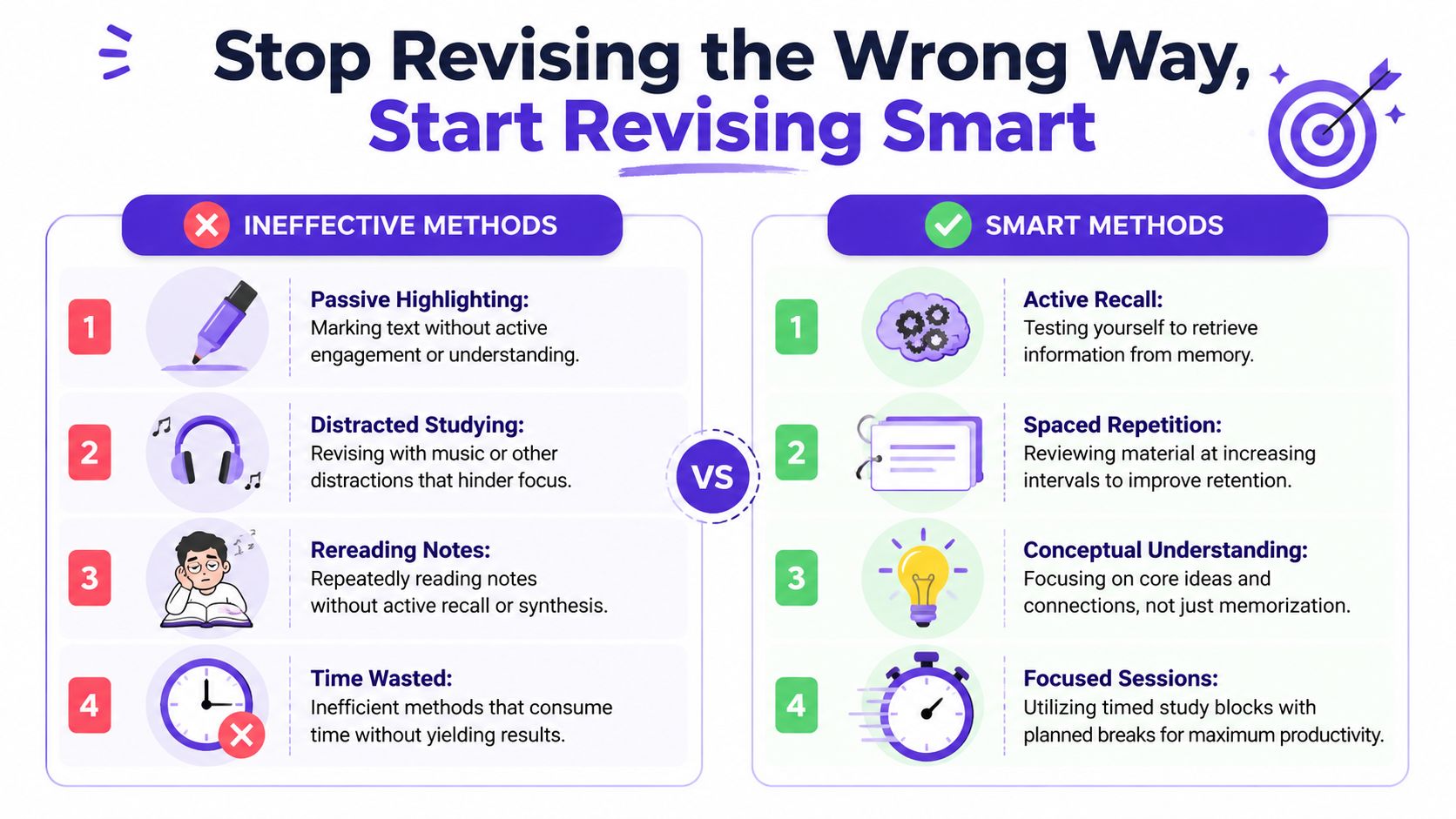
Stop Revising the Wrong Way Start Revising Smart
The weird truth about English revision is that the methods students trust most are often the ones that waste the most time.
Rereading notes feels tidy. Highlighting feels busy. Copying quotes into colour-coded pages feels like progress. In an English exam, though, none of that matters unless you can pull ideas out of your memory, shape them into analysis, and write them fast enough for a mark scheme written around clear assessment objectives.
That is the shift students miss. English revision is not just about knowing the text. It is about converting knowledge into marks under pressure. A good system has to train three things together: memory, examiner-friendly analysis, and timed writing fluency.
Why passive revision falls apart in the exam hall
English papers are retrieval tasks disguised as writing tasks.
You sit down, turn the page, and suddenly need to remember a quote from Macbeth, spot a pattern in an unseen poem, or explain why a single word sounds threatening, fragile, or ironic. Your book is gone. Your notes are gone. The examiner only sees what you can produce on your own.
That is why passive revision keeps disappointing students:
- Recognition is easier than recall. Seeing “vaulting ambition” on a flashcard is one thing. Producing it in the middle of an essay is another.
- Highlighting can trick you into feeling confident. You mark the “important bit” without practising how to explain its effect.
- Rereading smooths over gaps. Your brain borrows the answer from the page, so you never test whether you really know it.
- English marks reward performance, not familiarity. Assessment objectives care about interpretation, analysis, references, and clear communication. A page of highlighted notes does not practise any of those in full.
A simple rule helps here. If the answer is in front of you while you revise, you are usually practising recognition, not exam performance.
Use active recall as your default method
Cognitive scientists Henry L. Roediger III and Jeffrey D. Karpicke found in their study on test-enhanced learning that retrieving information from memory improves long-term retention better than repeated study in many cases, as reported in their research summary on retrieval practice.
For English, that means one method beats ten decorative ones. Active recall.
Active recall works like strength training for memory. Reading notes is watching someone else do the workout. You may understand what good form looks like, but your brain has not done the lift.
Here is the simplest version.
- Choose one narrow target. Pick Macbeth: guilt, Mr Birling and responsibility, or how an unseen poem shifts tone.
- Hide your notes.
- Set five minutes. Short is fine. Short often works better.
- Write everything you can remember. Quotes, methods, theme links, context, and possible interpretations.
- Check and correct in a different colour.
- Turn mistakes into the next task.
If focus slips after two minutes, use visual timers for productivity. They make short recall sessions easier to stick to, especially when your phone is trying to drag you elsewhere.
What this looks like with Macbeth
Say your prompt is ambition.
Your first brain dump might give you this:
- witches trigger Macbeth's ambition
- Lady Macbeth pressures him
- “vaulting ambition”
- ambition links to disorder
- Banquo as a contrast
- Macbeth gains power, loses peace
That is a solid start. Then the useful part begins.
You check your notes and realise you forgot Macbeth's ambition is dangerous partly because Shakespeare links it to the breaking of natural and political order. You also notice that “vaulting ambition” is not just a quote to drop in. It is a metaphor suggesting ambition that overleaps judgment and falls on the other side. That is where marks live. Not in owning the quote, but in being able to explain what it does and why the examiner can reward it under AO2.
This is the integrated approach students need. First retrieve the knowledge. Then connect it to the assessment objective. Then practise writing it in a sentence that would make sense to an examiner at speed.
For example:
Weak analysis: Macbeth is ambitious and this causes problems.
Stronger analysis: Macbeth describes his desire as “vaulting ambition”, a metaphor that presents ambition as reckless and unstable, suggesting he already knows his drive has pushed beyond moral control.
Same idea. Far more marks.
Build revision that matches the paper you will sit
Plenty of revision guides treat English as a pile of separate tips. Learn quotes. Revise devices. Do a past paper at some point. Students then know a bit about everything but struggle to turn that knowledge into fluent answers in timed conditions.
A smarter system joins the parts up.
- Learning science gives you the method. Use active recall instead of passive review.
- Examiner psychology gives you the target. Learn what the AOs reward, so your revision produces analysis the marker can credit quickly.
- Time management gives you consistency. Short, repeated practice beats waiting for a three-hour burst of motivation that never arrives.
Digital tools can help organise that practice. If you want structured support, AI Powered Revision can help you keep recall tasks focused. The principle stays the same either way. Close the notes. Retrieve first. Check after. Then write one or two examiner-friendly sentences from memory.
That is revising smart. And yes, you can get much better at it, even if English has felt fuzzy up to now.
Build Your Battle Plan The Ultimate English Revision Timetable
A revision timetable should stop panic, not create it. If you make one giant block called “English” on a Sunday afternoon, you'll probably spend half of it deciding what to do and the other half pretending a quote poster counts as work.
A better plan breaks English into parts. Literature recall. Language analysis. Timed writing. Past paper review. Each needs its own slot because each uses a different mental skill.
Start with realistic time, not fantasy time
One useful anchor comes from outside English. For GCSE Statistics, students are advised to spend approximately 120 hours over a six- to seven-month period, with 3 to 4 hours daily if starting early, while last-minute cramming can push that to 7 to 8 hours a day, which often leads to burnout and weaker retention, as outlined in this GCSE Statistics revision guide. The exact subject is different, but the planning lesson is the same. Start earlier, spread the work, and don't build a timetable that only works if you suddenly become a machine.
For English, that means shorter, repeated sessions beat random marathons.
Split English into revision lanes
Don't timetable by subject name alone. Timetable by task.
| Revision lane | What goes in it | What success looks like |
|---|---|---|
| Literature recall | Quotes, themes, characters, context | You can write from memory |
| Literature essays | Plans and paragraphs | You can turn ideas into argument |
| Language reading | Unseen extracts, AO-focused analysis | You explain effects precisely |
| Language writing | Descriptions, speeches, articles, stories | You can produce fluent writing on time |
| Review | Marking, fixing weak spots, redoing errors | You stop repeating the same mistakes |
That's where Spaced Repetition makes sense. You don't revise a topic once and move on. You come back to it after a gap, then again later, then again when it starts to fade.
A timetable that people actually follow
Keep it simple enough to use on a tired Tuesday.
- Pick fewer topics per session. One Literature text plus one Language skill is better than “revise all of English”.
- Alternate the type of effort. If you do quote recall first, follow it with essay planning or timed writing. That keeps your brain active.
- Build in return points. If you revise Macbeth today, revisit it later in the week and again the following week.
- Leave room for marking. Revision without checking is guessing.
Treat your timetable like a training plan. You're not trying to prove how long you can sit at a desk. You're trying to build exam performance.
A weekly pattern that works
Try a repeating shape instead of a rigid minute-by-minute prison:
- Early week for recall and knowledge building
- Midweek for applying that knowledge in paragraphs or short responses
- Later week for timed practice
- Weekend for review, corrections, and weak topics
That pattern works for students aiming to recover and for students aiming high. If you're behind, it gives you structure. If you're already strong, it stops you from coasting on what feels easy.
Keep your sessions narrow
“Revise poetry” is too vague. “Compare how power is shown in two poems” is workable. “Revise English Language” is too broad. “Practise AO2 effect sentences on one unseen extract” is much better.
The smaller the task, the more likely you are to start. And starting matters more than having a perfect colour-coded timetable that never survives first contact with real life.
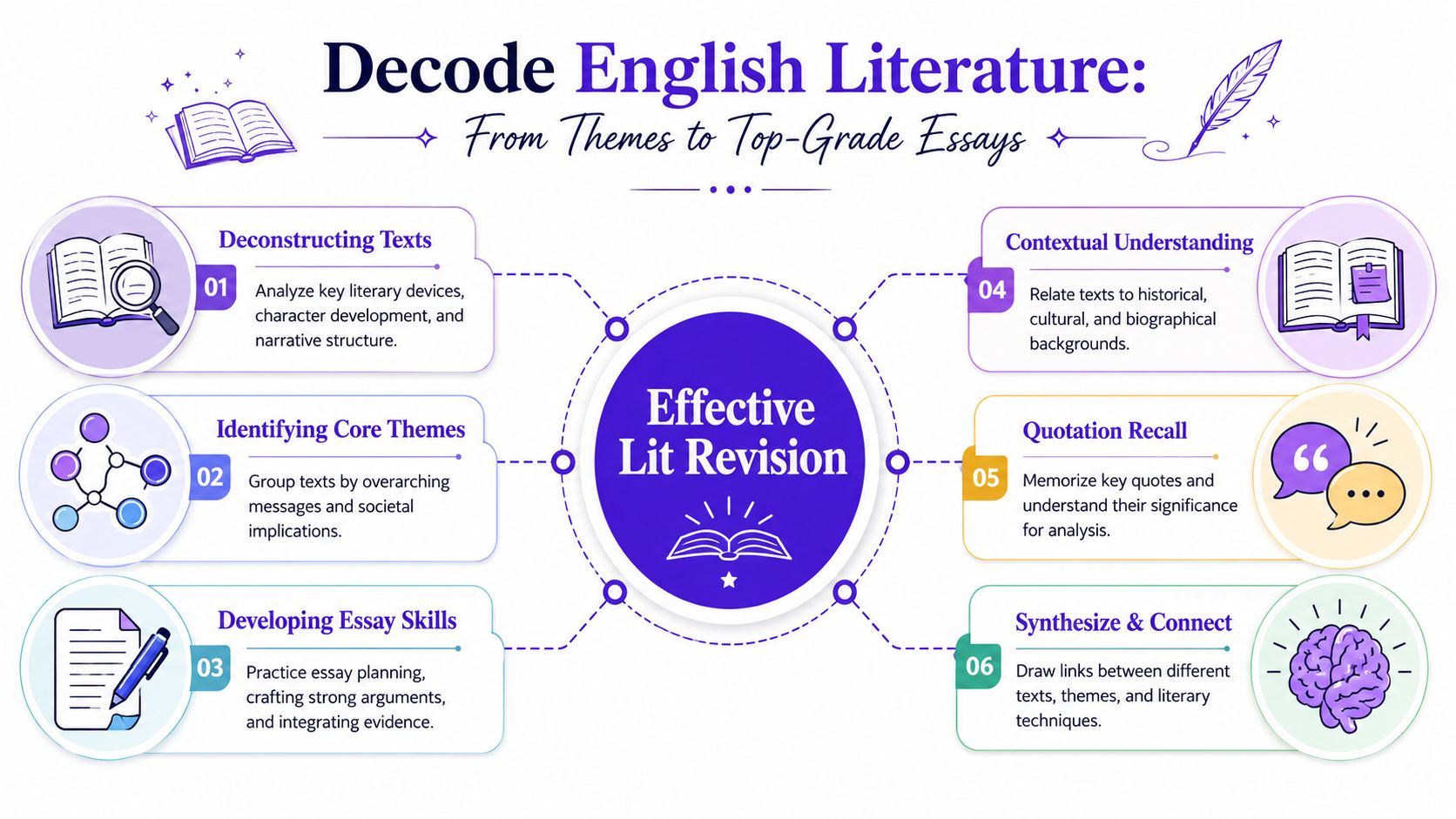
Decode English Literature From Themes to Top-Grade Essays
A lot of students revise Literature as if the exam is a memory contest. It isn't. You do need secure knowledge, but you're not being rewarded for retelling the plot like a Netflix summary. You're rewarded for building an argument about the text.
That changes how to revise. Don't start with “What happens?” Start with “What idea runs through this text, and how does the writer develop it?”
Revise by theme, not just by chapter
Take Macbeth. If you revise scene by scene only, your knowledge stays trapped in order. In the exam, you need to move across the whole play.
For a theme like ambition, build one page around:
- Where it appears early
- How it changes
- Which characters represent it differently
- What Shakespeare might be warning the audience about
- Which quotations are flexible enough to use in more than one essay
A useful theme page on ambition might include Macbeth, Lady Macbeth, Banquo, kingship, guilt, and disorder. That's stronger than a random list of quotes because it already behaves like an essay plan.
Track character arcs like a story of change
Characters are easier to revise when you think in movements.
For Macbeth, ask:
- Who is he at the start?
- What pushes him?
- When does he choose rather than hesitate?
- What does he become by the end?
That gives you a line of argument. He begins as a respected warrior, gets pulled into violent ambition, chooses murder, and ends isolated and hollow. Once you can describe that arc clearly, essays become much less scary because you're not fishing for points. You already have a shape.
Good Literature revision turns the text into patterns. Themes, changes, contrasts, and writer's intentions are easier to remember than random page-by-page detail.
Build quote banks that are actually usable
Don't memorise twenty long quotations badly. Memorise a smaller set well and know how to unpack them.
For Macbeth, a short quote can do a lot of work if you understand it. “Vaulting ambition” helps with character, theme, tragedy, and Shakespeare's warning about unchecked desire. “Look like th' innocent flower” can support appearance versus reality, manipulation, and Lady Macbeth's influence.
Use a table like this:
| Quote | Theme links | What it suggests |
|---|---|---|
| “Vaulting ambition” | ambition, tragedy, power | Macbeth knows desire can overleap reason |
| “Fair is foul” | appearance, disorder, evil | the play begins by destabilising moral certainty |
| “Out, damned spot” | guilt, madness, consequences | guilt cannot be scrubbed away by force or denial |
That's revision with purpose. The quote isn't just a line to parrot. It's evidence attached to meaning.
Turn knowledge into paragraphs that score
A solid paragraph doesn't need to sound fake-posh. It needs to do clear jobs.
Try this structure:
- Point. Make a direct argument.
- Evidence. Use a short quotation or precise reference.
- Analysis. Zoom in on key words and their effects.
- Writer's purpose. Explain why Shakespeare or Priestley shaped it that way.
- Bigger link. Connect back to the question and the whole text.
Example:
Macbeth is presented as dangerously self-aware because he recognises that “vaulting ambition” is driving him towards disaster. The verb “vaulting” suggests something leaping beyond safe limits, so Shakespeare shows ambition as excessive rather than heroic. Macbeth isn't ignorant. He understands the moral danger and still moves towards it. That makes his downfall more tragic because he chooses the path he knows is wrong.
That paragraph works because it argues. It doesn't just label a technique and move on.
Push beyond obvious points
The jump from average to strong often comes from asking one more question.
Instead of writing:
- Shakespeare uses imagery to show Macbeth is guilty.
Push it to:
- Why guilt here?
- Why now?
- Why this image?
- What does the audience learn about Macbeth or the play's message?
If you want extra practice on shaping stronger essay responses, these strategies for a perfect essay score can help you think about structure and clarity. Use that kind of support to sharpen expression, not to replace the hard thinking.
What students usually get wrong
- They retell instead of analyse. Plot summary eats time and earns less.
- They bolt context on at the end. Context should deepen your interpretation, not sit there like a random fact.
- They use quotations they can't explain. A short quote you understand beats a long one you don't.
- They forget the whole text. Even if the question starts from an extract, your answer usually needs a wider view.
If you're wondering how to revise for English Literature without drowning in notes, this is the answer. Revise patterns, quotations, and arguments, then practise turning them into short, sharp paragraphs.
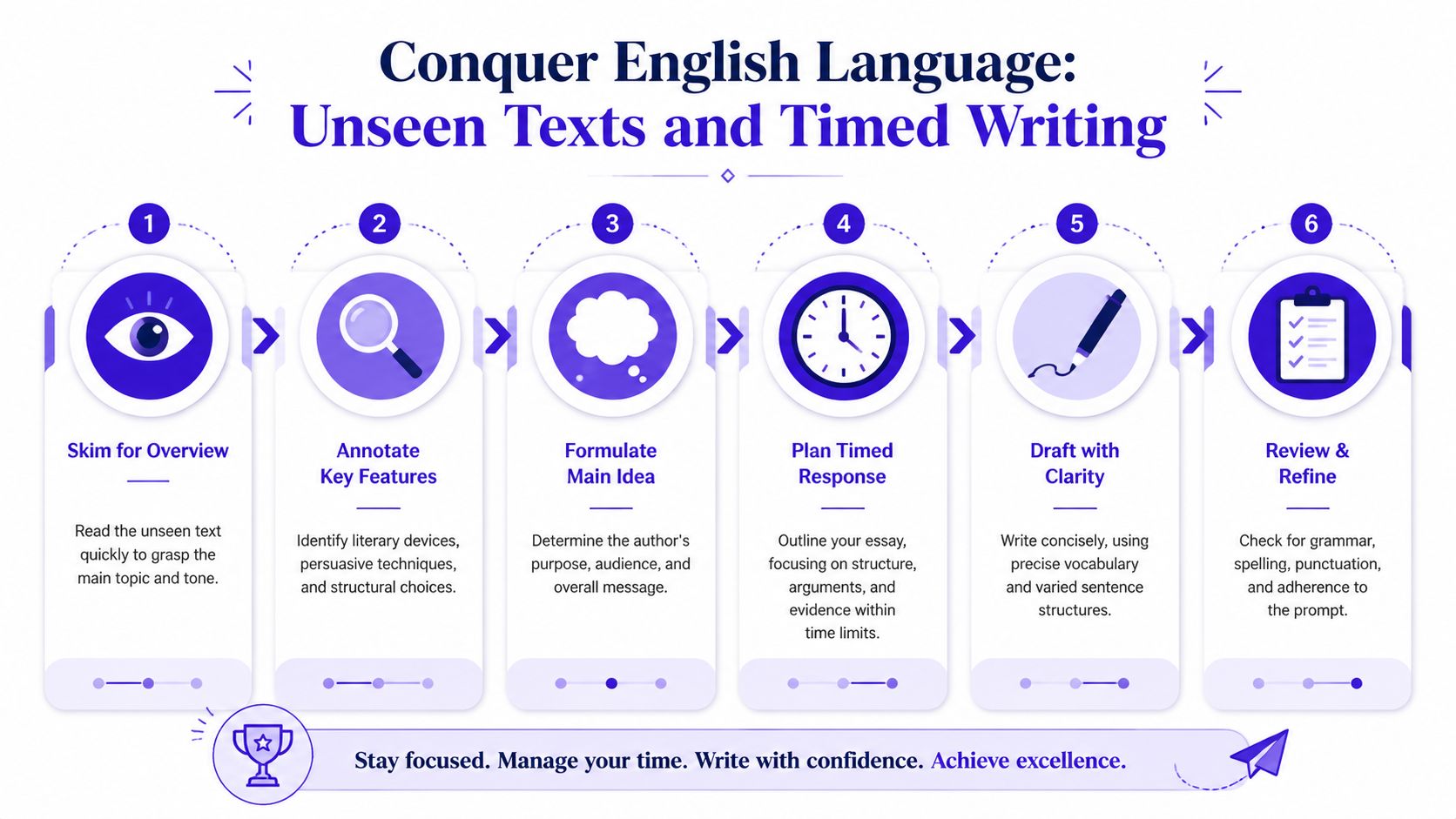
Conquer English Language Unseen Texts and Timed Writing
English Language catches students out because it looks less content-heavy than Literature. That tricks people into thinking they can “just do a few papers” and wing it. Then the exam arrives, the unseen text feels weird, the clock moves too fast, and suddenly every sentence you write sounds like it was produced by a startled potato.
The fix is precision. For reading questions, you need to explain effects properly. For writing questions, you need fluency under pressure.
Stop technique spotting and start effect explaining
This is one of the biggest weak spots in English Language. According to the 2024 Ofqual Annual Report on GCSE outcomes, 42% of students in English Language scored below the threshold for AO2, and recent 2025 AQA examiner reports noted a 15% rise in “superficial commentary” where students list techniques without linking them to the writer's purpose. That means many students can spot a metaphor or contrast, but they don't explain what it does.
So don't write this:
- The writer uses a metaphor.
- This makes it interesting.
- The reader wants to read on.
That's technique spotting with filler attached.
Write this instead:
- The writer uses [technique] to [create effect], which makes the reader [response], because it helps present [writer's purpose].
Example with a tricky unseen poem:
The poet uses the image of the sea “clawing” at the shore to make nature feel aggressive and invasive. The verb “clawing” gives the sea an animal quality, which creates menace for the reader. That helps the poet present the scene as threatening rather than peaceful.
That is AO2-friendly because it moves from method to effect to purpose.
A quick AO2 checklist
When you analyse a word, image, or structural move, ask:
- What has the writer chosen?
- What does that choice suggest?
- How does it shape the mood or tone?
- Why might the writer want the reader to feel or think that?
If your sentence ends at naming the technique, you haven't finished the job.
Build timed writing fluency before exam day
The writing section punishes hesitation. Many students can write well when they have ages to think. Exams don't offer that luxury. You need a structure that appears quickly when the question lands.
That's why pre-planned templates help. Not stiff, robotic templates. Flexible ones.
For a speech or article, try this five-part structure:
- Open with a clear viewpoint
- Give a vivid example or scenario
- Develop one strong argument
- Add a contrasting idea or counterpoint
- Finish with a memorable final line
For creative writing, use a different shape:
| Part | What to do |
|---|---|
| Opening | Establish setting and mood fast |
| Shift | Introduce a change, interruption, or discovery |
| Focus | Zoom in on sensory detail and reaction |
| Turn | Reveal consequence, tension, or insight |
| Ending | Echo the opening or land on a strong image |
This stops the blank-page freeze because you're not inventing everything at once. You're filling a known structure.
Practise pace, not just quality
A lot of students only practise full pieces. That's useful, but it's not enough. You also need short fluency drills.
Try these:
- Five-minute openings. Write only introductions to different prompts.
- Idea sprints. Give yourself one prompt and list possible images, arguments, or settings.
- Paragraph bursts. Write one fully developed paragraph against a timer.
- Sentence variety drills. Rewrite a plain paragraph using varied openings and lengths.
For board-style timed practice, using something like Exam Practice for GCSE can help recreate the pressure, but the key skill is still your own response speed and control.
A worked unseen example
Suppose the text describes a deserted house and says the hallway was “holding its breath”.
A weak response:
The writer uses personification to make it eerie.
A stronger response:
The writer presents the house as tense and almost alive by describing the hallway as “holding its breath”. This personification suggests a moment of silence before something happens, which creates suspense for the reader. It also makes the setting feel watchful and unnatural, so the writer turns an ordinary space into something unsettling.
That answer earns more because it is specific. It explains how the language works.
If you want to know how to revise for English Language properly, that's the shift. Stop collecting labels. Start practising explanation and timed output.
Think Like an Examiner Use Past Papers for Maximum Marks
Doing a past paper and checking the final score feels productive. Sometimes it is. Often it isn't.
Value of past papers comes when you stop acting like a student who has finished and start acting like the person marking the script. That's where progress speeds up. You begin to see why one paragraph gets described as clear and another as perceptive. You spot where marks leak away. You notice that a decent idea without precise development doesn't travel very far.

There's a serious reason to care about those small differences. One study summarised in The Forgotten Third found that students who “just failed” to achieve a grade C were 2% more likely to drop out of education and become NEET, while marginally achieving the grade increased the probability of starting a higher-level academic or vocational qualification by 6–9 percentage points. In other words, a few marks are not trivial.
Read the mark scheme like a translator
Mark schemes can look dry, but they tell you what the examiner values. Words like clear, thoughtful, developed, perceptive, and critical are not decoration. They describe the difference between levels.
When you review your answer, ask:
- Did I answer the question directly?
- Did I use evidence precisely?
- Did I explain effects, not just identify features?
- Did I build an argument across the whole response?
- Did I keep linking back to the writer's purpose or the task?
That's more useful than staring at a raw mark and feeling either pleased or wounded.
What examiners notice fast
Examiners usually pick up these things quickly:
| If they see this | They often think this |
|---|---|
| Repeated plot summary | Limited analysis |
| Technique labels with no effect | AO2 is weak |
| Quotations dropped in without comment | Evidence isn't being used well |
| General comments that could fit any text | Response lacks precision |
| A line of argument that keeps developing | Higher-level thinking |
That last one matters a lot. Strong answers don't just collect points. They develop a viewpoint.
“What is this student really arguing?” is a useful question to ask yourself before you write and after you finish.
Mark one paragraph, not just one paper
A full paper can be overwhelming to review. A paragraph is manageable. Pick one paragraph and examine it hard.
For example, if your point is:
Shakespeare presents Lady Macbeth as powerful.
That's not wrong, but it's too open. Now test it like an examiner.
- Is it precise enough? Powerful in what way?
- Is there a line of argument? Does that power change?
- Can the evidence carry the point? Which quote proves it best?
- What pushes it higher? Link her power to manipulation, gender expectations, or moral collapse.
A better version might be:
Shakespeare first presents Lady Macbeth as verbally dominant, using her language to pressure Macbeth and challenge his idea of masculinity.
That gives the paragraph somewhere to go.
Use a three-pass review system
When you finish a past paper, don't just mark and file it away. Review it in passes.
Content pass
Highlight where you answered the actual question and where you drifted.AO pass
Label parts of your answer. Which sentences show interpretation? Which explain language? Which build structure or comparison?Upgrade pass
Rewrite one weak paragraph and one weak introduction. That's where real learning happens.
If you want a bank of GCSE Past Papers, organised practice helps, but the key move is always the same. Do less blind practice and more reviewed practice.
Compare weak and strong thinking
Here's a simple comparison using an unseen text response.
Weak:
The writer uses short sentences. This makes it dramatic.
Stronger:
The writer's short sentences break the description into abrupt fragments, which creates tension and makes the scene feel unstable. That clipped rhythm mirrors the speaker's anxiety, so the reader experiences the moment as pressured rather than calm.
Both notice the same feature. Only one explains it with enough precision to feel convincing.
A similar jump happens in Literature essays.
Weak:
Scrooge changes because he learns to be kind.
Stronger:
Dickens shapes Scrooge's transformation as a moral education, showing that generosity is not just a private virtue but a social duty.
The second version sounds stronger because it interprets, not just reports.
Train the examiner voice in your own head
One of the best revision habits is to ask, after every answer, “Why would this earn marks?” If you can't answer that, your revision isn't finished.
This short video is useful for thinking about revision and exam performance in a more deliberate way:
Teachers often say students need to “engage with the mark scheme”. True, but that phrase is annoyingly vague. In practice, it means learning to identify the gap between what you wrote and what the board rewards. Once you can see that gap, you can close it.
That's the point where past papers stop being a box-ticking exercise and start becoming one of the most powerful tools in your revision.
Stay Sharp and Sane Track Progress and Beat Exam Stress
The students who feel calmest before English exams are not always the ones who revised for the longest. They are usually the ones who can prove to themselves what they know, what they keep missing, and what to practise next.
That is the actual job of tracking.
As noted earlier, strong revision depends on metacognition and self-regulation. In normal English, that means checking your own understanding instead of guessing. If you finished a session on Macbeth and still could not explain how Shakespeare presents ambition across the play, the session was not finished well, even if it took an hour.
Use a Red Amber Green tracker
A Red Amber Green tracker works because it measures performance, not effort. English revision can feel fuzzy if you only ask, “Did I spend time on it?” A tracker asks the sharper question: “Can I do it?”
Use the ratings like this:
- Red. You cannot recall it or use it without help.
- Amber. You know part of it, but your answer still wobbles under pressure.
- Green. You can recall it, apply it, and explain it clearly in writing.
English is not just knowledge. It is knowledge translated into marks. A student may know that Lady Macbeth is ambitious, but under timed conditions they also need the quote, the method, the effect, and a line of argument the examiner can reward.
A simple tracker might look like this:
| Topic | Rating | Next action |
|---|---|---|
| Macbeth ambition quotes | Amber | Do a Brain Dump tomorrow |
| Unseen poem AO2 effect | Red | Practise 3 short analysis paragraphs |
| Speech writing openings | Green | Revisit later in the week |
Track what you can produce, not how long you sat at your desk.
Make progress visible
Visible progress lowers panic because it gives your brain a clear signal: I am getting somewhere.
Here is what that looks like in practice. On Monday, your unseen poetry analysis is Red because you keep spotting language features without explaining effects. On Wednesday, you write three short paragraphs and one finally works: “The abrupt caesura interrupts the calm description, making the speaker sound emotionally trapped.” That moves to Amber. By Saturday, you can do that in eight minutes without freezing. Now it is Green.
That shift matters more than saying you “revised poetry” three times.
Stress usually grows in the gaps
A lot of exam stress comes from uncertainty. The mind hates blurry problems. “I'm bad at English” feels huge and impossible to fix. “I need two better quotes for guilt in Macbeth and one timed introduction for Question 5” is specific, and specific problems are easier to handle.
Use that idea to keep stress manageable:
- Shrink the task. Swap “revise English” for one concrete target.
- Finish by checking evidence. What moved from Red to Amber? What still needs work?
- Practise under timed conditions. Fluency is a skill, and skills grow through repetition under realistic pressure.
- Protect sleep. Memory, focus, and emotional control all get worse when sleep slips. If stress is affecting rest, advice on how to manage stress for sleep can help.
Confidence follows proof
Students often wait to feel confident before attempting hard practice. English usually works the other way round.
Confidence grows after you see evidence. You remember four quotes instead of two. You write a paragraph on a tricky unseen poem without drifting into retelling. You complete a timed response and your handwriting, ideas, and structure hold together for the full answer. That is why active recall and timed writing matter so much. They give you proof.
Re-reading notes can feel comforting, but it is a poor test of whether you could perform in the exam hall. Retrieval practice, examiner-focused paragraph drills, and short timed responses tell the truth faster.
If you are behind, that truth helps because it shows where to focus. If you are already doing well, it stops you wasting time on revision that feels productive but does not raise marks. That is the system: learn the content, check it like an examiner, and train yourself to produce it under pressure.
Ready to master this topic?
Practise with quizzes, blurt exercises and exam questions on MasteryMind.
7 days Premium · Then free forever · No card, no charge