How to Revise for English Literature: A-Level & GCSE Guide

You’ve probably got a pile of stuff in front of you right now. A Shakespeare play full of annotations you barely recognise, a poetry anthology with sticky notes falling out, a novel you meant to re-read weeks ago, and a vague feeling that everyone else has a system except you.
That feeling is normal. English Literature can look messy because it isn’t revised the same way as Maths or Science. You can’t just memorise methods and repeat them. You need to know the text, shape an argument, analyse language, and do it fast under exam pressure.
The good news is that English Lit is very revise-able once you stop treating it like a reading task and start treating it like a performance subject. You’re training yourself to recall evidence, build ideas, and hit the mark scheme on command.
Stop Drowning in Books and Start Revising Smart
A lot of students start English revision by re-reading everything. It feels sensible. It also burns time and gives a false sense of progress.
The problem is overload. GCSE students often have to cover multiple full texts plus poetry, depending on the exam board, and that makes it easy to drift into passive revision. You sit there with a highlighter, turn pages, and tell yourself it’s going in. Usually, it isn’t.
That matters because top marks are rare. In the summer 2024 GCSE exams, only 3.4% of candidates achieved Grade 9 in English Literature, which is one reason students need a method that goes beyond simple rereading, as noted by Save My Exams on GCSE English Literature difficulty.
What strong revision actually looks like
Students who improve in English Literature usually stop doing three things:
- Re-reading without a task. If you aren’t hunting for themes, methods, or argument ideas, you’re mostly recognising, not learning.
- Memorising huge quote lists. You don’t need a museum of quotations. You need usable evidence.
- Writing essays too late. Plenty of students “revise” for weeks, then discover in their first timed essay that they can’t organise an answer.
What works is more structured and less glamorous:
- Learn the text through themes and patterns, not plot alone.
- Use active recall so your brain has to retrieve material.
- Practise exam-style writing before you feel ready.
- Revise to the mark scheme, not to your own idea of what sounds clever.
Practical rule: If your revision wouldn’t help you answer a question in timed conditions, it’s probably too passive.
The Grade 7 to Grade 9 difference
The jump isn’t usually about “being more intelligent”. It’s about control.
A Grade 7 answer often knows the text and has relevant points. A Grade 9 answer selects evidence more sharply, analyses methods more precisely, and links ideas across the whole text instead of retelling what happens. That’s good news, because those are trainable habits.
If you’re trying to work out how to revise for english literature, start with this idea: your job is not to read more. Your job is to think better, recall faster, and write more deliberately.
Build Your Revision Blueprint for the Year
The fastest way to panic in English Lit is to revise by mood. One night you do Macbeth because guilt hits. The next night you copy a few poetry notes. Then nothing for a week. That’s how students end up feeling busy but unprepared.
A proper plan spreads the load. It also protects you from burnout. A 2025 NFER study reported that 65% of UK A-Level students said cramming caused burnout, while the 12% who used spaced review showed 22% higher attainment of grades 8/9, according to Oxford Revise’s guidance on revising English Literature effectively.

Split the year into cycles, not marathons
Think in revision loops. Each text should return regularly so you don’t have to relearn it from scratch.
A simple blueprint looks like this:
- Map your course first. List every set text, poetry cluster, and unseen skill for your board.
- Divide revision into weekly slots. Give each slot a clear job such as quote recall, theme revision, or paragraph practice.
- Rotate text types. Don’t spend two weeks only on a novel. Mix Shakespeare, poetry, and prose to keep your thinking flexible.
- Return to older material. Revisit what you studied earlier rather than chasing only what feels urgent.
What to put on the plan
Your timetable should include more than “revise An Inspector Calls”. That’s too vague. Name the task.
Better examples:
| Week focus | Specific task |
|---|---|
| Shakespeare | Recall key scenes from memory, then build two theme maps |
| Poetry | Compare two poems on conflict, then write one timed comparison paragraph |
| Novel | Learn short quotes linked to power, guilt, or setting |
| Unseen practice | Annotate one poem and plan one response without notes |
Tools can help, especially when you want board-specific practice instead of random internet worksheets. If you want structured question practice, GCSE Past Papers can make planning easier because they let you tie revision directly to real exam tasks.
Use a repeatable weekly rhythm
Most students do better with a rhythm than a perfect timetable. For example:
- Early week for recall and note-tightening
- Midweek for one deeper text session
- Weekend for timed writing and review
A workable plan beats an ambitious one you abandon after four days.
If you’re months away from the exam, the goal is steady coverage. If you’re closer than you’d like, the same principle still applies. Short, regular sessions beat heroic all-nighters.
Learn Smarter with Active Recall Techniques
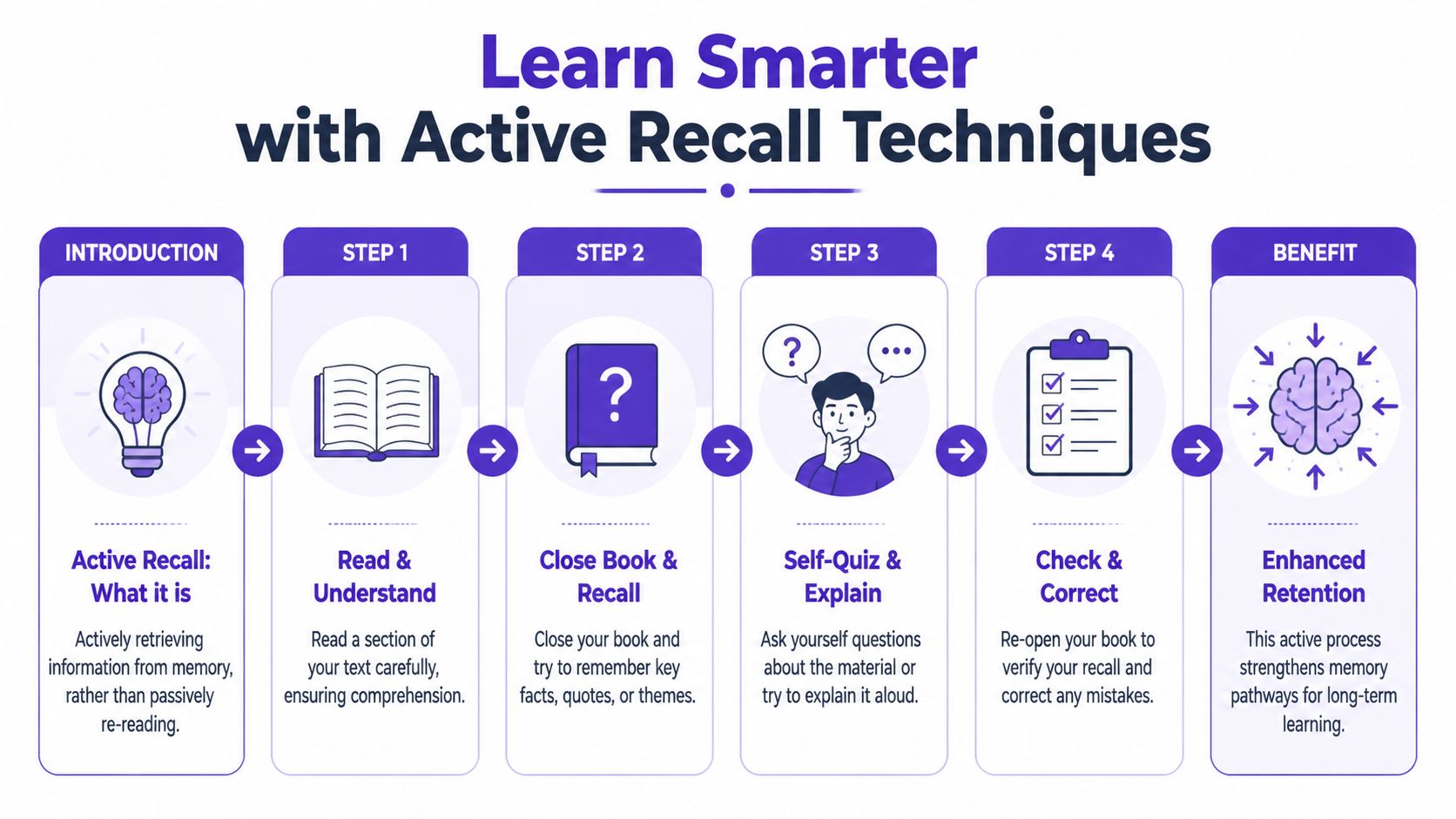
If you only change one thing about your English revision, make it this. Stop trying to recognise the material. Start trying to retrieve it.
That’s what active recall means. You shut the book, remove the notes, and force your brain to bring the information back. It feels harder because it is harder. That’s why it works.
Evidence-based learning suggests that spaced repetition can move information into long-term memory 5 to 10 times more effectively than cramming, as explained in Queen's Online School’s guide to revising English Literature GCSE.
Why active recall feels worse and works better
Passive revision feels smooth. You read a quote, nod, and think, “Yes, I know that.” But recognising a line on a page is not the same as producing it in an exam.
Active recall creates small struggles on purpose. Those struggles show you what you really know and what falls apart under pressure.
Good English Lit revision questions sound like this:
- What are three ways Lady Macbeth is presented as powerful?
- Which quote from the inspector could fit more than one theme?
- How does the writer shift tone in this stanza?
- What context helps this argument, and what context is waffle?
Three active recall methods that work for English
Blurt first, tidy second
Take a theme, character, or poem title. Close everything. Write down everything you can remember in a messy burst.
Then compare it with your notes and fill the gaps in a different colour. That gap is the lesson. It shows you where memory is weak.
This works especially well for:
- Themes such as power, responsibility, conflict
- Characters and how they change
- Scene recall in Shakespeare or drama
- Unseen poetry approach steps
Speak your analysis out loud
English is a spoken subject before it becomes a written one. If you can’t explain a quotation aloud, you probably don’t fully own the idea yet.
Try this:
- Pick one quote.
- Explain what it suggests.
- Identify a method.
- Link it to the wider theme or context.
- Keep going until you get stuck.
Students often discover their analysis is thinner than it looked in their notes. That’s useful.
If you want more ways to build retrieval into revision, MasteryMind's Active Recall strategies are worth a look because they focus on turning recall into something structured rather than vague.
Flashcards that test thinking, not just memory
A weak flashcard says: “Quote for guilt?” A stronger one says: “How does this quote present guilt as destructive?” That second version forces analysis.
Use both sides properly:
| Front of card | Back of card |
|---|---|
| How is power shown in this scene? | Short quote, method, effect, wider theme |
| Which two poems connect through conflict? | Comparison point and one supporting quote from each |
| What does this image suggest? | Interpretation plus why the writer may have used it |
Don’t make flashcards into mini textbooks. If a card takes ages to read, it won’t get used.
Add spacing so revision sticks
Here’s the simple version. Revise something, then come back to it after a short gap, then a longer one, then a longer one again. Each return strengthens memory.
A practical pattern is:
- First revisit soon after learning it
- Second revisit a little later
- Third revisit the following week
- Later revisits as part of mixed revision
That pattern matters more than the exact app or notebook you use. The method is what makes how to revise for english literature feel less chaotic and more reliable.
Break Down Your Texts Like an Examiner
Students often revise a text by following the plot from beginning to end. That feels organised. In exam terms, it often leads straight to summary.
Examiners repeatedly report that up to 70% of low-grade scripts are chronological summaries, while stronger responses are thematic and connect close analysis to wider meaning, as described by RevisionDojo’s guidance on English Literature revision and analysis.

Revise by theme, not by chapter
For each text, build a map around a handful of big ideas. The exact themes depend on your text, but the method stays the same.
For example, for a play or novel, one theme page might contain:
- Core idea about what the writer says on that theme
- Key moments across the whole text
- Short quotes that can travel into different essays
- Methods worth analysing
- Context links that sharpen the point, not decorate it
That means your Macbeth page on ambition isn’t “Act 1 then Act 2 then Act 3”. It’s a web of evidence showing how ambition appears, changes, and damages people.
Build a quote bank you can actually use
A sensible target is a small set of flexible quotations per text. Shorter is usually better because it’s easier to remember accurately and easier to analyse closely.
Good quote-bank rules:
- Choose short quotations with strong language, imagery, or tone
- Pick lines with more than one use so a single quote can fit theme, character, and context
- Attach a method to each quote so you don’t end up quote-dumping
- Learn the surrounding idea as well as the wording
A quote bank becomes powerful when each line answers three questions:
| Quote | What does it show | What can you analyse |
|---|---|---|
| Short line from a key scene | Character, theme, or turning point | Word choice, imagery, structure, tone |
Approach each text type differently
Shakespeare
Shakespeare rewards pattern-spotting. Track shifts in power, conflict, guilt, love, order, or deception across scenes. Don’t only collect famous lines. Sometimes a brief phrase gives you more AO2 material than a long speech.
Nineteenth-century novels
These need close attention to narrative voice, setting, and social context. The best notes connect what happens to how the writer frames it. Ask what the narrator reveals, hides, judges, or exaggerates.
Modern texts
Students sometimes underestimate these because the language feels more familiar. That’s a mistake. You still need to analyse structure, tone, symbolism, and dramatic method.
Poetry and unseen poems
For anthology poetry, revise poems in pairs or groups by theme. For unseen poetry, follow a fixed first-read routine:
- Read once for gist.
- Read again and mark shifts in tone.
- Spot patterns in language, imagery, and structure.
- Ask what the title does.
- Build one clear argument before writing.
If you can group texts by idea rather than by page order, you’re thinking like an examiner already.
Master Exam Technique from Recall to 24-Mark Essays
Knowing the text is only half the job. The exam rewards what you can produce on the page, under time pressure, in the form the mark scheme wants.
That’s why students can know quite a lot and still underperform. They haven’t turned knowledge into exam craft.
Ofqual’s summer 2024 data showed that English Literature had 335 changes of 2+ grades after review, the highest number of significant GCSE grade adjustments in the subject area discussed there, which underlines how tightly marks depend on analytical precision and alignment with assessment objectives in Ofqual’s summer 2024 marking review data.
Translate the AOs into plain English
The AOs sound abstract until you make them practical.
- AO1 means answering the question directly and building a clear argument.
- AO2 means analysing how the writer creates meaning through language, form, and structure.
- AO3 means using context where it helps interpretation.
- Comparison, where required, means linking texts in a purposeful way rather than treating them as two separate mini-essays.
A lot of decent essays lose marks because they do one AO well and neglect the others. The classic example is strong knowledge with weak analysis. Another is context that gets bolted on because the student has memorised it, not because the essay needs it.
Practise in layers
Don’t jump straight from reading notes to full essays every time. Build up.
Try this sequence:
Quick-fire recall
Test characters, themes, and quotes without notes.Single analytical paragraph
Write one paragraph on one quotation and make sure it includes an argument, a method, and an effect.Mini plans
Spend a few minutes planning how you’d answer several possible questions.Timed essay
Write the full response under exam conditions.Self-mark and redraft
Improve one paragraph rather than rewriting everything.
This kind of progression is what many students miss. They either stay in note-making mode or throw themselves at full essays without tightening the smaller skills first.
What a better essay paragraph looks like
A weaker paragraph often does this: gives a quote, labels a technique, then retells the story.
A stronger paragraph does something more deliberate:
- answers the question straight away
- selects a short quotation
- zooms in on a word or image
- explains the effect
- links it back to the writer’s bigger message
If you want a second pair of eyes while improving essays, an AI education essay analyzer can be useful for checking structure and clarity before you take the work back to a teacher or tutor.
Here’s a useful explainer to watch once you’ve done some written practice and want to compare your approach with a taught one.
Simulate the exam before the exam
The final stretch of revision should feel increasingly like the actual paper. Sit at a desk. Time yourself. Use the exact question format for your board. Then mark with brutal honesty.
For students who want that exam simulation built in, Exam Practice for A-Level is one route because it focuses on timed conditions and examiner-style structure rather than just recall drills.
Strong exam technique is mostly calm repetition. Students who seem “naturally good at essays” have usually just rehearsed the thinking more often.
Design Your Personal Study Timetable
A timetable only works if it tells you what to do when you sit down. “English Lit” is not a plan. “Revise guilt in Macbeth with quote recall, then write one paragraph” is a plan.
You also need a timetable that matches reality. Some students are building steadily from months out. Others need a rescue plan because the exam is close. Both can improve, but the structure has to be honest.
If you want a flexible layout to adapt for school, homework, and revision blocks, Kohru's weekly study template is a useful starting point.
Sample GCSE English Literature Revision Timetables
| Day | Activity (Steady Planner - 3 months out) | Activity (Two-Week Rescue Plan) |
|---|---|---|
| Monday | Recall one theme from Shakespeare, then check gaps in notes | Learn core plot and theme map for weakest text |
| Tuesday | Build quote bank for novel and test from memory | Memorise short, flexible quotes for one text |
| Wednesday | Compare two anthology poems and write one paragraph | Write one paragraph on a common exam theme |
| Thursday | Review context links and attach them to themes | Practise unseen poem annotation |
| Friday | Timed mini-plan for one exam question | Plan two likely essay questions quickly |
| Saturday | Write one timed essay and self-mark | Write one timed essay on strongest text |
| Sunday | Light review, flashcards, and quote recall | Review mistakes and re-test weak areas |
How to adapt the timetable without breaking it
Keep three ingredients in every week:
- Content review so you still know the text
- Active recall so memory gets tested
- Written practice so ideas become exam answers
The steady planner has more room for spacing and mixed-text revision. The rescue plan is narrower. It strips revision down to high-yield tasks: key themes, short quotes, unseen practice, and timed writing.
Don’t try to make every session long. Short, focused sessions are easier to repeat. That’s what matters.
Your English Literature Revision Questions Answered
How many quotes should I learn per text
Learn a small, flexible bank rather than endless lines. Short quotations that work across several themes are far more useful than obscure ones you’ll never deploy. If you know what the quote does, not just what it says, you’re in a strong position.
What if I hate one of the texts
You don’t need to love a text to revise it well. Start with a theme or character conflict that makes sense to you, then build from there. Curiosity is helpful, but exam success comes from clarity and pattern recognition, not emotional attachment.
Should I use summaries instead of the full text
Use summaries as a support, not a substitute. They’re useful for refreshing plot, checking sequence, or reminding yourself of a scene. They’re weak at teaching the precise language choices you need for AO2, and that’s where higher marks are often won.
What should I do if I’m running out of time
Prioritise in this order:
- Know the main themes and turning points
- Memorise short, adaptable quotes
- Practise planning answers
- Write at least a few timed paragraphs or essays
That order gives you the best return when time is tight.
How do I revise unseen poetry
Use one repeatable routine every time. Read for meaning first, then track tone, imagery, structure, and shifts. Keep asking, “What is the writer doing here, and why?” A calm method beats panic and random annotation.
Why do my essays sound knowledgeable but still miss top marks
Usually because the analysis stays too broad. High-level answers don’t just mention techniques. They show how specific words, images, or structural moves shape meaning and support an argument. Knowledge gets you into the conversation. Precision moves you up the mark scheme.
If you want one place to combine recall practice, past-paper style questions, and examiner-aligned feedback, MasteryMind is built for UK GCSE and A-Level revision. It’s useful when you want to move from “I’ve revised the text” to “I can answer the question well.”
Ready to master this topic?
Practise with quizzes, blurt exercises and exam questions on MasteryMind.
7 days Premium · Then free forever · No card, no charge