How to Revise for GCSE Maths and Actually Boost Your Grade
Let's be real: the best way to revise for GCSE Maths isn't by staring at your notes until your eyes glaze over. It’s about getting your hands dirty and actually doing the maths. The secret lies in creating a smart, personal plan from day one. That means knowing exactly what you're up against and where your own weak points are. This approach makes sure every minute you spend revising actually counts.
Your Smart Start to GCSE Maths Revision
Is that pre-exam dread starting to creep in? Maybe you're looking at your maths textbook feeling totally lost, or perhaps you're gunning for a Grade 9 but have no idea what to focus on. Either way, you're in the right place. Moving from panic to progress isn’t about logging more hours; it's about having a clever strategy.
This is where we ditch the vague "I need to revise" anxiety and build a proper plan. This guide is for the student who feels they're behind and needs to catch up, just as much as it is for the one aiming to ace every paper. It's also packed with the kind of practical, no-fluff advice teachers can pass on to their classes.
Know Your Battlefield: The Exam Board
First things first: you have to know who sets your exams. Are you with AQA, Edexcel, or OCR? It's a common mistake to assume they're all the same. While the core maths content is broadly similar, there are subtle but important differences in question style, the structure of the papers, and even how marks are given out.
Don't just guess. Check your school's website, ask your maths teacher directly, or just look at the front cover of your last mock exam papers. Knowing your board is the first real step towards targeted revision because it dictates which past papers and resources will be most useful. For example, AQA's three papers add up to 240 marks, whereas OCR's total 300. Little details like this matter.
The real secret to effective revision isn't just working hard; it's working smart. Wasting time on generic advice is like trying to unlock a door with the wrong key. Pinpointing your exact challenges from day one is the fastest way to build confidence and see real improvement in your grades.
Find Your Weak Spots Immediately
I've seen it time and time again: the biggest revision mistake is going over the topics you're already good at. It feels comfortable and productive, but it won’t push your grade up. You have to get brutally honest about what you find difficult.
A quick way to do this is to take a recent mock paper and mark it honestly. If you don't have one, just grab your textbook and scan the contents page. Use a simple traffic light system for every topic:
- Green: You're confident with these. You get the questions right almost every time.
- Amber: You get the general idea, but you make silly mistakes or get stuck sometimes.
- Red: These are the topics that make your heart sink. You find them difficult and consistently get them wrong.
Your 'Red' and 'Amber' topics are now your revision priority list. This isn't about making you feel bad about what you don't know; it’s about giving you a clear, actionable starting point. Instead of facing a huge, scary subject called "Maths," you now have a specific mission: "Master solving quadratic equations" or "Get confident with circle theorems." This focused approach is far less overwhelming and much more effective, whether you're using textbooks or exploring Online Revision for GCSE. This initial diagnosis is the foundation for your entire revision plan.
Right, you’ve done the hard work of figuring out which maths topics you’re good at and which ones send you into a cold sweat. Now for the clever part: getting strategic.
Not all topics on the GCSE Maths syllabus are created equal. Some are guaranteed to show up and are worth a huge chunk of your final mark, while others are less common. To revise effectively, you need to start thinking like an examiner and put your energy where it counts the most.
You only have so many hours before exam day. Wasting them on obscure topics you might not even see is a common mistake. Instead, we’re going to use a bit of insight to figure out which topics are high-priority. This turns revision from a random flick through a textbook into a focused plan for bagging every possible mark.
Learning to Predict Your Exam Paper
Exam boards like AQA, Edexcel, and OCR don’t just throw topics into the papers at random. They have to ensure the content is balanced across the entire series. By looking at what’s already come up, you can make some very educated guesses about what’s left.
For instance, after Paper 2 of the 2025 Edexcel series, it was clear there was a heavy focus on Statistics. Number and Algebra felt a little light compared to previous years. What does that tell us? It’s a massive clue that topics like Algebra—which historically makes up around 22% of the marks—are highly likely to feature heavily in Paper 3.
This is a powerful revision tactic. Always pay close attention to the topics that seem to have been underrepresented in the first papers. You can see a full analysis of how papers can shift focus to help steer your revision on thirdspacelearning.com.
The whole process starts with a simple, smart approach to planning.
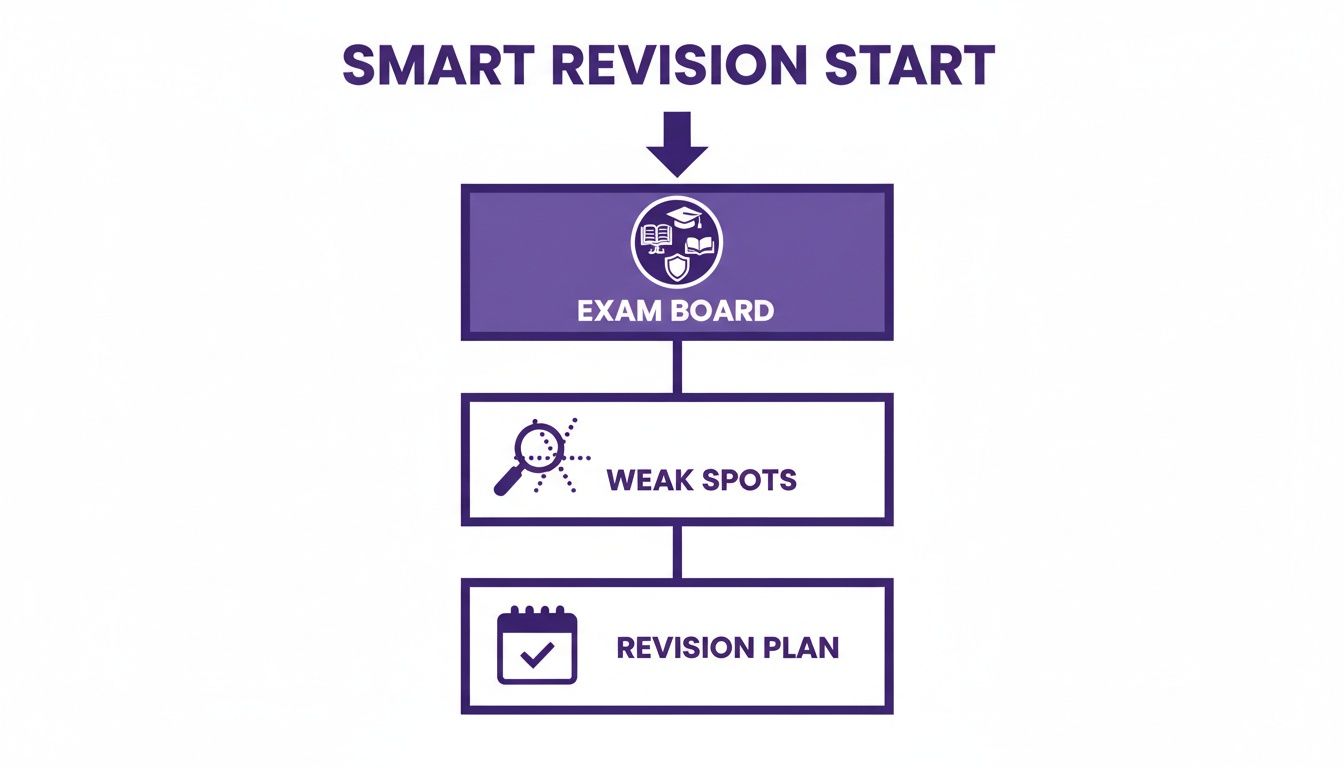
As you can see, it all begins with knowing your exam board inside-out. From there, you can pinpoint your weak areas and build a plan that truly works.
Creating Your Topic Priority List
Now let’s get practical. It’s time to take your 'Red' and 'Amber' topics and sort them into a clear priority list. This isn’t about ignoring things; it’s about being smart with your time.
Tier 1: Must-Knows. These are the non-negotiables. They show up on nearly every paper and carry big marks. Think core Algebra skills like solving equations for Higher Tier, or fundamental Number work like fractions and percentages for Foundation.
Tier 2: Should-Knows. These topics appear regularly and are essential for securing a solid grade. This is where you’ll find things like Probability, Transformations, and Ratio & Proportion.
Tier 3: Could-Knows. These are the less frequent or trickier topics that can push you over a grade boundary. Things like Vectors or complex Circle Theorem proofs fall into this category.
The game plan is simple: get completely confident with your 'Must-Knows' before you even think about dedicating serious time to the 'Could-Knows'. This secures the foundation of your grade first.
To get this organised, use the framework below. Grab a notebook or open a spreadsheet and build a table like this—it will quickly become the master plan for your entire revision schedule.
GCSE Maths Topic Prioritisation Framework
Use this table to organise your revision topics based on their importance and your current confidence level. This helps create a targeted study plan.
| Priority Tier | Description | Example Topics (Based on Analysis) | Your Action |
|---|---|---|---|
| Must-Know (Tier 1) | High-frequency, high-mark topics. These are the foundations of your grade. | Algebra (Equations, Sequences), Number (Fractions, Percentages) | Revise these first and practise until you are 100% confident. |
| Should-Know (Tier 2) | Regular topics that build on the basics. Crucial for moving up grade boundaries. | Ratio & Proportion, Geometry (Area, Volume), Basic Statistics | Focus on these after mastering Tier 1. Aim for 80-90% confidence. |
| Could-Know (Tier 3) | Less common or more difficult topics. Good for securing top grades but a lower priority. | Vectors, Circle Theorems, Advanced Trigonometry (e.g., Sine/Cosine Rule) | Tackle these once Tiers 1 & 2 are solid. Don't panic if they don't click immediately. |
Using this tiered system turns a mountain of revision into manageable hills. You're no longer just "revising maths"; you are strategically building your knowledge base, one priority topic at a time. This methodical approach is the secret to effective revision, ensuring every study session is productive and moves you closer to your target grade.
Mastering Active Recall and Spaced Repetition
If your main revision strategy involves rereading your textbook or highlighting notes, I’m going to ask you to stop. It feels productive, I know, but it’s one of the least effective ways to actually remember anything long-term. This is what we call passive learning, and it’s the reason topics you covered in February feel completely alien by the time May rolls around.
To make your revision truly stick, we need to shift to two powerful, science-backed techniques: active recall and spaced repetition. In simple terms, active recall is forcing your brain to pull information out of your memory, while spaced repetition involves revisiting that info at clever intervals. Let's break down how you can actually use these for GCSE Maths.
Forcing Your Brain to Remember with Active Recall
Active recall is the difference between vaguely recognising a formula and knowing exactly how to apply it to solve a problem. It’s all about retrieving knowledge, not just passively looking at it. The research is clear: active recall can double how much information you retain compared to just reading.
Here are a few simple, maths-specific ways I’ve seen work wonders.
The 'Blurting' Technique
This method is brilliantly simple but unbelievably effective. First, pick a topic—let's say, 'Quadratic Equations'. Set a timer for just five minutes and on a blank piece of paper, scribble down absolutely everything you can remember about it. Formulas, methods, key terms, example questions, common mistakes… anything that comes to mind.
When the timer pings, grab your textbook or notes and a different coloured pen. Compare what you wrote to the official material. Fill in the gaps and correct any mistakes in the new colour. This gives you an instant, visual map of what you know well and, more importantly, what you don't.
Smarter Flashcards
Don't just write a formula on one side and its name on the other. That’s too easy. Create flashcards that force you to think.
- Front: "What are the three essential steps for solving an equation with the quadratic formula?"
- Back: List the steps: 1. Rearrange the equation into the form ax² + bx + c = 0. 2. Substitute your a, b, and c values into the formula. 3. Solve to find the two possible values for x.
Teach the Concept
This is a classic. Try explaining a topic, like how to find the area of a trapezium, to a friend or a family member. You can even just explain it to your wall! If you can articulate it clearly enough for someone else to understand, you've truly got it. The moment you stumble or they look confused, you’ve found a weak spot in your own understanding.
Locking in Knowledge with Spaced Repetition
So, you're now actively recalling information. Great. But how do you stop it from vanishing a week later? This is where spaced repetition comes in. The whole idea is to review a topic at increasing intervals, right at the point when you’re about to forget it.
This isn't about cramming; it's about smart, strategic scheduling. Revisiting a topic for a few minutes a day later, then three days later, then a week later, is far more powerful than reviewing it four times in one afternoon. This is how you transfer knowledge from your short-term to your long-term memory.
A structured plan makes a massive difference here. For instance, Edexcel's own 6-week revision programmes for GCSE Maths have shown grade improvements of 12-18% in mocks. Why? Because structured practice directly tackles the "retention gap"—a major factor in why an estimated 68% of GCSE resits end in failure, according to Ofqual. You can read more about Pearson's findings on structured revision programmes.
Combining Active Recall and Spaced Repetition
The real magic happens when you bring these two methods together. Here’s what a practical schedule could look like for a new topic you’ve just revised using blurting or flashcards:
- Day 1: Learn the topic using active recall.
- Day 2: Do a quick review (maybe 5-10 minutes of practice questions).
- Day 4: Another quick review session.
- Day 7 (One week later): Try a few past paper questions on this specific topic.
- One month later: Make sure it’s included in a mixed-topic revision session.
This systematic approach is how you ensure the hard work you put in now actually pays off in the exam hall. It turns your brain from a messy pile of forgotten notes into a well-organised library where every piece of information is easy to find when you need it most. It's a cornerstone skill in learning how to revise for GCSE Maths effectively.
Using Past Papers and Mark Schemes the Right Way
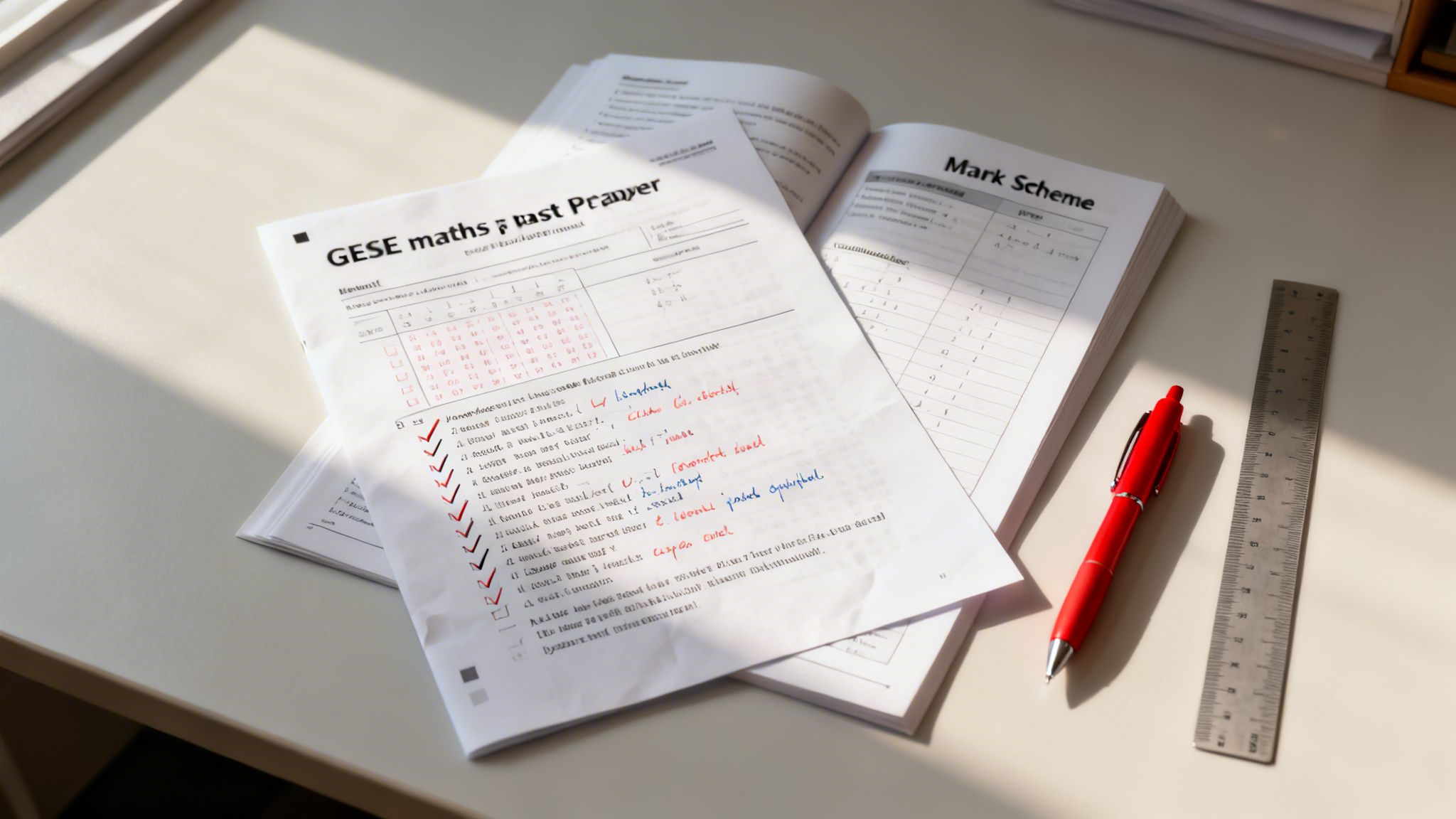
Past papers are, without a shadow of a doubt, the most powerful tool in your revision kit. But here’s a secret not everyone gets: just doing them isn’t enough. The real, grade-boosting progress happens when you learn how to use them as a diagnostic tool.
Think about it. Just doing a paper and seeing you got 60% is like weighing yourself but never changing what you eat. You know the number, but you have no clue how to improve it. We’re going to fix that.
Let’s walk through how to squeeze every last drop of value out of a past paper, turning it from a simple test into the very core of your learning strategy.
Treat It Like the Real Thing
First things first, you need to mimic the real exam environment as closely as you can. This isn’t just about testing your knowledge; it’s about building the mental stamina to perform when the pressure is on.
You don't need to do this every single time, especially in the early days of revision, but it's a skill you should build up.
- Time Yourself: Get a timer and set it for 90 minutes. This is non-negotiable for getting your pacing right.
- No Distractions: Phone in another room, music off, door closed. Let your family know you're in an exam.
- Use the Right Equipment: Have your black pens, a sharp pencil, ruler, protractor, compass, and calculator (if it's a calculator paper) ready to go. No revision notes, no textbook, no safety nets.
It feels a bit intense at first, but it's the only way to get an honest snapshot of where you really are. You'll quickly see if you're struggling with time, not just the questions themselves.
The point of a timed paper isn’t to score 100%. It's to create a realistic picture of your performance under exam conditions. The real work starts once that 90-minute timer goes off.
Become the Examiner and Use the Mark Scheme
This is where the magic happens. Once the time is up, don’t just count your correct answers and move on. You need to put on your examiner's hat and dig into the official mark scheme. This is often the most neglected step, but it’s the most important.
Mark schemes can look a bit cryptic, but they're a window into how examiners think. They show you precisely where marks are won and lost.
Pay close attention to these codes:
- M marks (Method marks): Awarded for showing a valid method. You can get these even if a slip-up in your calculation leads to a wrong final answer. This is huge—it proves showing your working is essential.
- A marks (Accuracy marks): These are for the right answers, but you often can't get them without the connected method (M) mark. They are a team.
- B marks (Independent marks): Given for a correct answer or statement, no matter the working shown.
By marking your own paper, you'll start spotting your personal patterns. Are you constantly dropping marks for forgetting the units? Getting the method right but making silly arithmetic mistakes? This is the kind of specific feedback that leads to real improvement.
Turn Mistakes into a To-Do List
Every single mistake you find is a gift. Seriously. It’s a bright, flashing signpost showing you exactly what to work on next. Grab a notebook or open a spreadsheet and create your "Error Log."
For every question where you dropped marks, note down three things:
- The Topic: e.g., "Solving simultaneous equations" or "Circle theorems."
- The Reason for the Error: Be brutally honest with yourself. Was it a daft mistake (like a sign error)? Did you forget a formula? Or did you just have no idea how to even start the question?
- The Action: What are you going to do about it? This needs to be a concrete action, like "Redo 10 practice questions on this" or "Watch a tutorial video and make notes."
This process transforms a potentially discouraging score into an actionable revision plan. Instead of feeling down, you now have a clear set of priorities for your next study session. This focused approach is the key to revising for GCSE maths effectively.
Use Topic-Specific Questions for Targeted Practice
Once your error log has flagged a weak area—let's say, trigonometry—it's inefficient to just do another random past paper hoping it comes up. It's time to drill down.
This is where resources offering topic-specific questions from GCSE Past Papers and other question banks are your best friend. Hunt down 10–15 questions just on trigonometry and work through them systematically. This focused practice builds skill and confidence way faster than jumping between topics.
The data backs this up: combining topic-specific practice with analysis of exam trends can boost GCSE Maths results by an average of 1.5 grades. For instance, if analysis of the 2025 Edexcel papers shows a lot of Statistics on Paper 2, it hints that other key areas are more likely to be tested heavily on the other papers. Platforms like Physics & Maths Tutor have brilliantly categorised questions, while MasteryMind's drills boast 98.7% alignment with exam board mark schemes. For more ideas, you can see how revision activities can shape your approach on colleenyoung.org. This smarter, data-led approach ensures you’re always working on what matters most.
Nailing Your Exam Day Technique and Mindset
You can know Pythagoras’ theorem inside out, but if you panic when the exam clock starts, all that revision goes out the window. Getting the grade you deserve is as much about exam technique as it is about knowing the actual maths.
This isn’t just about feeling a bit calmer. It's about having a solid game plan for the moment you turn over that paper. Let’s break down the practical strategies that will help you turn your hard work into marks on the page.
Before You Even Pick Up Your Pen
The first few moments in the exam hall can make or break your performance. Before you even think about writing your name, just take a couple of deep, slow breaths. Seriously. It’s a simple trick that helps calm that first rush of adrenaline and focus your mind.
Now, spend the first two or three minutes just flicking through the entire paper. Don't answer anything. This isn't wasted time; it’s reconnaissance. You’re giving your brain a preview of what's ahead, mentally spotting the questions that look like easy wins and flagging the ones that might need more thought. It’s like glancing at the map before you start the journey.
Managing the Clock Like a Pro
The fear of running out of time is probably the biggest cause of panic in a maths exam. You've likely heard the ‘one minute per mark’ rule. For a 90-minute paper with 80 marks, that’s a decent guideline, and it even gives you a small buffer.
A smarter approach, though, is to be flexible. Don't feel you have to tackle the paper in order. Flick to a couple of those questions you spotted earlier that you feel confident about. Bagging those first 5-10 marks is a huge confidence boost and gets your brain working.
If you hit a tricky 4-mark question and you're still completely stumped after a few minutes, circle it and move on. It makes far more sense to bank marks on questions you can do than to burn precious minutes on one problem. You can always come back to it later.
Your job in the exam isn't to answer every question in order. It's to collect as many marks as possible in 90 minutes. A mark on question 21 is worth exactly the same as a mark on question 1.
Smart Tactics for Calculator and Non-Calculator Papers
The two papers require a slightly different approach. Adapting your technique is a non-negotiable skill if you're figuring out how to revise for GCSE maths.
H3: Calculator Papers
- Use it for everything. Don’t risk silly errors by doing simple sums in your head. Use the calculator for basic addition and subtraction to be safe.
- Know your machine. Make sure you’re comfortable with all its key functions. Can you input fractions or use the standard form button without thinking? Fumbling with your calculator costs you time.
- Do a "sense check". Once you have an answer, quickly ask yourself, "Does that number seem reasonable?" If you're calculating the height of a flagpole and get 0.2cm, you’ve probably made a mistake.
H3: Non-Calculator Papers
- Estimation is your best friend. Before diving into a calculation like 48.9 x 21.3, round it to 50 x 20 in your head. The answer is 1000. Your final, precise answer should be in that ballpark.
- Show all your working. Without a calculator, your written steps are the only way an examiner can see your thought process. This is where you pick up vital method marks, even if your final answer is wrong.
Keeping a Cool Head
Exam anxiety is very real. If you feel your mind going blank or your heart racing, just pause. Put your pen down, close your eyes for 20 seconds, and focus on your breathing. Remind yourself that you've done the revision and you know this stuff.
Building this kind of mental resilience starts long before exam day. It comes from practising under realistic conditions. Using tools that simulate the pressure, like a dedicated Exam Practice for GCSE feature, helps you get accustomed to that pressure in a low-stakes way. That’s how you build the focus needed to stay on track for the full 90 minutes and confidently tackle whatever the paper throws at you.
Your GCSE Maths Revision Questions Answered
You’ve got a plan and you're learning the techniques, but revision always throws up a few nagging questions. Whether you're a student trying to iron out the last few details or a teacher looking for clear advice for your class, I’ve put together some straightforward answers to the questions I hear most often.
Let's clear up some of those common worries so you can get back to what matters: effective practice.
How Many Hours a Week Should I Revise for GCSE Maths?
This is the big one, but honestly, there’s no magic number. The quality of your revision is far more important than the sheer number of hours you put in. Cramming for hours on end is usually less effective than shorter, sharper bursts of focused work.
A good goal to aim for is three to five focused sessions a week, with each session lasting around 45 to 60 minutes. That’s enough time to dig into a topic properly without hitting a wall and burning out.
The real secret is to give every single session a specific goal. Don't just vaguely decide to "do some maths." That's how you end up wasting time.
- A weak plan: Revise maths for 1 hour.
- A strong plan: Monday evening: Spend 45 mins using active recall on Trigonometry formulas, then 15 mins trying three related past paper questions.
This simple shift makes your time far more productive. It also helps you track what you’ve covered and ensures you're revisiting topics consistently, which is exactly what you need for long-term memory.
What Is the Best Way to Revise for the Non-Calculator Paper?
The non-calculator paper is designed to do one thing: test your fundamental number skills. It's where the examiners find out if you truly understand the mechanics of maths without a machine doing the heavy lifting for you.
Your revision, then, needs to be laser-focused on these core areas:
- Mental Arithmetic: You need to be quick and accurate. Get your times tables, addition, and subtraction razor-sharp.
- Fractions, Decimals, and Percentages: Fluency is everything. Practise converting between them and doing calculations until it becomes second nature.
- Estimation: This is a seriously underrated skill. Before you even try to work out something like 39.8 × 5.1, get a rough idea in your head (40 × 5 = 200). This acts as a brilliant sense-check for your final answer.
- Core Methods: Dust off and practise your long multiplication and division. Don't let these fundamental skills be the reason you drop easy marks.
Whenever you tackle a past paper, do the non-calculator ones under strict exam conditions—put your calculator in another room. This will quickly highlight any weak spots in your mental maths.
The non-calculator paper is a test of your foundations. A solid grounding in number work won’t just score you marks here; it will make you faster and more confident on the calculator papers, too.
How Can I Stop Making Silly Mistakes?
Ah, the "silly mistake." We've all been there. It’s incredibly frustrating because it’s rarely about not knowing the maths. These errors usually creep in because of stress, rushing, or a momentary lapse in focus. The good news is, you can absolutely train yourself to make fewer of them.
The single most powerful habit you can build is checking your work. Don't just finish a question and race to the next one. Invest an extra 30 seconds to reread the question. Did you answer what it actually asked? Did it ask for two decimal places? Did you remember to include the units?
Another brilliant technique is to keep an Error Log. When you mark a past paper, don’t just look at the red crosses and move on. Analyse the mistake. Write down exactly what happened (e.g., "forgot the negative sign in the quadratic formula," or "misread 'perimeter' as 'area'"). After a few papers, you'll start to see patterns, and that awareness is the first step to stopping them for good.
How Do I Get the Marks for 'Show Your Working' Questions?
Examiners can't read your mind, so you need to show them your thought process. This is particularly vital for method marks (often labelled 'M1' or 'M2' on mark schemes). You can pick up a surprising number of marks for using the correct method, even if a slip-up means your final answer is wrong.
Think of it as telling the story of how you solved the problem. Write down every stage of your calculation, logically and clearly.
When you review mark schemes, pay very close attention to where those 'M' (method) and 'A' (accuracy) marks are awarded. It’s like getting a direct peek into the examiner's brain. You'll learn precisely what they are looking for and can start structuring your own answers to tick those same boxes. Never throw away these valuable marks.
Ready to put this advice into action? Stop passively reading and start actively revising with a tool designed to mirror your real exams. MasteryMind provides unlimited, curriculum-aligned practice questions that adapt to your level, give you instant examiner-style feedback, and help you track your progress topic by topic. Start building your confidence for free today at https://masterymind.co.uk.
Ready to master this topic?
Practise with quizzes, blurt exercises and exam questions on MasteryMind.
7 days Premium · Then free forever · No card, no charge