A* Guide: How to Write Methodology for GCSE & A-Level
You've probably got a coursework brief open, a half-written document, and a methodology section that still says something like “I will do a survey and analyse the results”. That's normal. Most students get stuck here because methodology sounds more complicated than it is.
The good news is that this part is more learnable than people think. It isn't about sounding clever. It's about understanding what examiners want, then giving it to them clearly. If you know how to write methodology in a way that matches UK mark schemes, this section stops being awkward filler and starts becoming one of the easiest places to pick up marks.
Teachers usually spot the same problem straight away. Students describe what they did, but they don't explain why they chose that method. That gap matters because recent data from the UK Department for Education shows that 68% of GCSE candidates fail to articulate rationale for methods in research-based questions, while 82% of UK revision resources omit this alignment with exam board expectations according to this analysis of the research gap in methodology guidance.
Why Your Methodology Is a Secret Goldmine for Marks
A lot of students treat methodology like admin. They rush through it because the “real marks” must be in the analysis or conclusion. That's a mistake.
Examiners like methodology because it has rules. If your introduction is a bit clunky, that can be hard to rescue. If your analysis is weak, improving it takes practice. But methodology is different. You can learn the structure, apply it, and instantly sound more secure.
The bit most students miss
For AQA, OCR and Edexcel, a decent method description gets you only so far. Higher marks usually come from justification. That means explaining why your sample, design, equipment, controls, questions, timings, or data type were suitable for your aim.
Practical rule: if you write “I used...”, add “because...”.
That one habit changes the whole tone of your work. Instead of sounding like you randomly picked a method, you sound deliberate. That's what top-band responses tend to do.
Here's the difference:
| Weak version | Stronger version |
|---|---|
| I used a questionnaire. | I used a questionnaire because it made it possible to collect comparable responses from several participants in the same format. |
| I chose Year 11 students. | I chose Year 11 students because they were directly relevant to the research question and easy to access within the time available. |
| I controlled the environment. | I controlled the environment to reduce outside variables that could affect the results. |
Why this is such a good place to recover marks
If you're behind on revision, methodology is still worth fixing because it rewards precision more than flair. You don't need to invent a genius idea. You need to show that your choices make sense.
If you're aiming high, this is also where you separate yourself from students who only describe steps. A justified methodology tells the examiner you understand the logic of the investigation, not just the order of events.
A lot of generic advice online misses this UK-specific exam focus. That's why students often end up with “correct” methods that still don't score as highly as they should. If you're revising coursework technique alongside content, tools built around board-specific practice such as AI Powered Revision can help you train that exam-style thinking.
The Blueprint Before You Build
Writing a methodology before you've nailed your aim is like writing a recipe before you know what dish you're cooking. You'll end up with steps that don't lead anywhere.
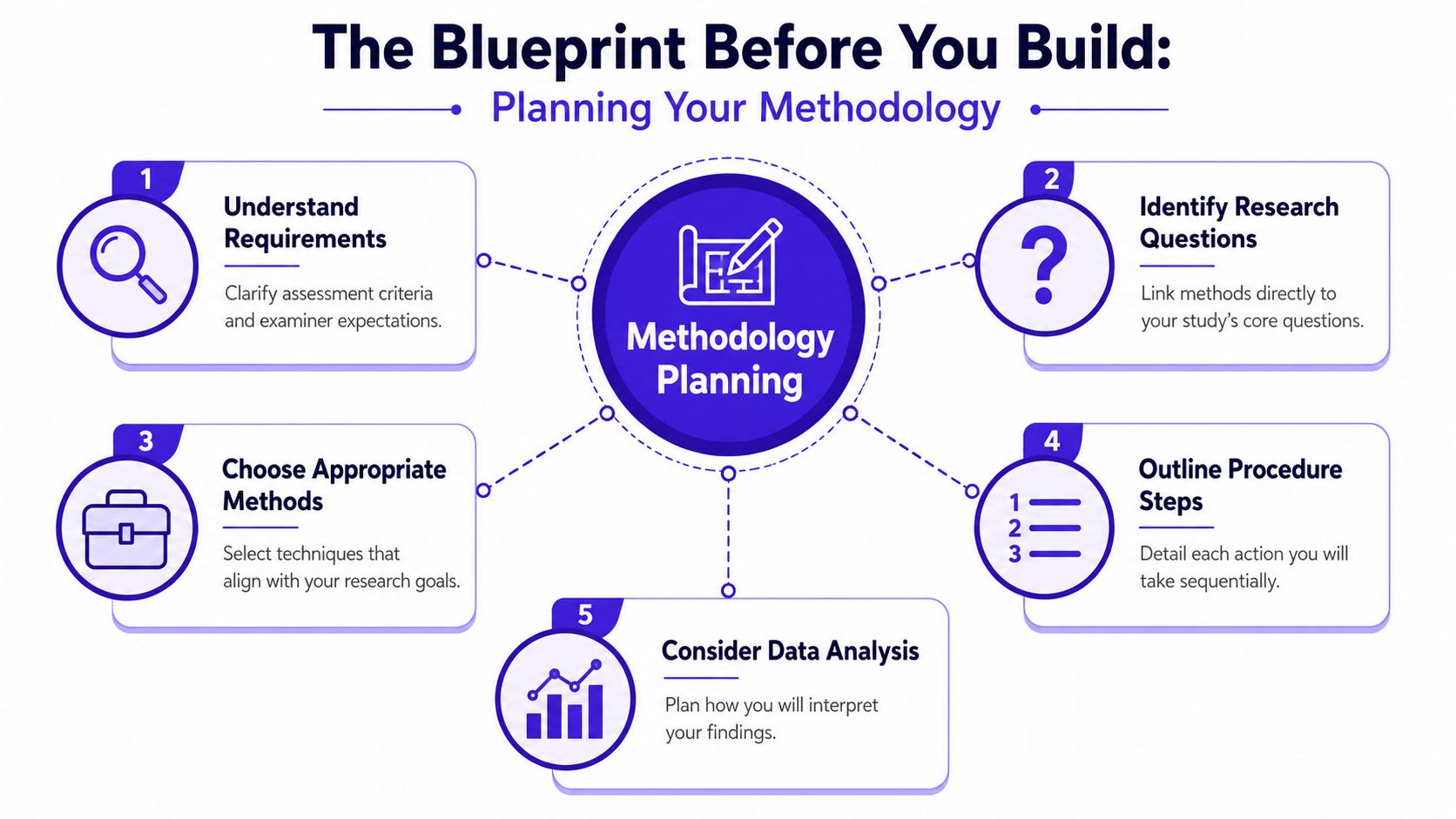
Start with the aim, not the method
Before you write a single line, answer these three questions in plain English:
- What am I trying to find out?
- What kind of evidence would answer that?
- What method gives me that evidence most clearly?
That order matters. Too many students start with “I'll do a survey” because it feels easy. But if your question needs detailed opinions, an interview might fit better. If you need measurable change, an experiment may be stronger. If you're spotting patterns between two things, a correlational approach may make more sense.
In university work, students often have to rewrite methodology several times because this planning wasn't sorted early. In UK higher education, 73% of students report that their methodology section was revised at least three times before acceptance, and failure to justify methodological choices leads to a 42% higher rejection rate for first-year submissions, according to guidance on dissertation methodology in the UK. The lesson applies at GCSE and A-Level too. A shaky plan creates a shaky method.
Match the method to the question
Try this simple matching frame:
| If your question is asking about... | A method that may fit |
|---|---|
| cause and effect | experiment |
| opinions or experiences | interview or questionnaire |
| patterns or relationships | correlational study |
| behaviour in a real setting | observation |
| place-based trends | fieldwork methods |
This isn't about forcing every subject into the same shape. It's about showing the examiner that your method follows from your aim.
If your method doesn't clearly answer your question, the examiner notices before they finish the paragraph.
Map the choices before writing full sentences
Use a quick planning grid:
Research question
What exactly are you investigating?Variables or focus
What will change, what will be measured, or what theme will be explored?Participants or sources
Who or what will provide the data?Data type
Will you collect numbers, words, observations, or a mix?Analysis plan
How will you make sense of what you collect?
This is also where it helps to look at examples of research strategies for content creators, not because you're writing content marketing, but because the breakdown between primary and secondary research is explained in a really usable way. Students often get marks down because they haven't thought clearly about what kind of evidence they're gathering.
Think like the mark scheme
For UK exam boards, a strong methodology usually has a visible chain of logic:
aim -> choice of method -> procedure -> data -> evaluation
If one part is missing, the section feels patchy. If every part links, the examiner can reward it.
If you want more subject-specific planning support before drafting, it's worth practising with UK exam preparation guides that are aligned to the way British courses assess method, evidence and justification.
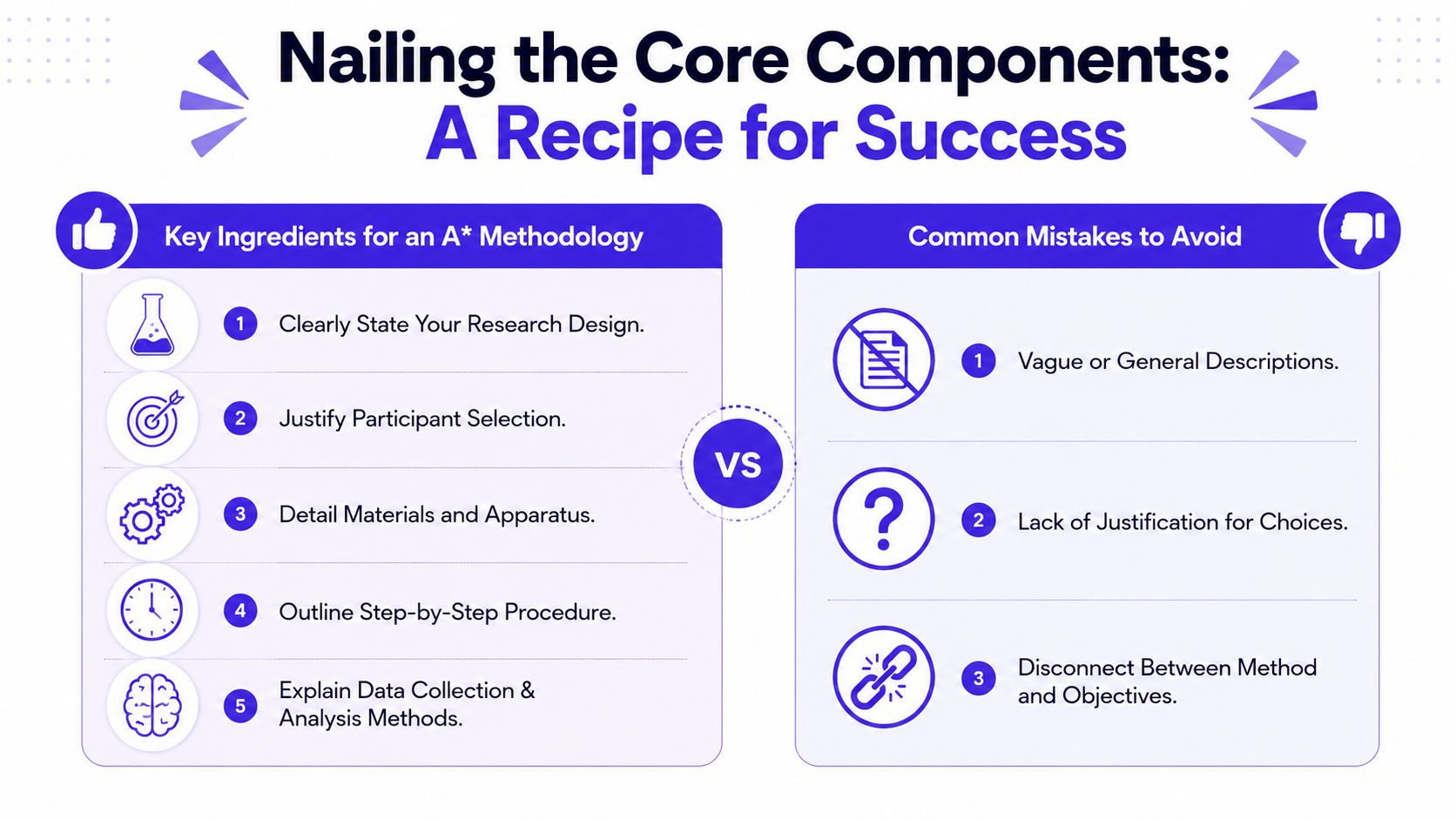
Nailing the Core Components a Recipe for Success
A strong methodology should read like someone else could pick it up and carry out the same investigation. That's why UK academic standards say the method section should function like a recipe, with precise criteria, exact specifications, and chronological steps so the work can be replicated and validated, as explained in this guide to UK academic writing standards.
Variables
If you're doing a scientific, psychological, or social-science style investigation, this is one of the first things the examiner looks for.
You usually need to identify:
Independent variable
What you changed.Dependent variable
What you measured.Control variables
What you kept the same so the results were fair.
A weak student sentence looks like this:
We changed the temperature and saw what happened.
A better version sounds like this:
The independent variable was temperature. The dependent variable was the time taken for the reaction to complete. The volume of solution, concentration, and apparatus used were kept constant as control variables to improve fairness.
That last phrase matters. Naming a control is good. Explaining why it matters is better.
Sampling
Sampling is where a lot of methodology sections become vague. Students write “we asked some people” and move on. That's too loose.
Include:
| What to include | What the examiner wants to know |
|---|---|
| who took part | the relevant group |
| how they were chosen | random, opportunity, purposive and so on |
| why that group was suitable | relevance to the question |
| any limitations | possible bias or narrow representation |
For example:
An opportunity sample of sixth form students was used because they were accessible during the time available. This was practical, but it may limit how far the findings can be generalised.
That single sentence does three jobs. It states the sample, justifies it, and evaluates it.
Materials and apparatus
This part is often underwritten. “We used a laptop and a questionnaire” won't impress anyone.
Be specific enough that another person could repeat the setup. If relevant, include:
Named equipment
Beaker, stopwatch, data logger, transect tape, Google Forms, voice recorder.Key settings or features
Timings, scales, question format, measurement units.Relevant conditions
Same room, same instructions, same time window, same source set.
In coursework subjects, clear writing matters here more than students expect. If your description is muddy, the whole method feels less reliable. A useful side read on that skill is mastering clear writing for professionals, because the same principle applies here. Clear sentence structure makes your method look more controlled.
Procedure
This is the heart of the section. Write it in logical order and make each step earn its place.
A reliable procedure usually includes:
Preparation
What was set up before data collection began.Instructions
What participants were told, or what the researcher did.Collection
How the data was gathered.Recording
How responses or results were stored.Repetition or consistency checks
How reliability was supported.
For many subjects, numbered steps work well because they force clarity. For example:
- Participants were given the same written instructions.
- Each participant completed the questionnaire individually.
- Responses were collected in the same lesson to reduce variation in conditions.
- Data was entered into a single spreadsheet for comparison.
- Results were grouped by response category and reviewed for patterns.
Data analysis
Students often forget this belongs in the methodology too. Don't stop at “we collected the data”. Explain what you did with it.
If you gathered numbers, say how you compared them. If you gathered written responses, say how you grouped or coded them. If you used mixed methods, explain how each type of evidence contributed to the final judgement.
Quick check: if your methodology ends before the examiner knows how you handled the data, it's incomplete.
A mini template you can adapt
Use this skeleton and swap in your own subject details:
The investigation used a [type of method] to explore [research aim]. The sample consisted of [participants or sources], selected using [sampling method] because [justification]. The independent variable was [x], and the dependent variable was [y]. Control variables included [a], [b], and [c] to improve validity. Materials included [specific tools or equipment]. The procedure was carried out in the following order: [brief step summary]. Data was recorded using [method] and analysed by [analysis approach].
That's how to write methodology without waffling. Specific, logical, repeatable.
Writing with an Examiner's Pen
Describing a method is safe. Justifying it is what pushes your work upward.
A lot of students get trapped in low-to-mid marks because they think a methodology is just a list. Examiners usually want more than that. They want evidence that you understand why the method was suitable, what its strengths were, and where its limits sit.
That matters if you're aiming high. Outcomes at grade 7 and above remained stable at 21.8% in 2025, meaning 78.2% of students were below that standard, according to Ofqual's GCSE and Level 1 and 2 results overview. One clear separator is depth of justification. Students who explain choices tend to sound more evaluative and more secure.
Turn description into justification
Compare these two lines:
- I used an online questionnaire.
- I used an online questionnaire because it allowed responses to be collected in a consistent format and made comparison between answers easier.
The second one sounds more thoughtful because it explains the method's value. That's the jump you want.
Use sentence starters like these:
- This method was selected because...
- This was more suitable than ... because...
- To improve reliability, the procedure...
- To reduce bias, participants were...
- This limitation means the findings may...
- This choice matched the aim because...
Write comments an examiner can reward
A handy trick is to justify at the point of mention instead of dumping evaluation at the end.
| Method feature | Better way to write it |
|---|---|
| sample | explain why that group fits the aim |
| control variable | explain how it protects validity |
| questionnaire | explain why it suits the data needed |
| repeat trials | explain how they improve reliability |
| secondary sources | explain why they are relevant and trustworthy |
That creates a method section with analysis built in.
The best methodology paragraphs don't just tell the examiner what happened. They quietly answer the question, “Why should I trust this approach?”
This kind of thinking becomes much easier when you practise exam-style responses and get used to AO-focused feedback. If you're working on extended responses, Exam Practice for A-Level is useful because it mirrors the move from simple recall into analysis and evaluation.
A quick model for AO3-style thinking
Use this three-part chain:
choice -> reason -> impact
For example:
A structured interview format was used because each participant needed to be asked the same core questions. This improved consistency and made the responses easier to compare.
That's simple, but it does real work.
A short explainer can help if you want to hear this style broken down verbally before you write your own:
What top-band methodology usually sounds like
It sounds calm. Specific. Reasoned.
Not dramatic. Not overcomplicated. Just controlled.
If your paragraph keeps answering “why this method?” and “how does this help the investigation?”, you're writing with the examiner's pen instead of your own panic.
Ethics Safety and Common Pitfalls to Avoid
The most painful lost marks are the avoidable ones. Not the huge conceptual mistakes. The silly ones.
That's especially frustrating when a secure pass matters. In Summer 2024, the overall GCSE pass rate at grade C/4 or higher was 67.6%, the lowest since 2019, according to Statista's UK GCSE pass rate summary. When a third of students are below that benchmark, preventable methodology errors matter more than people like to admit.
Ethics isn't optional
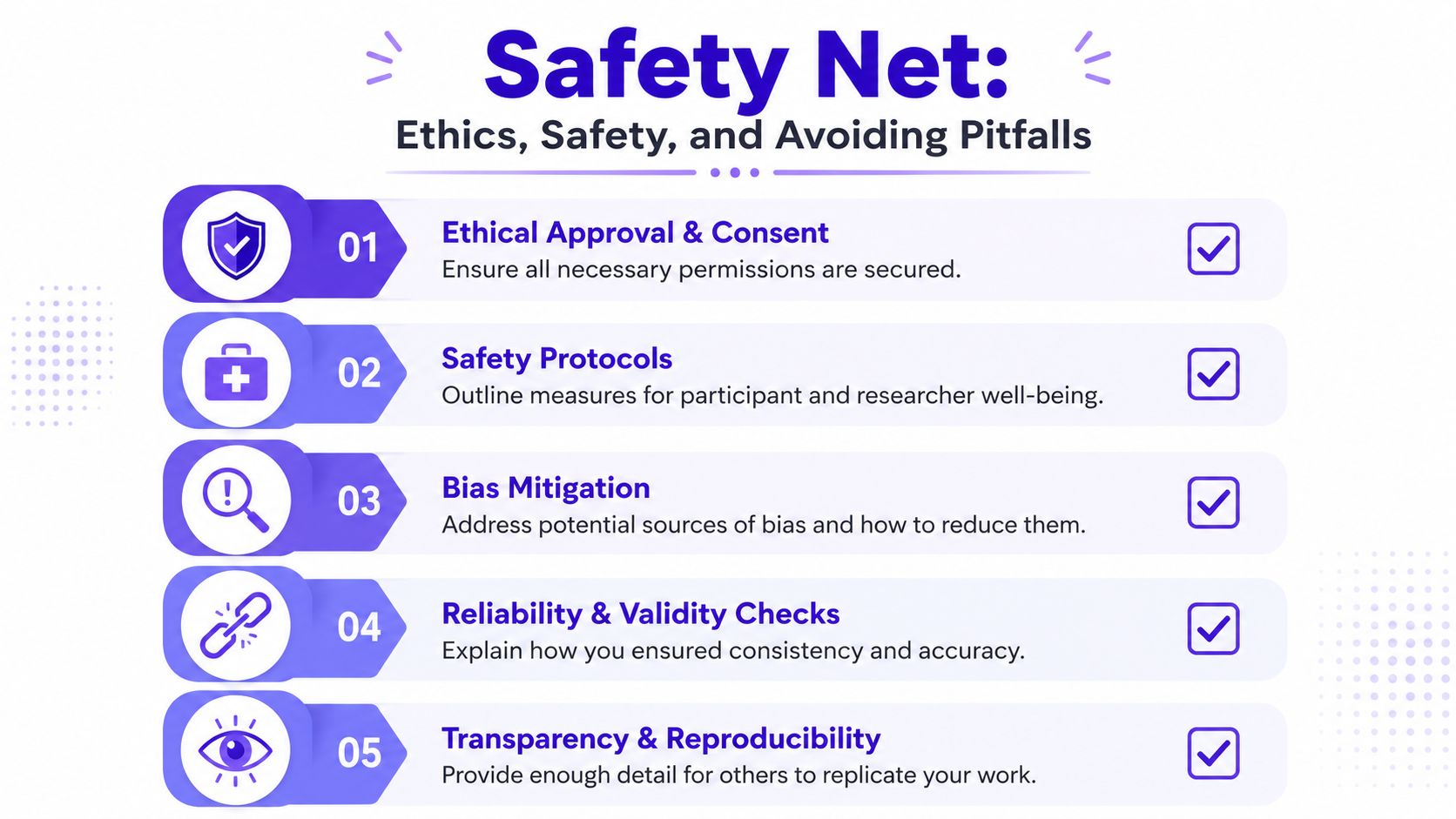
If people are involved, ethics should appear in your methodology, even briefly.
You may need to mention:
Consent
Participants agreed to take part.Confidentiality
Names were removed or anonymised.Right to withdraw
Participants could stop if they wanted.Protection from harm
The task did not put them under unfair pressure or risk.
For geography fieldwork, science practicals, psychology tasks, and sociology-style investigations, this instantly makes your method look more serious.
Safety needs to be concrete
Don't write “health and safety was considered” and leave it there. That says almost nothing.
Write exactly what was done. For example:
| Weak | Better |
|---|---|
| Safety was considered. | Goggles were worn during the practical and spills were cleared immediately. |
| Risks were reduced. | The fieldwork route was checked in advance and students worked in supervised groups. |
Common mistakes that drag marks down
Here are the ones I see all the time:
Being vague
“Some students answered questions” should become something precise about who, how, and why.Mixing method with results
Methodology says what you did. Results say what you found.Using the wrong tense
If the investigation has already happened, write it in the past tense.Forgetting limitations
A perfect-sounding method can look less believable than one that admits realistic limits.Ignoring bias
If your sample was narrow or convenient, say so.
Final check: if another student could not repeat your method from what you've written, it still needs work.
A fast pre-submission scan
Before handing it in, ask:
- Can someone else follow this exactly?
- Have I justified my main choices?
- Have I separated method from results?
- Have I covered ethics or safety where relevant?
- Have I admitted any fair limitations?
That quick check catches a lot.
Putting It All Together Examples and Final Polish
The easiest way to spot a strong methodology is to compare it with a weak one.
Before
I did a questionnaire with students to find out what they think about revision. I asked them questions and then looked at the answers. This was a good method because it was quick.
That isn't disastrous, but it's thin. It's vague about the sample, the design, the process, and the reason the method fits the aim.
After
A questionnaire was used to investigate students' attitudes towards revision methods because it allowed several responses to be collected in a consistent format. An opportunity sample of sixth form students was selected due to ease of access during the available time period, although this may limit how representative the findings are. All participants received the same questions in the same order to improve reliability. Responses were recorded anonymously to support honest answers and reduce pressure on participants. The data was then grouped by response type so patterns in revision preferences could be compared clearly.
Why the second version scores better
- It names the method clearly instead of vaguely saying “I did”.
- It justifies the method by linking it to the aim.
- It explains the sample and gives a limitation.
- It includes reliability and ethics in a natural way.
- It shows what happened to the data after collection.
Good methodology has three jobs. It shows your plan, proves your control, and justifies your decisions.
If you're editing your own work, keep those three words in your head: Blueprint. Build. Justify.
Blueprint means your method matches the question. Build means the section has all the working parts, written clearly enough to repeat. Justify means you explain why your choices were sensible in the eyes of the examiner.
That's the essence of writing methodology well. You're not writing to sound academic for the sake of it. You're showing that you understand the rules of the game and can play them properly. If you do that, the section stops feeling scary and starts feeling winnable.
For extra practice comparing strong and weak exam responses, working through real A-Level Past papers helps because you start noticing exactly where justified method choices pick up marks.
If you want revision that matches how UK exam boards mark, MasteryMind is built for that. It gives GCSE and A-Level students examiner-aligned practice across AQA, OCR, Edexcel and WJEC, with feedback that breaks answers down by assessment objective. That makes it useful whether you're trying to recover a grade fast, push into the top band, or give your students more structured support without generic AI waffle.
Ready to master this topic?
Practise with quizzes, blurt exercises and exam questions on MasteryMind.
7 days Premium · Then free forever · No card, no charge