IGCSE Chemistry Past Papers: Your Ultimate 2026 Guide
You've probably got one of two feelings right now.
Either Chemistry has crept up on you and the words “I'll start past papers tomorrow” have been doing a lot of work. Or you're already revising hard, but you want to stop wasting time on random papers that leave you tired and not much smarter.
Both situations are fixable.
IGCSE Chemistry past papers can feel brutal because they don't just test what you know. They expose what you only half know, what you panic on under time pressure, and where your wording is too vague to earn marks. That's exactly why they're so useful. Used properly, they're less like a final judgement and more like a diagnostic tool.
A lot of students treat past papers like a punishment phase at the end of revision. That's the wrong way round. The smarter move is to use them to guide revision from the start, so every mistake tells you what to study next.
Why Past Papers Are More Than Just a Test Run
Students often think past papers are for the final stretch only. That's why so many leave them until they're already stressed, then get discouraged by a low score and conclude they're “bad at Chemistry”.
Usually, the actual problem isn't Chemistry. It's the method.
What past papers actually do
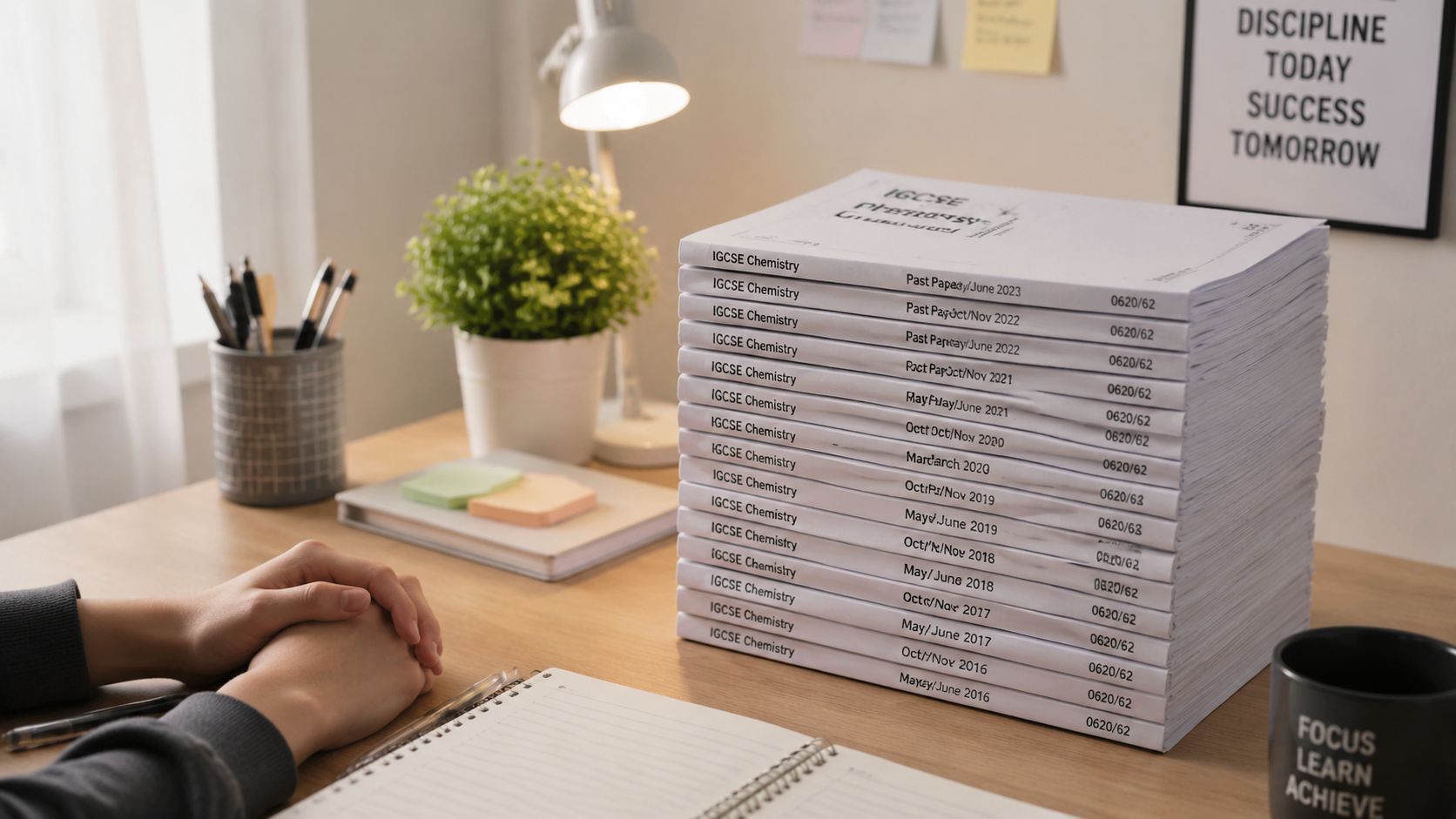
A good IGCSE Chemistry past paper shows you three things at once:
- Content gaps: You thought you knew electrolysis until one question asked for the product at an electrode and your brain went blank.
- Technique gaps: You knew the idea, but the mark scheme wanted a more precise term.
- Pressure gaps: You can answer at home with notes open, but not when the clock is running.
That's why past papers matter so much. They reveal the difference between recognition and recall. Reading a notes page and thinking “yes, I remember this” is not the same as producing the answer cold.
Practical rule: A wrong answer in a past paper is useful only if you can name the reason it went wrong.
Why Chemistry is especially sensitive to exam technique
Chemistry punishes fuzzy wording more than many students expect. In class, a teacher may understand what you meant. In an exam, the wording on the page has to match what the mark scheme rewards.
That's also why random paper grinding isn't enough. If you keep making the same mistakes in equations, practical questions or command words like describe, explain and state, doing more papers without review just repeats the error.
A better mindset is this:
- Use papers to find patterns
- Turn those patterns into target topics
- Practise those topics until the weakness shrinks
- Return to papers and test again
If you're behind, this gives you a comeback route. If you're aiming high, it gives you a cleaner route to top marks.
Finding Your Exam Goldmine Where to Get Official Papers
The first trap is using the wrong materials. Students download whatever turns up first, then revise from papers that don't match their syllabus, paper type, or current question style.
Start with official resources where possible.
What you need to collect
For each paper set, try to get all three:
- Question paper: This is the exam itself.
- Mark scheme: This shows what examiners reward.
- Examiner report: This explains the mistakes students commonly make.
If you only use the paper, you miss the lesson. If you only read the mark scheme, you miss the pressure and structure of the actual exam. You need both.
Cambridge papers and why they matter
Cambridge International makes previous-session papers publicly available through its past-paper archive, and registered schools can access teaching and learning materials including papers from 2018 onward through the School Support Hub, which makes this a long-running and documented part of the Cambridge assessment system for UK learners and schools through the Cambridge past-paper archive.
Cambridge IGCSE Chemistry also publishes official past papers, examiner reports and specimen exams, and it warns that older papers may not reflect the current syllabus. That means recent papers should carry more weight in your revision choices than very old ones.
For broader paper browsing, it also helps to keep a clean bank of subject links such as GCSE Past Papers, especially if you're comparing resources across subjects and boards.
Build one organised folder, not chaos
Don't leave papers scattered across downloads, tabs and screenshots. Make one simple folder system:
| Folder | What goes in it | Why it helps |
|---|---|---|
| Recent papers | Your newest, syllabus-safe papers | Best match to current expectations |
| Older practice papers | Older archived papers | Extra question variety |
| Mark schemes | Matching schemes for each paper | Fast self-marking |
| Examiner reports | Official comments on common errors | Helps you spot repeated traps |
| Topic mistakes log | Your own weak areas | Turns practice into a plan |
One common mistake
Students often print a huge stack and feel productive before they've answered anything.
That isn't revision. That's admin.
Your paper bank should reduce decisions, not create them.
If you're a teacher or parent helping a student, this part matters more than it seems. A tidy set of current, clearly labelled papers removes friction. That alone makes regular practice far more likely.
Your Strategic Approach to Past Papers
The worst way to start is with a full timed paper from some random year, then a dramatic sigh when the mark is lower than expected.
That's not a fair test of what you know. It's a stress test of everything you haven't yet organised.
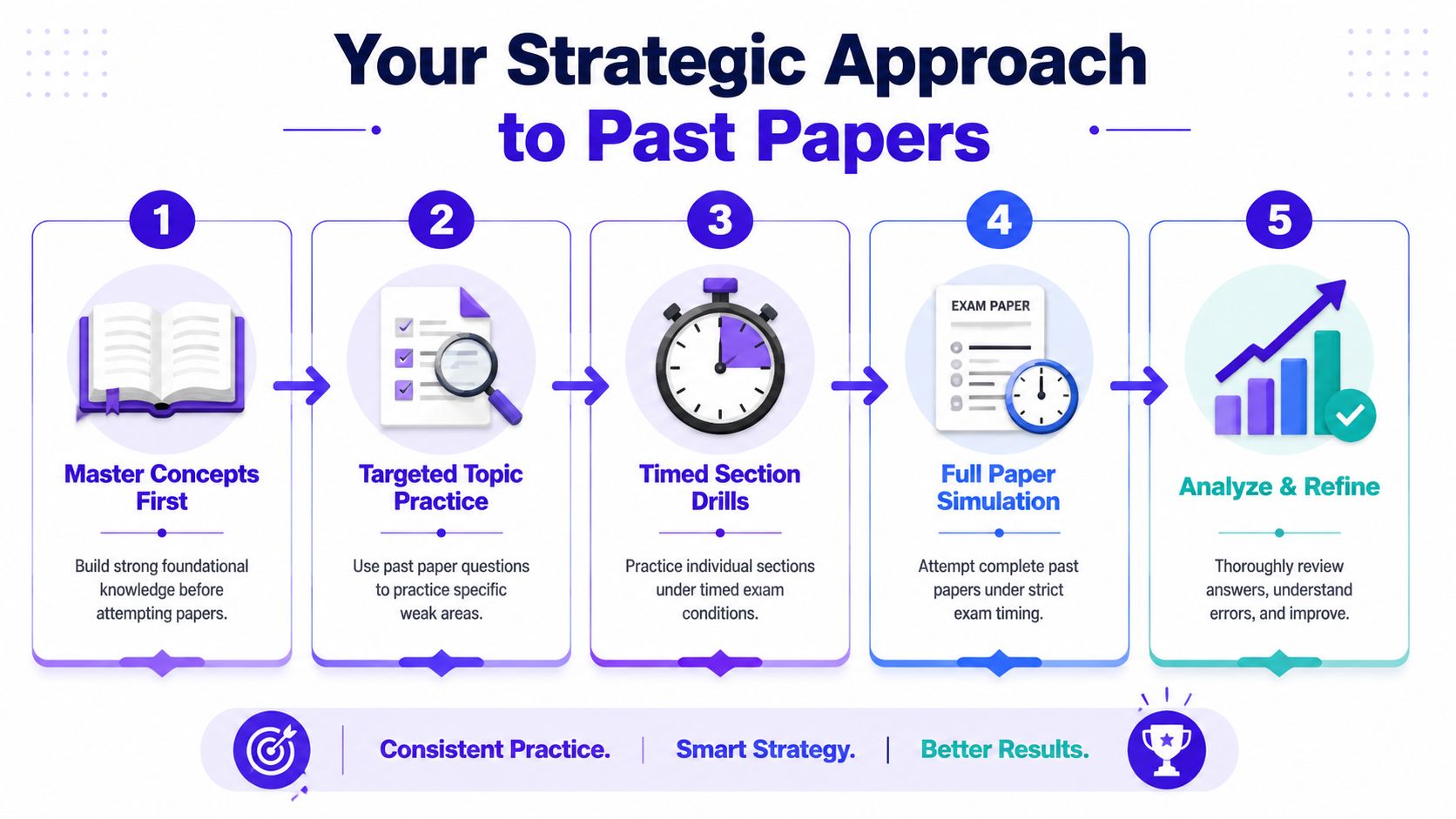
Revision guidance for IGCSE Chemistry points to a better workflow. Past-paper practice works best when it starts topic by topic first, then moves to full papers later. The recommended sequence is to learn a topic, drill targeted questions, and then move into paper-specific practice because Chemistry mark schemes reward very specific terminology, as explained in this IGCSE Chemistry past paper revision guide.
The learn, drill, apply model
Think of your revision in three phases.
First, learn the content. That means notes, flashcards, worked examples, diagrams, definitions, and whatever else helps you understand the topic.
Then drill it using past-paper questions from that single topic. If acids and salts are weak, don't do a whole paper. Hunt only acids and salts questions until the pattern becomes familiar.
Then apply it in mixed or full papers, where your brain has to choose the method without being told the topic in advance.
Why topic-first beats panic-first
A full paper hides too many variables at once. If you get a question wrong, was it because:
- you didn't know the content?
- you rushed?
- you misread the command word?
- you forgot a formula?
- you gave the right idea in the wrong words?
With topic-first work, you isolate the problem. That makes fixing it faster.
A useful comparison comes from other exam systems too. Even outside Chemistry, structured preparation works better than random practice. You can see the same logic in this Texas STAAR Grade 3 roadmap, where preparation is broken into manageable stages rather than one giant leap into test mode.
A simple weekly sequence
Try this pattern for a single weak topic:
- Review the content
Write out key facts, equations, definitions and diagrams from memory. - Answer a small set of targeted questions
Keep your focus narrow. One topic. One paper type if possible. - Mark with care
Don't just count marks. Identify the exact missing word, step or idea. - Redo similar questions
Test whether the mistake has been corrected. - Mix it into broader practice
Only then put it back into a full paper setting.
If you can't explain why your answer lost marks, you haven't finished reviewing it.
Choosing the right paper type
Paper types matter. Multiple-choice practice tests recognition and quick discrimination. Theory papers test explanation, structure and calculations. Practical-style papers test method, observations and experimental thinking.
Students often over-practise the paper they dislike least. That's comforting, but not strategic.
If you're strong on recall but weak on practical planning, your revision should reflect that. If you're fine with facts but shaky on long explanations, spend more time writing full responses and less time only doing quick-fire questions.
Perfecting Timed Practice and Self Marking
At some point, you do need to sit the paper properly. No notes. No pausing. No checking an answer halfway through because you “just want to be sure”.
That's where exam skill gets built.
Timed practice isn't only about speed. It teaches control. You learn how long a calculation really takes, how much writing a practical question needs, and whether you're spending too long chasing one stubborn mark.
Set up the paper properly
Treat the session seriously enough that it feels different from homework.
- Clear your desk: Keep only the paper, pens, calculator and whatever the examination allows.
- Use one sitting: If you pause for snacks, messages or “just a quick check”, you've changed the task.
- Write full answers: Don't do half-sentences because “I know what I mean”.
- Keep rough work visible: Especially for calculations, so you can see where method breaks down.
Students who do this regularly stop feeling shocked by exam pressure. It becomes familiar.
Time management is a skill, not a personality trait
Some students think they're naturally fast or naturally slow. Usually, they just haven't trained timing in a deliberate way.
A sensible rule is to avoid getting trapped on one question. If a question is draining time, move on, bank easier marks elsewhere, then return. That habit shows up in many subjects, not just Chemistry. This guide on Master O Level Math time management explains the same principle clearly: controlled pacing beats emotional pacing.
For students who want exam-style sessions without printing every time, digital tools built for timed work can help too. Features like Exam Practice for GCSE are useful when you want a cleaner simulation and a faster review loop.
How to self-mark like an examiner
Most marks are regained at this point. Students rush marking because the hard part feels over. It isn't.
When you mark, don't ask only, “Did I get it right?” Ask better questions:
| Question to ask | Why it matters |
|---|---|
| Did I use the term the mark scheme rewards? | Chemistry often needs exact language |
| Did I answer the command word? | State is not the same as explain |
| Did I show enough working? | Method can matter, not just the final value |
| Did I include both action and result? | Common in practical and test questions |
| Did I lose marks through vagueness? | A familiar Chemistry problem |
Here's a useful habit. Mark in two colours.
Use one colour for content mistakes and another for exam technique mistakes. That shows you whether your problem is knowledge or presentation. Those need different fixes.
A student who keeps saying “I knew that” after marking usually didn't know it well enough to earn the mark.
Build a live error log
After every timed paper, write down:
- the topic
- the type of mistake
- the correct wording or method
- one action for next time
For example:
- Electrolysis
Mixed up products at electrodes. Relearn ion discharge rules and redo three questions. - Practical test question
Wrote the method but forgot the expected observation. Practise full test answers. - Rate of reaction explanation
Mentioned particles moving faster but didn't connect it clearly to successful collisions.
That error log is more valuable than the score by itself. Scores tell you where you were. Logs tell you what to do next.
Using Examiner Reports to Think Like an Examiner
A mark scheme tells you what earned marks on one question. An examiner report gives you something wider. It shows where students repeatedly slip, over-explain, under-explain, or answer a different question from the one on the page.
That's powerful because the same kinds of mistakes appear again and again.
Cambridge IGCSE Chemistry publishes official examiner reports, and Cambridge also warns that older papers may not reflect the current syllabus. So when you read reports, keep your revision tied to the latest specification and the more relevant paper sets in the official Cambridge IGCSE Chemistry archive.
How to read a report without getting lost
Don't read examiner reports like a novel. Scan for patterns.
Look for comments about:
- imprecise terminology
- common misconceptions
- missing steps in calculations
- weak practical descriptions
- misread command words
Then compare those comments with your own scripts.
If the report keeps flagging vague wording and your answers are also vague, that's not bad luck. That's a fixable pattern.
A useful way to apply them
Say a report comments that students often gave incomplete practical answers. You should then ask:
- In my own answer, did I include the method?
- Did I include the observation or expected result?
- Did I use exact scientific language, or did I rely on loose phrases?
That kind of review sharpens your answers quickly because it trains you to predict what an examiner is looking for before you write.
For students who want a cleaner way to compare answers against expected wording, it also helps to explore MasteryMind's mark schemes, especially when you want a more structured review than scribbles in the margin.
Examiner reports are like borrowing the examiner's frustration list before you sit the paper.
Teachers notice this immediately
When students use examiner reports properly, their answers start sounding more disciplined. They include the missing condition. They stop using vague filler. They answer the actual command word.
That's often the difference between “basically right” and “worth the mark”.
From Paper to Platform Bridging the Revision Gap
A past paper tells you where you're weak. It does not automatically fix the weakness.
That's the gap many students fall into. They do the paper, mark it, feel annoyed about redox or bonding or practical methods, then move straight to another paper and hope repetition alone sorts it out.
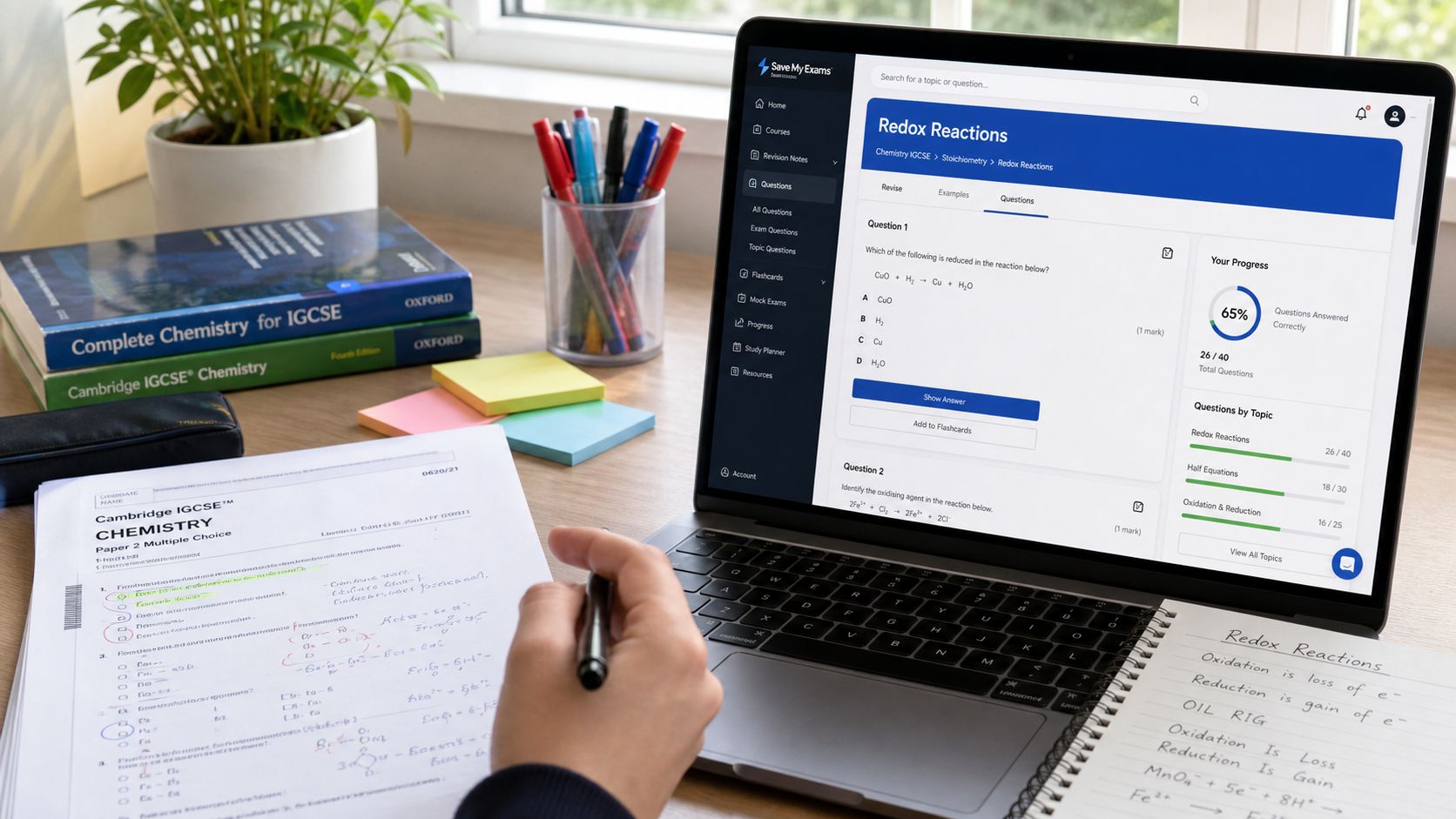
A more useful approach is to turn every mistake into targeted follow-up practice.
A key gap in many revision guides is exactly this problem. Generic advice often says “do more papers”, but doesn't really explain how to turn errors into focused revision when specifications and question styles shift. That's where structured digital practice and examiner-style feedback can help, as discussed in this Paper 6 resource overview.
What a hybrid method looks like
Use paper first. Then use digital practice second.
For example:
- You miss several questions on rates of reaction
- Your marking shows the issue is explanation wording
- Instead of doing another whole paper, you do a short run of targeted explanation questions on that topic
- Then you return to timed paper practice and check whether the issue is still there
That closes the feedback loop faster.
This is also why students often like interactive practice in other subjects. A good example is gamified online English practice, where quick feedback keeps learners engaged while targeting weak points. The same basic revision principle works in Chemistry. Short, focused correction beats endless unfocused repetition.
One practical use of AI revision tools
If your past-paper review says, “I keep losing marks on command words, practical descriptions and terminology,” a digital platform can help by serving more of exactly those question types.
One option is AI Powered Revision, which lets students move from past-paper diagnosis into topic-based practice with examiner-style feedback. Used properly, that doesn't replace papers. It sits between papers and helps you repair the problem the paper exposed.
Here's a useful walkthrough if you want to see a digital revision format in action:
Don't outsource your thinking
There's one warning here. Digital tools are only useful if you stay active.
That means you still need to ask:
- What exactly did I get wrong?
- Is this a content problem or a wording problem?
- Have I now fixed the weakness, or just seen another explanation of it?
The paper gives you evidence. The platform gives you repetition with direction. Together, that's far better than blindly doing one or the other.
Building Your Personalised Revision Timetable
A good revision timetable doesn't try to look impressive. It tries to be survivable.
If your plan says six hours a day, every day, with no weak-topic review and no paper-marking time, it's not a plan. It's fantasy. A timetable only works if you can repeat it.
Pick the version that matches your reality
If you're behind, you need a comeback plan with ruthless prioritisation.
If you're already fairly secure and want top grades, you need a longer cycle that mixes topic review, retrieval, full papers and repeated correction. The key difference isn't effort. It's how much time you have for refinement.
Sample IGCSE Chemistry Revision Schedules
| Phase | The Comeback Plan (4 Weeks) | The Grade 9 Plan (12 Weeks) |
|---|---|---|
| Phase 1 | Audit weak topics from one marked paper and your class notes. Pick a short list of priority areas. | Build a full topic map of the syllabus and sort topics into strong, shaky and weak. |
| Phase 2 | Spend most sessions on topic-first practice. Focus on weak definitions, equations, calculations and practical responses. | Work topic by topic with deeper note review, flashcards, retrieval practice and targeted past-paper questions. |
| Phase 3 | Add timed drills from specific paper sections. Practise writing complete answers under pressure. | Start mixing question types so you recognise the topic without being told it directly. |
| Phase 4 | Sit full papers in exam conditions. Mark carefully and update your error log after each one. | Sit full papers regularly, then return to weak areas for repair work before the next paper. |
| Phase 5 | Final stretch focuses on repeated mistakes only. Don't keep revising what you already know. | Final stretch focuses on precision. Tighten wording, improve consistency and revisit examiner-style traps. |
A weekly rhythm that works
For many students, a balanced week is better than a heroic one.
Try something like this:
- One or two sessions for content review
- Two sessions for targeted past-paper questions
- One timed section or full paper
- One review session for marking and error logging
That structure gives every task a purpose. It also stops you from mistaking activity for progress.
The best revision timetable is the one that keeps producing corrected mistakes, not crossed-off hours.
Keep adjusting as evidence changes
Your timetable shouldn't stay fixed if your errors change.
If practical questions keep causing problems, move more time there. If your multiple choice is solid but extended explanation is weak, stop overfeeding the comfortable area. Let your recent marked work decide the next block of revision.
That's where a lot of students turn a corner. They stop asking, “What should I revise today?” and start asking, “What did my last paper prove I need next?”
If you want a cleaner way to turn past-paper mistakes into targeted next steps, MasteryMind is worth a look. It's built for UK learners and can help you move from spotting weak areas to practising them in a more structured way, especially when you want examiner-style feedback without spending ages assembling questions by hand.
Ready to master this topic?
Practise with quizzes, blurt exercises and exam questions on MasteryMind.
7 days Premium · Then free forever · No card, no charge