Master the IGCSE Maths Edexcel Specification: Your Ultimate Guide
Staring at the Edexcel IGCSE Maths specification and feeling the dread set in? You're not alone. But that document, officially known as 4MA1, is your secret weapon. Seriously. It’s the blueprint for the entire exam, laying out exactly what you need to know to smash the grade you're after.
Your Secret Weapon for Acing IGCSE Maths
Let’s be real. The official Edexcel spec is not exactly a page-turner. It's dense, full of jargon, and looks intimidating. But here’s the inside scoop: every single question on your exam paper has to come from that document. It’s not a vague guide; it’s the non-negotiable checklist the examiners use.
Think of it as the rulebook for a game you desperately want to win. You wouldn't play blind, right? The IGCSE Maths Edexcel specification is that rulebook. Get to know it, and you can:
- Target your revision: Stop guessing. Focus your precious time only on what will actually be on the exam.
- Get inside the examiner's head: The spec shows you the exact skills they have to test.
- Boost your confidence: Knowing your revision is 100% relevant is a massive stress-reducer.
- Track your progress like a pro: Use it as a checklist and tick off topics as you nail them.
So, What Exactly Is This 4MA1 Thing?
The "Pearson Edexcel International GCSE in Mathematics A (4MA1)" is the full, fancy title. It comes in two flavours, Foundation and Higher, and it’s a popular choice for students worldwide, including many in UK independent schools.
Here's what you need to know: it's all about two written exam papers. No coursework, no projects. Plus, you can use a calculator in both papers, which is a major win compared to the domestic GCSE Maths course.
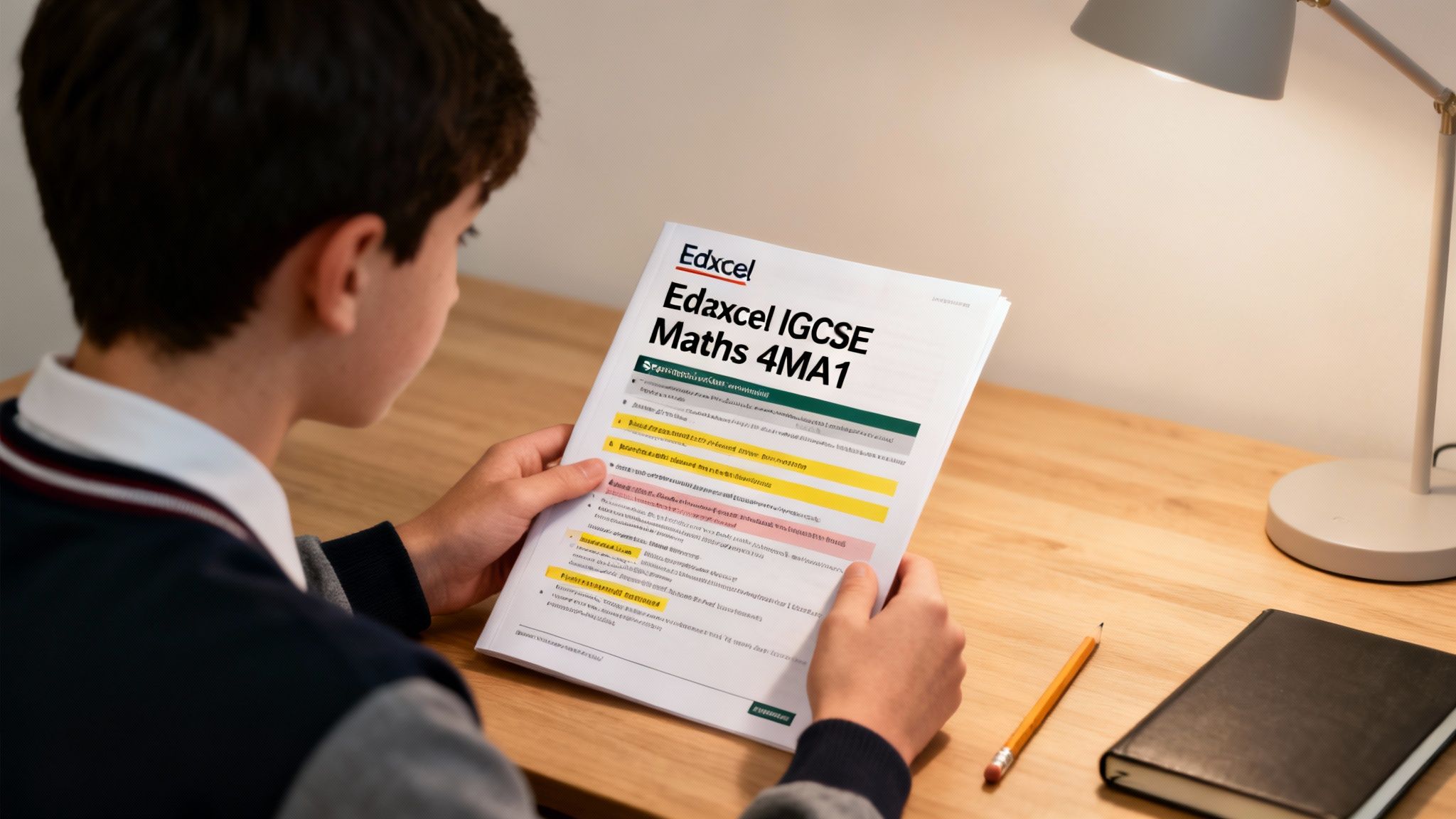
The official Pearson Edexcel website is your go-to for the latest spec, past papers, and examiner reports – all essential tools.
In this guide, we’ll break down this document for you, piece by piece. We'll turn it from a wall of text into your most powerful ally. For more structured support on your mathematics revision journey, you can also find resources designed to match every point in this specification.
Decoding What Examiners Actually Want: The Assessment Objectives
Ever wondered what the examiners are really looking for? It's not just about getting the right number at the end. The entire Edexcel IGCSE Maths specification is built around three core ideas called Assessment Objectives (AOs). Understanding these is like getting the secret to the marking scheme before you even walk into the exam.
Simply put, these AOs are the skills the exam is designed to test. Getting your head around them explains why some questions are worth one mark and others are worth six. It’s the difference between just doing maths and starting to think like a mathematician—which is exactly what you need for the top grades.
What are AO1, AO2, and AO3?
Let's cut the jargon. Every question fits into one of three categories, each testing a different skill. Knowing this is your ticket to smarter revision because it tells you where to focus.
AO1: Use and apply standard techniques. This is your bread and butter. It's about remembering facts, knowing the lingo, and carrying out routine calculations. Can you solve a standard equation or find the area of a circle? That's AO1. It tests your core knowledge and skills.
AO2: Reason, interpret and communicate mathematically. This is where things get more interesting. It’s about making logical steps, drawing conclusions, and presenting your arguments clearly. Whenever a question asks you to "show that" or "explain your reasoning," you're in AO2 territory.
AO3: Solve problems within mathematics and in other contexts. This is the big one, especially if you’re aiming high. AO3 is about tackling messy, multi-step problems where the solution isn't obvious. You have to bring together different bits of maths and come up with a strategy. Think of those tricky word problems that need a proper plan of attack.
As the official IGCSE Maths Edexcel specification states, the goal is to "develop fluent knowledge, skills and understanding of mathematical methods and concepts." In plain English, this means they want to see you do the maths (AO1), explain your maths (AO2), and apply your maths to crack real problems (AO3).
How the AOs Are Weighted in Your Exam
Knowing what the AOs are is good, but knowing how much they're worth is a game-changer. The weightings show which skills are most valuable, giving you a huge clue on how to prepare.
Here's a quick breakdown of how marks are allocated across both tiers.
Edexcel IGCSE Maths Assessment Objectives (AOs) Breakdown
| Assessment Objective | What It Means in Practice | Foundation Tier Weighting | Higher Tier Weighting |
|---|---|---|---|
| AO1 | Recalling formulas and doing standard calculations. | 60-70% | 40-50% |
| AO2 | Explaining your working and interpreting results logically. | 15-25% | 25-35% |
| AO3 | Solving unstructured, multi-step problems. | 15-25% | 20-30% |
You can see straight away that AO1 makes up most of the Foundation paper. It’s all about getting those core skills right.
For Higher Tier students, the balance shifts massively. A huge 25-35% of marks are for AO2, and up to 30% come from AO3. The message is clear: just knowing the methods isn't enough for a top grade. You have to reason, communicate your thinking, and be a confident problem-solver.
The Complete IGCSE Maths Topic Checklist
This is where the rubber meets the road. If the Edexcel spec is the rulebook, this is your complete playbook. We've broken down the entire 4MA1 curriculum into the five key areas you’ll be tested on: Number, Algebra, Geometry, Measures, and Statistics.
Use this as your personal revision planner. Tick off topics as you master them, highlight your weak spots, and figure out what to tackle next. It’s all about focused, efficient revision – no more wasted time.
Your Roadmap to Revision
To make this super clear, we’ll mark any topic that is exclusive to the Higher Tier with an (H). If you're a Foundation student, you can ignore these. For those of you aiming for the top grades, the (H) topics are where the battle is won; this is where you’ll prove you’re the best.
This checklist is designed for quick reference. Whether you're cramming or making a long-term study plan, you can find any topic in a flash and know exactly what the examiners expect.
Number
This is the foundation for everything else. You have to be rock-solid on these fundamentals, as they pop up everywhere.
- Integers and Arithmetic: All four operations (add, subtract, multiply, divide), handling negative numbers, and mastering the order of operations (BIDMAS/BODMAS).
- Fractions, Decimals, and Percentages: Fluently converting between them, finding fractions or percentages of amounts, and working out percentage change.
- Powers, Roots, and Standard Form: Working with indices (including negative and fractional ones (H)), simplifying surds (H), and using standard form for massive or tiny numbers.
- Ratio and Proportion: Simplifying ratios, sharing amounts, and tackling direct/inverse proportion problems (H).
- Rounding and Estimation: Approximating calculations and understanding the limits of accuracy (bounds) (H).
- Sets: Understanding set notation, Venn diagrams, and using them to solve problems (H).
Algebra
For many, this is the scariest part of the course, but it carries a huge weight in the exam – especially at Higher Tier. A solid command of algebra is non-negotiable for a top grade.
- Expressions and Formulae: Simplifying expressions, expanding brackets (including double and triple (H)), factorising (including quadratics (H)), and changing the subject of a formula.
- Equations and Inequalities: Solving linear and quadratic equations (H), solving simultaneous equations (both linear and one non-linear (H)), and showing linear inequalities on number lines or graphs.
- Graphs: Plotting and interpreting graphs of linear, quadratic, cubic (H), and reciprocal (H) functions. Also finding gradients and intercepts.
- Sequences: Finding the nth term of a linear sequence and understanding arithmetic progressions (H).
- Functions: Using function notation, finding inverse functions, and creating composite functions (H).
- Calculus: Differentiating polynomials to find gradients and turning points, and applying this to kinematics (velocity and acceleration) (H).
The flowchart below gives a great visual breakdown of the Assessment Objectives, showing how your skills are split between calculation, reasoning, and problem-solving.
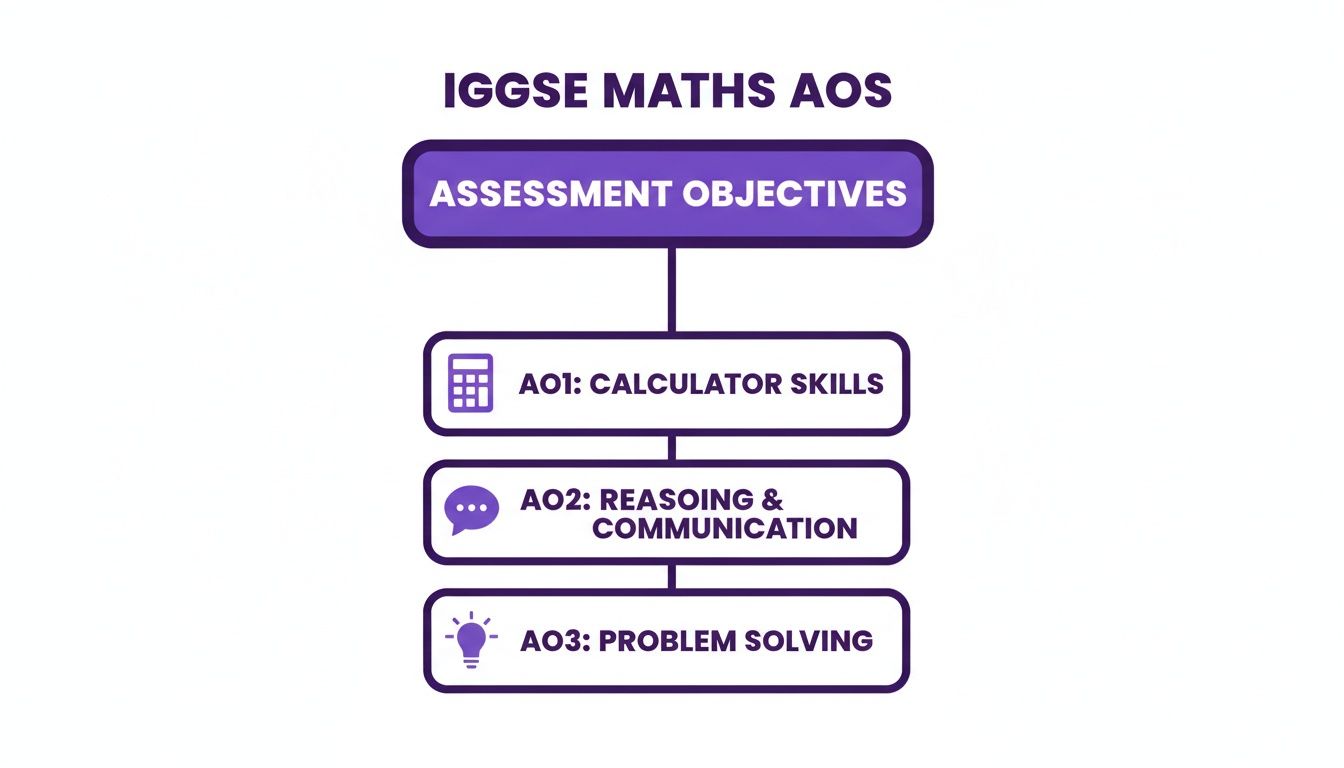
As you can see, just 'doing the maths' isn't enough. To hit the higher grades, you need to prove you can apply your knowledge and logically solve complex problems.
Geometry and Measures
This topic is all about shapes, space, and their properties. It's very visual, so getting good at sketching diagrams is a vital skill.
- Properties of Shapes: Understanding angles in polygons, parallel lines, and circles (including all the circle theorems (H)).
- Mensuration: Calculating perimeter, area (triangles, quadrilaterals, circles), and volume (cuboids, prisms, cylinders, spheres, cones (H)). Also covers arc length and sector area (H).
- Pythagoras’ Theorem and Trigonometry: Using Pythagoras in 2D and 3D (H), and applying SOH CAH TOA, the Sine Rule (H), Cosine Rule (H), and the area formula ½abSinC (H).
- Transformations: Carrying out reflections, rotations, translations, and enlargements (including with a negative scale factor).
- Vectors: Understanding vector notation and using vector arithmetic to solve geometry problems (H). For a useful comparison of how these topics are handled in a similar qualification, you can explore our guide on the Edexcel GCSE course.
Statistics and Probability
The final piece of the puzzle is handling and interpreting data. These questions are often longer, wordier problems set in a real-world context.
- Data Handling: Constructing and interpreting bar charts, pie charts, and histograms (H). You'll also need to calculate averages (mean, median, mode) and spread (range, interquartile range (H)).
- Probability: Calculating theoretical probabilities, understanding mutually exclusive and independent events, and using tools like tree diagrams and Venn diagrams to solve trickier problems, including conditional probability (H).
How Exam Grades Are Linked to Specific Topics
Ever noticed how some topics always seem to appear in the killer questions at the end of the paper? That’s deliberate. The Edexcel IGCSE Maths specification is structured so that certain topics are gateways to the higher grades. Knowing this is the key to creating a smart revision plan that gets you the grade you want.
Instead of trying to learn everything with the same intensity, you can focus your energy where it makes the most difference. Think of it like levelling up in a game: you have to master the basics before you can take on the final boss.
Securing a Grade 4/5: Nail the Foundations
If you're aiming for a solid pass—a Grade 4 or 5—your focus has to be on the core skills. These are the topics that underpin the whole course, pop up all the time, and are the building blocks for harder problems. Getting these right is non-negotiable.
Here’s your essential checklist for a strong foundation:
- Number fundamentals: Get totally comfortable with fractions, percentages, and standard form. These skills are often just the first step in a longer question.
- Basic Algebra: This means being confident in solving simple linear equations, expanding single brackets, and factorising simple expressions.
- Core Geometry and Measures: Mastering the area and perimeter of common shapes, along with basic angle rules, will bag you a ton of marks.
These topics are almost always tested as AO1 (using standard techniques), which makes them a reliable source of marks if you’ve put in the practice.
Pushing for Grades 6-9: The Game Changers
To climb into the top grade brackets (6, 7, 8, and 9), you have to show you can do more than just follow a recipe. This is where the difficulty steps up and you find the topics that separate the top students from everyone else. Success here is about solving multi-step problems that pull together different parts of the spec.
The topics that consistently define the top-tier students include:
- Advanced Algebra: We're talking quadratic and simultaneous equations, algebraic fractions, and functions.
- Complex Trigonometry: This means going beyond SOH CAH TOA to master the Sine and Cosine Rules, and applying them to 3D problems.
- Vectors: A classic Grade 9 challenge is using vectors to prove geometric facts.
- Conditional Probability: Problems with tree diagrams where the probabilities change are a huge hurdle, but they're essential for the highest marks.
The challenge is real. In the Autumn 2023 exams, only 2.8% of UK students achieved a Grade 9. This shows that mastering these tougher, problem-solving topics is what truly makes the difference. You can explore more detailed grade statistics to see what you're up against.
Practical Exam Techniques and Past Paper Strategies
Knowing the content in the IGCSE Maths Edexcel specification is one thing. Performing under pressure in an exam is a totally different skill. Nailing your two papers comes down to having a solid game plan. Let's move beyond just knowing the topics and dig into the practical strategies that will actually earn you marks when the clock is ticking.
Walking into that exam with a clear plan is your biggest advantage. It's not just what you know, but how you apply it when you're stressed and short on time. This means managing your time, figuring out what examiners really want, and understanding why showing your working is a non-negotiable safety net.

Don't Just Practice - Analyse
The biggest mistake students make is just doing past paper after past paper. The real value is using them as a diagnostic tool. Don't just churn through a paper and mark it; you need to properly analyse your performance.
The goal isn't just getting the right answer; it's understanding the method the mark scheme rewards. Treat past papers like a dress rehearsal. Do them under timed conditions to see where you slow down and which topics make you freeze.
This approach transforms practice into a powerful revision strategy. It pinpoints your exact weaknesses, showing you precisely where to focus your energy next.
Master the Mark Scheme
Every single mark counts. You can't afford to throw any away. Understanding how to bank every possible point is crucial, especially on those tricky, high-value questions.
Here are a few essential exam techniques:
- Show All Your Working: This is critical. Even if your final answer is wrong, a correct method can earn you most of the marks. Examiners are trained to reward your thinking process, so give them something to work with.
- Decode the Command Words: There’s a huge difference between 'calculate', 'explain', and 'show that'. 'Calculate' just wants a number. 'Show that' means you have to demonstrate every logical step to reach a given answer.
- Time Management: A good rule of thumb is about one minute per mark. If you’re spending five minutes on a two-mark question, it’s time to flag it, move on, and come back later.
Looking at the June 2023 Edexcel IGCSE Maths A (4MA1) exam, for instance, students had to tackle questions worth up to 8 marks on topics like conditional probability. Hitting the top grades demands precision on these complex problems. You can dig into the recent Edexcel grade statistics here for more insights.
Using AI Tools to Align Your Revision with the Specification
Traditional revision can feel like shooting in the dark. You work through a textbook, do some practice questions, and hope you’re covering the right stuff. But how can you be sure that every minute you spend is laser-focused on the IGCSE Maths Edexcel specification? This is where modern AI learning platforms change the game.
These tools don’t just throw random questions at you. Instead, they map every single problem back to a specific point in the 4MA1 specification. This is a huge deal—it means you're not just 'doing maths', you're systematically building skills against the exact curriculum you'll be tested on. Random practice becomes targeted training.
From Guesswork to Guided Learning
Think of it like having a personal tutor who knows the spec inside out. That’s the role an adaptive AI platform like MasteryMind plays. It guides you through the curriculum, making sure you master concepts in a logical, structured way.
The learning journey mirrors how exam questions get harder:
- You start with simple recall questions that check your core knowledge (AO1).
- Once you're comfortable, the system gives you questions that require reasoning and interpretation (AO2).
- Finally, you'll face complex, multi-step problems that demand real strategic thinking, just like the toughest questions on the paper (AO3).
This adaptive path keeps you working at the edge of your ability, pushing you to improve without being overwhelming. It’s a much smarter way to build your skills and your confidence.
For teachers, this is a game-changer. Forget waiting for mocks to see where the gaps are. You get real-time data showing exactly which specification points students are struggling with. This allows you to step in with focused support right when it's needed most.
Building Knowledge That Actually Lasts
One of the biggest revision hurdles is just forgetting what you learned last month. AI tools tackle this head-on using proven learning science to help you build long-term memory.
This isn't about last-minute cramming; it's about making knowledge stick. Features like spaced repetition will bring topics back for review just as you’re about to forget them. This technique fights the ‘forgetting curve,’ helping move information from your short-term recall into your long-term memory.
On top of that, you get instant, examiner-style feedback. Instead of just a tick or a cross, you get a step-by-step verification showing you exactly where you went wrong. This immediate feedback is vital for correcting mistakes before they become bad habits—it’s like having an examiner marking your work in real-time.
Your IGCSE Maths Questions Answered
When you're deep in revision for Edexcel IGCSE Maths, it's easy to get bogged down in the details. Let's cut through the noise and answer some of the most common questions from students and teachers.
No fluff, just straight answers to help you focus.
What Is the Real Difference Between Foundation and Higher Tiers?
Choosing your tier is a big deal. The real difference is the range of grades you can get.
Foundation Tier: This paper covers grades 1 to 5. If you're aiming for a strong pass and want to nail the core concepts, this is for you. The questions are more direct and focus heavily on AO1 skills (applying standard techniques).
Higher Tier: This is for anyone targeting grades 4 to 9. You have to sit the Higher paper if you want a Grade 6 or above. Expect complex, multi-step problems that test your reasoning (AO2) and problem-solving (AO3) skills.
Simply put, Foundation gets you a solid pass; Higher is the only way to the top grades. You should only really consider Higher if you're comfortably working at a Grade 5 level or higher.
Are You Given a Formula Sheet in the Exam?
Yes, you are. For both tiers, Edexcel provides a formula sheet at the front of each exam paper. This is a bit of a lifeline.
The Higher Tier sheet gives you the more complex formulas, like the quadratic formula, cosine rule, and volume of a sphere. The Foundation sheet covers the essentials. But don't get lazy – the real test isn't remembering the formulas, it's knowing when and how to use them.
How Do Grade Boundaries Work?
This confuses a lot of people. Grade boundaries aren't decided in advance. After all the papers are marked, a team of senior examiners at Edexcel analyses how everyone performed. Only then do they set the minimum mark needed for each grade.
This keeps things fair. If an exam paper turns out to be unusually hard, the grade boundaries will probably be lowered. If it was more straightforward, you might need a higher mark. That’s why your best bet is to forget about chasing a specific number and just focus on scoring every single mark you can.
I Am Behind on Revision Where Should I Start?
Feeling overwhelmed is completely normal. The trick is to start smart. Don't just dive into the hardest topics.
The smartest strategy is always to go back to the core Number and Algebra topics. They are the absolute bedrock of the course, and the skills pop up everywhere else. Get confident with fractions, percentages, and solving basic equations, and you'll find the tougher topics much more manageable.
Once you’ve shored up that foundation, move on to past papers. They are the best tool for spotting your exact weak points, which is a far more efficient way to revise than just reading a textbook.
Succeeding in Edexcel IGCSE Maths is all about focused, intelligent revision. At MasteryMind, we've built our entire platform on that idea, linking every single question back to the specific skills and assessment objectives you'll be tested on. Ready to turn that revision confusion into real confidence? Take a look at our AI-powered revision tools.
Ready to master this topic?
Practise with quizzes, blurt exercises and exam questions on MasteryMind.
7 days Premium · Then free forever · No card, no charge