Light Dependent Reaction: A GCSE & A-Level Guide (2026)
You're probably here for one of two reasons. Either photosynthesis has turned into a blur of PSII, PSI, ATP and NADPH, or you already know the basics and want the version that helps you score marks.
The good news is that the light dependent reaction becomes much easier once you stop seeing it as a random list of facts and start seeing it as an organised energy-transfer system. Light energy goes in. Electrons get excited. A proton gradient is built. ATP and NADPH come out. That's the whole story.
The trick is knowing that story well enough to explain it clearly under exam pressure, with the right biological terms and without falling into the usual traps.
Why the Light Dependent Reaction Matters for Your Grade
This topic isn't a side quest. It sits right in the middle of bioenergetics, which means examiners love it because it connects structure, process, energy transfer and application.
For GCSE students, the weighting alone should get your attention. AQA gives 15-20% of the Bioenergetics topic to the light-dependent reactions, and exam analysis found that only 62% of candidates in 2014 correctly linked the proton gradient to ATP synthase activity, which led to more focus on these mechanisms in later specifications, as outlined in Khan Academy's light-dependent reactions page. On Edexcel, this area is worth around 12 marks in Paper 2, and only 45% of students achieved grade 7+ on related questions in 2022, again noted on Khan Academy's summary of the topic.
That tells you something important. Students don't usually lose marks because they've never heard of photosynthesis. They lose them because they mix up the sequence, the locations, or the role of each molecule.
Where students slip up
A lot of answers sound vaguely right but still miss marks. Common examples include:
- Mixing up products: saying oxygen comes from carbon dioxide rather than water
- Being too vague: writing “energy is released” instead of explaining how electrons move through carriers
- Confusing place names: stroma, thylakoid membrane and thylakoid space get blurred together
- Forgetting the link: ATP synthase works because of a proton gradient, not because light directly “makes ATP”
Practical rule: if you can trace one electron from water to NADPH and one proton from stroma to ATP synthase, you're in strong shape for most exam questions.
Teachers and tutors usually spot this early. If you run group sessions or track where learners repeatedly miss these mark points, structured systems such as tutoring center software can help organise intervention around specific weaknesses rather than broad “revision”.
If you're studying beyond GCSE, this topic gets even more valuable because it feeds directly into tougher essay and data questions. For students building that bridge, Online Revision for A-Level can help you keep exam-board wording consistent while you practise.
Inside the Chloroplast's Power Plant
A chloroplast is the workplace. The thylakoid membrane is the machinery line. If you keep that map clear in your head, most of the topic stops feeling messy.
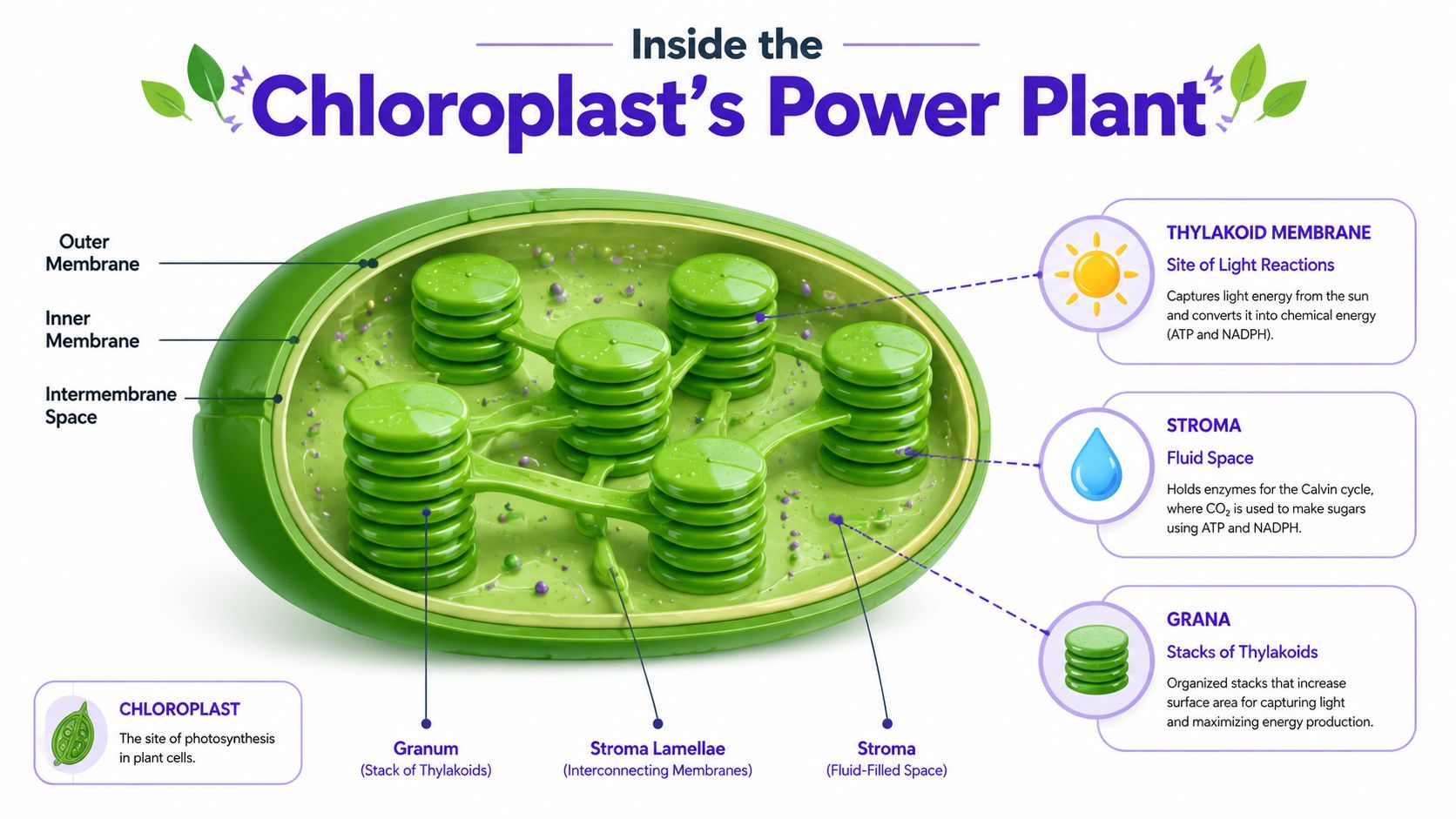
The parts that matter
Think of the chloroplast like a power plant with a membrane running through it.
| Part | What it is | Why it matters |
|---|---|---|
| Grana | stacks of thylakoids | increase surface area for the light dependent reaction |
| Thylakoid membrane | membrane containing pigments and carriers | site of the light-dependent reactions |
| Thylakoid space | inside of each thylakoid | where protons build up |
| Stroma | fluid around the grana | where ATP and NADPH are used later in the Calvin cycle |
The main protein complexes sit in the thylakoid membrane.
- Photosystem II captures light and replaces lost electrons by splitting water.
- Electron carriers, including the cytochrome complex, pass electrons along and help move protons.
- Photosystem I re-excites electrons using more light energy.
- ATP synthase lets protons flow back and uses that energy to make ATP.
A simple way to picture it
PSII is the entry point. It's where water is split, so it's the part strongly linked with oxygen release.
The cytochrome complex is like the pump station in the middle. As electrons move through, their energy is used to push protons into the thylakoid space.
PSI is the second light booster. Electrons arrive lower in energy and get lifted again.
ATP synthase is the turbine. Protons move through it down their gradient, and that movement powers ATP formation.
The most useful mental picture is not “light makes sugar”. It's “light powers a membrane system that stores energy temporarily in ATP and NADPH”.
Why biologists became confident about this
A key historical breakthrough came from Robert Hill's work at Cambridge. The Hill reaction of 1937 showed that isolated chloroplasts could produce oxygen without CO2 fixation, providing the first evidence for PSII-driven photolysis, as described in the Wikipedia overview of light-dependent reactions. That discovery matters in teaching too, because it helped separate the light stage from carbon fixation. The same source notes that this idea now forms 80% of Edexcel A-Level Topic 5 content, and later work at Imperial College London in the 1980s helped reveal photosystem structure in more detail.
That history matters because it explains why the specification treats oxygen release and carbon fixation as separate ideas. Oxygen is tied to the light-dependent stage. Glucose is not made there.
The Z-Scheme Electron Rollercoaster
The non-cyclic pathway is easiest to remember as a journey. One electron doesn't just “get energy”. It gets excited twice, loses energy between those points, and ends up helping to make NADPH.
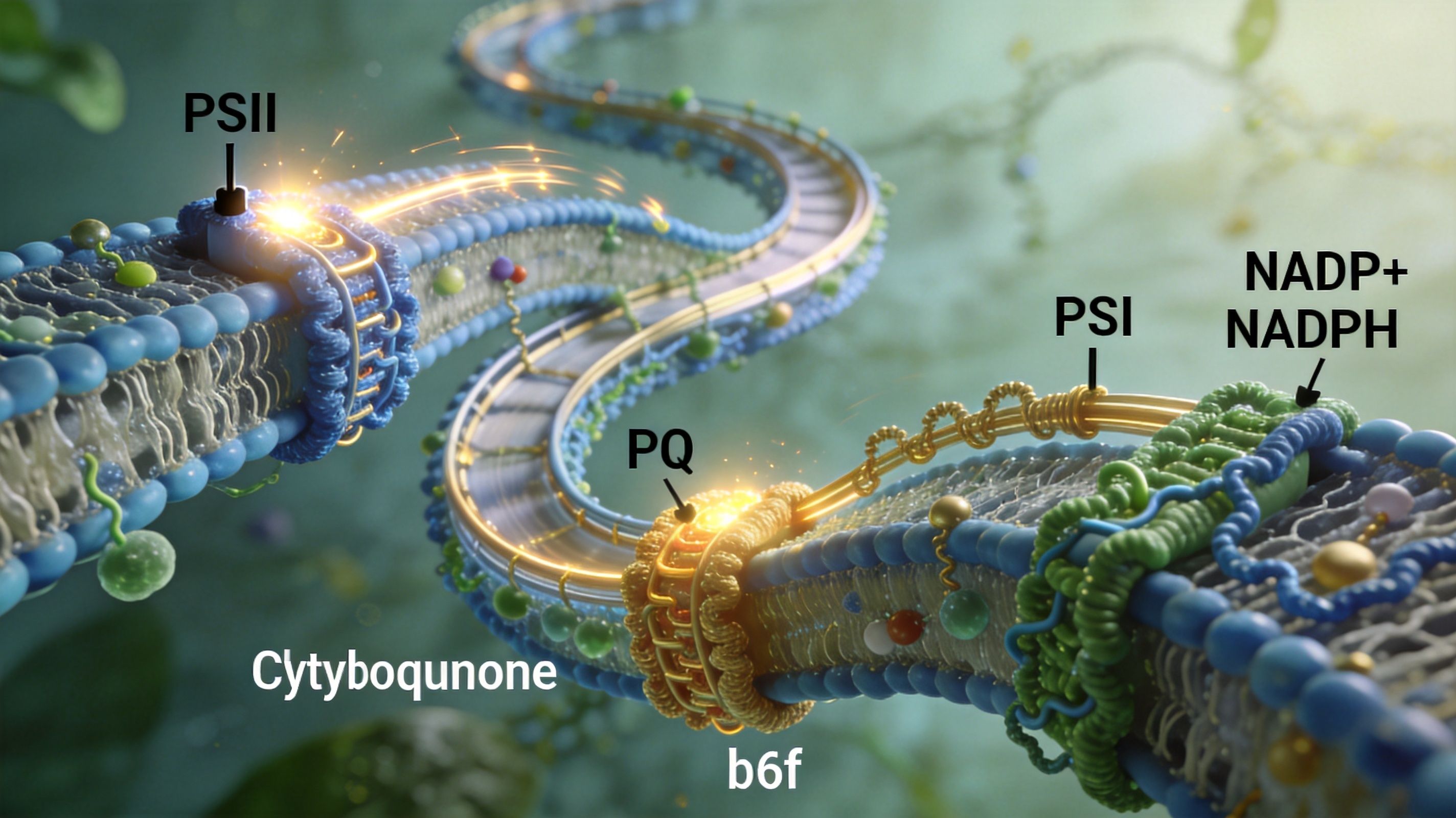
Step one at Photosystem II
Light hits Photosystem II, and chlorophyll absorbs that energy. An electron becomes excited and leaves the photosystem.
That creates a problem immediately. PSII has lost an electron, so it must get one back. Photolysis provides the electron.
Photolysis of water
Water is split using light energy. At GCSE and A-Level, you should know the products clearly:
- Electrons replace those lost from PSII
- Protons contribute to the proton pool
- Oxygen is released as a by-product
If an exam asks where oxygen in photosynthesis comes from, the high-mark answer is water, not carbon dioxide.
The downhill part of the ride
The excited electron from PSII doesn't jump straight to NADP. It passes through a chain of electron carriers in the thylakoid membrane.
As it moves along this chain, it loses energy. That energy is not wasted. The membrane system uses it to move protons into the thylakoid space, which is the basis of chemiosmosis.
That's one of the reasons the process is drawn as a Z-scheme. Electron energy rises sharply when light excites it in PSII, falls as it travels through carriers, then rises again when light excites it in PSI.
Step two at Photosystem I
When the electron reaches Photosystem I, it isn't energetic enough for the final reduction step. So PSI absorbs light and boosts the electron again.
This second excitation is easy to forget in rushed answers. If you leave it out, your description of non-cyclic photophosphorylation becomes incomplete.
Examiner mindset: they're often checking whether you understand that both photosystems absorb light. PSII starts the chain. PSI re-energises electrons later in the chain.
A quick visual explanation can help fix that pathway in memory:
The full route in one clean sequence
If you want the shortest accurate summary, use this order:
- Light excites electrons in PSII
- Water is split to replace lost electrons
- Electrons pass along carriers and lose energy
- That energy helps build a proton gradient
- Electrons reach PSI
- Light excites them again
- Electrons move to the final carrier system and reduce NADP
That sequence is worth memorising exactly because it stops the common muddle where students merge ATP production and NADPH formation into one vague sentence.
Building the Proton Gradient to Power ATP
A lot of students can say “ATP is made by chemiosmosis” but can't explain what that means. That's where marks disappear.
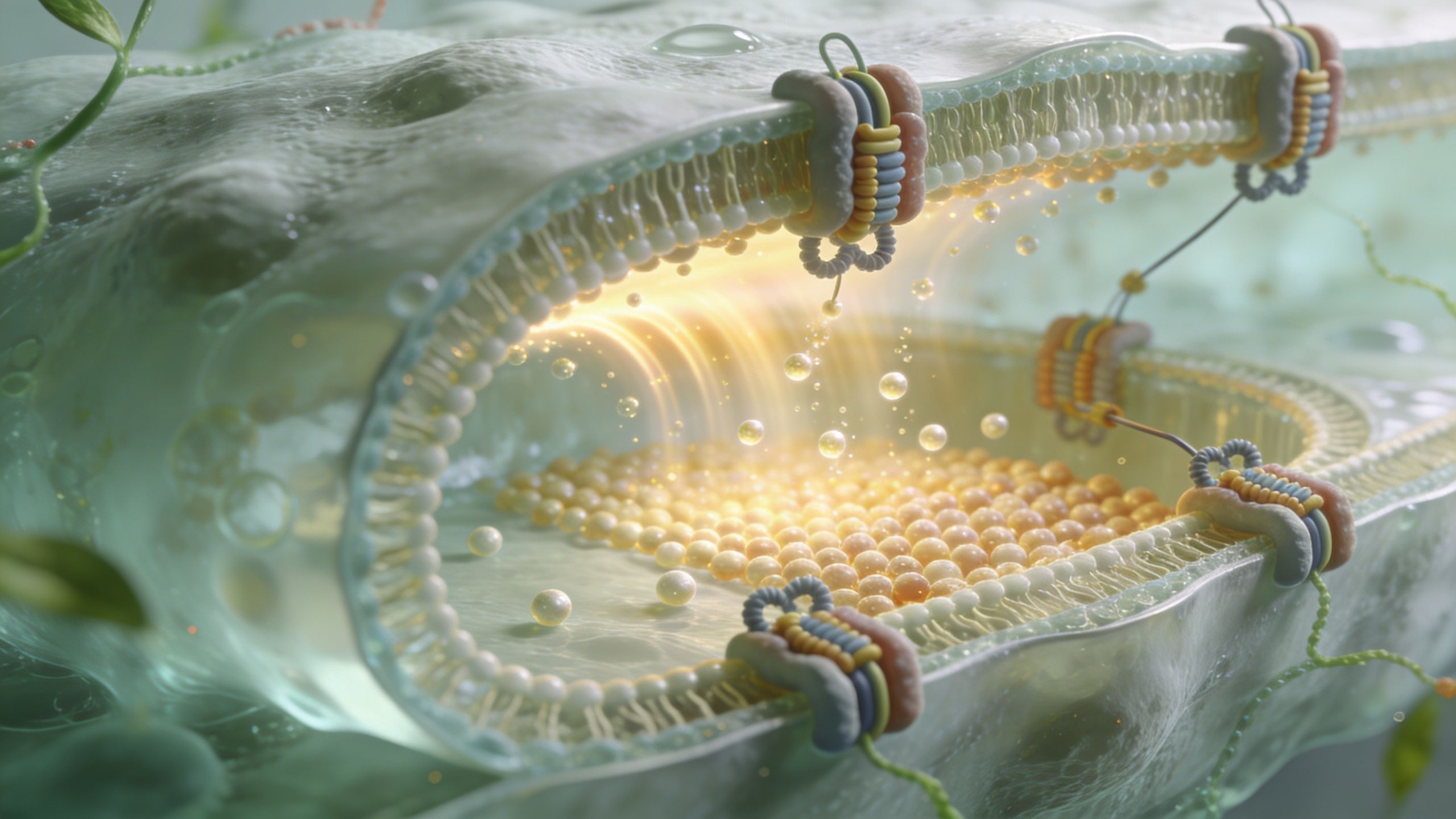
The core idea is simple. As electrons move through carriers between the two photosystems, the membrane system uses their energy to pump protons from the stroma into the thylakoid space. This creates a concentration gradient.
Think dam, not magic
The best analogy is a dam. Water stored behind a dam has potential energy because of the difference in level. Protons stored in the thylakoid space have potential energy because of the difference in concentration and charge across the membrane.
The thylakoid space ends up with more protons. The stroma has fewer. That imbalance matters.
How ATP synthase uses the gradient
Protons can't drift back through the membrane wherever they like. They mainly return through ATP synthase.
As they flow down the gradient, ATP synthase uses that energy to join ADP with inorganic phosphate and make ATP. This process is called chemiosmosis.
Here's the chain of logic examiners want:
- Electron transfer provides energy
- Energy pumps protons
- A proton gradient forms
- Protons flow back through ATP synthase
- ATP is synthesised
Don't write “ATP synthase stores ATP”. Write that it catalyses the synthesis of ATP as protons move through it.
The wording that wins marks
Students often lose precision here. These phrasing choices are safer:
- Say “across the thylakoid membrane” rather than just “across the membrane”
- Say “from the stroma into the thylakoid space” rather than “into the chloroplast”
- Say “down the proton gradient” rather than “protons are absorbed”
If you can explain this stage cleanly, you've solved one of the biggest weaknesses that shows up in bioenergetics answers.
Creating the Final Products ATP and NADPH
ATP is only half the story. The second key product is NADPH, sometimes written in specifications as reduced NADP.
After electrons are re-excited in PSI, they pass along a short final carrier pathway. At the end of that route, the electrons are transferred to NADP+, which combines with them and a proton to form NADPH.
ATP and NADPH do different jobs
Students often blur these together, but they are not interchangeable.
- ATP supplies usable energy for reactions that need it.
- NADPH carries hydrogen and high-energy electrons for reduction reactions.
That difference matters because exam questions often ask for the function of products, not just their names.
A simple memory aid
If ATP is the spendable energy, NADPH is the loaded delivery van carrying reducing power. Both leave the light-dependent stage and are then used in the light-independent stage.
This is why answers like “light produces glucose” are too crude. The light dependent reaction doesn't produce glucose directly. It produces the molecules needed to help make carbohydrate later.
If a question asks for the products of non-cyclic photophosphorylation, the safe list is ATP, NADPH and oxygen.
One common confusion is saying NADPH is produced by light alone. That skips the actual mechanism. NADPH forms after electrons have travelled through the pathway and reduced NADP+.
The Cyclic Shortcut and Limiting Factors
Sometimes the chloroplast doesn't need the same balance of products. In those cases, it can use cyclic photophosphorylation.
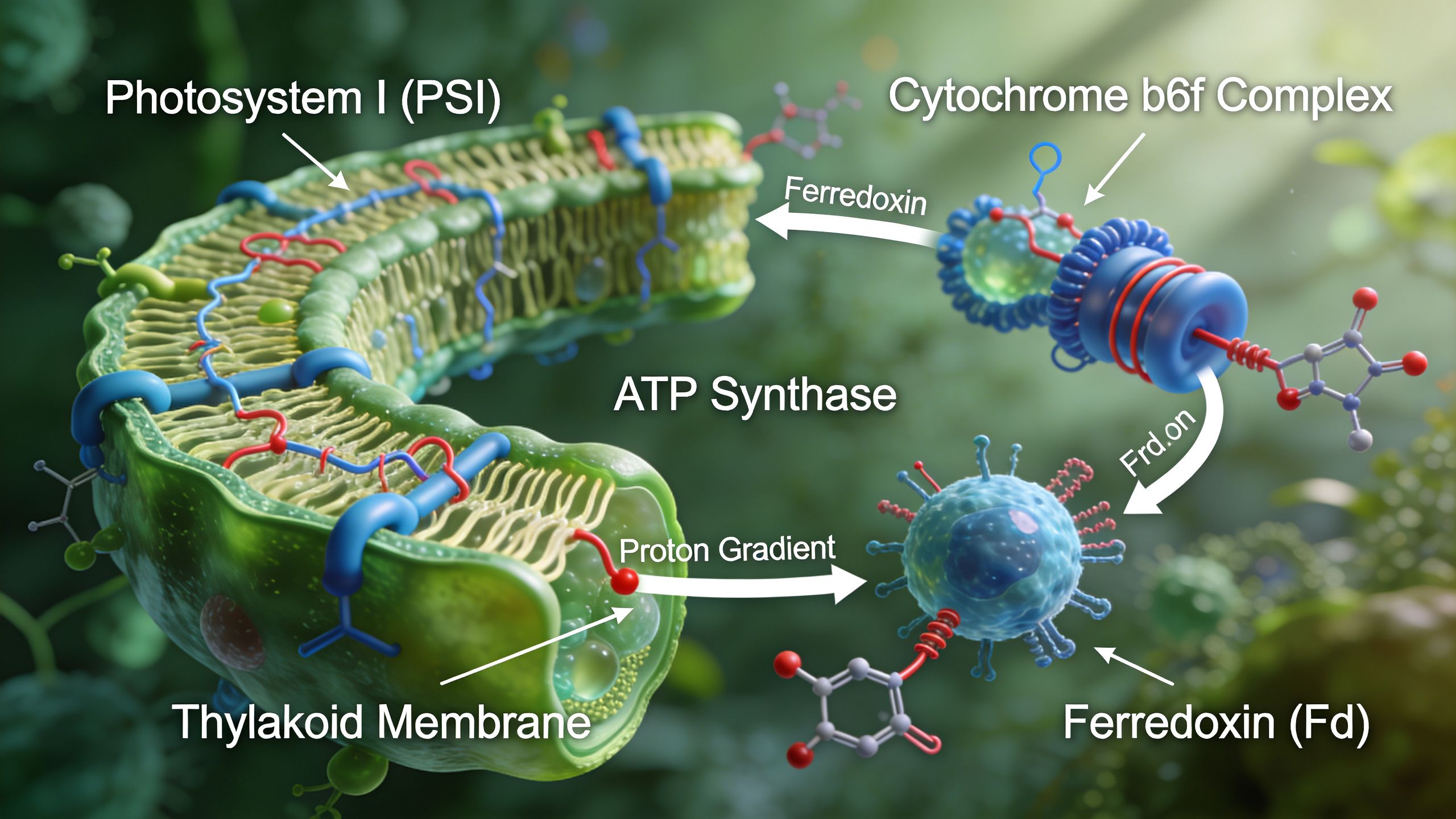
How cyclic photophosphorylation differs
In the cyclic pathway, Photosystem I is involved but Photosystem II is not. The excited electrons from PSI don't reduce NADP+. Instead, they cycle back through carriers and help generate a proton gradient.
That means cyclic photophosphorylation:
| Feature | Non-cyclic | Cyclic |
|---|---|---|
| Uses PSII | Yes | No |
| Uses PSI | Yes | Yes |
| Splits water | Yes | No |
| Produces oxygen | Yes | No |
| Produces NADPH | Yes | No |
| Produces ATP | Yes | Yes |
This is a classic compare question. If you can learn the table logic, you can write strong contrast paragraphs in exams.
Why it matters in real plants
Recent UK research highlighted in LibreTexts on the light-dependent reactions notes that cyclic photophosphorylation is 15% more efficient in shade-adapted crops like wheat under variable light conditions. The same source also reports that 35% of GCSE students still confuse NADPH here, often treating it as a direct product of light rather than a result of electron transport in the non-cyclic pathway.
That second point is a huge exam clue. If you're revising this topic, use comparison questions and A-Level Past papers to check whether you can separate the two pathways fast.
Limiting factors you should mention carefully
For light-dependent reactions, the usual influences include:
- Light intensity affects how many photons are available to excite electrons
- Wavelength matters because pigments absorb some wavelengths better than others
- Temperature can affect enzyme-linked stages, although it is often more strongly associated with later reactions in photosynthesis as a whole
A careful answer stays specific. If the question is about the light dependent reaction, bring your explanation back to electron excitation, photolysis, membrane transport and ATP synthesis, not just generic “photosynthesis increases”.
How to Nail Light Reaction Exam Questions
The students who do best on this topic usually aren't the ones who memorise the most words. They're the ones who answer in the right order and use precise terms.
The mistakes that cost marks
Here are the errors I see most often:
- Wrong location: writing that ATP is made in the stroma without mentioning ATP synthase in the thylakoid membrane
- Wrong source of oxygen: saying carbon dioxide is split to release oxygen
- Wrong pathway products: claiming cyclic photophosphorylation makes NADPH
- Missing mechanism: naming a proton gradient but not explaining how it forms
A better way to tackle a 6-marker
Take a common question such as: Describe non-cyclic photophosphorylation.
A strong answer usually follows this sequence:
- State that light excites electrons in PSII
- Explain that photolysis of water replaces lost electrons and releases oxygen and protons
- Describe electrons passing along carriers
- Explain that their energy is used to pump protons across the thylakoid membrane
- State that protons move back through ATP synthase to make ATP by chemiosmosis
- Add that light excites electrons again in PSI
- Finish with reduction of NADP+ to NADPH
If you write those points in order, you usually sound organised and secure.
Answer-building rule: when the command word is “describe”, give the sequence. When it's “explain”, add the reason each step matters.
A model paragraph shape
You don't need fancy prose. You need clarity.
Start with the first light absorption event. Move to photolysis. Then describe electron transport and proton pumping. After that, bring in ATP synthase. End with PSI and NADPH.
That order keeps your biology accurate and stops you from jumping between products randomly.
For timed revision, Exam Practice for A-Level is useful because it forces you to turn knowledge into complete answers rather than just recognising facts in notes.
The final check before you move on from this topic is simple. Can you explain where it happens, what enters, what leaves, how ATP is made, how NADPH is made, and how cyclic differs from non-cyclic? If yes, you're no longer just revising. You're exam ready.
If you want structured, exam-board-aligned revision on topics like the light dependent reaction, MasteryMind is built for UK learners studying GCSEs and A-Levels. It gives you targeted questions, examiner-style feedback, past-paper practice, and adaptive revision that matches AQA, Edexcel, OCR and WJEC specs, so you can turn tricky biology content into marks on the page.
Ready to master this topic?
Practise with quizzes, blurt exercises and exam questions on MasteryMind.
7 days Premium · Then free forever · No card, no charge