Mind Mapping for Revision: Ace Your GCSEs & A-Levels
Your notes are everywhere. One page has highlighted definitions. Another has half a flashcard set. Your textbook is open, but you're mostly just staring at it and hoping something sinks in.
That's a rough place to revise from, especially when GCSEs and A-Levels reward recall under pressure, not recognition on a bedroom desk. You need a way to shrink a big topic, see how the pieces fit, and recall it when the paper lands in front of you. That's where mind mapping for revision earns its place.
Why Your Revision Needs More Than Just Highlighters
Highlighting feels productive because it's quick. You read, you swipe a pen across a line, and the page starts to look important. The problem is that coloured pages don't automatically become usable memory.
If you've ever looked back at a beautifully highlighted chapter and still struggled to answer a six-marker, you already know the issue. Re-reading and highlighting often keep you in recognition mode. In an exam, you need recall.

Why mind maps have lasted
Mind maps were popularised in the 1970s by Tony Buzan, and the method still appears in UK study guidance today. The University of Sheffield advises students to start with a central idea, build branches, and then test themselves by trying to recreate the map from memory in its mind map study guidance.
That matters. It tells us mind mapping for revision isn't a fad that turned up on social media last month. Schools, tutors, and universities keep coming back to it because it helps students organise large topics in a way that can be used again later.
Practical rule: If your revision method doesn't help you retrieve information without the book open, it's not enough on its own.
What a mind map does better than a page of notes
A good mind map gives you one clear view of a topic. Instead of ten pages on Cold War tensions or organic chemistry, you've got one structure showing the main areas and how they connect.
That's especially useful when:
- A topic feels huge: You can turn a messy chapter into a visible outline.
- You keep missing links: Causes, effects, methods, themes, and processes sit together instead of being split across pages.
- You're short on time: One map is easier to revisit than a pile of full notes.
If focus is part of the problem, it also helps to sort out how you're reading in the first place. Some students do better when they combine mapping with routines that reduce distraction, so it's worth looking at these ways to learn to focus with Habit Huddle.
For students who want a digital option alongside paper maps, AI Powered Revision can sit next to your own notes rather than replace them. The key point is simple: stop treating revision as exposure to information, and start treating it as organised retrieval.
How Mind Maps Rewire Your Brain for Better Recall
You've probably had this happen in a lesson test. You look at a question and think, “I know this.” Then nothing comes out. That gap between knowing and producing is where many revision plans fall apart.
Mind mapping for revision helps because it forces you to organise material, not just look at it. You choose the main ideas, strip them into cues, and place them in relation to each other. That makes revision active.
Recognition is not recall
Linear notes are often too friendly. Everything is laid out in order, with complete sentences doing the thinking for you. In an exam, there's no page guiding you down the line. You have to pull the material out yourself.
A mind map changes the job your brain has to do:
- You condense: You pick the keyword instead of copying the paragraph.
- You connect: You decide which branch links to which concept.
- You retrieve: You use the map as a prompt, not as a script.
That's why the method works well for subjects where one idea depends on another, such as chemistry calculations, historical causation, or English themes across a whole text.
What the evidence says
Research summarised in Nulab's overview reports that mind mapping can improve long-term information retention by 10 to 15% compared with re-reading text, which is especially relevant when exam questions depend on recalling linked ideas rather than isolated facts in this piece on science-backed benefits of mind mapping.
That's not magic. It fits what good revision usually looks like. The more you organise, shorten, and reconstruct knowledge, the more likely you are to remember it later.
A useful test is this. Can you explain the branch without reading full notes underneath it? If not, the map still needs work.
If you want to strengthen the memory side of revision beyond mind maps alone, these strategies for information recall are a sensible companion read. They pair well with the same principles behind active recall for GCSE and A-Level, where the goal is to pull knowledge out, not just recognise it on the page.
From Blank Page to Big Picture in Four Moves
The hardest part is often the start. You sit with a blank sheet, write the topic in the middle, then wonder what on earth is meant to go around it.
A revision mind map is not meant to be artistic homework. It's a memory tool. Keep that in mind and the process gets much easier.
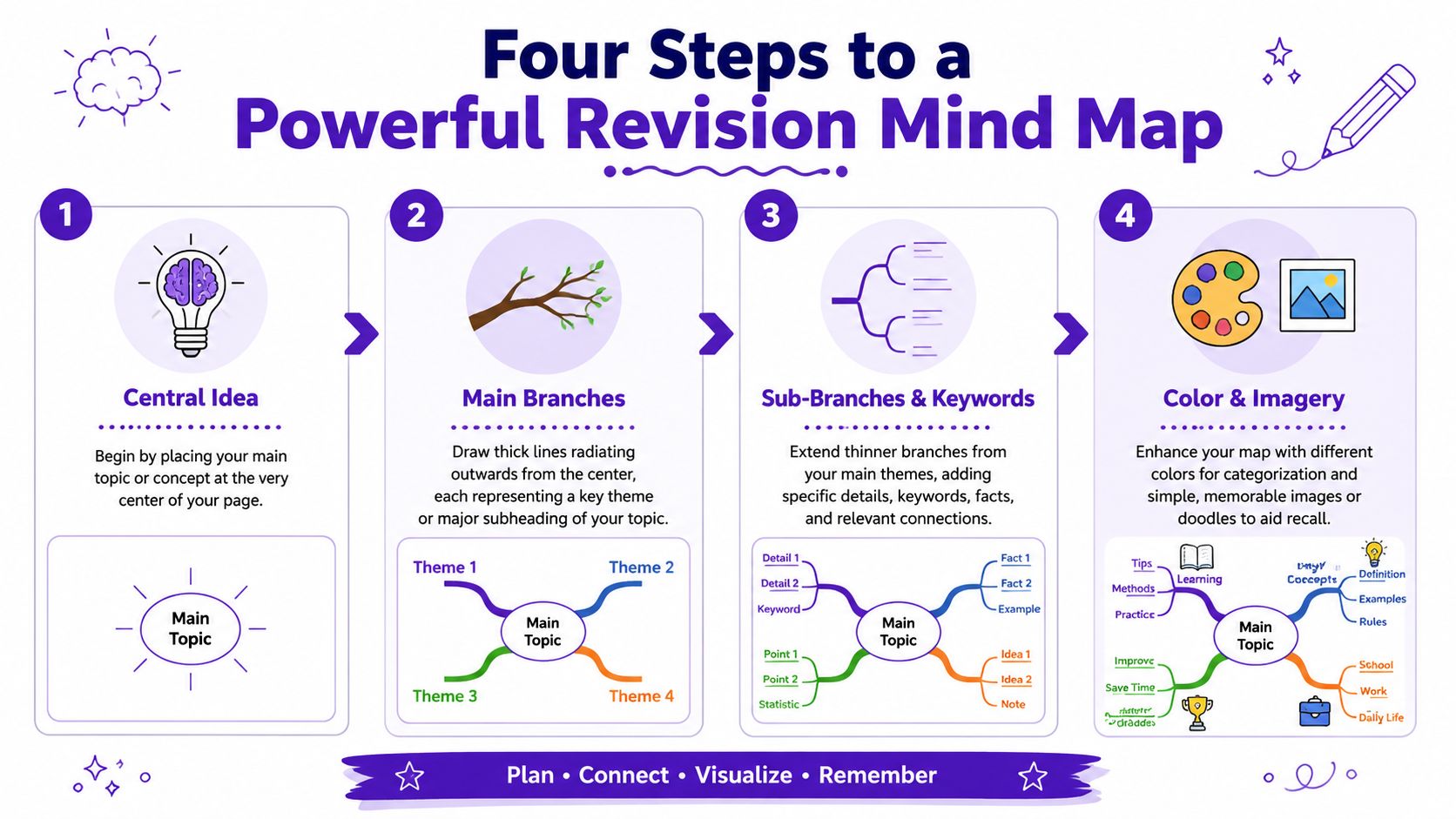
Move one starts in the centre
Put the topic in the centre of the page. Keep it specific enough to be useful.
“Biology” is too broad. “Photosynthesis” works. “Elizabethan England” works. “Rates of reaction” works.
The centre is your anchor. Every branch must earn its place by linking clearly back to that topic.
Move two builds the main branches
Your next job is to add the major syllabus headings. Think of these as the skeleton of the topic. Save My Exams recommends a three-layer structure made up of a central topic, main branches, and secondary branches using concise keywords of roughly 5 to 10 words in its guide to revision mind maps for exam success.
For example:
| Subject | Centre | Main branches |
|---|---|---|
| History | Weimar Germany | economy, politics, opposition, recovery, collapse |
| Chemistry | Bonding | ionic, covalent, metallic, properties, structure |
| English Lit | Macbeth | ambition, guilt, power, supernatural, characters |
Don't overthink the wording at this stage. You're creating handles your memory can grab.
Move three adds the detail without turning into notes
A common mistake students make is that they start strong, then cram full explanations onto every line. Once that happens, the map stops being a map and becomes messy revision notes with branches.
Keep your sub-branches short:
- Use single keywords where possible
- Use short prompts instead of full sentences
- Add symbols or tiny doodles if they help
- Keep each branch brief enough to scan quickly
A History branch on “alliances” might split into Triple Alliance, Triple Entente, tension, balance of power. A Chemistry branch on “covalent” might split into shared electrons, molecules, giant covalent, examples.
Memory check: If a branch needs a whole paragraph to make sense, split it into smaller branches instead.
Move four makes the map memorable
Now add colour and links between branches. Colour helps separate categories. Cross-links help you notice ideas that connect across the topic rather than sit in neat boxes.
That matters because exam questions rarely stay inside one tiny syllabus bullet. A question on Lady Macbeth may also involve power, guilt, and the supernatural. A question on rates of reaction may pull in collision theory and practical method at the same time.
A few simple upgrades make a real difference:
- Use one colour per main branch so the map is easier to scan.
- Circle command words or key triggers if the topic often appears in extended questions.
- Draw arrows between related branches to show relationships.
- Leave space so you can add later details after a class test or past paper.
If colour helps you remember, this guide on how to improve memory with color coded notes gives practical ways to make that system more consistent.
Mind Mapping Ideas for GCSE and A-Level Subjects
Students often understand the technique in theory, then freeze when trying to use it for a real subject. The trick is to build the map around the kind of thinking the subject demands.
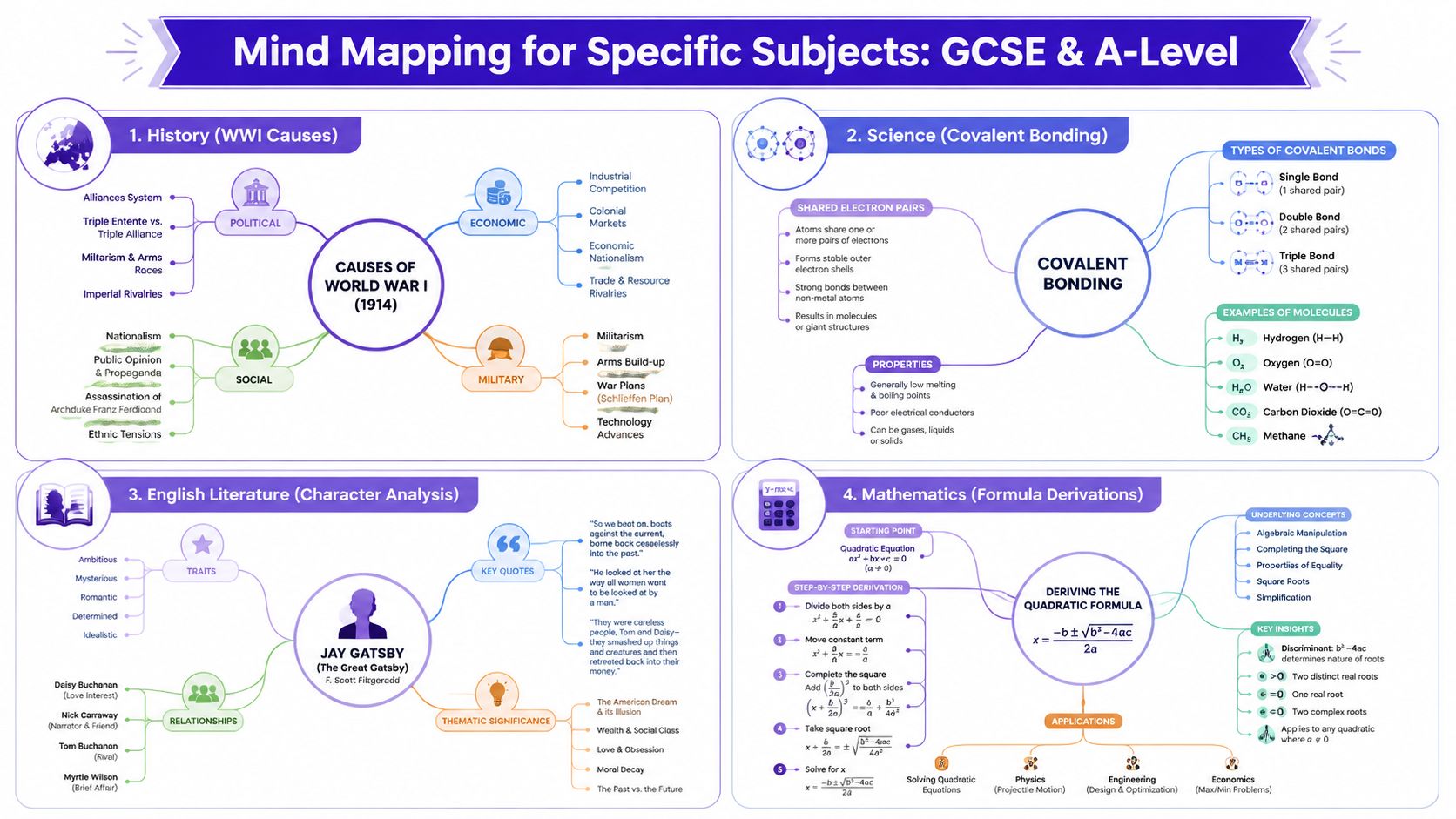
History works well with causes and consequences
Say you're revising the causes of the First World War. Put that in the centre. Your main branches could be alliances, militarism, imperial rivalry, nationalism, and assassination.
Then you push outward. Under alliances, add the two major blocs and the way they increased tension. Under assassination, note the trigger event and why it spread. The useful part isn't just listing factors. It's showing how one branch affects another.
Chemistry needs process and comparison
Take covalent bonding. Place it in the middle. Main branches could include definition, shared electrons, simple molecules, giant covalent structures, and properties.
Under “properties”, you might split into melting point, conductivity, and examples. Then link “giant covalent” back to those properties. That's where the map helps. You're not learning isolated facts. You're learning why the structure leads to the property.
In science, don't just map what something is. Map what causes it and what follows from it.
English Literature benefits from theme webs
For a character like Macbeth, the centre could be the character or a theme such as ambition. Branches might include key scenes, relationships, quotations, methods, and thematic meaning.
One branch could hold short quote cues rather than full quotations. Another could link Macbeth to Lady Macbeth, kingship, or the supernatural. If you do this well, essay planning gets easier because the connections are already visible.
Maths can map methods, not just facts
Maths students sometimes assume mind maps are only for essay subjects. They're useful here too, especially for topics that involve choosing a method.
For quadratic equations, your branches might be factorising, completing the square, quadratic formula, graph links, and common mistakes. Then add sub-branches showing when each method is useful and what to check.
If you want topic ideas across your course, you can browse revision subjects and then decide which topics are best suited to a one-page map.
Power Up Your Revision with Active Recall and Spaced Review
A finished mind map is not the end product. It's the thing you use to test yourself.
That's why some students spend ages making maps and still don't improve much. They build a neat page, admire it, file it away, and move on. Revision only changes memory when you come back and make your brain work again.
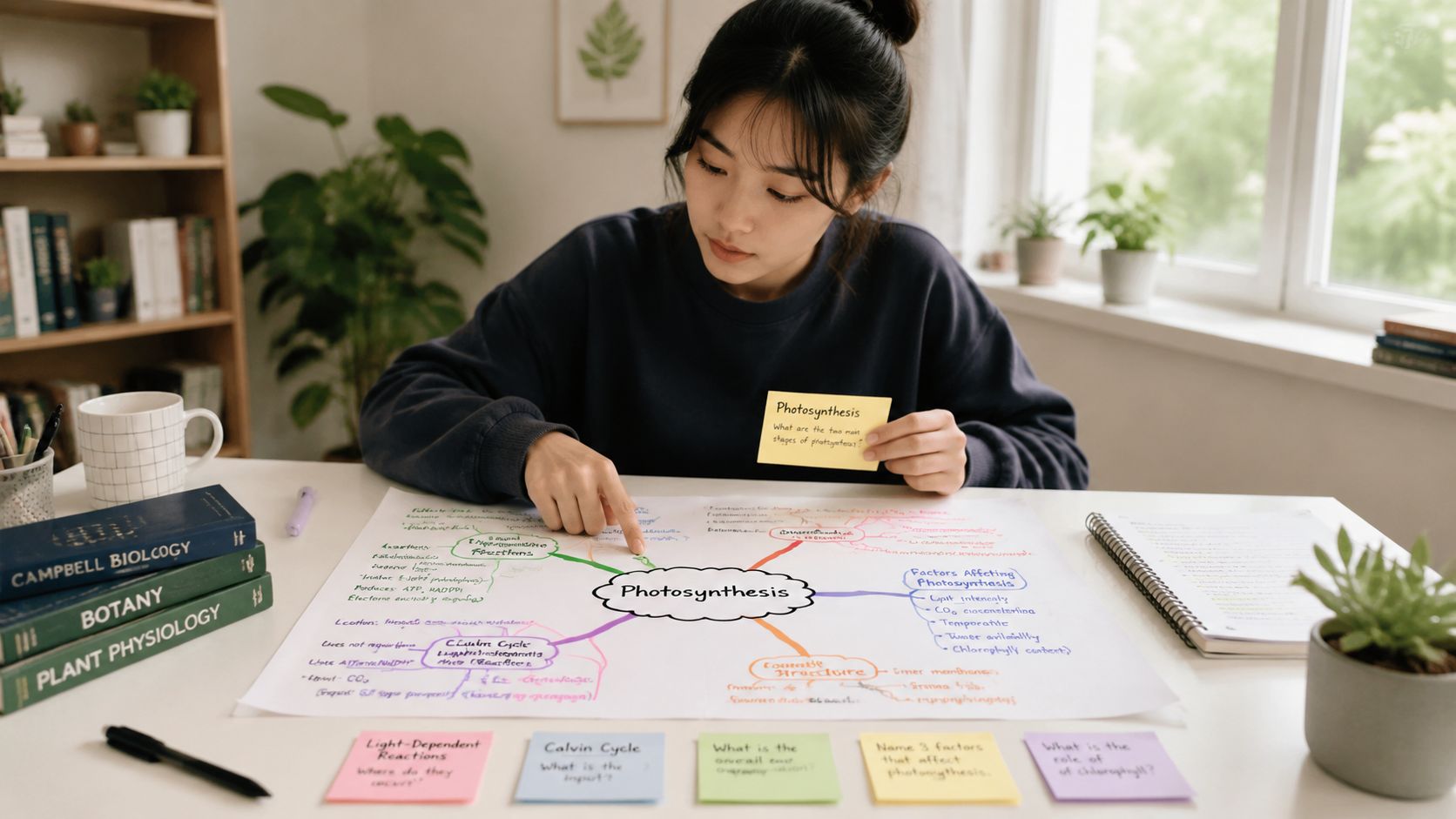
Turn the map into a test
Start with the finished map in front of you. Read a branch, cover it, and try to say or write everything you can remember from that cue. Then check what you missed.
You can also:
- Rebuild the whole map from memory on a blank page
- Cover one branch at a time and explain it out loud
- Use the map to answer exam questions without looking back
- Ask someone else to point at a branch and quiz you on it
This is the same basic idea behind low-tech blurting. You aren't trying to make the page look good anymore. You're trying to catch the gaps.
Space the reviews
One revisit won't do much if you never return again. Use the same map several times across your revision period.
A simple pattern works well:
- First review: soon after making the map
- Second review: after a short gap
- Third review: later in the week
- Further reviews: before topic tests, mocks, or past papers
The spacing matters because each return forces reconstruction after some forgetting has happened. That effort is what makes the map useful.
A digital tool can support this if you want exam-style follow-up after your paper map session. For example, Exam Practice for GCSE focuses on specification-aligned questions and feedback, which can help after you've identified weak branches on your map.
A quick visual walkthrough can also help if you want to see the method in action:
Don't ask, “Have I looked at this topic?” Ask, “Can I rebuild it without help?”
Avoid These Common Mind Mapping Traps
A bad mind map usually fails for one reason. It's trying to hold too much.
When students overload a map with dense notes, the page becomes harder to read, harder to remember, and harder to use under pressure. InnerDrive highlights this problem clearly in its discussion of common mind mapping mistakes. The value comes from keywords and relationships, not from copying the textbook into bubble form.
The traps that waste your time
- Writing full sentences: That turns a recall tool into passive notes.
- Making one giant map for an entire subject: Keep each map tied to a clear topic.
- Ignoring links between branches: Exams often reward connections.
- Never testing the map: A map you only read is weaker than a map you rebuild.
A better standard to aim for
Your map should be clear enough to scan quickly and sparse enough to challenge you. If every answer is already written out, there's nothing left for memory to do.
Teachers tend to be sceptical of revision methods that look tidy but achieve little. Fair enough. The test is simple. Does the map help you retrieve, explain, and apply knowledge faster than your normal notes? If yes, keep it. If not, simplify it until it does.
If you want a revision system that goes beyond note-making, MasteryMind gives UK learners specification-aligned practice, active recall tasks, spaced review support, and examiner-style feedback for GCSE and A-Level subjects. It works best when you use it alongside solid methods like mind maps, flashcards, and past-paper practice rather than hoping one tool does everything for you.
Ready to master this topic?
Practise with quizzes, blurt exercises and exam questions on MasteryMind.
7 days Premium · Then free forever · No card, no charge