My Last Duchess Poem Summary: Your GCSE & A-Level Guide
It's late. You've got an English exam coming up. You open My Last Duchess and it looks like the worst kind of revision problem: old-fashioned language, a man talking about a painting, and a poem that seems polite until it suddenly becomes horrifying.
That's why this poem catches students out.
On the surface, it's about a Duke showing someone a portrait of his dead wife. Underneath, it's a psychological thriller about control, ego, and what happens when someone treats a person like an object. Once you see that, the poem becomes much easier to remember, and much easier to write about under pressure.
A lot of revision guides stop at “the Duke is controlling”. True, but not enough. In an exam, knowing the meaning is only half the job. You also need to show how Browning builds that meaning through voice, structure, and form, and then turn that into a clear argument that earns marks.
Your Guide to Nailing My Last Duchess
A student I once taught summed this poem up as “some rich guy showing off his art collection”. That's not wrong. It's just not the whole story.
The trick is realising that Browning has built a trap. The Duke thinks he's presenting himself as cultured, powerful, and refined. Instead, every sentence reveals something ugly about him. The more he talks, the worse he sounds. That's the engine of the poem.
Why students panic with this poem
Most students get stuck in one of three places:
- The language feels distant. Victorian poetry can sound formal, so readers assume it must also be complicated.
- The plot seems thin. If you miss the implied violence, it can seem like “a man talking”.
- The analysis feels repetitive. Lots of answers say “he is controlling” again and again without pushing further.
Practical rule: If your paragraph could fit almost any “powerful man” poem, it isn't specific enough for My Last Duchess.
What examiners want is precision. They want you to notice that the Duke controls the painting, the conversation, the memory of the Duchess, and even the pace of the poem. They also want you to notice the irony: he tries to control everything, but his own words expose him.
What strong revision looks like
A useful My Last Duchess poem summary doesn't just retell events. It helps you answer questions such as:
- How does Browning present power?
- How does the Duke reveal his character?
- How does the poem show control, jealousy, or objectification?
- How should you organise this into an essay?
If you're revising seriously, it helps to pair close reading with timed practice. Tools like Online Revision for GCSE can help you turn poem knowledge into exam-ready responses rather than leaving it as half-remembered notes.
The Story in Plain English A Full Poem Summary
The easiest way to understand this poem is to treat it like a scene from a film. A Duke is speaking to a visitor. He pulls back a curtain and shows the visitor a portrait of his dead wife, the “last Duchess”. While talking about the painting, he slowly reveals what kind of husband he was.

What happens first
The Duke begins in a very controlled, polished way. He points out the painting and seems proud of it. Straight away, though, there's something odd. He speaks about the Duchess as if she belongs to him, even now. She's no longer a living person in his speech. She's an artwork he can display.
He also likes the fact that he controls access to the portrait. That matters. In life, he couldn't fully control her. In death, he can draw the curtain and decide who gets to see her.
What he complains about
As he keeps talking, the Duke explains what annoyed him about his wife. The Duchess seemed warm, friendly, and easily pleased. She appreciated simple things. She smiled at people. She enjoyed kindness and beauty wherever she found it.
The Duke hates that.
He thinks her attention should have been reserved for him and for the status he gave her through his family name. In plain English, his complaint is this: she didn't treat me as more important than everything else.
That's what makes him so disturbing. He isn't angry because she has done something clearly wrong. He's angry because she was generous, alive, and not obsessed with his ego.
Here's a quick walkthrough if you want the sequence clearly:
- He shows the portrait and boasts about it.
- He explains the Duchess's behaviour and reveals his jealousy.
- He suggests he refused to speak openly to her because that would mean lowering himself.
- He gives the chilling line about commands, implying her death.
- He moves on to the next marriage arrangement as if this is normal.
A short explanation can help if you like hearing the poem unpacked aloud:
The darkest moment in the poem
The line most students remember is the Duke's remark that he “gave commands; / Then all smiles stopped together.” He never says directly, “I had her killed.” That's what makes it colder. He hides possible murder behind neat, controlled language.
The Duke speaks as if he's solving a problem, not ending a life.
That's one of Browning's smartest choices. The understatement forces the reader to do the moral work. We hear the gap between what the Duke says and what he means.
Why the ending matters
At the end, the Duke turns back to business. He's talking to a representative connected to his next potential marriage. That changes the whole scene. This isn't just reflection on the past. It also feels like a warning about the future.
He finishes by showing off another artwork. That detail matters because it shows his values haven't changed. People and art blur together in his mind. Both become possessions that prove his taste, rank, and authority.
Understanding the Poem's Context
You are in an exam, you remember the plot, and then the question asks about context. This is the moment where strong students pull ahead. Examiners do not want a chunk of history dropped onto the page. They want context used like evidence. It should sharpen your argument about the Duke, his values, and Browning's method.
For My Last Duchess, the most useful context comes from three places. Browning's choice of dramatic monologue, the Renaissance Italian setting, and Victorian ideas about power, gender, and reputation.
The dramatic monologue in simple terms
Browning published the poem in 1842 in Dramatic Lyrics. The poem is a dramatic monologue, a form in which one speaker talks to a silent listener and reveals far more than he intends. The British Library's page on dramatic monologue and Browning is useful here because it shows how Victorian poets used a single voice to expose character.
That form works like overhearing one side of a meeting with the headteacher after something serious has happened. You never hear the other person speak, but you can still judge the speaker from tone, excuses, and what they avoid saying.
That is exactly what Browning wants from us.
The Duke tries to sound cultured, controlled, and superior. Instead, he reveals jealousy, pride, and a frightening sense of entitlement. This is the context that gets marks, because it links directly to AO2. Browning chose a form that makes readers become judges. We have to read between the lines.
Why Browning sets it in Renaissance Italy
The poem is set in Renaissance Ferrara and is loosely inspired by Alfonso II d'Este, Duke of Ferrara, whose young wife Lucrezia de' Medici died early in their marriage. The Encyclopaedia Britannica entry on Alfonso II d'Este gives the historical background without turning the poem into biography.
You do not need to memorise a timeline of Italian noble families. What matters is what Browning gains by using this setting.
A Renaissance court is a world of status, display, marriage deals, and male authority. That setting makes the Duke's attitudes believable, but Browning is also inviting Victorian readers to judge them. The poem is not only about one Italian ruler. It examines what happens when power goes unchecked and another person is treated like property.
That idea is everywhere in the poem. The Duchess becomes a portrait behind a curtain. Her value is discussed alongside dowry and taste. The Duke speaks about her as something he once owned and can still control.
The Victorian context students often miss
Students sometimes stop at “it's based on a real Duke.” That is only half the job.
Browning was a Victorian poet writing for a society keenly interested in morality, reputation, and the roles of men and women. He uses a foreign historical setting as a safe way to criticise arrogance, patriarchy, and the abuse of social power. Examiners like this point because it shows you understand context as a writer's choice, not a fact file.
A strong sentence in an essay might sound like this:
Browning places the poem in Renaissance Italy so he can expose extreme male control in marriage while also making Victorian readers question similar power structures in their own society.
That is much stronger than listing dates.
What context should sound like in an essay
Strong context is brief, precise, and tied to the writer's method. Weak context sits on the page by itself.
Use context like this:
- Browning's dramatic monologue lets the Duke condemn himself through his own speech.
- The Renaissance court setting suits a poem about rank, possession, and arranged marriage.
- The historical inspiration helps Browning create a believable aristocratic speaker, but the poem's ideas reach beyond one real marriage.
- Victorian readers would recognise the poem as a warning about the corruption of power and the objectification of women.
Here is the examiner-focused rule to remember.
Context should answer “how does this help explain the poem?”
If it does not help you analyse language, structure, or Browning's purpose, leave it out.
If you want more practice turning context into marks instead of waffle, Mastering English Literature for exams can help you build clearer AO1, AO2, and AO3 paragraphs.
Analysing Form and Structure
You are in an exam. You know the Duke is controlling, so you write, “the poem shows power.” That is a start, but it will not get you far on its own. Higher marks usually come from showing how Browning builds that power into the poem's shape, rhythm, and movement.
The form mirrors the speaker
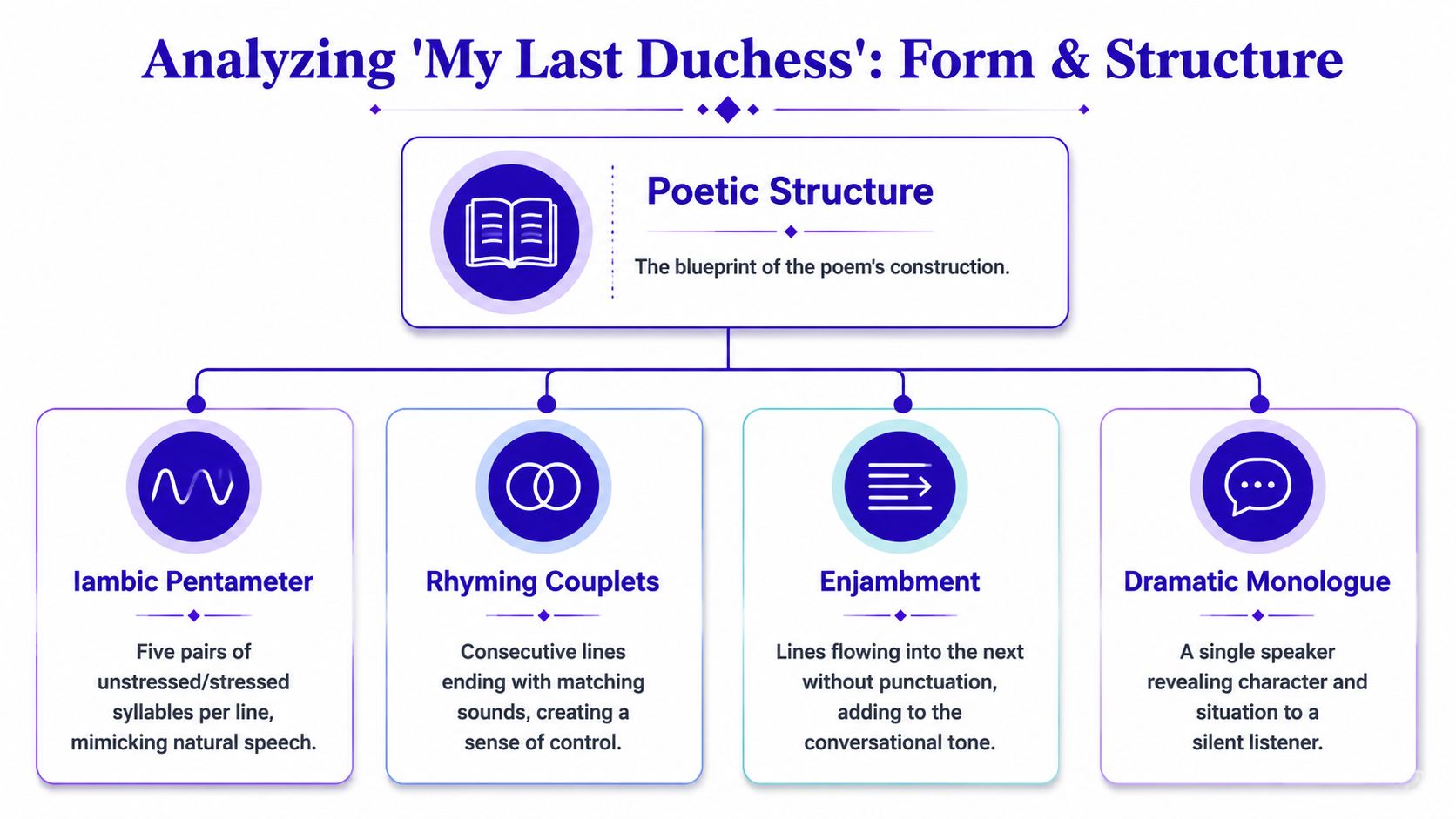
My Last Duchess is a dramatic monologue. That means one speaker talks while someone else listens. In practice, Browning gives us the Duke's voice and leaves us to judge him from what he says, how he says it, and what he accidentally reveals.
That matters for exams because form is not a label to memorise. It is Browning's method. A dramatic monologue lets the Duke sound confident and civilised on the surface while subtly exposing his cruelty underneath. If you only write “it is a dramatic monologue,” you are naming the method. If you write “the dramatic monologue traps the reader inside the Duke's version of events, so his controlling mindset becomes impossible to ignore,” you are analysing it.
If you want a useful comparison with Browning's other disturbing speakers, the MasteryMind Porphyrias Lover resources can help you notice how voice becomes evidence.
The poem sounds controlled
The poem uses iambic pentameter and rhyming couplets. Those terms can look scary, but the effect is simple.
Iambic pentameter creates a steady beat, close to formal speech. It helps the Duke sound calm, educated, and in command. The rhyming couplets add neatness. Line after line seems paired off and closed down, which suits a man who wants everything placed neatly under his authority, including people.
A helpful way to remember this is to picture a perfectly arranged room. Everything appears polished and ordered. Browning gives the Duke that same polished surface in the poem's rhythm and rhyme.
The structure refuses to stay tidy
The clever part is that the poem does not feel as neat as the couplets suggest. Browning uses enjambment again and again, so sentences run over line endings instead of stopping cleanly. Scholars at the British Library discuss how Browning's dramatic monologues often rely on a speaker's own flowing speech to reveal more than he intends in their introduction to Robert Browning.
So the poem has two movements at once. The rhyme tries to contain the Duke. His sentences keep spilling forward.
That tension is exactly what strong analysis should notice. The Duke wants control, but his own speech shows strain, irritation, and obsession. He sounds smooth, yet he cannot fully keep his darker thoughts in check.
What examiners want you to say about that tension
A basic point sounds like this:
- the couplets show control
A stronger point explains the clash between order and overflow:
| Feature | Surface effect | Deeper meaning |
|---|---|---|
| Dramatic monologue | We hear one polished voice | The Duke exposes himself without realising it |
| Iambic pentameter | Speech sounds measured and authoritative | He performs social power |
| Rhyming couplets | The poem feels neat and controlled | He wants to organise people like possessions |
| Enjambment | Sentences run on | His jealousy and arrogance press through the polished surface |
This is the jump from summary to marks. You are not spotting techniques like items on a checklist. You are showing how Browning makes form and structure carry meaning.
A model idea you could use in an essay
Try building a paragraph around a contradiction:
Browning uses the regularity of iambic pentameter and rhyming couplets to give the Duke an air of confidence and control, but the frequent enjambment lets his thoughts spill over, suggesting that his obsessive need for dominance cannot be fully contained.
That sounds stronger because it connects method, effect, and interpretation in one sentence.
A quick rule for revision
When you revise form and structure, ask two questions:
- How does the poem sound on the surface?
- What is Browning letting slip underneath?
If you can answer both, you are writing like a student who understands how the poem works, not just what happens in it.
Key Themes and Important Quotations
This is the revision bit you'll want before a test. Learn the themes, but don't revise them as separate boxes. In this poem, power, pride, jealousy, and objectification all overlap.
One helpful comparison is with Browning's other dramatic monologues. If you're revising poems that show obsession and violence, these MasteryMind Porphyrias Lover resources can help you notice how Browning uses voice to reveal disturbing psychology in different ways.
The themes that matter most
The core themes are:
- Power and control
- Pride and jealousy
- Art and objectification
- Appearance versus reality
Below is a table built for quick revision.
Key Quotations for My Last Duchess
| Quotation | Theme(s) | Quick Analysis (Language/Structure/Effect) |
|---|---|---|
| “That's my last Duchess painted on the wall” | Power, objectification | The possessive “my” makes the Duchess sound owned. He introduces her first as an image, not a person. |
| “Looking as if she were alive” | Art vs reality, control | The painting preserves an illusion of life, but also traps her in a version he can manage. |
| “Will't please you sit and look at her?” | Power, control | It sounds polite, but it also feels like a command. His manners hide dominance. |
| “I call / That piece a wonder, now” | Objectification, pride | “Piece” reduces her to an artwork. “Now” hints that he values her more as a controllable object than as a living wife. |
| “Too soon made glad” | Jealousy, pride | He frames her warmth as a flaw. His criticism reveals insecurity rather than her guilt. |
| “She liked whate'er / She looked on, and her looks went everywhere” | Jealousy, control | The broad phrasing makes her seem open and generous, but he twists that into evidence against her. |
| “My gift of a nine-hundred-years-old name” | Pride, status, power | He sees marriage as something he bestowed on her. His family name matters more to him than emotional connection. |
| “I choose / Never to stoop” | Pride, control | His refusal to “stoop” shows arrogance. He would rather destroy the relationship than speak honestly. |
| “I gave commands; / Then all smiles stopped together” | Power, violence | The euphemistic phrasing hides brutality. The pause after “commands” makes the statement feel cold and final. |
| “Notice Neptune, though, / Taming a sea-horse” | Power, objectification | The closing image mirrors the Duke's mindset. He admires domination and sees taming as something noble. |
How to revise quotations without drowning in them
You don't need a huge quote bank. You need a usable one.
Try this approach:
- Learn short quotations rather than full chunks. “Too soon made glad” is easier to use than a long sentence.
- Pair each quote with one idea. For example, “I choose / Never to stoop” equals arrogance.
- Notice movement. The poem begins with a portrait, moves through complaint, and ends with business. That sequence helps you talk about the Duke's coldness.
A quotation is only useful if you know what argument it proves.
Where students often get confused
Some students say the Duchess was flirtatious. Be careful. The poem gives us the Duke's interpretation, not an objective truth. A much safer point is that the Duchess seems warm, appreciative, and socially open, while the Duke sees that as intolerable.
That distinction matters because it keeps your essay thoughtful. You're analysing the Duke's mindset, not accepting his judgement.
How to Write a Top-Grade Answer
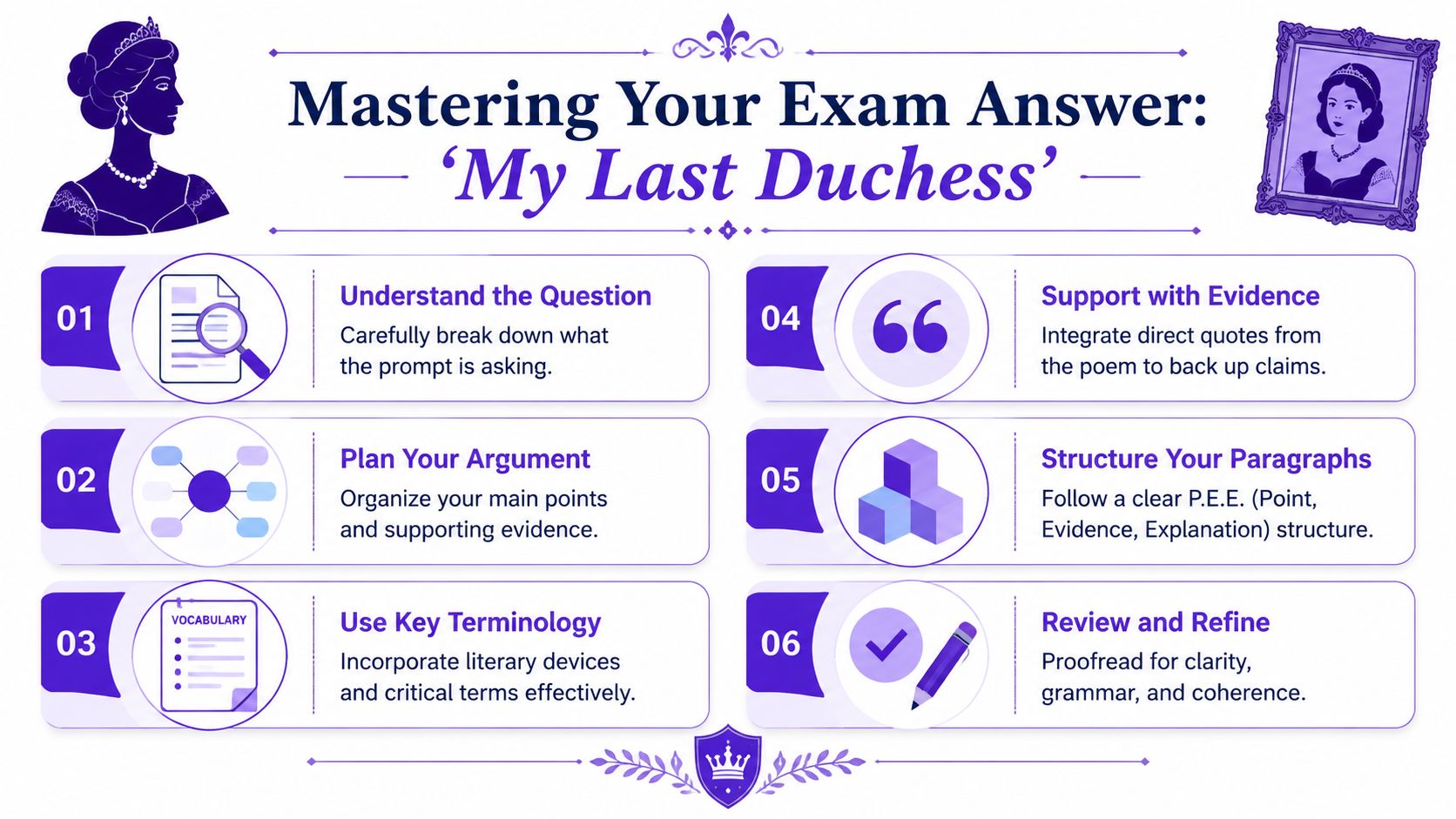
Students usually lose marks in two places. They either retell the poem, or they spot techniques without making an argument. A strong answer does neither. It makes a clear claim, proves it with quotation, and explains how Browning's choices shape the reader's response.
A model paragraph
Question: Explore how Browning presents power in My Last Duchess.
Browning presents power as something the Duke wants to control absolutely, especially within marriage. This is clear when he introduces “my last Duchess”, because the possessive pronoun suggests that he sees his wife as property rather than an equal partner. Browning strengthens this through the dramatic monologue form, since the Duke controls the whole conversation and tries to shape how the listener sees the Duchess. However, his power also becomes disturbing when he states, “I gave commands; / Then all smiles stopped together,” because the vague, euphemistic wording hides brutal action behind calm language. As a result, Browning shows that the Duke's idea of power is not protective or noble. It is possessive, insecure, and destructive.
That paragraph works because it does three things in order:
- Makes a point
- Uses evidence
- Explains effect and writer's method
What examiners like seeing
Use this as a quick checklist before you memorise anything else:
- Answer the command word. If the question says explore, stay analytical. If it says compare, keep both poems active.
- Zoom in on one word when it matters. “My”, “stoop”, and “commands” are all rich choices.
- Mention form naturally. Don't bolt it on at the end.
- Link structure to meaning. The controlled surface and leaking emotion is a strong line of argument.
- Keep context brief and relevant. One sharp sentence beats a paragraph of detached background.
- Write like you're proving a case. Every sentence should help answer the question.
For general student writing tips, it's worth looking at practical advice on organising ideas and writing clearly under pressure, especially if your analysis is stronger in your head than on the page.
A final revision list for the night before
- Know the plot cold. If you can't summarise it, analysis gets shaky.
- Memorise a small set of quotations you can use.
- Have one strong form point ready about control versus leakage.
- Practise one paragraph on power and one on the Duke's character.
- Train with timed questions so your ideas don't collapse under pressure.
If you need structured timed practice, Exam Practice for GCSE is one way to work on turning poem knowledge into answers that match exam-style wording and timing.
If you want more support with English Literature revision, essay structure, and exam-focused practice across GCSE and A-Level subjects, MasteryMind offers curriculum-aligned revision tools designed for UK learners.
Ready to master this topic?
Practise with quizzes, blurt exercises and exam questions on MasteryMind.
7 days Premium · Then free forever · No card, no charge