OCR a Level Explained: Your 2026 Ultimate Guide
You're probably in one of two places right now.
Either you've looked at your folder, your class notes, and your test scores and thought, “I need to rescue this before mocks get ugly.” Or you're the opposite type. Organised, ambitious, slightly allergic to vague revision advice, and wanting to know how OCR works so you can use the system properly.
Both instincts are sensible. OCR A-Level success isn't just about working harder. It's about understanding the board's structure, the way papers are built, and the kind of thinking examiners reward. Once that clicks, revision stops feeling like random effort and starts feeling more like training for a specific event.
What Is OCR and Why Does It Matter for Your A-Levels
In sixth form, exam board names get thrown around as if everyone already knows what they mean. OCR. AQA. Edexcel. Teachers say them casually. Students nod along. Then someone gets home and googles whether they're all the same thing.
OCR is one of the major UK exam boards. It offers GCSEs, AS levels, A levels, and vocational qualifications, and its specifications are assessed nationally and tracked through annual results releases, which is why schools and teachers treat OCR data as a reliable baseline for how qualifications are performing across the UK, according to OCR results statistics and administration information.
That matters because your board shapes three things:
- What gets taught: The specification decides the exact content.
- How you're assessed: Paper structure, command words, practical work, source analysis, essays, and coursework all depend on the board.
- What “good revision” looks like: A revision method that works brilliantly for one board can be too vague or too narrow for another.
Think of exam boards as different rulebooks
The subject is still the subject. Biology is still biology. Maths is still maths. But each board writes its own version of the route through that subject.
A simple way to think about OCR is this. It's not a different mountain. It's a different path up the same mountain.
A student revising without checking the OCR specification can end up confident in the wrong areas. They may know a topic generally, but not in the level of precision OCR wants. Teachers see this all the time. The student says, “I revised that.” The script says, “Not in the way the question asked.”
The board doesn't change your intelligence. It changes the game you're playing.
If you're stressed, that should reassure you. You don't need some magical talent for OCR. You need familiarity. Once you know the board's habits, your revision becomes more focused, and your marks usually become less random.
How Your OCR A-Level Is Structured and Assessed
Most OCR A-Levels are built to test what you can do at the end of the course, not just what you remembered last week. That changes the whole revision picture.
Imagine building a house. Year 12 lays the foundations. Year 13 adds the walls and roof. If the foundations are shaky, the rest of the house can still stand for a while, but cracks show up when pressure arrives.
The big pattern to expect
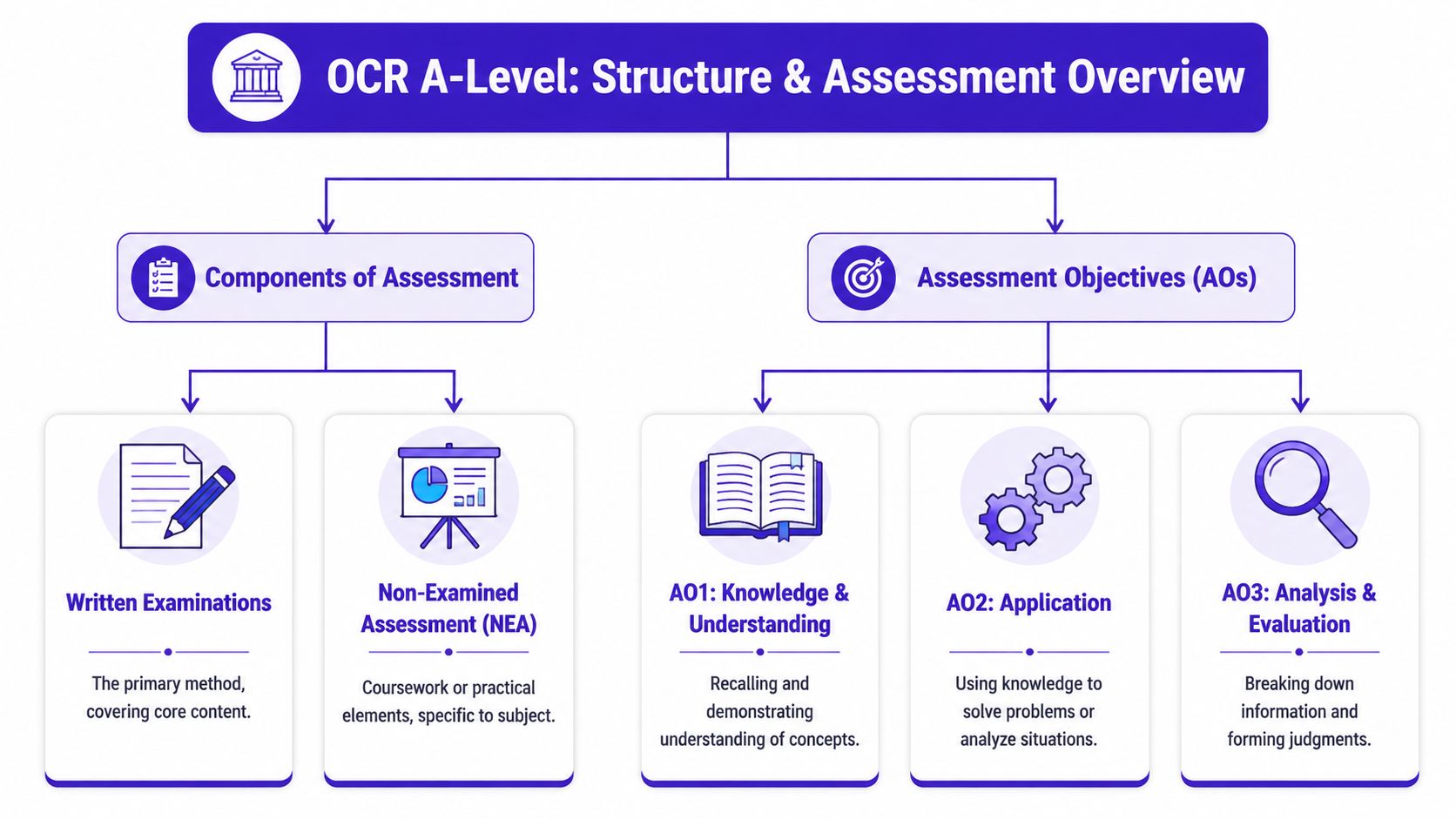
Across OCR subjects, assessment usually combines written examinations and, in some subjects, Non-Examined Assessment, often shortened to NEA. Written papers test what you can do under time pressure. NEA tests what you can produce over time, with planning, drafting, and sustained problem-solving.
That's why generic revision advice often falls flat. “Revise little and often” isn't wrong, but it's incomplete. You need to revise in the same format that OCR will later demand from you.
For many students, the mistake is treating all knowledge as equal. It isn't. Some knowledge is there to be recalled directly. Some is there to be applied. Some is there to help you explain, compare, evaluate, or construct a method.
Assessment objectives matter more than most students realise
Assessment Objectives, often called AOs, are the hidden framework behind your marks. They tell examiners what kind of performance they're rewarding.
A rough way to think of them is:
- AO1: What do you know and understand?
- AO2: Can you apply it?
- AO3: Can you analyse, interpret, or evaluate it?
That means reading notes isn't enough on its own. If a subject rewards application, then revision has to include application. If a subject rewards evaluation, then you have to practise making judgements, not just collecting facts.
What that means for revision
Students usually revise in the style they prefer. OCR assesses in the style the subject demands. Those are not always the same thing.
A better weekly routine includes:
- Specification checking: Know exactly which content points belong to your course.
- Question practice: Use real exam-style tasks, not only summary notes. The A-Level Past papers approach helps here because it keeps revision tied to paper format rather than just topic familiarity.
- Error review: Don't just mark a paper and move on. Work out whether the miss came from knowledge, method, timing, or command-word misunderstanding.
Practical rule: If your revision never looks like the final assessment, you're practising comfort, not performance.
A Closer Look at Popular OCR A-Level Subjects
OCR becomes easier to understand when you stop seeing it as one giant system and start looking at how it behaves in actual subjects. The board's style shows up differently in science, maths, computing, and essay subjects.
Biology feels staged for a reason
OCR A Level Biology A has a clear internal build. The first four modules form the AS Level, and the full A Level then continues with modules 5 and 6, as set out in the OCR A Level Biology A specification.
That staged structure matters because students often treat Year 12 content as “last year's work”. In OCR Biology, that's a bad habit. The later material builds on it directly. If your understanding of foundational modules is hazy, Year 13 topics don't just feel harder. They feel disconnected.
For teachers, that module progression is also a clue about sequencing. For students, it means revision should spiral back. Not because teachers enjoy repetition, but because OCR's structure assumes continuity.
Computer Science is split between pressure and process
OCR A Level Computer Science gives a very clear example of mixed assessment. The qualification is assessed through two 2-hour-30-minute written papers worth 140 marks each and a programming project worth 70 marks. The written papers contribute 40% each and the NEA contributes 20%, according to this breakdown of the OCR A Level Computer Science H446 specification.
That tells you something important straight away. You can't survive on coding skill alone, and you can't survive on theory alone either.
A strong programmer who neglects written explanation gets punished. A neat note-maker who avoids the project gets punished too.
The tactical lesson from that structure
For Computer Science students, revision needs two lanes running at the same time:
- Timed written practice: You must get used to explaining logic, algorithms, systems, and theory under exam conditions.
- Project discipline: The NEA needs planning, testing, documenting, and regular progress, not a last-minute sprint.
The GCSE and A-Level topics route can help students organise practice by specification area, but the primary benefit comes from matching the task to the assessment mode. If it's an exam skill, practise it at speed. If it's an NEA skill, build it steadily.
Maths rewards method choice, not just final answers
OCR Maths can trip up good students because it often exposes whether they really understand a method or whether they've only memorised examples. One neglected gap in OCR A Level coverage is angle-finding in 3D vectors and line or plane questions. OCR's A Level Mathematics A specification explicitly includes this geometry and vector content, as shown in the OCR Mathematics A specification.
Students get stuck here because the topic often appears in fragments. One video shows a worked example. Another worksheet gives a slightly different version. What's missing is often the decision-making process.
When do you use a dot product? When do you form a direction vector? When is the angle between lines not the same as the angle the examiner wants?
In OCR Maths, confusion often starts before the calculation. It starts at the point where the student has to choose the method.
That's why OCR A-Level revision should never become a pile of model solutions copied line by line. You need a method map. Not just “how this question was done”, but “how I know this is the method to use”.
How OCR Grading and NEAs Actually Work
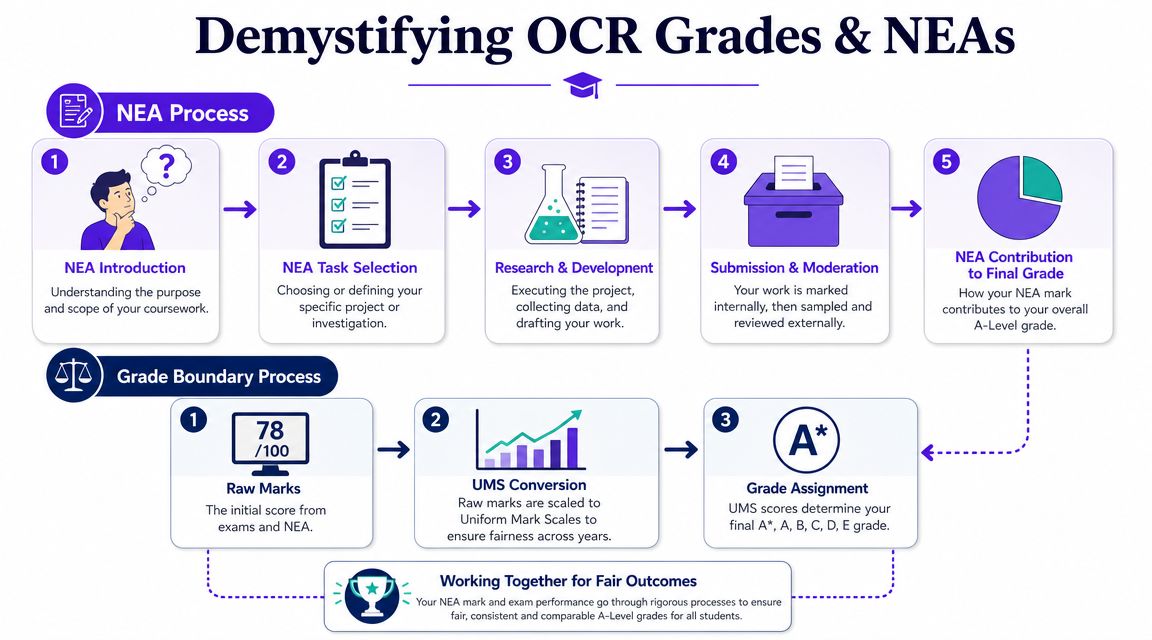
Grading feels mysterious when you only see the final letter on results day. It becomes less mysterious when you separate three different ideas. Your raw performance, how marks are combined, and what part NEA plays in the full picture.
What an NEA is really doing
An NEA is coursework or project work assessed outside the final exam hall. Different subjects use it differently, but the basic purpose is similar. It gives students a chance to demonstrate skills that aren't always best measured in a timed paper.
A useful analogy is a chef's signature dish. The final service exam shows what you can do under pressure. The signature dish shows what you can produce when planning, development, and refinement all matter.
That doesn't make the NEA easier. It makes it different.
Students often misunderstand the risk
The danger with NEA work isn't just weak quality. It's drift. Students leave it too long, teachers chase checkpoints, and then panic replaces planning.
A steadier approach looks like this:
- Define the task clearly: Know what success looks like before you start producing material.
- Keep evidence as you go: Drafts, tests, decisions, and reflections are easier to record in real time.
- Treat milestones as real deadlines: Internal deadlines are usually there to save you from the final crunch.
If you want structured help while staying within the rules, you can discover MasteryMind Nea Coach, which is designed around guidance rather than rewriting.
What grading can and can't tell you
OCR's June 2025 provisional results for A Level Mathematics reported 16,845 candidates, with 75.2% awarded A to C* and 15.0% awarded A or A*, according to OCR's June 2025 provisional results statistics.
Those figures are useful as a broad picture. They show that OCR is assessing a large national entry in a major subject, and they remind students that grade outcomes sit within a full cohort, not just their classroom.
What they don't do is predict your grade from your current mood, one mock, or one bad week.
Your grade is not a personality verdict. It's the result of how well your performance matched the assessment demands on that paper set.
The most useful way to think about marks
Students often ask, “How many marks do I need?” A better question is, “What kind of marks am I currently losing?”
That leads to a more useful diagnosis:
| Mark loss type | What it usually means |
|---|---|
| Knowledge gaps | You didn't know the content securely enough |
| Method errors | You knew the topic but chose or executed the wrong approach |
| Command-word misses | You answered a different question from the one set |
| Timing losses | You could do it, but not efficiently enough |
Once you know the type of loss, revision gets sharper. You stop revising everything badly and start fixing the actual leak.
Is OCR Different from AQA or Edexcel
Yes, but not in the dramatic way students sometimes hope or fear.
OCR, AQA, and Edexcel all assess nationally recognised qualifications. None of them is a magic shortcut. The useful comparison isn't “Which is easier?” It's “What kind of response does this board seem to reward?”
The real difference is style
Teachers often talk about board “personality”. That's informal language, but it points to something real. Boards differ in specification wording, question phrasing, balance of recall and application, and how they distribute marks across tasks.
A student who says “I'm just bad at OCR” is often really saying one of these things:
- “I misread the command words.”
- “I didn't expect that style of application.”
- “I revised the topic, but not the question type.”
- “I'm comparing my paper to a different board's materials.”
OCR vs AQA vs Edexcel at a Glance
| Exam Board | General Philosophy | Typical Question Style | Example Subject Focus |
|---|---|---|---|
| OCR | Often rewards secure knowledge plus careful application to the task set | Questions can expose whether students can choose and apply methods, not just recall them | In subjects like maths or sciences, students may need to justify method or explain reasoning clearly |
| AQA | Often feels structured and explicit in how questions are staged | Students may find the wording more scaffolded in some subjects, though demands remain high | In essay subjects, students often need clear line of argument and accurate support |
| Edexcel | Often feels specification-driven with a distinct paper style teachers get used to over time | Questions may reward familiarity with recurring formats and expectations | In content-heavy subjects, students often benefit from close attention to paper habits |
That table isn't a ranking. It's a revision reminder.
If you're on OCR, the worst strategy is revising from a mixed pile of random resources and assuming “A-Level is A-Level”. It isn't. The board-specific fit matters. A lot.
So should you worry if friends are on another board
Not really.
If your friend is on AQA and says their papers look easier, that tells you almost nothing useful unless you compare the whole specification, wording style, and mark scheme logic. Students are very good at comparing stress levels and very bad at comparing assessment systems properly.
The winning move is much simpler. Learn your own board's habits so well that comparisons stop mattering.
Smart Revision Strategies for OCR A-Level Success
The fastest way to waste revision time is to revise in a way that feels productive but doesn't match OCR assessment. Highlighting notes can feel calm. Re-reading a textbook can feel responsible. Neither guarantees marks.
The strategic question is this. What does OCR require you to do on the day, and have you practised doing exactly that?
Start with the specification, not your notes
Your notes reflect what happened in class. The specification reflects what can be assessed.
That's a big difference.
If you're revising OCR A-Level subjects, use the specification like a checklist and ask:
- Can I define this clearly?
- Can I apply it to an unfamiliar question?
- Can I explain it in the language the mark scheme is likely to reward?
This keeps revision anchored to the course, not to your memory of a lesson.
Practise command words like they're part of the content
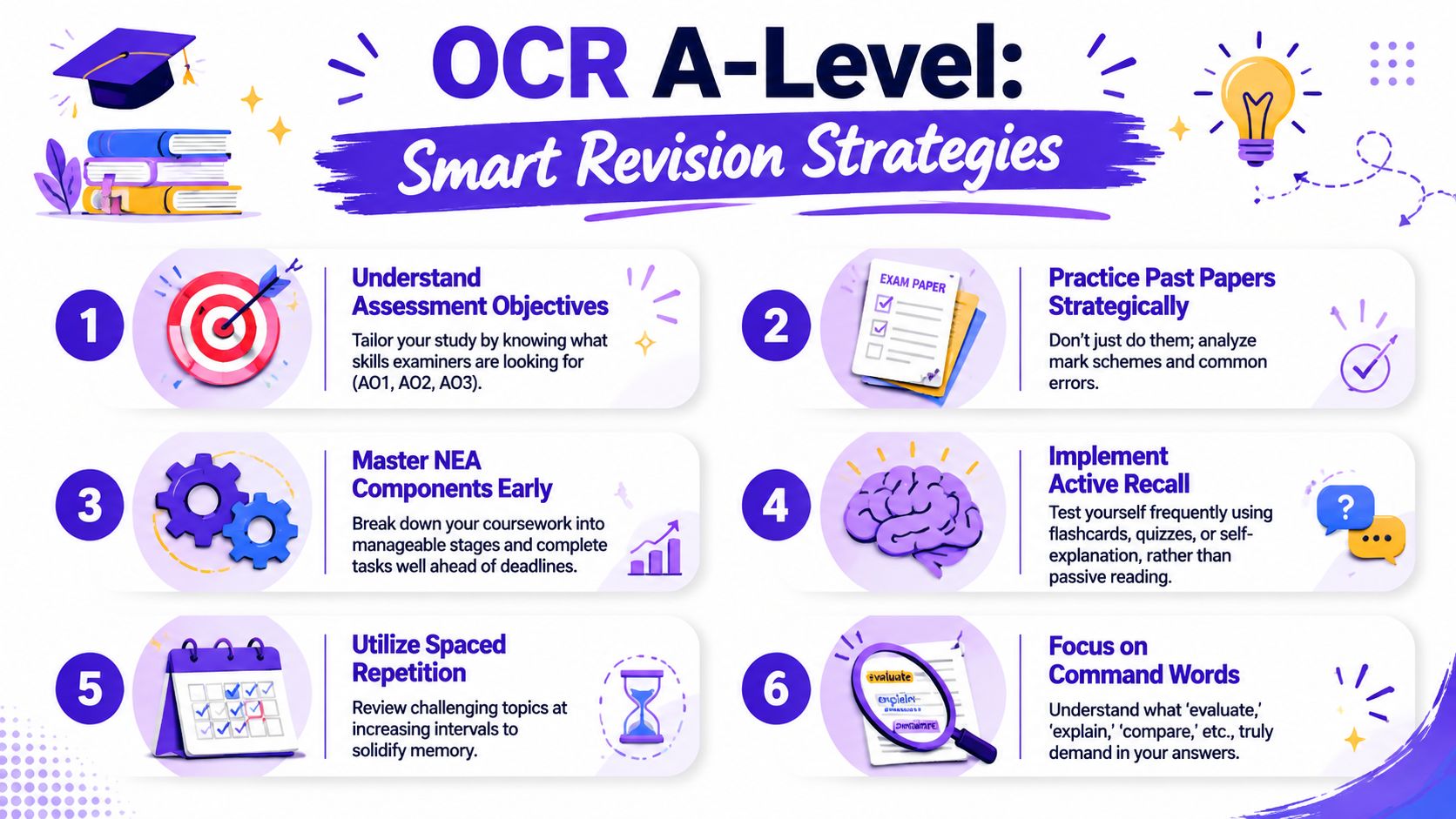
Students often treat command words as decoration. They aren't. In OCR papers, the command word tells you what sort of answer earns credit.
A few examples:
- Explain usually needs a clear chain of reasoning.
- Compare needs similarities and differences, not two isolated paragraphs.
- Evaluate needs judgement, not just description.
- Calculate still rewards method, not only the final answer.
That means a strong student can lose marks while knowing the topic well. They answer accurately, but in the wrong mode.
Here's a useful reset. Every time you answer a question, circle the command word first and write a tiny reminder beside it. One or two words is enough. “Judgement”. “Reasons”. “Both sides”. “Method”.
Teacher habit worth stealing: mark the command word before you even start planning the answer.
A short video can also help if you need a reset on exam technique and study habits:
Target the gaps that generic resources miss
Some OCR weak spots are very specific. That's why broad revision advice often misses the mark.
One example comes from Chemistry. A common gap in OCR A Level Chemistry resources is explaining why bond angles shift due to lone pairs or multiple bonds, which is an application skill that goes beyond memorising ideal shapes, as discussed in this guide to OCR A Level bond angles and molecular shapes.
That tells you something wider. If a topic is often taught as recall but examined as reasoning, your revision has to bridge that gap deliberately.
A better OCR revision routine
- Use active recall: Shut the book. Rebuild the answer from memory.
- Interleave topics: Mix old and current content so Year 12 material stays alive.
- Analyse mark schemes properly: Don't just count marks. Notice what triggered them.
- Practise under conditions: Some sessions should feel uncomfortable. That's useful.
- Use board-aligned tools when possible: Exam Practice for A-Level is one example of a tool built around specification-linked practice and AO-style feedback, which can help students rehearse OCR-style demands rather than generic quizzes.
The pattern is simple. OCR rewards students who can move from knowing to doing. So your revision should do the same.
Your OCR A-Level Questions Answered
Where can I find official OCR past papers and mark schemes
Use OCR's own subject pages and exam materials through your school or department first. Teachers usually know exactly which papers match your specification code, and that matters.
Can a school switch from another exam board to OCR
Yes, schools can change boards, but that's a centre-level decision. Departments usually weigh curriculum fit, teaching resources, prior experience, and assessment style before making a switch.
Does OCR offer access arrangements
Access arrangements are normally handled through your school's exams officer and SEN team, under the usual exam regulations. If you think you may need support, raise it early. Waiting until the exam season is rarely a good idea.
Is OCR harder than other boards
That's not the most useful way to frame it. OCR is different in style and emphasis. Students do best when they prepare for the board they sit, rather than ranking boards in the abstract.
What should I do if I'm behind
Start smaller than you think. Pick one subject, one topic list, one paper, one weak area. A recovery plan works best when it's specific. Panic plans usually collapse because they try to fix everything at once.
If you want OCR revision that stays close to actual specifications, question styles, command words, and feedback patterns, MasteryMind is one practical option. It gives UK learners structured GCSE and A-Level practice, including OCR-aligned topics, past-paper style work, exam mode, and NEA support tools that focus on guidance rather than doing the work for you.
Ready to master this topic?
Practise with quizzes, blurt exercises and exam questions on MasteryMind.
7 days Premium · Then free forever · No card, no charge