Master the Periodic Table A Level Chemistry for 2026
You've probably had one of these moments. You open your chemistry notes, stare at the periodic table, and it feels like someone handed you a dense wall chart that everybody else somehow understands. The symbols blur together. The trends sound similar. Then a teacher says, “Just use periodicity,” as if that clears everything up.
It doesn't, at least not straight away.
The good news is that the periodic table a level chemistry topic is far more logical than it first looks. It isn't a poster to memorise. It's a prediction tool. If you can read an element's position properly, you can work out a lot about how it behaves, how reactive it is, how strongly it attracts electrons, and why some exam questions contain those irritating little exceptions that catch people out.
That last bit matters. Plenty of students can recite the trend. Fewer can explain why the trend happens. Even fewer can explain why the trend briefly breaks. Those are often the answers that separate a safe pass from a high grade.
Your Guide to Nailing A-Level Periodicity
You are halfway through an exam. A question asks why magnesium has a higher first ionisation energy than sodium, then follows up with why sulfur does not fit the simple trend as neatly as you expected. If your revision has been built on memorising isolated facts, this is usually the point where confidence disappears.
A-level periodicity gets much easier once you treat the periodic table as a map of causes, not a poster of facts. An element's position helps you predict how strongly it attracts electrons, how large its atoms are, how easily it loses an electron, and where the examiners expect you to explain an exception instead of reciting a trend.
That is the part many students miss.
Strong answers do more than state, “the trend increases across a period” or “reactivity increases down a group.” They explain why. They mention nuclear charge, shielding, distance from the nucleus, and sub-shell structure when needed. They also handle the awkward cases that exam boards like to test, such as dips in first ionisation energy or the smaller-than-expected drop in atomic radius.
The periodic table works like an address system. Position gives you clues, and those clues lead to properties. Once that idea clicks, periodicity stops feeling like a memory test and starts feeling like a logic exercise.
This topic also rewards precise exam language. A vague phrase such as “the atom wants to lose an electron” rarely gets full credit. A mark-scheme-friendly answer explains that increased nuclear charge, with similar shielding across a period, increases the attraction between the nucleus and the outer electron. That level of reasoning is what turns decent answers into high-scoring ones.
If you are rebuilding confidence or sharpening exam technique, structured practice can help keep your revision tied to specification wording. Online Revision for A-Level is one way to keep that practice focused.
Keep one rule in mind as you work through periodicity. If you can explain an element's position, you can usually explain its behaviour.
Decoding the Periodic Table's Layout
The periodic table makes more sense when you treat it like an address system, not a scrapbook of elements.

An element's position gives you clues about its electron arrangement, and that electron arrangement drives chemical behaviour. That's why the layout matters so much. It isn't arbitrary. It's organised.
Groups tell you about similar behaviour
The vertical columns are called groups. Elements in the same group have similar chemical properties because they have similar outer-electron patterns. In A-level work, the modern IUPAC group numbering system runs from 1 to 18, and that numbering is used for discussing reactivity in familiar areas such as Group 1, Group 2, and the halogens on UK courses, as shown on the PubChem periodic table reference.
When students get stuck here, it's usually because they half-remember older numbering or mix up group number with total electron number. Don't do that. For the groups you most often meet early on, think in terms of valence behaviour, not just labels.
A quick way to read a group:
- Group 1 elements tend to lose one electron.
- Group 2 elements tend to lose two electrons.
- Group 17 elements tend to gain one electron.
- Group 18 elements are already stable enough to be far less reactive in normal conditions.
That won't answer every question, but it gives you a strong starting point.
Periods tell you about shells
The horizontal rows are called periods. Period number tells you the number of occupied electron shells. A standard example is lithium, which is in Period 2 and therefore has two occupied shells.
That one rule clears up a lot of confusion. If an atom is lower down the table, it has more shells. More shells usually means the outer electrons are further from the nucleus. That idea becomes essential when you explain size, attraction, and ionisation energy.
Practical rule: group helps you predict outer-electron behaviour, period helps you judge distance from the nucleus.
A common error is to look at a position and describe only one of those. High-mark answers usually use both.
Here's a simple summary:
| Feature | What it tells you | Why it matters |
|---|---|---|
| Group | Similar outer-electron pattern | Helps predict bonding and reactivity |
| Period | Number of occupied electron shells | Helps explain distance and shielding |
| Atomic number | Position in increasing proton number | Fixes the element's identity |
This video is useful if you want a quick visual reset before practising questions.
Blocks show where electrons are being added
Students often ignore the blocks, then get surprised when d-block questions feel harder. The blocks are the broad regions called s, p, d, and f. They tell you which type of sub-shell is being filled.
You don't need to panic about every detail immediately. Just know this:
- s-block sits on the left
- p-block sits on the right
- d-block sits in the middle
- f-block is shown separately below
That layout starts to explain why transition metals behave differently from, say, sodium or chlorine. Their electrons are arranged differently, so their chemistry differs too.
Once you can read group, period, and block together, the table stops feeling like a wall chart and starts behaving like a map.
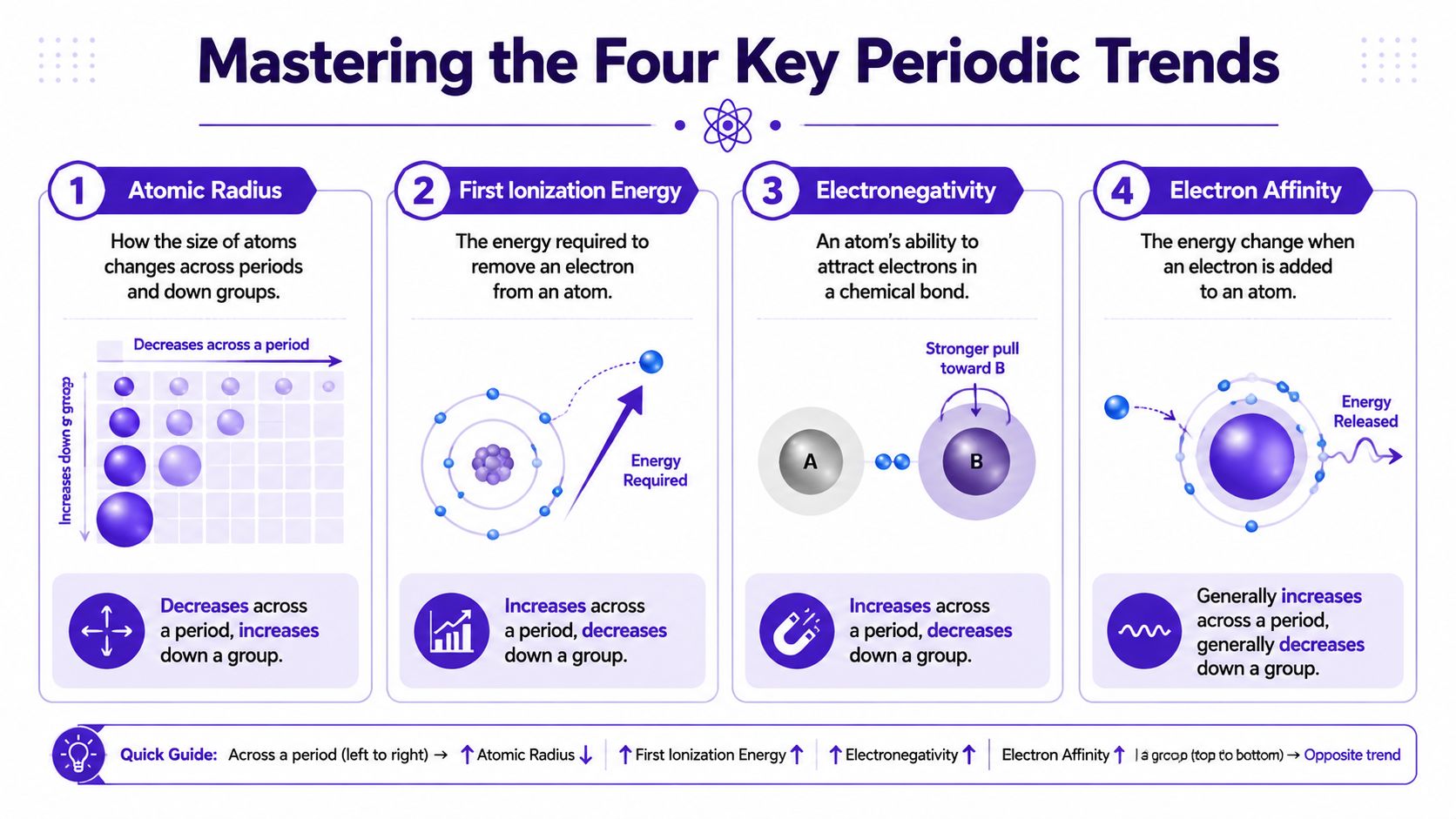
Mastering the Four Key Periodic Trends
Most periodicity marks come from one skill. You spot a trend, then explain it with proper cause and effect.
The cleanest method is structure → attraction → property. That's the pattern examiners reward. Save My Exams' OCR notes make this point clearly, including the idea that across Period 3, increasing effective nuclear charge with similar shielding explains the general rise in ionisation energy in their periodicity notes.
Atomic radius
This is the size of the atom. Students often memorise the direction of the trend but miss the reason.
Across a period, atomic radius generally decreases. Down a group, atomic radius generally increases.
Use the full chain:
- Structure. Across a period, proton number increases while electrons are added to the same main shell.
- Attraction. The nucleus pulls more strongly on the electrons because effective nuclear charge rises and shielding stays fairly similar.
- Property. The electrons are pulled in more tightly, so the atomic radius gets smaller.
Down a group, the structure changes differently. There are more occupied shells. That means more shielding and a greater distance between the outer electrons and the nucleus, so the attraction is weaker and the radius gets larger.
If your answer only says “it gets smaller across a period”, you've named the trend. You haven't explained it.
First ionisation energy
This is the energy needed to remove one electron from each atom in a mole of gaseous atoms. In exam answers, the key idea is how strongly the outer electron is held.
Across a period, first ionisation energy generally increases. Down a group, it generally decreases.
A strong explanation across a period sounds like this in simplified form:
- Proton number increases.
- Shielding stays fairly similar because electrons are added to the same shell.
- The attraction between nucleus and outer electron increases.
- More energy is needed to remove the electron.
Down a group:
- there are more shells,
- outer electrons are further away,
- shielding increases,
- nuclear attraction to the outer electron decreases,
- less energy is needed to remove it.
That sequence is much stronger than a short trend statement.
Electronegativity
Electronegativity is an atom's ability to attract the bonding pair of electrons in a covalent bond. Students often confuse this with ionisation energy because both involve attraction. They're related, but they're not the same.
Across a period, electronegativity generally increases because the nucleus attracts bonding electrons more strongly as effective nuclear charge rises. Down a group, electronegativity generally decreases because increased distance and shielding reduce that pull.
A quick comparison helps:
| Property | What is being attracted or removed | Key question |
|---|---|---|
| Ionisation energy | Removing an electron from an atom | How hard is it to take an electron away? |
| Electronegativity | Attracting bonding electrons | How strongly does the atom pull shared electrons? |
If you mix these up, your wording becomes vague. Keep the definitions separate.
Metallic and non-metallic character
This trend feels less neat because students meet it in lots of different topics. The basic pattern still follows the same logic.
Across a period, elements generally become less metallic and more non-metallic. Down a group, metallic character generally increases.
Why? Metals tend to lose electrons more easily. If attraction to outer electrons is stronger, losing electrons becomes harder, so metallic behaviour reduces. If attraction is weaker, losing electrons becomes easier, so metallic behaviour increases.
Here's the fast exam version:
- Across a period. Stronger nuclear attraction means atoms are less willing to lose electrons.
- Down a group. Increased shielding and distance mean atoms lose electrons more easily.
One way to write better trend answers
When you practise, force yourself to write every explanation in this shape:
- Structure
- Attraction
- Property
For example:
- Structure. More protons, same number of shells.
- Attraction. Stronger attraction between nucleus and outer electrons.
- Property. Smaller atomic radius.
That feels repetitive at first. Good. Repetition builds the habit that gets marks.
Why Periodic Trends Have Annoying Exceptions
If you've ever thought, “Chemistry tells me a rule and then immediately breaks it,” this is the bit you were waiting for.
Some first ionisation energy trends don't follow the simple pattern perfectly. Exam boards such as OCR expect students to explain anomalies like the drop from Be to B and from N to O using sub-shell ideas and electron-pairing repulsion, not just broad trend statements, as laid out in these OCR periodic table notes.
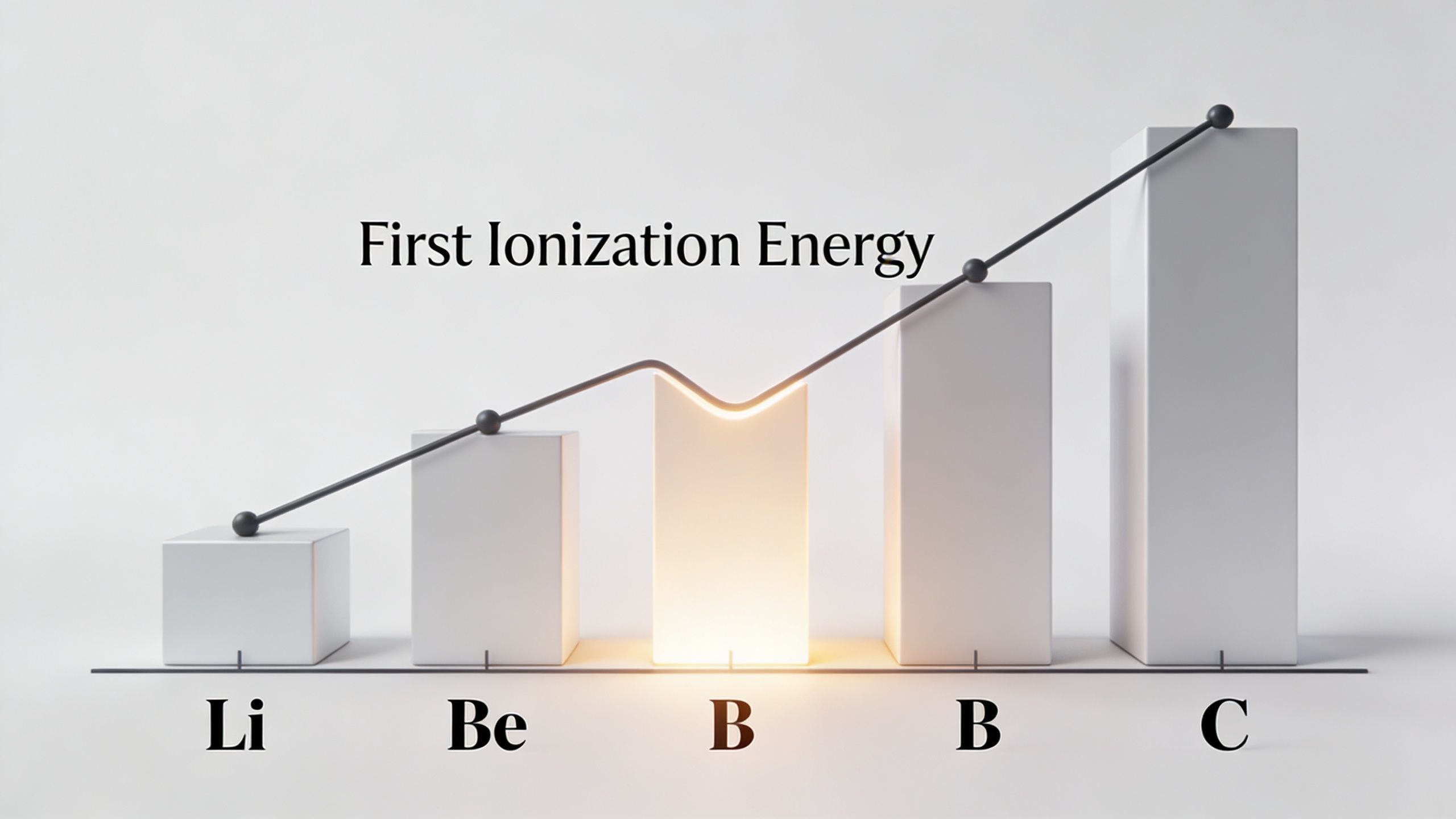
The drop from beryllium to boron
A student who memorises only “ionisation energy increases across a period” will get trapped here.
Beryllium's outer electron is in an s sub-shell, while boron's outer electron is in a p sub-shell. A p electron is at a higher energy level than an s electron in the same principal shell, so it is easier to remove.
The mark-scheme-friendly logic is:
- B's outer electron is in a higher-energy p sub-shell
- that electron is less strongly attracted
- less energy is needed to remove it
Short, precise, done.
The drop from nitrogen to oxygen
This one catches even strong students because the trend looks like it should continue upward.
Nitrogen has three p electrons arranged singly before pairing. Oxygen has one p orbital containing a pair of electrons. That pairing creates extra electron-electron repulsion, so one of those paired electrons is easier to remove.
A clean explanation is:
- oxygen has a doubly occupied p orbital
- repulsion between paired electrons reduces stability
- less energy is needed to remove one electron
You won't get full credit for writing “oxygen is an exception”. The marks are in the orbital explanation.
What examiners really want
When these questions appear, they're often testing whether you can move beyond a memorised trend. Keep your language tight.
Avoid phrases like:
- “it just breaks the trend”
- “it is less stable somehow”
- “there is more repulsion” without saying where
Use phrases like:
- higher-energy p sub-shell
- paired electrons in the same p orbital
- electron-electron repulsion
Those are the words that show you understand the chemistry, not just the pattern on a graph.
A Closer Look at the d-block and Transition Metals
The middle of the periodic table is where chemistry starts to feel more colourful, more flexible, and a bit stranger. That's the d-block, home of the transition metals.
Students often revise this topic as a list of random facts. Don't. The big properties of transition metals make more sense when you connect them to their electron structures, especially the presence of d electrons.
Variable oxidation states
Transition metals often form ions with different oxidation states. Iron is the familiar classroom example because you'll often meet both iron(II) and iron(III).
The core idea is that the energies of the outer electrons and d electrons are close enough that different numbers of electrons can be removed in different situations. That gives transition metals a flexibility that s-block metals don't usually show in the same way.
In exam answers, don't stop at “they have variable oxidation states”. Add why that matters. It means they can take part in a wider range of redox chemistry.
Coloured compounds
A lot of transition metal compounds are coloured, which is one reason they stand out so much in practical chemistry. At A-level, the important point is that this behaviour is linked to the d orbitals.
You don't always need a full advanced explanation unless your specification asks for it in detail. Often, it's enough to connect colour to the presence of partially filled d orbitals and the way they interact in compounds and complex ions.
Catalytic behaviour
Transition metals and their compounds often act as catalysts. Students sometimes treat this as another isolated fact to memorise, but it links back to the same flexibility in electron arrangement.
A useful way to think about it is that transition metals can interact with reacting species in ways that help alternative reaction pathways become possible. In exam responses, a concise statement is usually better than a waffly one.
Here's a compact recall set:
- Variable oxidation states help with redox processes
- Coloured ions and compounds link to d-orbital behaviour
- Catalytic activity links to their electronic flexibility
Exam reminder: if the question says “state two characteristic properties”, don't drift into stories about uses. Name the properties directly first.
Why this matters outside the classroom
This part of the table matters beyond exam halls. The UK government's Critical Minerals Strategy identifies elements such as cobalt and nickel, as well as lithium, as strategically important for the transition to net zero, linking d-block and s-block chemistry to supply-chain security in this chemical periodicity note.
That's useful context because it reminds you that periodicity isn't just theory. The table helps explain why certain metals are so important in batteries, catalysts, and industrial materials.
For teachers and stronger students, that real-world angle can sharpen revision. The same structural logic you use in exam answers is part of how chemists understand useful materials in the first place.
Applying Your Knowledge with Exam-Style Questions
You open the paper, see a six-mark periodicity question, and your mind goes blank. You know the trend. The problem is turning that half-remembered idea into the kind of answer the mark scheme rewards.
That is why exam practice matters here. Periodicity questions rarely ask you to recite a fact on its own. They ask for a causal chain. If you can explain what changes in structure, then how that changes attraction or repulsion, you are usually on the right track.
Question 1 Explain the trend in atomic radius down Group 2
A vague answer says, “Atomic radius increases because atoms get bigger.”
Examiners cannot give many marks for that because it skips the reason. A stronger answer builds the logic one step at a time:
- Each element down Group 2 has one more occupied electron shell than the one above.
- The outer electrons are further from the nucleus.
- Inner shells increase shielding.
- The nuclear attraction to the outer electrons is reduced.
- The atomic radius increases.
This works like a chain of cause and effect. If one link is missing, the explanation weakens. In longer questions, students often jump straight from “more shells” to “bigger atom” and lose marks because they have not explained why more shells matter.
Question 2 Explain an ionisation energy anomaly in a period
Many students lose marks here, even when they know the overall trend across a period is an increase. Exam boards like the exceptions because they test whether you understand the pattern underneath the pattern.
There are two common types of anomaly.
One is a sub-shell change. An electron is removed from a higher-energy p sub-shell rather than an s sub-shell, so it is easier to remove.
The other is a pairing issue. Two electrons occupy the same orbital, and repulsion between those paired electrons makes one easier to remove.
A strong exam answer usually follows this pattern:
- identify the type of anomaly
- state the relevant electron arrangement change
- explain why that makes electron removal easier
For example, if the drop is caused by electron pairing, do not just write “there is repulsion.” Say repulsion between paired electrons in the same orbital. That level of precision is often the difference between a partial explanation and a full one.
Question 3 Define a transition metal and give two characteristic properties
This question looks easy, but wording matters.
Start with the definition. A transition metal is an element that forms at least one ion with an incomplete d sub-shell. Then give two properties, such as variable oxidation states, coloured compounds, or catalytic activity.
The exam technique is simple. Bank the definition first. Then add the two properties. If the command word is state, keep it tight. You are not being asked for a mini-essay.
Timed practice helps because many periodicity mistakes are really phrasing mistakes. Short, focused sets from A-Level Past papers are useful for training that habit.
Use the data sheet properly
Mixed questions can combine periodicity with calculations, formula work, or interpretation of data. In those cases, check the values on the official sheet rather than relying on memory. OCR's data sheet, for example, lists relative atomic masses such as H 1.0, Na 23.0, Mg 24.3, Cl 35.5 and Ar 39.9 in the OCR chemistry data sheet.
That sounds like a small detail. In exam conditions, small details are where marks disappear.
A good rule is this. If the question involves a trend, explain it through structure. If it involves an anomaly, name the exact reason. If it involves data, use the sheet in front of you. That approach keeps your answers clear, accurate, and much closer to mark-scheme language.
Your A-Level Periodic Table Toolkit
At this point, the periodic table should look less like a memory test and more like a system you can interrogate.
You've got the core toolkit. You can read group, period, and block as clues to structure. You can explain major trends through structure → attraction → property instead of writing vague one-line claims. You can also handle the awkward ionisation energy dips with proper language about sub-shells and electron pairing.
That combination is what makes the topic manageable. Students who struggle often treat each fact separately. Students who improve start linking ideas. Position leads to electron arrangement. Electron arrangement changes attraction. Attraction changes behaviour.
Keep revision active:
- Talk it through aloud to check whether your explanation makes sense
- Write short exam answers rather than only reading notes
- Compare similar elements so the patterns become obvious
- Practise under time pressure because chemistry can look much harder when the clock is running
The periodic table rewards understanding more than brute-force memorising.
If you want to turn that understanding into routine exam performance, regular timed retrieval helps. Tools such as Exam Practice for A-Level can be useful because they force you to explain, not just recognise, the right answer.
The fundamental shift is this. You're not trying to memorize a massive chart. You're learning to think like a chemist interpreting evidence from position.
If you want structured, specification-aligned support while revising chemistry, MasteryMind offers UK-focused practice for A-Level students, including exam-style questions, feedback, and revision tools designed around real exam board language.
Ready to master this topic?
Practise with quizzes, blurt exercises and exam questions on MasteryMind.
7 days Premium · Then free forever · No card, no charge