Your Best Physics AQA a Level Textbook: A 2026 Guide
You're probably in one of two camps right now. Either you've got a shiny AQA A-Level Physics textbook on your desk and you're ready to be the person who finally gets organised, or that book is glaring at you like a 500-page guilt trip.
Both reactions are normal.
I've taught plenty of students who started by treating the textbook like a magic object. Buy the right one, read enough pages, highlight hard enough, and the grade will sort itself out. It doesn't work like that. A physics AQA A level textbook can be brilliant, but only if you use it as part of a system that matches how the exam works.
Teachers know this too. The book matters. The spec matters more. And the way a student uses the book matters most of all.
That New Textbook Feeling Good or Bad
One student opens a brand new textbook and thinks, “Good. Everything I need is in here.”
Another opens the same book and thinks, “I am so finished.”
Both are looking at the same pages. The difference is mindset, not paper quality.
A textbook gives structure, and that's valuable. Physics can feel messy when you've got mechanics, electricity, fields, waves, particle ideas, practical work, and then an optional topic sitting on top. A proper AQA-aligned book turns that mess into chapters, diagrams, worked examples, and end-of-topic questions. That's the good part.
The bad part is what students do next. They read passively. They highlight whole pages. They feel productive because they've spent two hours “doing physics” when all they've really done is stare at print.
A textbook should reduce confusion, not become a decoration for procrastination.
If you're behind, your book is not proof that you've failed. It's a recovery tool. If you're aiming high, it's not your whole strategy. It's your reference manual.
What the book is actually for
A strong physics AQA A level textbook does three jobs well:
- It organises the course so you stop revising random bits in random order.
- It explains core ideas clearly when class notes are rushed or patchy.
- It gives you a base layer of examples and questions before you move into harder exam practice.
That's it. It is not a memory machine. It will not automatically train your timing, sharpen your practical reasoning, or rescue weak maths skills unless you actively work on those things.
The smarter way to think about it
Treat the book like a map, not a destination.
Open it to locate a topic. Use it to understand the method. Then close it and test whether you can still do the question without the page in front of you. That one habit separates students who “know the chapter” from students who can answer exam questions.
Decoding the AQA Spec Your Textbook Must Cover
Before you judge any textbook, judge the exam it's supposed to prepare you for. If the book doesn't line up cleanly with AQA Physics 7408, it's the wrong tool.
The current AQA A-level Physics course is a linear qualification assessed by three 2-hour written exams, with the official AQA data booklet provided in every exam, so students need to know what's in the booklet and how to use it rather than trying to memorise every constant and equation from scratch. That means the full qualification involves 6 hours of external assessment and revision has to reflect that structure, not just chapter reading (AQA data booklet overview).
The three-paper reality
AQA 7408 is split very specifically. Paper 1 covers Sections 1 to 5 plus 6.1, lasts 2 hours, and carries 85 marks. Paper 2 covers Sections 6.2, 7 and 8 plus assumed knowledge from Sections 1 to 6.1, lasts 2 hours, and carries 85 marks. Paper 3 is 2 hours and 80 marks, assessing practical skills, data analysis, and one optional topic. That also means practical-analysis skills make up 32% of the A-level grade (AQA Physics specification breakdown).
That matters because students often revise as if all topics are equal and all questions are the same. They aren't.
Paper 1 and Paper 2 reward strong command of the core course. Paper 3 punishes anyone who ignored practical methods, uncertainty, graph handling, or their optional topic.
What your textbook must make easy
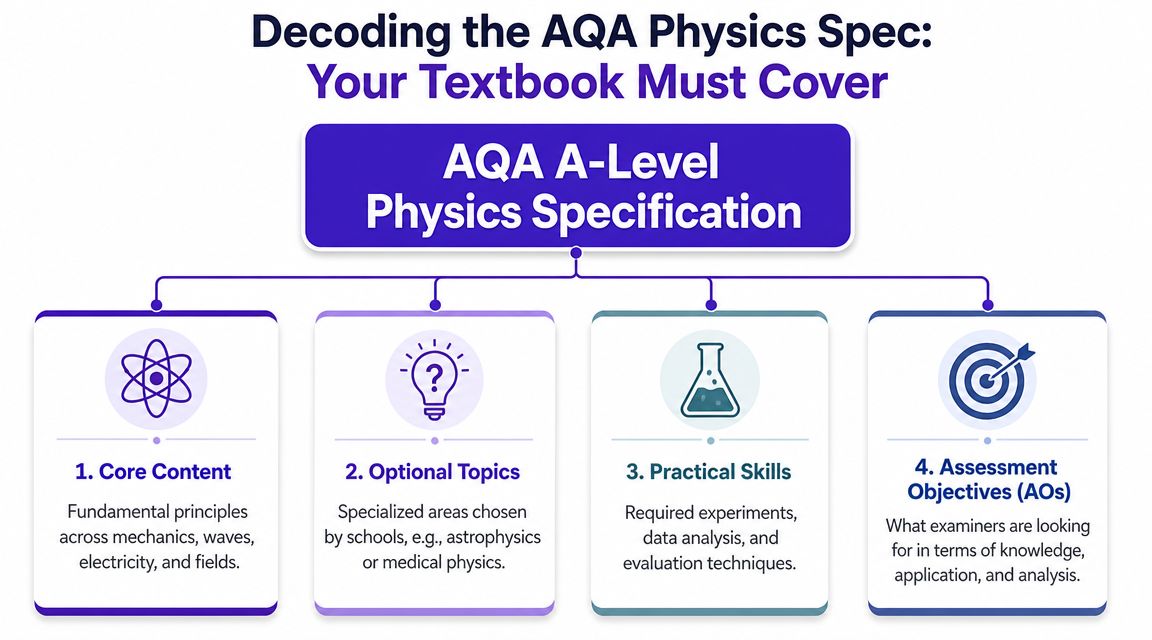
A decent book should help you track four things without fuss:
- Core content coverage that matches the AQA order closely enough for planning.
- Optional topic support so you're not left with a thin, rushed add-on chapter.
- Practical and data analysis work that feels like exam preparation, not just theory notes.
- Assessment-style thinking where application matters, not just definitions.
Practical rule: If a textbook is vague about practical skills or treats the optional topic like an appendix nobody cares about, put it back.
If you're studying outside a typical school route, this matters even more. Students returning to study often need a course that makes the AQA structure explicit, not assumed. That's why a resource like A Level Physics for adult learners can be useful context alongside your textbook choice.
For day-to-day revision, the smartest move is to pair your book with a spec-mapped hub where the topic sequence is already organised. You can Prepare for AQA A-Level by topic rather than bouncing randomly between pages, notes, and whatever panic search you did the night before.
The Five Essential Checks for Any Physics Textbook
A flashy cover tells you nothing. A low price tells you even less. If you want a physics AQA A level textbook that helps, check it properly.
Check one and two
Start with specification alignment. The cover should clearly say AQA A-Level Physics, not just “A-Level Physics” in a vague, broad sense. You want chapter structure that follows the course cleanly and doesn't blur exam board differences. This is especially important where optional topics are involved, because AQA-aligned books are built around a course that includes routes such as Astrophysics, Turning Points in Physics, Engineering Physics, Medical Physics, and Electronics, showing that these books are not generic science books but exam-specific resources tied to the national syllabus (AQA-aligned topic routes).
Then check the maths level. A weak book either spoon-feeds everything so much that you never build fluency, or it jumps too fast and assumes your algebra is already bulletproof. You need a book that bridges GCSE to A-Level maths properly, with rearranging equations, handling powers, interpreting graphs, and using standard forms in context.
Check three
Worked examples matter more than most students realise.
You're not looking for a page that gives the formula and one final answer. You want examples that show the setup, the substitutions, the unit handling, and the reasoning. Physics is full of students who recognise a question once they've seen the mark scheme, but couldn't have started it alone.
If the worked examples skip the hard middle, the textbook is doing the easy part and leaving you with the actual difficulty.
Check four
Now inspect the practical side. AQA students need books that treat practical skills as part of the course, not as a side note. That includes required methods, graph interpretation, evaluation, and uncertainty handling. In AQA-aligned materials, even standard uncertainty treatment such as percentage uncertainty in the form δQ/Q × 100 appears because those skills belong in assessed work, not just in lab books.
Many students also need better study habits around independent learning. If you revise mainly online, TimeSkip's advice for online learning is worth reading because a good digital routine stops textbook study turning into open-tab chaos.
Check five
Finally, inspect the exam questions.
Not all practice is useful practice. You want questions that feel AQA-style in wording, structure, and demand. Command words matter. Multi-step questions matter. Practical interpretation matters. If the end-of-chapter questions are too short, too neat, or too repetitive, your book may teach comfort rather than exam readiness.
A simple way to test this is to use the textbook for learning and then cross-check your readiness with real A-Level Past papers. If the jump from textbook question to past-paper question feels brutal, the book isn't doing enough heavy lifting.
A quick buyer's checklist
- Board match: Is AQA named clearly and consistently?
- Maths support: Does it help students move from GCSE maths habits to A-Level problem solving?
- Worked method: Are examples step-by-step, not just answer-first?
- Practical depth: Does it prepare students for methods, analysis, and uncertainty?
- Exam realism: Do the questions look and feel like what AQA asks?
Choosing Your Champion AQA Textbook Series Compared
No single series works for everyone. That's the honest answer. Some students need a book that slows down and explains. Others need one that gets to the point and leaves room for harder practice elsewhere.
The main names students usually compare are Oxford University Press, CGP, and Hodder Education. Each has a distinct style, and that style matters.
The personalities of the main series
Oxford University Press is usually the one I'd call the steady teacher. It tends to feel structured and classroom-friendly. If you like a more formal explanation style and want a book that teachers can teach from without constantly correcting the layout of the course, this kind of series often works well.
CGP is the blunt one. Fast to scan, often easier to read when you're tired, and usually good for students who want quick clarity. The downside is that quick clarity can become shallow confidence if you don't back it up with tougher application.
Hodder Education often sits between the two. It can suit students who want solid detail without the book feeling too dry. For some learners, that balance is ideal. For others, it means the book is fine at everything but not outstanding at the exact thing they personally need most.
The optional topic issue
Optional topics matter more than students expect. The AQA course includes routes such as Astrophysics, Turning Points in Physics, Engineering Physics, Medical Physics, and Electronics, so textbook series have had to support both compulsory material and extension routes aligned to that structure. That's one of the clearest signs that you should buy by specification fit, not by general reputation.
If your school teaches Astrophysics and your book barely treats it seriously, that book is already losing value.
AQA A-Level Physics Textbook Series at a Glance
| Textbook Series | Best For | Worked Examples | Exam Practice Style | Optional Topic Depth |
|---|---|---|---|---|
| Oxford University Press | Students who want orderly explanations and a course-like structure | Usually clear and methodical | Often steady and classroom-aligned | Check your exact edition carefully |
| CGP | Students who want concise notes and quick revision support | Often direct and easy to follow | Good for short practice, but pair with harder exam work | Can be useful, but don't assume equal depth everywhere |
| Hodder Education | Students who want a middle ground between detail and readability | Often balanced | Usually solid for mixed practice | Often worth considering if your optional topic needs fuller treatment |
My blunt recommendation
If you're a student who's fallen behind, pick the clearest book, not the most impressive one. A book you'll use beats a book you admire from a distance.
If you're aiming for top grades, choose the series that gives enough depth to support your understanding, then add tougher question practice outside the book. No textbook series should be trusted as your full exam-prep plan.
Teachers should make the same calculation. The “best” class text is often not the one with the most detail. It's the one students can work through independently when they get stuck at home.
Common Textbook Traps and How to Avoid Them
Smart students make silly textbook mistakes all the time. Physics punishes those mistakes because the exam rewards application, not familiarity.
Trap one and two
The first trap is passive reading. You read a chapter on circular motion, nod along, and tell yourself it makes sense. Then a question twists the context slightly and you freeze. Recognition is not recall.
The second trap is using an outdated edition without checking alignment. A second-hand bargain is only a bargain if it still fits the current course and question style well enough to be safe. If the structure or emphasis is off, you'll waste time learning around the book instead of from it.
Trap three
The biggest trap is memorising formulas without learning the decision rules behind them.
AQA-style revision work shows a real weak point here. Students often know equations, but still struggle with vector decomposition, moments, refraction, and total internal reflection in unfamiliar contexts, because those skills demand applied and synoptic reasoning rather than formula recall alone (AQA-style sticking points in revision explanations).
So don't just ask, “What's the formula?” Ask:
- What tells me this is a components question?
- Where is the pivot and why does it matter?
- What clue suggests total internal reflection rather than simple refraction?
- Which information is useful and which is there to distract me?
Stop revising physics as a memory contest. Revise it as a decision-making subject.
The fix
After every worked example in your textbook, cover the solution and do three things from memory:
- State the method aloud in plain English.
- Redo the calculation without looking.
- Change one detail and ask whether the method still works.
That tiny shift forces the chapter to become usable knowledge.
Your Textbook Is Not Enough Build a Modern Revision Plan
A textbook is necessary. It is not enough.
That's not an insult to textbooks. It's just reality. A static book can explain physics well, but it can't schedule your revision, quiz you at the right time, expose weak spots quickly, or force active recall unless you build those layers yourself.
A realistic revision stack
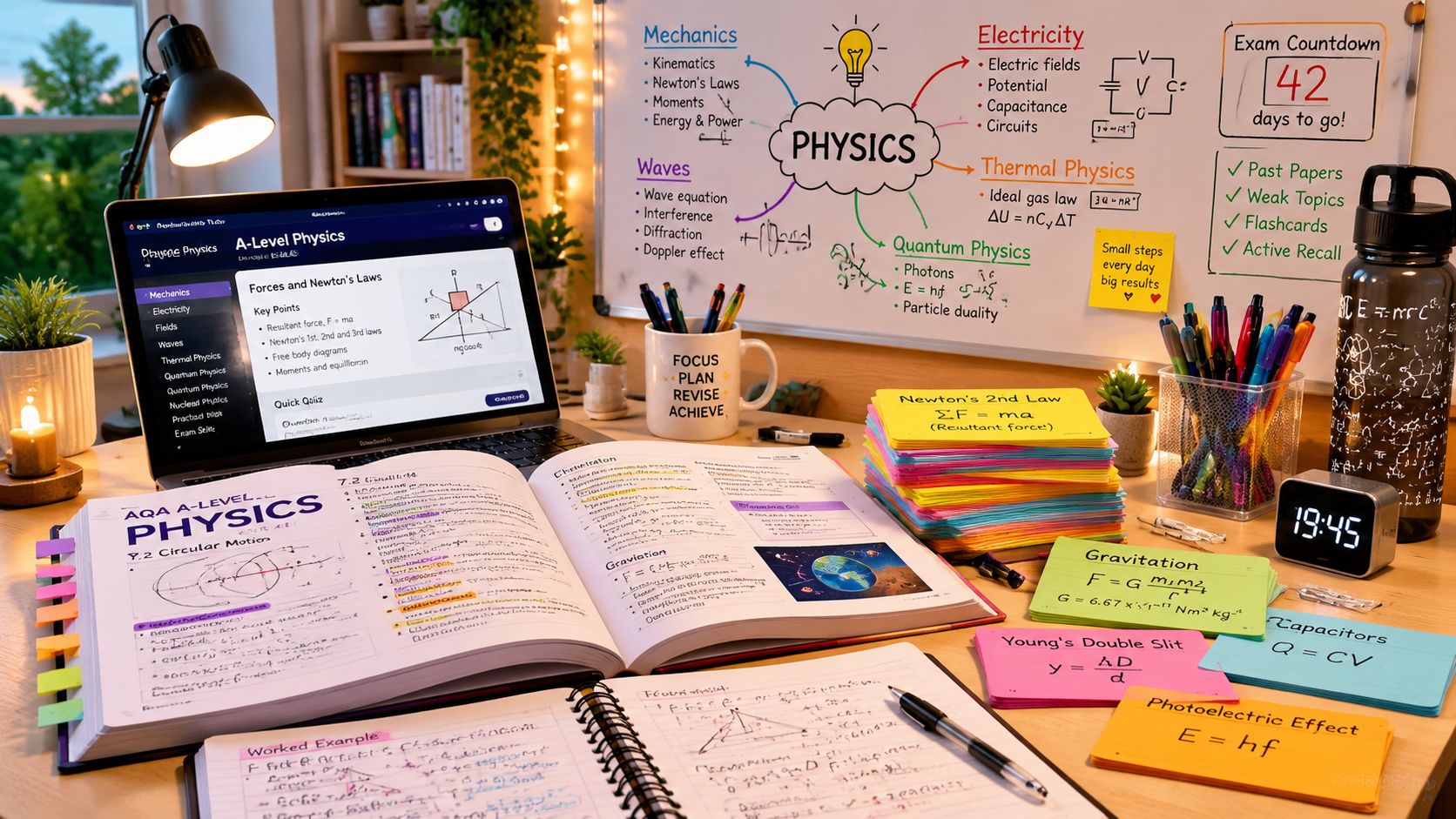
Use your textbook for the first pass. That means learning the topic, understanding examples, and sorting your notes.
Then switch mode. Test yourself from memory. Answer questions. Mix topics. Return to weak areas later instead of cramming one chapter to death in a single sitting.
If procrastination keeps wrecking that plan, get your routine under control first. Practical systems like these ideas to beat student procrastination are useful because poor time management makes even the right textbook feel useless.
What the missing layer looks like
This is the point where a digital revision tool earns its place. MasteryMind is one example. It's built for UK specs, including AQA, and it turns textbook content into active practice with topic questions, exam-style tasks, feedback, and spaced review. That matters because students don't need more pages. They need more retrieval, more correction, and better timing.
You also need methods that pull knowledge out of your head instead of pushing more text in. These effective active recall techniques are the part many students skip, even though they're the reason some revision sticks and some disappears by next week.
Tutor rule: Read less. Retrieve more.
A short explainer can help if you've never revised this way before:
The simple model
Think of your revision in three layers:
- Textbook for clarity
- Active recall for memory
- Exam practice for transfer
Miss the second layer and you forget. Miss the third layer and you panic when the question looks unfamiliar.
From Page Turner to Grade Booster
The right physics AQA A level textbook won't rescue bad revision habits, but it can become the backbone of a very strong system.
Choose the book carefully. Use it actively. Then add the training that books can't provide on their own. That means retrieval, mixed practice, practical reasoning, and proper exam questions under pressure.
If you're behind, don't try to read the whole thing cover to cover like a novel. Triage. Match chapters to the spec, fix the weakest topics first, and use worked examples properly.
If you're aiming for the top grades, be even stricter. Don't confuse understanding a page with being able to solve a new problem. They are not the same skill.
When you're ready to move from reading to performance, use focused Exam Practice for A-Level so the knowledge in your textbook turns into marks on the paper.
If you want a revision setup that goes beyond reading and rereading, take a look at MasteryMind. It's built around UK exam specs and can help turn your AQA Physics textbook from a pile of pages into a working revision routine.
Ready to master this topic?
Practise with quizzes, blurt exercises and exam questions on MasteryMind.
7 days Premium · Then free forever · No card, no charge