Physics GCSE Equation Sheet: Your 2026 Guide
You’re probably in one of two camps right now.
Either you’ve looked at physics revision and thought, “I’ve left this way too late,” or you’re already doing past papers and want every possible mark. Both groups need the same message. The physics gcse equation sheet is not a free pass, but it is a massive advantage if you know how to use it properly.
A lot of students hear “you get the equations” and relax too much. Then the paper lands, the formula is sitting right there, and they still lose marks because they picked the wrong one, missed a unit conversion, or didn’t rearrange it cleanly. This is the primary challenge now. Less panic over memory. More skill in application.
Teachers know this too. The challenge hasn’t vanished. It’s shifted. Students still need to recognise which equation fits, understand the symbols, and build a method that matches the mark scheme.
Your Ultimate GCSE Physics Equation Guide for 2026
The big change happened in November 2024, when the Department for Education and Ofqual announced that students sitting exams in 2025, 2026, and 2027 would no longer need to memorise standard physics equations, with sheets provided as inserts in GCSE Physics and Combined Science papers, as set out in the DfE and Ofqual policy update.
That’s good news. It removes one of the most annoying parts of revision. If you’ve ever blanked on an equation you definitely knew the night before, you’ll understand why this matters.
But don’t misread it. The exam hasn’t become easier in the lazy sense. It’s become more about using equations than memorising them. You still need to know what the symbols mean, when a formula applies, and how to turn a wordy question into a calculation that works.
What this means for your revision
Your revision needs a new focus:
- Know the layout: You should be able to scan the sheet fast and find what you need.
- Know the language: If the question says “energy transferred”, “work done”, or “change in thermal energy”, you need to connect that wording to the right formula.
- Know the traps: The sheet won’t save you from mixing up power and energy, or using grams when the equation expects kilograms.
Practical rule: Treat the sheet like a tool, not a rescue plan.
For students, that means less cramming random formulas and more practice with real questions. For teachers, it means drilling fluency with selection, substitution, rearrangement, and interpretation.
This guide keeps things practical. It covers the major boards, shows how the sheets differ, and walks through the kinds of equations that keep showing up. If you want to recover your grade, this helps. If you want top marks, this helps even more.
Why Mastering the Equation Sheet Wins Marks
A lot of physics marks sit behind calculations. In AQA GCSE Physics from 2018 to 2024, questions involving listed equations accounted for 62% of total marks across Papers 1 and 2, based on mark scheme analysis reported by Rapid Assignment Help’s equation sheet breakdown.
That number should change how you revise.
If equation-based questions take up that much of the paper, then getting comfortable with the sheet isn’t a side quest. It’s central. Students who ignore it often end up doing lots of reading but not enough actual calculation practice.
Why the sheet still needs skill
The sheet gives you access to formulas. It doesn’t tell you:
- which formula is the best fit
- whether the question wants a one-step or multi-step method
- how to rearrange the formula
- when you need to convert units first
That’s where marks are won.
A student might see speed, distance, and time and do fine. Then the next question links kinetic energy and gravitational potential energy and suddenly they have to combine ideas, not just copy a formula. That’s exactly where many papers separate secure understanding from guesswork.
What strong students do differently
Strong students don’t just “know the equation”. They build a routine.
- Underline the known values
- Circle the target quantity
- Match the wording to the sheet
- Convert units before substituting
- Write the formula clearly
- Substitute with units
- Check if the answer makes physical sense
That routine sounds simple because it is. The hard part is doing it under pressure.
If you want realistic timed practice, Exam Practice for GCSE is one way to train that exam habit with board-aware questions and feedback on your method, not just your final answer.
The students who gain the most from the sheet are usually the ones who practise using it before the exam, not the ones seeing it properly for the first time in the hall.
Your Printable GCSE Physics Equation Sheet for All Boards
Most students waste time hopping between board websites, screenshots, and random revision pages. That’s messy. What you want is one clean reference you can print, annotate, and keep next to your practice questions.
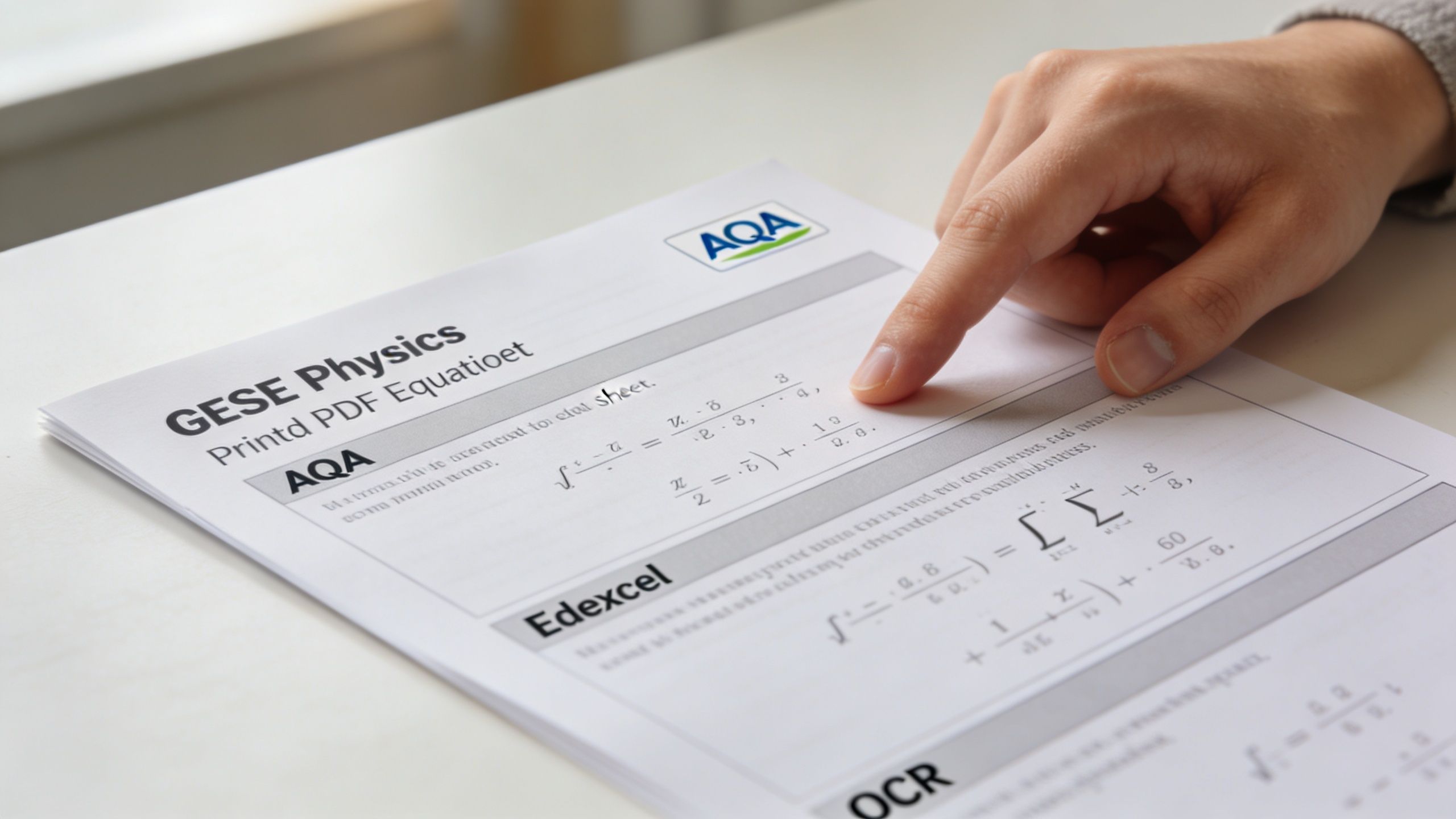
A good printable physics gcse equation sheet should do three things well. It should group equations by topic, label higher-tier content clearly, and keep the wording close to the official exam versions so nothing feels unfamiliar on the day.
What to look for in a printable sheet
A useful sheet isn’t just a dump of formulas. It should be organised so your brain can find patterns.
- Topic grouping: Mechanics together. Electricity together. Waves together.
- Clear tier labels: Higher Tier content should stand out immediately.
- Space to annotate: Add your own reminders like “kg not g” or “convert cm to m”.
- Board awareness: AQA, Edexcel, OCR and WJEC are similar in many places, but students still benefit from seeing the style they’ll meet in their own exam.
For a broader set of revision downloads and board-specific notes, the MasteryMind study materials page is a practical place to collect resources in one spot.
How to actually use it
Print it. Fold it into your exercise book. Use it during every calculation set you do from now on.
Don’t wait until exam week.
A simple routine works well:
- Monday: answer mechanics questions with the sheet open
- Midweek: redo the same topic without looking first, then check
- Weekend: mix topics so you practise finding formulas quickly
This video is useful if you want a visual run-through alongside your printed sheet.
The best printable sheet becomes familiar. By exam day, you shouldn’t be “reading” it. You should be navigating it.
AQA vs Edexcel vs OCR Sheets Explained
The main boards all give equation sheets for the current exam window, but they don’t present them in exactly the same way. That matters because small layout differences can slow students down if they’ve revised from the wrong style.
According to OCR’s formulae and equation sheet guidance, from 2025 to 2027 UK GCSE Physics exams across major boards like AQA (8463) and OCR (J249/J259) provide detailed equation sheets. For AQA, the June 2025 sheet lists 24 core equations, distinguishes Higher Tier only ones, and omits units to keep the focus on student familiarity.
AQA
AQA’s sheet is tidy and direct. If you’re doing AQA, get used to the exact wording and the fact that units aren’t spoon-fed to you in the equation list.
That omission catches some students out. They assume the sheet will remind them that mass should usually be in kilograms or distance in metres. It won’t. You still need unit sense.
AQA students should practise spotting the HT-only formulas early. If you’re aiming high, those equations need to feel normal, not “extra”.
Edexcel
Edexcel tends to cover the same core physics ideas, but students often notice slight changes in presentation and wording compared with AQA classroom resources. That’s why revising only from a friend’s board can be annoying. The physics is the same. The feel of the sheet isn’t always.
For Edexcel, the best move is simple. Use Edexcel-style questions with the Edexcel-style equation sheet beside you. Build speed with the version you’ll see.
OCR
OCR students should download and use OCR’s own sheet, not a generic one from social media. OCR often includes the same specification-linked equations students expect, but familiarity with placement and phrasing saves time.
Use the board’s real sheet during practice. Confidence goes up when the exam paper looks normal.
What stays the same across boards
Even with differences in format, the exam skills stay very similar. You still need to:
| Skill | What it looks like in the exam |
|---|---|
| Formula selection | Choosing the correct equation from several possible ones |
| Rearrangement | Solving for a different variable cleanly |
| Substitution | Putting numbers into the formula accurately |
| Unit handling | Converting before calculation when needed |
| Interpretation | Explaining what the answer means in context |
If you want to compare how these skills show up in real papers, GCSE Past Papers are useful because they let you see how one topic is tested in different board styles.
Mechanics and Energy Equations with Worked Examples
Mechanics and energy are where many students either settle into the paper nicely or start spiralling. The good news is that these topics are very pattern-based. Once you know what each equation is really saying, the questions feel much less random.
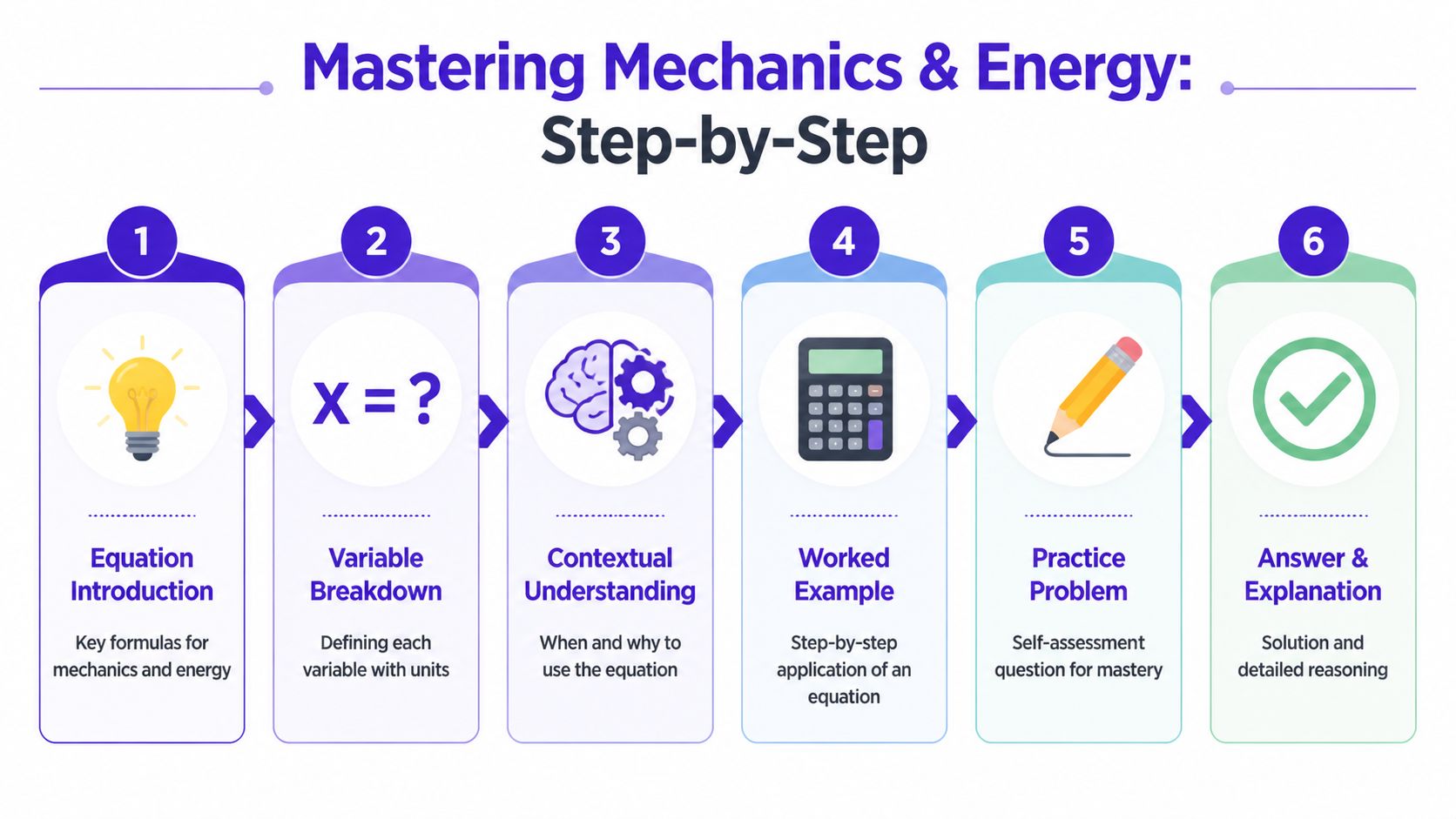
If you teach this topic, or you’re a student who likes precise word meaning, these science vocabulary definitions for educators can help tighten up language around force and motion. That matters because half the battle is decoding the question before you ever touch the calculator.
Speed, acceleration and force
Let’s start with the formulas students meet all the time.
| Equation | What it means | Common rearrangement |
|---|---|---|
| v = d / t | speed = distance / time | d = vt, t = d / v |
| a = Δv / t | acceleration = change in velocity / time | Δv = at |
| F = m × a | force = mass × acceleration | a = F / m, m = F / a |
Take v = d / t.
- Symbols and units: v is speed in m/s, d is distance in m, t is time in s.
- When to use it: any straight speed calculation where the question gives total distance and total time.
- Worked example: A cyclist travels 100 m in 20 s. Speed = 100 / 20 = 5 m/s.
Take F = m × a.
- Symbols and units: F is force in N, m is mass in kg, a is acceleration in m/s².
- Rearrangement: if you need acceleration, divide force by mass.
- Worked example: A trolley of mass 4 kg accelerates at 3 m/s². Force = 4 × 3 = 12 N.
Exam habit: Write the rearranged formula before you put numbers in. It makes your method easier to follow and often helps prevent algebra slips.
Weight, work done and gravitational potential energy
These are close friends in exam questions.
| Equation | What it means |
|---|---|
| W = m × g | weight = mass × gravitational field strength |
| work done = force × distance | energy transferred when a force moves something |
| Eₚ = m × g × h | gravitational potential energy |
Take W = m × g.
- Symbols and units: W is weight in N, m is mass in kg, g is gravitational field strength.
- Confusion alert: weight is a force, not the same thing as mass.
- Worked example: A mass of 2 kg has weight 2 × 9.8 = 19.6 N, if the question tells you to use g = 9.8 N/kg.
Take work done = force × distance.
- Symbols and units: work done in J, force in N, distance in m.
- When students slip up: using centimetres instead of metres.
- Worked example: A force of 10 N moves a box 3 m. Work done = 10 × 3 = 30 J.
Take Eₚ = m × g × h.
- Symbols and units: energy in J, mass in kg, height in m.
- Worked example: A 5 kg object is lifted 2 m. Eₚ = 5 × 9.8 × 2 = 98 J.
Kinetic energy and power
These often appear in linked questions.
| Equation | What it means | Quick note |
|---|---|---|
| Eₖ = 0.5 × m × v² | kinetic energy | square the speed, not the whole answer |
| P = E / t | power = energy transferred / time | power is a rate |
Take Eₖ = 0.5 × m × v².
- Symbols and units: energy in J, mass in kg, speed in m/s.
- Classic trap: forgetting to square the speed.
- Worked example: A 2 kg object moves at 4 m/s. Eₖ = 0.5 × 2 × 4² = 1 × 16 = 16 J.
Take P = E / t.
- Symbols and units: power in W, energy in J, time in s.
- Worked example: A machine transfers 120 J in 30 s. Power = 120 / 30 = 4 W.
Some of the strongest mechanics answers come from slowing down for ten seconds at the start. Pick the formula. Check the units. Then calculate. That tiny pause often saves a whole method mark chain.
Electricity and Magnetism Equations with Worked Examples
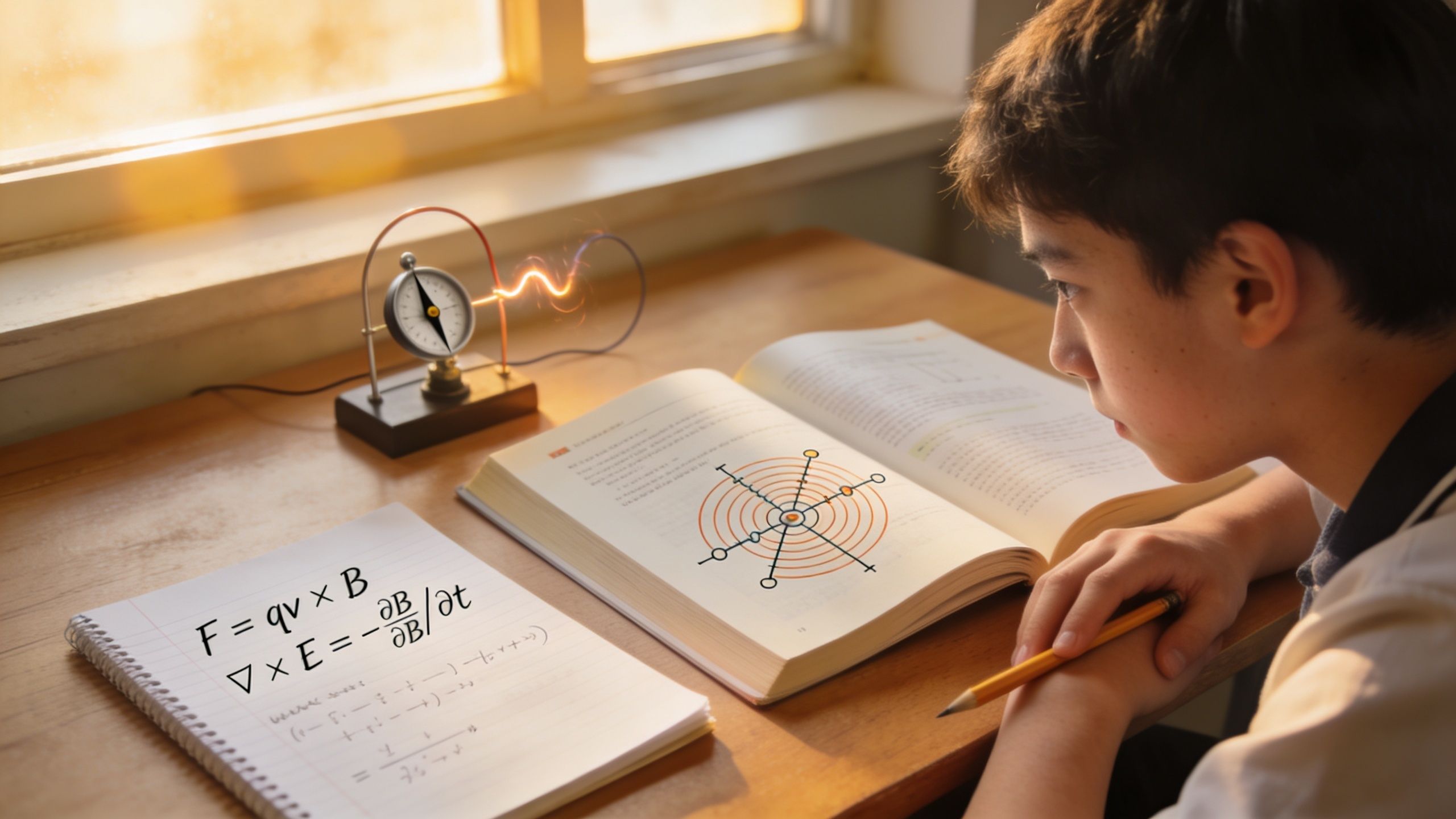
Electricity looks scary because the symbols start to crowd each other. V, I, R, P, Q. It can feel like alphabet soup. The fix is to attach each symbol to a physical idea, not just a letter.
Current, charge and potential difference
Start with the bread-and-butter equations.
| Equation | Meaning | Rearrangement |
|---|---|---|
| Q = I × t | charge flow = current × time | I = Q / t |
| V = I × R | potential difference = current × resistance | I = V / R, R = V / I |
Take Q = I × t.
- Symbols and units: Q is charge in coulombs, I is current in amps, t is time in seconds.
- Worked example: A current of 2 A flows for 5 s. Charge = 2 × 5 = 10 C.
- When to use it: battery and circuit questions where charge is transferred over time.
Take V = I × R.
- Symbols and units: V in volts, I in amps, R in ohms.
- Worked example: Current is 3 A and resistance is 4 Ω. Potential difference = 3 × 4 = 12 V.
- Trap: students sometimes mix this up with power equations because both use I.
Energy and power in circuits
Questions often move from a simple circuit value into energy transfer.
- Power = potential difference × current
- Power = current² × resistance
- Energy transferred = power × time
You may see these in slightly different forms depending on board style, but the use is similar.
Worked example. A device operates at 12 V with a current of 2 A.
- Use power = potential difference × current
- Power = 12 × 2 = 24 W
If that device runs for 10 s:
- Use energy transferred = power × time
- Energy = 24 × 10 = 240 J
Don’t choose an equation because it looks familiar. Choose it because it matches the quantities in the question.
Magnetism and the motor effect
These can feel more abstract, but the approach is the same. Read the variables carefully and decide whether the question is asking for a relationship, a calculation, or an explanation.
For motor effect calculations, students often succeed when they do three things:
- Sketch the situation: even a tiny diagram helps
- Label what is known: current, field strength, length
- Keep the units consistent: especially for lengths
A simple classroom-style example might ask for the force on a current-carrying conductor. If the equation is on your sheet, use it exactly as written, then substitute slowly. Don’t rush because the symbols look less familiar than speed or force equations.
Electricity rewards neatness. If your lines of working are tidy, your chances of spotting an error go way up.
Waves and Radioactivity Equations with Worked Examples
Waves and radioactivity often appear near explanation questions, so students sometimes forget that there are straightforward calculation marks here too. That’s handy. A clean method can steady you if a longer written answer elsewhere has gone badly.
Wave speed and frequency ideas
The most common wave equation students meet is the one linking speed, frequency and wavelength.
| Equation | Meaning |
|---|---|
| wave speed = frequency × wavelength | how fast a wave travels |
Take the equation.
- Symbols and units: wave speed in m/s, frequency in hertz, wavelength in metres.
- Rearrangement: frequency = wave speed / wavelength, wavelength = wave speed / frequency.
- Worked example: A wave has frequency 5 Hz and wavelength 2 m. Wave speed = 5 × 2 = 10 m/s.
Students often lose easy marks here because wavelength is given in centimetres. If that happens, convert to metres before using the formula.
Another confusion point is frequency versus time period. If the question mixes those ideas, read every word carefully and don’t grab the first formula that looks related.
Radioactivity and decay style questions
Radioactivity questions vary more by board and wording, but the same exam habits still apply. You need to identify the quantities, check what’s given in the question or graph, and decide whether the equation sheet helps or whether the task is more about interpreting data.
Some radioactivity items are less about plugging into a formula and more about understanding patterns such as count rate dropping over time or comparing penetration and ionisation. In those cases, the best students don’t force a calculation. They answer the question that’s there.
A typical worked-style approach might look like this:
- Read the graph or table first
- Identify whether the question asks for a calculation or a trend
- If it’s a calculation, choose the exact equation from the sheet
- If it’s explanation, use physics terms accurately
If the question gives you an equation sheet and a graph, use both. A lot of dropped marks come from students using only one source of information.
When the sheet helps less
This is worth saying clearly. Not every waves or radioactivity question becomes easy because a formula is available.
The sheet helps most when:
- the variables are clearly stated
- the units are sensible
- the relationship is direct
It helps less when:
- the question hides the useful quantity in a graph
- you need to combine a practical setup with theory
- the main task is explanation rather than calculation
That’s why mixed practice matters. You’re not just learning formulas. You’re learning judgement.
GCSE Physics Equations FAQ
Students ask the same few questions every year, and they’re good questions. Here are the ones that matter most in the exam hall.
Do I get marks for writing the formula?
Sometimes, yes. But don’t rely on it.
If the mark scheme rewards method, writing the correct formula can help you pick up a mark even if the arithmetic goes wrong later. But if you only copy an equation and don’t substitute or process it properly, that usually won’t be enough.
Best habit: always write the formula, then the values, then the answer with units.
Are constants like g on the sheet?
Don’t assume they are. Questions often give constants in the question where needed, and you should pay attention to that wording. If a value is provided in the question, use that one.
Teachers often warn students about this for a reason. The equation sheet is not a complete data booklet. It won’t think for you.
Is the equation sheet different for Combined Science?
Yes, it can be. The content matches the course you’re taking, so Combined Science students should revise with the sheet for their own specification, not a separate GCSE Physics one.
Students sometimes revise from a friend’s sheet and can then feel thrown by unfamiliar layout or missing formulas. Match your practice to your course.
Should I still try to memorise equations?
It helps to recognise them quickly, but your top priority is fluent use. If you naturally remember some formulas through practice, great. That will speed you up. But the main win is knowing what the formula means and how to apply it.
A student who half-remembers ten equations but can’t use them will score lower than a student who uses the official sheet calmly and accurately.
What’s the smartest way to revise with the physics gcse equation sheet?
Use it during practice from now on, then gradually test yourself with less support.
A solid routine looks like this:
- Start open-sheet: practise finding and using equations
- Move to recall checks: cover the sheet and try to predict the formula first
- Finish with exam-style questions: use the actual sheet under timed conditions
- Review errors properly: ask whether the mistake was formula choice, unit conversion, rearrangement, or calculator slip
That last step matters most. “I got it wrong” is useless. “I forgot to convert cm to m” is fixable.
If you want structured, board-aligned practice with physics calculations, MasteryMind gives UK learners a way to work through GCSE questions, past-paper style tasks, and revision activities matched to their exam board. It’s a practical option if you want more than a formula list and need regular practice using the equation sheet under exam-style conditions.
Ready to master this topic?
Practise with quizzes, blurt exercises and exam questions on MasteryMind.
7 days Premium · Then free forever · No card, no charge