Private Tutor Rate UK: A 2026 Guide for Students & Tutors
Most GCSE and A-Level tutoring in the UK sits around £25 to £60 an hour, but that headline range hides the factors that matter. Your real private tutor rate depends far more on where you live, what subject you need, how experienced the tutor is, and whether the sessions are online or in person.
That's why so many families get frustrated. One parent hears a friend say they pay one figure, another sees a completely different price online, and a student just wants to know whether help is still possible before mocks or final exams. If you're in Year 10, 11, 12 or 13 and you've left revision late, the price question feels urgent. If you're a tutor, it's just as awkward from the other side. Charge too little and you burn out. Charge too much without explaining the value and enquiries dry up.
The truth is simple. There isn't one UK tutoring price. There's a market, and it's uneven.
Why Everyone Is Talking About Private Tutor Rates
A lot of students start looking for tuition at the same point. The test results wobble. Confidence drops. A teacher says, “You know the content, but you're not answering the question.” Or the opposite happens. A student is already doing well and wants to push a grade higher before GCSEs or A-Levels.
That's when the search begins. Maths tutor. English tutor. Science tutor. Online or local. One hour a week or a short burst before exams. Then comes the awkward bit. Why does one tutor look affordable and another look completely out of reach?

Private tuition is no longer some niche add-on used by a tiny minority. In the UK, 27% of pupils had received private tuition at some point, rising to 41% among secondary pupils and 49% among those from higher-income families, according to the Sutton Trust evidence cited by Tutorbase's tutoring industry summary. That matters because it shows two things at once. Tutoring is mainstream, and access is still uneven.
Why exam years change the conversation
Families rarely ask about tutoring in the abstract. They ask when pressure spikes.
For most households, that means:
- GCSE build-up: Years 10 and 11 bring the first real sense that grades have long-term consequences.
- A-Level pressure: Years 12 and 13 raise the stakes again because subject depth increases and university offers can depend on outcomes.
- Recovery moments: A poor mock result, weak coursework habits, or patchy understanding can make outside help feel necessary fast.
The same evidence base links tutoring strongly to GCSE and A-Level preparation, which fits what most teachers and tutors see in practice. Demand tends to rise when exams stop feeling theoretical.
Students usually don't start by asking for “a tutor”. They start by saying, “I'm behind in maths,” or “I keep losing marks in essays.”
There's another reason this topic gets attention. Price pages online often talk about “average rates”, but average doesn't help much if you're deciding between one specialist lesson a fortnight and cheaper weekly support. Families need realistic choices, not bland averages.
For students trying to recover quickly, structured support outside live tuition can help too, especially with AI Powered Revision tools that let you practise between sessions instead of paying a tutor to reteach every basic point.
Decoding the Average UK Private Tutor Rate
The phrase private tutor rate sounds tidy. In reality, it isn't. The market works more like a set of overlapping bands shaped by level, subject, format, and location.
A practical way to think about it is this: the same student might see one rate for online GCSE English, another for in-person A-Level Chemistry, and a higher one again if they want a London-based specialist with exam-board expertise.
A realistic working table
Here's a simple benchmark families and tutors can use.
| Level & Subject | Online Rate | In-Person (Rest of UK) | In-Person (London) |
|---|---|---|---|
| GCSE English or Humanities | £25 to £40 | £30 to £45 | £40 to £55 |
| GCSE Maths or Science | £30 to £45 | £35 to £50 | £45 to £60 |
| A-Level English or Humanities | £30 to £45 | £35 to £50 | £45 to £60 |
| A-Level Maths, Physics, Chemistry | £40 to £55 | £45 to £60 | £55 to £70+ |
This table is a market guide, not a fixed national tariff. It reflects the broad UK range most families encounter, with the biggest premiums appearing where all the pressure points stack together. High-stakes exams, scarce subjects, travel time, and expensive cities all push rates up.
Why London and income matter so much
The hard part is that rate discussions often ignore access. In England, 30% of 11–16-year-olds had ever had private tutoring, but the pattern is uneven. 46% of pupils in London had tutoring versus 30% across England, and 32% of pupils in the top income quartile took tutoring in Year 10/11 compared with 13% in the bottom quartile, according to the Sutton Trust's Tutoring 2023 research.
That gap tells you the “average” rate is not just a money question. It's also a postcode question and a household-budget question.
Practical rule: If you're outside London, don't assume London pricing is normal. If you're in London, don't assume an online tutor from another region is lower quality.
There's a similar lesson in other service markets. People often compare prices without separating basic delivery from specialist work. The same mistake happens when businesses try to find affordable transcription services and realise that turnaround speed, complexity, and subject knowledge all change the actual cost. Tutoring works the same way. A one-hour slot isn't always the same product.
What the range actually means
If you're a student or parent, use the table to narrow the field, not to pick the cheapest number. Ask yourself:
- Is the problem content knowledge or exam technique? A stronger specialist is often better for exam technique.
- Do you need weekly accountability or short-term rescue help? The answer changes what rate makes sense.
- Could online remove travel cost without lowering quality? Often, yes.
If you're a tutor, this range should also free you from lazy comparisons. Charging above entry-level rates is reasonable when your service is clearly more specific, more targeted, and more results-focused.
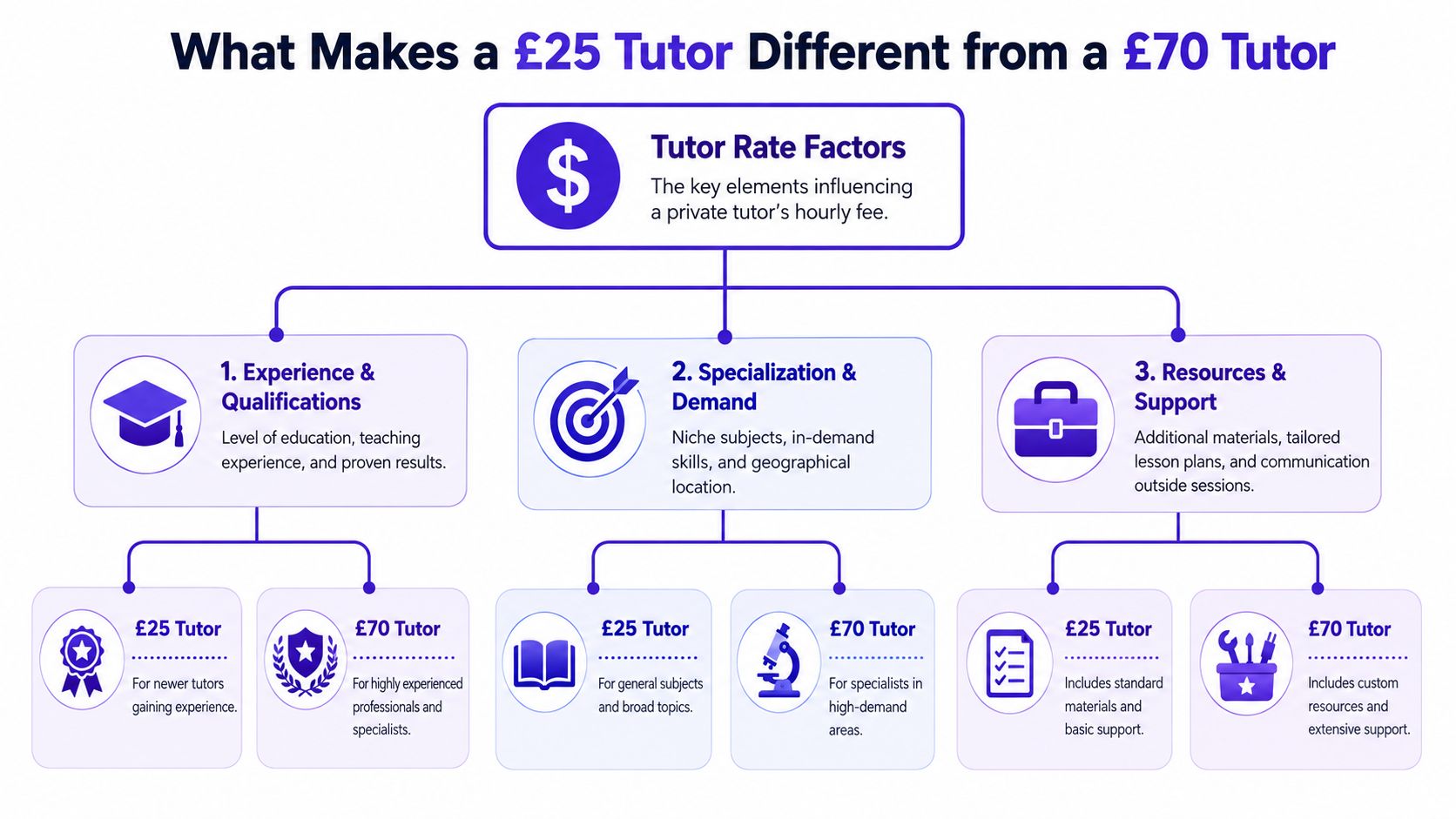
What Makes a £25 Tutor Different from a £70 Tutor
A higher private tutor rate isn't automatically better. Some expensive tutors are overrated. Some cheaper tutors are excellent. But there are real reasons one tutor charges near the bottom of the market and another commands much more.
The difference usually isn't charisma. It's precision.
Experience changes the session itself
A newer tutor often explains content reasonably well. A seasoned tutor usually spots the exact reason a student is stuck.
That matters because weak answers aren't always caused by weak knowledge. Sometimes a student knows the topic but misreads command words, writes too broadly, skips method marks, or panics under time pressure. An experienced tutor tends to diagnose this faster and wastes less paid time.
A useful analogy is driving lessons. You're not paying only for someone to sit in the car. You're paying for someone who notices the pattern behind the mistake before it becomes a habit.
Subject scarcity and exam-board fit carry a premium
Some subjects are harder to source well. Maths, Physics, Chemistry, and A-Level STEM often cost more because strong tutors in those areas are in shorter supply and the assessment demands are tougher.
Independent benchmarking discussed by Kapdec's overview of tutoring rates notes that GCSE and A-Level tutors with specialist subject knowledge and proven results can charge materially above the wider market because parents aren't just buying time, but mark-scheme literacy and examiner-aligned feedback.
That lines up with what helps students near exams:
- A general tutor can explain the topic.
- A specialist tutor can explain why a six-mark answer only got three.
- An exam-board-aware specialist can train the student to stop repeating that mistake.
Here's a quick sense-check before paying a premium:
- Ask about exam boards: AQA, Edexcel, OCR and WJEC all have their own patterns.
- Ask what they do with past papers: Good tutors don't just set them. They analyse them.
- Ask how they give feedback: “We go through mistakes” is vague. You want specifics.
For students who want support in a defined subject area, it helps to know the full spread of available revision subjects so you can compare where specialist support is worth paying for and where independent revision may cover more of the workload.
A short explainer on exam-focused tutoring can help here:
Resources and support matter more than people think
The cheapest tutors often sell the hour only. The stronger ones usually sell a fuller service. That might include personalized homework, annotated feedback, targeted question packs, or short follow-up messages that keep the student on track between sessions.
A £70 tutor who fixes the right problem can be better value than a £25 tutor who spends weeks circling it.
That doesn't mean everyone should buy the premium option. It means you should judge value by impact, not sticker price.
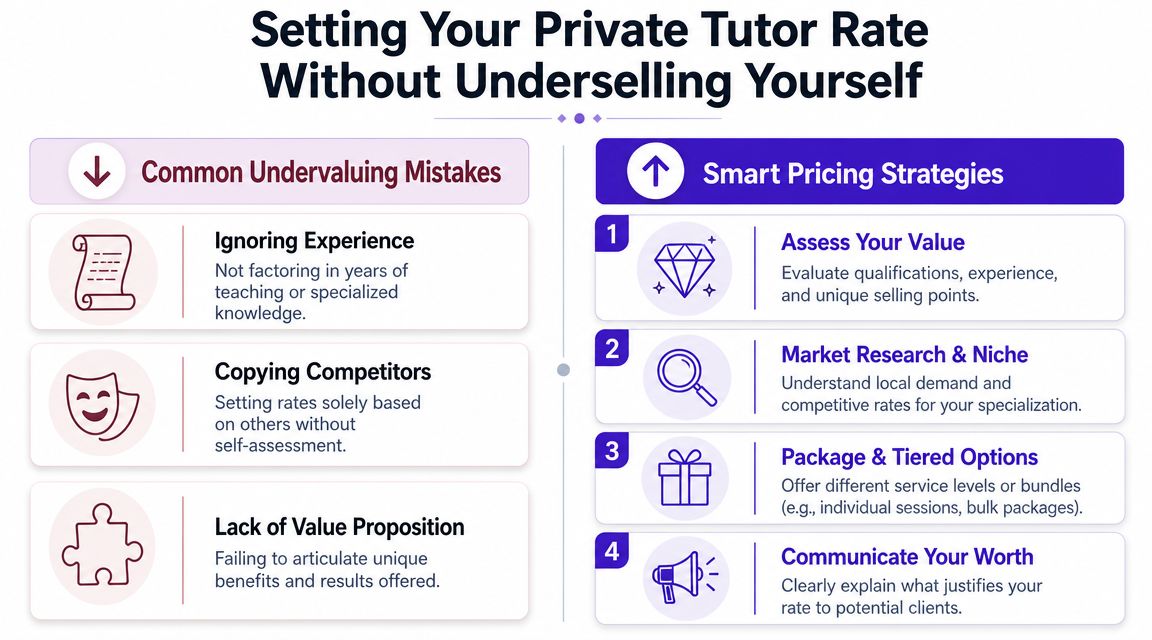
Setting Your Private Tutor Rate Without Underselling Yourself
If you're a tutor, picking a rate by scrolling other profiles is one of the quickest ways to underprice yourself. You end up copying someone whose experience, subject mix, travel time, and client type may have nothing to do with yours.
A sound private tutor rate starts with one uncomfortable question. What are families actually paying you for?
Stop charging for the hour alone
Parents see the hour. Tutors feel the invisible work around it.
That usually includes lesson planning, selecting questions, marking homework, replying to messages, and adjusting next week's session based on performance. If you teach exam classes, your knowledge of mark schemes and common answer errors is part of the product too.
If you ignore all of that, your rate looks competitive for a while, then your week becomes impossible to sustain.
Three pricing models that work in practice
Different tutors need different structures. The best one depends on your niche and the kind of clients you want.
| Model | Best for | Trade-off |
|---|---|---|
| Hourly single-session rate | New enquiries and flexible families | Income can be less predictable |
| Block booking | Students who need consistency | You need a clear cancellation policy |
| Small-group tuition | Popular GCSE topics and revision bursts | Less individual attention per student |
A few sensible templates:
- Straight hourly rate: Best if you want simplicity and fewer admin headaches.
- Block booking with a modest saving: Useful when a student needs steady work over a term.
- Mini-group pricing: Good for friends studying the same subject and exam board.
None of those models requires you to become pushy. They just help you price like a professional rather than a last-minute helper.
A fair rate is easier to defend than a cheap one
Families are usually more comfortable with a higher fee when you explain what's included. That means saying, in plain English, what happens before, during, and after the lesson.
You can borrow a basic pricing mindset from service businesses outside education. Good guidance on business valuation and pricing makes the same point. Price should reflect expertise, delivery cost, and the value of the outcome, not just what nearby competitors happen to charge.
If a parent asks why your rate is higher, don't get defensive. Explain the service clearly and let them decide.
A useful script sounds like this:
- For newer tutors: “My rate reflects focused one-to-one support and individualized session planning.”
- For experienced tutors: “I specialise in exam preparation, so sessions include mark-scheme feedback and targeted question practice.”
- For subject specialists: “My fee includes preparation for your student's exact course demands, not generic tutoring.”
What doesn't work
Tutors usually regret the same pricing mistakes:
- Charging low to win everyone: You attract bargain hunters, not always the best-fit students.
- Raising rates without changing the offer: A higher fee needs clearer positioning.
- Apologising for the price: Confidence matters. If you sound unsure, families will be unsure too.
A solid rate is one you can say out loud without flinching.
Finding the Right Tutor Without Breaking the Bank
If you're paying for tutoring, the goal isn't to find the cheapest tutor. It's to avoid paying for the wrong thing.
A lot of wasted money comes from mismatch. The tutor may be kind, smart, and perfectly decent, but not right for that student, that subject, or that exam problem. A Year 11 student who keeps dropping marks on AQA Chemistry six-markers needs something very different from a Year 12 student who can't keep up with weekly Maths homework.
Ask better questions in the first conversation
Most introductory chats are too soft. Families ask whether the tutor has experience. The tutor says yes. Everyone moves on.
You'll learn much more from questions like these:
- Which exam boards do you teach most often? You want a direct answer, not “all of them”.
- How do you spot why a student is losing marks? Listen for process, not slogans.
- Do you set work between sessions? This matters if budget is tight and you need each lesson to stretch further.
- How do you track progress? A strong tutor should be able to describe this clearly.
- What happens if my child is shy or low in confidence? Delivery style matters as much as subject knowledge.
The best tutors usually answer specifically. Weak ones stay general.
Spend money where it does the most work
Sometimes fewer sessions with a sharper tutor beat regular sessions with a weaker one. This is especially true when the issue is exam method rather than broad content gaps.
That said, not every part of revision needs live one-to-one time. Students can often cover recall, definitions, and routine practice independently, then use tutor sessions for tougher tasks like essay structure, synoptic links, unfamiliar questions, and past paper feedback.
That's where resources like GCSE Past Papers earn their place. They help students do the heavy lifting between sessions, so the tutor can focus on diagnosis, feedback, and high-value corrections instead of reading out textbook facts.
Good value often looks like this
Here's a sensible setup many families find more sustainable:
- Use independent revision for content review
- Book tutoring for bottlenecks
- Check progress after a short run of sessions
- Adjust quickly if it isn't working
You don't need blind faith. You need evidence that the student is becoming clearer, calmer, and more accurate.
Warning signs worth noticing
A lower rate can still be poor value if the tutor:
- Can't explain their lesson approach
- Avoids talking about exam technique
- Gives only vague feedback
- Relies on doing the student's thinking for them
A higher rate can still be poor value for the same reasons. Price is not proof. Fit is proof.
Negotiating Rates and Exploring Smart Alternatives
Talking about money doesn't have to be awkward. It only becomes awkward when one side treats the other like a problem to solve.
If you're a parent, a respectful negotiation usually works best when you're asking for a change in structure, not just a lower price. If you're a tutor, holding your rate is easier when you can offer a better format rather than a discount.
When negotiation makes sense
Reasonable requests include:
- A termly commitment: In exchange for regular bookings, ask whether there's a block-booking option.
- Sibling arrangements: Some tutors will structure this differently if lessons are related.
- Small-group sessions: Two or three students studying the same topic can lower the cost per family.
Reasonable responses from tutors include:
- Keeping the same hourly rate but adding value
- Suggesting online instead of in-person
- Reducing admin by setting a fixed weekly slot
Don't ask a specialist to become cheaper just because another tutor is. Ask whether there's a format that makes the support more efficient.
Alternatives that can genuinely work
Traditional one-to-one tutoring is only one option. Depending on the student, these can be strong alternatives or supplements:
| Option | Best use | Main limitation |
|---|---|---|
| Small-group tuition | Shared topics, revision bursts | Less personalised |
| Online one-to-one | Flexible, often better value | Requires focus and decent setup |
| Independent revision platform | Daily practice and feedback | No live human relationship |
| Blended approach | Tutor plus structured self-study | Needs planning and consistency |
For a lot of students, the smartest budget move is a blended model. Use a tutor for diagnosis, accountability, and higher-level feedback. Use structured digital practice for repetition, recall, and timed question work in between.
If you want a more exam-driven way to practise independently, Exam Practice for GCSE can help students rehearse under pressure without needing to pay for every minute of supervision.
The key is not to think in old categories. “Tutor or no tutor” is often the wrong question. The better one is: what should a human expert handle, and what can the student practise more cheaply on their own?
Your Next Steps to Tutoring Success
If you're a student, start with honesty. Don't search for a tutor because you feel guilty. Search because you know what's going wrong. Are you forgetting content, misreading questions, struggling with timing, or losing confidence after bad mocks? The clearer the problem, the easier it is to find the right help.
If you're a parent, judge value before price. Ask sharper questions, look for exam-board fit, and think in terms of total support, not just one hourly figure. Sometimes a realistic plan is one strong lesson every so often, backed up by proper independent revision.
If you're a tutor, stop pricing by nerves. Price by service, scarcity, and sustainability. If your support includes planning, customized resources, and precise feedback, your rate should reflect that. You don't need to be the cheapest to be a good choice.
The right private tutor rate is the one that creates a fair exchange. The student gets targeted support. The family stays within a workable budget. The tutor gets paid properly for skilled work.
That's the standard worth aiming for.
If you want to make tutoring time go further, MasteryMind gives UK students examiner-aligned practice, feedback, and revision structure for GCSEs and A-Levels. It's a practical way to cover the day-to-day grind of revision, so live tutor time can focus on the parts that really need a human expert.
Ready to master this topic?
Practise with quizzes, blurt exercises and exam questions on MasteryMind.
7 days Premium · Then free forever · No card, no charge