Social Action Theory: 2026 Exam Prep Guide

You might be revising this the night before a mock, half-remembering that Weber had “four types of action” and hoping that's enough. Or you might be the student who already knows the definitions but keeps losing marks because your essays sound descriptive instead of analytical.
That's where many individuals go wrong with social action theory. They learn the label, memorise a few keywords, and then stop. Examiners don't reward that. They reward students who can explain what the theory means, apply it to a real topic, and then challenge it.
If you can do those three things, this topic becomes much easier to score with.
What Is Social Action Theory Anyway
Start with a question that matters to sociology. Why do students in the same school make different choices about revision, university, friendships, or behaviour in class? A structural theory such as Marxism or Functionalism is more likely to begin with the system. It asks how institutions, class, or norms shape people.
Social action theory starts somewhere else. It begins with the individual actor and asks what their behaviour means to them.
That's why teachers often call it a bottom-up approach. Society isn't treated as a machine pressing down on passive people. Instead, society is built through repeated actions, decisions, habits, values, and interpretations. People don't just react. They define situations, read other people, and act in ways that make sense to them.
A good way to hold this in your head is this:
- Structural theories look at the rules of the game.
- Social action theory looks at how players understand the game and choose their moves.
- Top-band essays usually show awareness of both.
Students often get confused here and think social action theory means “people have complete freedom”. That's too simplistic. The stronger point is that sociologists should pay attention to meaning. If you ignore meaning, you miss why people do what they do.
Examiner shortcut: if a question asks about action, interaction, identity, labelling, motives, or meanings, social action theory is probably relevant.
This matters a lot in revision because it helps you classify topics fast. Education, family, crime, religion, and media all include situations where people respond to labels, expectations, routines, and other people's reactions. If you're building a revision plan across the available exam subjects, this is one of those theories that crosses into lots of essay questions rather than sitting in one tiny box.
For GCSE and A-Level, your first secure mark usually comes from stating the divide clearly. Structural theories explain behaviour through social forces. Social action theory explains behaviour through the meanings individuals attach to actions.
That one contrast already starts to sound like sociology, not just memory.
Unpacking the Core Concepts of Social Action
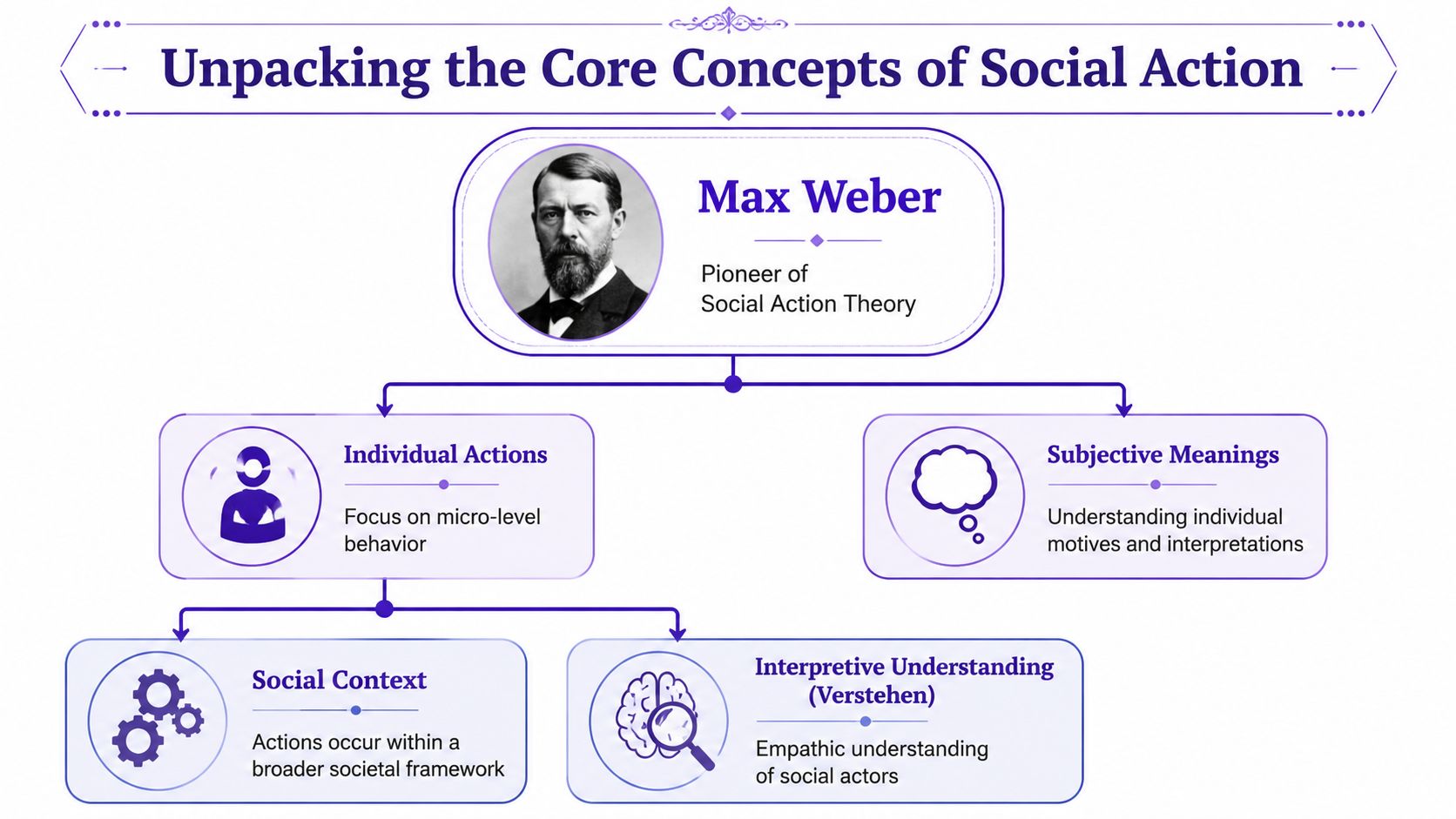
The key name here is Max Weber. In UK sociology teaching, Weber matters because he shifted attention away from social structures alone and towards the meanings people attach to action, and his four ideal types of action still appear as a core classification in textbooks and classrooms, as explained in this overview of Weber's social action theory in UK sociology teaching.
Why Weber changed the conversation
Before you even get to the four action types, lock in Weber's basic move. He argued that sociology should study social action, not just behaviour in general. That means behaviour that is oriented to other people and shaped by what we think they might do.
If I open a door because the wind blew it shut, that's just behaviour.
If I hold the door open because I think someone behind me expects politeness, that's social action.
That difference is tiny in everyday life, but massive in sociology.
Verstehen in plain English
The German word Verstehen comes up a lot, and students often panic because it looks abstract. Keep it simple. It means interpretive understanding or empathetic understanding.
A sociologist using Verstehen tries to understand the world from the actor's point of view.
Think of two students sitting in the same classroom.
- One puts their hand up because they love the subject.
- One does it because they want teacher approval.
- One stays quiet because they're shy.
- One stays quiet because acting “too keen” would damage their image with friends.
Outwardly, you just see hands up or hands down. Weber says that isn't enough. Sociology has to ask what those actions mean to the people doing them.
Social action theory tells you to look beyond what happened and ask why that action made sense to the person at the time.
A Lego analogy that actually helps
Structural theories can feel like looking at a finished Lego castle and explaining how the towers, walls, and gates fit together. Social action theory asks why each builder placed each brick where they did.
The castle still matters. Social action theory doesn't deny that larger patterns exist. It just argues that those patterns are produced and reproduced through many small actions.
For exam purposes, that's a strong line because it links micro-level interaction to bigger social outcomes.
What students should write, not just remember
When examiners see social action theory, they want more than “it focuses on individuals”. Better phrasing sounds like this:
- Meaning matters: action has to be interpreted, not just counted.
- Interaction matters: people act with others in mind.
- Agency matters: individuals are not merely puppets of structure.
- Interpretation matters: sociologists should try to understand motives.
If you can use two or three of those in a paragraph, your AO1 gets much sharper.
Weber's Four Types of Social Action Explained
This is the bit students usually revise as a list. That's risky. Lists get forgotten under pressure. It's better to understand the motive behind each type.
The easiest way to separate them
Ask one question: What is driving the action?
Sometimes it's calculation. Sometimes belief. Sometimes emotion. Sometimes habit.
Here's the comparison you need in your head:
| Type of Action | Core Motive | GCSE/A-Level Example |
|---|---|---|
| Instrumental-rational | Calculating the most effective means to reach a goal | Revising with flashcards because you think they'll help you score higher |
| Value-rational | Acting because you believe it is right or important | Joining a protest because you believe the cause matters |
| Affective | Acting from emotion | Storming out of class after an argument |
| Traditional | Acting from habit or routine | Wearing certain clothes or following family customs without much thought |
Instrumental-rational action
This is the most strategic type. The person weighs up means and ends. They ask, “What's the best way to get the result I want?”
A student picking revision methods to maximise grades is a simple example. They're not doing it because revision is morally good or emotionally satisfying. They're doing it because it works.
Students sometimes confuse “rational” with “good”. Rational doesn't mean kind, fair, or wise. It means goal-oriented and calculated.
Value-rational action
This one trips people up because it's still rational in a sense, but not in a calculating way. The actor follows a value, belief, duty, or principle even if it isn't the easiest route.
A student refusing to cheat in an exam, even under pressure, is acting value-rationally if they're guided by honesty. Someone might lose out in the short term, but still act because the principle matters.
That's the key distinction. Means-end rational asks what works. Value-rational asks what is right.
Practical rule: if the person would say “I did it because I believe in it,” you're probably looking at value-rational action.
Affective action
Affective action is driven by emotion. Excitement, anger, fear, pride, grief, jealousy. This type is often immediate and less thought-through.
You cheer when your team scores. You snap back in an argument. You cry at a goodbye. Those actions can still be social because they're shaped by relationships and other people's presence.
Students sometimes write “affective means irrational”. Be careful. In exam writing, it's safer to say the action is driven by feeling rather than careful calculation.
Traditional action
This is action based on custom, habit, or “the way things are done”. You don't need a deep reason every time. People often act routinely because repetition makes behaviour feel natural.
Think about family rituals, school routines, religious practices, or everyday greetings. A person may continue them without actively choosing them each time.
Traditional action is useful in essays because it helps explain how norms carry on across time. People often reproduce society by doing what they've always done.
The exam trick
The four types are ideal types. Real life is messier. A single action can contain more than one motive.
A student might revise:
- to get good grades,
- because they value hard work,
- because they panic if they don't,
- and because revising every evening has become a habit.
That doesn't break Weber. It shows social life is complicated. If you mention that actions can overlap, your answer sounds more thoughtful and less memorised.
Going Beyond Weber with Other Key Thinkers
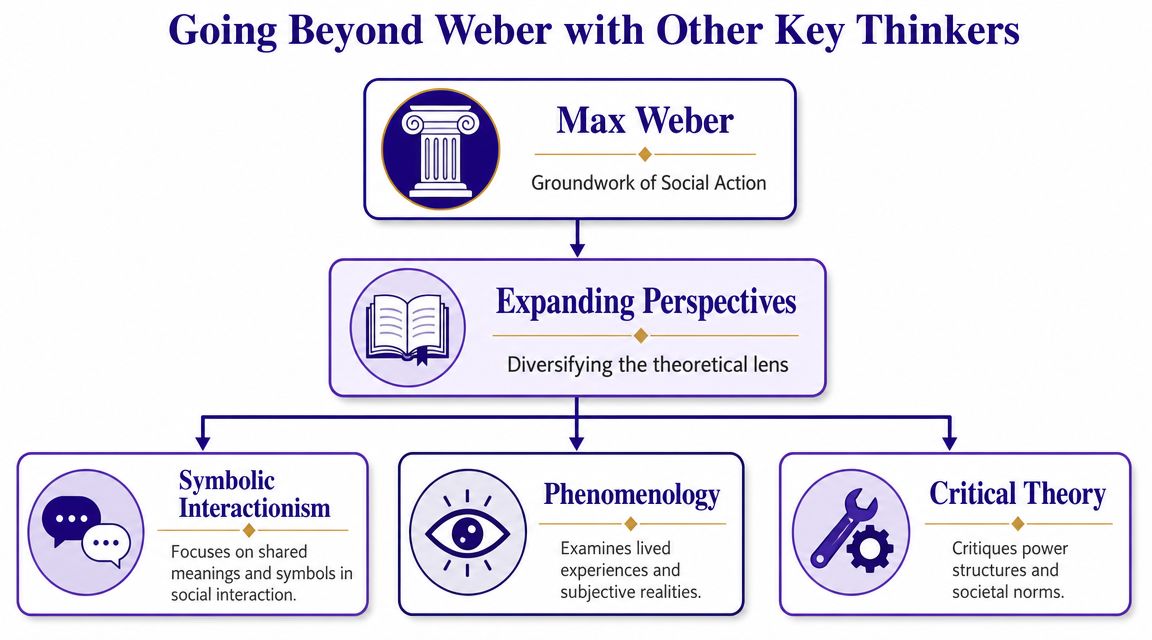
Knowing Weber gets you started. Bringing in related thinkers makes your answer feel developed.
Mead and the social self
George Herbert Mead helps because he shows that the self isn't something you're born with in finished form. Your identity develops through interaction with other people.
The short version students remember is the “I” and the “Me”.
- The “I” is the more spontaneous part of the self.
- The “Me” is the social side, shaped by how we think others see us.
That's useful in exams on identity, education, and family because it explains why behaviour is social even when it feels personal. A student doesn't just “have confidence” or “lack confidence”. They develop a sense of self through repeated interactions.
Blumer and negotiated meanings
Herbert Blumer pushed this further in symbolic interactionism. His basic point is that people act towards things based on the meanings those things have for them, and those meanings are created and changed through interaction.
That sounds technical, but the classroom example is easy. “Being clever”, “being naughty”, “being popular”, or “being set 1 material” are not just neutral facts. They become meaningful labels in interaction.
This is why symbolic interactionism is so powerful in education essays. It explains how meanings can shift. A student may begin to see themselves differently because teachers, peers, and school routines keep feeding them the same messages.
Goffman and everyday performance
Erving Goffman gives you one of the best analogies in sociology. Social life is a bit like a performance.
People manage the impression they give to others. They behave one way in front of a teacher, another with close friends, and another at home. That doesn't mean they're fake. It means social settings shape presentation.
For teenagers, this usually clicks straight away. The version of you in a classroom discussion isn't identical to the version of you on a group chat. Goffman helps explain why.
In essays, Goffman is brilliant when the question involves identity, roles, labels, stigma, or impression management.
Why this scores better than a Weber-only answer
An examiner notices range. If you can connect Weber to symbolic interactionism, you show that you understand social action theory as part of a wider interpretive tradition rather than one isolated idea.
A sharper comparison might look like this:
- Weber focuses on motives behind action.
- Mead shows the self develops socially.
- Blumer explains how meanings are negotiated.
- Goffman reveals how people manage identity in interaction.
That gives your essay breadth without losing focus. It also helps teachers trust the answer, because it sounds like real sociological thinking instead of a memorised paragraph.
How to Apply Social Action Theory in Your Exam
Application is where marks are won. Lots of students know the theory and still write weak essays because they never connect it to an actual social setting.

For UK A-Level sociology, social action theory is often used to show how micro-level interaction creates larger social outcomes. Weber defines social action as behaviour oriented to others and anticipated responses, which helps explain how institutions and authority are reproduced through repeated action. The same discussion notes that rational-legal authority relies most on purposive-rational action in this framework, in this review of Weber's methodology and sociological concepts.
Education example with teacher labelling
Take a classroom. A teacher sees one student as “hardworking” and another as “disruptive”. A social action approach doesn't stop at saying labels exist. It asks how the students interpret those labels and how they act in response.
Student A gets praised, starts seeing themselves as capable, answers more questions, and builds confidence. Student B gets watched more closely, feels picked on, acts defensively, and ends up confirming the label.
That's strong AO2 because you're showing process. Meanings lead to actions. Actions create patterns.
A good exam sentence would be:
A social action theorist would argue that educational outcomes are shaped by how students and teachers interpret each other in daily interaction, not only by formal structures.
Family example with marriage and divorce
Social action theory also works well in family essays because family life is packed with meanings. Marriage isn't just a legal institution. It can mean commitment, tradition, faith, security, romance, or social expectation.
That means two people may enter marriage for completely different reasons. One may be acting from traditional habit. Another from value-rational commitment. Another from emotional attachment.
The same applies to divorce. One person may leave because they no longer see the relationship as emotionally meaningful. Another may stay because of tradition or values. Social action theory helps you explain why the same family form can carry very different meanings for different actors.
Crime example with identity and reaction
In crime and deviance, this perspective works well when you focus on interaction. A person isn't just “a criminal” in some automatic way. Meanings matter. Reactions matter. Labels matter.
If someone is repeatedly treated as suspicious, excluded, or deviant, that social response can shape identity and later behaviour. In this context, symbolic interactionist ideas fit naturally beside Weber.
If you want support turning abstract theory into paragraph-level analysis, tools built for AI for theoretical application can help students practise linking concepts to scenarios without falling into vague writing.
A simple exam formula
When you're stuck, use this:
Name the concept
For example, affective action, labelling, negotiated meaning.Apply it to a setting
Classroom, family, peer group, workplace, media platform.Show the consequence
Identity changes, behaviour changes, relationships shift, patterns build up.
That last bit matters most. Examiners love it when students show how small interactions create larger effects.
To practise that under timed conditions, it helps to use something built around actual question wording and mark schemes, such as Exam Practice for A-Level.
A quick visual recap can also help when the wording starts to blur during revision:
Evaluating Social Action Theory for Top Marks
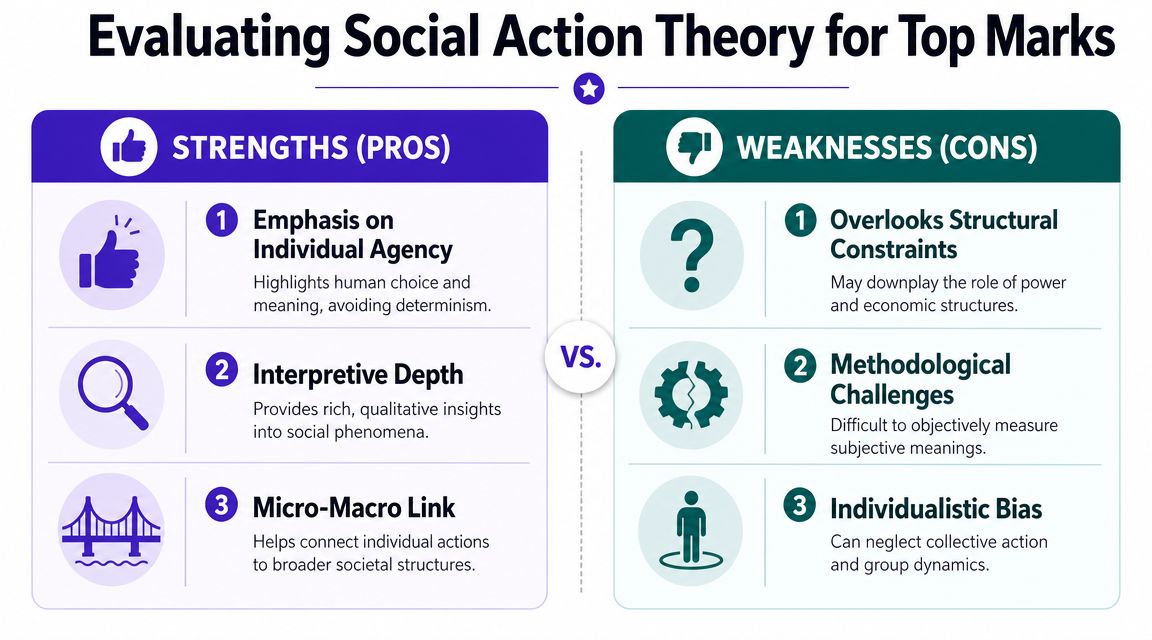
Strong essays separate themselves from safe ones on this specific point. You don't get top marks by praising a theory non-stop. You get them by weighing it up.
Why is social action theory useful
Its biggest strength is that it takes people seriously as meaning-making actors. It avoids the idea that humans are pushed around by social forces.
That makes it valuable in topics where identity, labelling, motivation, and interpretation are central. It also gives sociology interpretive depth. Instead of just asking what pattern exists, it asks how people experience that pattern.
Another strong point is that it can help link small interactions to wider institutions. If people keep acting in expected ways, they can reproduce authority, routines, and norms over time.
What does it miss
The classic criticism is that it can underplay structure and power. If you focus too hard on personal meanings, you can end up sounding as if everyone has equal freedom to define situations.
But they don't. Class, gender, ethnicity, school systems, workplaces, and state institutions shape options long before individuals start interpreting them.
A Marxist, feminist, or critical sociologist would say social action theory risks being too narrow if it doesn't pay enough attention to inequality and constraint.
A top evaluation paragraph usually says social action theory explains how people act within situations, but structural theories explain why those situations are unequal in the first place.
Can it explain digital life properly
A newer criticism is even more interesting. How well does Weber's approach explain actions shaped by platforms, feeds, and recommendation systems?
Critics note that Weber's framework can underplay wider structures and power in digitally mediated settings, which matters in the UK because the Online Safety Act 2023 has increased scrutiny of platform design and content moderation. That raises the issue that online action is not only about individual meaning-making but also about regulated digital environments and platform incentives, as discussed in this overview of social action theory and its limits in platform-mediated settings.
That's a brilliant evaluation point because it modernises your essay. If someone clicks, shares, comments, or joins an online pile-on, is that purely individual meaning? Or is platform design steering behaviour too?
That question pushes your answer beyond the textbook.
What to say in a final judgement
Don't finish with “therefore it is good” or “therefore it is bad”. Finish with balance.
Try something like this:
- Best judgement: social action theory is strongest when explaining meanings, identities, and interactions at the micro level.
- Main limitation: it is weaker on large-scale inequalities and structural power unless combined with other perspectives.
- Modern twist: digital environments make that limitation easier to see.
If you're building essay confidence with AI Powered Revision, this is the kind of judgement line worth practising until it becomes automatic.
Exam Practice Questions and Model Paragraphs
Try these the way an examiner would see them.
Practice questions
- 10 marks Outline and explain two features of social action theory.
- 20 marks Evaluate the view that social action theory is the best way to understand education.
- 20 marks Evaluate interpretivist approaches to society with reference to Weber.
A model paragraph shape
Point: Social action theory explains educational differences by focusing on interaction and meaning rather than only formal structures.
Evidence and explanation: A teacher may treat one pupil as promising and another as troublesome. Those labels affect how each student sees themselves and how they respond in class. Over time, these repeated interactions can shape achievement and classroom behaviour.
Evaluation: However, this approach may overlook wider inequalities such as class background, which influence how likely students are to receive positive labels in the first place.
That paragraph works because it hits all three assessment objectives:
- AO1: knowledge of social action theory
- AO2: applied classroom example
- AO3: criticism using structural inequality
If your revision notes are messy or you're trying to turn spoken explanations into usable essay material, a practical guide for students to transcribe lectures can help you convert class explanations into revision paragraphs you can use.
For timed practice, the smartest next step is working through real A-Level Past papers and checking whether every paragraph includes knowledge, application, and evaluation rather than drifting into description.
If you want revision that feels closer to what examiners reward, MasteryMind is built for that. It gives UK learners GCSE and A-Level practice matched to exam boards, with instant feedback on AO1, AO2, and AO3 so you can stop guessing what a stronger sociology answer looks like.
Ready to master this topic?
Practise with quizzes, blurt exercises and exam questions on MasteryMind.
7 days Premium · Then free forever · No card, no charge