The Storyline of Macbeth: A GCSE & A-Level Guide
You've probably had one of two Macbeth moments.
Either you're staring at your notes thinking, “I know he kills Duncan and then everything goes wrong, but I can't explain the storyline properly.” Or you already know the plot, but your essays still sound like a retelling instead of an argument.
Both problems come from the same place. You need the storyline of Macbeth to feel logical, not random. Once you can see the cause-and-effect chain, the play gets much easier to revise, teach, and write about.
Your Guide to Nailing the Macbeth Storyline
Macbeth can feel messy on a first read. Witches appear in thunder, people speak in riddles, and half the play is characters panicking in castles at night. But the plot is very tightly built. One choice triggers the next, and Shakespeare keeps tightening the pressure until the whole thing collapses.
That's part of why the play sticks in schools. Macbeth is generally dated to 1606 and is widely described as Shakespeare's shortest tragedy, and its focus on witches, kingship, and succession mattered in the years after King James I came to the English throne in 1603, as outlined in Bell Shakespeare's historical background on Macbeth. For exam students, that's not background fluff. That's AO3 waiting to happen.
A useful way to think about the play is this. It's a political thriller mixed with a psychological breakdown. Macbeth starts as a successful soldier, hears a prediction about power, and then turns possibility into murder.
What students usually get wrong
A lot of students reduce the play to this:
- Witches predict kingship
- Macbeth kills Duncan
- Macbeth becomes a tyrant
- Macduff kills Macbeth
That's not wrong. It's just too thin for a strong essay.
What examiners want is the chain underneath:
| Plot event | What it reveals | Exam use |
|---|---|---|
| Prophecy | Macbeth is tempted by power | AO1 and AO2 |
| Murder of Duncan | Ambition becomes action | AO1 |
| Banquo's murder | Power creates paranoia | AO1 and AO2 |
| Macduff's family killed | Tyranny becomes cruelty | AO1 |
| Macbeth's death | False confidence is exposed | AO1 and AO3 |
If you want a clean way to practise this kind of thinking, AI Powered Revision tools can help you test whether you're recalling events or analysing them.
Practical rule: if you can explain why each event causes the next one, you're already moving from basic plot knowledge towards grade-saving analysis.
Act I The Prophecy and The Plan
Act I opens with disorder. Before we even meet Macbeth properly, Shakespeare gives us the witches. That matters because, as the play begins, language is already unstable and truth is slippery.
Macbeth the hero meets the idea that ruins him
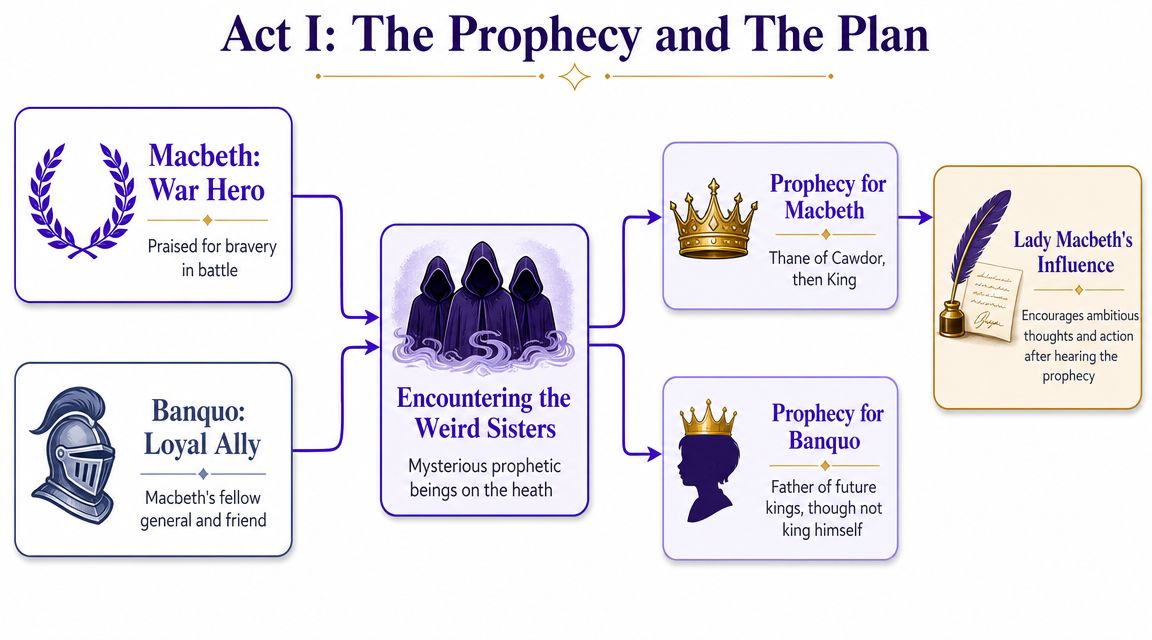
At first, Macbeth is not presented as a villain. He's a war hero. He and Banquo meet the Weird Sisters after battle, and they deliver the central spark of the plot. Macbeth will become Thane of Cawdor and then king. Banquo will not be king, but his descendants will inherit the throne.
That second prophecy often gets rushed past by students, but don't ignore it. Banquo's future matters because it becomes the reason Macbeth can never relax, even after he gets the crown.
When Macbeth is named Thane of Cawdor, the first part of the prophecy comes true. That's the moment ambition stops being abstract. The possibility suddenly feels real.
Lady Macbeth turns ambition into a plan
Macbeth still hesitates. That's significant. He doesn't go from prophecy to murder in one leap. He thinks. He imagines. He worries.
Lady Macbeth reads his letter and immediately understands what the crown now means. She doubts his ruthlessness and pushes the plot forward by giving his ambition a practical route. In simple terms, Macbeth has the desire. Lady Macbeth supplies the method.
A good modern analogy is this. Macbeth has a dangerous search in his head. Lady Macbeth opens every tab, drafts the message, and presses send.
Later in the act, King Duncan arrives at Macbeth's castle. Outwardly, everything looks noble and welcoming. Underneath, the murder plan is taking shape. That contrast is one of the key ideas in the play. Appearance and reality don't match.
For students trying to revise Act I, keep the order clear:
- Macbeth is praised after battle
- The witches make their predictions
- Macbeth sees one prophecy come true
- Lady Macbeth reads his letter
- She pushes him towards Duncan's murder
- Duncan arrives at Inverness
- The plan is set
That sequence is worth learning cold if you want to prepare for UK exam subjects with confidence.
After the opening explanation, this video is useful for locking the sequence into your head.
The best Act I answers don't just say “the witches made Macbeth evil”. They show that Shakespeare presents temptation first, then choice.
Act II The Point of No Return
Act II is where thought becomes deed. Up to now, Macbeth has imagined murder. Here, he commits it. Once Duncan is dead, there's no going back to the brave soldier from the start of the play.
The dagger scene matters because it shows choice under pressure
One of the most important interpretive points in the play is that Macbeth's path to murder isn't instant. The storyline moves from hesitation, to pressure from Lady Macbeth, to psychological turmoil in the dagger hallucination, showing how supernatural suggestion and human choice combine to produce the tragedy, as shown in the RSC scene-by-scene synopsis of Macbeth.
That's gold for essays. Why? Because it stops you writing a lazy argument like “the witches control Macbeth.” They don't physically force him to do anything. Shakespeare stages his inner conflict and makes us watch him move towards the crime.
What happens in the act
The emotional rhythm of Act II is sharp:
- Macbeth sees the hallucinated dagger
- He murders Duncan offstage
- He comes back shaken and disordered
- Lady Macbeth takes control of the aftermath
- Duncan's death is discovered
- Macbeth kills the guards
- Malcolm and Donalbain flee
The princes' flight is a classic Shakespeare move. Their escape is understandable, but it also makes them look suspicious. That clears Macbeth's route to power.
What to say in an essay
If you're writing about guilt, Act II gives you loads to work with. Macbeth can kill the king, but he can't control his reaction. He returns with the daggers, speaks in fragments, and sounds mentally splintered. Lady Macbeth, by contrast, is cold and efficient in the immediate aftermath.
That difference matters. At this stage, Macbeth feels the horror of what he's done more visibly than she does.
A simple exam paragraph structure might look like this:
| Point | Evidence focus | Analysis angle |
|---|---|---|
| Macbeth is not fearless | Dagger hallucination | His imagination reveals conflict |
| Murder damages him instantly | Disordered behaviour after Duncan's death | Guilt appears before punishment |
| Lady Macbeth dominates the scene | She handles the framing | Power in their marriage is uneven |
Students often ask whether the dagger is “real”. The stronger answer is that Shakespeare makes its status less important than its effect. The vision dramatises Macbeth's state of mind.
If the dagger leads him towards Duncan, the scene suggests that Macbeth is being pulled by his own imagination as much as by prophecy.
Act III A Reign Built on Blood
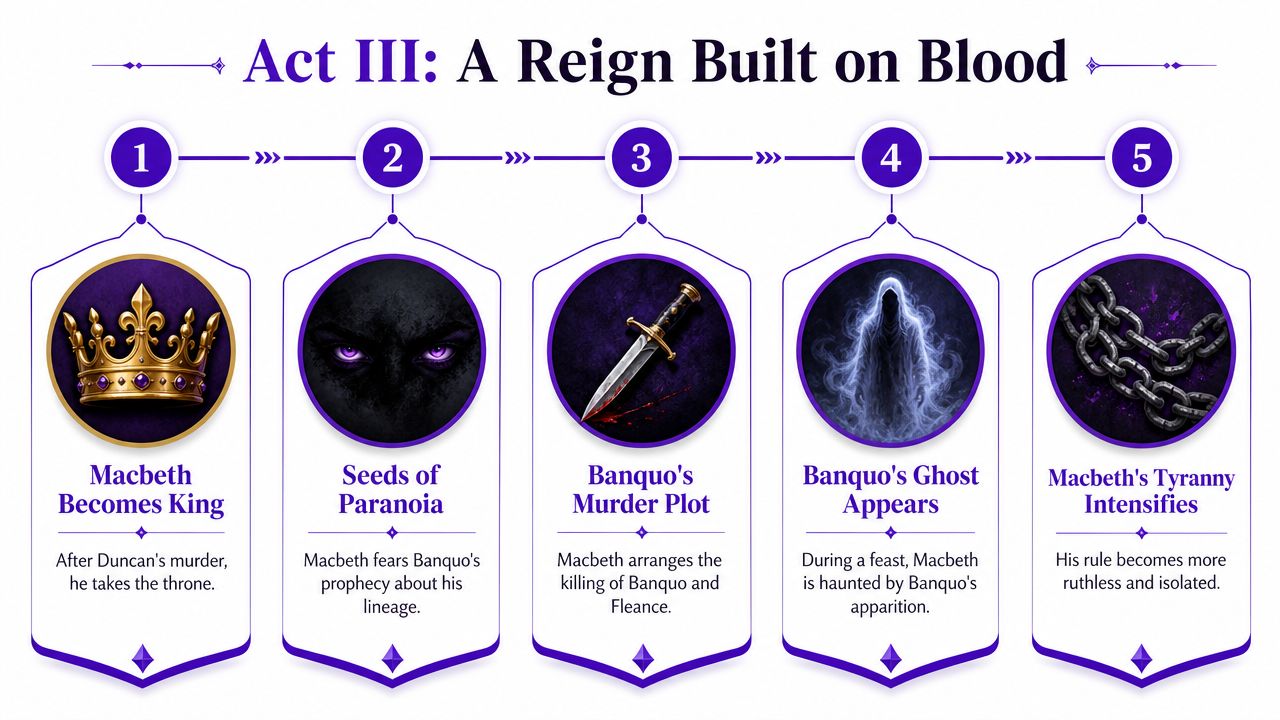
By Act III, Macbeth has achieved what he thought he wanted. He is king. But Shakespeare makes a brutal point here. Getting power and keeping power are not the same thing.
Kingship doesn't solve Macbeth's problem
Macbeth's new fear is Banquo. The witches said Banquo's descendants would be kings, so Macbeth starts to see his friend not as an ally but as a threat to his legacy.
That shift matters for character. In Act I, Lady Macbeth had to push him. In Act III, he plans violence himself. He hires murderers to kill Banquo and Fleance. Shakespeare is showing a darker version of Macbeth emerging, one that no longer needs persuading.
The pattern of violence
The play's structure becomes repetitive in a very deliberate way. The Shakespeare Theatre Company describes the plot after Duncan's death as an “obsessive, repetitive pattern” in which murders are planned in private and then announced publicly, creating new crises, as discussed in their reading guide to the meanings of Macbeth.
That helps you say something smarter than “Macbeth kills lots of people.” A stronger argument is that each violent act creates the next problem.
Here's the logic:
- He kills Duncan to gain the crown
- That creates insecurity about Banquo
- He arranges Banquo's murder
- Fleance escapes
- The threat survives
- Macbeth unravels in public at the banquet
So the murder plan half works and completely fails at the same time. Banquo dies, but the prophecy still hangs over Macbeth.
The banquet scene is the turning point
At the banquet, Macbeth sees Banquo's ghost. Nobody else can see it. Publicly, he looks unstable. Politically, that's disastrous. A king is supposed to project control. Macbeth does the opposite.
This is one of the best scenes for essay writers because it brings several threads together:
- Guilt because the ghost reflects what Macbeth can't bury
- Paranoia because he's now haunted by threats everywhere
- Power because his authority weakens in front of witnesses
- Isolation because Lady Macbeth can't fully contain the damage
If you're building revision notes, this is a good act to pair with MasteryMind study guides or teacher-made scene summaries, because the sequence of secret plotting and public collapse is easy to track once you know what pattern to look for.
Act IV Desperation and Depravity
Act IV gives you the version of Macbeth that would have been hard to imagine at the start. He isn't merely tempted any more. He's hardened, impulsive, and increasingly inhuman.
He returns to the witches for certainty
Macbeth goes back to the witches because he wants more than prediction now. He wants reassurance. That's an important distinction. He's trying to use the supernatural as a security system.
The apparitions tell him three things that shape the final part of the storyline. He should beware Macduff. No one “born of woman” will harm him. He will be safe until Birnam Wood comes to Dunsinane.
He interprets these statements directly and confidently. That's the trap.
Why this act is morally worse
At this point, some students still describe Macbeth as “ambitious”. That word is now too weak on its own. Act IV shows tyranny, not just ambition.
When Macbeth learns that Macduff has gone to England, he orders the slaughter of Macduff's family. This is one of the clearest moments in the play for understanding his decline. Duncan's murder was politically calculated. Banquo's murder was driven by dynastic fear. The killing of Lady Macduff and her children feels far more savage.
A teacher or examiner will notice if you can explain that difference.
How to talk about Act IV in a strong answer
Try this contrast:
| Earlier Macbeth | Act IV Macbeth |
|---|---|
| Hesitates before Duncan's murder | Acts quickly and brutally |
| Needs Lady Macbeth's prompting | Gives orders alone |
| Feels moral conflict | Normalises violence |
| Worries about consequences | Tries to crush threats by force |
That's powerful because it links plot to character development. The storyline of Macbeth isn't just a list of deaths. It's a record of what power does to a person who chooses to protect himself through fear.
A grade-boosting move is to say that Macbeth no longer murders to gain power. He murders because he has become the kind of ruler who can only imagine control through destruction.
Act V The Unravelling and The End
Act V is all payoff. Everything Macbeth trusted starts failing him, and Shakespeare carefully dismantles the confidence built by the witches' riddles.
Lady Macbeth collapses first
Before Macbeth is defeated in battle, Lady Macbeth is defeated by her own mind. In the sleepwalking scene, she relives the bloodshed through compulsive gestures and broken speech. Earlier, she could manage the practical mess of Duncan's murder. Now she can't escape its memory.
That's an important reminder for essays about guilt. Guilt in Macbeth isn't a quick reaction and then done. It keeps resurfacing in different forms.
The prophecies come apart
The historical Macbeth ruled for 17 years and died in 1057, but Shakespeare reshapes that history into a sharper tragic ending where Macduff reveals he was delivered by Caesarean section, meaning he was not “born of woman” in the ordinary sense, while Malcolm's forces use branches from Birnam Wood as camouflage so the wood seems to move toward Dunsinane, as summarised in this historical overview of Macbeth.
That single fact set gives you the whole mechanism of the ending. Macbeth thinks he is protected because he has taken the prophecies at face value. Shakespeare shows that his confidence rests on interpretation, not truth.
A quick breakdown of the final reversals
Birnam Wood
Macbeth assumes a forest can't move. Malcolm's army cuts branches and carries them, making the prophecy appear impossible until it suddenly isn't.Born of woman
Macbeth assumes this phrase includes every man. Macduff reveals the exception.Safety through prophecy
Macbeth treats the witches' words like guarantees. They are really verbal traps.
This is why the ending feels both surprising and inevitable. Shakespeare has not cheated the audience. He has shown Macbeth hearing what he wants to hear.
Why Malcolm's ending matters
Macbeth's death matters personally, but it also matters politically. Malcolm is proclaimed king, and the play closes by restoring lawful rule after a period of violent disorder. For students writing AO3, that restoration of monarchy is a strong contextual point in a play shaped by Jacobean concerns about kingship and succession.
Macbeth dies fighting, but the more important defeat happened earlier. He lost the ability to read reality clearly.
From Story to A Star Grade Your Exam Strategy
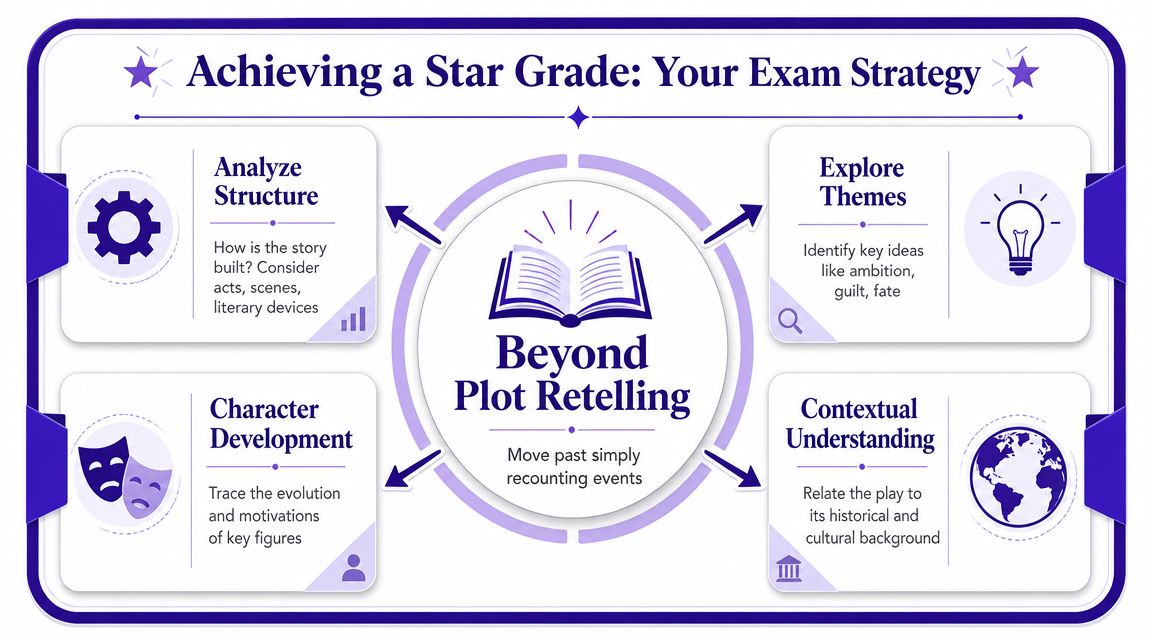
Knowing the storyline is the floor, not the ceiling. If your essay only retells events, you'll hit a limit fast. The jump to stronger marks happens when you treat plot as evidence.
What top answers do differently
A high-level reading of the storyline of Macbeth goes beyond “this happened, then this happened.” It asks how Shakespeare builds a story about interpretation, self-deception, and moral confusion. The witches' contradictory language, including “fair is foul”, makes the play more than a sequence of events and turns it into a study of how characters misread the world and themselves, a point noted in the Wikipedia overview of Macbeth.
That matters because many students can retell the plot but struggle to explain how the structure itself creates meaning.
Use the AOs like a checklist
Here's the simplest way to make the play work for your exam.
AO1 Make an argument, not a summary
Don't write: Macbeth kills Banquo and sees a ghost.
Write something more like this idea: Macbeth's murder of Banquo shows that kingship has intensified his paranoia rather than secured his power.
That turns plot into argument.
AO2 Analyse methods
Don't stop at “the witches are evil.” Look at ambiguity, repetition, hallucinations, stagecraft, and public versus private scenes.
A quick method map:
- Hallucination in the dagger scene shows inner conflict.
- Ghost imagery at the banquet turns guilt into public collapse.
- Riddling prophecy creates false certainty.
- Sleepwalking exposes repressed guilt in Lady Macbeth.
AO3 Use context precisely
Context works best when it explains meaning. If the play is obsessed with regicide, succession, and rightful kingship, link that to its Jacobean world rather than dropping in random historical facts.
A smart revision routine
If you're rebuilding your confidence before mocks or final exams, use a routine that mixes recall and analysis:
Retell each act in five lines max
This forces clarity.Add one theme to each major event
Example: Duncan's murder links to ambition, guilt, and kingship.Add one method to each scene
Example: banquet scene, ghost, public breakdown, fractured authority.Turn plot points into arguments
Instead of “Macduff kills Macbeth,” try “Macduff exposes Macbeth's false trust in language.”
For extra practice, it can help to Access Macbeth study materials that focus on mock-style preparation rather than just passive reading.
If you want to practise this in a more exam-shaped way, A-Level Past papers are useful because they force you to turn knowledge into timed argument, which is the part students often avoid.
The big takeaway
Teachers know when an essay has only memorised the storyline. Examiners know too. The answers that stand out are the ones that keep asking, “Why this event? Why here? Why in this order?”
That's how you turn Macbeth from a blur of murders into a coherent tragedy about ambition, guilt, power, and misreading the world.
If you want one place to practise Macbeth with examiner-style feedback, timed questions, and curriculum-aligned revision, MasteryMind is a practical option for UK learners preparing for GCSEs and A-Levels.
Ready to master this topic?
Practise with quizzes, blurt exercises and exam questions on MasteryMind.
7 days Premium · Then free forever · No card, no charge