Tangent to a Circle: The Ultimate Guide for Exam Success
You're staring at a circle question that looks far nastier than it probably is. There's a tangent, a couple of lines, maybe a point outside the circle, and suddenly the page feels hostile. At this point, loads of students freeze, even when the maths underneath is built from a small number of ideas.
A tangent to a circle is one of those topics that keeps turning up because it links clean GCSE geometry to A-Level coordinate geometry and even calculus. If you can spot what the tangent is doing, the question usually becomes a lot less dramatic. Think of a bicycle wheel rolling along a flat road. The road touches the wheel at one instant and one place. That “just touching” idea is the picture you want in your head.
The difference between dropping marks and picking them up often comes down to recognition. You don't need magic. You need to notice the right angle, spot the equal lengths when two tangents come from the same external point, and stay calm long enough to turn the diagram into working. If you're building confidence for GCSE or pushing for top A-Level grades, that's the skill.
If you want extra support alongside this kind of topic-by-topic explanation, Online Revision for A-Level can help you practise in a more exam-focused way.
That Tricky Circle Question Solved
A student called Sam once showed me a circle question and said, “I don't even know where to start.” That's the main problem most of the time. Not the algebra. Not the geometry. The starting point.
The diagram had a circle, a tangent, and a radius drawn to the point where the line touched the circle. Sam thought there must be some hidden advanced theorem. There wasn't. The whole question became clear the moment he marked the angle between the radius and the tangent as a right angle.
That's why tangents matter so much in exams. They look fancy, but they're often a signal. The examiner is hinting, “There's a special relationship here. Use it.”
The road and wheel picture
The easiest mental image is a wheel on a flat road. The road doesn't cut through the wheel. It doesn't miss it completely. It just touches it at one point. That's the feel of a tangent to a circle.
Once you've got that image, exam diagrams become less abstract. You stop seeing random lines and start seeing structure.
A lot of circle questions become easier the second you stop asking “What formula do I need?” and start asking “What shape is hidden in this diagram?”
What students usually get wrong first
These are the classic early mistakes:
- They treat any nearby line as a tangent. A line is only a tangent if it just touches the circle.
- They miss the right angle. If you don't mark it in, you'll often miss the whole route to the answer.
- They panic when a point sits outside the circle. That outside point often helps, because it creates useful symmetry and equal lengths.
If you remember one exam-craft idea from the start, make it this. Tangent questions are rarely about memorising loads of facts. They're about spotting one decisive fact and using it properly.
The Core Properties of a Tangent
Examiners love tangent questions because one small detail can control the whole diagram. If you spot that detail early, the question often becomes a routine method question instead of a panic question.
A tangent has two core properties you should treat like triggers.
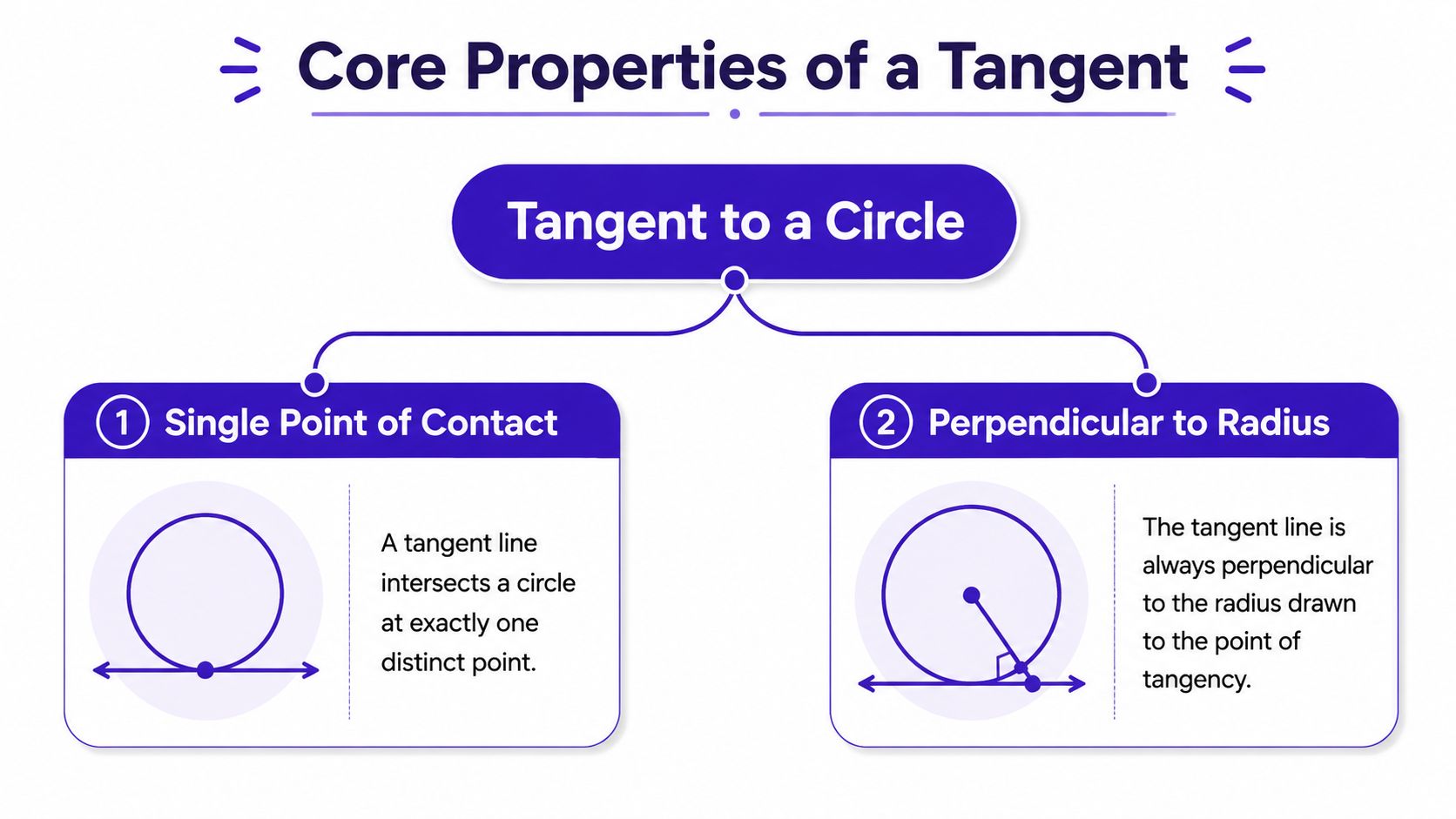
A tangent to a circle touches the circle at exactly one point. The radius drawn to that touching point is perpendicular to the tangent. You will see that second fact used again and again in school geometry, constructions, and formal reasoning, including in this geometry teacher resource.
The point of contact
The line meets the circle once, at a single touching point called the point of tangency.
That sounds harmless, but it matters a lot in exams. A secant cuts through the circle and creates different angle and length relationships. A tangent only touches, so it brings in tangent rules instead. If you mix those up, you can lose method marks even if your arithmetic is fine.
A reliable habit is to label the centre and the touching point straight away. If the centre is (O) and the touching point is (T), write them in. Clear labels make your explanation easier to follow, and that helps on proof questions where examiners award marks for correct reasoning, not just the final answer.
The right-angle rule
This is the property that does the heavy lifting.
If a tangent touches the circle at (T), and (O) is the centre, then (OT) is at 90 degrees to the tangent. In other words, the radius to the point of contact meets the tangent at a right angle.
The wheel-and-road picture helps here. A wheel touching flat ground meets it at one point, and the spoke from the centre down to the ground points straight into the road. That is the tangent picture in everyday form.
For GCSE, this usually leads to angle facts or Pythagoras. For A-Level coordinate geometry, it grows into a gradient rule: if the radius has gradient (m), the tangent has gradient (-\frac{1}{m}), provided (m eq 0). The geometry stays the same. Only the language changes.
Exam-craft tip: the moment you see a radius drawn to a tangent point, mark the right angle first. Many students wait too long and miss the shortest route to the marks.
Equal tangents from one outside point
There is another property examiners use a lot. If a point (P) sits outside the circle and you draw two tangents from (P), those two tangent lengths are equal.
It works like standing outside a circular pond with two straight paths that just touch the edge. The directions are different, but the touching paths from the same outside point match in length.
The properties of tangents quickly establish structural elements. The two tangent segments are equal. The radii to the two touching points are equal as well, because all radii in the same circle have the same length. These often result in congruent triangles, equal angles, or an isosceles shape hidden inside a busy diagram.
Students aiming for higher grades should notice what is happening here. At GCSE, you may use the equal lengths directly. Later, in coordinate geometry and calculus, the same idea appears in a more algebraic form. Tangency is still about one precise touch and one perpendicular relationship.
What to spot straight away in an exam
Use this quick scan before doing any calculations:
| What you see | What it usually means |
|---|---|
| Radius to touching point | Mark a right angle |
| One outside point with two tangents | Set the two tangent lengths equal |
| Tangent, centre, and another point | Look for a right-angled triangle |
| A coordinate geometry tangent question | Use the radius first, then the perpendicular gradient |
That last row is a strong bridge between GCSE and A-Level thinking. Strong students do not treat these as separate topics. They recognise the same geometry wearing different clothes.
If you want extra practice on these foundations before tackling harder mixed questions, the revision guides for GCSE give a quick recap and useful exam-style practice.
How to Prove the Key Tangent Theorems
A lot of circle proof questions look harder than they are because the diagram hides one simple idea. A tangent only touches the circle once. The whole proof usually comes from squeezing that fact until the geometry has no choice but to behave.

At GCSE, that helps you justify standard theorems cleanly. At A-Level, the same idea turns into perpendicular gradients and, later, tangents found from differentiation. So these proofs are not just theory. They train the exact habits that pick up method marks across several topics.
Why the radius is perpendicular
Start with a circle, centre (O), and a tangent touching the circle at (T).
The key question is this. Why must the radius (OT) meet the tangent at a right angle?
A wheel on a flat road gives a good picture. The road touches the wheel at one point. The line from the wheel's centre to that contact point points straight down to the road. If it did not, the road would cut into the wheel instead of just touching it.
The proof version says the same thing more formally. Suppose (OT) is not perpendicular to the tangent. Then (T) is not the closest point on that line to the centre (O). There must be another point on the tangent line closer to (O) than (T). But (OT) is a radius, so any point closer than (T) lies inside the circle. That means the line passes through the circle, so it meets the circle in more than one point. A line that does that is not a tangent.
So the assumption fails. (OT) must be perpendicular to the tangent.
This is a classic contradiction proof. In an exam, the marks usually come from the chain of logic, not from fancy wording.
How to write that proof for full marks
Keep it tight and justified:
- Let the tangent touch the circle at (T), with centre (O).
- Assume (OT) is not perpendicular to the tangent.
- Then there is a point on the tangent closer to (O) than (T).
- That point would be inside the circle, since (OT) is a radius.
- So the line would cut the circle in more than one point.
- This contradicts the definition of a tangent.
- Therefore, (OT) is perpendicular to the tangent.
Examiners like proofs that read like steps, not guesses. If you write one statement and one reason at a time, you make it easy to award the marks.
Why tangents from the same external point are equal
Now place a point (P) outside the circle. Draw two tangents from (P), touching the circle at (A) and (B). Join (O) to (A), (O) to (B), and (O) to (P).
At first glance, this can look busy. Strip it down to the triangles. You have triangles (OAP) and (OBP).
Here is the structure that matters:
- (OA = OB) because both are radii
- (OP) is common to both triangles
- (\angle OAP = \angle OBP = 90^\circ) because a radius is perpendicular to a tangent at the point of contact
That gives congruent triangles by RHS. Once the triangles are congruent, the matching tangent sides are equal, so (PA = PB).
This is one of those results that saves time fast. In a length problem, spotting equal tangents can turn an awkward diagram into a clean algebra line or a quick substitution. At A-Level, the same instinct helps again. You stop treating geometry and algebra as separate chapters and start seeing the same structure in both.
Proving the alternate segment theorem without getting lost
The name sounds more complicated than the idea.
If a tangent touches a circle at one end of a chord, the angle between the tangent and the chord is equal to the angle in the opposite part of the circle standing on that same chord.
Students usually do not lose marks because the theorem is difficult. They lose marks because they match the wrong angles.
Use this method:
- identify the chord first
- find the angle made by the chord and the tangent
- look for an angle at the circumference standing on that same chord, on the opposite side
A good mental check is this. Both angles are tied to the same chord, just seen from different places. If your second angle is not standing on that chord, it is the wrong one.
Common proof mistakes and how to avoid them
Some students know the theorem but still drop marks in the written proof. The problem is usually presentation.
- Missing reasons. Writing “(PA = PB)” without showing congruent triangles first is too big a jump.
- Using the result before proving it. If the question asks you to prove equal tangents, you cannot assume they are equal halfway through.
- Forgetting the right angles. Mark them on the diagram as soon as you see a radius meeting a tangent.
- Choosing the wrong congruence test. Here it is usually RHS, not just “they look the same”.
- Mismatching angles in alternate segment questions. Always track the chord.
A strong proof feels a bit like laying stepping stones across a river. Each step has to land somewhere solid. If one reason is missing, the whole argument starts to wobble.
That habit matters beyond GCSE. In coordinate geometry, you justify a tangent using perpendicular gradients. In calculus, you justify it using the gradient at one point on a curve. Different tools, same exam skill. Show why each step is true, and you give the examiner a clear route to the answer.
Finding the Equation of a Tangent Line
The topic gets exciting because geometry stops being a picture-only chapter and starts talking to algebra. If you're at A-Level, this is standard territory. If you're aiming high at GCSE, it's also a brilliant way to make the geometry feel more concrete.
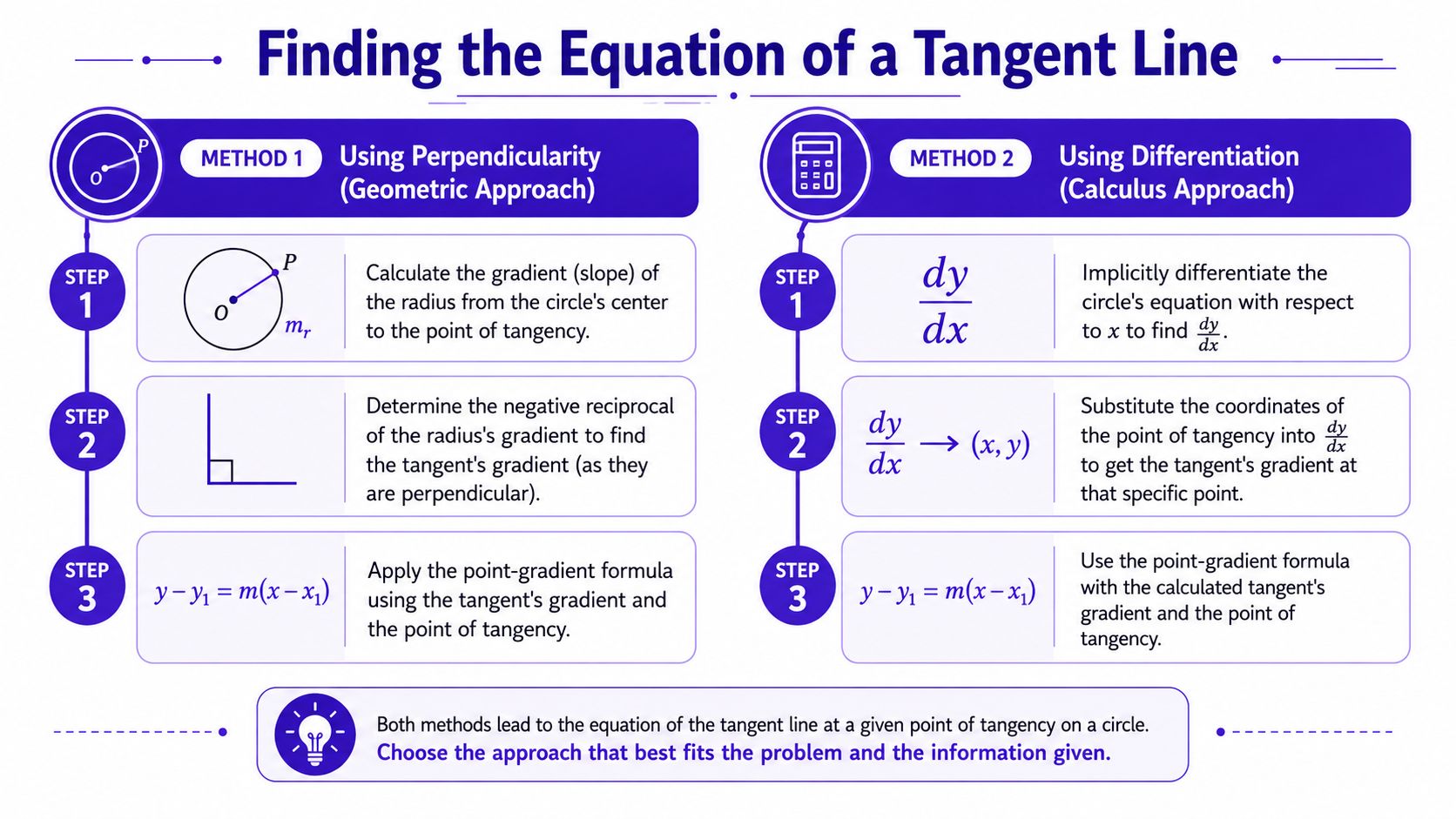
The geometry method
Suppose you're asked for the tangent to the circle (x^2 + y^2 = 25) at the point ((3,-4)).
Start with the centre. For this circle, the centre is ((0,0)). Then find the gradient of the radius from ((0,0)) to ((3,-4)):
[
m_{\text{radius}} = \frac{-4-0}{3-0} = -\frac{4}{3}
]
The tangent is perpendicular to the radius, so its gradient is the negative reciprocal:
[
m_{\text{tangent}} = \frac{3}{4}
]
Now use point-gradient form with the point ((3,-4)):
[
y+4 = \frac{3}{4}(x-3)
]
That's the equation of the tangent.
Why this method is often fastest
For many students, this is the best route because it uses things they already know:
- centre of a circle
- gradient formula
- perpendicular lines
- equation of a straight line
It also keeps the geometry visible. You're not just doing algebra mechanically. You're using the fact that the radius and tangent meet at a right angle.
Here's a compact comparison:
| Step | Geometric approach |
|---|---|
| Find centre | Read from the circle equation |
| Find radius gradient | Use the point and the centre |
| Find tangent gradient | Take the negative reciprocal |
| Find equation | Use point-gradient form |
A short walkthrough can help if you want to see the process in another format:
The calculus method
If you study calculus, there's another route. Differentiate the circle equation implicitly.
For (x^2 + y^2 = 25), differentiate both sides with respect to (x):
[
2x + 2y\frac{dy}{dx} = 0
]
Rearrange:
[
\frac{dy}{dx} = -\frac{x}{y}
]
Now substitute the point ((3,-4)):
[
\frac{dy}{dx} = -\frac{3}{-4} = \frac{3}{4}
]
That gives the tangent gradient immediately. Then use point-gradient form again:
[
y+4 = \frac{3}{4}(x-3)
]
Same answer. Different route.
If your differentiation is secure, calculus can be quicker. If your algebra under pressure is shaky, the geometric method is often safer.
Which method should you choose
That depends on the question in front of you.
- Choose geometry when the centre is obvious and the point of tangency is given clearly.
- Choose calculus when you've already differentiated the curve or the question sits inside a calculus problem.
- Choose the method you can explain. A shorter method isn't better if you're more likely to make a slip.
One more exam warning. Students often remember “perpendicular” but forget what to do with gradients. The rule is not “change the sign”. It's negative reciprocal. That mistake wrecks otherwise good solutions.
Worked Examples and Common Exam Pitfalls
The theory demonstrates its practical value. A tangent to a circle becomes much easier when you see how the clues behave in real questions.
A GCSE style length problem
Suppose a circle has centre O, and a tangent touches the circle at T. A point P lies on the tangent. You know OT is a radius and OP is also drawn.
The mark-winning thought is immediate. Triangle OTP is right-angled at T because the radius meets the tangent at a right angle.
If the question gives you two side lengths, Pythagoras is often the move. If it gives you one side and an angle, basic trig may take over. The big idea is that the tangent turns the diagram into a right-angled triangle.
Students who lose marks here often do so because they never write “angle OTP = 90°”. Put it on the page. Examiners can reward what they can see.
An A-Level coordinate geometry example
Find the equation of the tangent to the circle (x^2 + y^2 = 25) at the point ((3,-4)).
A concise examiner-style solution looks like this:
- Centre is ((0,0)).
- Gradient of radius to ((3,-4)) is (-4/3).
- Tangent gradient is (3/4).
- Equation is (y+4 = \frac{3}{4}(x-3)).
That's accurate, efficient, and fully justified.
A tougher external point problem
Now suppose you need the two tangents from an external point to a circle. Students often think this is a completely different topic. It isn't. It's the same tangent facts used more carefully.
The usual route is:
- call the unknown point of contact something sensible
- use the fact that the radius to that point is perpendicular to the tangent
- use equal tangent lengths if the same outside point generates two tangents
- solve the resulting equations
A neat sketch is essential. Even if the exam gives a printed diagram, redraw the essentials if the layout is confusing.
Draw your own cleaner version when the original diagram is cramped. That isn't wasting time. It's reducing mistakes.
The mistakes that cost marks most often
Here's the shortlist I keep seeing.
Mixing up tangent and secant
If the line cuts through the circle, it isn't a tangent. Don't apply tangent theorems to the wrong line.Forgetting the right angle
This is the biggest one. If you don't mark it, you may miss the entire method.Using the wrong perpendicular gradient rule
Perpendicular gradients are negative reciprocals, not just negatives.Messy algebra after good geometry
A lot of students do the hard thinking correctly, then drop easy marks expanding brackets or rearranging line equations.Not checking the given point lies on the circle
In coordinate questions, this quick check can save you from carrying an error all the way through.
If you want more timed practice with this style of problem, Exam Practice for GCSE is useful for building speed as well as accuracy.
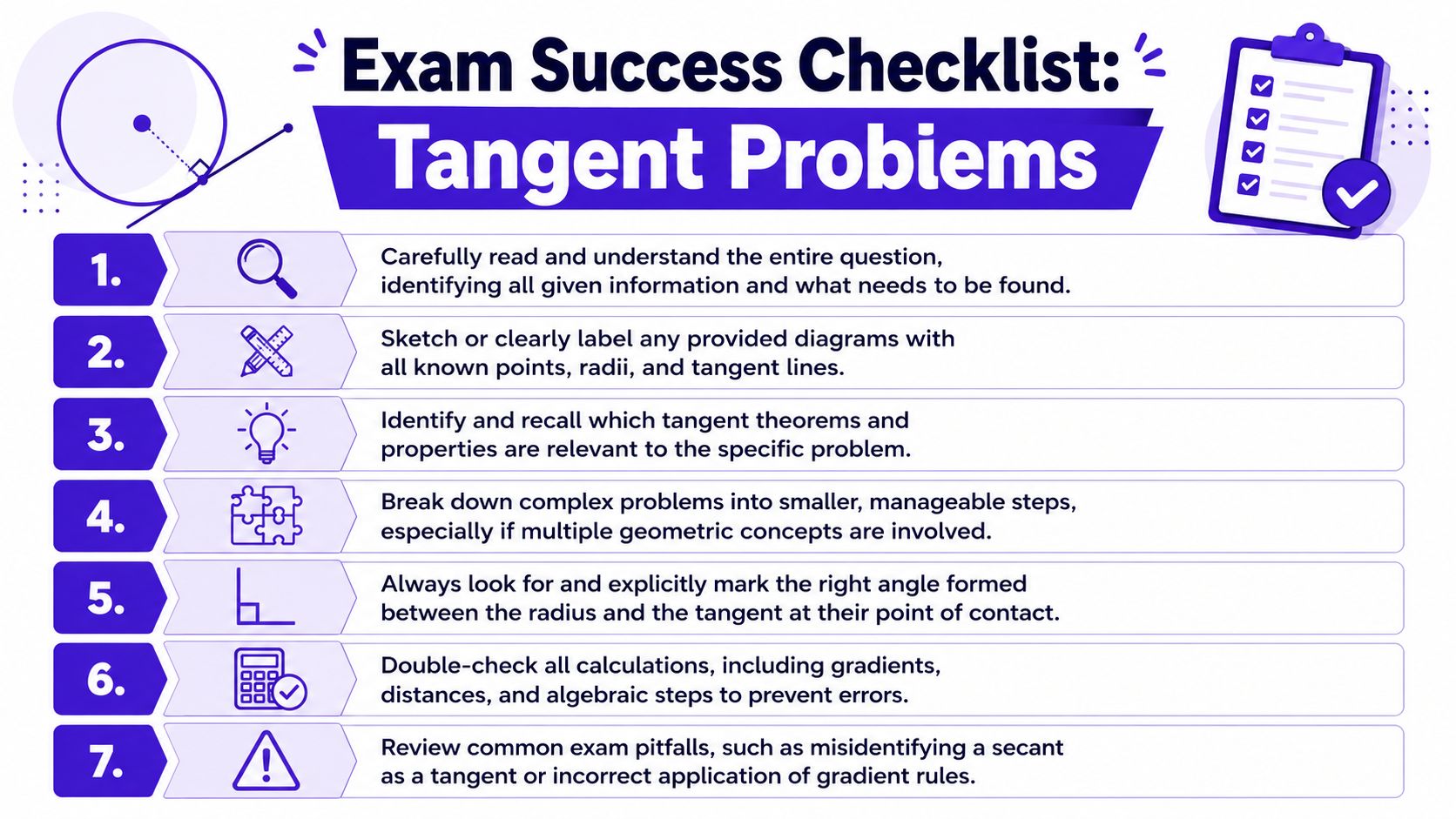
A quick exam checklist
Use this when a tangent question appears:
- Label the centre and touching point
- Mark the right angle immediately
- Check for equal tangent lengths from one external point
- Look for a hidden right-angled triangle
- Use clear notation for gradients
- Write the theorem or reason beside key steps
- Check your final equation or length fits the diagram
That's exam-craft in action. Not flashy. Just reliable.
Summary and Practice Questions
The whole topic gets simpler when you hold onto the right picture. A tangent to a circle touches the circle at one point. The radius to that point meets the tangent at a right angle. If two tangents come from the same external point, those tangent segments are equal in length. From there, you can solve angle problems, length problems, proofs, and coordinate geometry questions without guessing.
Try these.
Question 1
A tangent meets a circle with radius 5 cm. A line is drawn from the centre of the circle to a point on the tangent, and that point is 13 cm from the centre. How far is the point along the tangent from the point of tangency?
Feedback
Use Pythagoras in the right-angled triangle. The tangent length is (\sqrt{13^2 - 5^2} = 12) cm.
Question 2
Find the equation of the tangent to the circle ((x-2)^2 + (y+1)^2 = 10) at the point ((5,0)).
Feedback
The centre is ((2,-1)). The gradient of the radius to ((5,0)) is (1/3), so the tangent gradient is (-3). Using point-gradient form gives (y = -3x + 15).
For more topic-by-topic practice after this, GCSE Past Papers are one of the best ways to test whether you can recognise the method quickly under pressure.
MasteryMind helps students revise in a way that feels much closer to the actual exam experience. It gives UK learners GCSE and A-Level practice that matches exam boards, question styles, command words, and mark allocations, with instant feedback that shows not just what went wrong but how to improve. If you want structured maths practice, mixed-topic revision, and examiner-style support across subjects, take a look at MasteryMind.
Ready to master this topic?
Practise with quizzes, blurt exercises and exam questions on MasteryMind.
7 days Premium · Then free forever · No card, no charge